The Antikythera Mechanism: A Geared Sky Pulled From a Shipwreck
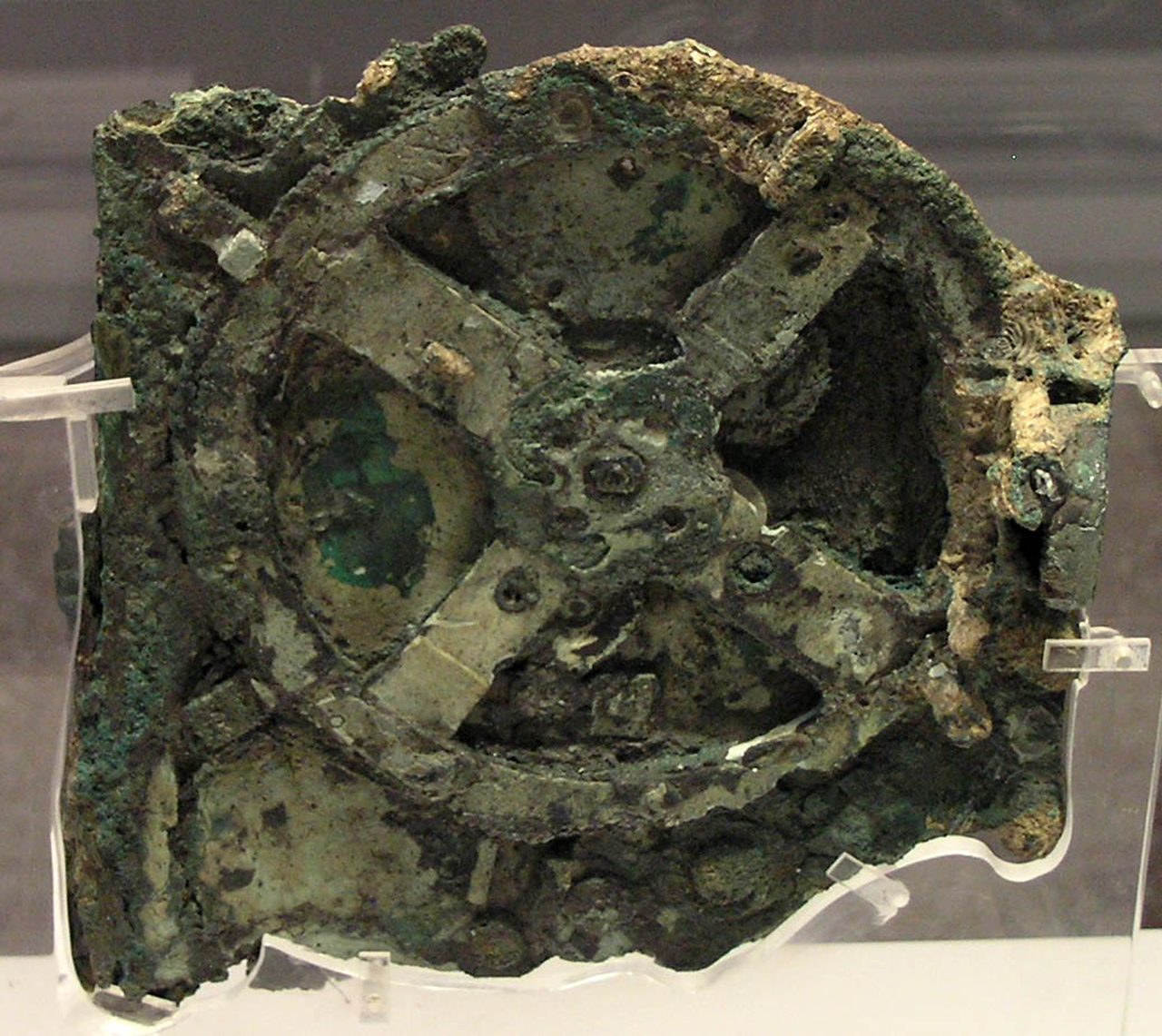
Greek sponge divers pulled it off a Roman-era wreck in 1901: a shoebox-sized lump of corroded bronze holding a hand-cut gear train that tracked the Moon's changing speed, ran several calendars at once, and told you which eclipses were coming. Here is the whole file, every claim wearing its evidence, including the two numbers the research still has not settled.
Most “lost ancient technology” stories ask you to take something on faith. This one does not. The object exists, it sits in a museum case, and it has been scanned. It is bronze, it survives in 82 pieces, and sealed inside those pieces is a hand-cut gear train that modeled the sky. Nobody disputes that it is real. Nobody seriously disputes what it did. What the research still cannot agree on is how many gears it originally had, and which century somebody sat down and cut them. Let's open the file.
01What The Divers Brought Up
Greek sponge divers found the wreck off Antikythera, the island sitting between Crete and the Peloponnese, and brought its cargo up from deep water. The two research files behind this piece differ slightly on the particulars: one gives spring 1901 at a depth of about 45 meters, the other gives 1900 to 1901 at about 42 meters. Both statements are Tier 1 inside their own document. Up alongside the bronze came marble and bronze statues, glassware, and pottery.
The wreck dates to roughly 70 to 60 BCE, fixed by the pottery, the coins, and the other artifacts found with it. The ship was probably Italian, sailing from the eastern Mediterranean toward Rome.
That cargo was luxury freight. Statues, glassware, fine goods, most likely destined for a wealthy Roman patron, and quite possibly including Greek technological treasures alongside the art.
Which raises a question this file will come back to. Was the machine in use on that ship, or was it merchandise in a crate?
| Feature | Detail |
|---|---|
| Surviving Fragments | 82, labeled Fragment A through Fragment delta |
| Largest Fragment | Fragment A, holding 27 gears and the main bearing |
| Total Gear Count | At least 37 by one research file, about 30 by the other; unresolved |
| Original Dimensions | About 34 x 18 x 9 cm, roughly the size of a shoebox |
| Material | Low-tin bronze sheet and plate |
| Gear Teeth | Triangular, cut by hand, some as small as 1.5 mm |
| Housing | A wooden case, now decayed, with inscribed bronze cover plates |
| Engraved Text | About 3,500 Greek characters, read by X-ray tomography in 2006 |
02Eighty-Two Pieces Of Bronze
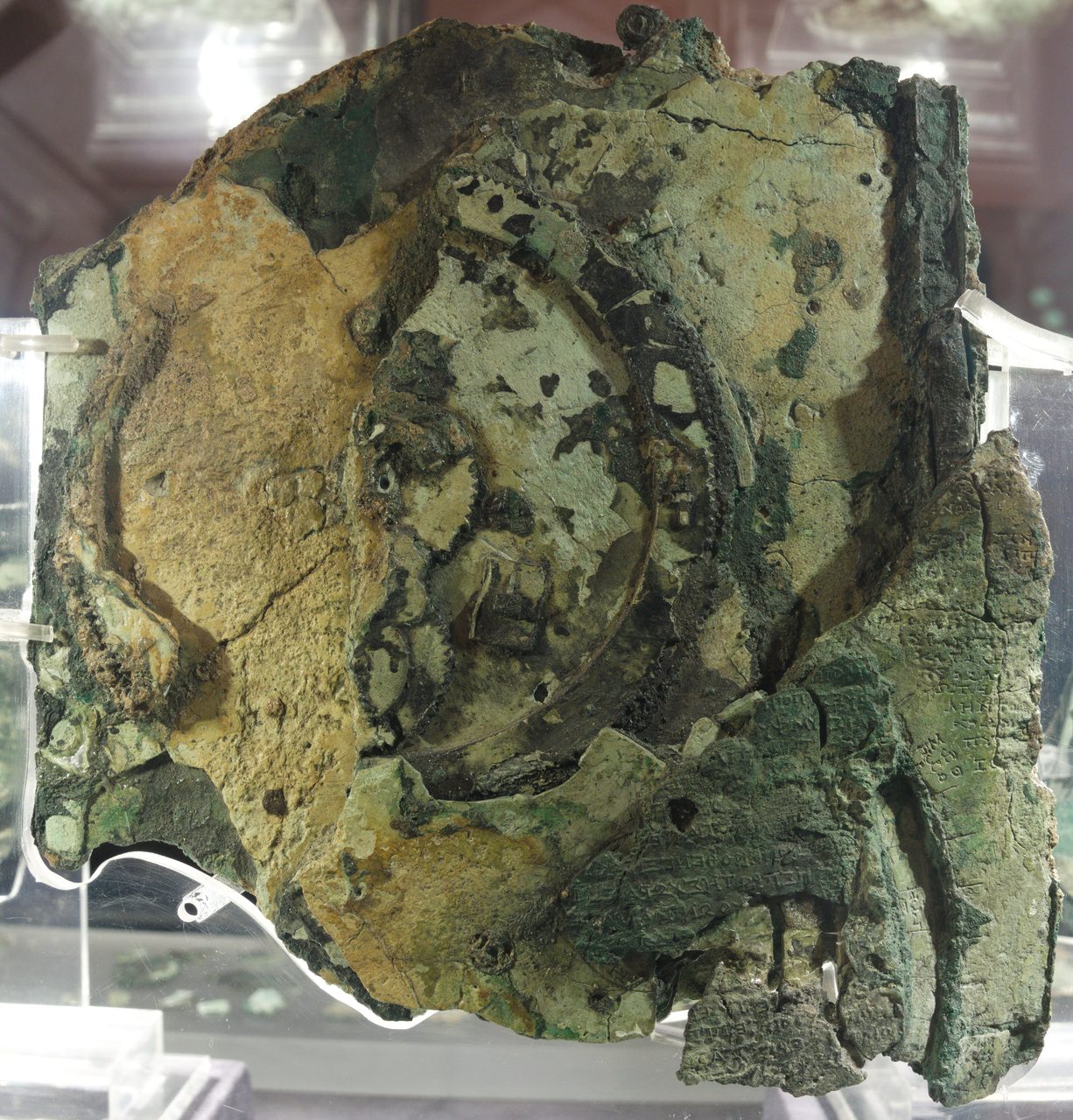
What survives is 82 fragments, labeled Fragment A through Fragment delta. Fragment A is the big one: it carries 27 gears and the main bearing. Complete, the machine measured roughly 34 by 18 by 9 centimeters, about the size of a shoebox, or a large hardcover book if you prefer the other file's comparison. It was built from low-tin bronze sheet and plate, its gear teeth cut by hand into triangular profiles, some of them as small as 1.5 millimeters. It lived inside a wooden case that has long since rotted away, leaving the inscribed bronze cover plates behind.
And then there is the number the two files cannot agree on.
The primary research file states that at least 37 gears have been identified, through the X-ray computed tomography study published in Nature by Freeth and colleagues in 2006.
The second research file, citing that same 2006 study, states at least 30 interlocking gear wheels, with Fragment A holding 27 of the roughly 30. Both files agree on the 27 inside Fragment A. Neither one says whether its total counts the gears that physically survive or the gears in the reconstructed whole, so the gap between 30 and 37 cannot be closed from either document alone. Two Tier 1 sources, one scan, different totals. This file is not going to average them and call that an answer.
03How The Gear Train Works
Strip away the corrosion and the folklore, and what is in there is solved mechanical engineering. Every part of it does something specific, and every part of it can be named.
The cleverest part is the pin-and-slot. A pin fixed to one gear rides inside a slot cut in another, so a steady turn going in comes out as a turn that speeds up and slows down. That is precisely what the Moon needs. Its orbit is an ellipse, so it does not cross the sky at a constant rate, and the mechanism models the first and second lunar anomalies with this one arrangement, functionally equivalent to Hipparchus's model of the first anomaly. Nobody reinvented the trick until the Geneva drive of the 17th century.
Crown gears, also called contrate gears, carry rotation between axes set at right angles to one another. That is what lets a three-dimensional gear train fold down into a case the size of a shoebox.
The gear ratios themselves encode precise astronomical periods: the 19-year Metonic cycle of 235 synodic months, the 223-month Saros eclipse cycle, the 76-year Callippic cycle, and the 54-year Exeligmos, which is three Saros cycles laid end to end.
04The Differential That Is Not There
Now the correction, because this is the single most repeated claim about the mechanism and it no longer holds.
Price's 1974 reconstruction, Gears from the Greeks, proposed that the mechanism contained a differential gear train, a configuration then believed not to exist anywhere before the 16th century. That reading has been superseded. The 2006 X-ray computed tomography study found no differential in the attested gear train. The Moon's varying speed is produced by the pin-and-slot arrangement instead. A differential figures only in Michael Wright's proposed reconstruction of a separate lunar-phase display, not in the machine's surviving gearwork.
The differential is the detail that made this object legendary, and it is the detail the scan took away. Everything else the tomography found was larger than what it removed.
05What The Dials Actually Showed
Front and back, the mechanism carried a set of separate displays, all of them driven off the same gear train. Here is what each one told you.
| Display | Where It Sat | What It Told You |
|---|---|---|
| Calendar and Zodiac | Front Face | The Sun's position in the ecliptic on a 365-day Egyptian calendar ring, with a movable zodiac ring to absorb the roughly quarter-day annual error |
| Lunar Phase | Front Face | A ball, half silver and half black, rotated by the gear train to show the Moon's current phase |
| Metonic Calendar | Upper Back Dial | A 235-month spiral tracking 19 years of the lunisolar calendar, the frame for agricultural and religious scheduling |
| Callippic Cycle | Upper Back Subsidiary | Four Metonic cycles, 76 years, the correction cycle |
| Saros Eclipse Cycle | Lower Back Dial | A 223-month spiral, about 6,585 days, with glyphs giving eclipse type, time, and direction, and inscriptions identifying specific eclipses |
| Exeligmos | Lower Back Subsidiary | A correction of 0, 8, or 16 hours, clearing the Saros cycle's 8-hour remainder across three full cycles, 54 years and 33 days |
| Games Dial | Small Subsidiary, Back | The four-year cycle of the Panhellenic games: Olympia, Pythia, Isthmia, Nemea, and possibly Naa and Halieia |
The eclipse dial is the one that still stops people. A 223-month spiral, about 6,585 days to a turn, carrying glyphs that give the type of eclipse, its time, and its direction, with inscriptions naming specific eclipses. The subsidiary Exeligmos dial adds a correction of 0, 8, or 16 hours, because a single Saros cycle runs an 8-hour remainder and the error only clears after three of them, 54 years and 33 days.
And then there is the games dial. A small subsidiary dial on the back indexed the four-year cycle of the Panhellenic athletic and religious festivals: Olympia, Pythia, Isthmia, Nemea, and possibly Naa and Halieia. The same box that told you when the Moon would go dark also told you when the games were.
What it was for is less settled than what it did. It is primarily an astronomical calculator, but researchers have proposed a navigational application as well, since precise knowledge of celestial positions and eclipse timing matters for seafaring, and the device was found on a ship. That association cuts both ways: the mechanism may simply have been cargo rather than a navigation tool in active use.
The mundane uses are the likeliest ones. Integrated calendar and astronomical functions would be practically useful for agricultural planning, for scheduling religious festivals, and for astrological consultations.
06The Manual Engraved Inside
The 2006 tomography did not only resolve the gears. It read about 3,500 characters of Greek text off the front and back cover plates and off internal surfaces sealed inside the corroded block. It is not decoration and it is not dedication. It works as an instruction manual, describing what each dial displays and how to interpret the outputs.
The imaging was led by Mike Edmunds and Tony Freeth through the Antikythera Mechanism Research Project from 2006 onward, using a purpose-built microfocus CT scanner nicknamed Bladerunner that resolved detail down to 7.5 micrometers.
Whoever built this expected somebody else to read it.

07Who Cut These Gears
The month names engraved on the Metonic dial belong to the Corinthian calendar, used in Corinth and in its colonies, Syracuse among them. That narrows the likely origin to the western Greek cultural sphere, and it is what leads scholars to the hypothesis that the mechanism came out of the intellectual tradition of Archimedes' school in Syracuse (Jones, 2017).
Cicero, writing in the first century BCE, describes two devices made by Archimedes that modeled celestial motions, one of them showing the movements of the Sun, the Moon, and the planets on a bronze sphere. In De Re Publica he places them in Rome, brought there by Marcellus after the sack of Syracuse in 212 BCE.
Archimedes worked in Syracuse, a Corinthian colony, and the Corinthian calendar on the mechanism supports a Syracusan and western Greek provenance. Cicero also credits Posidonius, roughly 135 to 51 BCE, with constructing a similar device, and Pappus and Proclus describe mechanized astronomical models attributed to Archimedes.
Direct attribution to Archimedes himself does not survive contact with the calendar. He died in 212 BCE, earlier than every construction date anyone has put on this device, so this specific machine is almost certainly not his own work. What it may be is a product of a tradition he founded or refined.
The competing candidate is Rhodes. Cicero described an astronomical device attributed to Posidonius, whose workshop was there, and Rhodes was a major center of astronomy, home to Hipparchus as well. Jones argues in A Portable Cosmos (2017) that inscription analysis and the calibration of the device's astronomical epoch point to Rhodes rather than Syracuse. The question stays open.
08And When? Three Answers, No Winner
This is where the file stops agreeing with itself, and it is worth watching closely, because the disagreement is not between science and the fringe. It is between one mainstream source and another.
The 70 to 60 BCE figure dates the shipwreck. It does not necessarily date the machine, and scholars have proposed a revised construction date of roughly 200 BCE, based on astronomical calibration of the eclipse predictor's epoch. That is a date derived from the device's own eclipse dial rather than from the ship's cargo.
The second research file states plainly, in its own summary, that the device was likely constructed circa 150 to 100 BCE, and explicitly treats that as a distinct estimate from the shipwreck's ceramic and coin date. That statement never carries a tier label of its own anywhere in that document, so it is tiered conservatively at Tier 2 here rather than promoted.
That same file's Tier 3 section then builds on the 150 to 100 BCE figure to argue against direct Archimedean authorship: on that dating the mechanism postdates Archimedes' death by at least 60 to 110 years, making it a later product of a workshop tradition he founded or inspired rather than the work of his own hand.
So: roughly 70 to 60 BCE for the wreck, roughly 200 BCE for one proposed construction date, roughly 150 to 100 BCE for another. The two construction proposals sit as much as a century apart from each other, in mainstream sources, unreconciled. Nobody in this file is going to hide that from you.
09The Front Face Nobody Has Recovered
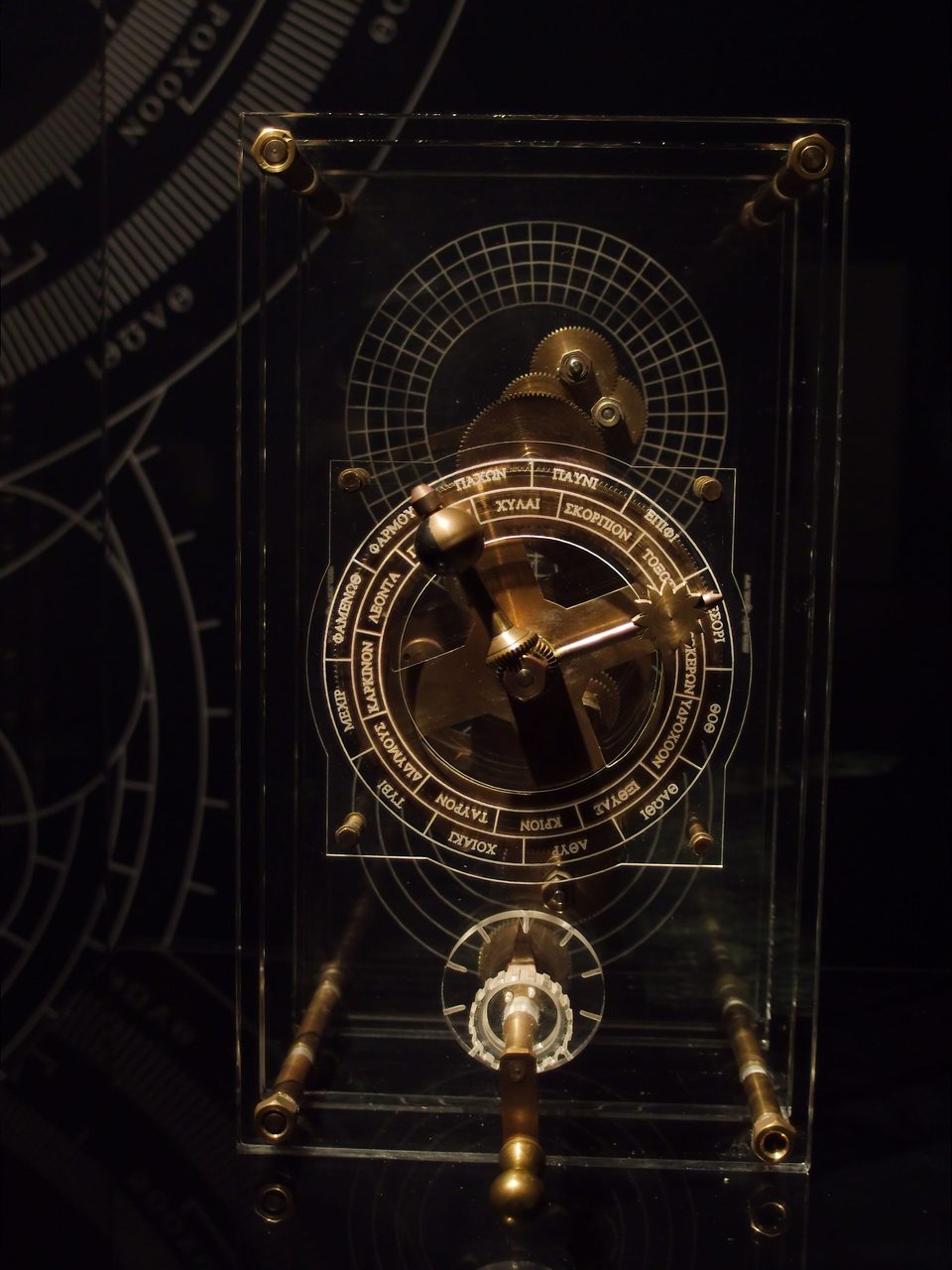
Freeth and colleagues published a complete proposed reconstruction of the front display in Scientific Reports in 2021: a geocentric model of the cosmos showing the positions of the Sun, the Moon, and the five planets visible to the naked eye, Mercury, Venus, Mars, Jupiter, and Saturn.
That model requires about 69 gears in total and drives concentric rings on the front face through nested co-axial tubes, each ring carrying a pointer or marker for one body. It is consistent with the inscriptions on Fragment C, which describe the synodic cycles of the planets, and it would make the mechanism a full planetarium rather than a calendar machine. It is also a hypothesis. The front section is the most damaged part of the object, the relevant gears are lost, and no surviving fragment can confirm the planetary gearing. Confirmation waits on a working reconstruction or on new fragments coming off the sea floor.
10Fourteen Centuries Of Silence
Nothing of comparable mechanical complexity appears anywhere in the surviving archaeological record until medieval Islamic astronomical instruments and European clockwork of the 13th and 14th centuries CE.
One of the two research files puts that gap at roughly 1,400 years, running from the mechanism to the first known Islamic equatoria of about the 10th to 11th century CE, and reads it as a knowledge tradition genuinely lost, somewhere in the decline of Hellenistic science, Roman pragmatism, and the disruptions of Late Antiquity.
A gap in the record is not a gap in reality. Bronze is trivially easy to melt down and re-use, and complex mechanisms are fragile by nature. The literary trail does not stop either: Hero of Alexandria described complex automata in the first century CE, and Byzantine and Islamic sources reference astronomical devices.
Whether intermediate devices actually existed, in Sassanid Persia, in Byzantium, in early Islamic workshops, and carried the tradition across the gap, is debated. No physical evidence bridges it.
11What One Survivor Implies
The mechanism survived for exactly one reason: it was lost at sea. Burial in the ocean floor kept it out of the scrap furnace. That is survivorship bias made physical, a single object standing in for a category we otherwise cannot see at all.
If one device survived through accidental preservation in a shipwreck, the implication is that similar or even more sophisticated devices were produced, and simply did not survive normal recycling and destruction.
The gear cutting argues the same way. Teeth that fine, and that consistently spaced, imply specialized gear-cutting tools and a manufacturing tradition standing behind them, and not one of those tools survives in the archaeological record. The device reads as the work of a trained workshop rather than of a lone individual, which in turn suggests that more than one of these was made.
The quality of manufacture points to a mature engineering tradition. This is not a prototype. It reads as the product of accumulated expertise spanning multiple generations.
From there the speculation runs further: that calculating devices of various types may have been common tools around the Hellenistic Mediterranean, in the hands of astronomers, navigators, and perhaps administrators, and that the loss of that tradition, accelerated by the destruction of centers of learning such as the Library of Alexandria, the sack of Syracuse, and the Roman conquest of the Greek world, amounts to an incalculable loss of technological knowledge.
12Where The Aliens Come In, And Why They Do Not
An object this far ahead of its apparent context is going to attract bigger claims, and it has. Both research files behind this piece meet them head on, in their own Tier 4 sections, and both reach the same verdict independently.
The claim that the mechanism is too advanced for its era, and must therefore represent alien technology or time travel, ignores the substantial evidence for the Hellenistic Greek engineering tradition it emerged from. The device uses no material, no technique, and no principle unknown in the ancient Mediterranean. It combines standard bronze metallurgy with gear-cutting techniques evidenced in other contexts, and its sophistication is remarkable but explicable within the Alexandrian and Syracusan mathematical and engineering traditions: Archimedes, Ctesibius, Hero.
The second file labels the same claim debunked outright. Lost-civilization and extraterrestrial origins fail on identical ground: the abundant textual evidence, Cicero, Pappus, and Archimedes' own works, establishes a Greek tradition of precision mechanics, and the mechanism is fully explicable within the known framework of Hellenistic mechanical and astronomical knowledge.
One more piece of hygiene at the same tier, and it cuts against our own headline instincts. The mechanism is routinely described as the world's first computer. It is an analog mechanical calculator. It does not perform general-purpose computation, it does not store arbitrary programs, and it does not process digital data. Calling it the first computer is a useful metaphor and a technically imprecise one.
Fast Facts
- Found
- By Greek sponge divers off Antikythera, between Crete and the Peloponnese; spring 1901 by one research file, 1900 to 1901 by the other
- Wreck Date
- Roughly 70 to 60 BCE, from pottery, coins, and cargo
- Survives As
- 82 fragments; Fragment A alone holds 27 gears and the main bearing
- Gear Count
- At least 37 by one research file, about 30 by the other; unresolved
- Build Date
- Unsettled; roughly 200 BCE and roughly 150 to 100 BCE have both been proposed
- Size
- About 34 x 18 x 9 cm, roughly a shoebox
- Engraved Text
- About 3,500 Greek characters, an instruction manual, read by X-ray CT in 2006
- Predicts
- Eclipses on the 223-month Saros cycle, plus Metonic, Callippic, Exeligmos, and Olympiad cycles
- Not
- Alien, not anachronistic, and not a computer in the modern sense
What We Can Actually Stand Behind
The object is real and largely read. 82 bronze fragments, a hand-cut gear train resolved by X-ray tomography, about 3,500 characters of Greek instruction text, dials for the Metonic, Saros, Callippic, and Exeligmos cycles, a half-silver lunar phase ball, and a games dial. A pin-and-slot arrangement gives the Moon its varying speed, and crown gears fold the train into a shoebox. The 1974 differential reading was superseded by the same 2006 scan: there is no differential in the attested gear train. All of that is settled.
Who made it, and where. Syracuse and the Archimedean tradition on the strength of the Corinthian month names, Rhodes and Posidonius on the strength of inscription analysis and epoch calibration. And when: the 200 BCE and 150 to 100 BCE construction proposals have never been reconciled with each other. The 2021 planetary front face is a mechanically plausible model built on gears that no longer exist, not a confirmed layout.
That devices like this were common working tools around the Hellenistic Mediterranean, that navigators used them at sea, and that intermediate machines carried the tradition through Persia, Byzantium, or early Islamic workshops. Reasonable inference from a mature-looking object. No physical evidence.
Alien technology, time travel, and a lost super-civilization all fail, and both research files reject them independently at this tier. The mechanism uses no material, technique, or principle unknown in the ancient Mediterranean. And it is not a computer in the modern sense either: it is an analog mechanical calculator, and calling it the first computer is a metaphor, not a specification.
So the file closes on two numbers nobody has pinned down. Two research documents, both working from the same 2006 scan, both stating it at Tier 1, count the gears differently: at least 37 in one, about 30 in the other. And the date is worse. The wreck's own pottery and coins give roughly 70 to 60 BCE. An astronomical calibration of the eclipse predictor's epoch has been used to argue for roughly 200 BCE. A third estimate puts the build at roughly 150 to 100 BCE. Those are not fringe alternatives competing with the mainstream. They are the mainstream, sitting unreconciled inside the sources. We can read this machine's instruction manual. We know it is Greek, and we know it came from nowhere else. We still cannot say how many wheels it turned on, or which century somebody sat down at a bench and cut them. A differential that everyone repeated for a generation turned out not to be in there at all. What else in this file is only the reading we have not corrected yet?
Sources & further reading
Everything above is drawn from two research documents in our library on Theories of Anything, M_1_02 and J_1_11, which cover the same artifact from the archaeology side and the engineering side. Where those two disagree, this file says so instead of picking a winner. Open them to check the sourcing, and follow the primary papers below to go deeper.
Image credits
- Antikythera Mechanism, Fragment A, close-up photograph by Marsyas, via Wikimedia Commons. CC BY-SA 3.0, CC BY 2.5, and GNU Free Documentation License v1.2+ (multi-licensed) Source.
- Antikythera Mechanism, Fragment A, rear face photograph by Logg Tandy, via Wikimedia Commons. CC BY-SA 4.0 Source.
- Marble bust of Cicero, Capitoline Museum, Rome photograph by Liam Clarkson-Holborn, via Wikimedia Commons. CC BY-SA 4.0 Source.
- Modern reconstruction of the Antikythera Mechanism, Berlin, 2012 photograph by marsupium photography, via Wikimedia Commons. CC BY-SA 2.0 Source.
- Card crop of Antikythera Mechanism, Fragment A, close-up photograph by Marsyas, via Wikimedia Commons. CC BY-SA 3.0, CC BY 2.5, and GNU Free Documentation License v1.2+ (multi-licensed) Source.

.webp)

.jpg)