Apkallu & Oannes, the Seven Sages
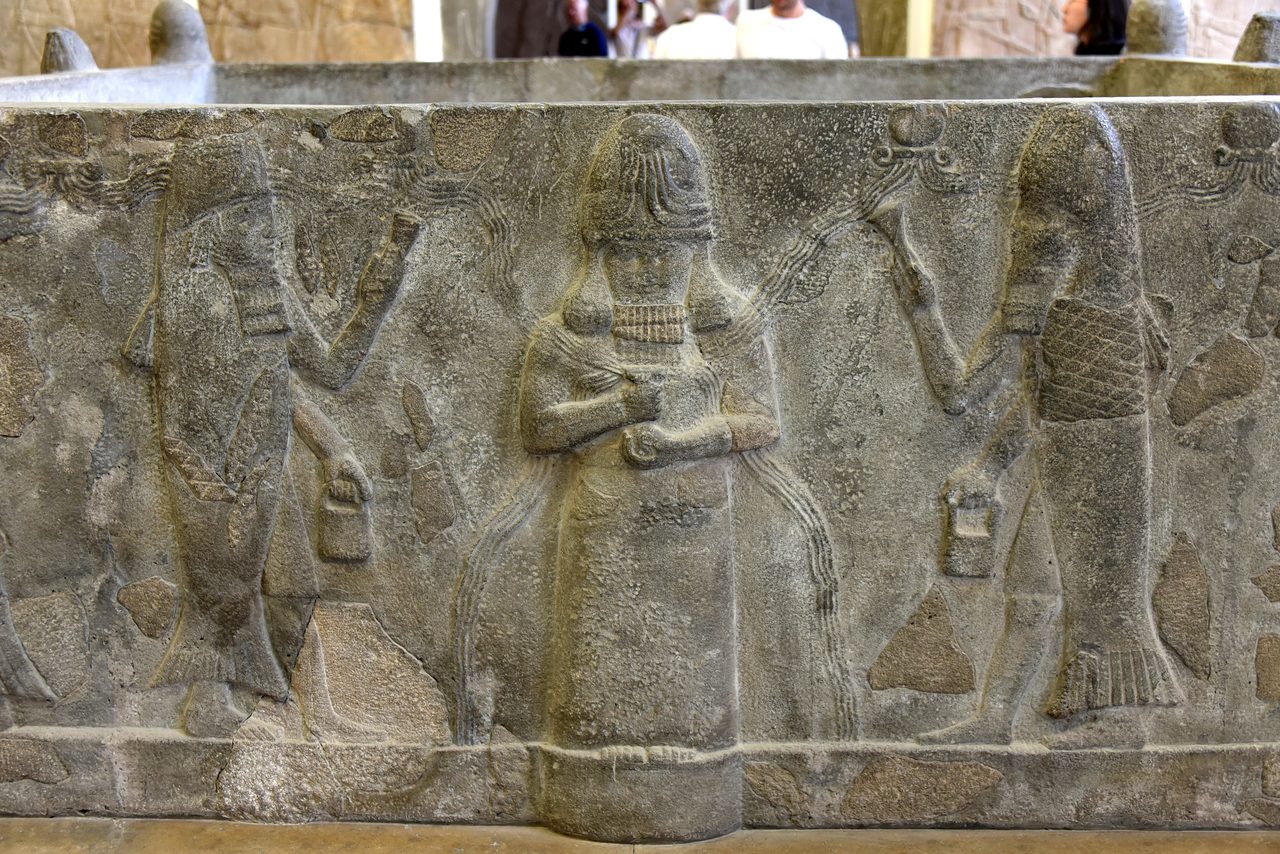
A creature with a fish's body and a human head came out of the Persian Gulf, taught Mesopotamia writing, law, geometry and farming, and went back into the water at nightfall. That is not a modern rumor. A Babylonian priest wrote it down in Greek around 280 BCE, and the beings he described are carved into Assyrian stone that stands today in the British Museum and Berlin's Pergamon Museum. This is the file on the Seven Sages, opened one sage at a time, every claim wearing its evidence.
Every origin story has a teacher in it somewhere. Mesopotamia's teacher walked out of the sea. In the accounts that have come down to us, seven beings were sent before the flood to hand humanity the whole apparatus of civilized life, already finished: writing, cities, temples, law, geometry, farming. Mesopotamia called them the Apkallu. In Greek, in the history a Babylonian priest wrote for a Seleucid king, the first of them is Oannes. And unlike almost every being catalogued in this wing, these ones left physical evidence of what their own people believed they looked like: fish-cloaked and bird-headed figures, carved into palace walls, buried under floors and doorways, and sitting in museum cases right now. This is the file, opened one sage at a time, every claim wearing its evidence.
01The Fish That Walked Out Of The Gulf
Start with the source, because he is better than the subject usually gets. Berossus was a Babylonian priest of Bel/Marduk who wrote around 280 BCE, in Greek, for the Seleucid king Antiochus I. His book, the Babyloniaca, was a history of Babylonia built on direct access to cuneiform temple archives spanning millennia. It does not survive. What survives are fragments quoted by later compilers: Alexander Polyhistor, Abydenus, Apollodorus, Eusebius of Caesarea and George Syncellus. Even in that broken state Berossus is considered one of the most important sources we have for Mesopotamian mythology and history, and modern critical editions are frank about the cost: variant readings, and a corpus that reaches us only in pieces.
| Feature | What the account says |
|---|---|
| Appearance | A fish's body, with a second human head beneath the fish's head and human feet beside the tail |
| Origin | Emerged from the Erythraean Sea, the Persian Gulf |
| Schedule | Taught among people by day, returned to the sea at night |
| Diet | Never ate food while among humans |
| Teachings | Writing, sciences, crafts, city-building, temple construction, law, geometry, agriculture |
| Legacy | 'Nothing further has been invented' since; all civilization credited to Oannes |
Here is the passage itself, preserved by Alexander Polyhistor and carried down through Eusebius. In the first year, from the Erythraean Sea, the water we call the Persian Gulf, a beast appeared adjacent to Babylonia. Its entire body was that of a fish, but underneath the fish's head it had another head, a human one, and human feet had grown alongside the fish's tail, and it had a human voice. It spent the days among men and never ate any food. It taught them letters, sciences and crafts of every kind. It taught them to found cities, to build temples, to establish laws, and it explained the principles of geometry. It showed them how to distinguish the seeds of the earth and how to collect fruits. In short, the fragment says, it gave them everything which could contribute to the refinement of life. 'From that time on, nothing further has been invented.' At sunset it plunged back into the sea and spent the night in the deep, for it was amphibious.
Read that last line again, because it is the strangest thing in the passage. This is not a people claiming to have built civilization. It is a people insisting that everything worth having arrived all at once, out of the water, before their history began, and that nothing has been added since.
02Seven Sages, Seven Cities
Oannes is not a lone monster in one Greek book. He is entry number one on a list, and the list is written in cuneiform.
The Uruk List of Kings and Sages, tablet W 20030,7, dates to about 165 BCE in the Seleucid era, and it does something a myth never has to do: it keeps records. It matches seven pre-flood kings, one at a time, with seven Apkallu, and it explicitly distinguishes those seven from the scholars who came after the flood, the ummanu. Each sage carries a city and an epithet. The first is Uanna, whom the Greeks called Oannes, at Eridu, under the king Ayalu, and his line reads: 'who finished the plans of heaven and earth.'
| The sage | City | Pre-flood king | The epithet he carries |
|---|---|---|---|
| 1. Uanna (Oannes) | Eridu | Ayalu (Alulim) | 'Who finished the plans of heaven and earth' |
| 2. Uannedugga | Eridu | Alalgar | 'Endowed with comprehensive intelligence' |
| 3. Enmedugga | Bad-tibira | Enmenlu-ana | 'Allotted a good fate' |
| 4. Enmegalamma | Bad-tibira | Enmengal-ana | 'Born in a house' |
| 5. Enmebulugga | Bad-tibira | Dumuzid the Shepherd | 'Grew up in pastureland' |
| 6. An-Enlilda | Larak | Ensipadzid-ana | 'The conjuror of Eridu' |
| 7. Utuabzu | Sippar | Enmeduranki | 'Who ascended to heaven' |
Two details on that list are worth stopping for. All seven carry an Eridu ancestry, back to the city of Enki, the god who sent them, even where the list seats a sage at Bad-tibira or Larak or Sippar. And the seventh, Utuabzu, is the one 'who ascended to heaven.' Hold that beside Enoch, seventh from Adam, of whom the text says God took him, and beside the seventh king on the same tablet, Enmeduranki. Three lists, three sevenths, one ending.
| The text | What it establishes |
|---|---|
| Uruk List of Kings and Sages (W 20030,7), about 165 BCE | Matches seven pre-flood kings with seven Apkallu, and separates them from the post-flood ummanu |
| Bit Meseri incantation series, 1st millennium BCE | Names all seven by name and description, calls them 'pure puradu-fishes of the sea,' and sets the ritual for burying protective figurines |
| A ritual text from Nineveh, Neo-Assyrian | Uses Apkallu figurines in building-foundation rituals |
| The Bit rimki purification ritual, Neo-Assyrian | Invokes the Apkallu as purifiers |
| 'Erra and Ishum' Epic, Tablet I, 1st millennium BCE | Refers to the Seven Sages sent before the flood |
The Apkallu are not a one-text tradition. They run right through the ritual literature. The Bit Meseri incantation series, the 'House of Confinement,' names all seven with descriptions and calls them 'pure puradu-fishes of the sea.' A Neo-Assyrian ritual text from Nineveh puts Apkallu figurines into building-foundation rites. The Bit rimki purification ritual invokes them as purifiers. The Epic of Erra and Ishum, Tablet I, refers to the Seven Sages sent before the flood. And the Electronic Text Corpus of Sumerian Literature carries accessible translations of the King List and related texts, its own Bit Meseri listings including the seven apkallu with the fish and winged motifs attached, which is what confirms their cultic role: these were apotropaic guardian figures, working ritual equipment.
That is the difference between this file and most of the beings in this wing. The Apkallu are not remembered in one contested account by one witness. They are named, listed, invoked and buried, across centuries of working religious practice.
03Fish-Cloak, Bird-Head, Human Face
Now the part almost everyone gets wrong. The Apkallu do not have one look. Assyrian art gives them three, and our file is exact about which is which, because the two most famous ones are constantly swapped.
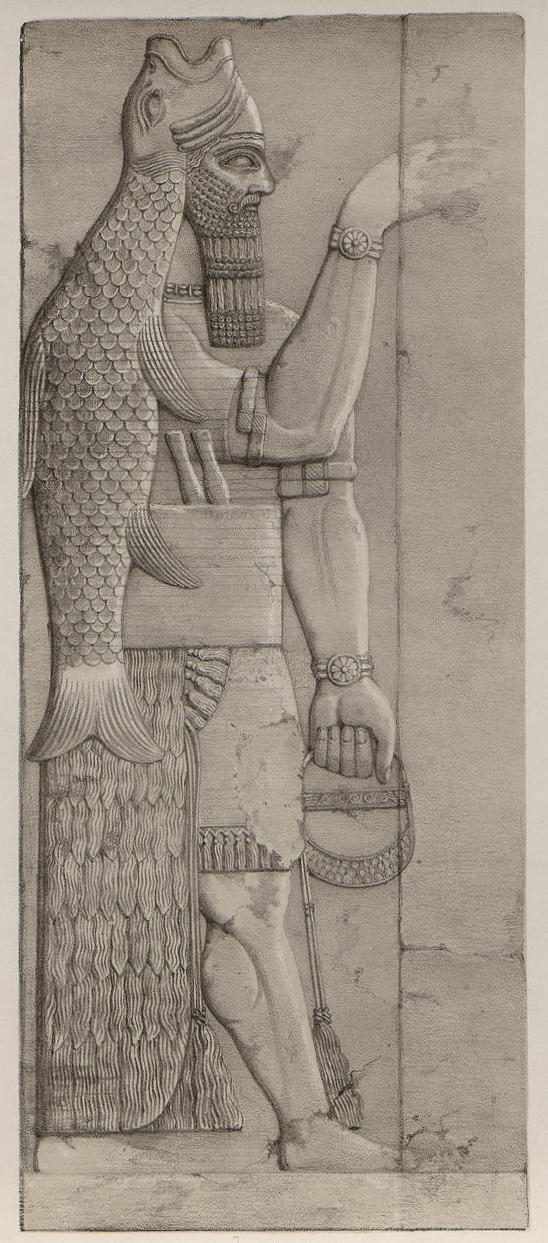
Type 1 is the Fish-Cloaked Apkallu, the kulullu, and the file calls him the Teacher. A human figure wears a fish skin as a cloak: the fish's head drawn up over his own head, the tail hanging behind him. That is Berossus's description of Oannes, matched almost line for line, in stone. In one hand he holds a bucket, the banduddu. In the other a pine cone, the mullilu, the purifier. The file's own line: the specific Seven Sages are almost synonymous with this Fish-Man form. The reference collection it names is the British Museum's Nimrud material from the Northwest Palace of Ashurnasirpal II, whose reign ran 883 to 859 BCE. It also names a specific accession number for an example gypsum panel, then flags its own citation as needing a catalogue cross-check, so we leave that number exactly where the file left it: unverified.
The Teacher is the one the texts mean when they say sage.
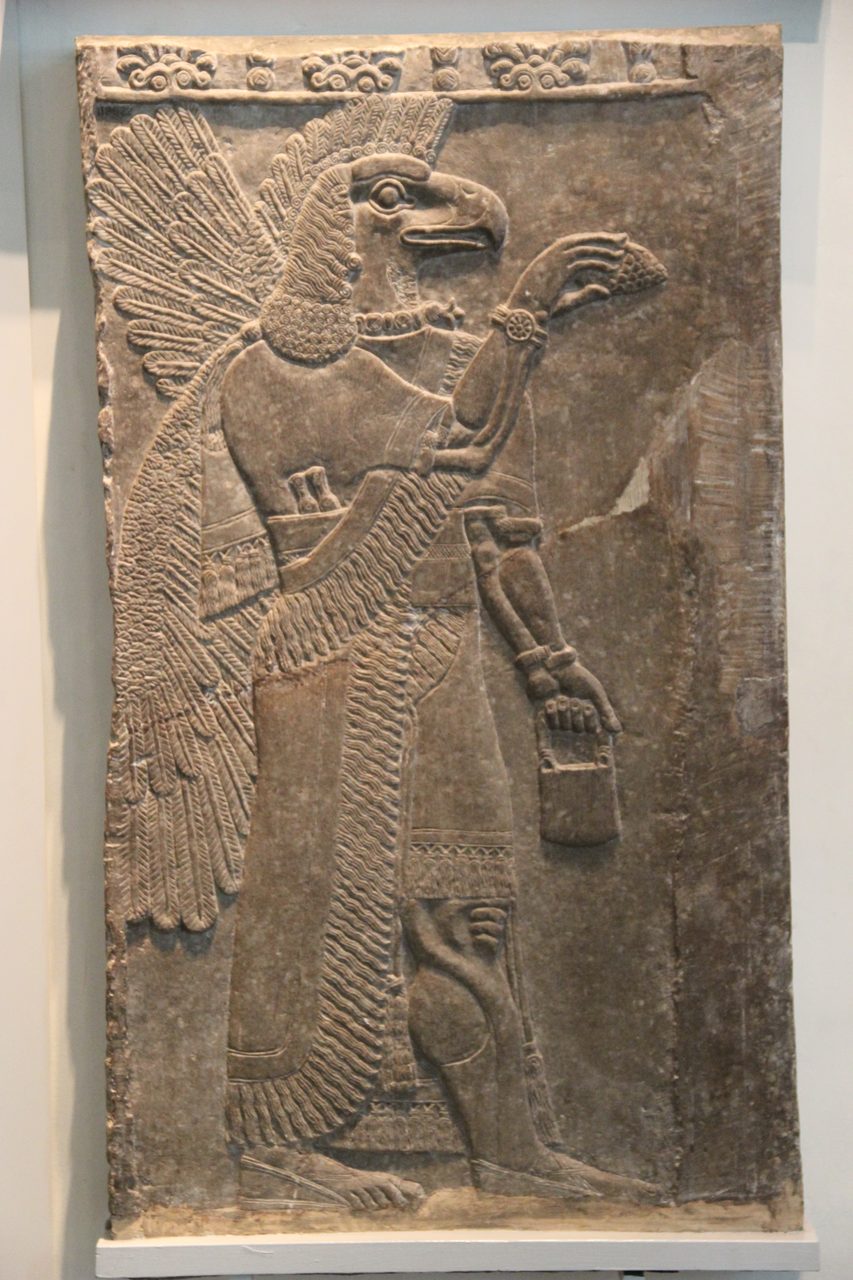
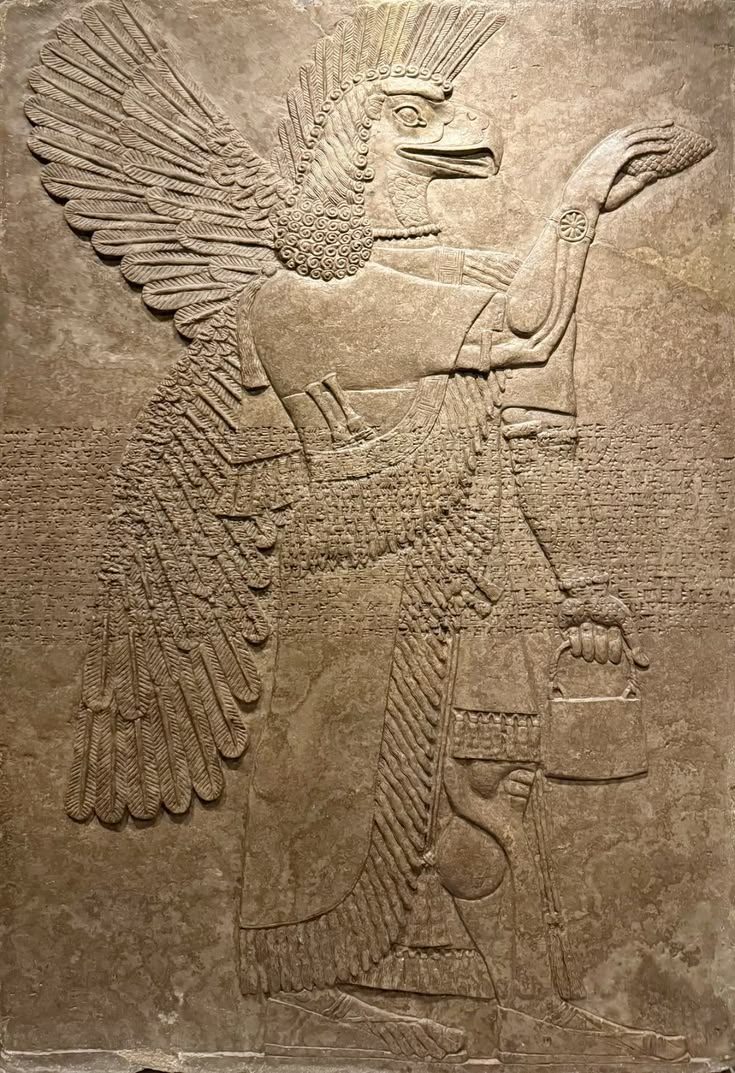
Type 2 is the Bird-Headed Apkallu, the Guardian: a human body with an eagle's head and wings across the back, carrying the same bucket and the same cone. These are the figures that flank the Tree of Life on palace reliefs, reaching toward it in what the file describes as a purification gesture. And here is the correction the file insists on: technically these are gryphon-demons, guardian figures, and they are often confused with the Sages proper.
If you have ever seen an article about the Apkallu illustrated with an eagle-headed winged figure, you have seen the Guardian wearing the Teacher's name.
Type 3 is the Human Apkallu: no fish skin, no beak, fully human in appearance but clearly meant to be divine or supernatural, marked out by elaborate dress and a headband. He carries the bucket and the cone like the others. He is the later, more human sage, the ummanu end of the line, and he matters for the pattern that runs through the second half of this file.
| Type | What it looks like | What it carries | Where the ritual says to bury it |
|---|---|---|---|
| Type 1: Fish-Cloaked (kulullu), the Teacher | A man in a fish-skin cloak, fish head over his own, tail behind | Bucket and pine cone | Near water sources: wells and bathrooms |
| Type 2: Bird-Headed, the Guardian | Human body, eagle or bird head, wings on the back | Bucket and pine cone | At doorways and gates |
| Type 3: Human Apkallu | Fully human, elaborate dress and a headband | Bucket and pine cone | In the foundation walls |
04Buried Under The Floor
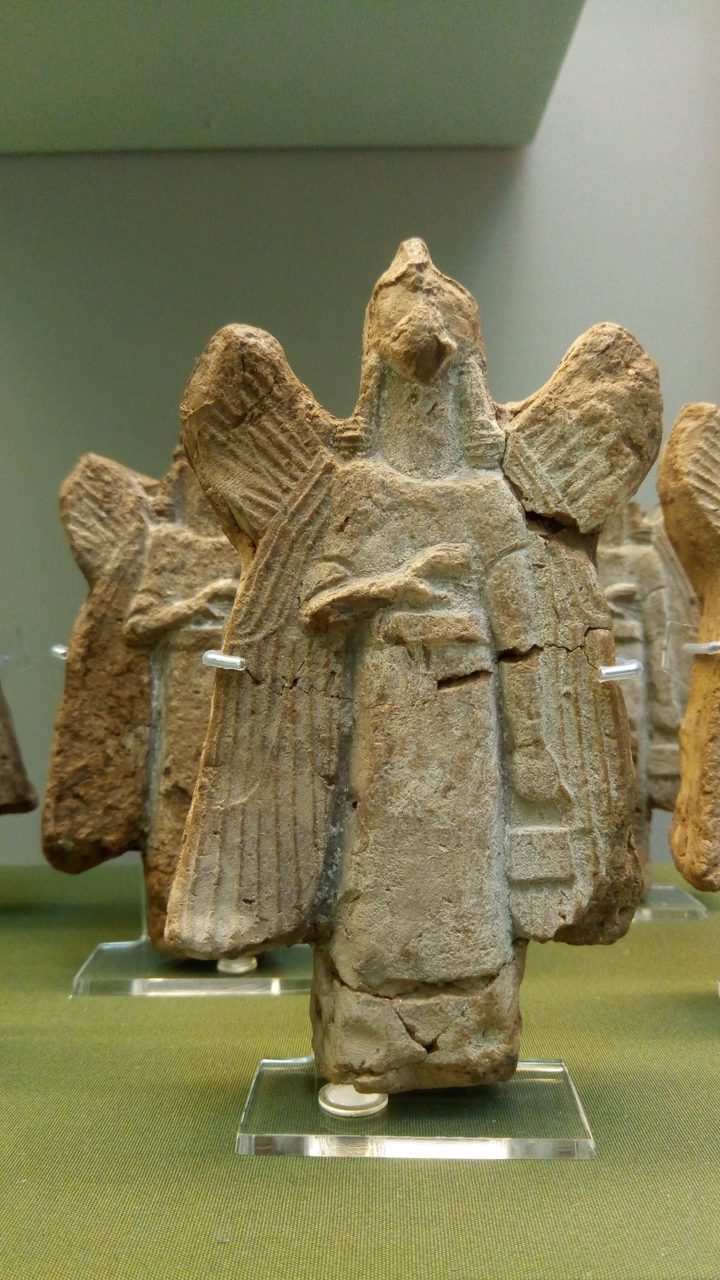
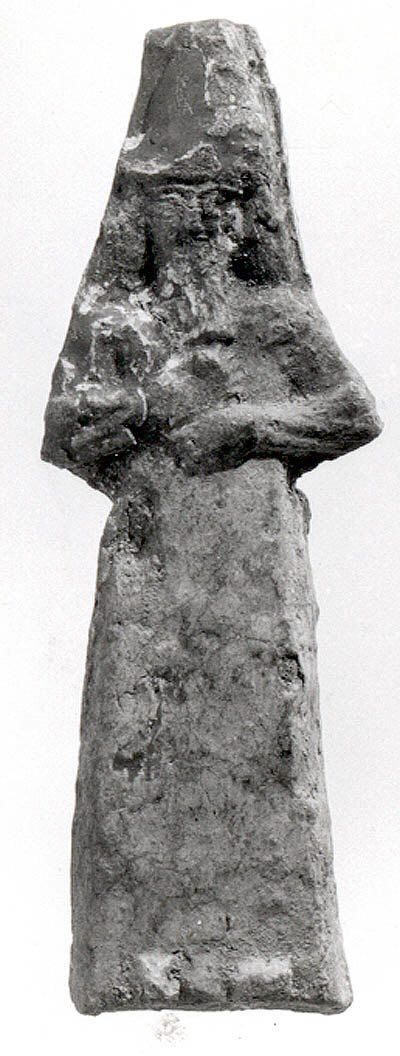
The Bit Meseri series is not only a story about the sages. Part of it is an instruction manual. It specifies where protective Apkallu figurines go, and it sorts them by type: the fish-cloaked figures near water sources, wells and bathrooms; the bird-headed figures at doorways and gates; the human-type sages inside the foundation walls. Every kind of threshold in a Mesopotamian building had its own guardian, and the guardian was chosen by species.
Small baked-clay figures of exactly that class survive, excavated and now sitting in museum cases. The belief left physical objects behind, which is more than most of the beings in this wing can say.
So the file draws the line hard, and we will repeat it because popular culture almost never does. The Teacher archetype is the Fish-Man. The Guardian archetype is the Bird-Man. Conflating the two is not a nuance, it is an error, and it is common enough in popular culture that the file singles it out.
05The Bucket And The Cone
All three types carry the same two objects, in every medium, for centuries. Nobody is certain what either of them is.
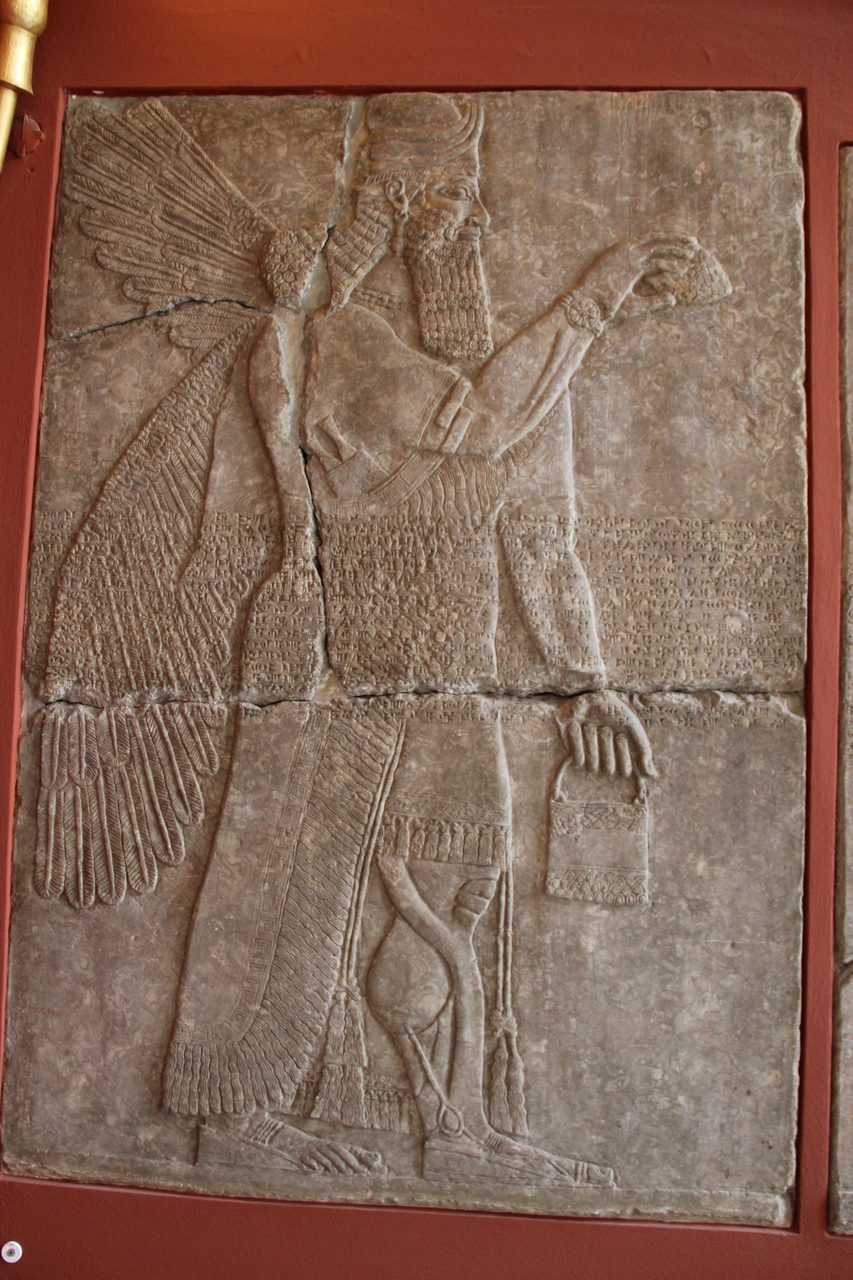
The academic reading of the bucket is practical: a ritual container for holy water, or for pollen. The file offers a second reading and grades it Tier 2 rather than Tier 1, which is the right call. In Sumerian tradition the gods held the ME, the divine programs and decrees of civilization. If the Apkallu are the delivery mechanism for civilization, then the banduddu is the delivery container. It is an elegant idea. It is also an interpretation stacked on an object whose function nobody has confirmed.
The cone is worse. Or better, depending on what you came here for.
The pine cone turns up far outside Assyria. The file lines up six traditions: the Assyrian reliefs, where the cone is pointed at the Tree of Life; the giant bronze Pigna in the Vatican's Court of the Pine Cone; the Staff of Osiris, with two serpents rising to meet a pine cone; the thyrsus of Dionysus and Bacchus, topped with one; Shiva's hair, shaped like one; and the Buddha's ushnisha, the protrusion on the head that resembles one. Then the file undercuts its own centerpiece, honestly: Assyriologists debate what mullilu even refers to in the Bit Meseri texts. Some restrict the word to the bucket-and-cone pair, or to a sprinkler, and not to the cone alone. The comparison is worth having. It is not standing on solid ground.
And then there is the reading you have already heard somewhere. The pineal gland takes its name from the Latin pinea, pine cone. In reptiles and amphibians the pineal gland contains a literal photoreceptor, a third eye. Descartes called it the seat of the soul. So, the argument runs, if the Apkallu's cone stands for activating the pineal gland, then the gesture toward the Tree of Life is a gesture about activating higher consciousness, aligning with Kundalini, the Third Eye and shamanic traditions worldwide. Our own file rates that one and does not flinch: 'visually suggestive but no cuneiform text supports this interpretation; remains in the realm of modern speculation.' It is a Tier 3 and it stays a Tier 3. A resemblance between two objects is not a statement about what an ancient priest meant.
06The Sage Who Turned Down Immortality
The first of the seven has a story of his own, preserved on fragments from Tell el-Amarna in Egypt and from Nineveh. Adapa was created by Ea, the god the Sumerians called Enki, as the model of humanity: given wisdom, and deliberately not given immortality. He served as a priest of Ea at Eridu, providing for the temple. One day, out fishing, he was capsized by the South Wind, and he cursed it and broke the South Wind's wing. That is not something a man can do. The supreme god Anu summoned him to heaven.
Ea sent his own creature up with a warning. The warning was wrong, and it cost Adapa everything.
Ea told him: they will offer you the bread of death and the water of death, do not eat, do not drink. But Anu, impressed by Adapa's wisdom, offered him the bread of life and the water of life, which would have granted him immortality. Adapa, obedient to his own patron, refused them both, and went home mortal. The file's reading is blunt: Ea's warning was wrong, or deliberately misleading, and the model of humanity lost immortality because of it. Set that beside the Eden narrative and the shape is identical. Knowledge is given. Immortality is withheld. And the withholding runs through a deception by the being who made you.
07After The Flood, Nobody Replaced Them
The tradition does not stop at seven. It tracks a decline, and it names the stages. Before the flood, the apkallu: fully divine beings sent by Ea. Then a transitional class, the apkallu-type, described as two-thirds divine and one-third human. Then, after the flood, the ummanu: fully human scholars and advisors, the court experts of historical Mesopotamia. Divine teachers, then hybrids, then men. Knowledge passing through steadily more human channels, and thinning at every step.
| Stage | The term | What they were |
|---|---|---|
| Before the flood | apkallu | Fully divine beings, sent by Ea |
| The transition | apkallu-type | Two-thirds divine, one-third human |
| After the flood | ummanu | Fully human scholars and advisors |
That pattern is not unique to the Apkallu, and the file says where else it runs: the Sumerian King List, whose reign lengths collapse from superhuman to ordinary; the biblical patriarchs, whose lifespans fall from more than 900 years to normal ones; and the Hindu Yugas, running down from a Golden Age to the Kali Yuga. Four sequences, one direction of travel. In every one of them the greatest knowledge sits at the beginning, not at the end. Nobody in that world was writing a progress narrative.
08The Same Beings, Told As Villains
Now the turn that takes this file out of Mesopotamia entirely.
Amar Annus, an Assyriologist at the University of Tartu, published the key paper in 2010: 'On the Origin of Watchers: A Comparative Study of the Antediluvian Wisdom in Mesopotamian and Jewish Traditions,' in the Journal for the Study of the Pseudepigrapha, volume 19, issue 4. His argument is that the Watchers of 1 Enoch, the divine beings who come down before the flood and teach humanity, are the Apkallu tradition carried into Jewish literature and turned inside out.
| The point of comparison | The Apkallu, in Mesopotamia | The Watchers, in 1 Enoch |
|---|---|---|
| Number and timing | Seven sages sent before the flood | 200 Watchers descending before the flood |
| How they came | Sent by Enki/Ea | Came on their own initiative, in rebellion |
| What they taught | Civilization: writing, cities, law | Forbidden knowledge: metalworking, cosmetics, astrology |
| How the knowledge is judged | Positive, a gift from the gods | Forbidden, a source of corruption |
| What they are tied to | Specific pre-flood kings | Specific teachings |
| What happens after the flood | They become ummanu, human scholars | They are imprisoned by God |
| The seventh | Utuabzu, who ascends to heaven | Enoch, the seventh patriarch, who ascends to heaven |
Read that table down the middle and the inversion is total. Same era, same act, same seventh figure walking into heaven, opposite verdict. In Mesopotamia the knowledge is a gift from Enki and the sages are honored. In 1 Enoch the knowledge is forbidden, the teachers arrive in rebellion, and after the flood they are imprisoned by God. The file reads that flip as a cultural one: the transition tracks the shift during the Babylonian Exile in the 6th century BCE, when post-exilic Judaism was defining itself against Babylonian religion. And it fits a wider pattern. The serpent who gives knowledge is a benefactor in Sumer and a villain in Genesis. The beings who teach civilization are sages in Babylon and Watchers in Enoch. Same act, opposite moral.
Annus is not alone in this. Helge Kvanvig's Primeval History: Babylonian, Biblical, and Enochic (2011) argues independently for Mesopotamian origins of the Watcher tradition, which is corroboration rather than an echo. And the foundational study underneath all of it, F.A.M. Wiggermann's Mesopotamian Protective Spirits: The Ritual Texts (1992), is the work that sorted the figurines and the ritual texts into the typology everyone now uses.
The Watcher material is not confined to 1 Enoch either. The file cross-references a set of Dead Sea Scrolls fragments carrying the Watcher and Book of Giants traditions, among them 4Q203, 4Q206, 4Q530 to 4Q532, 4Q556 and 6Q8.
09The Pages With No Tier On Them
Two sections of our file carry no evidence tier at all. Rather than invent one, we are going to say so plainly and then give you what is in them, because between them they hold the file's best comparison and the strongest case against it.
The first is a comparison table. Eight traditions, one recurring shape: a being who arrives, usually out of water, and hands over the arts of civilization.
| Tradition | The figure | What they are said to have done |
|---|---|---|
| Babylonian | Oannes and the Apkallu | Fish-human hybrids who teach civilization, out of the sea |
| Dogon (Mali) | The Nommo | Amphibious 'masters of water' who taught astronomy and agriculture |
| Sumerian | Enki | God of wisdom, living in the Abzu, creator of humanity |
| Hindu | The Matsya Avatar | Vishnu as a fish, saving Manu from the flood |
| Chinese | Fuxi | Serpent-bodied and water-associated, creator of the civilizing arts |
| Greek | Prometheus | Teaches fire and technology, and is punished for it |
| Philistine | Dagon | A fish deity with temple worship (1 Samuel 5:1-7) |
| Mesoamerican | Quetzalcoatl | Emerged from the sea, taught civilization, promised to return |
The second untiered section is the criticism, and it is not a strawman. The mainstream scholarly position is that the Apkallu are mythological legitimation for the scribal and priestly classes: sages claiming a divine origin for their own knowledge, and a pre-flood sage tradition that establishes the antiquity and authority of Mesopotamian scholarship. On that reading the fish-cloak imagery may derive from fishermen's ritual dress, and the cross-cultural parallels are explained by cultural diffusion rather than by shared experience.
The file names the specific works, with citations. Stanley Mayer Burstein's The Babyloniaca of Berossus (1978) argues that Berossus's original is lost and every scrap of Oannes material we have passed through later Hellenistic and Christian compilers, so the fish-man details may be compiler distortion rather than Berossus. W.G. Lambert (1957) and Erica Reiner (1961) argue the tradition worked as a mythological charter for priestly and scribal authority: professional legitimation, not a record of events. F.A.M. Wiggermann (1992) identifies the fish-cloaked apkallu figures as depictions of ritual garments worn during apotropaic ceremonies, which is to say costumed priests performing purification rites, not hybrid beings and not visitors.
Marc Van De Mieroop's A History of the Ancient Near East (2016) argues that shared iconographic motifs spread through documented ancient trade networks and cultural contact, not down from a common pre-diluvian origin. Jean-Pierre Protzen and Stella Nair's The Stones of Tiahuanaco (2013) caution that visual similarity across cultures is not evidence of connection, since bucket-shaped containers are functional forms that appear independently in many unrelated traditions. And Kenneth Feder's Frauds, Myths, and Mysteries (2020) names the method itself as the problem: selective iconographic comparison across vast temporal and geographic distances, with context ignored, is a classic case of confirmation bias in fringe archaeology.
Our file answers back, and its answers are worth hearing too. If legitimation was the goal, why a fish-human hybrid, when fully divine beings would have been more prestigious? The teaching list is oddly specific, and it matches the actual curriculum of Mesopotamian schools. The cross-cultural parallels extend to civilizations with no known contact with Mesopotamia. And the oldest carved example of the shared motif we are about to look at predates Mesopotamian civilization outright. None of that settles anything. It does mean the skeptical reading has to keep working.
10The Bag Three Cultures Carved
Which brings us to the object in the Apkallu's hand, and the reason this file does not close cleanly.
Take the existence of each carving first, because that part is not in dispute and the file rates it Tier 1. On Neo-Assyrian reliefs from Nimrud and Khorsabad, 9th to 7th century BCE, all three Apkallu types carry the banduddu, the handled bucket. On Pillar 43 at Gobekli Tepe in southeastern Turkey, the pillar known as the Vulture Stone, three handbag shapes sit along the top register, dated circa 9500 to 8000 BCE. On Olmec Monument 19 from La Venta in Mexico, circa 1200 to 400 BCE, a seated figure carries a bag amid serpent imagery. Those three carvings exist, they are dated, and you can go and stand in front of them.
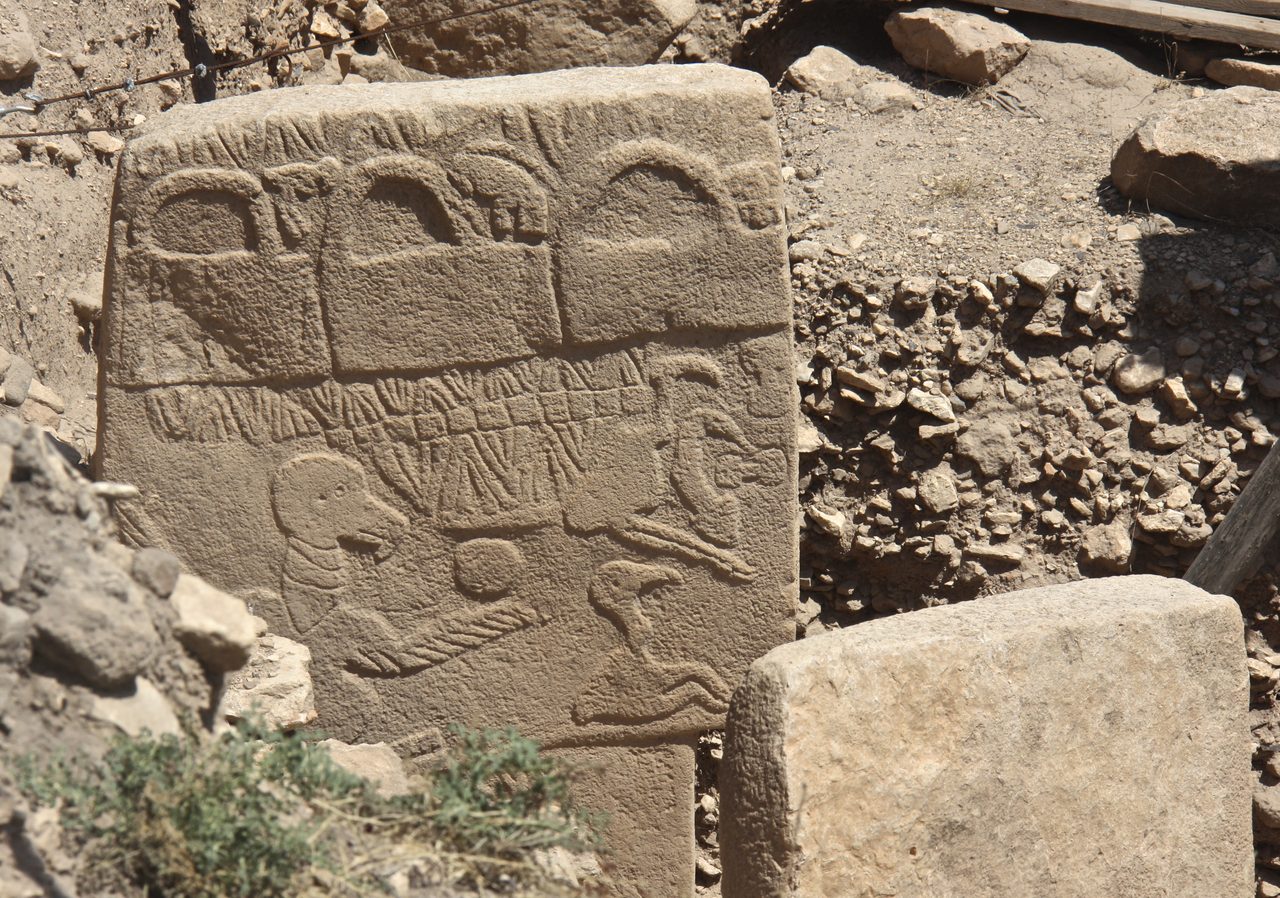
What is not Tier 1 is the line drawn between them, and the file splits its own rating right there: existence in each culture is Tier 1, the cross-cultural linkage is Tier 2. So here is the honest form of the claim. Three distinct cultures, Mesopotamia, Anatolia and the Olmec, display the same specific visual, a square bag with a handle, held in a ritual context. And the Gobekli Tepe version predates Mesopotamian civilization by more than 5,000 years, which means that if there is anything in the connection at all, the tradition is far older than the cuneiform that records it.
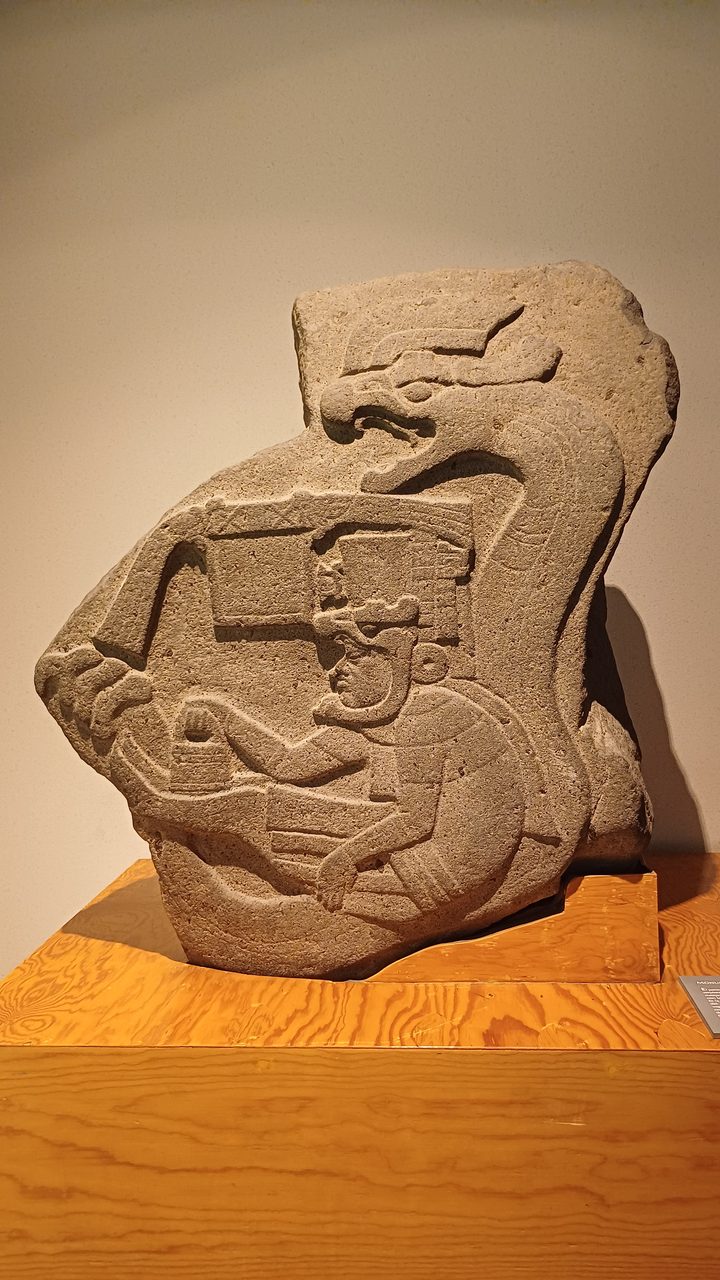
Each culture also has a perfectly sensible local explanation, and the file prints those alongside its own. At Nimrud the bucket is a ritual container for holy water or pollen; the alternative reading makes it a container of ME. At Gobekli Tepe the shapes are read as sunsets, roofs or baskets; the alternative reading calls them the same wisdom bag the Apkallu carries. At La Venta the bag is read as a copal-incense container used in ritual; the alternative reading makes it a wisdom bag brought by Quetzalcoatl. Three mainstream answers, three different objects, one repeated shape.
The file also polices its own list, which is the part that earns it some trust. The Maori kete o te wananga, the 'baskets of knowledge,' are kept in as a conceptual parallel only and explicitly ruled out as an iconographic match: woven flax, no rectangular handle-bag form. The Egyptian ankh, which popular treatments love to add here, is struck off entirely, since it is a hieroglyph held by a handle rather than a container and its form is structurally unrelated. Figures at Tula in Mexico, circa 900 to 1200 CE, appear in the wider distribution. But the genuine visual case rests on exactly three traditions, and the file says so itself.
| Where | What is carried, and when | The academic reading | The alternative reading |
|---|---|---|---|
| Mesopotamia | The banduddu bucket, held by all three Apkallu types, 9th to 7th century BCE | A ritual bucket for holy water or pollen | A container of ME, the divine programs of civilization |
| Gobekli Tepe (Pillar 43) | Three 'handbag' shapes on the top register, circa 9500 to 8000 BCE | Sunsets, roofs or baskets | The identical 'wisdom bag' the Apkallu carries |
| Olmec (La Venta Monument 19) | A figure carrying a bag amid serpent imagery, circa 1200 to 400 BCE | A copal-incense bag used in ritual | A 'wisdom bag' brought by Quetzalcoatl |
| Maori (kete o te wananga) | 'Baskets of knowledge' in oral tradition, pre-contact | Woven flax, visually distinct, no handle-bag form | A conceptual parallel only; the file rules out an iconographic match |
Fast Facts
- The Claim
- Seven divine sages, sent before the flood, handed humanity the whole apparatus of civilization
- Oldest Full Account
- Berossus, Babylonian priest, writing in Greek around 280 BCE, surviving only in fragments quoted by later compilers
- The Tablet
- The Uruk List of Kings and Sages (W 20030,7), about 165 BCE, pairing seven sages with seven pre-flood kings
- The Three Types
- Fish-cloaked Teacher, bird-headed Guardian, human sage. All three carry a bucket and a pine cone
- The Ritual
- The Bit Meseri series orders figurines buried by type: water sources, doorways, foundation walls
- The Seventh Sage
- Utuabzu, 'who ascended to heaven,' the same note struck for Enoch, seventh from Adam
- The Watcher Link
- Annus, 2010: the same pre-flood teachers, inverted from gift to crime. The file grades it plausible but unproven
- The Pineal Reading
- Tier 3, in the file's own words: no cuneiform text supports it
- The Open Question
- Three cultures with no known contact carved the same square bag with a handle. No settled explanation of the repetition
- Not Established
- That any Apkallu was a physical non-human being. The evidence here is texts and carvings
What We Can Actually Stand Behind
The spine of this file is solid, and unusually well documented for an ancient being. Berossus's account of Oannes exists and reads as described. The Uruk List pairs seven named sages with seven pre-flood kings and separates them from the ummanu. The Bit Meseri series names all seven, calls them pure puradu-fishes of the sea, and gives the burial rule for each type. The three-type iconography, fish-cloaked Teacher, bird-headed Guardian and human sage, each carrying bucket and cone, is on the stone. The Adapa narrative and the post-flood slide from apkallu to ummanu are in the texts. The file's own scorecard calls the primary textual attestations for the Apkallu strong, and the iconographic attestations 'robust but require careful typological matching,' which is exactly the caution this page has tried to keep.
The comparative layer is credible and correctly held one step back. The Apkallu-to-Watcher line, argued by Annus in 2010 and independently supported by Kvanvig in 2011, is graded by the file's own scorecard as 'plausible but unproven, overall TIER 2.' The bucket as a container of ME is an interpretation, not an identification. The pine cone comparison is a real cross-cultural pattern resting on a contested foundation, since Assyriologists cannot agree what mullilu refers to. And the handbag motif splits cleanly: the carvings are Tier 1, the connection between them is Tier 2, and anybody who tells you otherwise has upgraded the claim on their own authority.
The pineal reading is speculation and the file says so in its own words: visually suggestive, with no cuneiform text supporting it. It is a resemblance between a cone and a gland, run through Descartes and modern consciousness talk. Keep it as a curiosity. Do not carry it out of here as a finding.
There is no Tier 4 claim in this file, and saying so is more honest than manufacturing a debunk. What we refuse is the loose version of this story that circulates around it. The Egyptian ankh is not a handbag, and the file strikes it from the comparison itself: a hieroglyph held by a handle is not a container. The Maori baskets of knowledge are a conceptual parallel and nothing more, ruled out as an iconographic match by the file's own text, and using them as one is the exact confirmation bias Feder names. And these reliefs are not photographs of aliens: the foundational typological study of these figures reads the fish cloak as a ritual garment worn by priests during apotropaic ceremonies, which makes the honest reading of the most famous image in this file a costumed man. That is still remarkable. It is simply not what it usually gets sold as.
So the file ends where the stone does. The Apkallu are about as well documented as an ancient being gets: named on tablets, sorted into types, buried under floors by the rule book, remembered as the teachers who arrived before the flood and were never replaced. What the record does not contain is a single line explaining the bag. A ritual bucket at Nimrud, an incense pouch at La Venta, roofs or baskets or sunsets at Gobekli Tepe: three reasonable answers, one repeated shape, carved by peoples separated by continents and by millennia. Van De Mieroop's answer is trade and contact. Feder's answer is that we are pattern-matching across the world while ignoring the context of every piece. Both may be right, and neither of them has told us what the sages were carrying. Somewhere between about 9500 and 8000 BCE somebody at Gobekli Tepe cut a square bag with a handle into a pillar, thousands of years before Mesopotamia existed to be taught anything. Much later, half a world away, somebody cut it again. What was in the bag, and why did it matter enough to carve twice?
Sources & further reading
Everything above is drawn from our research library on Theories of Anything, which is where we worked from. The papers, reports and primary records listed beneath them are where you can check us independently.
Image credits
- The god Ea flanked by fish-cloaked apkallu, basalt water basin from Assur, reign of Sennacherib, Pergamon Museum photograph by Osama Shukir Muhammed Amin FRCP(Glasg), via Wikimedia Commons. CC BY-SA 4.0 Source.
- Plate 6, 'fish god,' from Austen Henry Layard's second series of the monuments of Nineveh (London, 1853) engraving after an ancient bas-relief, published in Austen Henry Layard's A second series of the monuments of Nineveh, via Wikimedia Commons. Public Domain Source.
- Neo-Assyrian bas-relief of an eagle-headed winged Apkallu, British Museum photograph by Gary Todd, via Wikimedia Commons. CC0 1.0 Source.
- Baked-clay apotropaic figurines of bird-headed sages (apkallu), Neo-Assyrian period, British Museum photograph by Zunkir, via Wikimedia Commons. CC BY-SA 4.0 Source.
- Alabaster bas-relief of a human-headed winged Apkallu holding a bucket and cone, Northwest Palace of Ashurnasirpal II at Nimrud, Pergamon Museum photograph by Gary Todd, via Wikimedia Commons. CC0 1.0 Source.
- Apkallu figure, male with a fish-skin hood, Assyrian ceramic sculpture, Metropolitan Museum of Art (54.117.25) Metropolitan Museum of Art Open Access, via Wikimedia Commons. CC0 1.0 Source.
- Relief with an Apkallu, Room F, Northwest Palace, Nimrud, Bristol Museum and Art Gallery photograph by SpeakingArch, via Wikimedia Commons. CC BY-SA 4.0 Source.
- Pillar 43, the Vulture Stone, Gobekli Tepe, Sanliurfa, Turkey photograph by Sue Fleckney, via Wikimedia Commons. CC BY-SA 2.0 Source.
- Olmec Monument 19 from La Venta, National Museum of Anthropology, Mexico City photograph by José Luiz Bernardes Ribeiro, via Wikimedia Commons. CC BY-SA 4.0 Source.
- Card crop of The god Ea flanked by fish-cloaked apkallu, basalt water basin from Assur, reign of Sennacherib, Pergamon Museum photograph by Osama Shukir Muhammed Amin FRCP(Glasg), via Wikimedia Commons. CC BY-SA 4.0 Source.
_flanked_by_fish-cloaked_apkallus,_part_of_a_basalt_water_basin_from_Assur,_Iraq._Reign_of_Sennacherib,_7th_century_BCE._Pergamon_Museum,_Germany.jpg)
_1853_(cropped).jpg)


.jpg)


_-_Gulf_-_National_Museum_of_Antropology_-_Mexico_2024.jpg)