Baalbek: The Stones That Outweigh Jumbo Jets
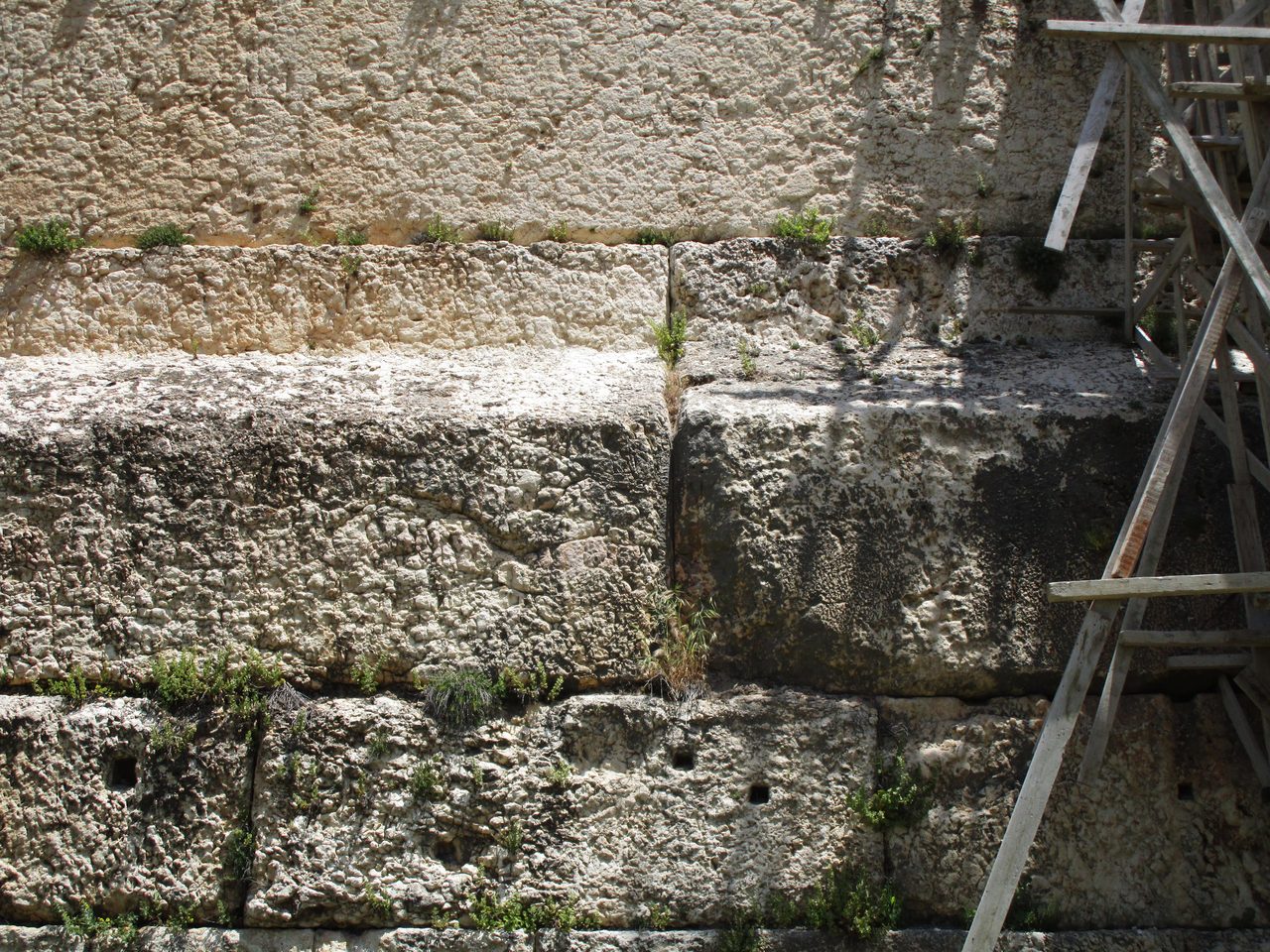
Three blocks of limestone sit in a wall in Lebanon, each one heavier than a fully loaded 747, and the quarry next door holds one even bigger that was never moved at all. Here is the file, opened from the ground up, every claim wearing its evidence.
Say the word “trilithon” and most people picture three big rocks. What actually sits in the retaining wall of the Temple of Jupiter at Baalbek is closer to three loaded jumbo jets, stacked into a wall, fitted so precisely you cannot slide a coin into the seam. And a short walk away, still attached to the bedrock it was cut from, sits a fourth stone bigger than all three of those put together. Nobody ever finished moving it. Let's open the file.
| Block | Dimensions | Estimated weight |
|---|---|---|
| Block 1 | 19.6 m × 4.3 m × 3.65 m | ≈ 800 tonnes |
| Block 2 | 19.3 m × 4.3 m × 3.65 m | ≈ 800 tonnes |
| Block 3 | 19.1 m × 4.3 m × 3.65 m | ≈ 800 tonnes |
| Six blocks beneath them | smaller courses | ≈ 300 to 400 tonnes each |
01The numbers that don't sound real
The German Archaeological Institute's own measurements confirm all three Trilithon blocks: roughly 19 to 20 meters long, 4.3 meters high, 3.6 meters deep, an estimated 800 tonnes each, resting about 7 meters above ground on six blocks of their own, each around 300 to 400 tonnes. This is settled, published archaeology, not a rounded up legend.
For scale, a fully loaded Boeing 747 weighs about 400 tonnes at takeoff. Each Trilithon block is the weight of two of them, quarried from solid rock, moved, lifted, and set with joints between the stones barely visible at all.
02Who actually stacked them
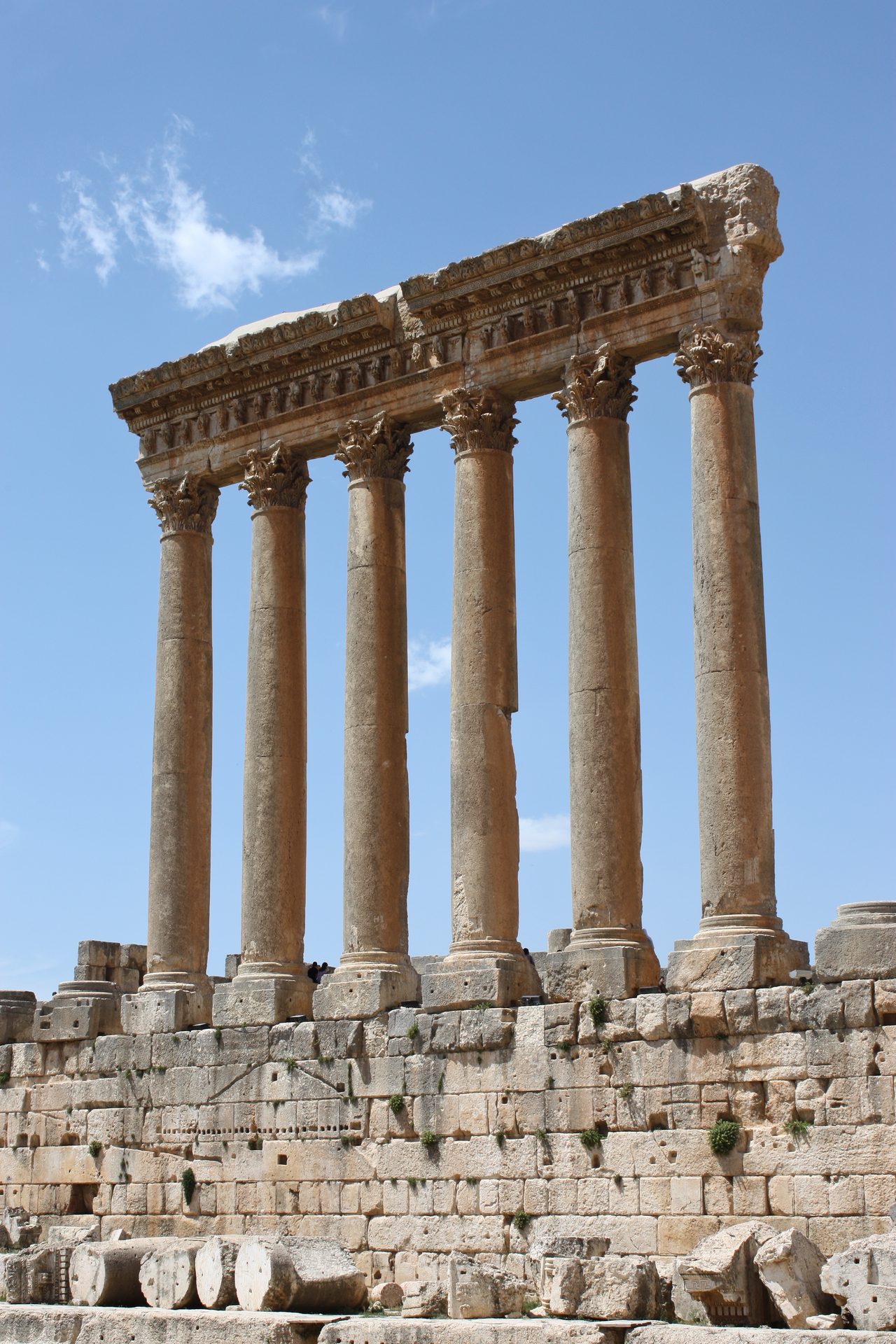
The temple sitting on top of the Trilithon is not in dispute. The Temple of Jupiter Heliopolitanus, the largest Roman temple ever built, went up in stages from the late 1st century BCE through the 1st century CE, part of the same imperial building program that financed monuments across the empire. The adjacent Temple of Bacchus followed under Antoninus Pius in the mid 2nd century CE. Pottery, coins, Latin inscriptions, and architectural style all agree on the date.
No pre-Roman material, no earlier pottery, no different dating evidence, has ever turned up inside the Trilithon's own masonry. The stones are structurally integrated with the unambiguously Roman levels above them.
Whether the very lowest courses, the largest and least regularly shaped blocks, were begun earlier, under Hellenistic rule before Rome ever arrived, is a real and still open academic question. Kropp and Lohmann (2011) argue the massive podium was likely started under Ptolemaic or Seleucid patronage and finished under Augustus. Mainstream archaeology leans Roman or Hellenistic. It does not claim certainty. The lowest courses simply have not produced the datable evidence that would close the question either way.
03The quarry that gave up
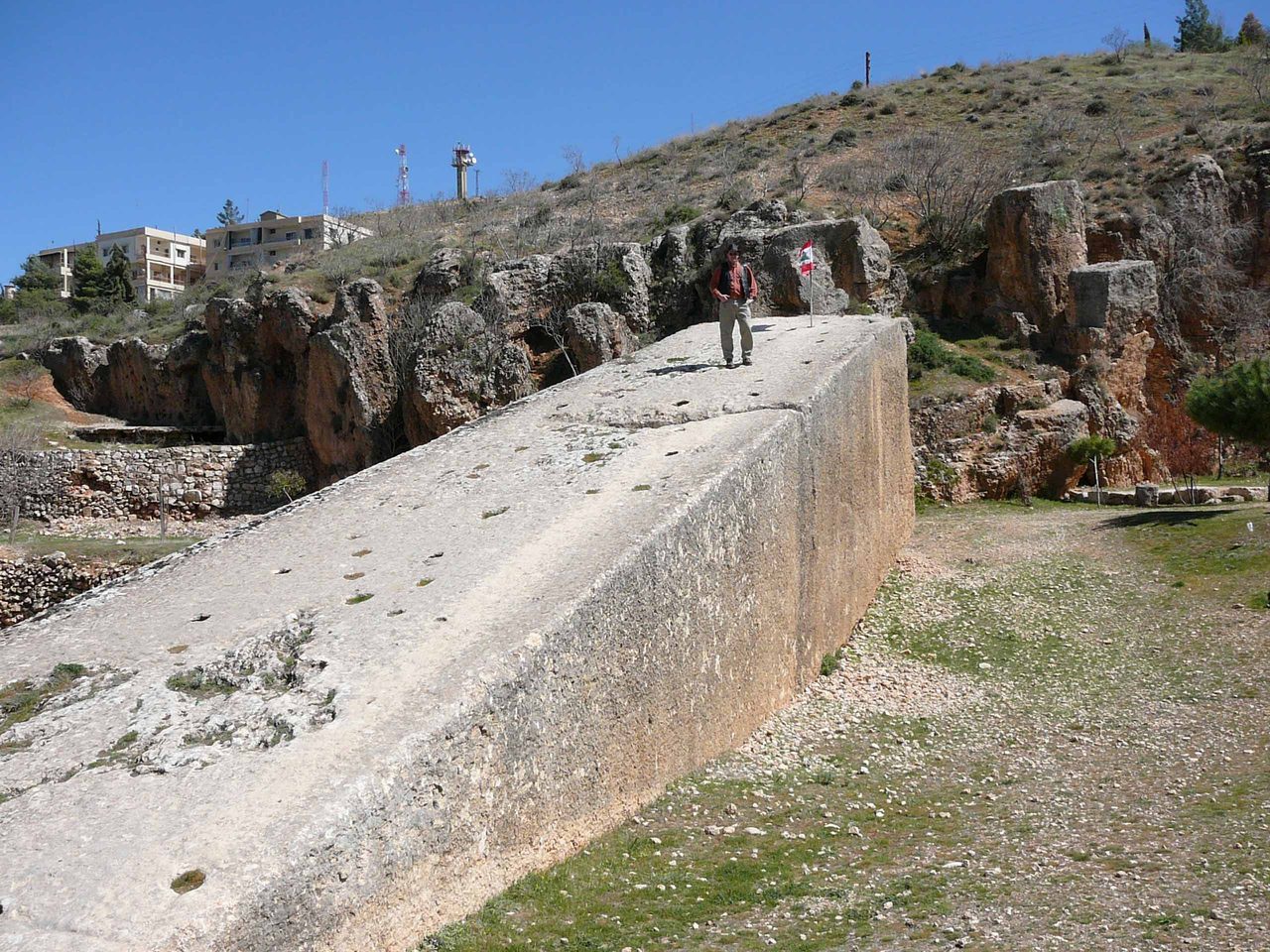
About 800 meters from the temple sits Hajjar al Hibla, the Stone of the Pregnant Woman: a monolith around 20.3 meters long and roughly 1,000 tonnes, still attached to the bedrock on three sides, chisel marks showing it was almost entirely freed before someone simply stopped. In the 1990s, excavators found a second stone underneath it, about 1,242 tonnes. In 2014, a German Archaeological Institute team led by Margarete van Ess found a third stone beneath that one: roughly 19.6 by 6 by 5.5 meters, an estimated 1,650 tonnes. It is, as far as anyone has found, the largest single stone block any human being has ever cut.
All three quarry monoliths are confirmed by direct DAI excavation and measurement, cut from the same geological formation as the temple stones, on ground slightly uphill from the temple, meaning transport downhill would have had gravity's help, not gravity's opposition.
Why quarry a stone bigger than anything you had already succeeded in moving, and then abandon it? Nobody knows. It might have cracked. It might have been cut oversized on purpose, meant to be trimmed down. It might mark the exact point where the logistics ran out. The stone itself does not say.
| Stone | Weight | When |
|---|---|---|
| Baalbek Trilithon block | ≈ 800 t | 1st century BCE/CE |
| Lateran Obelisk, Rome | ≈ 455 t | 357 CE, from Egypt |
| Thunderstone pedestal, St. Petersburg | ≈ 400 t | 1770, overland |
| Vatican Obelisk | ≈ 323 t | 1586, Renaissance tech |
| Trajan's Column base block | ≈ 77 t, lifted 34 m | early 2nd century CE |
04Moving 800 tonnes without an engine
No Roman source describes exactly how the Trilithon blocks were moved. Engineering historian Jean Pierre Adam calculated that a single 800 tonne block would need roughly 40,000 laborers pulling in coordination along a prepared track, using timber rollers, sledges, and capstan winches on earthen ramps. Extreme, but well inside what Roman logistics and manpower could field.
The quarry sits roughly 10 to 15 meters higher than the temple. Transport ran downhill the entire 800 meters, which meaningfully reduces the labor problem compared to hauling uphill.
05Where the aliens come in, and why they don't hold up
Erich von Däniken put Baalbek in Chariots of the Gods in 1968: a landing platform, built by beings from elsewhere, far beyond human ability. Other writers have argued the Trilithon predates Rome by thousands of years, a leftover from some unknown pre Flood civilization the Romans simply built their temple on top of.
The pre-Roman-civilization claim rests entirely on the stones' size feeling too large for ancient hands. No artifact, no construction technique, no dating evidence beneath or within the Trilithon supports an older builder. That is an argument from incredulity, not an argument from evidence.
Extraterrestrial builders, antigravity, acoustic levitation, and claims that the site shows evidence of ancient nuclear destruction are all unsupported by anything found on the ground. Roman quarrying tool marks, iron wedge holes, and channel cutting consistent with known Roman technique are documented at Hajjar al Hibla itself. The pattern here, big stone, therefore unknown builders, is the same argumentum ad lapidem fallacy that shows up at almost every megalithic site on this wing. It feels like evidence. It is not.
Fast Facts
- Site
- Baalbek, ancient Heliopolis, Bekaa Valley, Lebanon
- Trilithon
- 3 blocks, ≈ 800 tonnes each
- Largest quarry stone
- ≈ 1,650 tonnes, found 2014 by the DAI
- Quarry distance
- ≈ 800 m, downhill grade toward the temple
- Built
- Late 1st century BCE to 3rd century CE, Roman
- Estimated labor
- ≈ 40,000 workers per Trilithon block (Adam, 1977/1999)
- UNESCO status
- World Heritage Site since 1984
What we can actually stand behind
The Trilithon is real, it is Roman, and moving it was one of the single most extreme engineering efforts documented anywhere in the ancient world.
Whether the lowest, largest courses were begun earlier under Hellenistic builders before Rome finished the job is an unresolved question among archaeologists, not a settled fact in either direction.
Extraterrestrial builders, antigravity, and ancient nuclear destruction all fail. Not because scholars refuse to look. Because nothing at the site supports them.
Which leaves the actual mystery sitting exactly where the Romans left it 2,000 years ago: three more stones, cut even bigger than anything they ever finished lifting, going nowhere, forever. Something stopped them. Nobody has ever found out what.
Sources & further reading
Everything above is drawn from our research library on Theories of Anything, deep-read in full rather than skimmed. The corpus files are where we worked from; the papers, reports and primary records listed beneath them are where you can check us independently.
Image credits
- Temple of Jupiter at Baalbek photograph by Eusebius (Guillaume Piolle), via Wikimedia Commons. CC BY 3.0 Source.
- The Trilithon, west wall of the podium photograph by Lodo27, via Wikimedia Commons. CC BY-SA 3.0 / GFDL Source.
- The Stone of the Pregnant Woman photograph by Ralph Ellis, via Wikimedia Commons. CC BY-SA 4.0 / GFDL Source.
- Card crop of The Trilithon, west wall of the podium photograph by Lodo27, via Wikimedia Commons. CC BY-SA 3.0 / GFDL Source.


