Betty & Barney Hill and the Classic Cases

In September 1961, Betty and Barney Hill drove home through the White Mountains of New Hampshire and reported a light in the sky to the Air Force. Three years later, under hypnosis, they described being taken aboard a craft, and an entire genre was born. Fourteen years after that, an Arizona logging crew watched Travis Walton approach what they described as a glowing disc, and then watched him vanish for five days. These are the two cases every abduction story since has been measured against, and they are unusual in one important way: an enormous amount about them is genuinely documented. A military file. Roughly fifty recorded hypnosis sessions. A hand-drawn star map astronomers still argue over. Polygraph charts on every side. What the documents cannot tell us is what actually happened, and this article does not pretend otherwise. Dr. Benjamin Simon, the respected Boston psychiatrist who ran the Hills' sessions, concluded the whole thing was a fantasy. Others are not so sure. Here is the entire record, tier by tier, including the parts that stay open.
Almost every alien abduction story you have ever heard runs on the same rails: a dark road at night, a light that should not be there, a stretch of time that simply goes missing, and hours or years later a memory that will not surface until someone goes looking for it under hypnosis. That template did not exist before 1961. Two people wrote it, without meaning to, on a mountain highway in New Hampshire, and an Arizona logging crew added the second act fourteen years later. These are the two cases every other abduction account is still measured against, and they are worth real attention precisely because so much of them is not a story at all. It is a paper trail: a military file, roughly fifty recorded hypnosis sessions, a hand-drawn star map, a stained dress in a university archive, and polygraph charts on both sides of a fight that has not ended. Here is exactly what that record holds, tier by tier, and exactly where it stops.
01The Night Drive
On the night of September 19 into the early hours of September 20, 1961, Betty and Barney Hill were driving home through the White Mountains of New Hampshire on Route 3 when they saw a bright object in the sky. Barney studied it through binoculars. Whatever they believed it was frightened them badly enough that within twenty-four hours, on September 21, they reported the sighting to Pease Air Force Base. The Air Force opened a Project Blue Book file on it, catalogued as case number 100-1-61. And here is the detail that matters most, because it is the one the legend usually drops: Blue Book did not call it a hoax, and it did not call it explained. It classified the sighting as 'insufficient data.'
Secondary retellings of the declassified file add a little more color than the corpus record formally carries, and it is worth flagging as exactly that. Those accounts say the report was written up by a Major Paul W. Henderson on September 26, 1961, and that Henderson's informal first read leaned toward the Hills having mistaken the planet Jupiter for a craft, a guess later folded into the softer official verdict of insufficient data. Treat that as lower-confidence background, not settled fact. The solid Tier 1 claim is only that a file was opened and left open, not who wrote it or what he privately suspected.

02Two Missing Hours
By the Hills' own reckoning, the drive home should have taken a certain number of hours. It took roughly two hours longer than that, and they could not fully account for the gap. On its own that proves nothing at all: people miscount, stop, slow down, lose the thread of a long night drive. But that missing time turned out not to be theirs alone. Budd Hopkins and David Jacobs would later catalogue the same reported gap across roughly 300 abduction accounts, which makes it a genuine recurring pattern that asks for an explanation, whatever that explanation turns out to be. A pattern is not proof of its own cause. It is just a thing that keeps happening and refuses to be ignored.
03What The Hypnosis Uncovered
The abduction itself, the part everyone remembers, did not come from the roadside. It surfaced on a psychiatrist's couch almost three years later.
Between February and June of 1964, the Hills underwent hypnosis with Dr. Benjamin Simon, a respected Boston psychiatrist who had used hypnotherapy to treat traumatized combat veterans. Across roughly fifty sessions, methodical and recorded, the now-famous narrative emerged under hypnosis: the craft on the road, the beings, the examination said to have happened aboard it. That these sessions took place, and broadly what was said in them, is not in dispute. Simon kept the record.
What the legend almost always leaves out is what Dr. Simon himself concluded about the story his own sessions had produced. Simon did not believe the abduction had literally happened. His assessment, given in correspondence and later stated publicly, was that the narrative was a fantasy: one that began in Betty's own vivid dreams of an alien encounter, which had started about ten days after the sighting, and was then transferred to Barney through a shared mechanism he named folie a deux, a delusion passed between two closely bonded people. This is Dr. Simon's clinical judgment about his own patients. It is not a verdict this article is handing down on the Hills, and it is not an adjudicated fact about what happened on Route 3. But it belongs in the record at full weight, because the one clinician who sat through roughly fifty sessions inside this case did not come out of it believing the aliens were real.
The account reached the public in 1966, when the journalist John G. Fuller published The Interrupted Journey, the first detailed telling of the case, built directly from the hypnosis transcripts and released with Dr. Simon's permission. It is the book that turned a New Hampshire couple into the founding story of an entire genre.
04The Star Map
Of everything the Hills produced, one artifact has kept scientists arguing for half a century: a star map.
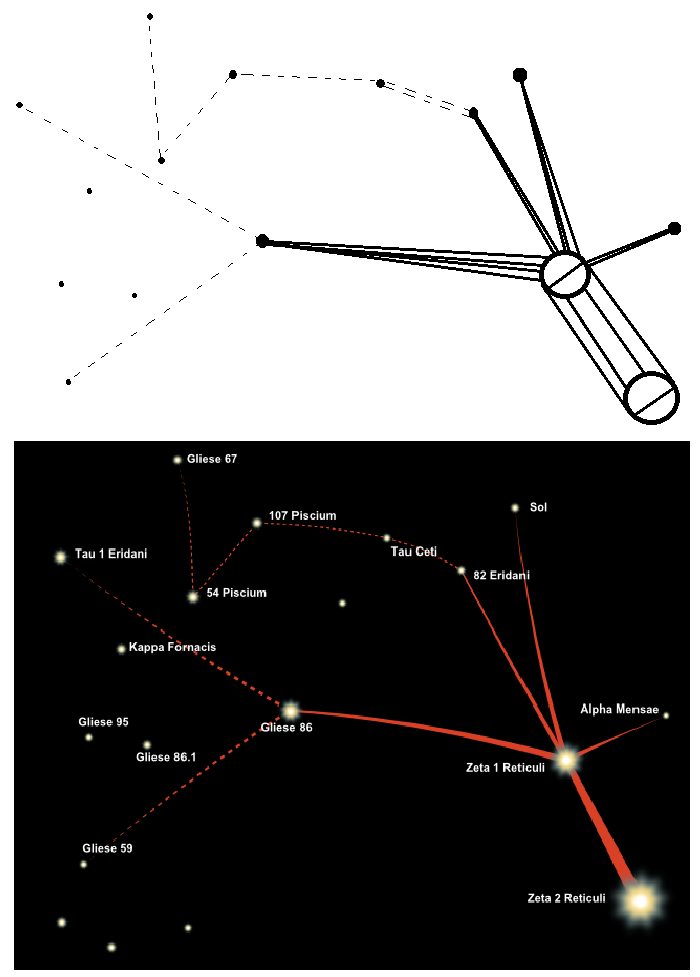
After the hypnosis, Betty Hill drew a map she said she had been shown aboard the craft, a scatter of dots with lines drawn between some of them, which she was told marked trade routes. Unlike a memory, a drawing holds still, and a thing that holds still can be tested. So it was, for decades, and the argument over it is one of the most serious in the entire file.
The two people who tested it hardest reached opposite conclusions, and both conclusions deserve to be taken seriously. One found a real match hiding in the dots. The other found the ordinary human genius for seeing patterns in noise. Neither has ever landed the knockout.
An amateur astronomer named Marjorie Fish set out to test the map properly. Between 1968 and 1974 she built three-dimensional models of the nearby star systems, positioning beads in real space to get the geometry right, and hunted for a vantage point from which the actual stars would fall into Betty's pattern. She proposed a match: a configuration centered on Zeta Reticuli, a binary star system about 39 light-years from Earth. Two things gave her result real teeth. She published it through Walter Webb of the Hayden Planetarium and in the December 1974 issue of Astronomy magazine, and Webb himself called the match 'interesting.' And her selection rule was not arbitrary. She counted only sun-like stars, excluding red dwarfs and giants, a genuine and non-obvious constraint that should have made a coincidental match harder to find, not easier.
Carl Sagan was not convinced, and his objection is every bit as serious. In his 1975 book Other Worlds, Sagan argued that the analysis had granted itself too much freedom. Give yourself enough liberty in which stars to include and how to orient the view, he warned, and almost any random scatter of dots can be matched to some configuration of nearby stars. On that reading the apparent precision is manufactured by the search itself: look hard enough through enough angles and a pattern will always appear. Both arguments are honest, and neither has knocked the other down. Fish's constraint is real, and so is Sagan's warning about the freedom of the fit. Fifty years on, the star map is exactly what it was: suggestive to some, an artifact of pattern-matching to others, and proof to no one.
05The Dress And The Trunk
Betty Hill kept the dress she wore that night, and it now sits in the archives of the University of New Hampshire. It carries a pinkish stain and some damage, and from 2001 to 2003 the chemist Phyllis Budinger analyzed it, reporting protein-based biological material of unknown origin. That sounds dramatic until you weigh it honestly. A garment handled, stored, and moved for more than forty years has a chain of custody full of gaps, and any number of ordinary contaminants could leave a protein trace. The material is real and its origin is genuinely unknown, which is not at all the same thing as unearthly. It is Tier 3 for a reason.
The car told a similar story, and it is no more conclusive. The Hills reported that the trunk showed about a dozen shiny spots that had not been there the day before, and that when they held a compass near them the needle deflected. It is a concrete, testable-sounding detail, and it is also a home experiment run by two shaken people on their own vehicle, unwitnessed and never repeated. Interesting, unresolved, and nowhere near strong enough to carry the weight the story wants to hang on it.
06Why Psychology Might Explain It
There is a mainstream explanation for the Hill case that needs no spacecraft at all, and it is not a sneering one. The Harvard psychologist Susan Clancy set it out in her 2005 book Abducted. Sleep paralysis, hypnagogic hallucinations at the edge of sleep, and false memories built under hypnotic regression can, together, produce an abduction narrative that is vivid, detailed, emotionally shattering, and entirely sincere, in people who are psychologically normal. Clancy's research found that abduction experiencers score higher than average on fantasy-proneness and absorption, the tendency to become fully immersed in inner experience, but are not mentally ill. That is the crucial and humane point. You do not have to be lying, and you do not have to be disturbed, to remember something that never happened. The ordinary machinery of a healthy mind is enough.
One detail sharpens the case for a cultural source rather than a cosmic one. In 1990, writing in the magazine Magonia, the researcher Martin Kottmeyer noticed something about the aliens Barney had described under hypnosis. Their most distinctive feature was a pair of eyes that wrapped around the sides of the head. That is an unusual thing to invent, and it had appeared before, on television. The Outer Limits episode 'The Bellero Shield' featured an alien with exactly those wraparound eyes, and it aired on February 10, 1964, just twelve days before Barney's first hypnosis session. Twelve days. It does not prove Barney borrowed the image, but it is very hard to un-see once you know the timeline, and it is precisely the kind of contamination that makes memories recovered under hypnosis so treacherous as evidence.
07The Arizona Logging Crew
Fourteen years later and most of a continent away, the second founding case put the same pattern to a very different test, because this time there were witnesses.
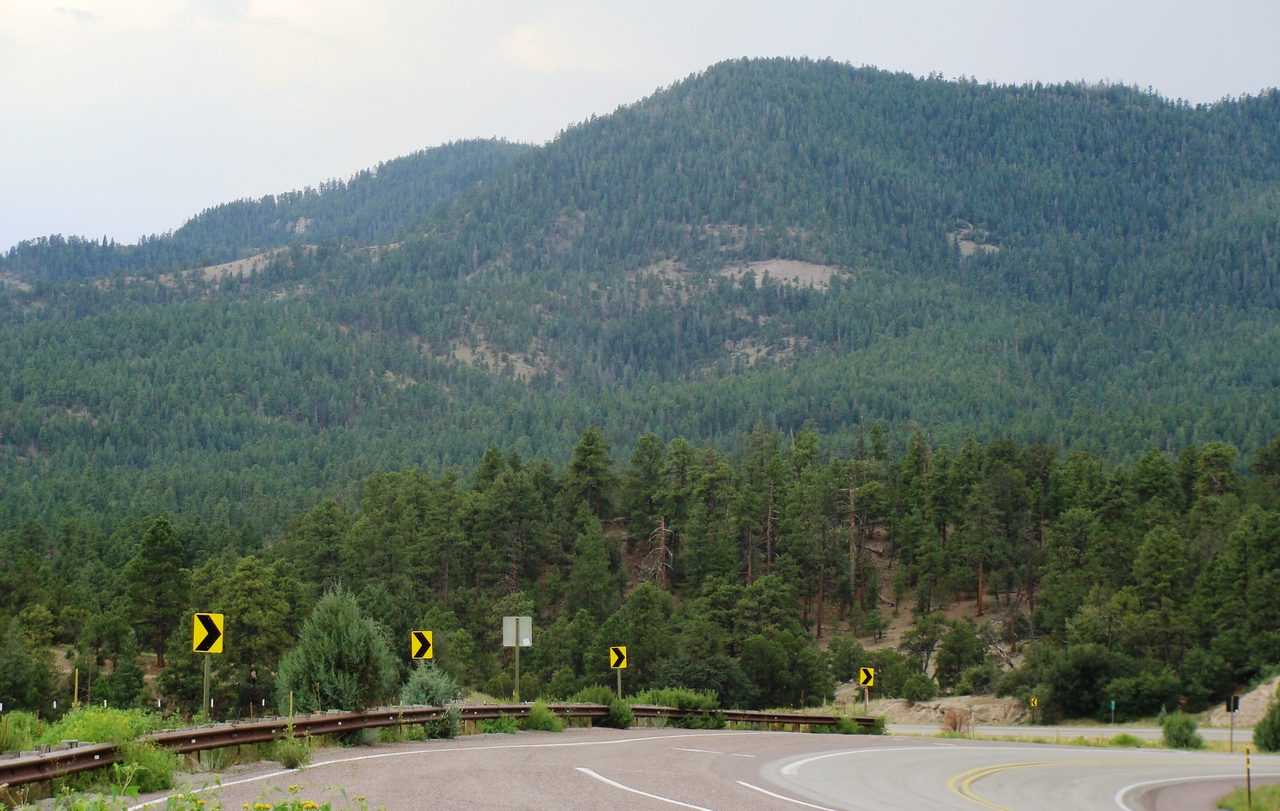
On November 5, 1975, a seven-man logging crew was working under a U.S. Forest Service contract in the Apache-Sitgreaves National Forest near Snowflake, Arizona: Mike Rogers, Allen Dalis, John Goulette, Ken Peterson, Steve Pierce, Dwayne Smith, and Travis Walton. According to the crew, as they drove out at dusk they saw a glowing disc hovering near the road. Walton left the truck and walked toward it, and was struck by a beam of light. The other six, terrified, drove off, and when they came back Walton was gone. They reported it right away. Navajo County Sheriff Marlin Gillespie organized a search. For five days there was nothing. Then, on November 10, 1975, Walton reappeared. What is documented here is not what happened to Walton but what the crew did: they reported a man vanishing, immediately, to law enforcement, and a real search followed.
08The Dueling Polygraphs
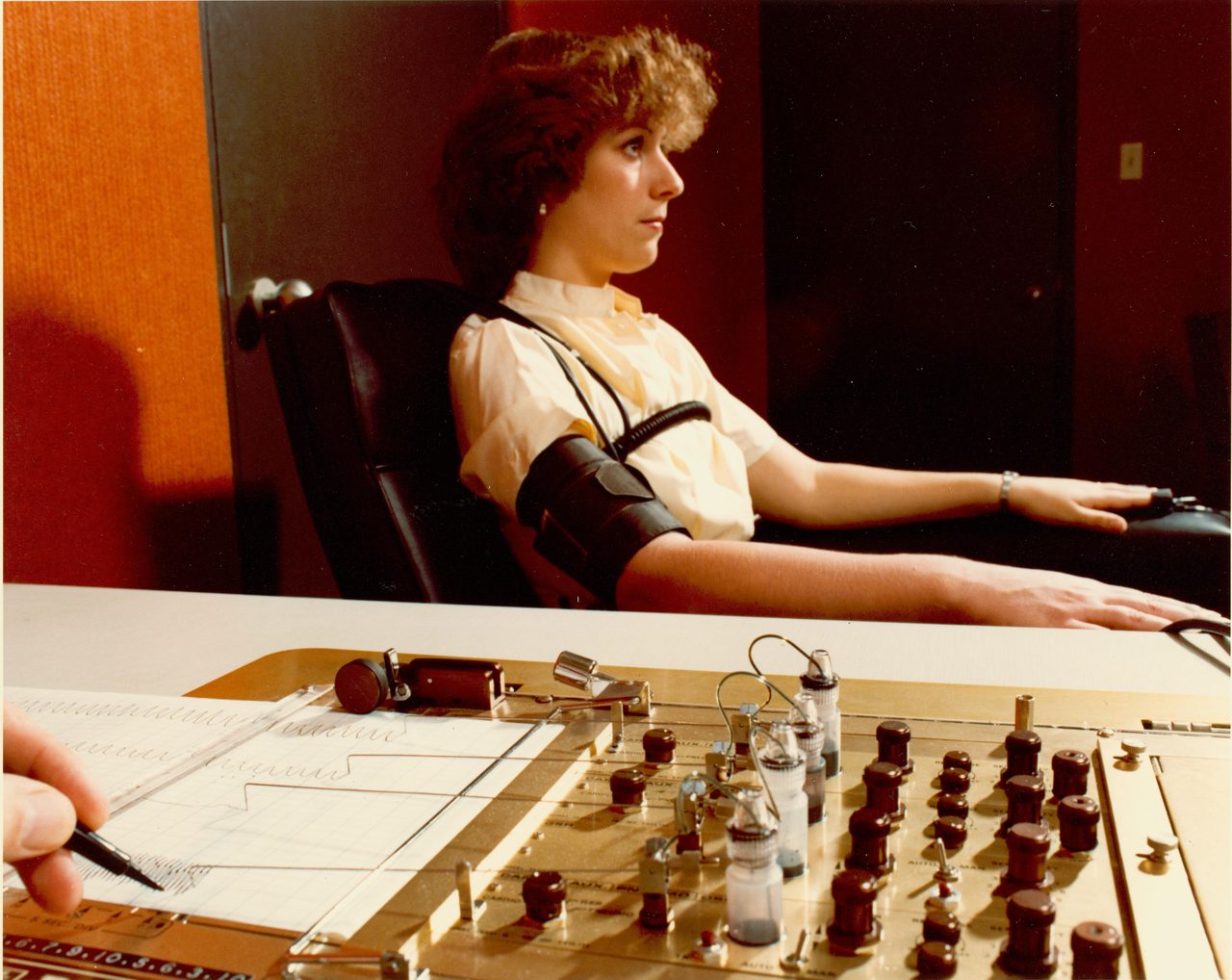
Ten days after the crew first reported it, on November 15, 1975, six of the seven men sat for polygraph examinations administered by Cy Gilson of the Arizona Department of Public Safety. All six passed. Arizona DPS records document it and the examiner confirmed it. A polygraph is not a truth detector, so this does not prove a disc carried anyone anywhere. But it does indicate something real: the six were not knowingly, deliberately lying. Whatever they believed had happened, they believed it.
Travis Walton has told the same story for about fifty years without material change, and in 2008 he passed a polygraph of his own, administered by Cy Gilson, the very examiner who had cleared the crew in 1975. To supporters, that is the core of the case: six men cleared at the time, the central witness consistent for half a century and cleared again decades later. Consistency and passed tests, they argue, are what truthful testimony looks like.
The most detailed skeptical case comes from Philip Klass, in his 1983 book UFOs: The Public Deceived, and it deserves equal weight because it is not hand-waving. Klass documented that the logging crew was behind schedule on its Forest Service contract and faced financial penalties for the delay, and he proposed that the abduction story was a hoax engineered to win a contract extension. He also surfaced a fact the crew's supporters rarely mention: Walton's first polygraph was not Gilson's. On that same day, November 15, 1975, a different examiner named John McCarthy tested Walton and judged the result deceptive, an outcome quietly set aside while the crew's six clean results were reported everywhere. A deceptive first test proves a hoax no more than the later clean tests prove an abduction. But a case that leans on 'he passed the polygraph' has to reckon honestly with the polygraph he did not pass.
Both sides of the Walton fight lean hard on polygraph charts, which raises a question worth answering before you put weight on any of them: what does one of these machines actually detect?
09What A Polygraph Actually Measures
A polygraph does not measure truth. It measures the body: skin conductance, blood pressure, breathing rate, the physiological signature of stress. The 2003 National Academy of Sciences review of the field, The Polygraph and Lie Detection, put its accuracy at roughly 80 to 90 percent for specific-incident testing, which is well above chance and well short of proof, and it named two weaknesses that matter enormously here. Trained subjects can defeat it with countermeasures. And, more to the point, a person who sincerely believes a false memory will pass without a flicker, because there is no deception for the instrument to catch. That is the quiet problem sitting under every passed test in both of these cases. A polygraph confirms sincerity, not reality, and sincerity is exactly what a false memory manufactures.
10What Hypnosis Cannot Do
One belief holds this entire genre together, and it does not survive contact with the evidence: the idea that hypnosis unlocks buried true memories. It does not. The American Medical Association said so in 1985, and the American Psychological Association has said so repeatedly. Hypnosis reliably raises a person's confidence in a memory while doing nothing to guarantee its accuracy, which means it inflates true and false memories alike. Elizabeth Loftus showed in her 1994 book The Myth of Repressed Memory that hypnotic technique can implant entirely fabricated memories that the subject then experiences as completely real. This is the load-bearing crack under both cases: the Hill abduction narrative, and much of what is popularly known about abduction accounts generally, was recovered by exactly the method the science says cannot be trusted to recover anything. [DEBUNKED]
One larger claim rides on the back of these cases and deserves a flat answer. David Jacobs, in 1998, and Budd Hopkins before him argued that abduction reports reveal a systematic alien program to breed human-alien hybrids. There is no physical evidence for it, none at all: no hybrid, no alien genetic material, no medical trace of the procedures described, nothing an independent lab can put on a bench. It is not part of the Hill or Walton files themselves, and it is Tier 4 for the simplest possible reason. Extraordinary claims still require evidence, and this one has produced none. [DEBUNKED]
11Where They Are Now
Barney Hill did not live to see how large his story would grow. He died of a cerebral hemorrhage on February 25, 1969, at the age of 46. Betty Hill lived another thirty-five years, never remarried, and became a familiar presence at UFO gatherings before her death from cancer on October 17, 2004, at the age of 85. The road they were driving that night is still there, and so is the file.
Travis Walton is alive. As of 2025 he was still giving interviews about the night he vanished, speaking with Arizona outlets like KJZZ and Fox 10 Phoenix around the fiftieth anniversary of the incident, and he still holds, exactly as he always has, that what happened to him was real. He is not a historical figure to be discussed in the past tense. He is a living man who says he was taken, and who has never once stopped saying it.
Fast Facts
- The Hill Sighting
- September 19 to 20, 1961, on Route 3 through the White Mountains of New Hampshire. Reported to Pease Air Force Base within 24 hours; Project Blue Book file 100-1-61, classified 'insufficient data,' not a hoax and not explained.
- The Hypnosis
- Roughly 50 sessions with Dr. Benjamin Simon, a respected Boston psychiatrist, February to June 1964. Dr. Simon's own conclusion was that the narrative was a fantasy begun in Betty's dreams and passed to Barney by folie a deux. His clinical judgment, not a settled fact about the night.
- The Star Map
- Betty Hill's hand-drawn map. Marjorie Fish's 1968 to 1974 models proposed a match to Zeta Reticuli (published in Astronomy, December 1974); Carl Sagan (Other Worlds, 1975) countered that almost any scatter of dots can be fit to some stars. Still unresolved.
- The Walton Incident
- November 5, 1975, near Snowflake, Arizona; a seven-man Forest Service logging crew. Travis Walton was reported struck by a beam from a hovering disc and missing for five days, reappearing November 10.
- The Polygraphs
- Walton's six coworkers passed exams by Cy Gilson (Arizona DPS) on November 15, 1975, and Walton passed a 2008 Gilson test. That same day in 1975, a different examiner, John McCarthy, judged Walton's own first test 'deceptive,' a result left unpublicized.
- Klass's Theory
- Philip Klass (1983) documented that the crew was behind schedule and facing contract penalties, and proposed the story was a hoax for a contract extension. Klass's theory, presented as his, not a proven finding.
- The Refused Claim
- That hypnotic regression recovers accurate buried memories. The AMA (1985), the APA, and Elizabeth Loftus (1994) establish that it does not, and that hypnosis can implant fully false memories a subject believes are real.
- The Primary Tier
- The research file grades the case as a whole Tier 3, speculative. The reports, the file, the sessions, and the polygraphs are Tier 1 documented events; what any of it means is the open question.
So What Actually Happened On Those Two Nights?
This much is not in doubt, and it is more than the skeptics or the believers tend to admit. The Hills reported a sighting to Pease Air Force Base within a day, and Blue Book opened file 100-1-61 and left it 'insufficient data.' Roughly fifty hypnosis sessions with Dr. Benjamin Simon happened and were recorded. Betty drew a star map that scientists still analyze. Walton's six coworkers reported him missing, a real sheriff's search followed, and six of them passed polygraphs in 1975. Every one of those is a documented event, true regardless of what actually happened to anyone. The paper trail is real.
There is a strong, non-mocking explanation for the Hill case that needs no craft. Sleep paralysis, hypnagogic imagery, and hypnosis-induced false memory can produce a vivid, sincere abduction narrative in perfectly healthy people, as Susan Clancy's Harvard work argues, and Martin Kottmeyer's catch that Barney's wraparound-eyed beings matched an Outer Limits alien aired twelve days before his first session is hard to shrug off. Dr. Benjamin Simon, the Boston psychiatrist who actually ran the sessions, reached a fantasy and folie a deux conclusion of his own. None of this is proof the Hills invented anything. It is a credible, evidence-backed route to the same experience with no aliens in it.
And here the honesty has to hold, because the file's own primary grade for the case is Tier 3, speculative. Whether Dr. Simon was right, whether Marjorie Fish's Zeta Reticuli match means anything against Carl Sagan's warning that any dots can be fit to some stars, whether the protein trace on Betty's dress or the marks on the trunk are anything at all, and whether Travis Walton, still alive and still telling it, lived through something real or something staged as Philip Klass argued: none of that is settled. The consistency of Walton's account and his passed tests pull one way; McCarthy's 'deceptive' first result and the crew's contract troubles pull the other. The evidence genuinely does not close. Anyone who tells you it does, in either direction, is adding certainty the record does not contain.
One thing does get a flat no. Hypnotic regression does not reliably recover true memories; it inflates confidence in true and false memories alike and can implant wholly fabricated ones, per the AMA, the APA, and Loftus. [DEBUNKED] So the very method that produced the most famous parts of these stories is not a trustworthy route to what happened, which is exactly why the core stays open rather than proven. And the broader claim that abduction accounts expose a hidden hybrid-breeding program has no physical evidence behind it whatsoever. [DEBUNKED]
That is the honest shape of the two cases that started it all: a mountain of documented fact built around a hole no document can fill. The Hills really did report something, and really did spend roughly fifty sessions describing it under hypnosis. Walton really did vanish for five days in front of six witnesses who passed their tests. And more than sixty years later, with the Blue Book file still reading 'insufficient data' and one of the principals still telling his story to anyone who asks, the most honest thing anyone can say is that we do not know. So here is the question these cases have been asking since 1961 and still have not answered: if a healthy human mind can build a memory this detailed, this consistent, and this sincere out of nothing but fear and a dark road, how would we ever tell that memory apart from a true one, if a true one ever came?
Sources & further reading
Everything above is drawn from our research library on Theories of Anything, which is where we worked from. The papers, reports and primary records listed beneath them are where you can check us independently.
Image credits
- The main entrance sign at Pease Air Force Base, New Hampshire (photographed 1987) photograph by Master Sgt. Dave Casey, US Air Force, via Wikimedia Commons. Public domain (work of a US Air Force airman created as part of official duties) Source.
- A mountain vista in the White Mountain National Forest, New Hampshire photograph by Bob Linsdell, via Wikimedia Commons. Creative Commons Attribution 3.0 Unported Source.
- Betty Hill's star map compared with the positions of nearby stars diagram by Wikimedia Commons user K.i.f, via Wikimedia Commons. Creative Commons Attribution-ShareAlike 3.0 Unported Source.
- Apache-Sitgreaves National Forest, Arizona photograph by Wikimedia Commons user Zereshk, via Wikimedia Commons. Dual-licensed Creative Commons Attribution-ShareAlike 3.0 Unported and GNU Free Documentation License Source.
- The administration of a polygraph examination (illustrative FBI photograph) photograph by the Federal Bureau of Investigation, via Wikimedia Commons. Public domain (work of the US federal government, 17 U.S.C. Section 105) Source.
- Card crop of The main entrance sign at Pease Air Force Base, New Hampshire (photographed 1987) photograph by Master Sgt. Dave Casey, US Air Force, via Wikimedia Commons. Public domain (work of a US Air Force airman created as part of official duties) Source.

.jpg)


