The Book of Enoch: The 200 Angels Cut From the Bible
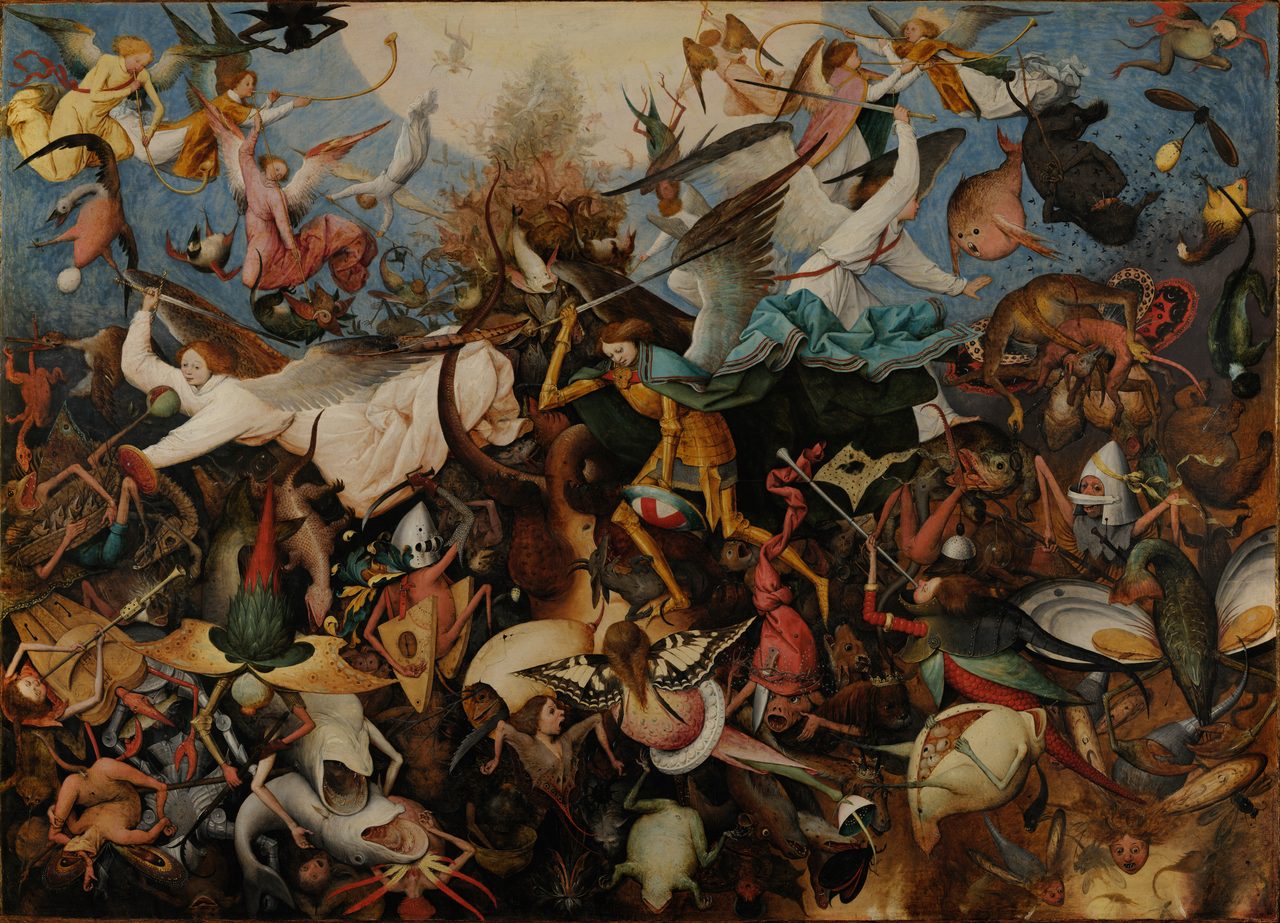
Genesis gives the fallen 'sons of God' four verses, then moves on. One ancient book stops and tells the whole story: 200 angels who came down on a named mountain, led by a named chief, with ten of them named one by one for the forbidden art each taught, the giants they fathered, and a Flood sent to undo all of it. It was cut from the Western Bible, survived only in the Ethiopian highlands, and the Dead Sea Scrolls proved it is older than Christianity. Here is the file, every claim wearing its evidence.
Open a standard Bible to Genesis chapter 6 and you get one of the strangest passages in all of scripture in almost no words at all. The 'sons of God' take human women as wives and father the Nephilim. Then the text closes the door: four verses, no names, no explanation, straight on to Noah and the Flood. There is another book that opens that door and walks all the way through it. It is old, it is real, and for most of Christian history the West did not even have it. This is the file on the Book of Enoch, opened claim by claim, every fact wearing its evidence.
01The Four Verses Genesis Left Unexplained
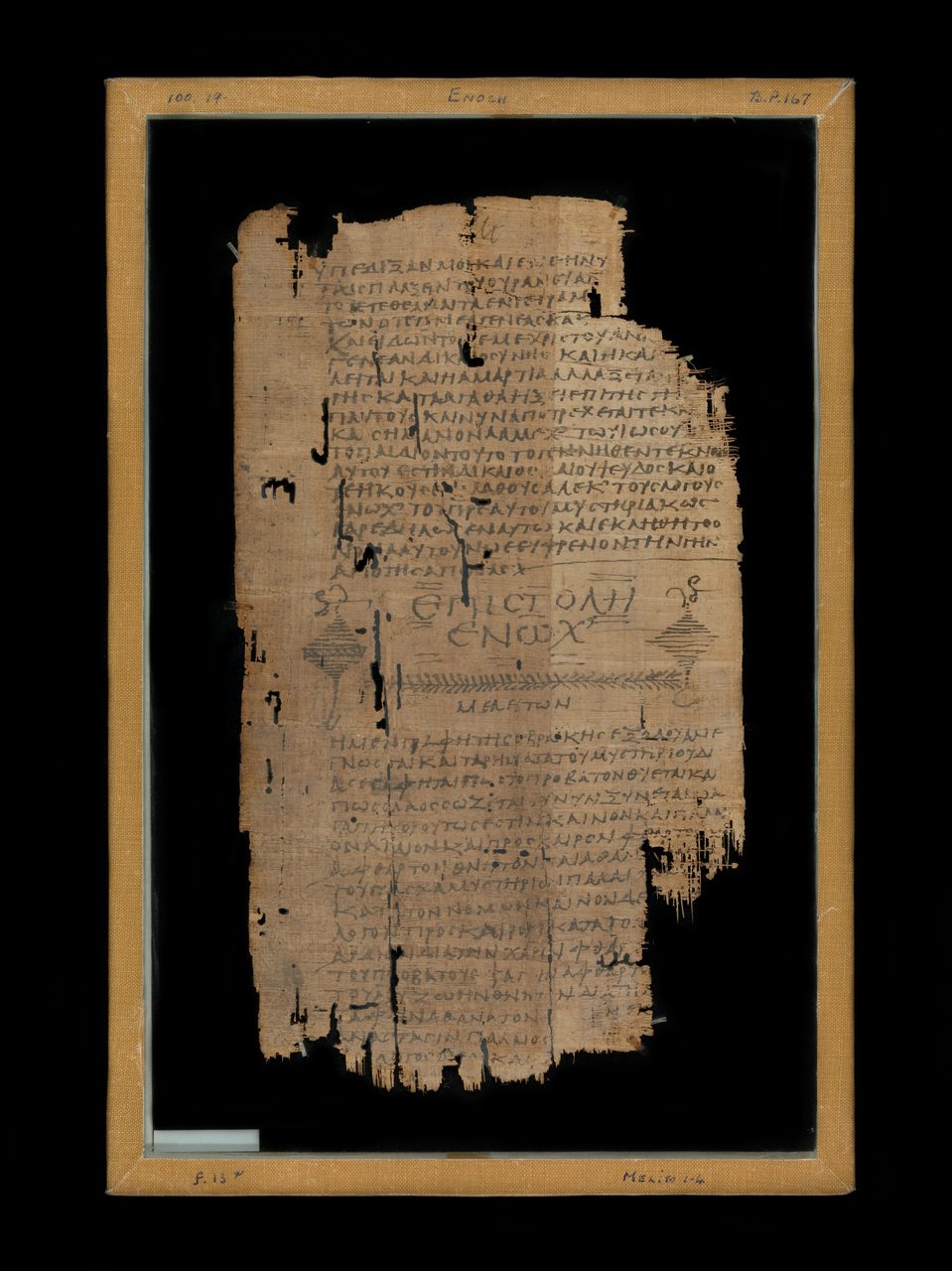
Genesis 6 gives the whole episode four terse verses about unnamed 'sons of God.' The Book of Enoch, or 1 Enoch, gives it thirty-six opening chapters: 200 Watchers on a specific mountain, led by a named chief, with ten of them named one by one alongside the specific skill each is said to have taught the human race. Where the canonical text is silent, this excluded one is exhaustive. That contrast, four verses set against a fully populated cosmology, is the whole reason the book still matters.
1 Enoch is not one book but five, bound together. Book I (chapters 1 to 36) is the Book of the Watchers, the descent and its fallout. Book II (37 to 71), the Parables or Similitudes, carries messianic visions and a figure called the 'Son of Man.' Book III (72 to 82) is the Astronomical Book, a technical manual of the heavens. Book IV (83 to 90) is the Book of Dream Visions, an allegorical history running from creation to final judgment. Book V (91 to 108) is the Epistle of Enoch, ethical exhortation. Mainstream scholarship reads the whole as a composite, stitched from several authors across several periods, with the Book of the Watchers and the Astronomical Book as the oldest layers, dated to the third century BCE or earlier.
02The Two Hundred On Mount Hermon
Chapter 6 names the crime. 200 beings the text calls Watchers, in Aramaic the 'irin, the 'wakeful ones,' also remembered as the Grigori, descend to Earth on the summit of Mount Hermon, the mountain that still stands on the modern border of Lebanon, Syria, and Israel. Their leader is Semjaza, chief of the 200, also spelled Shemyazaz or Samyaza. The text ties the name Hermon to the Hebrew root for 'cherem,' an oath or ban, marking the mutual oath the Watchers swore to go through with their plan. And the plan is simple and human: they wanted the women of Earth, and they took them as wives.
03The Catalog Of Forbidden Knowledge
What makes Enoch feel less like myth and more like a dossier is the specificity. The text does not just say the Watchers taught 'forbidden things.' It names ten of them one by one and lists exactly what each handed to humanity, leaving the rest to unnamed others.
| Watcher | What the text says he taught |
|---|---|
| Semjaza (chief of the 200) | Enchantments and root-cutting: herbalism, pharmacology, and sorcery, the pharmakeia |
| Azazel | Metalworking (swords, knives, shields, breastplates), plus cosmetics, dyeing, precious stones, and mirrors |
| Armaros | How to resolve and counter enchantments |
| Baraqiel | Astrology and astronomy |
| Kokabel | The constellations |
| Sariel (Tamiel) | The course of the moon |
| Shamsiel | The signs of the sun |
| Araqiel | The signs of the earth |
| Asael | Further teachings on metalwork |
| Penemue | Writing, ink, and 'the secrets of wisdom,' a knowledge the text treats as corrupting |
Read as a list, the curriculum falls into three groups: the technology of war (metallurgy and weapons), the arts of vanity (cosmetics, dyes, mirrors), and the knowledge of the heavens (astrology, the constellations, the celestial cycles). It is a compressed origin story for civilization itself, and the pattern is older than Israel. The same shape sits in the Sumerian tradition of the Apkallu, the Seven Sages, who brought the arts of civilization to humanity before the Flood.
There is a sober reading of all this, and it is the mainstream one. Scholars such as George Nickelsburg and James VanderKam treat the Watcher story as a Jewish theodicy: an explanation for where evil came from, told through the old literary motif of divine beings who cross a line they should not. On that reading the specific 'teachings' are not a memory of alien technology transfer. They are Second Temple Jewish anxieties about Hellenistic culture, its cosmetics, its astrology, its weapons, projected back onto the dawn of time.
04The Giants, The Demons, And The Flood
The union produces the Nephilim, and the Nephilim are a catastrophe. The text describes them as giants, one passage putting their height at 3,000 ells, though the manuscripts disagree on the number. They eat through everything the world can grow. When the food runs out they turn on the humans who made it, then on the animals, and they drink blood. 'And there was great godlessness upon the earth,' the text says, 'and it was made desolate.'
One phrase has carried an enormous amount of later speculation: the 'corruption of all flesh.' It can be read to suggest something biological, a hybridization that runs deeper than mere size. The mainstream reading pushes back hard. In Second Temple Jewish writing, argues Loren Stuckenbruck, that language points to moral and ritual corruption, not genetics, and the Nephilim function as an origin story for how wicked the pre-Flood world became, not a literal account of tampered biology.
Heaven notices. The archangels Michael, Uriel, Raphael, and Gabriel look down on the ruin and carry the report to God. The judgment comes in parts: Azazel is bound and buried in the valleys of the earth until the Day of Judgment; Semjaza and the rest of the Watchers are chained and imprisoned; the Nephilim are set against each other until they are destroyed; the Flood is sent to wash the world clean; and Enoch himself is dispatched to deliver the sentence to the Watchers.
The giants die, but the story does not let them rest. Their bodies fall in the destruction, and their spirits stay behind as the 'evil spirits' that still roam the world. In a handful of lines, the Book of Enoch writes the origin of demons and hands later Judaism and Christianity a ready-made demonology.
This reframes the Flood entirely. It is not simply a punishment for human wickedness. It is a cleanup: a sanitizing of the earth to erase what the text frames as ontological corruption, both the contamination the Nephilim embody and the civilizational chaos the Watchers let loose by handing over technology the world was not ready for. That is the context Genesis leaves out. The four verses in chapter 6 are the summary; Enoch is the full report behind them.
05Enoch's Journey And The Calendar That Split A Community
Enoch is an unusual narrator for all this, because Enoch does not die. Genesis 5:24 says only that 'Enoch walked with God; then he was no more, because God took him away.' 1 Enoch tells you where he went. In chapters 17 to 36, guided mostly by the angel Uriel, he is taken on a tour of the cosmos: the prison prepared for the Watchers, the throne of God rendered in crystal and tongues of fire and wheels, the Tree of Life, the ends of the earth, the 'portals of heaven' where the stars and winds come out, a mountain of fire, and a deep abyss.
The most technical stretch is the Astronomical Book, chapters 72 to 82, and it is stranger than its dry name. It lays out a 364-day solar calendar, exactly 52 weeks, four quarters of 91 days each, with the sun and moon passing through fixed 'gates' in the sky and the day length shifting across the year through the solstices and equinoxes. That same 364-day calendar turns up in the Dead Sea Scrolls, in Jubilees and the Temple Scroll, which means it was a live rival to the standard Jewish lunar calendar. The community at Qumran, most likely the Essenes, ran their entire religious life on Enoch's calendar.
How you read that depends on where you start. The mainstream view is that the Astronomical Book records a priestly calendar tradition, careful sky-watching by trained scribes, nothing supernatural. The other reading notes how systematic and specific it is, more than you might expect from the period, and asks the question the text itself raises: was this knowledge worked out by human observation, or was it, as the story insists, taught by the Watchers? That question is genuinely open.
06History Told As Prophecy
The fourth book, the Dream Visions of chapters 83 to 90, retells the entire span of history as a bestiary. It is called the Animal Apocalypse. Bulls stand for the patriarchs, Adam and Seth and the rest; sheep stand for Israel; wild beasts stand for the Gentile nations; fallen stars stand for the Watchers; and a white bull at the end stands for the Messiah. What matters is the shape of it: in this telling, the descent of the Watchers is not a footnote to history. It is the hinge the whole of history turns on.
The final book, the Epistle of Enoch, includes the Apocalypse of Weeks, which slices all of time into ten prophetic 'weeks.' The third week holds Noah and the Flood; the seventh is Enoch's own age of apostasy, with judgment bearing down; the tenth is the eternal judgment, a new heaven, and the moment even the angels are finally called to account. It is one of the earliest fully worked-out visions of history running on rails toward a final reckoning, and it left fingerprints all over what came after.
07Cut From The Canon
Here is the part most readers never hear. The Book of Enoch was not fringe when it was written. It was mainstream, quoted as scripture, and then, over a few centuries, deliberately left out.
The New Testament quotes it directly. Jude 1:14 and 15 lift a prophecy straight from 1 Enoch 1:9, naming 'Enoch, the seventh from Adam,' as its author. Jude 1:6 points to the Watchers, 'the angels who did not keep their positions of authority.' 2 Peter 2:4 echoes the same punishment, God casting the rebel angels down into Tartarus. Hebrews 11:5 celebrates Enoch as the man 'taken up so that he should not see death.' A book later branded apocryphal is sitting inside the canon that replaced it, quoted as prophecy.
So what happened? Enoch was widely read and deeply influential on Jewish apocalyptic thought from the third to the first centuries BCE. Early Church Fathers, Tertullian among them, argued it belonged in scripture. Then, across the fourth century, the doors closed one council at a time.
| When | What happened |
|---|---|
| 3rd to 1st centuries BCE | Widely circulated; shapes Jewish apocalyptic thought |
| 1st century CE | Quoted directly by Jude in the New Testament (Jude quotes 1 Enoch 1:9) |
| 1st to 3rd centuries CE | Cited as authoritative by Church Fathers: Tertullian, Clement of Alexandria, Origen |
| 4th century CE | Increasingly questioned; the Council of Laodicea rules out apocryphal readings |
| 367 CE | Athanasius's Easter Letter omits Enoch from its canonical list |
| 382 CE | Council of Rome, under Pope Damasus, excludes it |
| 393 CE | Council of Hippo confirms the exclusion |
| 397 CE | Council of Carthage finalizes the Western canon without Enoch |
| To this day | Still canonical scripture in the Ethiopian Orthodox Tewahedo Church |
Why cut a book the apostles quoted? Scholars point to several pressures at once, and the honest answer is that no single one settles it. The sheer detail about non-human beings teaching humanity read as dangerous to institutional control. The 364-day solar calendar collided with the established liturgical one. An organized, coordinated angelic rebellion sat awkwardly with a theology of absolute divine sovereignty. The Nephilim, half human and half angel, raised questions about their nature and salvation that no one could answer cleanly. There was even a technical objection that Enoch could not have written it, though the same charge applied to other books that made the cut. And as Christianity pulled away from Judaism, a text this deeply rooted in Jewish apocalypticism lost favor. What the mainstream account is careful to say is that this was a slow, tangled, theological and political process, not a single conspiracy to bury a secret.
08The Book Ethiopia Saved
The reason we can read it at all is a single church. The Ethiopian Orthodox Tewahedo Church is one of the oldest Christian bodies on earth, established around the fourth century CE, with its own tradition tracing back to the first, to the Ethiopian official baptized in Acts 8. 'Tewahedo' is Ge'ez for 'unified,' the mark of its Miaphysite view of Christ. Its Bible is the largest in all of Christianity: 81 books, against 66 for Protestants, 73 for Catholics, and 78 for Eastern Orthodox. Growing up largely apart from Rome and Byzantium, it kept texts that were destroyed or simply forgotten everywhere else.
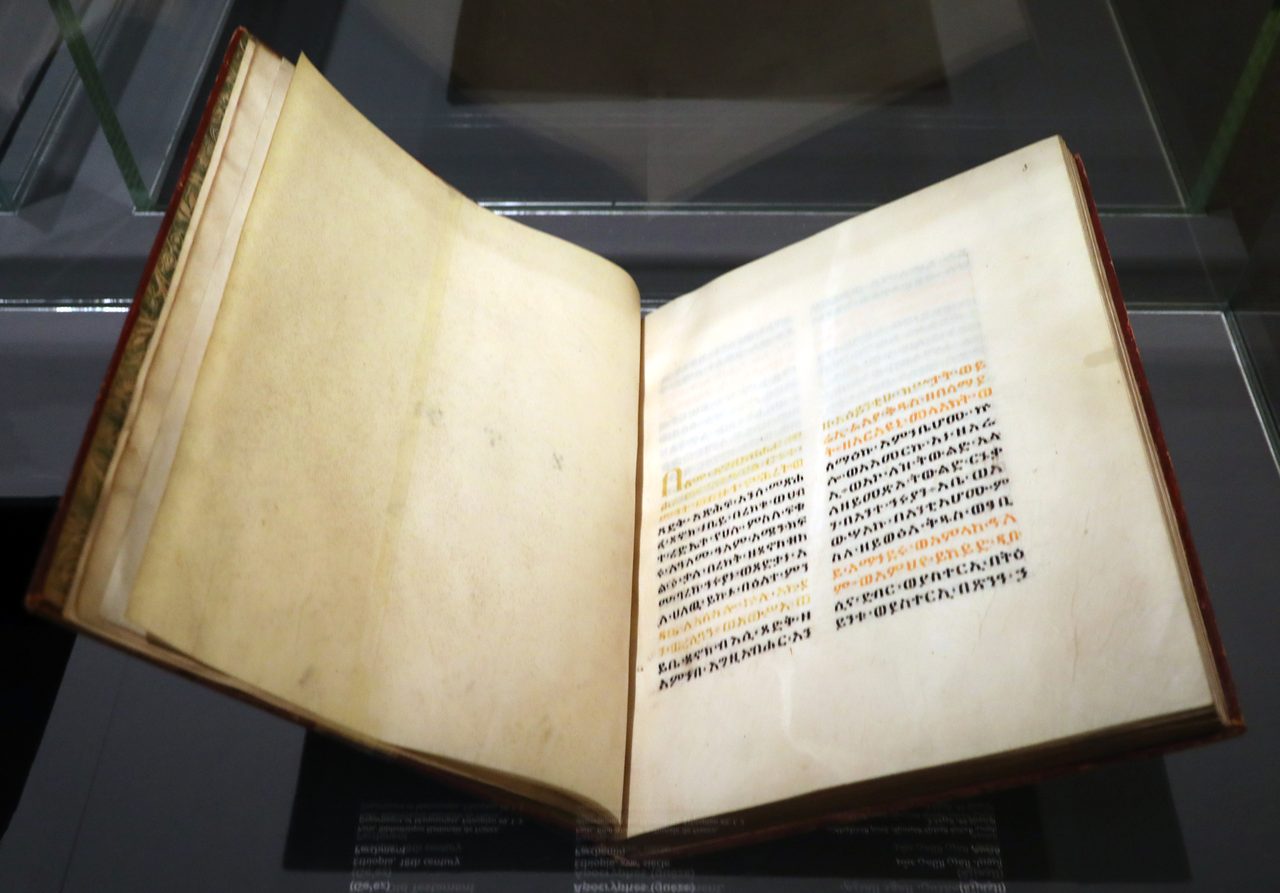
Enoch is not the only thing Ethiopia saved. The same canon preserves Jubilees, lost elsewhere; 1 and 2 Meqabyan, effectively unknown outside it; and the Kebra Nagast, Ethiopia's national epic, which the rest of the world had never heard of. A whole shelf of antiquity survived in one highland tradition because it was never told to throw it away.
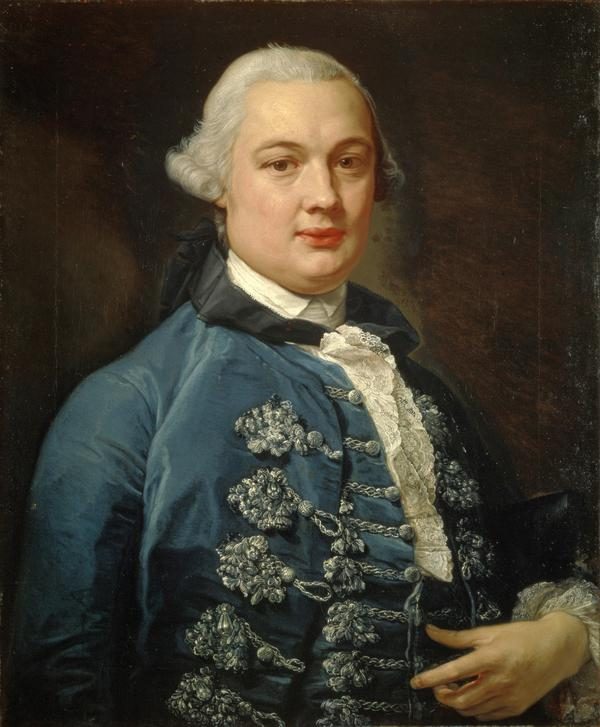
The West only got Enoch back by going to get it. In 1773 the Scottish explorer James Bruce carried three Ge'ez manuscripts of the book out of Ethiopia and into Europe. Richard Laurence published the first English translation in 1821; August Dillmann produced a critical edition in 1853; R.H. Charles assembled the standard scholarly edition around the turn of the twentieth century. The last piece landed in 1976, when J.T. Milik identified Aramaic fragments of Enoch among the Dead Sea Scrolls.
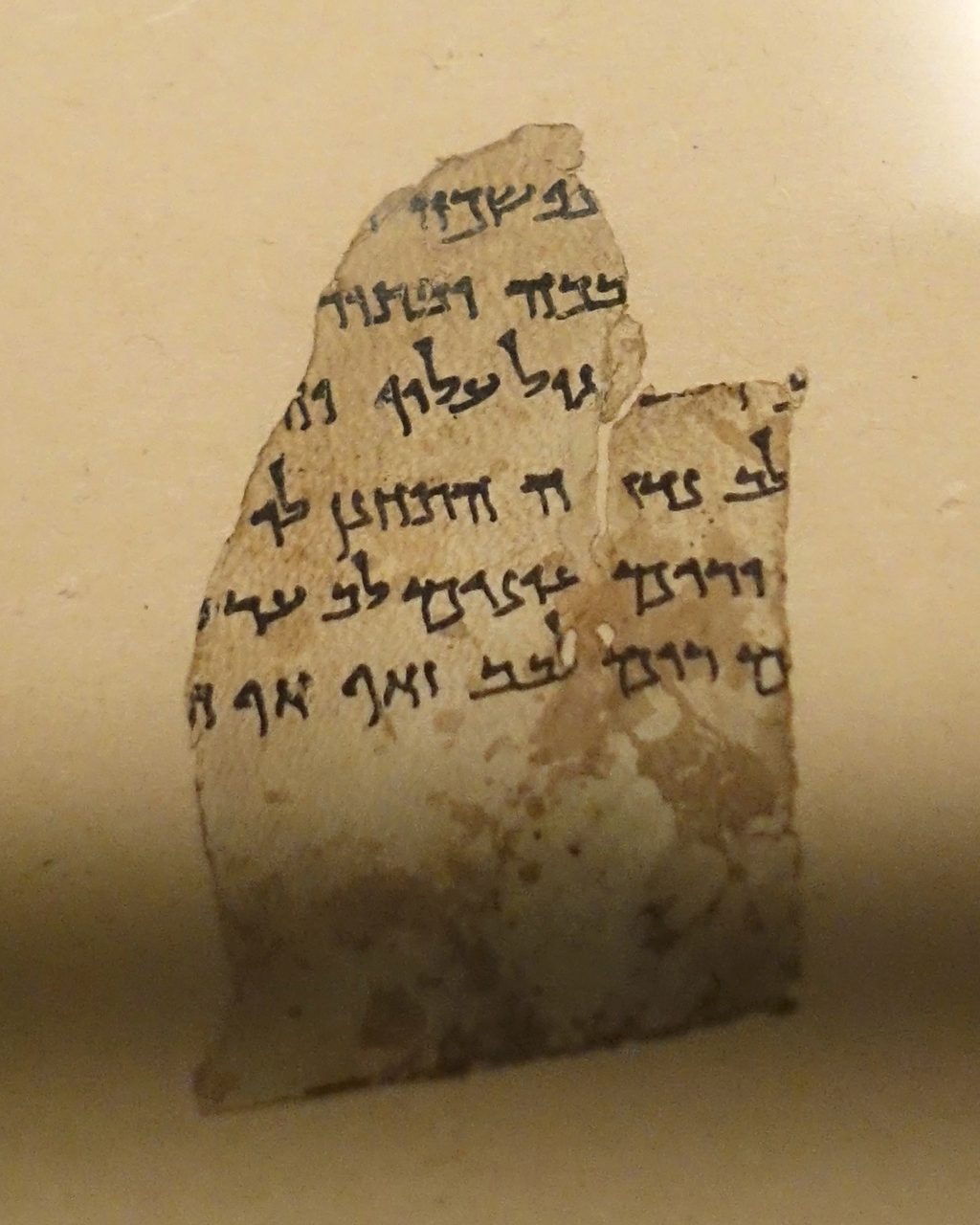
Those fragments settle the age question for good. 11 fragmentary Aramaic copies of 1 Enoch turned up at Qumran, primarily in Cave 4, dated to the third through first centuries BCE. They prove two things at once: the book is pre-Christian, older than the religion whose councils would later reject it, and it was not originally written in Ge'ez at all but in Aramaic, centuries before the Ethiopian copies. The fragments preserve the Book of the Watchers, the Astronomical Book, the Dream Visions, and the Epistle. One section is missing: the Parables, chapters 37 to 71, the very part with the 'Son of Man.' Its absence at Qumran drives a real scholarly debate over whether the Parables were added to the book later.
09Three Books Named Enoch, And The Ark In Axum
1 Enoch has relatives, and they are their own texts, not the same book. 2 Enoch, the Slavonic Enoch, survives in Old Slavonic and is dated anywhere from the first century BCE to the seventh century CE. It carries Enoch up through seven heavens, past angels who run the weather and the stars, past the rebel Watchers in torment, past Paradise and its shadow, to the throne of God, where Enoch is transformed into the angel Metatron and told to record all of creation in 360 books.
3 Enoch, the Hebrew Sepher Hekhalot, belongs to the later Merkabah 'divine chariot' mystical tradition and is dated to roughly the fifth or sixth century CE. Here the Rabbi Ishmael ascends and meets Metatron, who reveals that he was once Enoch, now the most powerful angel beneath God himself. The line of transformation runs across all three books: the man who did not die becomes, in the end, a divine being.
| Text | Language and date | What it is |
|---|---|---|
| 1 Enoch | Aramaic originals, preserved in Ge'ez; oldest parts 3rd century BCE or earlier | This article's subject: the Watchers, the Nephilim, the cosmic journeys, the calendar, the apocalypses |
| 2 Enoch | Old Slavonic; dated 1st century BCE to 7th century CE | Enoch's ascent through seven heavens; his transformation into the angel Metatron |
| 3 Enoch | Hebrew; roughly 5th to 6th century CE | Merkabah mysticism: Rabbi Ishmael meets Metatron, revealed as the transformed Enoch |
The Kebra Nagast, 'The Glory of Kings,' is the most famous of Ethiopia's rescued books. Compiled into its present form around the 14th century from far older material, it tells how the Queen of Sheba, called Makeda in Ethiopian tradition, visited King Solomon in Jerusalem; how their son, Menelik I, later came to his father and carried the Ark of the Covenant home to Ethiopia; and how the Ethiopian royal line, the Solomonic Dynasty, descends from that union.
That last claim has a physical address. The Ethiopian Church says the Ark of the Covenant sits today in the Church of Our Lady Mary of Zion in Axum, watched over by a single monk, and it has never once let an outsider in to check. The claim has never been proven and never been disproven. Whatever is or is not in that chapel, the tradition tells you exactly how Ethiopia sees itself: as the keeper of the things everyone else lost, which is precisely the role it played with the Book of Enoch.
10The Same Story, Older Than Israel
Step back from Enoch and the pattern keeps repeating. The Sumerian Apkallu, the Seven Sages, rose from the sea to teach humanity writing, law, agriculture, and architecture before the Flood. Across Mesopotamia the same arc recurs: non-human beings hand over the arts of civilization, and then a flood arrives as the correction. Zoroastrianism splits the cosmos between good and evil spiritual beings. Islam remembers Harut and Marut in the Quran, 2:102, two angels who come down to Earth and teach human beings magic, a story that sits remarkably close to the Watchers. The Apkallu parallel in particular is hard to wave away: two traditions, independently, describing a pre-Flood transfer of advanced knowledge from non-human beings, followed by catastrophic judgment. Whether that is shared memory, cultural diffusion, or the same story invented twice is debated and unresolved.
The book's reach is easier to measure than its origin. In Judaism it shaped the apocalyptic and Merkabah mystical traditions, and the Qumran community built its calendar on it, even as Rabbinic Judaism later pulled back toward a tamer angelology. In Christianity it left its mark on how angels, demons, the Fall, and the Last Judgment were understood, quoted by Jude and treated as authoritative by early Fathers, and it lives on unbroken in Ethiopia. In Islam the Harut and Marut tradition carries the same shape, even without citing Enoch by name. For a book most Christians have never opened, its fingerprints are everywhere.
11Where The Bigger Claims Come In
A book about beings who came down from the sky and taught humanity forbidden knowledge is a magnet for much larger claims. Some readings are honest speculation, clearly labeled. One is not evidence at all. Here is where the line sits.
The 'too detailed' argument. Genesis needs four verses; Enoch counts 200 beings, names ten of them for the specific art each taught, sorts those teachings into categories, and pins them to a named mountain. That density has led some to argue it reads less like invention and more like a memory of something real. It is a fair thing to notice and an unfair thing to conclude. Whether the detail is preserved memory, literary elaboration, or a record of real contact cannot be settled from the text itself. It stays a question, not an answer.
The 'ontological corruption' reading. On this view the Flood corrects not human sin but the human species: 'the corruption of all flesh' becomes literal hybridization, the biosphere itself contaminated, the Watchers' technology transfer a premature acceleration that knocked human development off its natural track, with the binding of the Watchers, the destruction of the Nephilim, and the Flood forming a three-part reset. It is a coherent story built on the text. It is also unprovable from it.
The technological reading of the journeys. Enoch's 'portals' and 'gates,' the crystal and fire and wheels of the throne, the machinery-like precision of the astronomy: a modern eye can read all of it as description of technology, the same way it reads Ezekiel's chariot. Maybe. Whether Enoch was carried on a literal journey through the heavens or the whole thing is vision and literature is, once again, something the text will not resolve.
The ancient-astronaut reading. This is the one that gets stated as fact and is not. It equates the Watchers with extraterrestrial visitors, the interbreeding with genetic engineering, the teachings with technology transfer from a spacefaring civilization. There is no textual or archaeological evidence for it over the ordinary religious and mythological readings, and it only works by forcing a modern technological lens onto authors who had no such lens. The text is not ambiguous about what its beings are: the Watchers are angelic beings from a divine hierarchy, not aliens from another world.
'Enochian magic' is a different confusion. In the 16th century John Dee and Edward Kelley claimed to receive an 'Enochian language' through angelic contact, and the magical system they built from it fed the Golden Dawn, Aleister Crowley, and modern ceremonial magic. It borrowed Enoch's name and almost nothing else. There is no scholarly link between the Dee-Kelley system and the ancient Aramaic or Ethiopian text. When someone says 'Enochian,' they may mean either one, and the two are not the same thing.
Fast Facts
- Text
- 1 Enoch, the Book of Enoch: five books bound as one, Aramaic origins preserved in Ge'ez
- Core story
- 200 Watchers descend on Mount Hermon, teach forbidden arts, and father the Nephilim
- Oldest parts
- 3rd century BCE or earlier (Book of the Watchers, Astronomical Book)
- In the New Testament
- Quoted directly by Jude; echoed in 2 Peter and Hebrews
- Cut from the canon
- Councils of Rome 382, Hippo 393, Carthage 397 CE
- Saved by
- The Ethiopian Orthodox Tewahedo Church, where it is still scripture
- Age confirmed by
- 11 Aramaic copies from Qumran, primarily Cave 4 (3rd to 1st centuries BCE)
What We Can Actually Stand Behind
The text and its history are settled. 1 Enoch is genuinely ancient, pre-Christian by the third century BCE at the latest. It was widely used in the Second Temple period, quoted directly by Jude, deliberately excluded from most biblical canons in the fourth century CE, and preserved as scripture in Ethiopia when it was lost everywhere else. The Dead Sea Scrolls confirmed its antiquity, and its influence on the New Testament is documented and disputed by no scholar. All of that is solid ground.
The cross-cultural parallel is real and unexplained. The Watchers and the Sumerian Apkallu tell the same structural story, non-human beings teaching humanity before a world-ending flood, and other traditions echo it. That the pattern recurs is a fact. What it means, shared memory, cultural diffusion, or the same human story reinvented, is honestly unresolved. And the recurrence, on its own, is not evidence that any of it literally happened.
The bigger readings stay speculative, neither ruled out nor established. That Enoch is too detailed to be pure invention; that 'the corruption of all flesh' means literal hybridization and the Flood a genetic reset; that the portals, gates, and wheels describe technology: each is a coherent story built on the text, and none can be proven or disproven from it. They are worth holding as open questions. They are not answers, and nothing in the text forces them.
The ancient-astronaut reading fails. The Watchers were not extraterrestrials. The text itself presents them as angelic beings within a divine hierarchy; no textual or archaeological evidence supports the alien reading over the religious and mythological one; and it survives only by forcing a modern technological lens onto Second Temple authors who had none. This is not a live open question. It is a modern overlay on an ancient book.
And 'Enochian magic' is not this book. The Dee-Kelley system of the 16th century borrowed the name and nothing more; it has no scholarly connection to the ancient Aramaic and Ethiopian text. Do not let the shared word fool you.
So the fullest, most specific account of the sons of God, the one book that names their chief and ten of their number, catalogs what those ten taught, and follows the wreckage all the way to the Flood, is also the one the Western Church decided not to keep. It survived only where the empire's reach ran out, in the highlands of Ethiopia, and the Dead Sea caves proved it was there before Christianity, before the councils, before anyone thought to leave it out. Strip away the alien overlay, and one honest question is still standing: when a text is this old, this detailed, and this deliberately set aside, what exactly did the people who wrote it believe they were remembering?
Sources & further reading
Everything above is drawn from our research library on Theories of Anything, and every claim traces back to the files below. Open the full file to check the sourcing and go deeper.
Image credits
- Pieter Bruegel the Elder, The Fall of the Rebel Angels (1562) painting by Pieter Bruegel the Elder (1526/1530-1569), digitized via the Google Art Project, via Wikimedia Commons. Public Domain Source.
- 18th-century Ge'ez manuscript page of the Book of Enoch photograph by Francesco Bini (Wikimedia Commons user Sailko), supported by Wikimedia CH, via Wikimedia Commons. CC BY-SA 4.0 Source.
- 4th-century Greek papyrus leaf preserving 1 Enoch 106:8-18 (Chester Beatty Library) Chester Beatty Library, Dublin (shelfmark CBL BP XII, f. 13v), via Wikimedia Commons. Public Domain Mark 1.0 Source.
- Portrait of James Bruce of Kinnaird by Pompeo Batoni, 1762 painting by Pompeo Batoni (1708-1787), National Galleries of Scotland, via Wikimedia Commons. Public Domain Mark 1.0 (artist died 1787) Source.
- Dead Sea Scroll fragment with Hebrew text, Qumran Cave IV, Oriental Institute Museum photograph by Daderot, via Wikimedia Commons. CC0 1.0 Universal Source.

,_xviii_secolo_(bnf).jpg)
.jpg)

