The Crystal Skulls: What Four Instruments Found
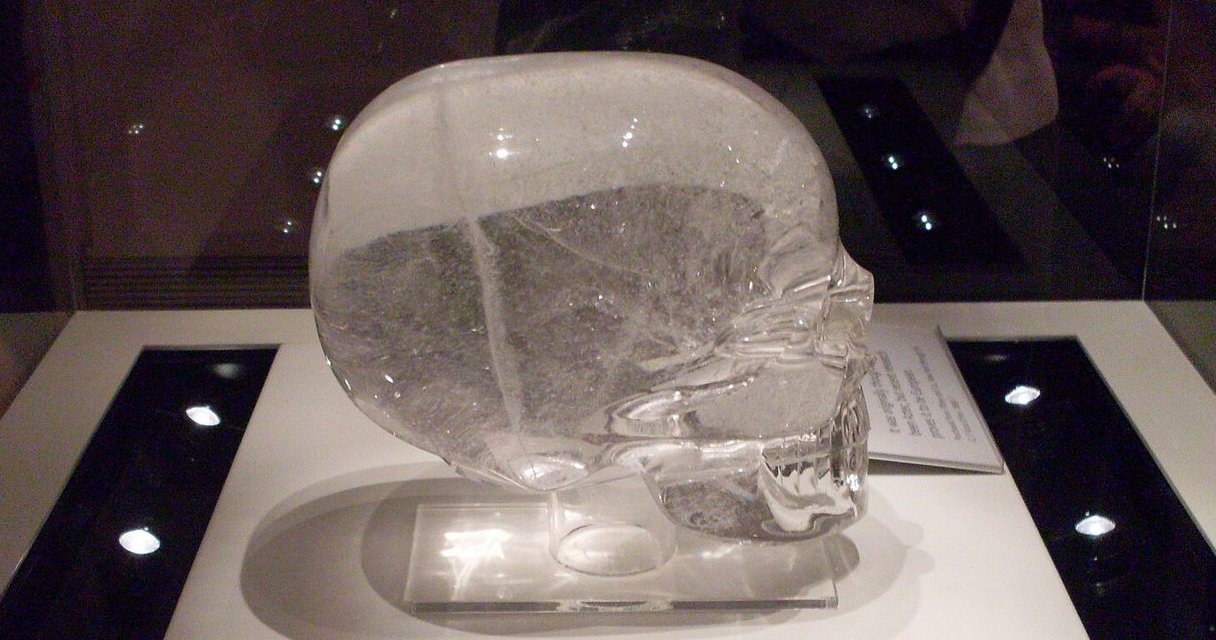
Four objects, four owners, four sets of instruments. The British Museum skull carries the striations of a rotary wheel and quartz that points to Brazil or Madagascar. The Smithsonian skull carries carborundum, a synthetic abrasive patented in 1893. The Paris skull's cut surface is younger than a reference surface cut in 1740. The Mitchell-Hedges skull first appears in a London dealer's letter in 1933. All four came back modern, and not one carver has ever been named.
Quartz keeps a record of how it was cut. A rotary lapidary wheel, meaning a wheel mounted on a spindle and spun against a workpiece held in the hand, leaves striations across a polished surface that are characteristic of it, and a scanning electron microscope can still read them a century later. Pre-Columbian Mesoamerican lapidaries had no rotary wheel. That pair of sentences is the whole case, and everything below is the detail of how it was established, what it did not settle, and why the part nobody has solved is more interesting than the part everybody argues about.
One thing has to be straightened out before the story starts, because it is the reason writing on this subject goes wrong so reliably. There is no such thing as the crystal skull. There are four separate objects that get told as one legend: a life sized skull in the British Museum, a small drilled one in Paris, the largest of them all at the Smithsonian which arrived anonymously in the post, and the famous one with the detachable jaw that has never left private hands. Different arrivals, different centuries, different instruments pointed at them, different findings. This file names which skull it means in every paragraph. If you take one habit away from it, take that one.
And here is the ending, up front, because it is not the ending you would expect. Of every crystal skull that has been put under a microscope, not one has come back ancient, and not one of the entire category has ever been recovered from an excavation. The objects are solved. The people are not. No workshop, no carver and no order for a life sized quartz skull has ever been found.
01The Marks A Rotary Wheel Leaves
Scanning electron microscopy of the British Museum skull found striations across the quartz that are characteristic of a rotary lapidary wheel: a wheel mounted on a spindle, spun, and held against a workpiece the carver turns in his hands. Pre-Columbian Mesoamerican lapidaries had no rotary wheel. The study appeared in the Journal of Archaeological Science in 2008 under five names, Margaret Sax, Jane M. Walsh, Ian Freestone, Andrew Rankin and Nigel Meeks, working between the British Museum and the Smithsonian. Two national museums investigating their own holdings together, which is worth saying out loud, because it is the opposite of the way this story usually gets told.
Pre-Columbian Mesoamerican carvers worked hard stone with stone, bone and wooden tools, possibly some copper, and loose abrasive sand. They worked mostly from relatively small water worn pebbles collected out of alluvial deposits. The Aztec and Mixtec traditions did produce skull carvings in stone, jade and crystal, and they are typically small, a few centimetres. No life sized crystal skull is known from any controlled archaeological context anywhere in the pre-Columbian Americas.
That is the hinge of the entire subject, and it is worth slowing down for. The marks on the British Museum skull are not merely modern. They are marks the workshops the object was attributed to could not have left, because they are the trace of a machine those workshops did not have. A tool mark is not a judgment about style or taste. It is the physical record of a specific motion, and the motion here is a wheel turning on a spindle.
The other half of the argument has to be stated carefully, because it is the half that goes wrong. Producing a life sized quartz skull with the polish and anatomical accuracy of the British Museum or Mitchell-Hedges pieces would have been extraordinary for any ancient culture. It is not impossible in principle, since other traditions produced remarkable quartz carvings. It is without precedent in the known Mesoamerican lapidary record, which is a different statement. George Frederick Kunz, writing in 1890 as Tiffany and Co.'s own gem expert, had already noticed that the size of the block was unusual against a tradition that worked small alluvial pebbles.
Keep those two in that order and never merge them. The first on its own is an argument from incredulity, which is exactly the reasoning this wing exists to refuse. The second is a measurement.
02Four Objects, Not One Legend
Here are the four objects this file keeps apart, each with the one feature that identifies it on sight. Three sit in national collections. The fourth, the one everybody has heard of, has been in private hands throughout its documented life.
| Object | Where It Is | The Distinguishing Feature | How It Arrived |
|---|---|---|---|
| The British Museum Skull | British Museum, London, registered Ethno 1898-1 | Life sized, no drilled hole | Boban to Tiffany and Co. at the 1886 New York auction, then to the museum in 1897 |
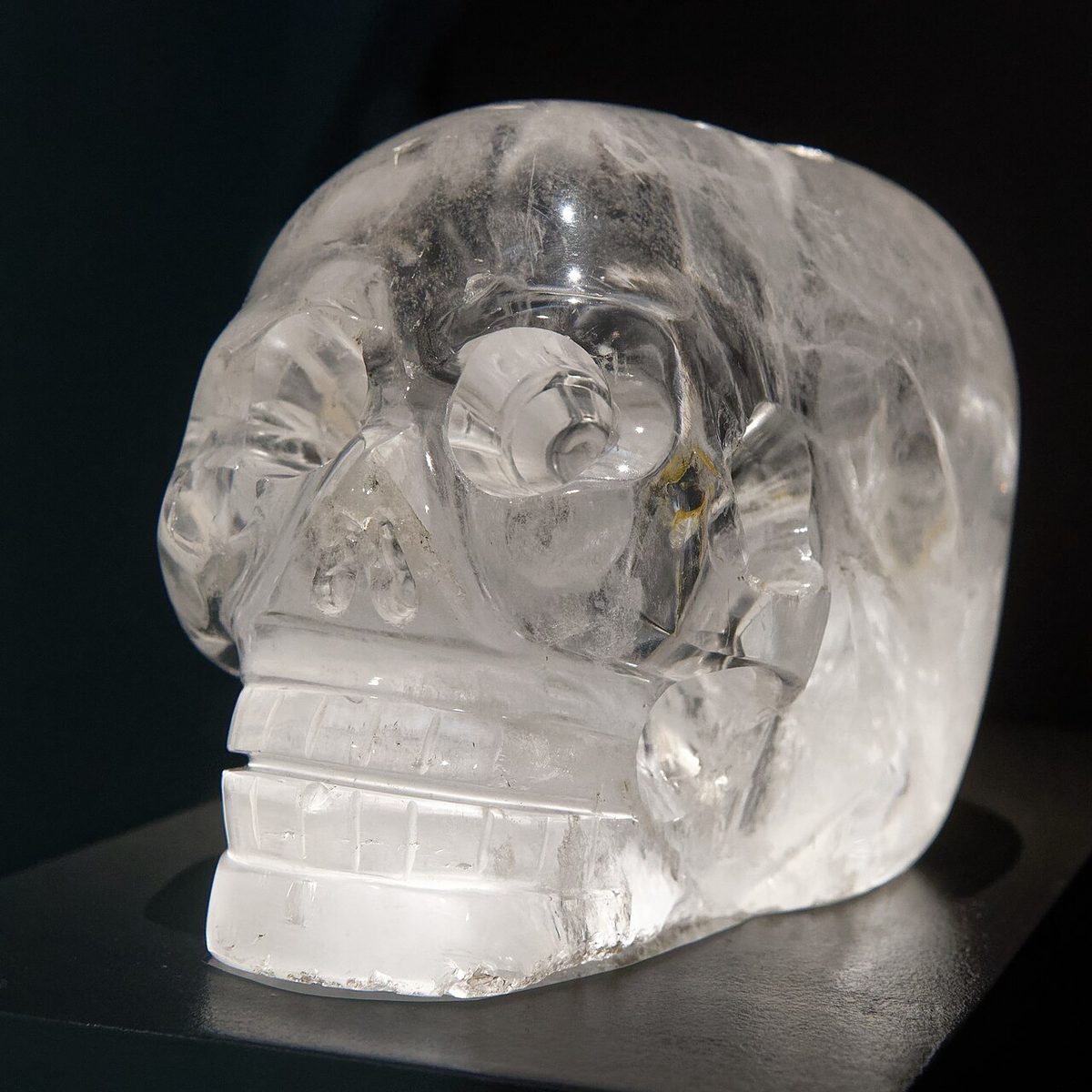
| The Paris Skull | Musee du quai Branly, inventory 71.1878.1.57 | Small, about 11 cm high, drilled through vertically | Boban to Alphonse Pinart, donated to the Trocadero in 1878 |
| The Smithsonian Skull | Smithsonian Institution, catalogue 409954 | The largest, roughly 31 pounds and close to 10 inches high | Sent anonymously in the post in 1992 with a letter |
| The Mitchell-Hedges Skull | Private hands throughout its documented life | A separate, detachable lower jaw, which no other has | With the dealer Sydney Burney in London by 1933, sold at Sotheby's in 1943 |
No crystal skull has ever been recovered from a documented, controlled archaeological excavation. Not one. Every one of them entered a museum or a collection through a dealer, a donation, an auction or an anonymous parcel. That is the quietest fact in this story and the strongest, because it holds before anybody switches on an instrument. The entire category exists only in the market.
How many are there? Nobody has an authoritative census. The research file this article was built from puts the number of major crystal skulls that have surfaced at approximately a dozen, and that is an estimate rather than an inventory. They range from pieces about an inch high to the Smithsonian's ten inch example, they enter and leave private hands constantly, and new ones keep appearing.
03Where The Stone Came From
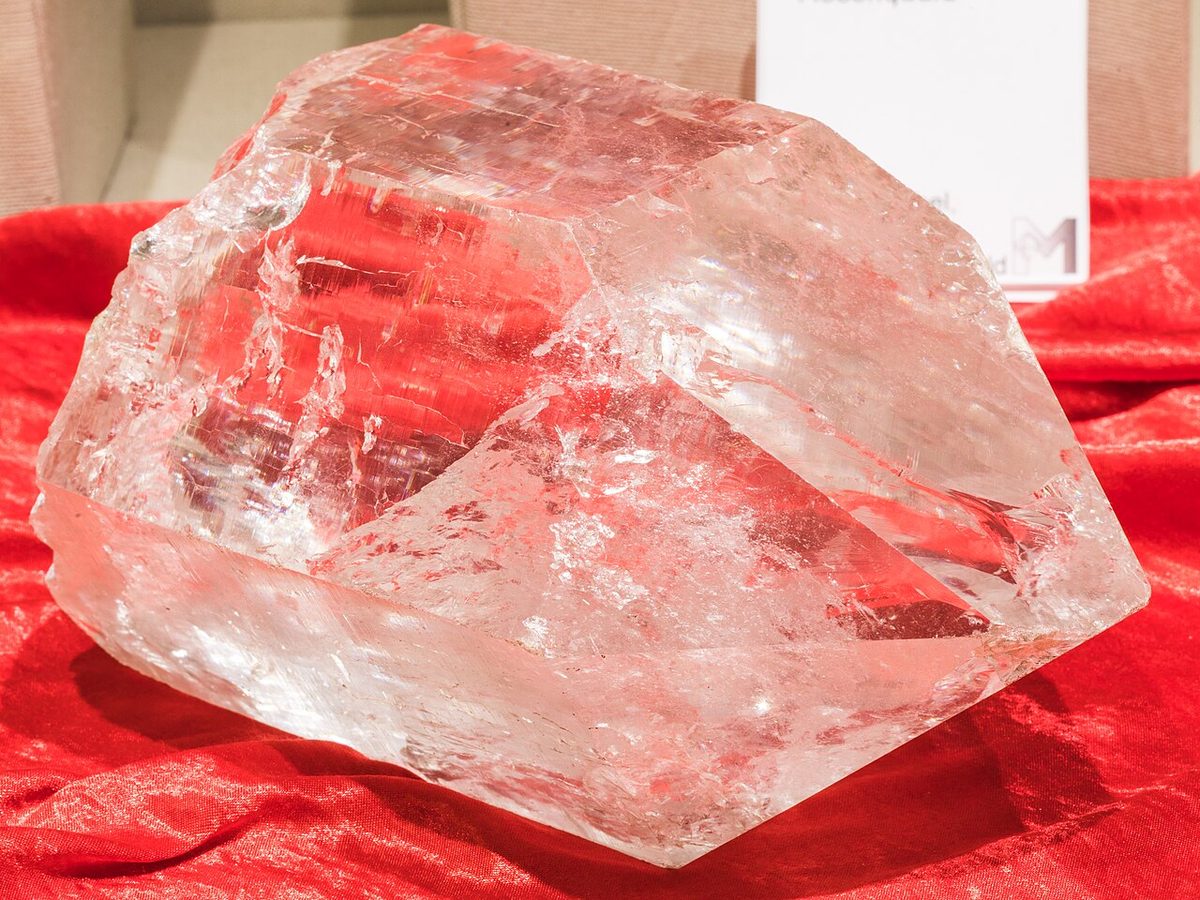
Analysis of the fluid and solid inclusions trapped inside the British Museum skull's quartz, by microscopy and Raman spectroscopy, showed that the crystal formed in a mesothermal metamorphic setting equivalent to greenschist facies. That signature points to Brazil or Madagascar as the geological source, and neither lay inside any pre-Columbian Mesoamerican trade network. Read it at exactly that strength: this is a geological inference from inclusion chemistry, not a fingerprint match to a named quarry.
Two instruments, two entirely different physical properties, one direction of answer. The tool marks say how the object was made. The inclusions say where the stone came from. Neither result leans on the other, and that independence is what makes this case unusually strong: a single line of evidence can always be argued with, and two that agree without needing each other are much harder work.
And it belongs to one skull only. The Brazil or Madagascar signature was measured on the British Museum piece. It has been attached in print to the Paris skull, which had no mineral sourcing done on it at all. That is the commonest error in accounts of this subject, and the reason this file names the object in every sentence.
04The Skull That Arrived In The Post
The Smithsonian skull was sent to the institution anonymously in 1992, accompanied by a letter claiming it was Aztec, that it had come from the collection of Porfirio Diaz, and that it had been bought in Mexico City in 1960. That 1960 purchase is what the letter asserted, not an established fact. The object is catalogued as number 409954 and it is the largest of the group, roughly 31 pounds and close to 10 inches high, which dwarfs every other skull in this story.
An object arriving in the post with no sender is the best single picture of how this trade works, and it needs no embellishment from anybody. Somebody wanted the skull to be in a national collection and did not want to be asked where it came from.
Traces of carborundum, silicon carbide, were detected on the Smithsonian skull. Note which instrument did which job, because the two are constantly confused: the electron microscope showed the shape of the marks, and X-ray diffraction identified the substance left in them. Silicon carbide does not occur in usable quantity in nature. It is a synthetic industrial abrasive, so its presence on a worked surface means that surface was worked after silicon carbide existed.
Which was not very long ago. Edward Goodrich Acheson was granted United States patent 492,767, 'Production of Artificial Crystalline Carbonaceous Materials', on 28 February 1893, and founded the Carborundum Company the following year. The abrasive was patented in 1893 and in commercial production from the mid 1890s. That is a floor under the Smithsonian skull's surface and nothing more: a floor is not a date of manufacture.
The researchers put the object a good deal later than the floor. The carborundum, together with evidence of a high speed rotary tool carrying a hard abrasive, has been read as indicating manufacture in the 1950s or later. That figure is stated here as theirs and not as this file's own: it is a reported conclusion from a paper this file did not read in full, and it is flagged as such in the sources note. The claim that needs no hedge at all is the simple one underneath it. The abrasive is modern, therefore the object is modern.
Set that beside the letter. It said Aztec, and it said the skull had been bought in Mexico City in 1960. If the researchers' reading is right, the object may have been cut within a few years of the date its anonymous donor gave for buying it. The provenance and the surface are telling stories centuries apart, and only one of them is a measurement.
05The Paris Skull, And The Object The Tests Cleared
The rock crystal skull in the Musee du quai Branly, inventory number 71.1878.1.57, is a different object with a different study behind it. A French team examined it using optical and scanning electron microscopy together with elastic recoil detection analysis, an ion beam method that measures how deeply hydrogen has penetrated a quartz surface over time. The tool marks show the skull was cut from a block using machine lapidary techniques unavailable to pre-Columbian artisans. The shallow hydrogen penetration shows it was cut more recently than a reference quartz surface cut in 1740. The team concluded that it is probably not pre-Columbian and was carved in the eighteenth or nineteenth century. The paper is Calligaro and colleagues, in Applied Physics A in 2009.
The hydrogen method deserves a sentence of its own, because it is a lovely piece of thinking. A freshly cut quartz surface begins taking up water from the air, and the hydrogen creeps inward slowly enough to be useful: measure how far it has got, compare that against a surface whose cutting date is known, and you have a rough clock that starts when the carver's wheel stopped rather than when the crystal grew.
And then the detail that decides whether any of this can be trusted. The same French study examined a second quai Branly object, a smaller anthropomorphic head in rock crystal, and reached the opposite conclusion about it: its surfaces were more likely carved and polished by hand, with techniques comparable to ancient ones. Not proved ancient, which the paper does not say and this file will not add. More likely hand worked, which is a statement about technique. Same team, same session, same instruments, two objects, two different verdicts. The instruments did not condemn everything put in front of them, and that is precisely what a test is for.
| Method | The Question It Answers | The Object | What It Found |
|---|---|---|---|
| Scanning Electron Microscopy | What shape are the marks on the surface | The British Museum skull | Striations characteristic of a rotary lapidary wheel |
| Inclusion Microscopy And Raman Spectroscopy | Where did the stone itself come from | The British Museum skull | A mesothermal metamorphic signature pointing to Brazil or Madagascar |
| X-Ray Diffraction | What substance was left in the marks | The Smithsonian skull | Carborundum, a synthetic abrasive patented in 1893 |
| Ion Beam Hydrogen Profiling | How long ago was this surface cut | The Paris skull | More recent than a reference surface cut in 1740 |
| Silicone Moulds And Microscopy | What cut a surface you are not allowed to remove | The Mitchell-Hedges skull | High speed, modern, diamond coated lapidary tools |
Stand back and the shape of the record is this. Three separate objects in three separate national collections were examined by three separate teams using different instruments, and all three came back modern: the British Museum skull by electron microscopy and inclusion analysis, the Smithsonian skull by microscopy and X-ray diffraction, the Paris skull by microscopy and ion beam hydrogen profiling. The Mitchell-Hedges skull was examined separately, with silicone moulds and microscopy, and came back modern too. What none of this work established is who carved any of them.
06The Man Who Sold Them
Eugene Boban, 1834 to 1908, was a French antiquarian who lived in Mexico from the 1850s to 1869, learned Spanish and Nahuatl, and built a collection of several thousand pre-Columbian artefacts. He opened a shop in Paris called Antiquites Mexicaines a few months after returning in 1869. He went back to Mexico City in February 1885 and opened a four hall museum he called the Museo Cientifico. He left abruptly for New York in March 1886, auctioned his entire collection and library there that December, sold his Mexican archaeological collection to Eugene Goupil in 1888 and became Goupil's curator, and went on selling artefacts until his death.
He is not a cartoon forger and this file will not draw him as one. He was a genuine scholar of Mexican antiquities who published catalogue work on the Goupil collection, and he also wrote about the trade in faked Mexican antiquities himself. A man who knows exactly how the counterfeiting works is an interesting character, not a simple one.
Three of the crystal skulls now in major museums passed through Boban's hands. Two reached the Trocadero in Paris in 1878 through Alphonse Pinart and are still in the Musee du quai Branly. The third was sold at Boban's New York auction in 1886, bought by Tiffany and Co., and sold on to the British Museum. The Smithsonian skull is not one of his: it arrived more than a century later from an anonymous sender and must never be attributed to him.
The Paris skull reached a public museum before either of the others, and the route it took is the mechanism this whole article is about. Boban sold it to Alphonse Pinart, a young French explorer. Pinart donated his collection to the Museum of Ethnography at the Trocadero in 1878. Accounts of that gift name three crystal skulls; two are the objects still in the museum. The museum did not acquire it from a dealer; it acquired it from an explorer. That is how a dealer's stock picks up a traveller's provenance on its way into a national collection. The object measures 11.3 cm high by 10.9 cm wide and has a hole drilled vertically through it.
| Year | What Is Documented |
|---|---|
| 1881 | Boban offers the skull in Paris for 3,500 francs |
| 1885 | He takes his collection to Mexico City and exhibits it in his own Museo Cientifico |
| 1886 | He moves to New York and auctions the collection; Tiffany and Co. buys the skull |
| 1897 | Tiffany and Co. sells it on to the British Museum |
| 1898 | The museum registers it, which is why the number reads Ethno 1898-1 |
The British Museum skull's route is documented end to end, which is unusual for anything in this story. Boban offered it in Paris in 1881 for 3,500 francs, took it to Mexico City in 1885 and exhibited it in his own Museo Cientifico, moved to New York in 1886 and put his collection to auction, where Tiffany and Co. bought the skull. Tiffany's sold it on to the British Museum about a decade later, in 1897, and the museum registered it in 1898. The transaction went through George Frederick Kunz, Tiffany's gem expert, who is named on the museum's own label. Both dates you will see quoted are right: bought in 1897, registered the following year.
What Tiffany and Co. paid is genuinely disputed, and this file will not pick a number for the sake of a tidy sentence. Walsh's 2008 article in Archaeology gives 950 dollars; her 2013 account with David Hunt gives one thousand dollars. Two published accounts by the same lead author, five years apart. The detail that is not in dispute is the better one anyway: Tiffany's sold the skull on to the British Museum for the same sum it had paid for it.
The British Museum now displays the object as a nineteenth century one. Two visitors photographed the case years apart and transcribed its gallery label the same way: 'Rock crystal skull. Late 19th century AD. Purchased from Tiffany and Co., New York through Mr G.F. Kunz Ethno 1898-1'. A label photographed in a different year reads differently: 'It was originally thought to have been Aztec, but recent research proves it to be European.' Those readings come from independent visitor transcriptions of the gallery label rather than from the museum's own catalogue page, and this file attributes them accordingly. Even at that strength it is remarkable. The museum convicts its own object, in its own gallery, on the card beside the case.
07Nobody Hid Anything
The manufacture and sale of fake Mexican antiquities was being reported in the scientific press while it was happening. William Henry Holmes of the Smithsonian published 'The Trade in Spurious Mexican Antiquities' in Science in 1886, the same year Boban's collection went to auction in New York, and returned to the subject in a further note in the same volume.
Hold that against the frame this subject usually arrives in. There was no century of suppression and no buried truth waiting for a brave outsider. A Smithsonian archaeologist published a warning about the trade, under a title that says exactly what it is about, in the year of the auction. The market did not care and museums bought anyway, which is a far more interesting fact about people than a conspiracy would have been.
Carving a human skull out of rock crystal was not a new idea in nineteenth century Europe either. The Louvre holds one, inventory MR 327, catalogued as German work of the second half of the sixteenth century, a date the museum's own record prints with a question mark, and recorded as having entered the French royal collection before 1791. That is a European craftsman carving a skull in quartz three hundred years before anybody called one Aztec. It is not a claim that the Louvre skull is connected to the Mexican ones. No evidence of any such link exists and none is asserted here. It is a claim about genre: the object was familiar in Europe long before the label was.
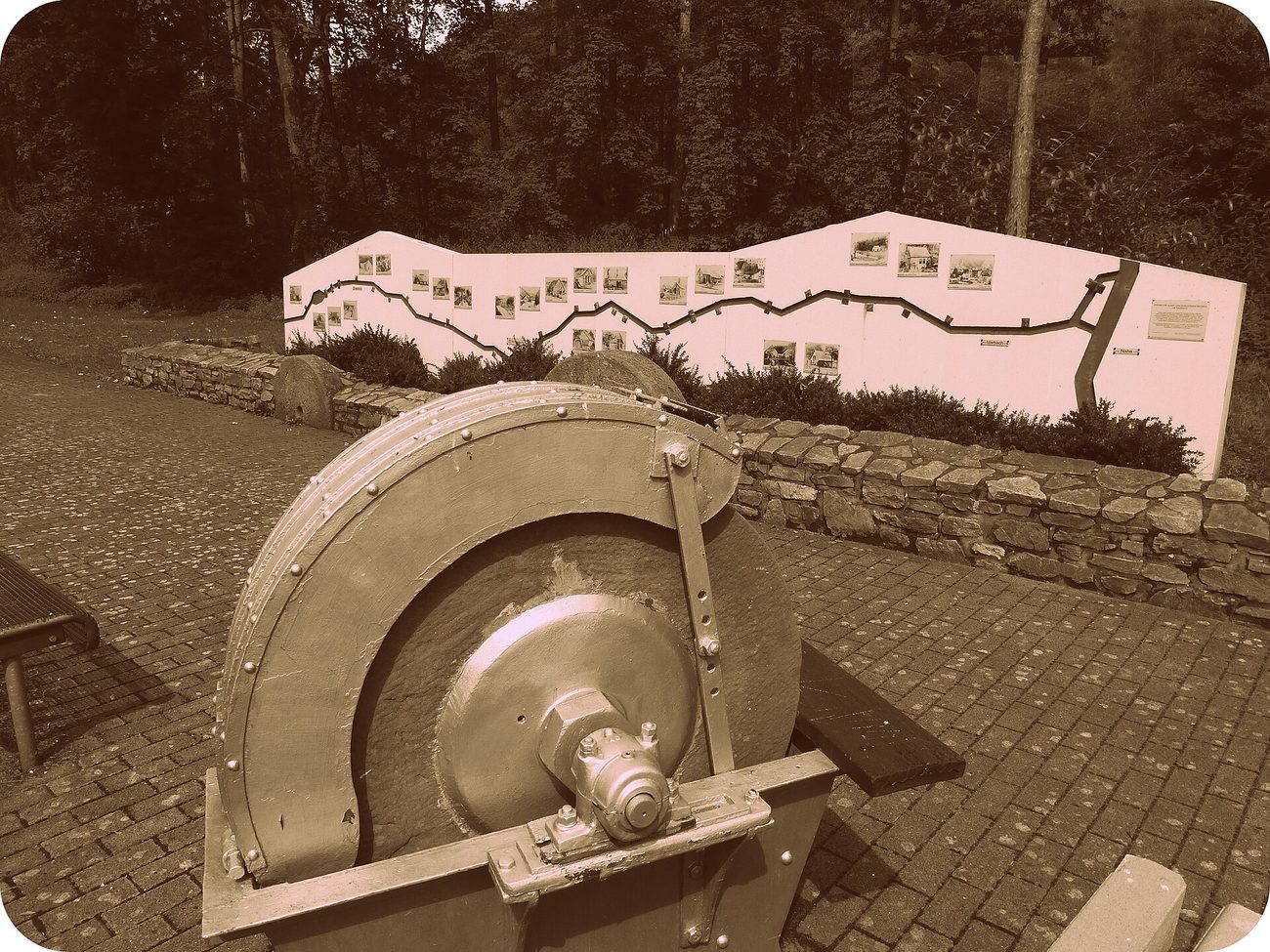
So where were they cut? The skulls were most probably carved in nineteenth century Europe, and the workshops usually named are those of Idar-Oberstein in the German Rhineland, then the world's leading centre for cutting quartz and other hard stones, and a place that worked imported Brazilian material in quantity. Read that at its own strength and no higher. It is an inference from the tool marks, the stone's likely source and the trade routes of the period. It is not a documented attribution. No workshop record, no order book and no maker has ever been identified. The continent and the century are strongly supported; the town is circumstantial.
08Curators Arguing In Print, 1936
In 1936 the journal Man carried a four part exchange about two crystal skulls, prompted by Sydney Burney bringing his skull to the British Museum. G.M. Morant published 'A Morphological Comparison of Two Crystal Skulls'. Adrian Digby, a British Museum curator, published comments on it. Morant replied to Digby. H.J. Braunholtz, the museum's Keeper of Ethnography, added further comments. The two skulls being compared were the British Museum's own and Burney's, the object the world would later know as the Mitchell-Hedges skull.
Long before anybody put a crystal skull under an electron microscope, the argument was running in print, inside the institution that owned one of the two objects, between named curators who signed their doubts. They had no instrument that could settle it. They had morphology, judgment and a journal, and they used all three in public. The doubt did not arrive from outside the museums decades later. It started in the building.
09A Letter In 1933, A Catalogue In 1943
The Mitchell-Hedges skull's documented history begins in London in 1933, in the hands of the art dealer Sydney Burney. In February of that year Burney wrote to the director of the American Museum of Natural History: 'I have just acquired a life-size rock crystal skull with separate jaw, from Mexico.' He kept it for a decade and sold it at Sotheby's in London on 15 October 1943 to Frederick A. Mitchell-Hedges for 400 pounds. The Sotheby's catalogue lists it as lot 54 and describes it as 'A superb life-size crystal Carving of a Human Skull, the lower jaw separate.'
That catalogue page survives. It has been scanned and published, and it is the document that does the work here: a printed page, on a named date, giving a lot number and a description that matches the object exactly. It places the most famous crystal skull in the world in a London saleroom rather than under an altar in Belize.
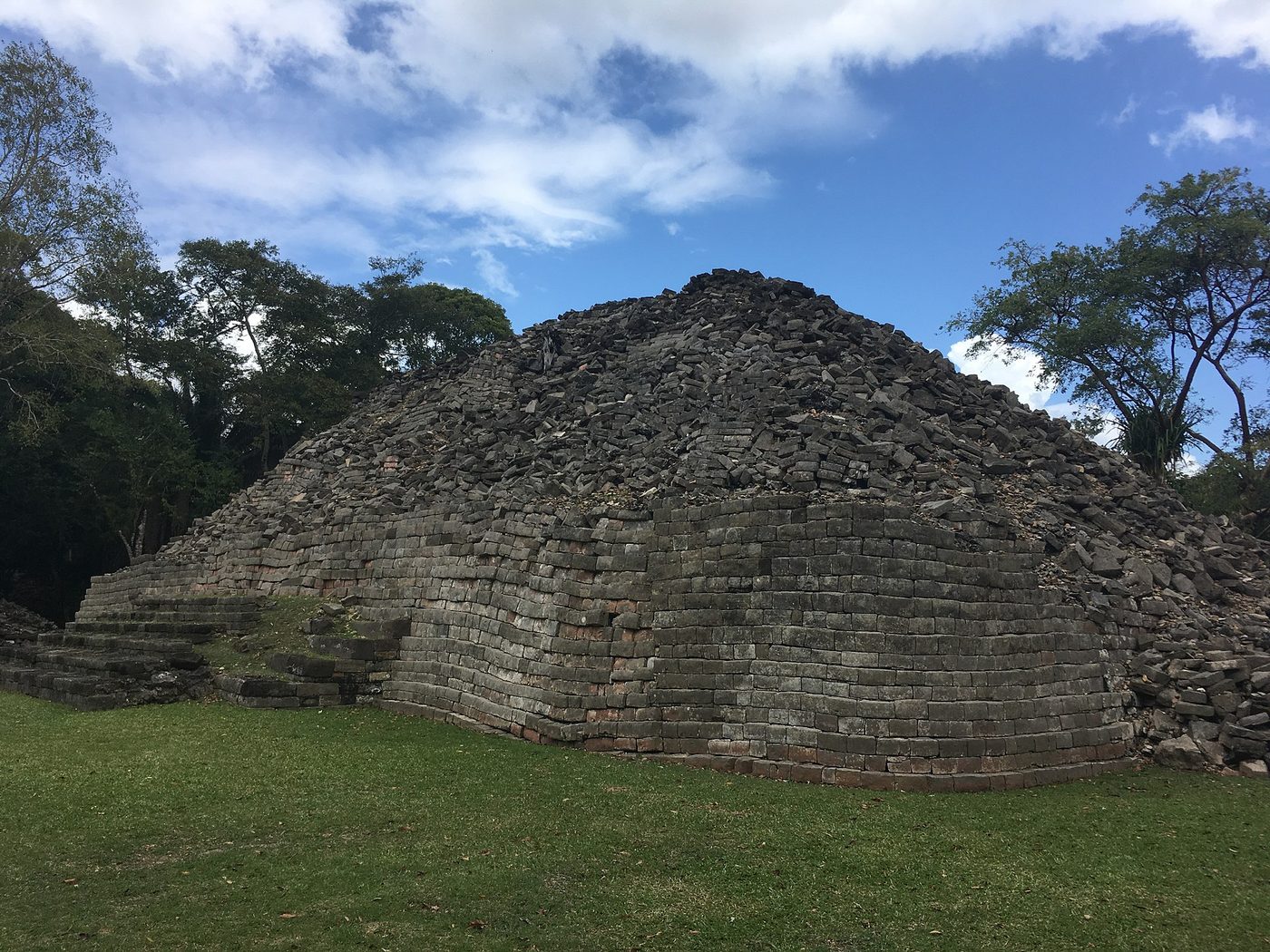
The skull was analysed far later and far less than the museum pieces, because its owners restricted scientific access. It stayed with Frederick Mitchell-Hedges until his death in 1959, and with his adopted daughter Anna until her death in April 2007. The examinations described in the next section followed. Those are the dates, laid out in order; this file draws no conclusion about anybody's motive from them, because no source behind it supports one.
10A Discovery Story That Begins In 1964
The famous origin story is not merely uncorroborated. It is dated. Jane MacLaren Walsh, who worked through the documentary record, states that Anna Mitchell-Hedges's account of finding the skull under an altar at Lubaantun was her own invention, beginning in 1964, as part of what Walsh calls a joint promotion. F.A. Mitchell-Hedges himself told a different story, placing the find somewhere in Central America in the 1930s. Walsh's verdict on the pair of accounts is flat: 'Neither of their contradictory accounts is true.'
Read those dates in sequence, because the sequence is the argument. The skull appears in a dealer's letter in 1933. It is sold at auction in London in 1943. The altar story starts in 1964, twenty one years after the auction, and the man who supposedly found it told it differently. That is not a story lacking corroboration. It is two people telling incompatible stories about an object that was already on the market.
| Date | What Is Documented |
|---|---|
| February 1933 | Sydney Burney writes that he has just acquired a life size rock crystal skull with a separate jaw |
| 15 October 1943 | Lot 54 at Sotheby's in London, bought by F.A. Mitchell-Hedges for 400 pounds |
| 1959 | F.A. Mitchell-Hedges dies; the skull stays with his adopted daughter Anna |
| 1964 | Anna's account of finding it under an altar at Lubaantun begins |
| April 2007 | Anna dies |
| May 2010 | Walsh publishes what the silicone moulds and the microscopes showed |
Walsh examined the Mitchell-Hedges skull on two occasions, taking silicone moulds of its carved and polished surfaces and studying those moulds under high power light and scanning electron microscopes. That is how you study a surface you are not permitted to take away. Her conclusion, published in Archaeology in May 2010, is that the skull is not a Maya artefact and was carved with high speed, modern, diamond coated lapidary tools. Access was restricted for most of a lifetime; once it was given, the answer arrived quickly.
And the finding that ought to be better known than the legend it replaces. The Mitchell-Hedges skull is almost exactly the same shape as the British Museum skull. Walsh describes it as a veritable copy of the British Museum specimen, and as 'an improved version' of it, most likely carved in Europe between 1900 and the early 1930s. Its one distinguishing feature is the separate, detachable lower jaw, which no other skull in this story has.
11What The Skulls Are Said To Do
The claim that some crystal skulls are genuinely ancient, predating the nineteenth century pieces and representing a lost tradition of crystal carving, has no scientific support. Every skull subjected to rigorous analysis has shown either modern tool marks or an untraceable provenance, and usually both. This sits at Tier 3 rather than Tier 4 for one honest reason: unexamined objects exist, and nobody can say what a skull nobody has tested would show. What can be said flatly is that of the skulls that have been examined, none has come back ancient, and that the category has no excavated example at all.
The story that thirteen crystal skulls exist and must be reunited to avert or fulfil a prophecy is a modern legend, and it is refused here as history. It has no basis in any pre-Columbian source. No Maya or Aztec text refers to it. It does not correspond to any inventory of actual objects. Refusing it as history is not the same as denying that people hold it, which many sincerely do, and those two statements have to stay apart or the result is either sneering or credulity.
The belief is itself a real subject and has been studied as one. Joseph P. Laycock's 'The Controversial History of the Crystal Skulls: A Case Study in Interpretive Drift' appeared in the peer reviewed journal Material Religion in 2015 and traces how the meaning attached to these objects shifted over time. Pointing a curious reader at that literature is more useful, and considerably more respectful, than mockery.
Claims that crystal skulls heal, amplify psychic ability, carry encoded messages from a lost civilisation, were left behind by Atlanteans or extraterrestrials, or connect to a 2012 Maya prophecy have no evidential basis. Quartz has well understood optical and piezoelectric properties and nothing beyond them. Piezoelectric means the crystal generates a small voltage when it is squeezed, which is why a sliver of quartz keeps time in a wristwatch. That is the whole of the physics, and it is a very long way from a channel.
The legend reached a wide audience through popular books, of which the best known is Richard M. Garvin's The Crystal Skull, published by Doubleday in 1973. Its subtitle runs: 'The story of the mystery, myth, and magic of the Mitchell-Hedges crystal skull discovered in a lost Mayan city during a search for Atlantis.' That closing phrase is the entire genre in eleven words, printed on a mass market book by a major publisher. On the other side of the argument, Joe Nickell's 'Riddle of the Crystal Skulls', in Skeptical Inquirer volume 30 number 4 for July and August 2006, is a widely cited sceptical survey that appeared two years before the museum studies did.
So the refusal, stated without softening. No crystal skull has been authenticated as a genuine pre-Columbian artefact by any museum, archaeological institution or peer reviewed study. The Aztec and Maya attributions attached to these objects were sales descriptions, and every physical test applied to them has contradicted the attribution. Note the wording, because it is deliberate. Not 'no skull has yet been authenticated', which politely holds a door open. The attributions were what an object needed in order to be worth buying.
12The Fourth Skull
In 1887 Boban sold the Army Medical Museum something quite different: a real human cranium, catalogued by the Smithsonian in 1904 as number 243967, which he identified as the skull of the Mexican guerrilla leader Antonio Rojas. Smithsonian staff had long doubted it. In 2012 Walsh and the physical anthropologist David R. Hunt re-examined it with computed tomography, three dimensional surface rendering and craniometric analysis, and superimposed the scan on a photograph of Rojas. Their conclusion was that the cranium is consistent with the photograph and with a nineteenth century Mexican or Central American man. An earlier Smithsonian catalogue card had recorded the skull as female, which the 2012 work attributes to its small size falling in the lower range for a nineteenth century Mexican male. Their account is 'The Fourth Skull: A Tale of Authenticity and Fraud', published in The Appendix in 2013.
That is the answer to any reader who suspects the museums decided in advance that everything Boban touched was fraudulent. Same dealer, same institution, same kind of testing, and the answer came back the other way. 'Consistent with' is not 'proved', and this file will not upgrade it. But the instruments were not running a campaign, and the man who sold three invented artefacts also sold one object that was exactly what he said it was.
One more thing the debunking register tends to lose. The crystal skulls are genuine nineteenth century antiques and impressive pieces of European lapidary craft. A life sized human skull hand polished from a single block of clear quartz is a remarkable object whichever century produced it, and the people who cut these knew their trade thoroughly. What they are not is what they were sold as. The objects are real; the labels were false.
Which leaves the gap almost every account of this subject slides over. Whether Boban commissioned the skulls, bought them already carved, or was himself deceived has never been established. Walsh and Topping's biography of him, the fullest study of the man, is titled The Man Who Invented Aztec Crystal Skulls, and a publisher's title is not a finding. No workshop, carver, order or invoice has been identified for any of these objects. The physical evidence dates the carving without naming the carver. Selling is not making, and the distance between the two is where the remaining mystery actually lives.
So the honest open question is not the one this subject usually ends on. It is not how old these objects are. It is who made them, in which workshop, and for whom. Rotary wheels and quartz pointing at Brazil place the work in nineteenth century Europe, and the trade routes point at the German gem cutting towns. But no carver has been named. No workshop record has been produced. No order for a life sized quartz skull has ever been found. A well documented industry left no paper trail at all for its most famous product.
How To Read A Crystal Skull Headline
- Aztec Crystal Skull
- A sales description. No crystal skull has been authenticated as pre-Columbian by any museum, archaeological institution or peer reviewed study.
- Thirteen Skulls Must Be Reunited
- A modern legend with no pre-Columbian source and no matching inventory of real objects. The number of major skulls that have surfaced is an estimate, about a dozen.
- Found Under An Altar At Lubaantun
- Anna Mitchell-Hedges's account begins in 1964, twenty one years after the skull was bought at Sotheby's, and her father told a different story.
- Scientists Proved The Crystal Skulls Are Fake
- Four named objects were examined and all four came back modern. Nobody has tested every crystal skull in existence, and no test has named a carver.
- Made By Eugene Boban
- He sold three of them into museums. No workshop, carver, order or invoice has ever been identified, and a publisher's book title is not a finding.
- Carved In Idar-Oberstein
- The workshops usually named, on an inference from tool marks, stone source and trade routes. No workshop record or order has been produced.
- The Truth Was Suppressed For A Century
- Holmes published 'The Trade in Spurious Mexican Antiquities' in Science in 1886, the year Boban's collection was auctioned in New York.
- The Smithsonian Skull Is Aztec
- That is what the anonymous letter accompanying it in 1992 claimed. X-ray diffraction found carborundum, a synthetic abrasive, on its surface.
What Holds, And What Does Not
The instruments, each on its named object. Scanning electron microscopy found rotary wheel striations on the British Museum skull, and inclusion analysis put its quartz in a setting that points to Brazil or Madagascar. X-ray diffraction identified carborundum, a synthetic abrasive patented in 1893, on the Smithsonian skull, which arrived anonymously in the post in 1992. Ion beam hydrogen profiling showed the Paris skull's cut surface is more recent than a reference surface cut in 1740, and the same study found a companion object more likely hand worked. Silicone moulds and microscopy showed the Mitchell-Hedges skull was cut with high speed modern diamond coated tools, and that it copies the British Museum piece, most likely carved in Europe between 1900 and the early 1930s. The documents hold too: Boban to Pinart to the Trocadero in 1878; the 1886 New York auction, Tiffany and Co., the British Museum in 1897 and its register in 1898; Burney's letter in February 1933 and lot 54 at Sotheby's on 15 October 1943. Holmes published his warning in Science in 1886, and curators argued the case in Man in 1936. And the absence underneath all of it: no crystal skull has ever come out of a controlled excavation.
That the workshops were the German gem cutting towns, Idar-Oberstein above all, which is an inference from tool marks, stone source and trade routes rather than a documented attribution. That the Smithsonian skull is not merely modern but recent, the 1950s or later, which is the researchers' reported reading and is carried here as theirs. That about a dozen major skulls have surfaced, an estimate and not a census. What Tiffany and Co. paid at the 1886 auction, which is genuinely disputed: 950 dollars in one published account and one thousand dollars in another, by the same lead author. That the Rojas cranium Boban sold in 1887 is consistent with the photograph and with a nineteenth century Mexican or Central American man. And the counter-argument worth saying out loud: these are genuine nineteenth century antiques and impressive European lapidary work, real objects that were sold under false labels.
That any crystal skull represents a genuinely ancient tradition of crystal carving. It has no scientific support, and it stays at Tier 3 rather than Tier 4 only because unexamined objects exist and nobody can speak for a skull nobody has tested. And who actually carved these: whether Eugene Boban commissioned them, bought them ready made, or was deceived himself has never been established, and no workshop, carver, order or invoice has been identified for any of them.
No crystal skull has been authenticated as a genuine pre-Columbian artefact by any museum, archaeological institution or peer reviewed study. The Aztec and Maya attributions were sales descriptions, and every physical test applied to these objects has contradicted them. No, the Mitchell-Hedges skull was not found under an altar at Lubaantun: that account begins in 1964, and the other person who told the story told it differently. No, the thirteen skulls of the legend are not a pre-Columbian tradition, and they correspond to no inventory of real objects. And no, quartz does not heal, amplify psychic ability, or carry a message from Atlantis. It generates a small voltage when squeezed, which is why it keeps time in a watch.
Four objects, four ways of catching them. A wheel that turned on a spindle. A stone that formed on the wrong continent. An abrasive that did not exist until 1893. A cut surface younger than one made in 1740. Then the paperwork: a dealer's letter in 1933, a lot number in 1943, an altar story that starts in 1964, and a museum label that now convicts the object standing behind it.
Everything here has been answered except the thing anyone would have guessed was easiest. Somebody sat down at a wheel and cut a human skull out of a block of clear quartz, well enough that two national museums bought the results. Somebody paid for that work. Somebody wrote the label that made it Aztec. The instruments told us when. Nobody has ever told us who.
Sources & further reading
The research file M_1_07 is where this article was worked from, not where it can be checked. The checking is in the external links below it: the two laboratory studies, Jane MacLaren Walsh's three published accounts of the objects and their acquisition, the four items of the 1936 exchange in Man, Holmes's 1886 warning in Science, and Acheson's patent. Three honest limits travel with them. Four of the twelve citations in the research file could not be resolved to the works they name, so none of the four is used or paraphrased here. The two laboratory papers, Sax and colleagues 2008 and Calligaro and colleagues 2009, sit behind publisher paywalls and were not read in full for this file; they are cited for their findings as reported and never quoted, which is why the 1950s or later dating in section 04 is attributed to the researchers rather than stated flat. And the British Museum gallery label, the quai Branly dimensions and the Louvre attribution are museum records read at second hand, through transcriptions, each labelled as such in the link that carries it.
Image credits
- Crystal Skull in British Museum Kacperg333, via Wikimedia Commons. CC BY-SA 3.0 Source.
- Crystal Skull in British Museum Kacperg333, via Wikimedia Commons. CC BY-SA 3.0 Source.
- Crystal skull Quai Branly 71.1878.1.57 n1 Marie-Lan Nguyen, via Wikimedia Commons. CC BY 4.0 Source.
- Lubaantun 01 Kaldari, via Wikimedia Commons. CC0 Source.
- Bergkristall. Antsirable, Madagaskar-8841 Raimond Spekking, via Wikimedia Commons. CC BY-SA 4.0 Source.
- Idar-Oberstein, exhibition of historic grinding wheels Ekkehard Streit, via Wikimedia Commons. CC BY 3.0 Source.


