The Dogon, the Nommo, and the Secret of Sirius
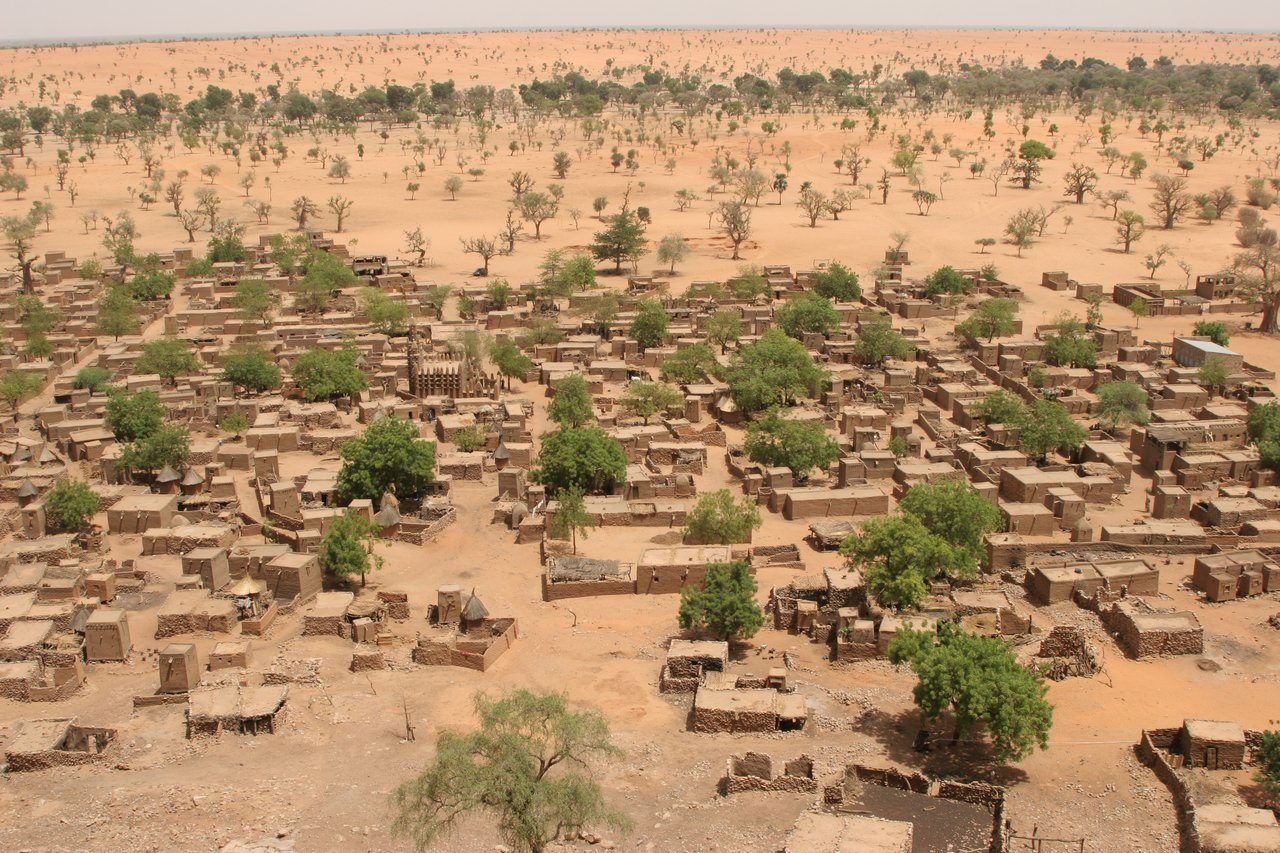
The Dogon are a real people, roughly 800,000 of them, farming the sandstone cliffs of Bandiagara in central Mali, and their culture is authentic, still practiced, and older than any European who ever came to study it. That much is not in question. What is in question is one extraordinary claim: that long before a telescope ever reached them, the Dogon knew Sirius is not one star but two, that its companion is impossibly small and impossibly heavy, and that it circles the bright star roughly every fifty years. Sirius B is a white dwarf. No eye can see it. Almost everything the Dogon were reported to say about it is, astronomically, correct. From that one fact a whole mythology of ancient alien contact was built. But the man who recorded it worked mainly with a single blind elder, over thirty-three days, in a French colony, and European science had already known about Sirius B for sixty-nine years by then. Here is the whole case, the people first and the mystery second, the Nommo who supposedly brought the knowledge, the fish-teachers of Sumer who look so much like them, and every claim wearing the tier the evidence actually earns. The Dogon are real. The question is who first told them about the star they could not see.
Start with the star, because the star is what makes this famous. Sirius is the brightest point in the night sky, and to the naked eye it is one star. It is not. It is a binary: a brilliant main star, Sirius A, and a tiny, dense, invisible companion, Sirius B, a burned-out white dwarf that no human eye has ever seen without a telescope. And a people in Mali, according to the French ethnographer who lived among them, described that companion in detail, its size, its weight, its fifty-year orbit, decades before anyone thinks they could have been told. That is the Sirius Mystery. What follows is the Dogon taken in full, the people first and the mystery second, each claim wearing the weight the evidence gives it.
01The People of the Cliffs
The Dogon inhabit the Bandiagara Escarpment and the surrounding Seno Plain in central Mali, roughly 300 kilometers south of Timbuktu. The escarpment is a sandstone cliff running about 150 kilometers, and Dogon villages are built into its faces, along its plateau, and across the sandy lowlands below. They number roughly 800,000, and their language is not one language but a family of about twelve dialects, Dogul Dom, Toro So, Jamsay, and others among them.
The cliffs were inscribed as a UNESCO Mixed World Heritage Site in 1989. The Dogon farm millet, sorghum, and onions, keep some livestock, organize themselves patrilineally around spiritual and political leaders called hogon, and practice a religion that blends traditional Dogon animism with Islam (about 35 percent) and Christianity (about 10 percent). They are thought to have reached Bandiagara between the 13th and 15th centuries CE, possibly fleeing Islamization in the western Sahel or the collapse of the Ghana and Mali empires. Before them the Tellem left cliff-dwellings and burial sites the Dogon later reused, and before the Tellem the Toloy culture held the area as early as the 3rd century BCE. This is a living people with a deep past, and nothing in what follows casts any doubt on that.
02Griaule Among the Dogon
Marcel Griaule (1898 to 1956), a French ethnographer, first came to Dogon country in 1931 as leader, with Michel Leiris, of the Mission Dakar-Djibouti, a large-scale expedition that crossed the width of Africa from Dakar on the Atlantic to Djibouti on the Horn. He returned for further fieldwork in the village of Sanga in 1935, and he kept coming back.
His most famous fieldwork ran over thirty-three consecutive days in 1946 to 1948, and produced the 1948 book Dieu d'Eau: Entretiens avec Ogotemmeli, in English God of Water: Conversations with Ogotemmeli. Griaule died in 1956. Le Renard Pale, The Pale Fox, which completed his unfinished work, was published in 1965 by Germaine Dieterlen (1903 to 1999), his long-time collaborator and student, who went on working with the Dogon after his death. Together, in 1950, the two had already published the paper that started everything, A Sudanese Sirius System, in the Journal de la Societe des Africanistes, the first to bring Dogon astronomical claims to scholarly attention.
Ogotemmeli was a blind Dogon elder and hunter, blinded in a gunpowder accident, and he was Griaule's principal informant. Over those thirty-three days in his home in Sanga, Griaule recorded what he called la connaissance profonde, the 'deep knowledge' of Dogon religion and cosmology, a systematized metaphysics he set against the 'surface' knowledge he said uninitiated Dogon held. Notice the shape of that already: nearly everything at the center of this story comes through one man.
Griaule's method held that the Dogon possess four ascending levels of knowledge, and that Ogotemmeli had opened only the third; the deepest level, he said, was closed even to most Dogon. That surface-to-deep framework was central to how Griaule worked, and it would become central to the fight over whether his work was real, because a claim of knowledge so secret that most of the people themselves cannot reach it is a claim that is very hard to check.
03The Dogon Cosmos: Amma, the Egg, and the Pale Fox
In the cosmology Griaule and Dieterlen recorded, the supreme creator is Amma, who made the universe through a vibrating, spiraling motion, flinging pellets of earth that swelled into stars and cosmic bodies. Creation began as a cosmic egg, Aduno Tal, holding four elements and the seeds of everything to come; the egg vibrated seven times to establish the cardinal directions and cosmic structure, and it carried eight 'seeds of Amma,' one prefiguring each category of being.
Then came the rebellion. Ogo, a primordial being, broke from Amma's ordered plan, tore a piece of the cosmic placenta, and descended to earth too soon, bringing disorder. Ogo became the Pale Fox, Yurugu, a trickster figure, and to this day Dogon sand divination reads the future in the tracks a fox leaves across prepared tables of sand, tracks tied to Ogo's endless search for his lost twin.
And set against Ogo's disorder are the Nommo, amphibious, fish-like beings created by Amma to organize the world and teach humanity. They are the heart of this story, and we will come back to them in full.
04The Sigui: A Ceremony Every Sixty Years
The Sigui is the greatest Dogon ceremonial cycle, held roughly once every sixty years (accounts range from 57 to 63), to commemorate the first revelation of speech to humanity by the Nommo and the death of the first ancestor. The documented cycles are real events, not legend: one around 1847, poorly recorded; one in 1907 to 1912 that colonial administrators watched travel village to village over six years; and one in 1967 to 1973 that the cinematographer Jean Rouch filmed extensively. The next is expected around 2027.
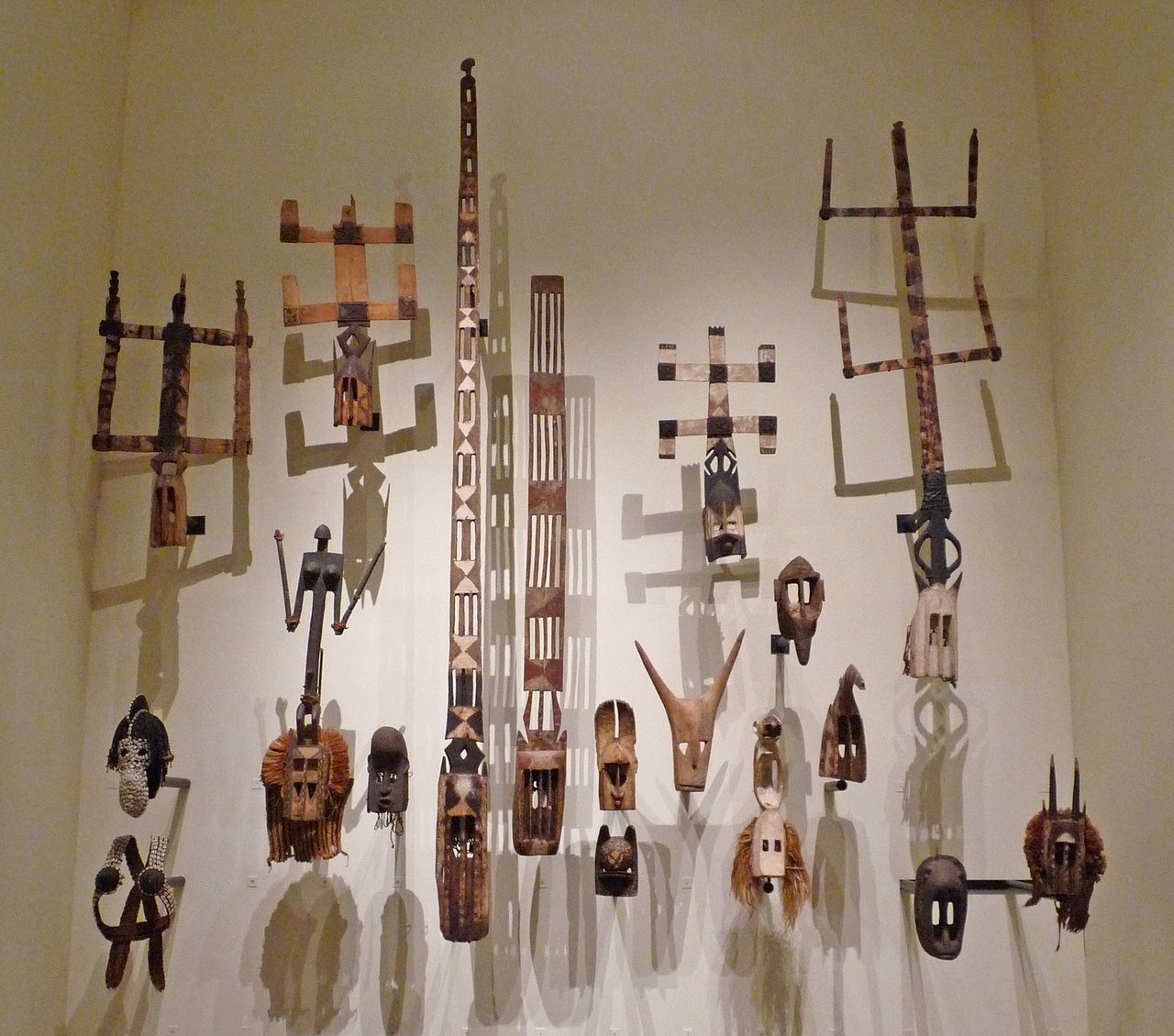
The sixty-year cycle has often been linked to Sirius B's roughly fifty-year orbit, and the file is blunt that the numbers do not actually line up: sixty is not fifty, and the correlation is suggestive at best, not a confirmed match and not proof of anything. During the Sigui, masked dancers perform in the tall, cross-shaped Kanaga masks, reenacting the Nommo's descent, and the ceremony moves from village to village across six consecutive years.
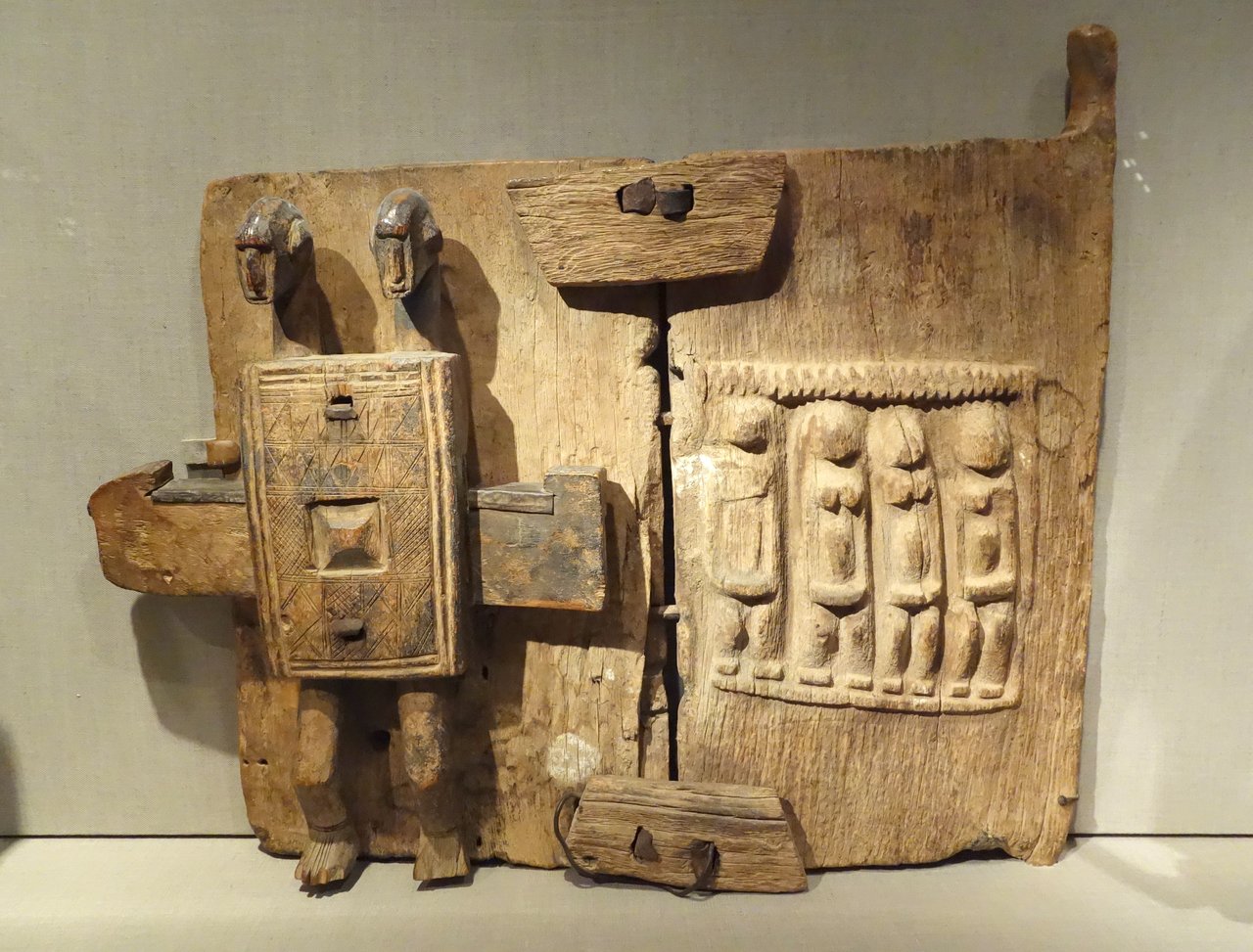
Dogon material culture is dense with all of this: the tall cross-shaped Kanaga masks that map the upper and lower worlds; the Satimbe masks that carry the yasigine, the 'sister of the Sigui'; the Toguna, the low-ceilinged men's meeting house whose carved pillars host dispute and cosmology; granary doors cut with Nommo figures, crocodiles, and ancestors; and Nommo sculptures, paired or solitary figures with their arms thrown up, often part-fish. Much of this predates Griaule entirely, which will matter later.
05The Sirius Mystery
The 'Sirius Mystery' is the name for the claim, born in Griaule and Dieterlen's writing and later blasted worldwide by one popular book, that the Dogon held detailed astronomical knowledge of the Sirius system that should have been impossible to obtain without a telescope.
Here is what Griaule reported the Dogon to say. Read the middle column against the right one, because the astronomy is not vague; on two points it is exact.
| What Griaule Reported the Dogon Said | What Modern Astronomy Finds | As Pre-Contact Knowledge |
|---|---|---|
| Sirius is two stars: Sigi Tolo and Po Tolo | Sirius A and B are a real visual binary | Tier 3 · disputed |
| Po Tolo is the smallest and heaviest thing there is, made of a material called sagala, heavier than all the iron on Earth | Sirius B is a white dwarf, about 0.98 solar masses crushed to roughly Earth size | Tier 3 · disputed |
| Po Tolo circles Sigi Tolo about every 50 years, along an elliptical path drawn out for Griaule | Sirius B orbits every 50.09 years, with an eccentricity of about 0.59 | Tier 3 · disputed |
| A third star, Emme Ya Tolo, the sorghum-female star, larger but lighter than Po Tolo | No Sirius C has ever been confirmed, as of 2026 | Tier 3 to 4 · unconfirmed |

Two of those lines are genuinely hard to wave away. A white dwarf's density and a fifty-year orbit are not things you can read off the naked-eye sky. The name carries the same strangeness: Po Tolo means 'fonio star,' after po, Digitaria exilis, the smallest cereal grain grown in West Africa, and Griaule reported that the Dogon likened Sirius B's density to that tiniest of seeds, calling the smallest thing they knew the heaviest. (A 1995 study even floated a small red-dwarf companion to Sirius, echoing the third-star claim, but the Hubble Space Telescope later found no sign of it.) All of this being reported is Tier 1; it is on the record. That it proves the Dogon knew any of it before Europeans arrived is only Tier 3, and that is precisely what the next sections take apart.
The book that made this a global sensation was The Sirius Mystery: New Scientific Evidence of Alien Contact 5,000 Years Ago, published in 1976 and revised in 1998 by Robert Kenneth Gould Temple (born 1945), an American-born, British-based author and Fellow of the Royal Astronomical Society.
Temple's thesis has four moving parts, and it is worth laying out plainly, because it is where the reading leaps off the evidence. One: the Dogon's Sirius knowledge is real and could not have come from the naked eye. Two: it came from direct contact with amphibious extraterrestrials, the Nommo, originating in the Sirius system itself. Three: those same beings also contacted the Sumerians, whose fish-god Oannes is the same contact event remembered. Four: the knowledge then spread from Sumer and Egypt down into sub-Saharan Africa over thousands of years by cultural diffusion. Steps three and four are arguable cultural history. Step two, real beings from Sirius, is where the file draws its hardest line: there is no physical evidence of any kind, and the claim rests entirely on reading a myth literally.
Temple also tied Dagon, the Philistine fish-god, to the very name 'Dogon.' The file calls that connection what it is: linguistically unfounded.
06Egypt's Own Star
Set the Dogon aside for a moment, because Sirius mattered enormously to a civilization that unquestionably watched it: Egypt. There Sirius was Sopdet, Sothis to the Greeks, personified as a goddess associated with Isis. After roughly seventy days hidden below the horizon, Sirius rose again at dawn, its heliacal rising, and that dawn rising coincided with the annual Nile flood, the akhet season, so the star set the planting seasons, the festivals, and the New Year. Egypt's 365-day civil calendar drifted against the true 365.25-day Sothic year, producing the great 1,461-year Sothic cycle. The ivory tablet of Djer, from the 1st Dynasty around 3000 BCE, may carry the earliest reference to Sopdet. This matters here because Temple's diffusion route runs straight through Egypt.
07The Case for Contamination
The decisive test came from the field. The Dutch anthropologist Walter van Beek published Dogon Restudied: A Field Evaluation of the Work of Marcel Griaule in Current Anthropology in April 1991, after eleven years of intermittent fieldwork, 1978 to 1991, among the Dogon of the very same Sanga region where Griaule had worked, interviewing many informants across several villages. He could not find the Sirius knowledge. His informants did not recognize po tolo as a traditional term, did not describe Sirius as a binary, and gave the bright star no special significance beyond its brightness. The elaborate cosmology Griaule presented, the egg, the eight seeds, the vibrating creation, was not consistently there; Dogon accounts varied sharply from person to person and village to village.
Van Beek put it flatly: "Though they do speak about 'sigu tolo' [which is simply the star Sirius], they disagree completely with each other as to which star is meant; for most of them, the term 'po tolo' is meaningless."
Van Beek's conclusion was pointed: Griaule had practiced 'leading witness' ethnography, unconsciously steering his informants with specific, suggestive questions and rewarding the answers he was hoping for. That is a critique of one anthropologist's colonial-era method, a real and well-documented episode in the history of anthropology, and it is not a claim about the Dogon people. It is also contested: van Beek's article ran alongside replies from several other scholars, some defending Griaule and suggesting van Beek had simply never been let into the deepest, most secret level of Dogon knowledge.

Carl Sagan had already offered the simplest explanation, in Broca's Brain (1979), in a chapter titled 'White Dwarfs and Little Green Men.' The most parsimonious account, he argued, is contamination: the Dogon absorbed knowledge of Sirius B through contact with Europeans. And the channels were wide open. France took Bandiagara in 1893 and held Mali from then on; French colonial schools were running in the region by the early 1900s; Catholic White Fathers missionaries were active in Dogon country from the early 20th century; and many Dogon men served in the French army as tirailleurs senegalais in both World Wars, moving through a Europe that had known about Sirius B for decades.
| Year | What Happened |
|---|---|
| 1862 | Alvan Graham Clark first sees Sirius B through an 18.5-inch refractor; Arthur Auwers calculates its orbital period the same year (modern value 50.09 years) |
| 1915 | Walter Adams theorizes, from its spectrum, that Sirius B is a white dwarf |
| 1925 | Sirius B's white-dwarf nature is confirmed |
| 1931 | Marcel Griaule begins his Dogon fieldwork |
That leaves a sixty-nine-year window, 1862 to 1931, in which Sirius B's existence, its density, and its orbital period were all published European astronomy, freely available to any soldier, teacher, or missionary who might have carried it to Mali. The dates themselves are Tier 1 fact. The inference that the knowledge crossed that gap is Tier 2, but it is the most economical story on the table.
Others pressed the point from different angles. Philip Coppens (1971 to 2012) noted that Griaule's method drifted, from neutral observation in the 1930s to actively hunting for comprehensive cosmological systems in the 1940s, exactly as the claims attributed to Ogotemmeli grew more elaborate. Ian Ridpath, in Investigating the Sirius Mystery (Skeptical Inquirer, 1978), pointed out that the Dogon were also credited with knowing Saturn's rings and Jupiter's four Galilean moons, both of them schoolbook facts in Europe since the 17th century. Paul Dougall (2015) argued that everything the Dogon can independently be shown to know about the sky is consistent with skilled naked-eye observation. And Robert Burnham Jr. noted that Sirius B was an object of popular-science fascination in the early 20th century, printed in non-specialist publications that could have reached Mali through colonial networks.
08The Defense, and the Verdict of the Field
The defenders have real points too. Dogon esoteric knowledge is genuinely restricted, held by particular lineages and initiatory grades, so van Beek may simply never have reached the level Griaule claimed to. Griaule, by some accounts, was adopted into a Dogon family and given honorary initiatory status, the olu baru, an access a later researcher might not receive. Dieterlen kept working with Dogon informants for decades after Griaule died and stood by the reported cosmology. And some Dogon ritual objects, masks and sand drawings, do appear to encode diagrams that can be read astronomically, though what they mean is contested.
So where does the field actually stand? The file's own verdict, as of 2026, is that the weight of evidence leans toward the contamination and leading-witness hypothesis. The reasons are structural: the core Sirius claims trace to a single primary informant, Ogotemmeli; no independent researcher has ever replicated Griaule's specific findings about Sirius B; and the colonial-era timeline offered ample opportunity for the knowledge to cross over. But hold the two claims apart, because everything depends on it. That the Dogon knew Sirius B before Europe told them is probably false. That the Dogon's broader culture is authentic is not in doubt at all: the Sigui ceremony, the cosmological framework, and above all the Nommo tradition are real, are still practiced, and predate Griaule's intervention entirely. Doubting one European anthropologist's Sirius claim takes nothing away from a living people or their gods.
09The Nommo
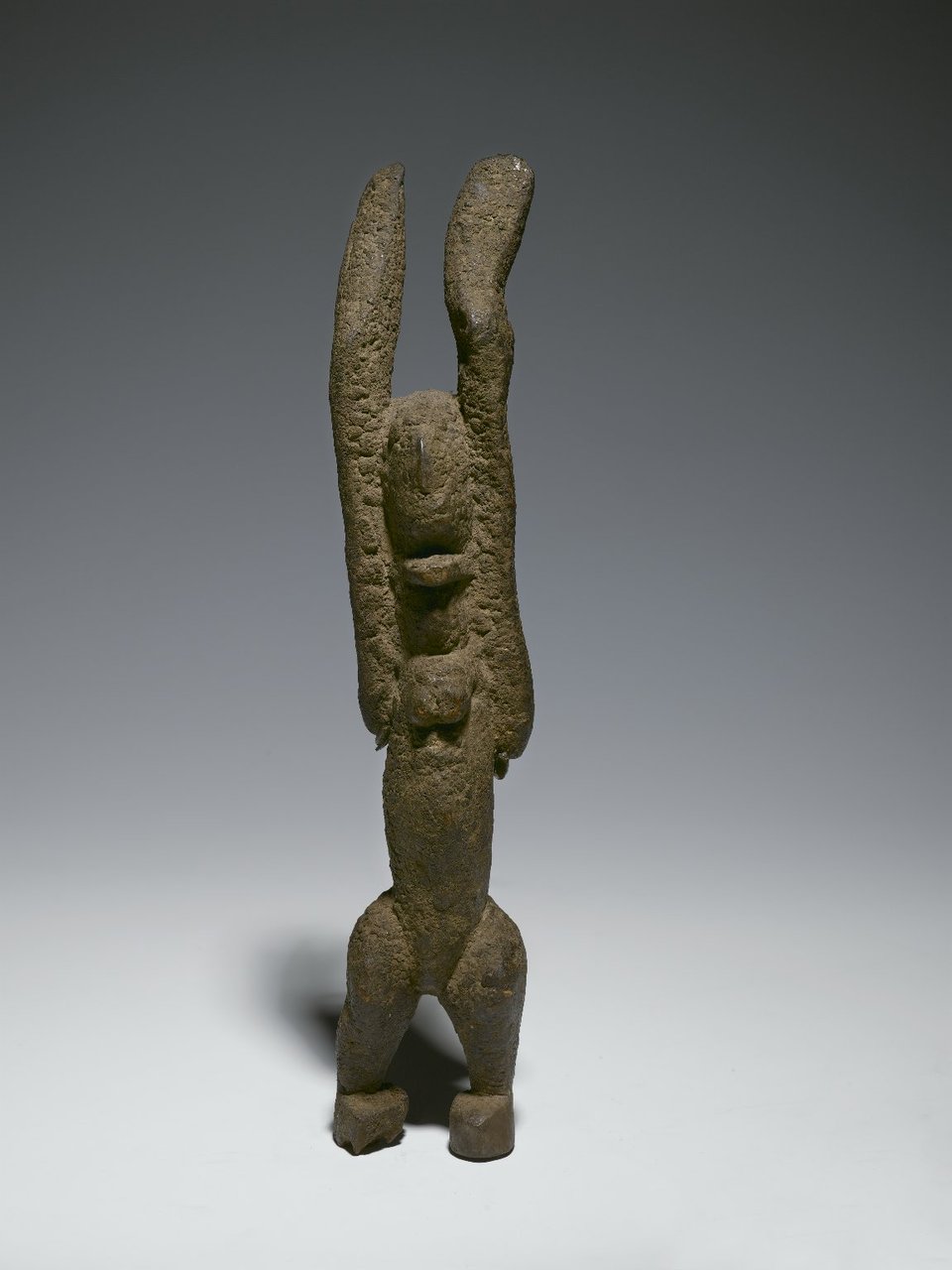
The Nommo do not need the Sirius Mystery, and never did. They are corroborated by sculptures, masks, and ceremonies that were in Dogon hands long before Griaule showed up. In the tradition they are amphibious beings, part human and part fish or serpent, at home in water and on land, created by Amma as the first complete and ordered beings, the living answer to the incomplete and disorderly Ogo.
They came, the accounts say, down from the sky in an ark, amid a great noise and wind that blackened the earth where it landed, and they set about their work as teachers and civilizers: they taught speech, agriculture, weaving, metallurgy, and the ordering of society. And at least one of them, the Nommo Semi, was sacrificed, dismembered, and resurrected, its body parts distributed across the world to sanctify and organize creation.
| Nommo | Role |
|---|---|
| Nommo Die | the great original pair, created by Amma as ideal beings |
| Nommo Titiyayne | the messenger, an intermediary between heaven and earth |
| Nommo Semi | the sacrificed one, killed, dismembered, and resurrected, its body becoming trees, stones, and heavenly bodies |
| O Nommo | the Nommo of the pond, who remains in the sacred waters, tied to fertility |
The descent is told in vivid detail. The ark was shaped like a Dogon granary, a cylinder capped by a cone, itself a little model of the cosmos, and it came down on a copper chain amid fire, wind, thunder, and a great noise; the landing scorched the ground black, and the Nommo stepped out and planted the first field, establishing agriculture. It is tempting to read a rocket into that, and the file heads the temptation off directly: fire-and-thunder arrivals are the standard way gods land in the world's mythologies, from Yahweh at Sinai to Indra's thunderbolt, and that explains the imagery far better than a literal spacecraft does.
The dying-and-rising teacher is one of the oldest patterns in religion, and the Nommo Semi sits squarely in it, beside Osiris, murdered and dismembered and reassembled; Tammuz and Dumuzi of Mesopotamia, dying and returning with the seasons; Christ; Quetzalcoatl, who departs and is promised to return; and Odin, who hangs nine nights on the world-tree, dies, and wins knowledge. And the specific twist, a body broken up to become the very stuff of the world, echoes the Vedic Purusha of Rig Veda 10.90 and the Norse giant Ymir of the Prose Edda, where a primordial being's body becomes the material of creation.
10The Fish-Teachers of Sumer
But the closest parallel of all, and the one Temple leaned on hardest, is not in Egypt or India. It is in Sumer, where the fish-being Oannes and the Seven Apkallu, the Seven Sages, taught the first civilization. Set the two traditions side by side.
| The Nommo (Dogon) | Oannes and the Apkallu (Sumer and Babylon) |
|---|---|
| Amphibious, part fish, part serpent, part human | Fish-formed with a human shape underneath, per Berossus's Babyloniaca (around 281 BCE): the body of a fish but underneath the figure of a man |
| Descended from the sky in an ark | Emerged from the sea, the Persian Gulf or Erythraean Sea |
| Several kinds of Nommo | The Seven Apkallu, the Seven Sages |
| Taught speech, agriculture, weaving, metallurgy, and social order | Taught writing, the arts and sciences, city-building, and law |
| Active before the current age | Active before the Flood |
| Benevolent organizers of the world | Benevolent: per Berossus, nothing material has been added by way of improvement to his instructions |
That is a striking match, and it is the backbone of Temple's whole diffusion argument. But a match is not a mechanism, and the file lays out three ordinary ways it could arise with no visitors from anywhere: water is a near-universal symbol of origin, so different cultures reach for aquatic wisdom-bringers independently; West Africa and the Near East really were in contact across the trans-Saharan trade routes; and human beings simply tend to project the origin of their knowledge onto some being that rose out of the water. None of the three needs a starship.
And the water-teacher is everywhere once you look. Matsya, the fish avatar of Vishnu, warns Manu of the flood and preserves the Vedas. Fuxi, serpent-bodied, gives China writing, fishing, and the trap. Viracocha rises from Lake Titicaca to teach the Andes, then departs across the Pacific. Quetzalcoatl carries water and Venus and the calendar. Dagon of the Levant, Ea and Enki of the fresh waters, and the pan-African Mami Wata all belong to the same vast family of knowledge poured out of the water.
11The Spiral and the Double Helix
One more claim has to be handled, because it comes up constantly. Some writers point at the Dogon creation story, with its spiraling, vibrating seeds, and see the double helix of DNA, or the arms of a spiral galaxy, or wave-based cosmology, ancient science hidden inside a myth. The file rejects this outright, and names why: the spiral is among the most common motifs in all of human art and mythology, in shells, water vortices, growing plants, and weather, and matching an old spiral motif to DNA after the fact is one of the best-documented traps in alternative-history writing. In its own words, the Dogon spiral creation is an interesting cosmological motif and nothing more; it does not constitute evidence of ancient scientific knowledge.
12Two Explanations, One Pattern
Step back and the real puzzle is not the Dogon at all. It is that the water-being who brings knowledge turns up on every inhabited continent, Nommo, Apkallu, Viracocha, Fuxi, and the rest, and there are only two serious ways to explain that. One is diffusion: a single real contact event, long ago, remembered in broken fragments across cultures, which is Temple's bet. The other is independent invention: water is universally associated with creation, birth, and origin, so pouring wisdom out of an aquatic being is a move human minds make again and again on their own. As for Sirius itself, it hardly needed aliens to be noticed: it is the brightest star in the sky, at magnitude minus 1.46, and it carried meaning far beyond Egypt and Mali, the scorching Seirios of the Greek dog days, a navigation star for wayfinding across Polynesia, Tianlang the celestial wolf in China, and, paired with Antares, one of the two dog-stars that guard the path of souls in Cherokee tradition.
And that is finally what the Dogon case is for. The file frames it as a critical methodological warning for cross-cultural research, and it is a good one. It shows how confirmation bias shapes what a fieldworker finds; why independent replication matters, and what it means that van Beek could not confirm Griaule; how a secret-knowledge claim becomes unfalsifiable, since any absence of evidence can be waved away as secrecy withheld; and why skeptical peer review earns its keep, from Sagan to van Beek to Ridpath. The file says the same caution applies to every single-informant, unverifiable oral source, and it names one of its own: the accounts of Credo Mutwa, filed elsewhere in the corpus, alongside ancient-astronaut interpretations generally.
Fast Facts
- The claim
- The Dogon of Mali were reported by a French ethnographer to know that Sirius has a tiny, dense, invisible companion, Sirius B, a white dwarf, and to describe its size and its fifty-year orbit, knowledge that should have needed a telescope.
- Who recorded it
- Marcel Griaule, working mainly with one blind elder, Ogotemmeli, over thirty-three days in 1946 to 1948. The claim reached the world through Robert Temple's 1976 book, The Sirius Mystery.
- The problem
- Sirius B had been European astronomy since 1862, sixty-nine years before Griaule arrived, and Mali was a French colony with schools, missionaries, and soldiers who moved through Europe. The knowledge had an easy road in.
- The field test
- Walter van Beek spent eleven years restudying the same Dogon region and could not find the Sirius knowledge at all; for most of his informants, he wrote, the key term po tolo was meaningless.
- What is NOT in doubt
- The Dogon are a real, living people of roughly 800,000, and their culture, the Sigui ceremony, the cosmology, and the Nommo tradition are authentic and older than Griaule. Doubting the Sirius claim says nothing against any of that.
- Ruled out
- That the Nommo were real amphibious beings from Sirius (no physical evidence; it rests on reading a myth literally), and that the Dogon spiral-creation story encodes DNA (the file rejects the pattern-match outright).
- The open question
- Why the water-being who teaches civilization appears on every continent: one lost contact remembered everywhere, or the same human answer to water, reached again and again.
What the Evidence Actually Holds
The documented spine is solid. The Dogon people and their living culture; that Griaule reported the Sirius B claims; the astronomy itself (Sirius A and B a real binary, Sirius B a white dwarf near 0.98 solar masses on a 50.09-year orbit); the full telescopic history from Alvan Graham Clark's 1862 sighting onward; Walter van Beek's documented failure to replicate Griaule and his verbatim 1991 finding; Egypt's Sopdet and the Sothic cycle; the Nommo tradition's material corroboration in sculpture and ceremony; and the worldwide water-teacher pattern are all on firm ground.
The reading of the fight is credible but open. That the balance of evidence leans toward contamination and leading-witness ethnography, resting on a single informant, no replication, and a wide-open colonial timeline; Sagan's specific transmission vectors; the defenses about restricted initiatory knowledge; and the Nommo and Apkallu parallel read as ordinary shared symbolism and trade contact rather than contact from the stars, are all real, all argued, and none of them fully closed. And the thing that must be said in the same breath: the Dogon's culture and the Nommo tradition are authentic and predate Griaule, whatever becomes of the Sirius claim.
Whether the Dogon actually held pre-contact knowledge of Sirius B stays formally open. The weight leans toward no, but a case that runs on one informant and unrepeatable initiations cannot be closed with total confidence, and the possible third star, Emme Ya Tolo, has no confirmation from modern astronomy at all. This article does not pretend to have shut the door.
Two readings the file itself rules out. That the Nommo were literal amphibious extraterrestrials from Sirius who contacted both the Dogon and the Sumerians, Temple's core claim, has no physical evidence of any kind and stands entirely on taking a myth literally. And that the Dogon spiral-creation story is encoded knowledge of DNA is a post-hoc pattern-match the file rejects on its face. The mystery here is not a message from another star. It is a lesson in how a mystery gets made.
So keep the two things apart, the way the evidence demands. The secret of Sirius B was very likely carried into Mali the dull way, by soldiers and schoolteachers and the slow leak of a colony, then handed back to the world as ancient wisdom by a book that wanted it to be aliens. Strip that away and nothing is lost that matters: the Dogon are still there on the cliffs, still dancing the Nommo down from the sky roughly every sixty years, still older and stranger and more real than the mystery ever was. What lingers is not the star. It is the fish-teacher who keeps surfacing, on the Niger and the Nile and the Persian Gulf and the shores of Lake Titicaca, in the myths of peoples who never met. Maybe one of them really did come out of the water once, long ago, and the memory scattered. Maybe water was always going to become a teacher wherever people bent down to drink and wonder where their knowledge came from. The evidence cannot yet close the gap between those two answers. But the fish-teacher is still rising, all over the world, and still asking who first sent him.
Sources & further reading
Everything above is drawn from our research library on Theories of Anything, which is where we worked from. The papers, reports and primary records listed beneath them are where you can check us independently.
Image credits
- Telly village, Bandiagara Escarpment, Mali photograph by Ferdinand Reus, via Wikimedia Commons. CC BY-SA 2.0 Source.
- Dogon masks including Kanaga masks, Musee du quai Branly, Paris photograph by Ji-Elle, via Wikimedia Commons. CC BY-SA 3.0 Source.
- Carved granary shutter, Dogon people, Mali, early 20th century, De Young Museum photograph by Daderot, via Wikimedia Commons. CC0 1.0 Source.
- Astronomer Carl Sagan, Cornell University, 1987 photograph by Kenneth C. Zirkel, via Wikimedia Commons. CC BY-SA 4.0 Source.
- Nommo Figure with Raised Arms, Brooklyn Museum, 11th to 15th century, Mopti Region, Mali photograph via the Brooklyn Museum, via Wikimedia Commons. CC BY 3.0 Source.
- Sirius A and B, Hubble Space Telescope photograph NASA, ESA, H. Bond (STScI), M. Barstow (University of Leicester), via Wikimedia Commons. Public domain Source.
- Card crop of Telly village, Bandiagara Escarpment, Mali photograph by Ferdinand Reus, via Wikimedia Commons. CC BY-SA 2.0 Source.


