The Egyptian Book of the Dead: The Custom-Built Manual for Surviving Your Own Judgment
Forget the single leather-bound grimoire the phrase conjures. The ancient Egyptians never wrote a Book of the Dead. They wrote Pert em Hru, 'Coming Forth by Day,' and no two copies were ever the same. It was a personalized manual of protective and navigational spells, written on papyrus with the owner's own name threaded through every line, placed with the mummy so the dead could find their way through the underworld and stand before a scale that weighed their heart against the feather of truth. It was working magic and sincere theology at once, and it carried one of the most detailed moral codes antiquity ever produced. This file reports that system in the Egyptians' own terms, tier by tier, and marks the one place where even they seem to have hedged their bets.
Say the words Egyptian Book of the Dead and most people picture the same object: a single ancient volume of curses, the kind of thing a careless archaeologist cracks open in a film right before the mummy sits up. Almost none of that is real. There was no single book. There was no shared canon. There were no curses lying in wait for the living. What there was instead is stranger and far more serious: a piece of funerary technology the ancient Egyptians spent the better part of two thousand years refining, a personalized manual written to carry one specific dead person, by name, through the underworld and safely past the moment their own heart would be laid on a scale against the truth. This file reports that system the way the Egyptians meant it, as sincere theology and working magic at once, tier by tier, and it marks the one place where even they seem to have hedged their bets.
01Not A Book, And Not A Bible
Start with the name, because the famous one is wrong. The Egyptians never called this text the Book of the Dead. Its real name is Pert em Hru, usually translated 'Coming Forth by Day' or 'Going Forth by Day,' and it points not at death but at the soul's daily emergence into the light. 'Book of the Dead' is a modern coinage, attached to the material by the German Egyptologist Karl Richard Lepsius in 1842, and it has colored how the whole thing gets read ever since.
And it is not a book in the sense we mean. It is not a single canonical text, not a theological treatise, not a creed, and not scripture read aloud to a congregation. It was not even available to everyone: a fine copy was expensive, and only the wealthy could afford an elaborate one. What it actually was is a customized toolkit of protective and navigational spells, a personal selection assembled for one person's journey, continuing a funerary-text tradition already roughly two thousand years old. Two things were true of it at once, and flattening either one loses the thing entirely: it was working magic, and it was sincere theology, in the same breath.
The physical facts follow from that. The spells were written in hieroglyphic and hieratic Egyptian on rolls of papyrus that ranged from a few chapters to well over two hundred, and every copy was individualized, the owner's name inserted throughout so the magic addressed that exact person. Production peaked in the New Kingdom, roughly 1550 to 1070 BCE, and continued into the Ptolemaic period. Across all the surviving copies there are about 192 numbered spells, ordered by Lepsius's modern system, but no single roll ever carried all of them. You got the spells you could afford and the ones your priests thought you would need.
A handful of copies survive well enough to have become famous in their own right. The most celebrated are the Papyrus of Ani, from around 1250 BCE and now in the British Museum, and the Papyrus of Hunefer. A third, the Greenfield Papyrus, runs an astonishing 37 meters, long enough to line a corridor.
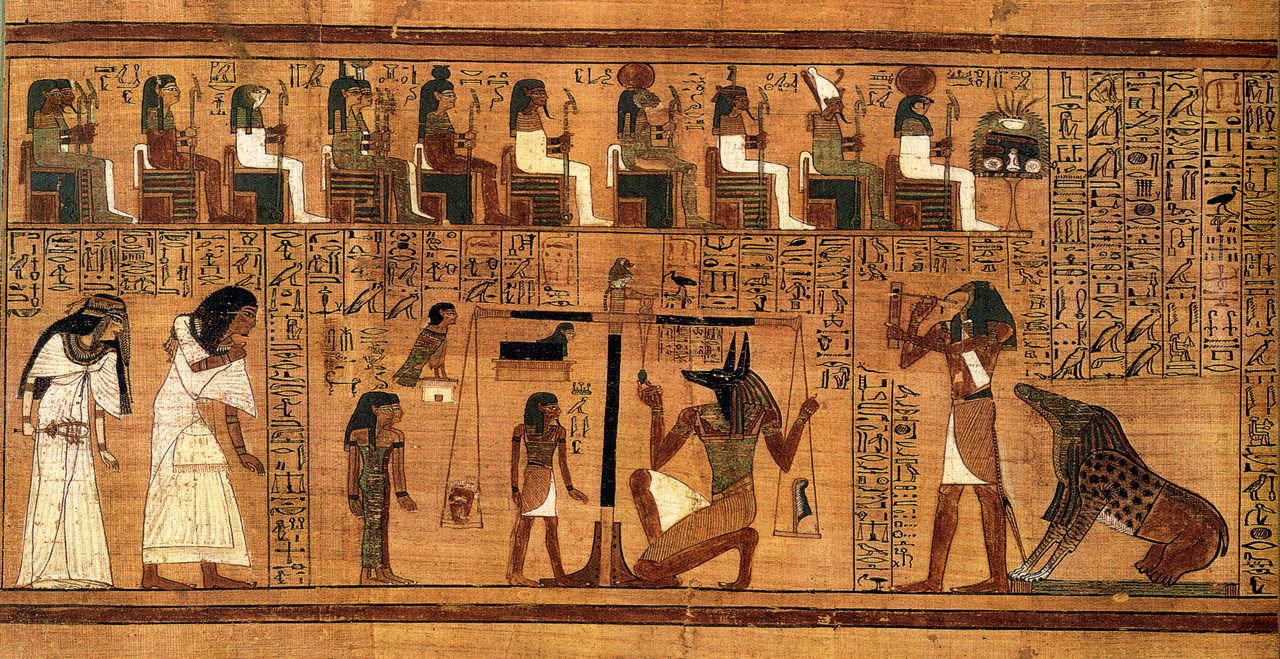
Two of those manuscripts are worth a closer look, though this particular detail comes from the British Museum's own collection records rather than the Theories of Anything file that anchors the rest of this page. The Papyrus of Ani (British Museum, EA10470) was acquired by E. A. Wallis Budge at Luxor in 1888 and is widely regarded as the finest surviving Book of the Dead, its colors still vivid. The Papyrus of Hunefer (British Museum, EA9901) dates to about 1275 BCE and belonged to Hunefer, a royal scribe and steward in the service of the pharaoh Seti I; its Weighing of the Heart vignette is among the most frequently reproduced images in all of Egyptology, which is very likely the version of the scene you have already seen.
02The Democratization Of The Afterlife
The Book of the Dead is the third act of a long story, and the shape of that story is the single most interesting thing about it. Egyptian funerary literature evolved through three phases, and each phase widened who was allowed to reach the afterlife at all. It begins as a royal monopoly and ends as something an ordinary literate Egyptian could buy.
| Tradition | Era | Where It Was Written | Who Could Use It |
|---|---|---|---|
| Pyramid Texts | Old Kingdom, c. 2400-2300 BCE | Carved inside the royal pyramids (Unis, Teti, Pepi I and II) | The pharaoh alone |
| Coffin Texts | Middle Kingdom, c. 2100-1650 BCE | Painted and written on wooden coffins | Nobles and officials |
| Book of the Dead (Pert em Hru) | New Kingdom onward, c. 1550-30 BCE | Papyrus scrolls placed with the mummy | Anyone who could afford a copy |
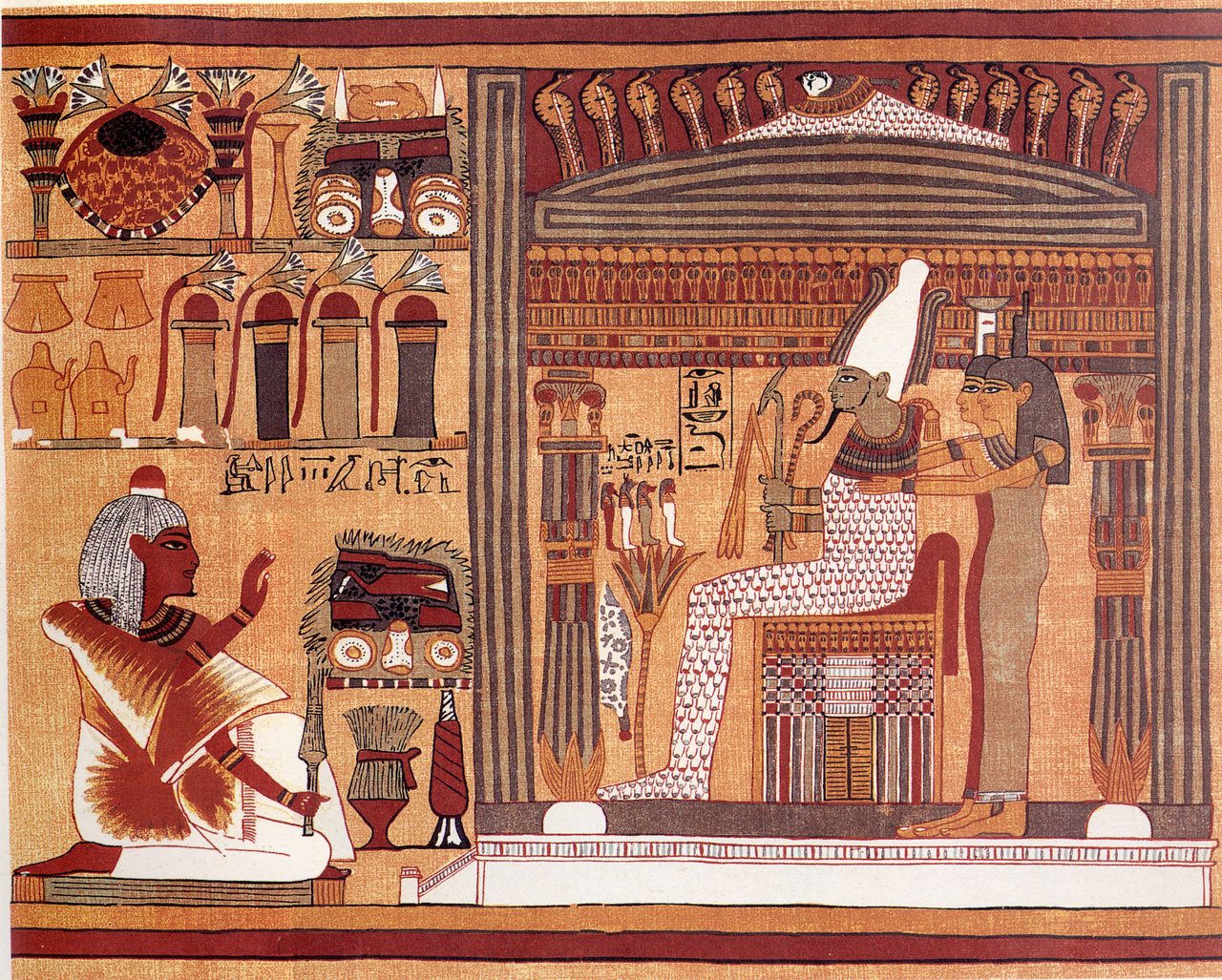
That progression has a name among Egyptologists: the democratization of the afterlife. What had once belonged to the pharaoh alone, the right to ascend and join the gods, gradually became available to anyone who could pay for a papyrus. The clearest sign of it is a small grammatical habit. By the New Kingdom the deceased of any rank is formulaically identified with Osiris himself and addressed as 'The Osiris N,' where N is simply the dead person's own name. In death, the commoner became Osiris.
The Book of the Dead was also not the only afterlife text of its era, only the portable one. Alongside it, painted on the walls of the royal tombs in the Valley of the Kings, ran a set of grander compositions reserved mostly for kings: the Amduat, 'That Which Is in the Underworld,' an hour-by-hour account of the sun's nightly passage; the Book of Gates, with its twelve gates each guarded by serpents and each needing a password; the Book of Caverns, the most detailed underworld geography of the group; and the Book of the Heavenly Cow, which preserves the myth of Ra's near-destruction of humanity.
03The Spells, And The Pictures That Were Spells
Open a copy and you are looking at spells, numbered and specific, each one a tool for a particular hazard on the road. Some are cosmic, some are procedural, and a few are almost tender. Here is a sampling of the ones that mattered most, including the two that will matter most later: Chapter 30B, and Chapter 125.
| Chapter | What It Did |
|---|---|
| Chapter 1 | Coming forth by day: the opening invocation as the deceased emerges from the tomb |
| Chapter 17 | A cosmological hymn and theological commentary, carrying a creation narrative and solar theology |
| Chapter 30B | The heart-scarab spell, which stops the deceased's own heart from testifying against them at judgment |
| Chapter 64 | A condensed summary of the entire book, for those who could not afford a full copy |
| Chapter 125 | The Weighing of the Heart, the judgment scene, the single most famous chapter |
| Chapter 148 | Provides sustenance, ensuring food and drink in the afterlife |
| Chapter 153 | Escaping the net, avoiding capture by the underworld's fishermen |
| Chapter 154 | Preventing bodily decay, preserving the mummy |
| Chapter 162 | Placing a flame beneath the head, warmth and protection for the mummy |
| Chapter 175 | Not dying a second time: escaping the annihilation of the soul if judgment fails |
| Chapter 189 | A hymn to the setting sun, a final farewell to Ra |
The spells came with pictures, and the pictures were not decoration. These painted illustrations, called vignettes, functioned as the spell's own visualization, a working diagram of the thing the words were meant to accomplish, and in the finest manuscripts like Ani's they are also masterworks of Egyptian art in their own right. The recurring scenes are the ones the whole system turned on: the Weighing of the Heart, the Fields of Reeds, offerings laid before Osiris, and the dead transforming into birds to move freely between worlds.
04The Weighing Of The Heart
Everything else in the Book of the Dead is, in a sense, preparation for one scene. It is called the Weighing of the Heart, it is Chapter 125, and it takes place in the Hall of Two Truths, the Hall of Ma'at. A great balance stands at the center of the hall, worked by Anubis, the jackal-headed god. On one pan goes the heart of the deceased, the ib, which the Egyptians believed held the entire record of a person's conduct. On the other goes a single feather, the feather of Ma'at, standing for truth, justice, and the cosmic order itself. Thoth, ibis-headed, stands ready to record the verdict. Osiris presides from his throne and receives those who pass. And ranged around the hall sit 42 divine assessors, one for each nome, or administrative district, of Egypt: a full jury drawn from the whole map of the country.
There is a monster in the scene too, waiting beside the scale. Ammit, the Devourer of the Dead, is a composite of the three animals Egyptians feared most: the head of a crocodile, the body of a lion, the hindquarters of a hippopotamus. Her role is simple and final. If the heart balances against the feather, or weighs lighter, the deceased is declared maa kheru, 'true of voice,' justified, and passes into the Field of Reeds. If the heart is heavy with wrongdoing, Ammit eats it. And here a precise point of Egyptian theology has to be stated exactly, because almost everyone gets it wrong: the fate of the condemned is not eternal torture. It is the 'second death,' total annihilation, the erasure of the person from existence. There is no Egyptian hell of endless flame. That idea belongs to later Western religion and must not be read back into this scale.
05The 42 Negative Confessions
To be judged, the deceased first had to speak. Standing before the 42 assessors, one confession for each judge, the dead person recited what are called the 42 Negative Confessions, a point-by-point declaration of innocence. Not 'I did good,' but 'I did not do this specific harm,' repeated 42 times over. Read as a set, they amount to one of the most detailed ethical codes to survive from the ancient world, and they are startlingly concrete.
| The Declaration | What It Governs |
|---|---|
| I have not done iniquity | General morality |
| I have not robbed with violence | Theft (Confession 2) |
| I have not committed murder | Homicide (Confession 5) |
| I have not told lies | Honesty (Confession 7) |
| I have not been unchaste | Sexual ethics (Confession 10) |
| I have not acted deceitfully | Fraud (Confession 14) |
| I have not polluted the water | Care of the shared water (Confession 22) |
| I have not been angry without cause | Emotional regulation (Confession 28) |
| I have not cursed the god | Religious respect (Confession 36) |
| I have not stopped water when it should flow | Water rights (Confession 38) |
| I have not waded in water | Ritual purity (Confession 42) |
Look at two of them in particular. 'I have not polluted the water,' says the 22nd confession. 'I have not stopped water when it should flow,' says the 38th. Set beside the declarations against murder and theft, sworn with the same gravity before the same gods, sit two rules about not fouling the shared water and not cutting off its flow to the people downstream. That is environmental and water-rights ethics, written into a moral code more than 3,500 years old, treated as the kind of thing your soul could be weighed for. It is one of the most quietly remarkable details in the entire text.
06The Seven Parts Of A Person
None of this makes sense without knowing what the Egyptians thought a person actually was, because it was not one thing. Where we tend to imagine a single soul, they mapped a self with multiple distinct components. The file's own prose says 'five (or more)' elements, and then its own table names seven, so here are all seven, because each one does real work in the system.
| Component | Symbol | What It Was |
|---|---|---|
| Ka | Two raised arms | The life force or vital double; it survives death and needs sustenance through offerings |
| Ba | A human-headed bird | The personality or mobile spirit; it travels between the tomb and the afterlife |
| Akh | An ibis or crested bird | The transfigured, immortal spirit, the union of ka and ba |
| Ib | The heart | The seat of intelligence, emotion, will, and the moral record; the part weighed at judgment |
| Ren | The cartouche | The name; a person keeps existing as long as their name is spoken |
| Sheut | The shadow | The shadow-self, which accompanies the ba |
| Khat | The mummy | The physical body, preserved so the ba and ka can find it again |
07The Map Of The Underworld
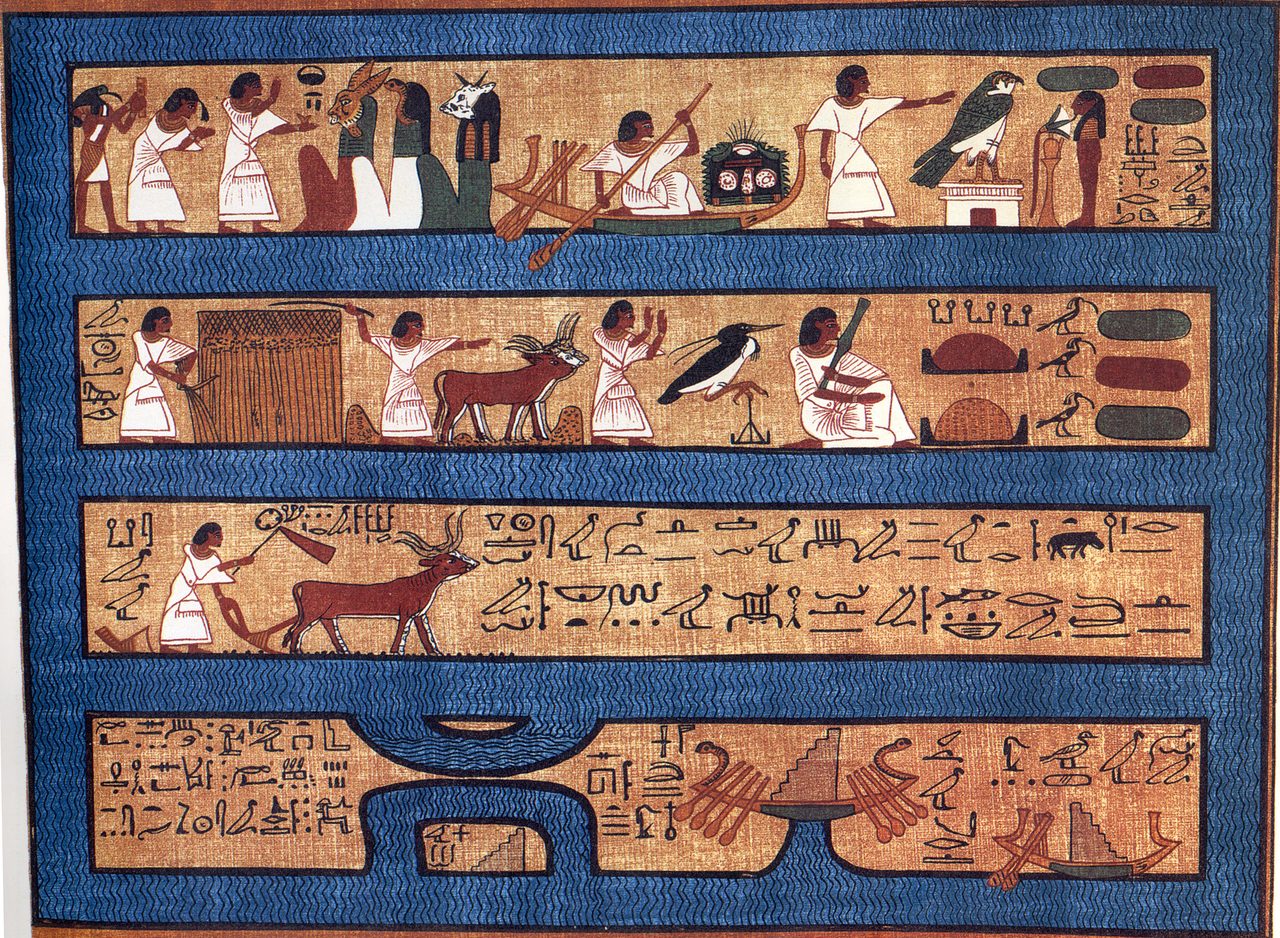
The self so assembled had somewhere to go, across a landscape as mapped as any country. There was the Duat, the underworld the sun itself crosses each night and the dead must cross too. There was the Field of Reeds, or Aaru, the paradise: an idealized mirror of Egypt with rich harvests, though tellingly the blessed dead still had to work its fields, which is exactly why the tombs were stocked with ushabti, small servant figures ready to labor on the owner's behalf. There was the Lake of Fire, which both purified and punished, passable to the righteous and consuming to the wicked. And there was the Isle of Flame, where the sun is reborn each dawn, held out as the ultimate destination for the enlightened dead.
The Egyptians were not the only people to hand their dead a manual for the road. The Greeks buried Orphic gold tablets inscribed with instructions and passwords for the underworld, and Tibetan Buddhism has the Bardo Thodol, its own guidebook read to the dying and the dead. The resemblance is real and worth naming, but it is a parallel, not a lineage: separate cultures arriving at the same idea, that the newly dead need directions, rather than evidence that one copied another.
08Four Questions Egyptology Still Argues
The research file does something most sources on this topic will not: it keeps four honest questions open rather than tidying them away, and it grades each one by how much evidence actually stands behind it. Here they are at the file's own tiers, none of them promoted past what the record supports.
Is the Book of the Dead a coherent theology? The file rates this Tier 1, and the answer is broadly yes: it rests on a consistent cosmological framework and a clear ethical system in the 42 Confessions. But the caveat is real and the file states it plainly. This is a coherent worldview, not systematic theology in the modern sense. Different surviving copies contradict one another, the content shifted across centuries, and there was never a single authorized version. It hangs together as a vision, not as a fixed doctrine.
Did the 42 Confessions influence the Ten Commandments? Here the file drops to Tier 2, and so must anyone honest. The case for it is not nothing: the Book of the Dead is demonstrably older, the ethical themes clearly rhyme, and tradition holds that Moses was raised in Egypt. But the two are built differently, negative declarations of innocence against positive commands, and human beings are entirely capable of arriving at 'do not murder' independently, on more than one continent. Influence is possible. It is not proven, and it should never be stated as settled history or direct descent.
Was widening access to the afterlife genuine social progress? Tier 2 again, and the honest word is partial. Something real did happen: ordinary Egyptians gained access to afterlife technology once reserved for kings, and the worship of Osiris was open to all. But a papyrus still cost real money, which quietly kept the poorest out, and the social hierarchy of the living was simply rebuilt inside paradise, where the blessed still needed servants. A democratization, yes, but a partial one, with the old order carried through the grave intact.
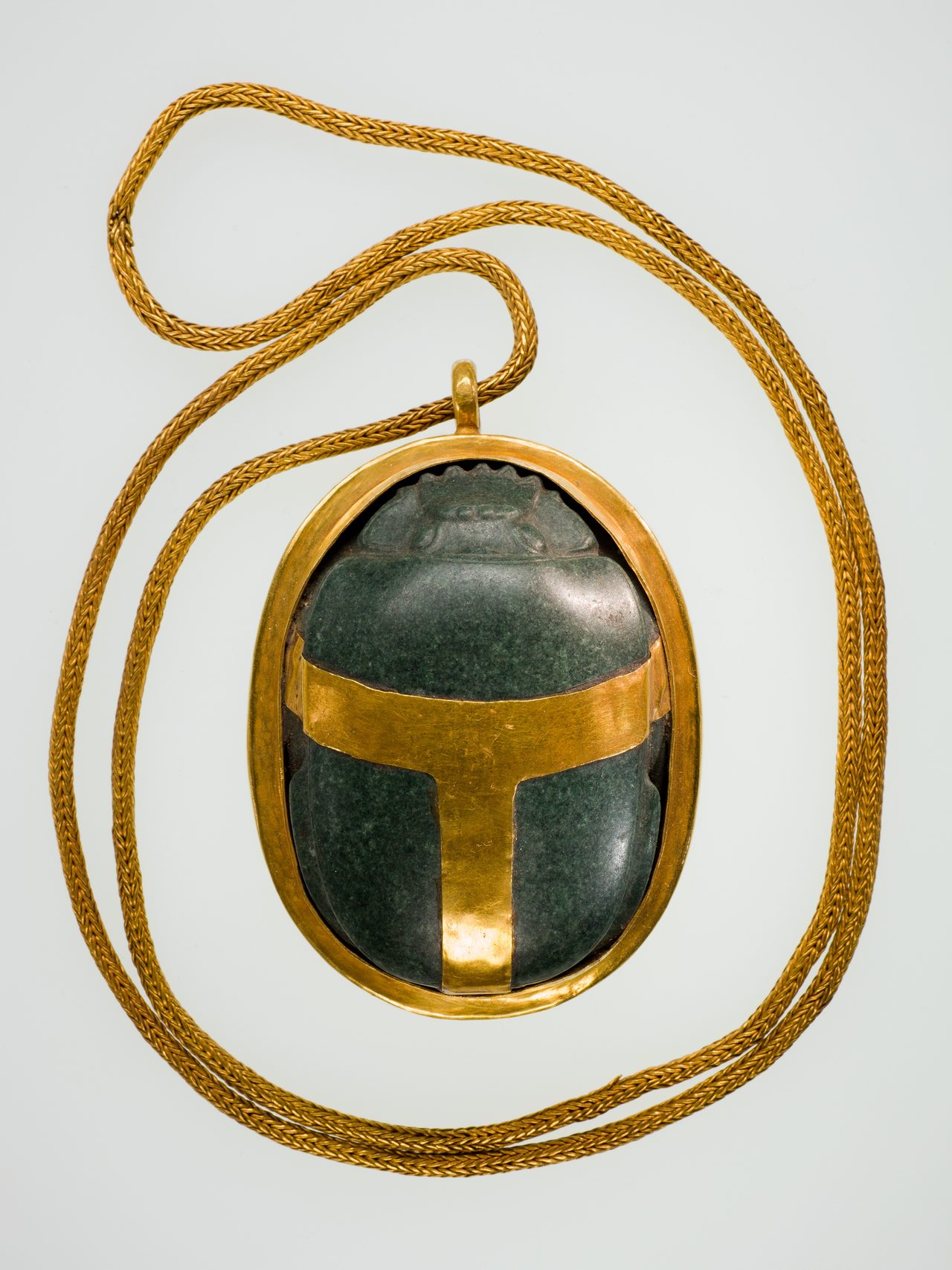
Does the weighing of the heart anticipate later ethical monotheism? This is the one the file refuses to resolve, and it labels it 'Mixed' rather than picking a side. On one hand, Ma'at is a genuine cosmic moral order and the judgment turns squarely on how a person behaved, which does point toward the ethical religions that came later. On the other, the whole setting is thoroughly polytheistic, and there is Chapter 30B. The heart-scarab spell was written for one purpose: to stop the deceased's own heart from testifying honestly against them at the very moment honesty was supposed to decide everything. The ethical emphasis is real. So is the magical escape hatch built to get around it. The file does not pretend those cancel out, and neither will this page.
Fast Facts
- Real name
- Pert em Hru, 'Coming Forth by Day.' 'Book of the Dead' is a modern label coined by Karl Richard Lepsius in 1842
- What it was
- A personalized roll of protective and navigational spells, written on papyrus with the owner's own name threaded throughout, placed with the mummy
- When
- Mainly the New Kingdom, c. 1550-1070 BCE, continuing into the Ptolemaic period; roughly 192 numbered spells, never all in one copy
- The famous copies
- The Papyrus of Ani (c. 1250 BCE), the Papyrus of Hunefer, and the Greenfield Papyrus, which runs 37 meters long
- The centerpiece
- The Weighing of the Heart (Chapter 125): the heart weighed against the feather of Ma'at, Anubis at the scale, Thoth recording, 42 divine assessors watching
- The moral code
- The 42 Negative Confessions, including two on water, not polluting it and not stopping it when it should flow, remarkable for a text 3,500 years old
- Failure
- Not eternal torture. The heart that fails is eaten by Ammit and the person dies the 'second death,' total annihilation
- The soul
- Seven named parts: Ka, Ba, Akh, Ib, Ren, Sheut, and Khat, not a single spirit
What We Can Actually Stand Behind
The textual and archaeological record is settled Egyptology, and it is exactly as reported here. The real name Pert em Hru, the personalized papyri, the three-phase history from Pyramid Texts through Coffin Texts to Book of the Dead, the mechanics of the Weighing of the Heart, the 42 Negative Confessions, the seven components of the self, and the geography of the Duat all rest on extensively translated primary sources. The file also rates the Book of the Dead a coherent worldview at Tier 1, with the honest caveat that it is a vision rather than a fixed, systematic theology.
Two interpretive questions stay genuinely open. Whether the 42 Confessions shaped the Ten Commandments is possible but not proven: the Egyptian text is older and the themes rhyme, but the structures differ and independent moral reasoning is a live alternative. And whether widening afterlife access was real social progress is only a partial democratization: ordinary people did gain access, but wealth still gated the papyri and the old hierarchy was rebuilt inside paradise. Neither is a fact to assert; both are cases with a real counter-case.
One question the file deliberately will not settle, and we hold the line with it. Whether heart-weighing anticipates ethical monotheism is genuinely mixed: the moral order of Ma'at is real and judgment turned on conduct, but the context is fully polytheistic and Chapter 30B, the heart-scarab spell, exists precisely to keep the heart from telling the truth at judgment. A sincere reckoning with a magical trapdoor built into it does not resolve cleanly, so we leave it unresolved rather than forcing an answer.
Two popular pictures are simply false, and they are worth refusing directly. There was no single, uniform Book of the Dead, no one spooky scroll of curses shared across Egypt: it was Pert em Hru, custom-assembled and different in every tomb, and it threatened no one living. And failing the scale did not condemn a person to a hell of eternal torment. The Egyptian penalty was the second death, annihilation, the end of existence, not endless punishment, and reading a Western-style hell into that scene gets the theology exactly backward. On both, the answer is no.
So the Book of the Dead lands here in the mythology wing, shelved beside the shapeshifters and the hidden folk, and the shelf almost hides what it was. Not a superstition, and not a curse. It was one of the most complete pieces of moral and spiritual engineering the ancient world produced: a personalized manual that walked a named person through the underworld, laid their conduct on a scale against the feather of truth, and made them answer, one confession at a time, for 42 specific wrongs, down to whether they had fouled the shared water or held it back from the people downstream. And then, in that same roll of papyrus, placed with that same mummy, it handed them Chapter 30B, a spell whose only job was to keep their own heart from telling the truth at the one moment truth was meant to decide everything. The Egyptians wrote both. They buried both together, for two thousand years. Which leaves the question this whole file keeps circling back to: did they see the contradiction we see, a sincere reckoning wired with a trapdoor, or did they understand something about the heart, and about mercy, that our tidier idea of judgment has simply lost?
Sources & further reading
Everything above is drawn from our research library on Theories of Anything, and every tiered claim traces back to the file below, A_3_03, plus the cross-referenced files it connects to. The related traditions named here, the Greek gold tablets and the Tibetan Bardo Thodol, are offered as genuine parallels in the literature of the dead, not as claims of direct influence. The one exception to the sourcing is the museum provenance of the Papyrus of Ani (British Museum EA10470) and the Papyrus of Hunefer (British Museum EA9901): those catalogue and acquisition details come from the British Museum's own collection records, not from the A_3_03 research file.
Image credits
- The Weighing of the Heart, Papyrus of Ani unknown ancient Egyptian artist, c. 1250 BCE, photographed by the British Museum, via Wikimedia Commons. Public domain Source.
- Ani kneeling before the enthroned Osiris, Papyrus of Ani (facsimile) unknown ancient Egyptian artist, c. 1250 BCE, facsimile by E. A. Wallis Budge, via Wikimedia Commons. Public domain Source.
- The Field of Hotep vignette, Papyrus of Ani (facsimile) unknown ancient Egyptian artist, c. 1250 BCE, facsimile by E. A. Wallis Budge, via Wikimedia Commons. Public domain Source.
- Heart Scarab of Hatnefer, Metropolitan Museum of Art photograph by Gustavo Camps, Metropolitan Museum of Art, via Wikimedia Commons. CC0 1.0 Source.
- A complete set of four canopic jars, Walters Art Museum photograph by the Walters Art Museum, Baltimore, via Wikimedia Commons. CC BY-SA 3.0 Source.
- Card crop of The Weighing of the Heart, Papyrus of Ani unknown ancient Egyptian artist, c. 1250 BCE, photographed by the British Museum, via Wikimedia Commons. Public domain Source.


