The Emerald Tablet: The Text That Built Western Alchemy
The four words most people associate with the Emerald Tablet, "as above, so below", are not in it. What is in it is stranger and far better documented: a text short enough to read aloud in under a minute, first surfacing in Arabic at the close of a book nobody can date to a year, credited to a sage who never existed, carried into Latin at least twice, by two different roads, printed at Nuremberg in the sixteenth century, and copied out in English by Isaac Newton. Here is the file, every claim wearing its tier.
Four words carry this text around the world, and they are not in it. As above, so below. They are on book covers, on forearms, in film scripts and in a thousand explanations of the Emerald Tablet. Go to the Latin, or to the Arabic, or to the English that Isaac Newton wrote out in his own hand, and they are simply not there. What is there is longer, older in the wrong way, and considerably more interesting.
The Emerald Tablet is real, and that is the part the argument about it keeps forgetting. It is a short text with a traceable manuscript history, sitting in named libraries under named shelfmarks, on a route we can follow step by step from Arabic into Latin into print into English. The legend wrapped around it is a separate object, and the whole value of this file is keeping the two apart: what the manuscripts show on one side, what tradition asserts on the other. Let's open the file.
01The Line, And The Line That Replaced It
The phrase as above, so below does not appear in the Emerald Tablet in that form. Not in the Latin, not in the Arabic, not in Newton's English. It is a modern English compression of two mirrored clauses in the text, and it came into wide circulation through later occult writing rather than through the text itself. That is not pedantry. The four-word version is a slogan: symmetrical, closed, finished. What the text actually says is a construction with a direction in it, and the direction is the thing that got lost.
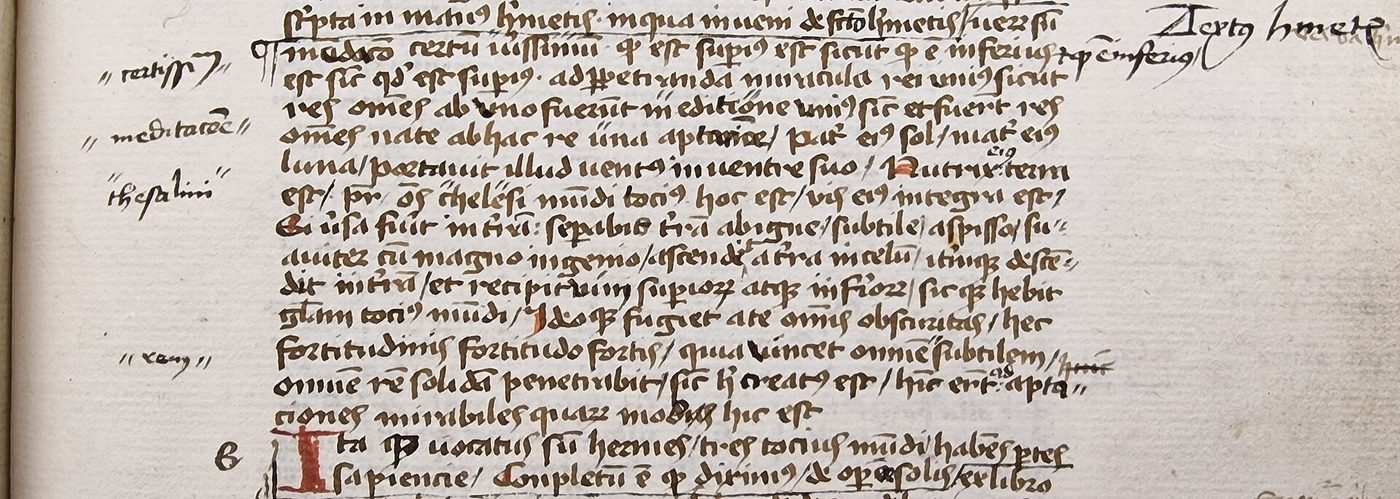
In the witnesses this page shows you, the below comes first. The Latin runs Quod est inferius est sicut quod est superius, that which is below is like that which is above, and only then the mirror clause running back the other way. Newton's English keeps the same order: "That which is below is like that which is above & that which is above is like that which is below to do the miracles of one only thing." Before either clause, the text insists on its own truthfulness. Newton's copy of the Latin, in Keynes MS 28, begins Verum est sine mendacio, certum et verissimum, which is "It is true, without lying, certain and most true." Printed editions carry that opening without the word est in the first clause. Manuscripts and printings differ, which is exactly why a quotation of this text should always name the witness it came from.
A text that begins by swearing it is not lying is a text that knows somebody might wonder. Hold on to that opening.
02The Oldest Thing Anybody Can Show You
There is no ancient original of the Emerald Tablet, and none has ever been found. It is not in the Corpus Hermeticum. It is not in the Latin Asclepius. It is not in any surviving Greek or Greco-Egyptian source. Brian Copenhaver's standard English edition of the Hermetica carries seventeen Greek treatises and the Asclepius, and the Emerald Tablet is not among them, because it belongs to a separate and later strand of Hermetic writing composed in Arabic. The honest way to put this is not that no original has yet been found, which invites you to picture one waiting in a vault somewhere. The history of this text begins where its evidence begins.
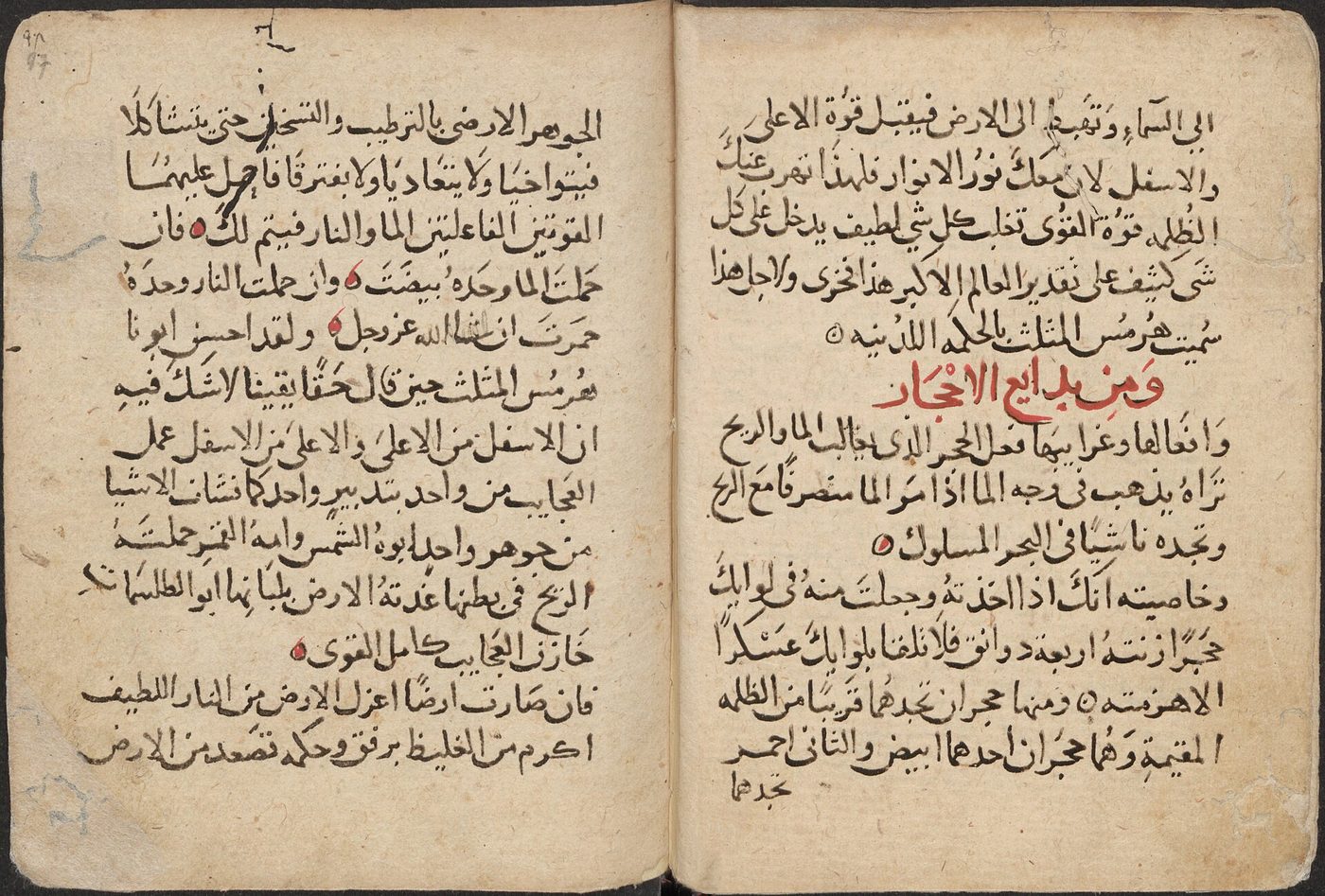
The earliest known text of the Emerald Tablet is in Arabic, and it sits at the close of a book called the Kitab sirr al-khaliqa wa-san'at al-tabi'a, the Book of the Secret of Creation and the Art of Nature. The Tablet comes at the end of that work, as a closing or appended text rather than something threaded through it. Ursula Weisser produced both the critical edition of the Arabic and the standard monograph study of the book, which de Gruyter published in 1980. Kevin van Bladel's The Arabic Hermes, from Oxford in 2009, is the current reference treatment of the whole Arabic Hermetic tradition this text belongs to.
The Secret of Creation is generally placed in the late eighth or the early ninth century, and in any case treated as complete no later than the caliphate of al-Ma'mun, 813 to 833. Earlier composition has been proposed and cannot be ruled out. The dating rests on internal evidence rather than on a dated manuscript, which is precisely why it arrives as a range and not as a year. Anyone who hands you a single year for the Emerald Tablet is telling you something the evidence does not support.
03Three Attributions, And Not One Author
The Secret of Creation is itself credited to somebody who did not write it. Balinas, the name on the book, is the Arabic form of Apollonius of Tyana, a Greek holy man of the first century. The work is a later Arabic composition written under his name, which is why Weisser's monograph is titled for the book of Pseudo-Apollonios of Tyana. So the earliest surviving container of the Emerald Tablet already carries a false name on its cover, and the text inside it carries a second one.
There is a second early Arabic witness. A somewhat shorter version of the Tablet is quoted in the Kitab ustuqus al-uss al-thani, the Second Book of the Element of the Foundation, one of the alchemical treatises attributed to Jabir ibn Hayyan. The Jabirian corpus and the Secret of Creation are the two earliest textual contexts in which this text survives at all.
And this is where the popular account of the Tablet's age quietly comes apart. It is often said that the Jabirian quotation dates the text to the eighth century, because Jabir ibn Hayyan lived in the eighth century. The scholarship says the opposite. Paul Kraus, in the two volumes of Jabir ibn Hayyan: Contribution a l'histoire des idees scientifiques dans l'Islam, published at Cairo in 1942 and 1943, argued that the writings under Jabir's name are not the work of one eighth-century man at all. They are the work of a group of authors of Isma'ili sympathies, produced piece by piece over roughly a century, beginning no earlier than the second half of the ninth century. Fuat Sezgin later disputed this and argued for greater antiquity, and the argument is not formally closed, but Kraus's dating is the position most historians of Arabic science still work from. The Jabirian corpus cannot push the Emerald Tablet back into the lifetime of the man whose name it wears, because the corpus itself does not reach that far.
That last part matters, because it is what a debunk gets wrong. The Emerald Tablet's attribution to Hermes Trismegistus is pseudepigraphic: the text speaks in the first person as Hermes, and it was composed centuries after the Hermetic literature it claims kinship with, in a different language and a different world. Attributing a new work to an ancient sage was normal, expected practice in the traditions this text comes from. It was how authority got built, not how a fraud got committed. Gilles Quispel's study Gnosis and Alchemy: The Tabula Smaragdina is a peer-reviewed treatment of that religious background. Judged as a forgery the Tablet is a curiosity. Judged as literature it is a particularly successful example of how that worked.
04Who Hermes Trismegistus Actually Is
Hermes Trismegistus, Thrice-Great Hermes, is a syncretic figure formed in Greco-Roman Egypt when the Greek god Hermes was identified with the Egyptian god Thoth, the ibis-headed patron of writing, wisdom and the moon. He is not a historical person and there is no candidate for one: no temple archive, no dynasty, no sage whose life the legend could be a distorted memory of. He is a name two religions built together.
That name is attached to a large and heterogeneous body of writing, philosophical, astrological, magical and alchemical, composed by many anonymous authors. The Greek philosophical Hermetica are broadly placed between roughly the first century before the common era and the third century after it. A separate and later body of Hermetic writing was composed in Arabic. The Emerald Tablet belongs to that Arabic strand. It is not a late copy of a Greek Hermetic text. It is a member of a different literature that hung the same name on its door.
Keep those two bodies of writing apart and almost every confusion about the Emerald Tablet dissolves. The Greek Hermetica are genuinely old. The Emerald Tablet is not part of them. It borrowed their author.
05Into Latin, Twice, By Two Different Roads
Hugo of Santalla, a translator working in the kingdoms of Aragon and Castile in the middle of the twelfth century, rendered the Secret of Creation into Latin as the Liber de secretis naturae, and the Emerald Tablet crossed into Latin inside it. Francoise Hudry published the critical edition of Hugo's Latin in the journal Chrysopoeia. Notice what that does not say. The text was not translated from "the Arabic" in some general sense but from one specific Arabic book, and which book turns out to matter enormously.
Because there is no single Latin Emerald Tablet. Several Latin versions circulated, and the one that became Europe's standard text, the vulgate later alchemists quote, did not come through Hugo. It reached the West chiefly inside the Secretum secretorum, the Latin translation of a pseudo-Aristotelian Arabic work called the Sirr al-asrar, which was one of the most widely copied books of the Middle Ages. Two routes, two different Arabic parents, one short text arriving twice. Robert Steele and Dorothea Waley Singer set out the competing Latin versions in the Proceedings of the Royal Society of Medicine in 1928, and the medieval Latin career of the text and its commentaries is the subject of two studies in the Brepols volume Hermetism from Late Antiquity to Humanism.
| Stage | What actually survives | Tier |
|---|---|---|
| An older Greek or Syriac original | Nothing. No manuscript, no fragment, no quotation in any other author. | Open question |
| Arabic, in the Secret of Creation | The text at the close of the Kitab sirr al-khaliqa, edited by Ursula Weisser. | Tier 1 |
| Arabic, across the recensions | Arabic and Persian copies in Berlin, Paris, Leipzig and Tehran. | Tier 2 |
| Arabic, quoted in the Jabirian corpus | A shorter version, inside the Second Book of the Element of the Foundation. | Tier 1 |
| Latin, by Hugo of Santalla | The Liber de secretis naturae, edited by Francoise Hudry in Chrysopoeia. | Tier 1 |
| Latin, inside the Secretum secretorum | The version that became Europe's standard text, by a different Arabic parent. | Tier 2 |
| A page carrying the Latin in De Alchemia, printed at Nuremberg by Johannes Petreius. | Tier 2 | |
| English, by Isaac Newton | Keynes MS 28, King's College, Cambridge, translated from a French source. | Tier 1 |
Read that as a chain of custody, because that is what it is. Every row below the first has a physical object behind it: a manuscript with a shelfmark, an edition with an editor's name, a printed page you could photograph. The first row has nothing behind it at all.
And notice how the documentation behaves at that boundary. It does not thin out gradually as you go back. It stops, all at once, at the Arabic. Behind that line there is no manuscript and no fragment, only an argument, and we come back to it at the end because it is still running.
06Into Print, And Into Everybody's Hands
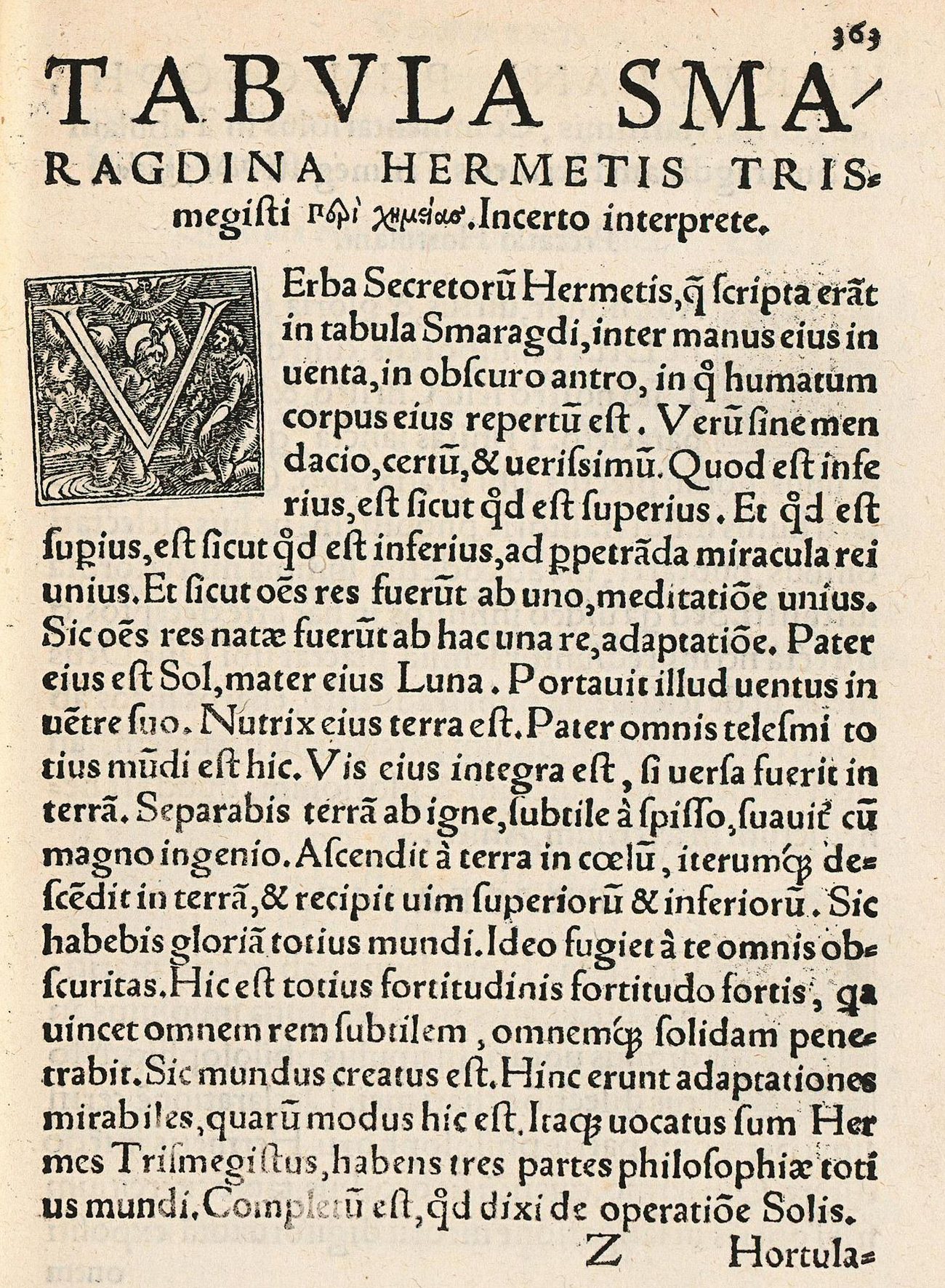
The Latin text was in print by the middle of the sixteenth century. A page carrying it survives in De Alchemia, printed at Nuremberg by Johannes Petreius in 1541. Print is the hinge of this whole story. A manuscript is a rumour you have to travel to read. A printed page is a text every alchemist in Europe can own and argue with, in the same words, at the same time.
The Arabic, meanwhile, survives in more than one recension, and the recensions differ in wording and in length. Julius Ruska set out the problem of the earliest form in the Orientalistische Literaturzeitung in 1925, and again the following year in a monograph, Tabula Smaragdina: Ein Beitrag zur Geschichte der hermetischen Literatur. Martin Plessner published further material a year after that in Der Islam. Surviving Arabic and Persian copies are held in, among other places, Berlin, Paris, Leipzig and Tehran.
Which gives the honest answer to the obvious question: how long is it? Short. Newton's English translation runs to a single paragraph of roughly two hundred words, and the whole of Keynes MS 28, translation and Latin text and Newton's commentary and notes together, comes to about a thousand words. You will see the Tablet described as having a specific number of lines or clauses. Treat every such figure with suspicion, because it depends entirely on which recension is being counted and on how one editor chose to divide it. The description that survives contact with the evidence is simpler: the Emerald Tablet is short enough to read aloud in under a minute.
07Five Centuries As The Charter Of A Discipline
For roughly five hundred years this text functioned as the theoretical charter of Western alchemy. Its "one thing" was identified with the prima materia, the first matter from which all substances were held to derive. The sequence it describes, separation of the subtle from the gross followed by ascent, descent and recombination, was read as the formula for the Great Work, the opus magnum. Lawrence Principe's The Secrets of Alchemy is the current standard general treatment of the tradition that read it that way. Sit with the size of that fact for a moment. A text short enough to read aloud in under a minute, whose author nobody can name and whose date nobody can fix closer than a span of decades, carried the theoretical weight of an entire discipline for five centuries.
It managed that not in spite of being short and obscure but because of it. A long, specific text can be shown to be wrong. Roughly two hundred words of mirrored clauses and mineral imagery can be read against almost any result a furnace produces, and that is what keeps a founding document alive.
Historians of science have argued that the Tablet's language encodes real laboratory operations, distillation, sublimation, calcination, in allegorical dress. Medieval and early modern alchemists certainly read it that way and worked from it, and the reading did not die with them: in 1923 the chemist E. J. Holmyard published a note on the text in Nature. Whether the original author or authors intended chemical specificity, or meant something purely philosophical, is not settled and probably cannot be settled from a text this short. The same handful of sentences served as a laboratory recipe for some readers and as metaphysics for others, for a thousand years, and the text never adjudicates between them.
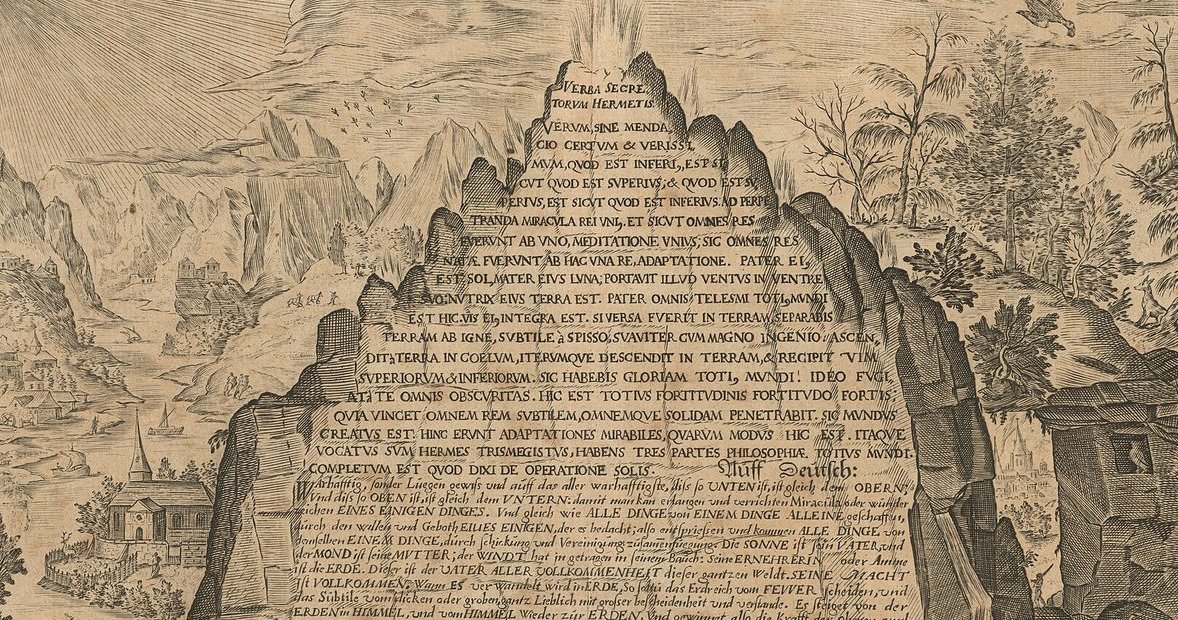
Europe did not only read the Tablet. It designed it. Heinrich Khunrath's Amphitheatrum sapientiae aeternae lays the text out as an engraved emblem, a thing to be contemplated whole as well as read line by line. That is a long way from a paragraph at the back of an Arabic book, and it is what the Tablet had become.
08Newton Copies It Out
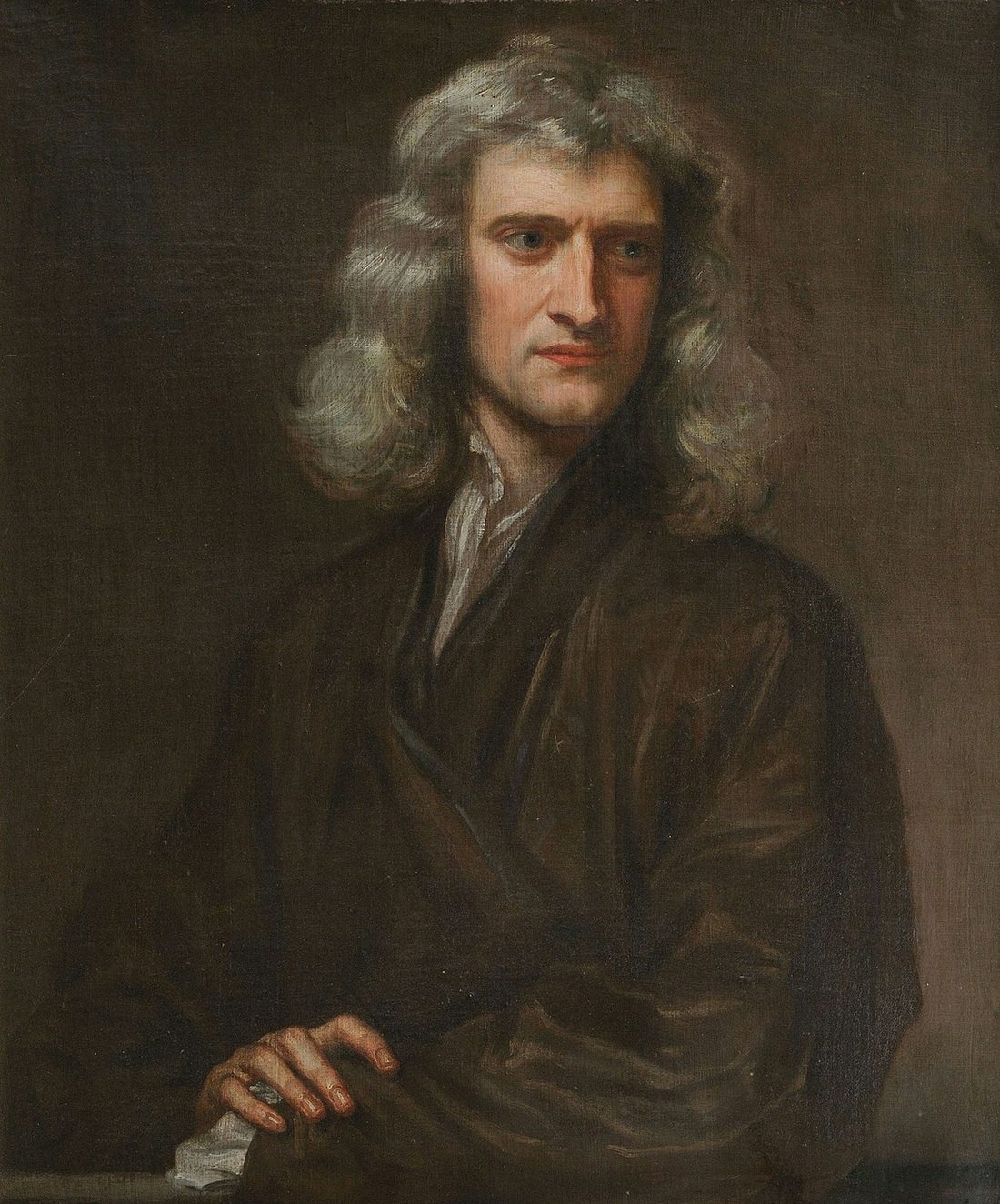
Isaac Newton copied, translated and annotated the Emerald Tablet. The manuscript is Keynes MS 28, in the library of King's College, Cambridge, and it holds three layers in his hand: an English translation, the Latin text, and a Latin commentary. The Newton Project's catalogue dates the document to the early 1680s through the 1690s and describes it as assembled in stages. The Latin was copied in the early 1680s, with notes following. The English translation came later, in the late 1680s or the early 1690s, and it was made from a French source. Further annotations may have been added after 1700. The date of about 1680 that often gets attached to for Newton's English translation is a decade too early.
Follow that chain once more, because it repays a second look. Newton's English Emerald Tablet is a translation of a French translation of a Latin translation of an Arabic text whose own original, if it ever had one, nobody has ever seen. The man who wrote the Principia was reading a rumour four languages deep, and taking notes.
Here is how his version opens: "Tis true without lying, certain & most true. That which is below is like that which is above & that which is above is like that which is below to do the miracles of one only thing." Between that and the end it names the sun as the thing's father and the moon its mother, says the wind carried it in its belly and the earth is its nurse, and instructs the reader to separate the earth from the fire, the subtle from the gross, sweetly and with great industry. It closes: "Hence I am called Hermes Trismegist, having the three parts of the philosophy of the whole world. That which I have said of the operation of the Sun is accomplished & ended." The ampersands are his.
None of this was a hobby kept in a drawer. Newton left a very large body of alchemical manuscripts, commonly described as running to something on the order of a million words, most of it unpublished in his lifetime and largely unknown until the twentieth century. He wrote more on alchemy than he ever published on physics. The Emerald Tablet commentary sits inside that body of work, and it is not an outlier there.
09The Idea Was Older Than The Text
Here is the thing the Tablet is usually credited with and did not actually do. The idea it compresses, that the structure of the cosmos is mirrored in the structure of the individual, was already old and widely distributed when the text was written. Plato's Timaeus describes the cosmos as a living being whose order is reflected in the human body. Stoic physics worked with sympatheia, a universal interconnection running between all parts of the cosmos. Chinese medical and cosmological writing treats the human body as a smaller version of the order of heaven and earth. The Emerald Tablet's contribution is not the idea at all. It is the compression: two mirrored clauses, short enough to memorise, portable enough to survive four languages and a thousand years of copying.
One parallel deserves a warning. A Sanskrit maxim usually rendered as "as in the microcosm, so in the macrocosm" is widely quoted in modern Hindu and yogic writing as the Indian version of the same doctrine, and it is routinely presented as scripture. Its textual source is hard to pin down. The attributions in circulation point variously at the Yajurveda, the Rigveda and the Puranas, and not one of them arrives with a chapter or a verse attached. That does not make the comparative point wrong. It does make the citation unusable, and it is worth noticing that the same process which handed the Emerald Tablet to Hermes is visibly still running.
10What This File Refuses
The Secret of Creation frames the Tablet with a discovery story. In it Balinas enters a hidden vault or chamber, finds the tablet held by a seated figure, and carries the text out. That story is part of the work as it was written. Its details vary between recensions, which is a useful signal in itself, and the story belongs to a recognised literary genre of its period. It is a frame, not a field report, and nobody at the time expected it to be read as one.
Which disposes of the name. The Tablet's title is sometimes explained by reaching for later alchemical colour symbolism. That explanation has nothing behind it, and it runs the sequence backwards, because the name is older than the imagery being used to account for it. The real answer is simpler and better. The text is called the Emerald Tablet because the story attached to it says the text was found written on a tablet of green stone. The name comes from the frame narrative, and the frame narrative is the only evidence there ever was.
And there was never a physical tablet of emerald. No such object has been found, described by any witness, catalogued in any collection, or referred to by anybody who claims to have seen it. Not once, by anyone, in the documented life of the text. The Emerald Tablet is a text. Claims of a literal gemstone slab are later embellishment layered onto a story that was already a literary device on the day it was written.
Nor does the Tablet preserve ancient Egyptian temple teaching carried through Hellenistic intermediaries into Arabic. No Egyptian-language precursor of this text has ever been found. No Greek precursor has been found either. The Egyptian colouring the Tablet carries is the Egyptian colouring the whole Hermetic literature carries, and that literature is a Greco-Roman and later Arabic construction of Egypt rather than a survival from it. This one sits at Tier 3 rather than Tier 4 deliberately, because nobody can prove a lost text never existed. What can be said flatly is that no such text has been found and nothing points toward one.
The Emerald Tablet, By The Evidence
- Earliest surviving text
- Arabic, at the close of the Kitab sirr al-khaliqa. Nothing older survives in any language.
- When
- Late eighth or early ninth century on internal evidence, complete no later than al-Ma'mun's caliphate. A range, never a year.
- Attributed author
- Hermes Trismegistus, a syncretic Greco-Egyptian figure who is not a historical person.
- Actual author
- Unknown, and anonymous by design. Attributing a new work to an ancient sage was normal practice in this literature, not a hoax.
- Length
- Short enough to read aloud in under a minute. Any line count you meet is one editor's division of one recension.
- Into Latin
- More than once. Hugo of Santalla in the middle of the twelfth century; the version Europe memorised came through the Secretum secretorum instead.
- Into print
- By the middle of the sixteenth century, at Nuremberg.
- Newton's copy
- Keynes MS 28, King's College, Cambridge. Latin copied in the early 1680s, English translated later from a French source.
- A physical tablet
- None. No object, no witness, no catalogue entry, ever.
11The One Question That Is Still Open
You will read that the scholarship on this text is settled. It is not, and the dispute is one of the more interesting things about the subject. The origin and the earliest form of the Emerald Tablet have been argued over continuously since the 1920s: Ruska's attempt to reconstruct an original form, Plessner's new materials the following year, Kraus's redating of the Jabirian corpus and Sezgin's rejection of that redating. What is well established is the transmission, which is why this file spends most of its length on it. What is not established is where the transmission starts.
So here is the open question, stated exactly. Nobody knows whether the Emerald Tablet is an original Arabic composition or a translation of an older Greek or Syriac text that has not survived. Some scholars have judged it plausible that the Arabic renders a lost earlier original. Others hold that it is an Arabic composition assembled out of older materials. No Greek or Syriac manuscript of it is known to exist. The question turns on internal evidence, on vocabulary and idiom, and a text this short makes very thin evidence for that kind of argument.
Read that seam carefully, because it is the easiest thing here to misread. The live question is philological and it concerns late antiquity: Greek or Syriac, argued by specialists over word choice. It is not a back door to the Egyptian temple. Those two claims live in different rooms, and only one door is open.
What We Can Actually Stand Behind
The Emerald Tablet is a real text with a traceable history, and its earliest surviving witnesses are Arabic: the close of the Kitab sirr al-khaliqa, and a shorter version quoted in the Jabirian corpus. Balinas, the name on the Secret of Creation, is pseudo-Apollonius of Tyana. The Jabirian treatises are themselves pseudepigraphic and cannot date the Tablet to the eighth century. Hugo of Santalla brought the text into Latin in the middle of the twelfth century. In Newton's copy and in the printed vulgate, the below comes first. Isaac Newton copied it, translated it and wrote a commentary on it, and that manuscript is Keynes MS 28 at King's College, Cambridge. The attribution of the Tablet to Hermes Trismegistus is pseudepigraphic.
Hermes Trismegistus himself is a syncretic Greco-Egyptian figure rather than a historical person. The Secret of Creation belongs to the late eighth or early ninth century and was complete no later than al-Ma'mun's caliphate. More than one Arabic recension survives and they differ in wording and length. There was never one Latin version: the text Europe standardised travelled inside the Secretum secretorum rather than through Hugo's translation. The Latin was in print at Nuremberg by the middle of the sixteenth century. For roughly five centuries the text served as the theoretical charter of Western alchemy. Newton's alchemical papers run to something on the order of a million words. Whether the Arabic renders a lost Greek or Syriac original is genuinely unsettled, and specialists argue it both ways.
That the Tablet's language encodes specific laboratory operations rather than a purely philosophical scheme, which a text this short probably cannot settle either way. That the text preserves genuine ancient Egyptian temple teaching: no Egyptian precursor has ever been found, no Greek one either, and nothing points toward one.
That a physical tablet of emerald ever existed. There is no object, no witness, no catalogue entry, and no description by anybody who claims to have seen one. That the name derives from later alchemical colour symbolism, when the name comes from the discovery story and is older than the imagery offered to explain it. And "as above, so below" is not a line of the Emerald Tablet in the Latin, in the Arabic, or in Newton's English.
So the file closes with a real gap in it, and the gap is nowhere near where the legend wants to put it. Nobody is out looking for a slab of green stone. What is genuinely missing is a manuscript in Greek or Syriac that may never have existed at all, and whose absence a text this short cannot settle either way. Meanwhile a text with no author, no original and no object outlasted the caliphate that first copied it, the Latin Christendom that translated it twice, and the print shops that sold it, and ended up in the handwriting of the man who worked out gravity. Something in it kept being worth copying out. What that something was is a question the manuscripts cannot answer, and it is still open.
Sources & further reading
The research file at the top is where we worked from. It is our own claim, so it is not a check on us, and on this subject it needed correcting in several places. Everything beneath it is where you can check us independently: the editions, the journal articles, and the two Newton entries, which are the manuscript itself and its catalogue record. Five identifiers carried by our own file turned out to resolve to book reviews of the books they named, to an unrelated work, or to no edition at all. None of the five is used here.
Image credits
- Heinrich Khunrath, Amphitheatrvm sapientiae aeternae Heinrich Khunrath, via Wikimedia Commons. Public domain Source.
- Heinrich Khunrath, Amphitheatrvm sapientiae aeternae Heinrich Khunrath, via Wikimedia Commons. Public domain Source.
- Emerald Tablet Landberg 121 Unknown author, via Wikimedia Commons. Public domain Source.
- Emerald Tablet British Library Arundel MS 164 fol 155r Paracelsus1493, via Wikimedia Commons. CC BY-SA 4.0 Source.
- Emerald Tablet Johannes Petreius Johannes Petreius, via Wikimedia Commons. Public domain Source.
- Portrait of Sir Isaac Newton, 1689 Godfrey Kneller, via Wikimedia Commons. Public domain Source.


