Gobekli Tepe: The Temple Built Before Farming
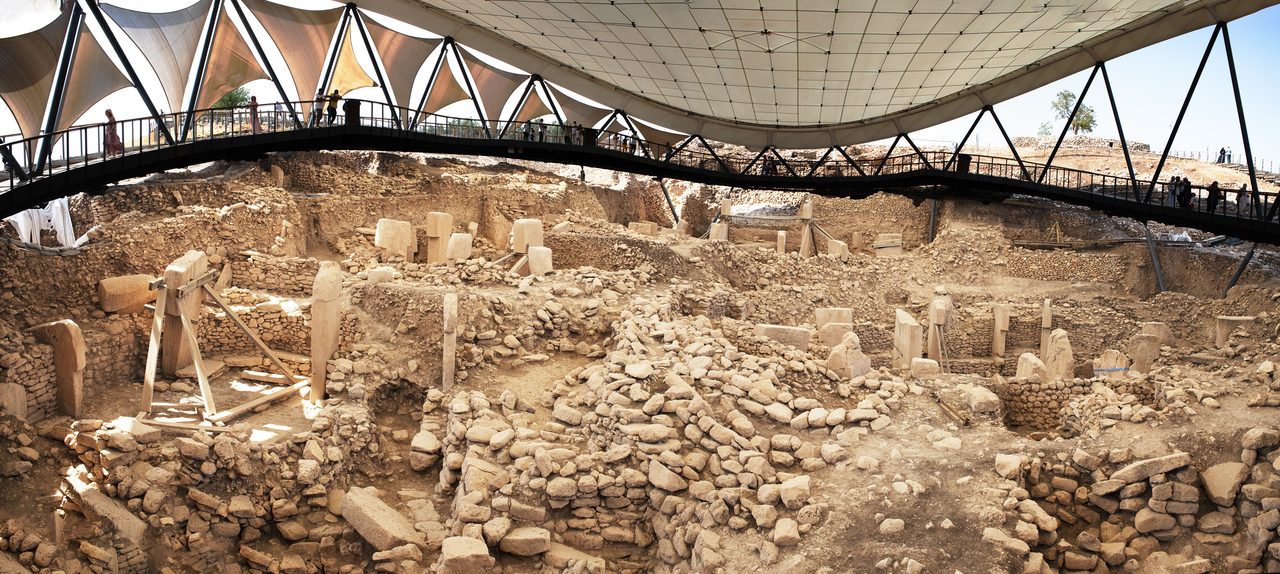
A ring of carved stone pillars rose in the hills of southern Turkey around 9600 BCE, raised by people who had no farms, no pottery, no metal, and no wheel. Then they buried it. Here is the file, opened from the bedrock up, every claim wearing its evidence.
Around 9600 BCE, in the hills above what is now Sanliurfa in southeastern Turkey, people who owned nothing we would call civilization began cutting rings of T-shaped stone pillars, some as tall as a two-story house and heavier than a truck. They had no pottery. No metal, only flint and stone. No draft animals, no wheel, no writing, and no farms. Every textbook said monuments like this came at the END of that list, not the beginning. Then, after more than a thousand years, they filled the whole complex in with rubble and walked away. Let's open the file.
| Feature | Detail |
|---|---|
| Typical pillar height | 3 to 6 meters (10 to 20 feet) |
| Weight per pillar | up to 10 to 20 tonnes |
| Central paired pillars | up to ~5.5 meters tall |
| Largest unfinished pillar | ~7 meters, still in its quarry |
| Quarry distance | ~100 meters from the enclosures |
| Tools available | flint and stone only, no metal |
| Enclosures mapped | at least 20 (by ground radar) |
01Older than farming, older than the wheel
Radiocarbon dates place Gobekli Tepe's oldest circular enclosures at roughly 9600 to 8500 BCE, deep in the Pre-Pottery Neolithic, with the site's broader occupation running on to about 8000 BCE. That is about 6,000 years before Stonehenge and roughly 7,000 years before the Great Pyramid of Giza. The chronology is peer-reviewed, and the site has been a UNESCO World Heritage Site since 2018. None of that is in serious dispute.
Here is why those dates detonate. Wild einkorn wheat grew on the surrounding hills, but domesticated crops do not appear in the earliest layers. By every model in every textbook, monuments were supposed to be the LAST thing a society produced, arriving only after farming created the food surplus that freed people to build. Gobekli Tepe was built first, by hunter-gatherers, thousands of years too early.
02Stone giants, cut with flint
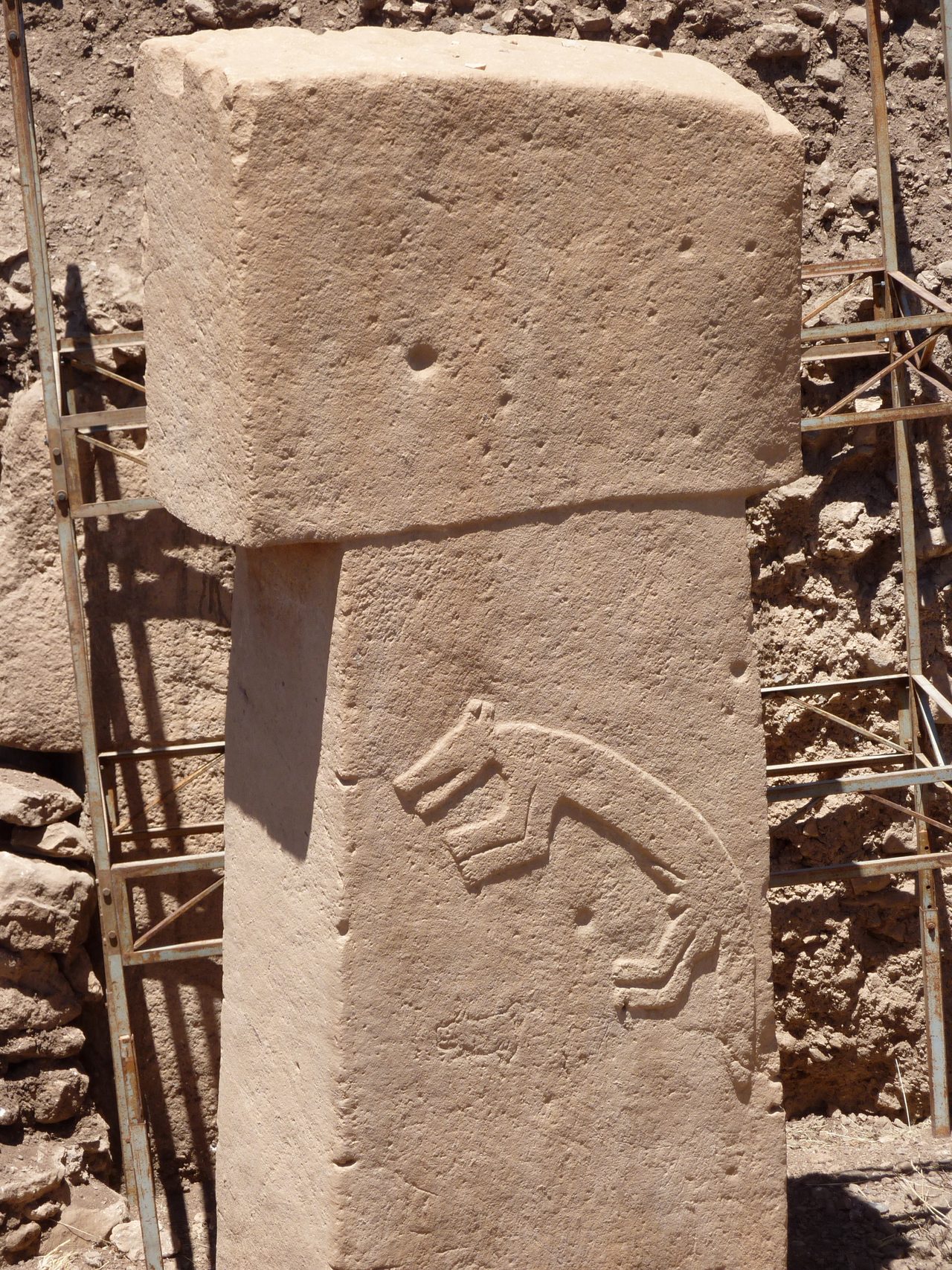
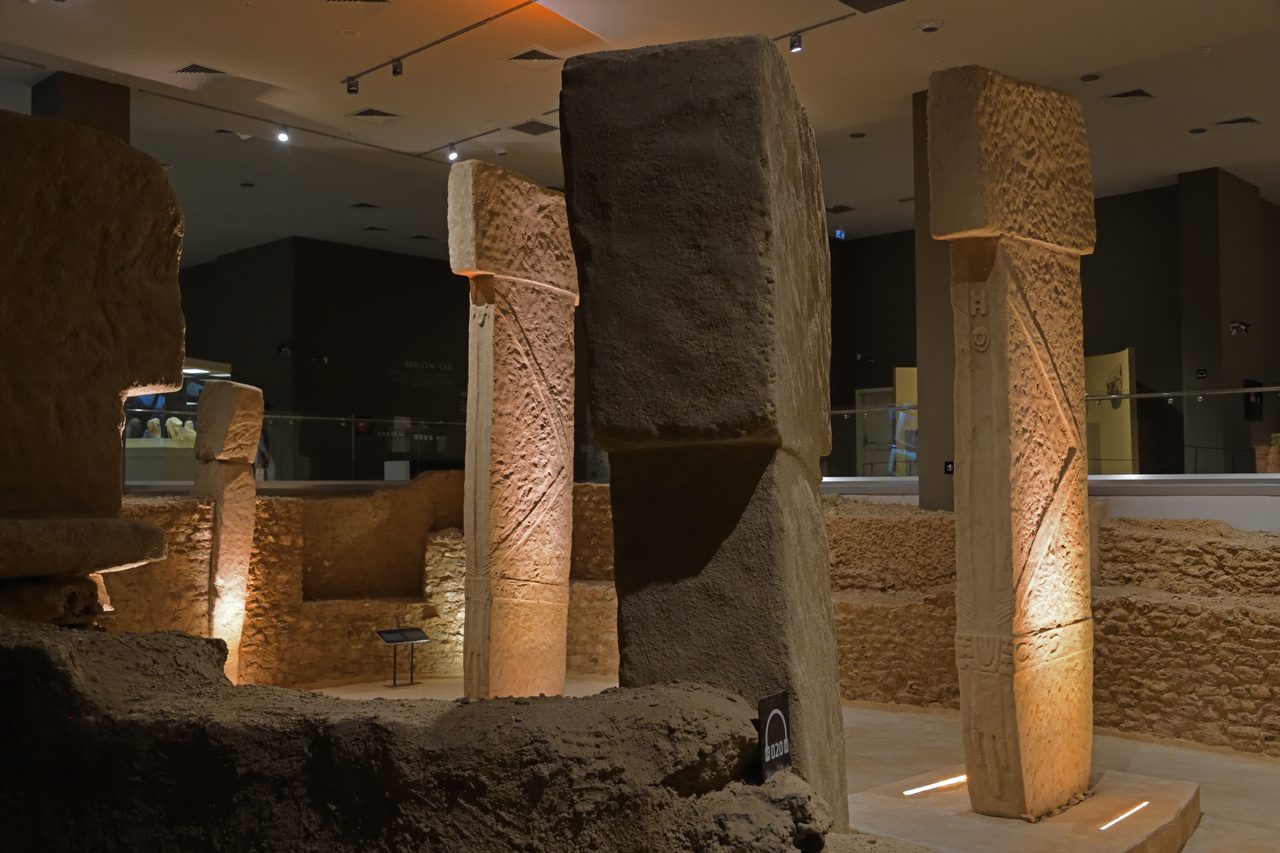
The T-shaped limestone pillars are real and measured. Most stand 3 to 6 meters (10 to 20 feet) tall and weigh up to 10 to 20 tonnes, with the central paired pillars in each enclosure reaching about 5.5 meters. The largest, still lying unfinished in a quarry roughly 100 meters away, is around 7 meters long. All of it was cut, moved, and raised with flint and stone tools, which archaeologists estimate took hundreds of coordinated workers per pillar.
The pillars are not blank slabs. They are carved in high relief with a bestiary of wild animals: foxes, boars, aurochs, cranes, scorpions, and above all snakes, which turn up in nearly every enclosure. The T-shape itself appears to be a stylized human body. Some pillars carry carved arms, hands, and belts, which makes each enclosure read like a ring of towering stone figures standing face to face.
03First came the temple, then the city
The standard sequence of human progress ran in one direction: farming first, then a food surplus, then permanent settlements, then social hierarchy, then organized religion, and only at the very end, monuments. Gobekli Tepe runs that list backwards. The monument and the shared ritual life came first, around 9600 BCE. Domesticated farming shows up in the same region centuries later. The site's excavator, Klaus Schmidt, compressed the whole upheaval into six words.
| The traditional model | The Gobekli Tepe model |
|---|---|
| Farming produces a food surplus | Ritual gatherings draw large crowds |
| Surplus frees people to build | Feeding the crowds spurs cultivation |
| Settlement, then religion, then temples | Temple, then settlement, then farming |
Some archaeologists go further and argue the causation actually reversed: that the need to feed the crowds gathering to build and worship here is part of what DROVE the domestication of wild grains. The oldest known domesticated einkorn wheat is traced to Karaca Dag, only 20 to 30 kilometers away. This is a serious, credible hypothesis, and it is genuinely open. Grinding stones and cereal residue are present at the site, but clearly domesticated crops are not, so the exact link between the temple and the birth of farming is not yet settled.
04The labor problem nobody has solved
Feeding a workforce this large, with no agriculture and no stored harvest, is a real puzzle, not a rhetorical one. Cutting, dragging, and standing 10 to 20 tonne pillars demanded organized teams of hundreds, and those people had to eat. Either Pre-Pottery Neolithic hunter-gatherers were far more socially organized than anyone had credited, or some food system we have not yet identified was in play. That the labor happened is beyond doubt. How it was fed is not.
The most common answer is feasting: seasonal gatherings where hunting parties brought in enough wild game and grain to sustain a building season. Thick deposits of animal bone in the fill are consistent with large communal meals. It is a good answer. It is not yet a proven one.
05Then they buried it
Now the strangest part. Around 8000 BCE, after more than a thousand years of use, the enclosures were packed to the brim with thousands of tonnes of rubble, stone chips, animal bone, and soil, and buried. The site was not toppled or left to erode. It was filled in, deliberately, with roughly the same enormous coordinated effort that raised it. That burial is exactly why the carvings survived, sealed and intact, for ten thousand years.
The enclosures were found packed with fill and preserved beneath it. Whatever the motive, the infilling sealed the site, which is how reliefs this old reached us at all. Different enclosures were buried at different times, and the care of the filling looks more like respect than destruction.
Why they did it is unknown, and even how deliberate it was is debated. The mainstream reads it as ritual closure, or as foundations for the smaller, later structures built on top. Archaeologist E. B. Banning (2011) pushed back, suggesting some enclosures may have been roofed domestic buildings and the fill partly ordinary occupation debris. No single explanation has reached consensus, and with only 5 to 10 percent of the site excavated, the answer may still be underground.
06Where the lost civilization comes in, and why it doesn't hold
Because the dates are so extreme, Gobekli Tepe has become a favorite exhibit for a far bigger claim. Writers like Graham Hancock argue it is not the beginning of civilization but the survival of one: a relic from an advanced culture erased by the Younger Dryas cold snap, whose refugees came here to preserve their knowledge. Older ancient-astronaut versions credit the precision to visitors from elsewhere, and reptilian readings point to all those carved snakes.
The lost-civilization reading rests on a real event and an argument from disbelief. The Younger Dryas cooling (roughly 10,800 to 9600 BCE) genuinely happened and genuinely reshaped the climate. But there is no artifact, no toolkit, no settlement layer at Gobekli Tepe from any earlier advanced culture. The claim runs on the feeling that hunter-gatherers could not possibly have done this, which is exactly the assumption the site itself demolishes.
Extraterrestrial builders, external instruction, and reptilian meaning read into the snake carvings all fail on the ground. Every pillar carries flint and stone toolmarks, not lost technology. The snakes sit beside foxes and cranes as ordinary regional wildlife, carved by people who lived among them. Klaus Schmidt, who dug the site for nearly twenty years, never once attributed it to anything but human beings. This is the same big-stone-therefore-not-us reasoning that haunts almost every megasite on this wing. It feels like evidence. It is not.
Fast Facts
- Site
- Gobekli Tepe, near Sanliurfa, southeastern Turkey
- Age
- ~9600 to 8000 BCE (Pre-Pottery Neolithic)
- Older than
- Stonehenge by ~6,000 years; the Great Pyramid by ~7,000
- Builders
- Hunter-gatherers, before farming, pottery, metal, or the wheel
- Pillars
- 3 to 6 m tall, up to 10 to 20 tonnes; central pairs ~5.5 m
- Excavated
- Only ~5 to 10% of the site, as of 2025
- Fate
- Deliberately backfilled around 8000 BCE
- UNESCO status
- World Heritage Site since 2018
What we can actually stand behind
Gobekli Tepe is real, it is roughly 11,600 years old, and it was built by hunter-gatherers before farming, pottery, metal, or the wheel. It genuinely rewrote the timeline of civilization.
Whether the temple actually drove the invention of agriculture is a real, unsettled question among archaeologists, not a closed case in either direction.
Exactly why the whole complex was so deliberately buried is still speculative. Ritual closure and foundations for later building are the leading ideas, but with under 10 percent of the site excavated, none is proven.
A lost pre-Ice Age civilization, ancient astronauts, and reptilian snake-gods all fail. Not because the site is ordinary, it is extraordinary, but because nothing dug out of the ground supports them.
The deepest part of the mystery is not who built Gobekli Tepe. We know that: people like us, twelve thousand years ago, with flint in their hands and no farms behind them. The question that stays open is why. Why gather by the hundreds to raise stone giants before you have crops or towns, worship among them for a thousand years, and then bury the whole thing so carefully that it waited ten thousand years to be found? More than ninety percent of the site is still underground. The answer may already be down there, waiting for someone to dig it up.
Sources & further reading
Everything above is drawn from our research library on Theories of Anything, deep-read in full rather than skimmed. The corpus files are where we worked from; the papers, reports and primary records listed beneath them are where you can check us independently.
Image credits
- Gobekli Tepe, main excavation area photograph by Spica-Vega Photo Arts (Banu Nazikcan), via Wikimedia Commons. CC BY-SA 4.0 Source.
- Carved animal relief on a Gobekli Tepe pillar photograph by Zhengan (photographer Alexandra Wang), via Wikimedia Commons. CC BY-SA 4.0 Source.
- Enclosure D central pillars (Sanliurfa museum replica) photograph by Dosseman (Dick Osseman), via Wikimedia Commons. CC BY-SA 4.0 Source.
- Card crop of Gobekli Tepe, main excavation area photograph by Spica-Vega Photo Arts (Banu Nazikcan), via Wikimedia Commons. CC BY-SA 4.0 Source.


