Was the Great Pyramid a Power Plant?
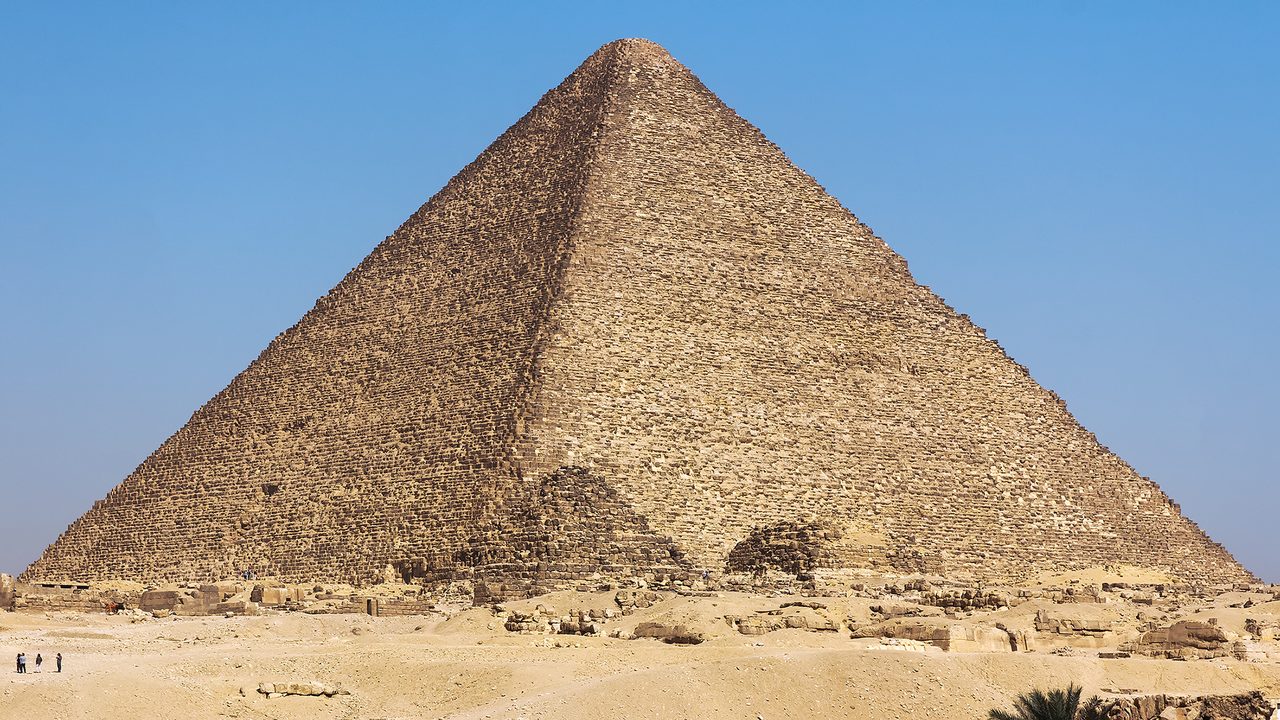
Deep inside the Great Pyramid sits a room of solid granite that rings at a frequency you can measure with a microphone, and one engineer spent years arguing that hum is the fingerprint of a machine. Here is the file, opened from the bedrock up, every claim wearing its evidence.
Descend into the heart of the Great Pyramid and you arrive at a room built entirely of granite, a chamber that rings at a frequency you can capture with a microphone. Most of us were taught this room was a tomb. One engineer spent years arguing it was something else entirely: the beating core of a machine that turned the Earth itself into a power source. It is one of the boldest claims in all of ancient studies, and unusually, parts of it are testably true. So let us open the file, from the bedrock up, and separate the part that genuinely hums from the part that does not hold.
| Feature | Measured value |
|---|---|
| King's Chamber granite | resonates at about 117 to 121 Hz |
| Dead-end Passage | 5.13 Hz resonant frequency |
| Chamber material | granite with significant piezoelectric quartz |
| Status of the readings | measurable and repeatable across studies |
01The room that actually hums
Strip away every theory and a hard core of measurement remains. The granite of the King's Chamber resonates at roughly 117 to 121 Hz. The so-called Dead-end Passage has been recorded with a 5.13 Hz resonant frequency, behaving like a resonance tube. And the granite itself holds a significant amount of quartz, a piezoelectric mineral that releases a tiny electric charge when it is squeezed or vibrated. These are not fringe readings. They are measurable, repeatable, and not seriously disputed.
What is unsettled is whether any of this was on purpose. Did the builders deliberately tune a chamber, or did stacking that much dense granite simply produce these acoustics as a byproduct? The measurements cannot tell design from accident, and honest researchers on both sides admit it.
In 1998 the machinist and engineer Christopher Dunn published The Giza Power Plant, and it is not a lazy book. Dunn examined the pyramid the way he would examine a piece of precision hardware on a shop floor, and concluded it was exactly that: a device engineered to convert the Earth's natural vibrations into a beam of microwave energy. In his reading, every famous chamber is a working component.
| Chamber | Claimed function |
|---|---|
| Subterranean chamber | hydrogen generation via reaction with water |
| Queen's Chamber | chemical input feeding the hydrogen production |
| Grand Gallery | acoustic resonators (Helmholtz resonators) |
| King's Chamber | piezoelectric transduction, granite plus quartz |
02Christopher Dunn's machine
Dunn's Giza Power Plant thesis is an ingenious piece of reverse engineering. It correctly leans on things that are real: the pyramid's extraordinary precision, the measured acoustic resonances, and the piezoelectric quartz in the granite. As an account of how such a machine could in principle work, it is genuinely clever. As a claim about what the pyramid actually did, it stays a hypothesis with no physical confirmation.
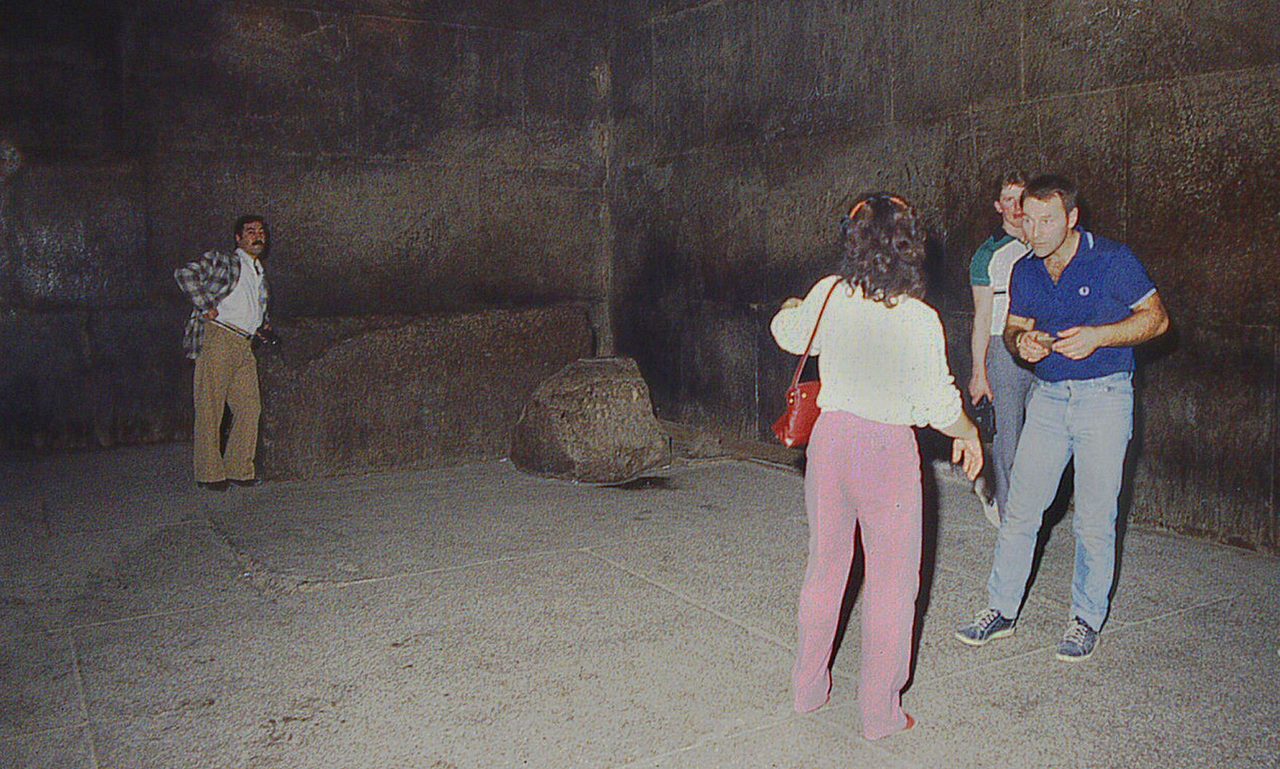
Here is where the machine stalls. In more than two centuries of investigation, no one has found any evidence of hydrogen ever being generated, no trace of microwave output, and no distribution system at all, no conduit, no cable, no terminal, that would carry power anywhere. And not one ancient Egyptian text, from a civilization that wrote obsessively about its monuments, describes the pyramid as an engine. The analysis is ingenious. The corroborating evidence is, so far, zero.
That gap, a brilliant mechanism paired with an absent output, is the pattern for almost every ancient-power claim. The device is imagined in full working detail. The switch is never once found in the on position.
03The one device that genuinely sparks
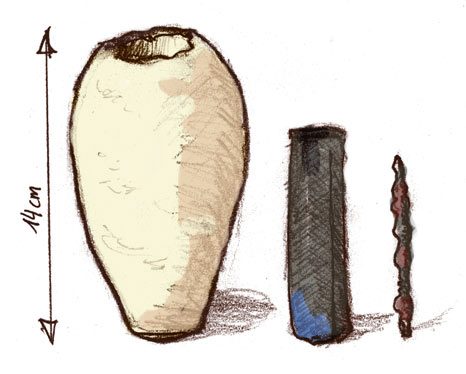
If you want a real ancient object that makes electricity, you have to leave Egypt and travel to Iraq. The so-called Baghdad Battery is a clay jar about 13 centimeters tall holding a copper cylinder, an iron rod, and an asphalt seal, dated to the Parthian and Sasanian era, roughly 250 BCE to 224 CE.
This part is not speculation. The artifact exists and reconstructions produce electricity. Filled with grape juice or vinegar, replicas generate about 0.5 to 1.0 volts. As a piece of electrochemistry, it works.
A 2026 reconstruction by Alexander Bazes, treating the porous clay as a separator between an alkaline electrolyte and the surrounding air, reported pushing a single cell past 1.4 volts. It is a credible recent result rather than a long-established one, and it has not yet been independently reproduced.
Could it have been used for power? Some Parthian-era silver objects carry gold plating that could, in principle, be electrodeposited, and electroplating with a cell like this is experimentally feasible. But fire-gilding with a mercury amalgam was already widespread and needs no electricity whatsoever. The electrical route is possible and completely unproven, with a simpler alternative sitting right beside it.
This is the objection that sinks the wider ancient-electricity picture. In not one case has anyone found a wire, a circuit, a bulb, a terminal, or a plated object still connected to a cell. A battery wired to nothing is a battery powering nothing. The likelier readings are mundane: a container for sacred scrolls, an incense vessel, or, as William Hafford of the Penn Museum argues, a magical device holding a written curse or prayer that was sealed and buried, never a part in a circuit.
04Tesla's ghost in the machine
Dunn's pyramid has a famous modern echo, and the alt-history world loves to draw the line between them. In 1901 Nikola Tesla began building Wardenclyffe Tower on Long Island, designed to transmit power wirelessly by using the Earth itself as a resonant conductor, energy injected at one point and drawn off anywhere on the planet. J.P. Morgan pulled the funding once he grasped that free, unmeterable energy was the goal, and the tower was scrapped in 1917.
Tesla was not a crank about the underlying physics. The space between the Earth's surface and the ionosphere really does behave as a resonant cavity. In 1952 Winfried Schumann identified its fundamental frequency, about 7.83 Hz, decades after Tesla predicted such Earth resonance. At small scale the effect is real and demonstrated.
But the leap from Tesla to the pyramid is conceptual, not evidential. Tesla had working physics and an engineering goal he never actually reached. Dunn's pyramid has neither a demonstrated mechanism nor a single measured output. Two ideas rhyming is not two ideas sharing evidence, and this borrowed glow is exactly what makes the pyramid-as-machine feel proven when it is not.
05The tomb, the soot, and the cherry-picked bulb
Set the machine aside and the mainstream reading is almost boringly solid: mainstream Egyptology regards the Great Pyramid as a funerary monument, a royal tomb, and reads the culture around it through an enormous surviving record of Egyptian burial practice rather than engineering. That could be dismissed as merely one opinion against another, except that the electrical picture also fails on its own evidence.
Consider the tombs the Egyptians painted. Their walls carry soot deposits from oil lamps, precisely where the painting was done. If these people had electric light, that soot would not be there. Where scholars suspected the chambers were simply too dark to work in, experiments (Frood and Ikram among them) showed that polished copper mirrors could bounce sunlight deep into the passages, bright enough to paint by and leaving no soot at all. And across the entire Egyptian record, no wiring, no components, and no energy storage of any kind has ever been recovered.
The showpiece of the Egyptian-electricity case, the Dendera reliefs read as glowing bulbs, falls apart on inspection. The carvings are real, but the accompanying hieroglyphic text names the figures plainly: the serpent Harsomtus rising from a lotus flower, supported by a Djed pillar, a standard creation scene that recurs in hundreds of other places, always mythological. Reading one of them as a light bulb (Krassa and Habeck, 1992) means ignoring the caption carved directly beside it. Selecting the single electrical reading out of thousands of identical mythic images is cherry-picking by definition.
Fast Facts
- Site
- Great Pyramid of Giza, Egypt
- King's Chamber resonance
- about 117 to 121 Hz, measured and repeatable
- Dead-end Passage
- 5.13 Hz resonant frequency
- Granite
- contains significant piezoelectric quartz
- Power-plant theory
- Christopher Dunn, The Giza Power Plant, 1998
- Baghdad Battery output
- about 0.5 to 1.0 V (past 1.4 V in a 2026 rebuild)
- Distribution system found
- none, at Giza or anywhere in Egypt
- Schumann resonance
- 7.83 Hz, confirmed 1952 (the Tesla parallel)
What we can actually stand behind
The acoustics are real. The King's Chamber granite resonates at roughly 117 to 121 Hz, the Dead-end Passage rings near 5.13 Hz, and the stone genuinely contains piezoelectric quartz. None of that is in dispute.
Whether those acoustic properties were engineered on purpose or are an incidental byproduct of building on that scale in granite is a fair question that the measurements alone cannot settle.
Christopher Dunn's Giza Power Plant is an ingenious engineering hypothesis. It is also, after decades of scrutiny, entirely without corroborating evidence that any energy was ever produced.
The Great Pyramid was not a working power plant. There is no hydrogen, no microwave output, no distribution system, no ancient text, and not one connected wire, at Giza or anywhere else in Egypt. The claim fails not because scholars refuse to look, but because nothing there has ever switched on.
So the machine is a mirage, and the tomb consensus holds. But notice what refuses to go quiet: the hum. A room of granite deep inside a mountain of stone really does resonate at a precise, repeatable frequency, and no one has fully explained why a burial chamber should ring like a struck tuning fork. A coincidence of mass and material, or a choice we have not yet learned to read? The stone has kept that answer since the day it was raised, and for now it is keeping it still.
Sources & further reading
Everything above is drawn from our research library on Theories of Anything. Open the full files to check the sourcing and go deeper.
Image credits
- The Great Pyramid of Giza photograph by Douwe C. van der Zee, via Wikimedia Commons. CC BY-SA 4.0 Source.
- Inside the Great Pyramid photograph by Mike McBey, via Wikimedia Commons. CC BY 2.0 Source.
- The Baghdad Battery photograph by Ironie (Wikimedia Commons user), via Wikimedia Commons. CC BY-SA 2.5 Source.
- Card crop of The Great Pyramid of Giza photograph by Douwe C. van der Zee, via Wikimedia Commons. CC BY-SA 4.0 Source.

.jpg)
