The Great Serpent Mound: A Snake Aimed at the Sun
A quarter-mile serpent of earth uncoils across an Ohio ridge, its jaws open around an oval, its head fixed on the midsummer sunset, its body laid on the rim of a meteor crater older than the dinosaurs. Here is the file, every claim wearing its tier.
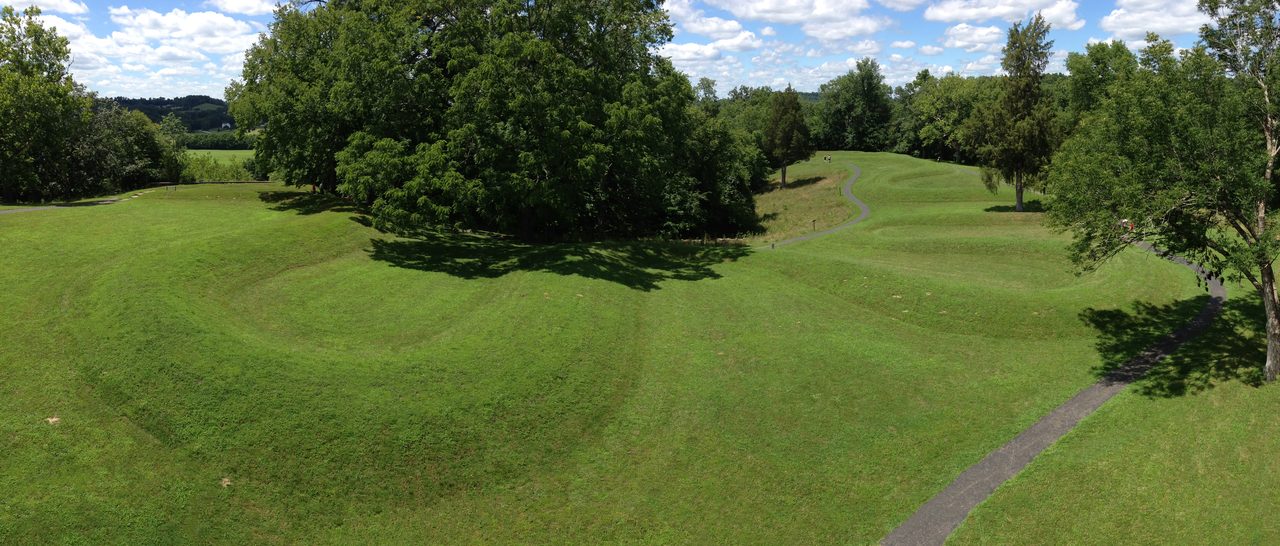
From the ground it is almost nothing: a low, grassy ridge, knee high, easy to walk past. From the air it becomes what it has always been, a snake a quarter of a mile long, uncoiling across a plateau in southern Ohio with its jaws stretched open around an egg. It holds no bones and no grave goods. It points its head at the sun on the longest evening of the year. And it rests on the scar of a meteor strike a quarter of a billion years old. Let's open the file.
| Feature | Measurement |
|---|---|
| Total length | 411 m (1,348 ft), tail to jaws |
| Height | ≈ 1 to 1.5 m (3 to 5 ft) |
| Width at base | ≈ 6 to 7.5 m (20 to 25 ft) |
| Body | Seven to eight curves, plus a coiled tail |
| The oval | ≈ 37 m (120 ft) long, held in the open jaws |
| Contents | Clay, ash, stone, earth. No burials, no artifacts |
01The largest snake ever drawn in earth
The Great Serpent Mound is the largest surviving effigy mound in the world: one sinuous serpent 411 meters long, built of clay, ash, and stone along the crest of a natural ridge above Brush Creek in Adams County, Ohio. That measurement, and the fact that the mound holds no burials and no artifacts, is settled, published archaeology. This is a picture, not a tomb.
The southeast end winds into a tightly coiled tail. The northwest end opens into a pair of jaws clamped around an oval roughly 120 feet long that people have read, variously, as an egg, the sun, a frog, or a cosmic disc. Nobody left a label. What is not in dispute is that the whole figure only resolves into a snake once you get above it.
02Who found it, and who saved it
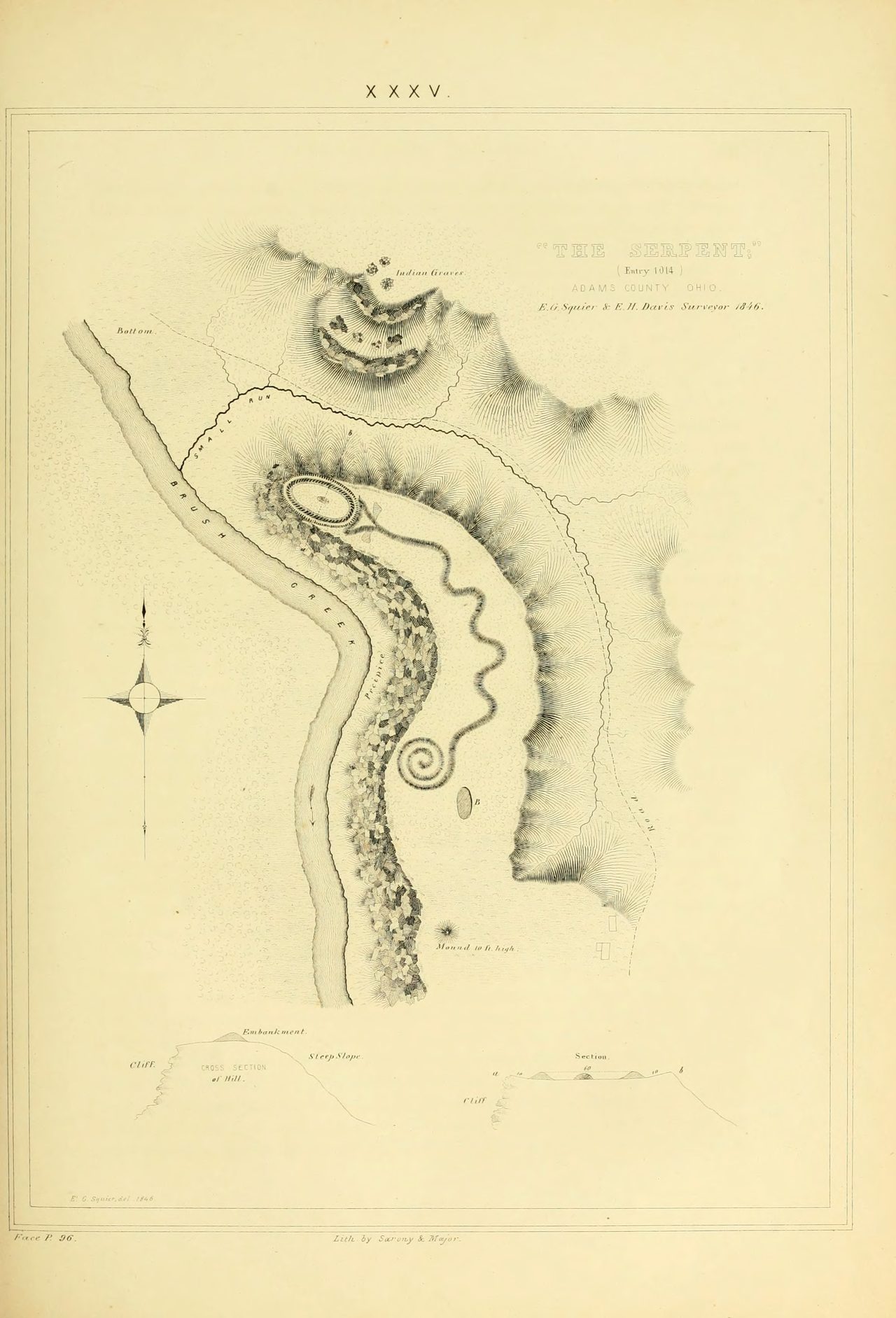
The serpent was first surveyed scientifically by Ephraim Squier and Edwin Davis in 1846, and their measured drawing carried it into the Smithsonian's founding volume. Forty years later Harvard's Frederic Ward Putnam, alarmed at the plowing and looting eating through Ohio's earthworks, raised the money to buy the site outright in 1887 and later handed it to the state to keep.
The documented record is unambiguous: surveyed in 1846, rescued and purchased by Putnam in 1887, protected as a National Historic Landmark since 1966, and on the United States list of candidates for UNESCO World Heritage status since 2008. The people who map it, study it, and guard it have never once been in doubt that human hands built it.
03A snake that watches the sun
The strongest alignment, and the one most researchers accept, is deliberate and singular: the serpent's open jaws and the oval they enclose point to the setting sun on the summer solstice, the longest evening of the year, at an azimuth near 300 degrees for this latitude of 38.7 degrees north. William Romain established the line in detail, and Robert Fletcher's independent transit surveys landed on the same bearing.
Romain goes further, matching curves along the body to the sunrise and sunset points of both solstices and the equinoxes, and even to the moon's maximum and minimum standstills across its 18.6-year cycle. Read that way, the whole snake becomes a calendar written in earth. This fuller reading rests mainly on Romain's own analysis, not on independently replicated surveys, which is why it stays a step less certain than the single solstice line.
The catch is worth stating plainly: a shape with this many curves offers a great many angles, and with enough angles you can hit almost any solstice or standstill you go looking for. Skeptics call it alignment by chance. The summer-solstice line survives that objection because it is single and clean. The fuller lunar calendar has not closed that gap yet.
| Feature of the mound | Proposed sky target | How solid |
|---|---|---|
| Head and oval | Summer solstice sunset (azimuth ≈ 300°) | Strong, widely accepted |
| Curves of the body | Solstice and equinox sunrise/sunset points | Proposed, debated |
| Wider body geometry | Lunar maximum and minimum standstills (18.6-yr cycle) | Proposed, contested |
04The scar under the snake
The serpent was laid down on the rim of something far older and far stranger than itself: the Serpent Mound Disturbance, a roughly circular zone of shattered, tilted, and jumbled rock about 8 kilometers (5 miles) across. The mound sits on its western edge.
Geologists now read the structure as an ancient impact crater. Argon-argon dating of impact-melted glass by Carlton and colleagues (2003) points to roughly 256 million years ago, in the Permian, though estimates for the event span 320 to 256 million years. Whatever struck here did so something like a quarter of a billion years before any human being stood on the ridge.
Did they know? The ground here is visibly odd, fractured rock, warped strata, a faint circular swell in the land, and indigenous peoples across North America often marked geologically strange places as sacred. It is tempting to think the serpent answers a spot that simply felt charged. Tempting, and consistent with the ethnography, but there is no direct evidence the builders understood what they were standing on.
05How old is the snake? Nobody can close the case
For more than a century the serpent was credited to the Adena culture, roughly 800 BCE to 100 CE, on the strength of three Adena burial mounds sitting close by. Then, in 1996, the picture cracked open.
In 1996 a team led by Robert Fletcher and Bradley Lepper published radiocarbon dates from charcoal inside the mound body, two samples calibrating to around 1070 CE. That is not Adena at all. It places construction in the Fort Ancient culture (c. 1000 to 1650 CE), part of the broader Mississippian-influenced era in which Cahokia also rose, a few hundred miles to the west.
William Romain and others push back hard: the serpent has been repaired repeatedly, by Putnam in the 1880s and by the state in the twentieth century, and charcoal from a patch job dates the patch, not the original. Herrmann and colleagues (2014) added optically stimulated luminescence dates that hint at two phases, an older Adena serpent later rebuilt or elaborated by Fort Ancient hands.
The field has not settled this. The leading view now is a two-phase model, built by the Adena and refurbished by the Fort Ancient, which lets both sets of dates be true at once. Until someone runs non-destructive dating across the whole mound, the honest answer to 'how old is it' is a range, not a number.
| Model | Culture | Rough date | Rests on |
|---|---|---|---|
| Traditional | Adena | c. 800 BCE to 100 CE | Nearby Adena burial mounds |
| 1996 radiocarbon | Fort Ancient | c. 1070 CE | Charcoal inside the mound body |
| Current lean | Two-phase | Adena, later rebuilt | OSL dates plus repair history |
One tantalizing footnote: the roughly 1070 CE date sits almost on top of the 1066 apparition of Halley's Comet, the same fireball stitched into the Bayeux Tapestry an ocean away. If the serpent was raised or rebuilt just then, a sky-serpent answering a comet is a lovely idea. It is also pure circumstance. A near-match in dates is not a cause.
06The claims that do not survive contact
The nineteenth century insisted a vanished 'lost race' built the mounds, because it could not stomach the idea that Native Americans had. Cyrus Thomas demolished that in 1894 with the Smithsonian's own excavations. The Great Serpent Mound was built by the indigenous peoples of Ohio, Adena or Fort Ancient or both. There is no mystery about who made it, and no room in the evidence for anyone else.
The other recurring claim, that the serpent was 'designed to be seen only from the air,' and therefore built for or by someone in the sky, collapses against the terrain. The figure is legible from the ridge itself and from the site's observation tower, and the builders shaped it by following a ridgeline they were standing on. The aerial photograph flatters it. It never needed one.
Fast Facts
- Site
- Great Serpent Mound, Adams County, Ohio
- Length
- 411 m (1,348 ft), the largest effigy mound on Earth
- Form
- A serpent, coiled tail to open jaws around an oval
- Key alignment
- Head and oval to the summer solstice sunset (≈ 300°)
- Contents
- No burials, no artifacts, purely ceremonial
- Built by
- Adena and/or Fort Ancient peoples of Ohio
- Age debate
- Adena (c. 800 BCE) vs Fort Ancient (c. 1070 CE)
- Sits on
- The Serpent Mound impact crater, ≈ 8 km across, ≈ 256 million years old
- Status
- National Historic Landmark; UNESCO candidate since 2008
What we can actually stand behind
The Great Serpent Mound is real, indigenous, and the largest effigy mound in the world, and its head genuinely points to the summer solstice sunset. That much is measured, surveyed, and settled.
Whether it is Adena or Fort Ancient, and how much of its body encodes a fuller solar and lunar calendar, are live questions. The best current reading is a two-phase mound that the sky was built into more than once.
It was not built by a lost race, and it was not laid out to be admired from aircraft or spacecraft. Those claims fail, not because anyone refuses to look, but because the ground, the dating, and the builders' own descendants all say otherwise.
Which leaves the oldest question lying in the grass, exactly where the builders left it. They aimed a snake's open mouth at the dying midsummer sun and set its body on the rim of a wound in the earth older than the dinosaurs. Did they know the ground was broken beneath them? Were they answering the sky, or the scar, or both at once? The serpent has kept that to itself for a thousand years, and it is not saying.
Sources & further reading
Everything above is drawn from our research library on Theories of Anything. Open the full files to check the sourcing and go deeper.
Image credits
- Aerial (overhead or oblique) photograph of the full Great photograph via Wikimedia Commons (Eric Ewing). CC BY-SA 3.0 Unported Source.
- Ephraim Squier and Edwin Davis's 1846 measured survey plan of photograph via Wikimedia Commons (Ephraim George Squier and Edwin Hamilton Davis). Public Domain (US; published 1848, pre-1929) Source.
- Card crop of Aerial (overhead or oblique) photograph of the full Great photograph via Wikimedia Commons (Eric Ewing). CC BY-SA 3.0 Unported Source.

