Life Without the Sun: Hydrothermal Vents
In 1977, a submersible called Alvin dropped two and a half kilometers through black, freezing water onto the Galapagos Rift, and the geologists inside found something no one had gone looking for: whole thriving communities of animals, crowded around warm cracks in the seafloor, in total darkness, impossibly far from the sun. It broke a rule everyone thought was unbreakable. Life, we had assumed, runs on sunlight. Down there it does not. An entire biosphere feeds on chemistry pouring straight out of the Earth, and its discovery quietly changed where we go looking for life on other worlds. This is not fringe speculation being weighed for and against. It is mainstream, peer-reviewed, hard-won oceanography, and it is one of the most astonishing things ever found on this planet. Here is how it works, tier by tier, including the one claim about vent life that the evidence flatly refuses.
For as long as anyone had thought about it, one rule of biology seemed unbreakable. Life runs on sunlight. Green things catch the light, everything else eats the green things or eats the eaters, and the entire living world traces back, link by link, to the sun. Then in 1977 a small submersible dropped to the deep ocean floor and found a thriving crowd of animals living in permanent darkness, kilometers down, with no sunlight reaching them at all. The rule was not so much broken as revealed to be half a rule. There was another way to be alive, and it had been running quietly on this planet the whole time.
01The Dive Nobody Expected
In 1977, a team from the Woods Hole Oceanographic Institution took the research submersible Alvin down to the Galapagos Rift, a volcanic seam in the seafloor, at a depth of roughly 2,500 meters. They were geologists, and they had come looking for hot springs, not life: warm water was expected to be seeping up through the young ocean crust there, and they wanted to see it. What they found instead was one of the great surprises in the history of biology. Clustered around the warm-water seeps were dense, unexpectedly lush communities of animals, thriving in permanent darkness at a depth and pressure where the textbooks said almost nothing should live. Nobody had gone down looking for a living world. It was simply there.
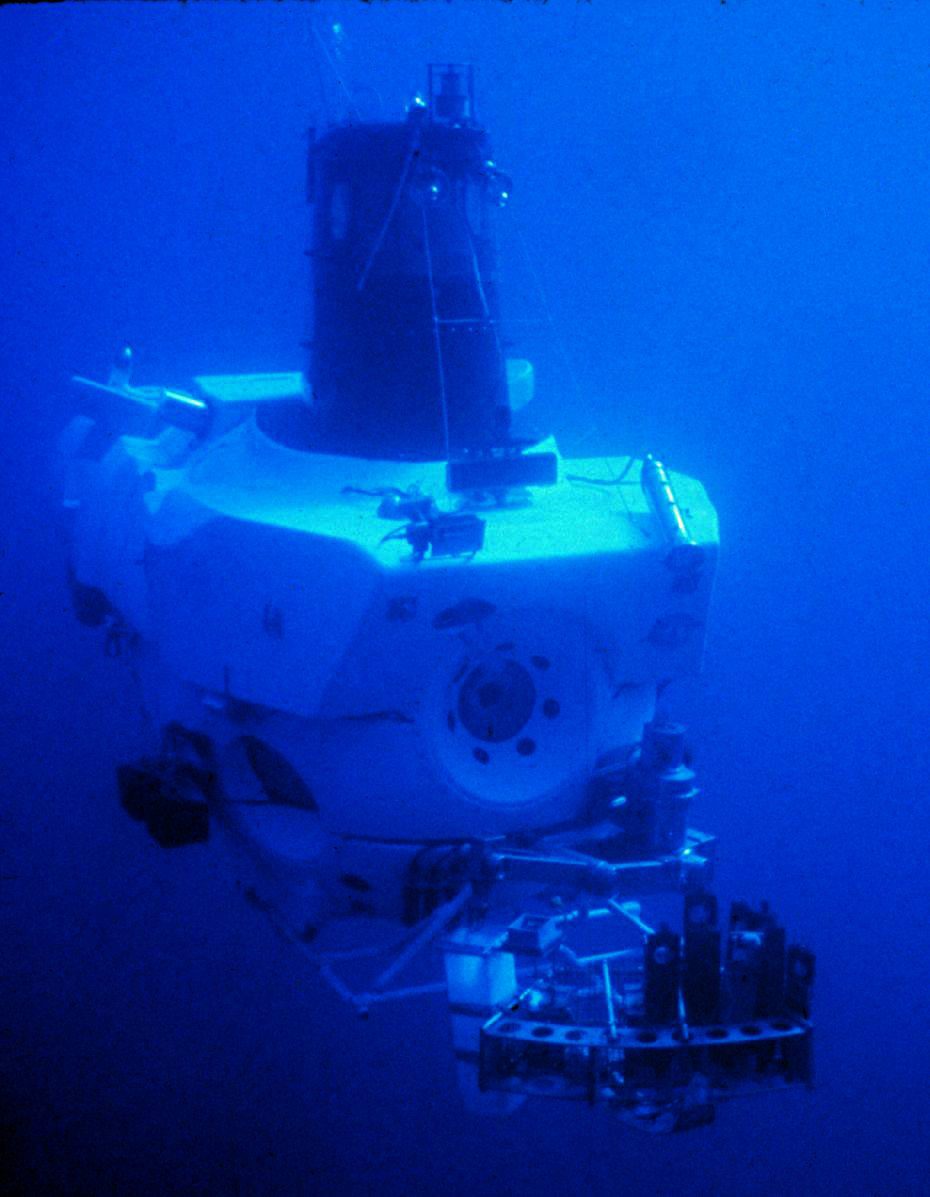
Alvin is one of the workhorses of deep-sea science, a small crewed submersible that can carry researchers thousands of meters down and bring them safely back. Its 1977 descent onto the Galapagos Rift is remembered as the dive that introduced an entire category of life to the people who study it. The photograph here shows Alvin in 1978, a year after that expedition. No open image survives of the discovery dive itself, but this is the same vessel that carried the first human beings ever to set eyes on a hydrothermal vent community.
02Black Smokers, White Smokers, And The Fluid That Feeds Them
The Galapagos vents were gentle, warm-water seeps. Two years later, explorers at the East Pacific Rise found the same phenomenon at its violent extreme, and it looked like the mouth of a furnace.
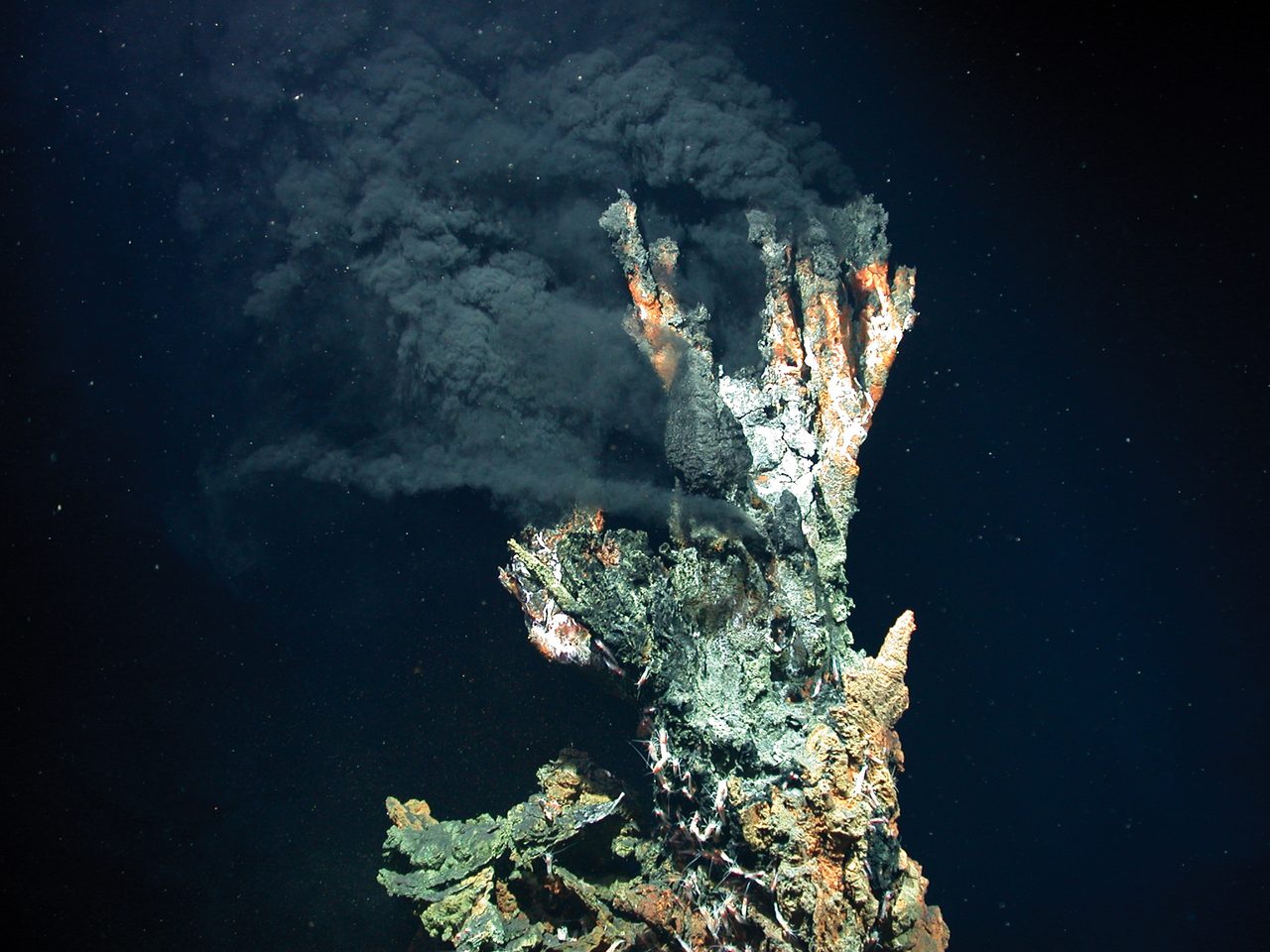
In 1979, at the East Pacific Rise near 21 degrees north, researchers came upon the structures that would become the icon of the whole field: black smokers. These are chimneys built by the vents themselves, rising straight up from the seafloor, and they gush a superheated fluid at roughly 350 to 400 degrees Celsius, far past the normal boiling point of water and kept liquid only by the crushing pressure of the deep sea. That fluid is loaded with dissolved metals, iron, copper, zinc and manganese, scavenged from the hot rock below. The instant it meets the near-freezing seawater around it, about 2 degrees Celsius, those metals crash out of solution as a billowing black cloud of metal-sulfide particles. The chimney is quite literally that smoke turning to stone, grain by grain.
Not every chimney is black. White smokers run cooler, roughly 100 to 300 degrees Celsius, and their plumes are pale rather than dark, colored by lighter precipitates of barium, calcium and silicon instead of heavy metal sulfides. Same underlying machine, different temperature and chemistry, different color of smoke.
And then there is the quiet kind. Diffuse venting is warm water, only about 5 to 50 degrees Celsius, seeping up through cracks in the rock without ever building a chimney at all. It shows only as a shimmer in the water, but it is often where the biology is thickest: these gentle seeps frequently support dense mats of microbes and the animal communities that graze on them, much like the ones Alvin first found in 1977.
What all of these fluids share is that they would be lethal almost anywhere else. Black-smoker fluid is intensely acidic, with a pH of roughly 2 to 3, and it arrives charged with hydrogen sulfide and a heavy load of dissolved metals, iron, manganese, copper and zinc among them. To a human being it is scalding, acidic poison. To the life that has made its home here, it is the raw material of an entire food web.
03Life That Runs On Chemistry, Not Light
So how does anything eat in a place with no light, no plants, and water that would kill almost anything from the surface? The answer is the single most important idea in this whole story, and it quietly rewrote what we thought a living world requires.
Sunlit ecosystems run on photosynthesis: plants and algae use light to build sugar, and everything else lives off that. Vent ecosystems do something fundamentally different. They run on chemosynthesis, in which microbes pull their energy not from sunlight but straight out of chemical reactions, harvesting the raw chemistry of the vent fluid itself. It is a completely separate way of powering life, and it needs no sun anywhere in the chain.
The details are precise and well understood. The base of the vent food web is built by bacteria and archaea using a metabolism called chemolithoautotrophy, a long word for a simple trick: they oxidize the reduced chemicals pouring out of the vent, hydrogen sulfide, hydrogen gas, methane, dissolved iron, and use the energy released to fix carbon dioxide into organic carbon, exactly the way a plant uses sunlight to do the same job. At most vents the single most important reaction is the oxidation of hydrogen sulfide, turning it into sulfate. That poisonous, rotten-egg gas seeping out of the seafloor is, to these microbes, food and fuel at once. Everything else down there, every worm and mussel and shrimp, ultimately lives off what those microbes make.
04The Animals Down There
The microbes are the foundation, but they are not the spectacle. The spectacle is the animals that learned to farm those microbes, and none is stranger or more famous than the giant tube worm.
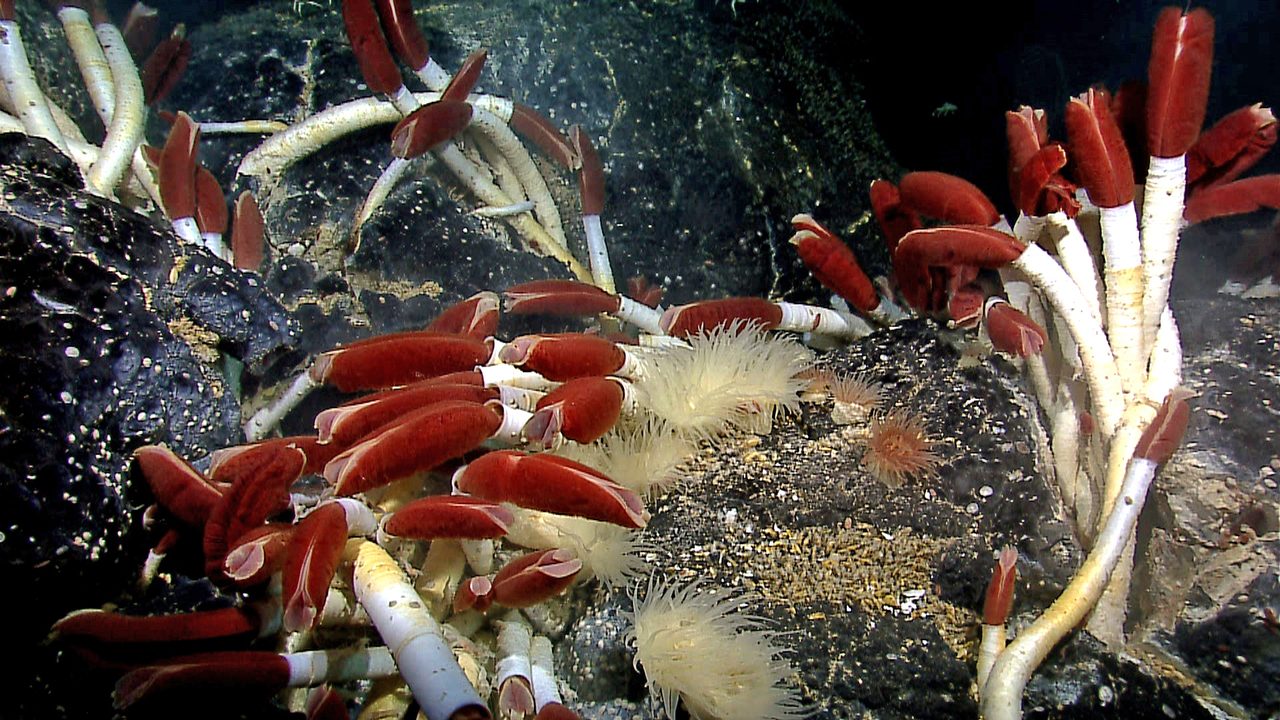
Riftia pachyptila, the giant tube worm, grows up to about two meters long and stands in swaying forests around the warm vents, each worm capped by a plume of brilliant red. And here is the astonishing part: an adult Riftia has no mouth, no gut, no digestive system at all. It does not eat, in any sense we would recognize. Instead it grows a specialized internal organ called the trophosome, packed with vast colonies of symbiotic sulfide-oxidizing bacteria living inside its own cells. The worm delivers the raw ingredients from the vent fluid to those bacteria, the hydrogen sulfide, the oxygen, the carbon dioxide they need, and the bacteria feed the worm in return. It is not an animal that eats. It is an animal that farms a chemical-eating garden inside its body, and lives on the harvest.
The tube worms are not alone in the trick. Vent mussels of the genus Bathymodiolus carry their own chemosynthetic symbionts, housed this time in their gill tissue, so that a mussel drawing vent water across its gills is also, in effect, tending a live crop of chemical-feeding bacteria inside them.
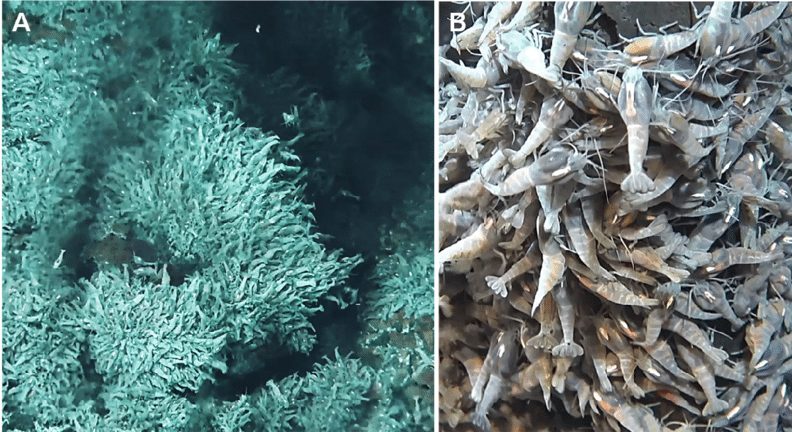
And then there are the shrimp. Rimicaris exoculata swarms over the black smokers of the Mid-Atlantic Ridge in seething masses, thousands strong, each one carrying colonies of bacteria on specially modified gill chambers, another farmer of the same invisible crop. Its name means eyeless shrimp, and it has no ordinary eyes, but it is not blind. It carries an unusual light-sensing organ that may pick up the faint glow of thermal radiation coming off the superheated vents themselves, letting it hug the warmth without cooking in it.
Put it all together and the result defies every intuition about the deep sea. These vent communities are not sparse and struggling. They reach biomass densities that rival the richest sunlit waters at the ocean surface, entire crowded oases of life, in total darkness, under kilometers of water and enormous pressure, fed by nothing but the chemistry leaking out of the Earth.
05More Than Seven Hundred Vents, And Counting
When Alvin made that first dive, hydrothermal vents were an astonishment. Today they are known to be a global feature of the planet. More than 700 vent sites had been documented worldwide as of 2023, strung mainly along the great volcanic seams where the seafloor is pulling apart: the Mid-Atlantic Ridge, the East Pacific Rise, the Central Indian Ridge, and the back-arc basins such as the Lau Basin and the Manus Basin. And that number keeps climbing, because most of the deep seafloor has still never been surveyed up close. Nearly every serious expedition finds more.
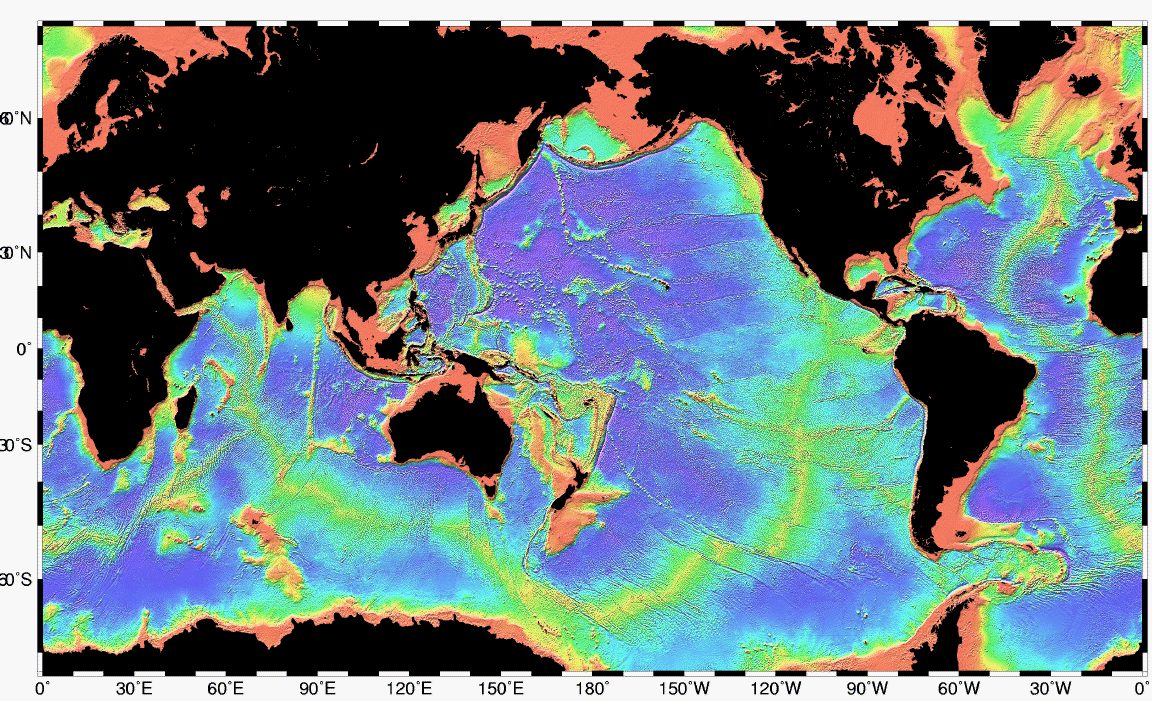
Most vents sit deep, in the range of about 1,500 to 4,000 meters down, which is part of why they stayed hidden for so long. But not all of them. Some lie surprisingly shallow: the Kolumbo submarine volcano in the Aegean Sea hosts vents at only around 200 meters, close enough to the surface to blur the line between the deep-sea world and our own.
Vents are also not the only alien habitat hiding on the deep seafloor. A companion piece on this site explores the underwater brine lakes that pool in the dark, a wholly different kind of extreme seabed, but that is a story for its own file.
06Did Life Begin At A Vent?
If vents can support this much life today, a bolder question follows almost on its own. Could life itself have begun at one?
This is a serious and much-discussed idea in origin-of-life research, and it has a specific form. The alkaline vent hypothesis, developed above all by the researchers Michael Russell and William Martin, proposes that life first emerged not in a warm surface pond but at a hydrothermal vent, and specifically at the gentler, alkaline kind of vent typified by a remarkable site called the Lost City Hydrothermal Field, discovered in the year 2000 on the Mid-Atlantic Ridge at a depth of about 800 meters. The hypothesis has gained real traction over the past two decades. It is not a fringe notion, but it is also not settled: it competes with other serious proposals that place life's origin in surface pools or in icy environments instead.
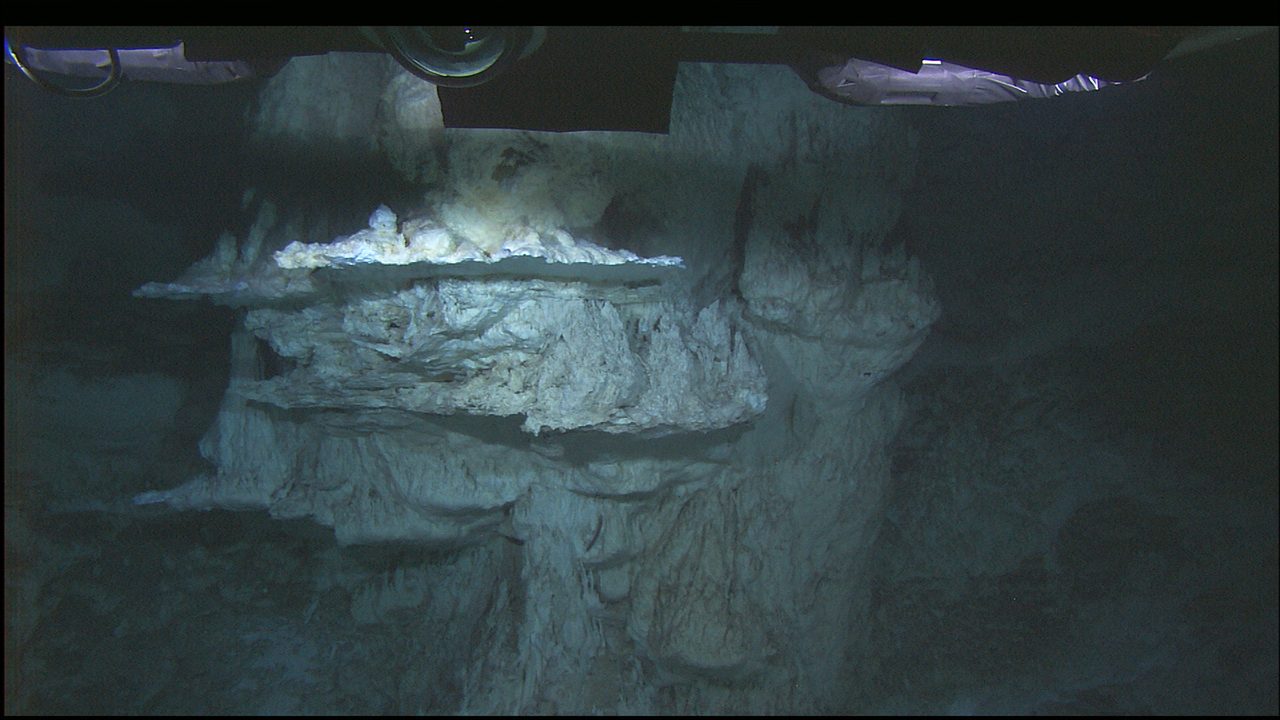
What makes Lost City so suggestive is how differently it works from a black smoker. Its chimneys are driven not by volcanic heat but by a chemical reaction called serpentinization, in which the mineral olivine in the ocean crust reacts with seawater. That reaction produces fluids that are alkaline, with a pH of roughly 9 to 11, rich in hydrogen gas, and only moderately warm, around 40 to 90 degrees Celsius, and it slowly builds tall, porous chimneys of carbonate and brucite. Warm, hydrogen-rich, alkaline and gentle: on paper, a far more hospitable cradle for delicate early chemistry than a 400-degree acid furnace.
The deepest part of the argument reaches right into how our own cells work. Every living thing on Earth, from a single bacterium to a human being, runs on the same fundamental energy trick: it pumps protons across a membrane to build up a gradient, then lets them flow back through to power its chemistry. This is the chemiosmotic mechanism, first set out by Mitchell, and every cell alive still depends on it. The striking thing about an alkaline vent is that it comes with a natural version of that very gradient built in. The sharp difference in acidity between the alkaline fluid inside the porous chimney walls and the more acidic seawater outside creates a proton gradient across a thin mineral barrier, for free, before any life exists to make one. And the mineral surfaces lining those chimneys, especially iron and nickel sulfides, may have worked as catalysts that helped drive the first prebiotic reactions. The hypothesis, in short, is that the vent performed the trick first, and life learned it from the rock.
07The Metals In The Dark
There is a harder, more worldly chapter to this story too. The same process that builds black smokers also concentrates metals, and over time a dead vent field can leave behind what geologists call a seafloor massive sulfide deposit, a mound of rock unusually rich in copper, zinc, gold, silver and rare earth elements. Those are exactly the metals a modern electronic economy is hungry for, and commercial interest in mining them has grown, with exploration licenses now granted in several jurisdictions. But the tension is real and it is not small. Vent ecosystems are highly localized, often slow to recover, and full of species found nowhere else on Earth, so mining a vent field can mean destroying a habitat and its found-nowhere-else life before we have even finished describing it. It is a genuine collision between what the deep sea is worth as ore and what it is worth as one of the last unexplored living frontiers on the planet.
08How Much Life Is Buried Down There
Here is a genuinely open question, and an enormous one. The vents we see on the seafloor may be only the visible edge of something far larger. Seawater does not just erupt at vents; it circulates through the entire upper oceanic crust, percolating through cracks and pores in the rock, warmed and chemically charged along the way, and that warm, chemical-rich water could feed a vast community of microbes living inside the rock itself, a deep subsurface biosphere hidden beneath the seafloor. Some estimates suggest this buried biosphere could hold a significant fraction of all the microbial life on Earth. But the truth is that we do not yet know its real size. Its boundaries and its productivity remain poorly constrained, which is a careful way of saying that one of the largest habitats on the planet may be sitting right beneath the ocean floor, and we have barely begun to measure it.
09Vents On Other Worlds
And here the story leaves Earth altogether. If life on this planet can flourish on vent chemistry in total darkness, then a cold, sunless, ice-covered ocean somewhere else in the solar system suddenly looks far less hostile than it used to.
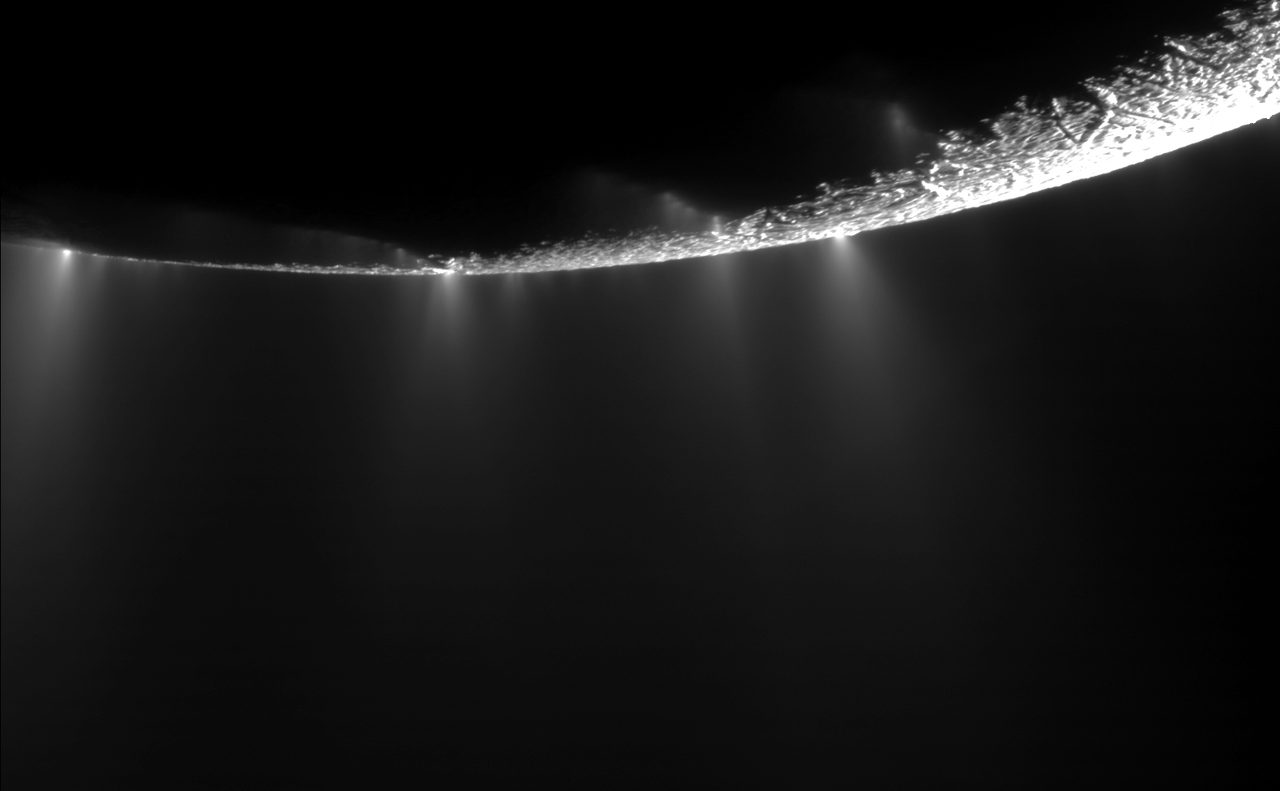
Two worlds in particular have astrobiologists watching closely. Jupiter's moon Europa and Saturn's moon Enceladus both appear to hide liquid-water oceans beneath their frozen shells, and both may host hydrothermal vents on their hidden seafloors, which would make them possible habitable environments. On Enceladus the case is unusually concrete. The Cassini spacecraft flew through the plume of icy spray erupting from the moon's south pole and, in a measurement led by Waite and colleagues in 2017, detected molecular hydrogen in it, exactly what you would expect if serpentinization, the same reaction that drives Lost City, were under way on a seafloor far below. The hydrogen detection itself is a real, peer-reviewed measurement. What stays genuinely speculative is the leap from that reading to a warm, living vent on an alien seabed, and that leap is why this whole picture belongs at the speculative tier rather than the verified one.
10The One Thing Vent Life Does Not Prove
There is exactly one claim in this whole subject that this file refuses outright, and it needs a flat answer, because it gets made a lot. The existence of extremophile life at hydrothermal vents does not prove panspermia, and it is not evidence that life on Earth came from space. It is easy to see why the idea tempts people: if life can survive conditions this brutal, sunless, scalding, crushing and acidic, then surely it is tough enough to have ridden here from somewhere else. But that is a leap the evidence does not support. What vent life actually demonstrates is that life can arise and thrive in extreme, sunless conditions, which genuinely does matter for where we look for life on other worlds. It says nothing whatsoever about where life on Earth originally came from, or whether it arrived from elsewhere. Resilience is not an origin story. [UNSUPPORTED]
Step back from all of it and the plain facts are stranger than any embellishment. An entire biosphere, whole crowded cities of animals and the invisible microbial farms that feed them, existed on this planet through the whole of human history and we had no idea. We did not discover it until 1977, and we discovered it by accident, when a submersible full of geologists went looking for hot springs and found a living world instead. It runs on chemistry rather than light. It needs no sun. And there is genuinely no serious scientific dispute about any of that: the core of this story is settled, mainstream, hard-checked science, which is rare enough to be worth saying plainly.
Fast Facts
- The Discovery
- In 1977 the submersible Alvin, from the Woods Hole Oceanographic Institution, found unexpectedly lush animal communities around warm seeps on the Galapagos Rift at about 2,500 meters. The geologists aboard had come looking for hot springs, not life.
- The Icons
- In 1979 came the black smokers of the East Pacific Rise: chimneys venting fluid at roughly 350 to 400 degrees Celsius, packed with dissolved metals and acidic to a pH of about 2 to 3, that crashes into dark mineral smoke on hitting the cold sea.
- The Engine
- Chemosynthesis. Microbes oxidize the vent's chemicals, above all hydrogen sulfide, and use the energy to build organic carbon from carbon dioxide, feeding the entire food web with no sunlight anywhere in the chain.
- The Star Animal
- Riftia pachyptila, the giant tube worm, grows up to about two meters and has no digestive system at all. It farms symbiotic sulfide-oxidizing bacteria inside a dedicated organ, the trophosome, and lives on what they make.
- How Many, And Where
- More than 700 vent sites are documented worldwide as of 2023, mostly along mid-ocean ridges and back-arc basins, usually 1,500 to 4,000 meters deep, though a few sit as shallow as about 200 meters.
- The Origin Idea
- The alkaline-vent hypothesis of Michael Russell and William Martin says life may have begun at a gentle, alkaline vent like the Lost City field, whose natural proton gradient mirrors the one every living cell uses for energy. Credible and debated, not proven.
- Other Worlds
- Europa and Enceladus may hide hydrothermal vents beneath their icy oceans. The Cassini spacecraft detected molecular hydrogen in Enceladus's plume in 2017, a possible sign of serpentinization below. Speculative, but built on real data.
- The Refused Claim
- That vent extremophiles prove panspermia or an alien origin of life. They do not. Vent life proves that life can thrive without the sun; it says nothing about where life on Earth began.
So Is There Really Life Without The Sun?
Yes, beyond any serious doubt. Alvin's 1977 discovery on the Galapagos Rift, the black smokers found in 1979, the chemosynthesis and chemolithoautotrophy that build the food web with no sunlight anywhere in it, the giant tube worm with no gut and its bacteria-farming trophosome, the more than 700 vent sites now mapped, the biomass that rivals sunlit seas: every piece of that is measured, peer-reviewed, mainstream science. There is no active scholarly dispute over the core of this story.
The bigger ideas built on top are strong but not settled. That life itself may have begun at an alkaline vent like Lost City, powered by the same kind of proton gradient every living cell still runs on, is a serious and well-argued hypothesis from Russell, Martin and others, but it remains in genuine competition with surface-pool and icy-origin alternatives. And the promise of the metals locked in dead vent fields, set against the ecological cost of mining habitats full of species found nowhere else, is a real and unresolved tension, not a solved problem.
Two questions stay honestly open. The true size of the deep subsurface biosphere living inside the ocean crust may be enormous or merely large; we do not yet know. And whether Europa or Enceladus actually hosts a living vent is unconfirmed: Cassini's detection of molecular hydrogen in the Enceladus plume is real data, but the jump from that measurement to habitability is exactly the speculative step.
One claim is refused outright. The extremophiles at hydrothermal vents do not prove panspermia, and they are not evidence that life on Earth came from space. [UNSUPPORTED] Vent life shows that life can arise and thrive without the sun, which matters enormously for where we search for it elsewhere. It says nothing about where our own life came from. Resilience is not an origin story.
Which leaves us staring back down into the dark. We stumbled onto an entire living world by accident, in one warm crack on one ridge, less than fifty years ago, and almost the whole deep seafloor is still unmapped. If a biosphere this vast could hide from us until 1977, and if the same chemistry may be quietly at work beneath the ice of distant moons, then the question worth sitting with is not whether life can exist without the sun. We know it can. The question is how much of it is still down there, and how much of it is out there, waiting for the next accidental dive.
Sources & further reading
Everything above is drawn from our research library on Theories of Anything, deep-read in full rather than skimmed. The corpus files are where we worked from; the papers and primary sources listed beneath them are where you can check us independently.
Image credits
- The Candelabra black smoker chimney, Logatchev Hydrothermal Field, Mid-Atlantic Ridge photograph by MARUM, Zentrum für Marine Umweltwissenschaften, Universität Bremen, via Wikimedia Commons. Creative Commons Attribution 4.0 International (CC BY 4.0) Source.
- The deep-submergence submersible Alvin (photographed 1978) photograph credited to NOAA, via Wikimedia Commons. Public domain (work of a NOAA employee, created as part of official duties) Source.
- A giant tube worm (Riftia pachyptila) colony on the Galapagos Rift photograph by the NOAA Okeanos Explorer Program, Galapagos Rift Expedition 2011, via Wikimedia Commons. Public domain (work of a NOAA employee or contractor, United States federal government material) Source.
- A swarm of vent shrimp (Rimicaris exoculata) at a black smoker, Mid-Atlantic Ridge photograph by Machon, Julia; Krieger, Jakob; Meth, Rebecca; Zbinden, Magali; Ravaux, Juliette; Montagné, Nicolas; Chertemps, Thomas; Harzsch, Steffen (2019), via Wikimedia Commons. Creative Commons Attribution 4.0 International (CC BY 4.0) Source.
- The global mid-ocean ridge system map by NOAA, via Wikimedia Commons. Public domain (work of a NOAA employee, created as part of official duties) Source.
- A carbonate chimney at the Lost City Hydrothermal Field, Mid-Atlantic Ridge photograph by NOAA, Okeanos Explorer expedition, via Wikimedia Commons. Public domain (work of a NOAA employee or contractor, United States federal government material) Source.
- Plumes erupting from the south pole of Enceladus (Cassini, June 2009) image by NASA / JPL / Space Science Institute, via Wikimedia Commons. Public domain (NASA material, not protected by copyright unless otherwise noted) Source.
- Card crop of The Candelabra black smoker chimney, Logatchev Hydrothermal Field, Mid-Atlantic Ridge photograph by MARUM, Zentrum für Marine Umweltwissenschaften, Universität Bremen, via Wikimedia Commons. Creative Commons Attribution 4.0 International (CC BY 4.0) Source.


