The Mantis and the Scarab
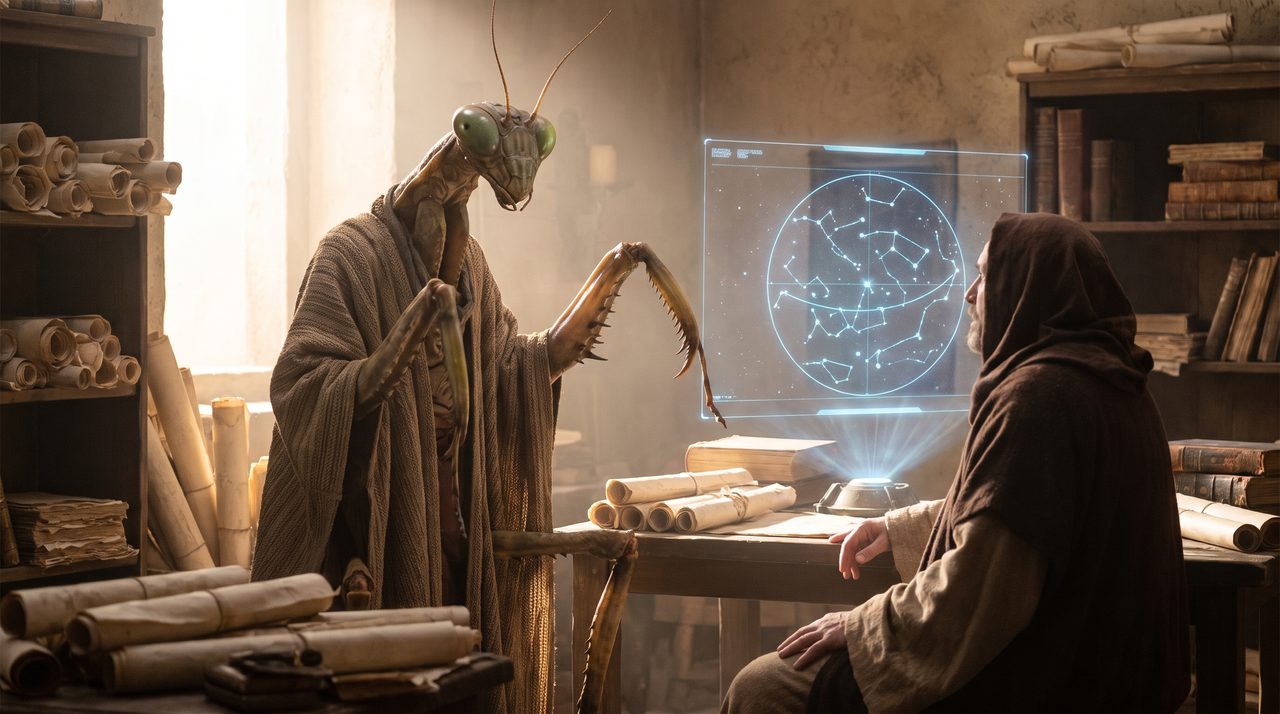
Insect-formed beings crawl through humanity's oldest sacred art and its strangest modern testimony alike — the scarab that rolled the sun, the bee that spoke prophecy, the towering mantis witnesses sketch from the abduction table and the DMT trance. A field guide to a very old uncanny, with the tiers kept honest.
01Two Worlds, One Silhouette
Set an Egyptian scarab amulet beside a witness's sketch of a towering, triangle-headed mantis from an abduction interview, and something uncomfortable happens: the silhouette rhymes. Insect-formed beings — entities with arthropod morphology, whether mantis-like, ant-like, or beetle-like — turn up in two places that supposedly have nothing to do with each other.
The first is ancient mythology, where insects were not monsters but sacred machinery: engines of rebirth, fertility, and prophecy. The second is the modern encounter report — the clinical psychedelic study and the UAP-abduction interview, where the insect returns as a watching, intelligent other. This piece walks both halves, keeps the source-tiers labelled, and resists the temptation to weld them into a single story.
02The Sacred Swarm: Insects of the Ancient World
03The Mantis in the Machine: Modern Encounters
Fast-forward to the late twentieth century and the insect changes register — from icon carved in gold to an entity people report meeting. Two literatures, one shape.
Between 1990 and 1995, psychiatrist Rick Strassman administered 400 doses of intravenous DMT to 60 volunteers at the University of New Mexico under DEA-approved clinical protocols. In DMT: The Spirit Molecule (2001) he reported that multiple subjects, independently, described encounters with insectoid and mantis-like beings during the drug state.
Read that carefully. What is documented is the testimony — that subjects said this — not that any being was in the room. AEON reports the study; it does not offer DMT as medicine, method, or advice. The interpretive question is the whole fight, and it comes in Section 05.
In UAP-abduction literature, insectoid entities — typically tall, mantis-like, with large dark eyes, angular limbs, and an apparent supervisory role over smaller "grey" beings — are a recurring report type recorded by Harvard's John Mack (1994) and David Jacobs (1998), turning up across cultures and demographics. The field, however, lacks standardized methodology, and that caveat matters.
Cognitive scientist Benny Shanon, in The Antipodes of the Mind (2002), catalogued entity encounters during ayahuasca experiences — insectoid figures among them — and proposed that the cross-cultural, cross-substance consistency points to either neurological universals or pharmacologically triggered activation of shared cognitive templates. A proposal, he stressed, not a proof.
04Kindred Forms Across Cultures
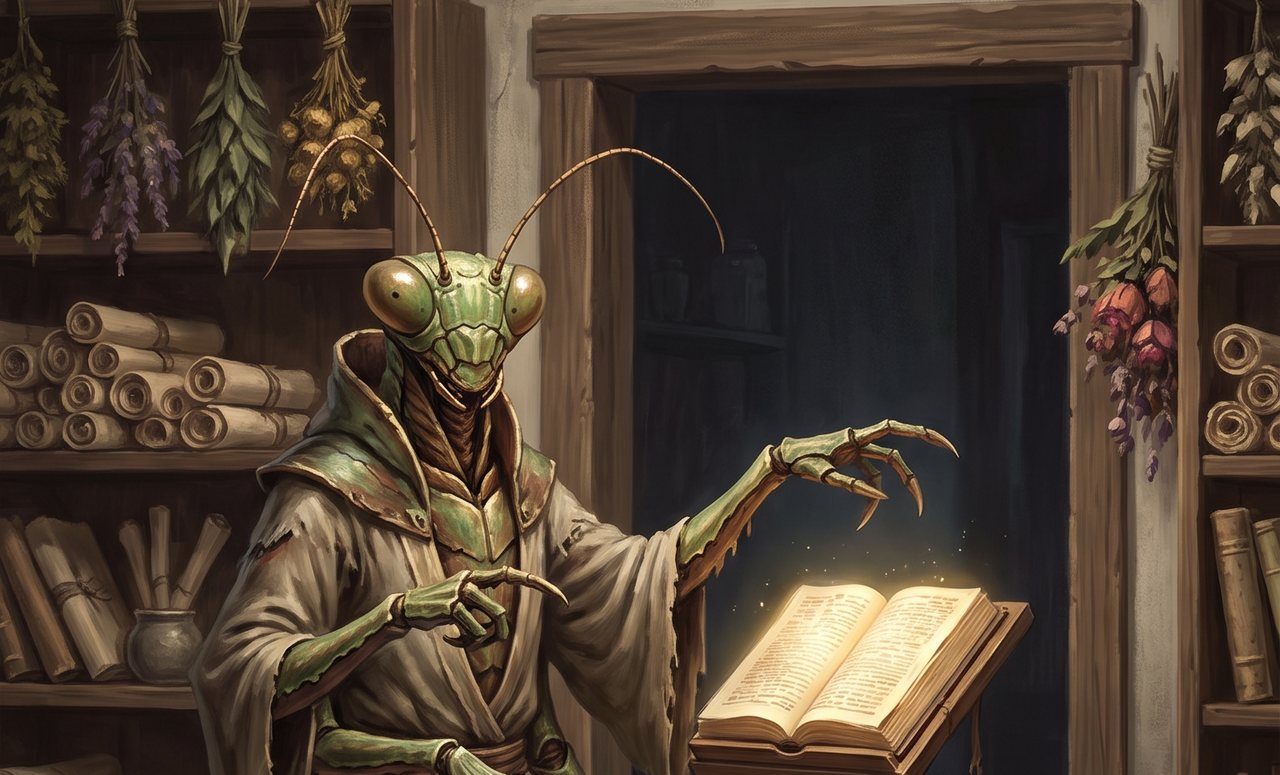
The mantis-and-scarab pairing is only the loud end of a much wider bestiary. Around the world, cultures independently reached for the arthropod when they needed to picture a trickster, a guardian, or a soul.
| Tradition | Insect form | Meaning / role | Tier |
|---|---|---|---|
| Egypt | Scarab (Khepri) | Solar rebirth and self-creation | 1 |
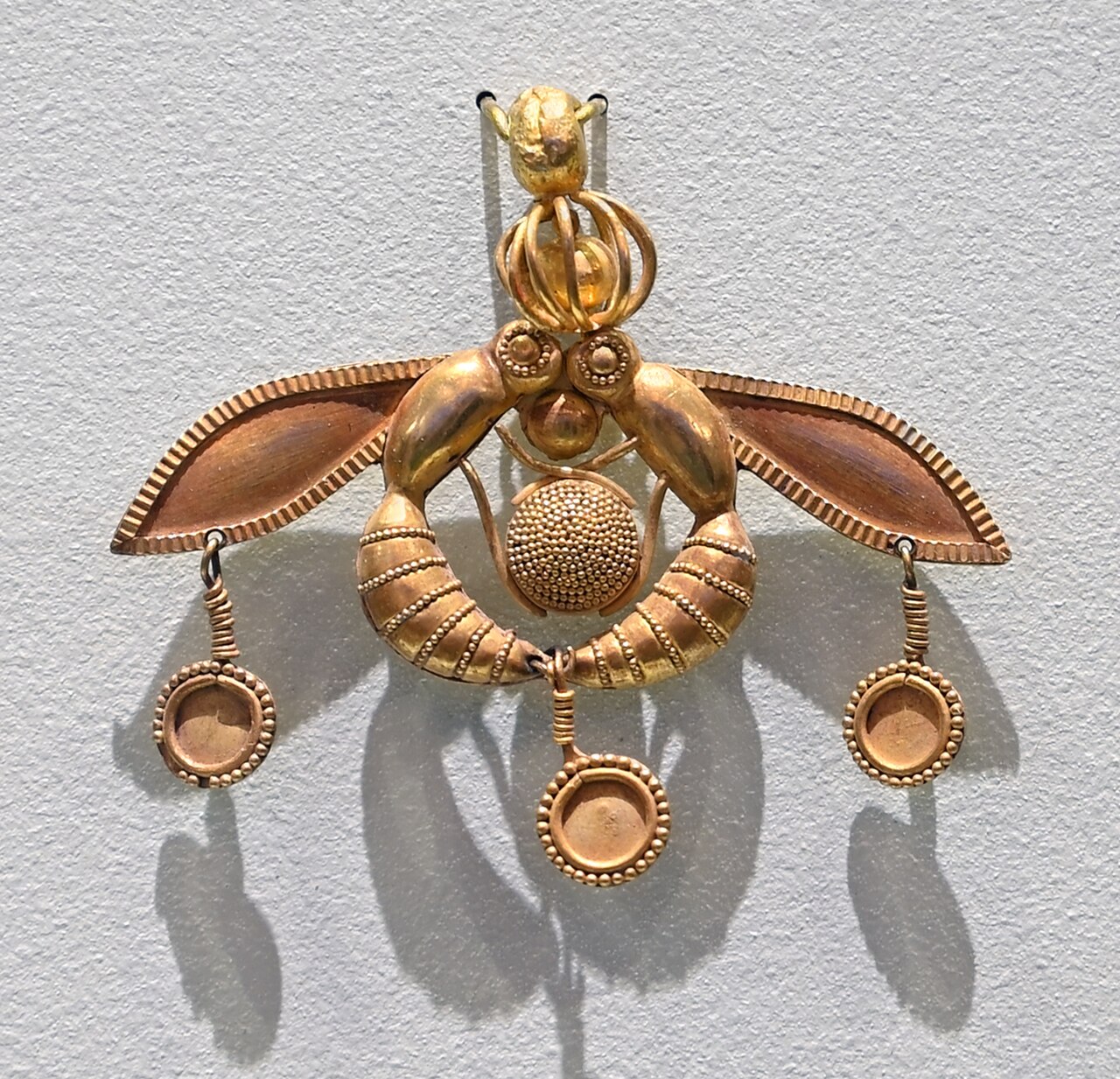
| Minoan / Mycenaean | Bee (the Melissa) | Fertility and prophetic ecstasy | 1 |
| /Xam San (southern Africa) | |Kaggen, the Mantis | Trickster-deity; therianthropic rock-art figures read as trance transformations (Lewis-Williams & Dowson, 1988) | 2 |
| Mesopotamia | Scorpion-men (girtablullû) | Guardians of the mountains of sunrise in the Epic of Gilgamesh, Tablet IX | 2 |
| Greek · Mesoamerican · East Asian | Moth & butterfly | Soul-symbol (Greek psyche = both "soul" and "butterfly"; the monarch's return read as ancestors in Purépecha tradition) | 2 |
A word of care here. The San mantis-trickster |Kaggen and the Puebloan Spider Woman are not fossils — they belong to living Indigenous cosmologies, and they deserve to be met on their own terms rather than mined for a UFO thesis. The comparison below is offered as resonance, not as evidence that these traditions were "really" describing the same thing.
05Archetype, Contact, or Contamination?
So why the recurrence? Why does the insect keep surfacing in DMT sessions, in meditation, in near-death accounts, in abduction interviews — and rhyme, faintly, with what the ancients carved? Researchers have floated three families of explanation, and it is essential to say plainly: none has been validated.
The hypotheses on offer are (a) a neurological archetype activated by specific brain states, (b) genuine autonomous entities accessible through altered consciousness, or (c) cultural contamination from shared media. The theory goes that one of these accounts for the convergence — but no hypothesis has been empirically confirmed, and honest researchers leave the question open.
The "hive mind" — insect colonies as a model of collective consciousness — has been floated as a frame for the telepathic communication witnesses report with insectoid entities. As the file itself flags, this remains entirely speculative, a suggestive metaphor rather than a finding.
Writer Graham Hancock, in Supernatural (2005), proposed that Paleolithic cave art, modern DMT experiences, and fairy folklore are all contact with the same class of non-human intelligence. This is his proposal; it is not accepted in mainstream anthropology or neuroscience.
And the skeptics have the sharper knife. Two counter-arguments cut hardest. First, priming: media images of insectoid aliens — from H.G. Wells's Selenites onward — preceded most of the encounter literature, so the "consistency" may be learned expectation, not a hard-wired template. Second, neurology: mainstream science reads DMT-induced entities as complex hallucinations from disrupted thalamocortical feedback, not perception of anything external. The subjective certainty that the being was real is not, by itself, evidence that it was.
The claim that Egyptian scarab worship encodes ancient contact with literal alien insectoids who steered pharaonic civilization is rejected. The scarab's meaning is fully explained by observable beetle behavior and Egyptian theological logic — no extraterrestrials required — and the credit for that theology belongs to the Egyptians who built it. The related notion that ordinary insects are "biological drones" for a non-human intelligence has no support in entomology.
The most defensible position is also the least dramatic: three genuinely different worlds — Bronze-Age symbolism, a living San trickster-myth, and a modern pharmacological experience — sharing a shape, for reasons we have not settled. Treat them as one phenomenon and you risk an anachronistic conflation the evidence does not license.
Fast Facts
- Reported forms
- Mantis-like, ant-like, beetle-like
- Oldest sacred icon
- Egyptian scarab (Khepri), from c. 2686 BCE
- Bronze-Age bee
- Malia gold pendant, Crete, c. 1800–1700 BCE
- Clinical DMT study
- Strassman: 60 volunteers, 400 doses, 1990–1995
- UAP researchers
- John Mack (1994) · David Jacobs (1998)
- Source confidence
- 2 / 5 — primary tier 3 (speculative)
- Status
- Ancient/modern link unresolved
The Honest Verdict
The ancient symbolism is solid and well-documented — scarab (Khepri), the Minoan bee-goddess and her Melissa priestesses, and spider-creators like Anansi and Spider Woman are among archaeology's and folklore's best-attested figures.
The modern testimony genuinely exists: Strassman's clinical DMT subjects and Mack's and Jacobs's abduction witnesses did independently report mantis-like beings. What is recorded is the testimony, not the being.
That these ancient and modern insect-figures form one continuous phenomenon is a hypothesis — archetype, contact, or contamination — and none of the three has been empirically validated.
The idea that scarab worship encodes contact with real alien insectoids is debunked; Egyptian theology explains it fully from beetle behavior, and the Egyptians deserve credit as its authors.
Mainstream neuroscience reads DMT entities as thalamocortical hallucination, and media images (Wells's Selenites onward) may have primed the reports — so treat the resemblance as suggestive, not settled.
Sources & further reading
Everything above is drawn from our research library on Theories of Anything. Open the full files to check the sourcing and go deeper.
Image credits
- Khepri in the palm of a hand: scarab amulets like this survive in the hundreds of thousands — the sun-beetle the Egyptians made stand for coming-into-being.. Art Institute of Chicago. source Public domain (CC0)
- The Malia pendant: two gold bees bent around a drop of honey, forged on Crete some 3,700 years ago, back when the goddess wore an insect's wings.. Wikimedia Commons. source CC BY-SA 4.0
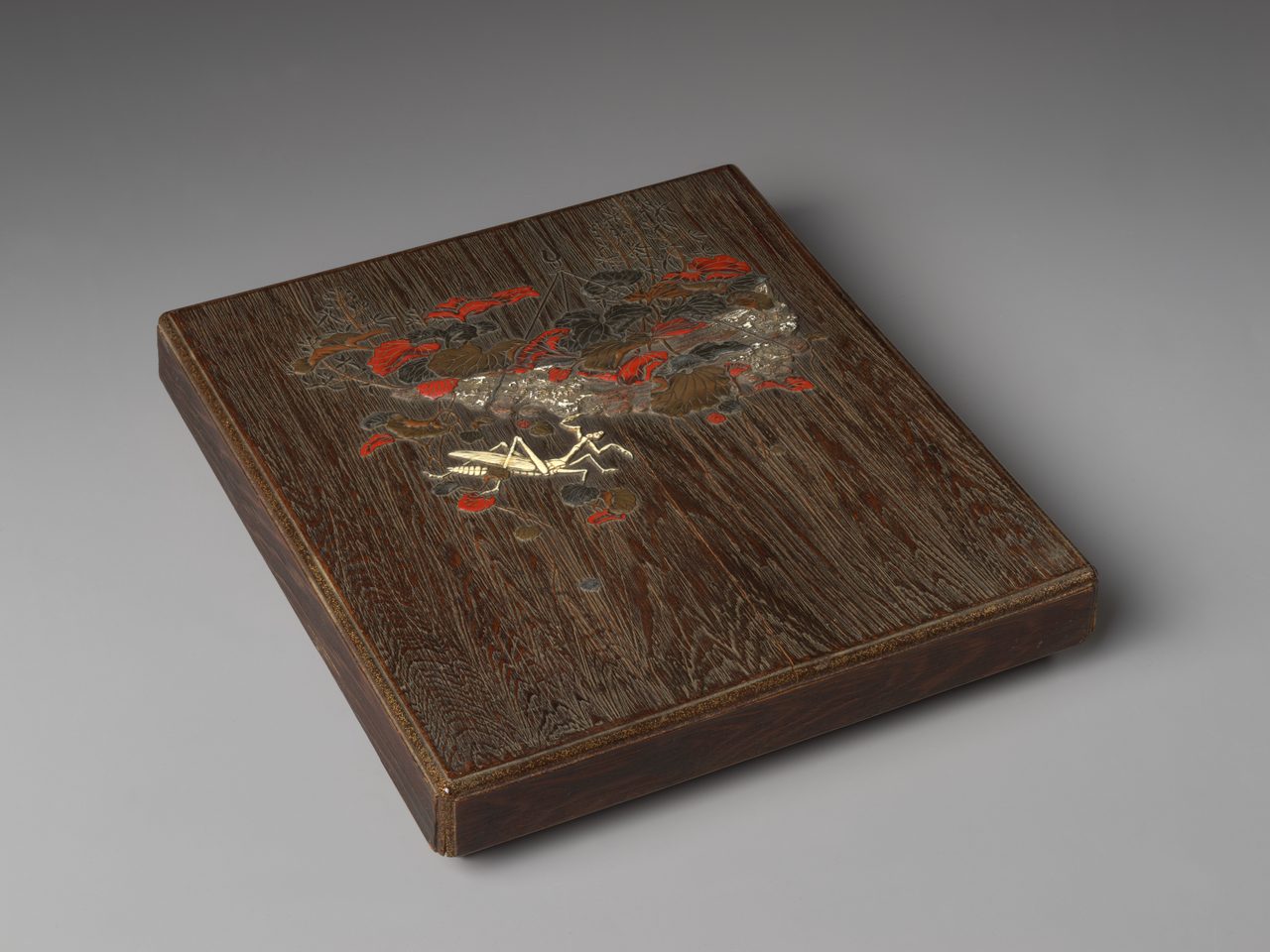
- The face witnesses keep drawing: the triangular head and folded, praying forelimbs of a mantis — the most consistently reported insectoid silhouette in both trance and abduction testimony.. The Met. source Public domain (CC0)
- Mantis-headed being teaching from a book, the Mantis Archive — AI-generated artist's impression; not a documented being. AI-generated
- Mantis-headed being with a holographic star chart — AI-generated artist's impression; not a documented being. AI-generated
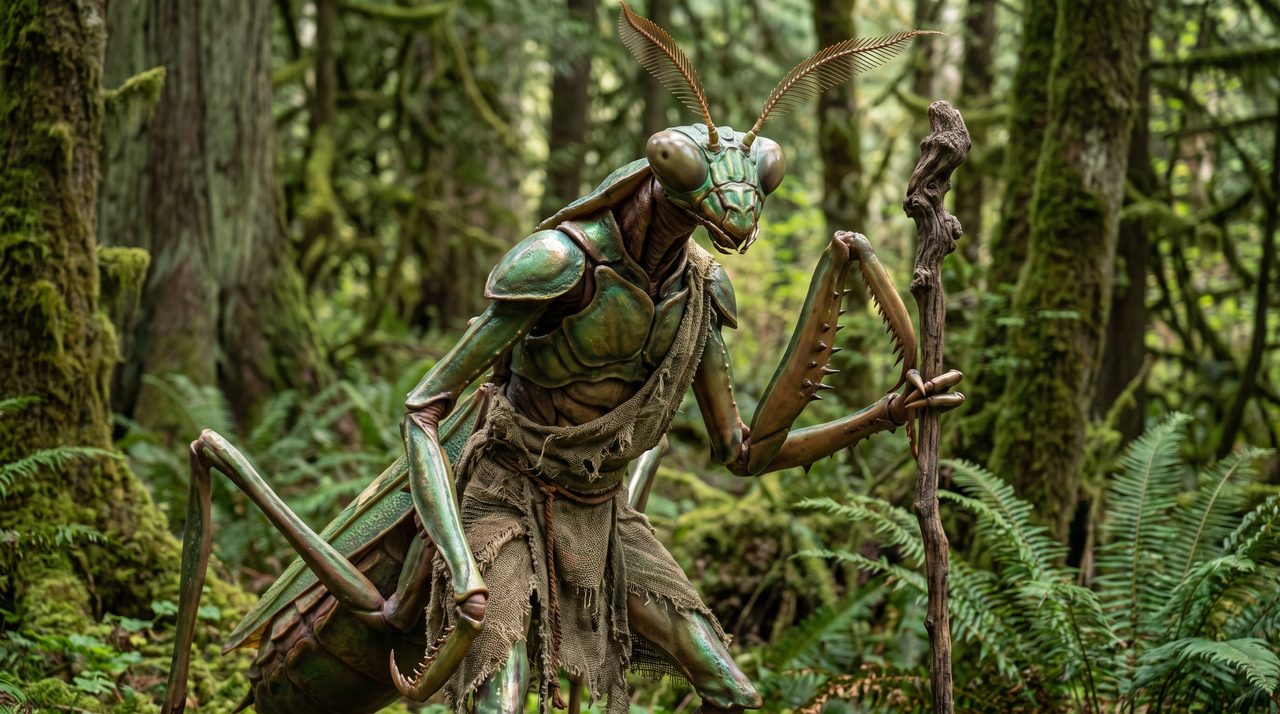
- Armored mantis-like being with a staff, forest setting — AI-generated artist's impression; not a documented being. AI-generated
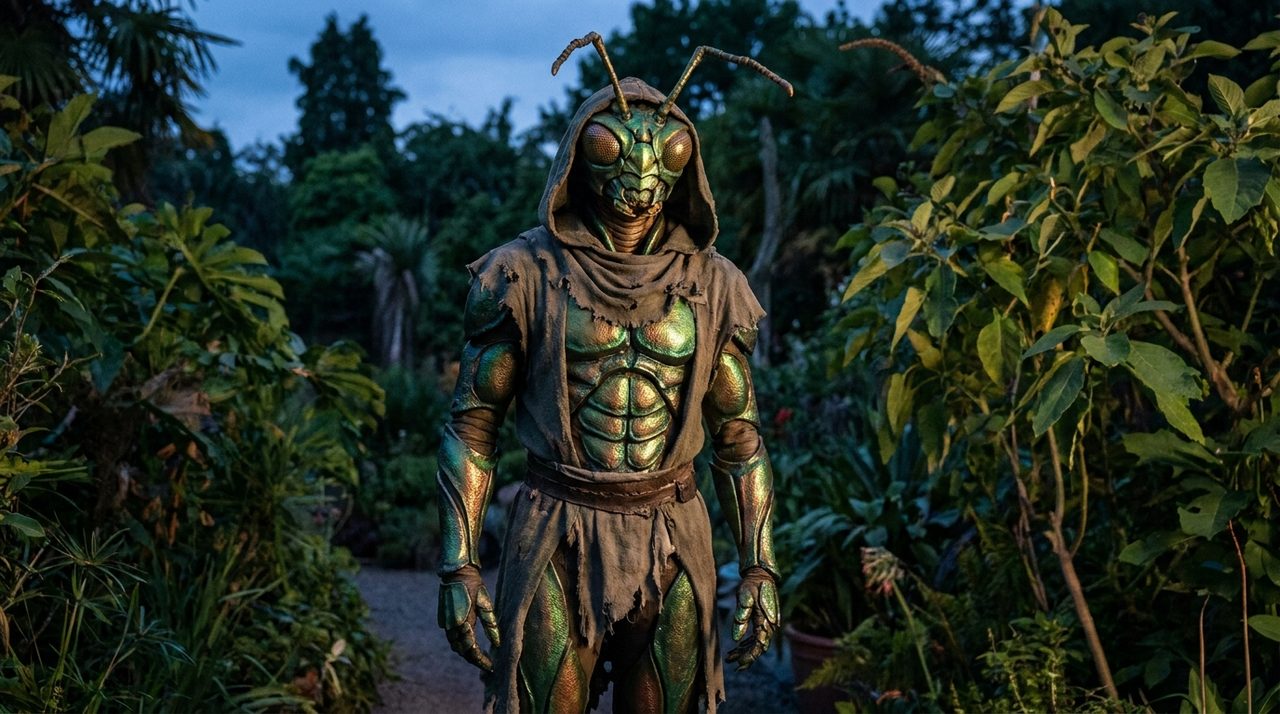
- Hooded insectoid being at dusk — AI-generated artist's impression; not a documented being. AI-generated