Karahan Tepe: Gobekli's Eerie Twin
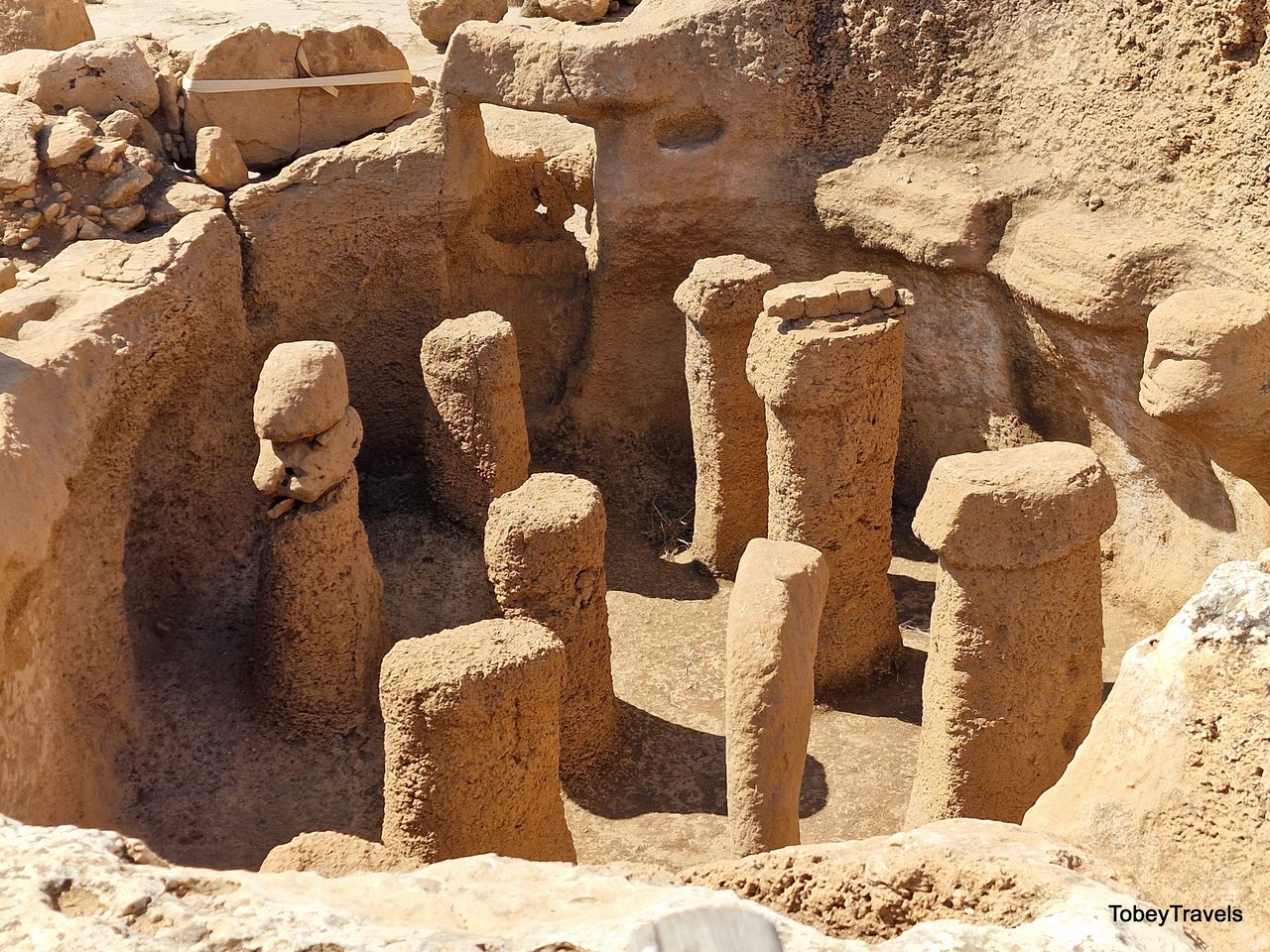
Forty-six kilometres from Gobekli Tepe, hunter-gatherers with no pottery and no farms carved a room into bedrock, stood eleven pillars in it, and left a human face pushing through the wall. Here is the file, every claim wearing its evidence, and the bigger story it tells: Gobekli Tepe was never a one-off.
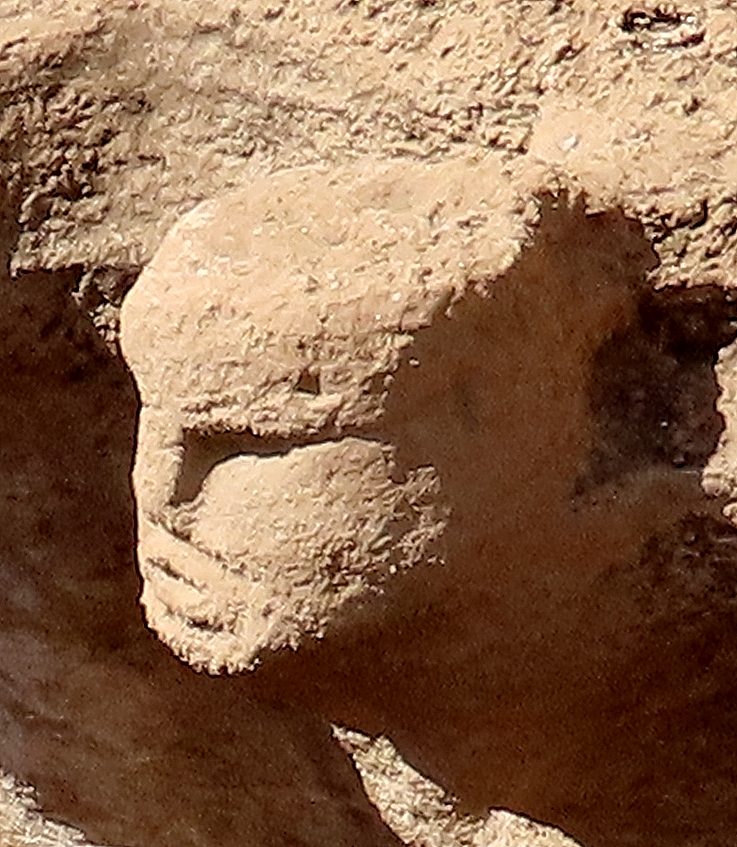
Climb down into the chamber they call Structure AB and the first thing you meet is a face. A human head, eyes and nose and jaw fully formed, pushing out of the bedrock wall as if someone were trapped inside the rock and leaning through it. Around it stand pillars carved straight up out of the floor, several of them unmistakably phallic. The people who cut this room had no pottery, no metal, no farms and no writing. They did it more than eleven thousand years ago. And here is the part that rewrote the textbooks: the room sits just 46 km from Göbekli Tepe, and it proves Göbekli was never alone. Let us open the file.
| Feature | Karahan Tepe | Göbekli Tepe |
|---|---|---|
| Distance | About 46 km southeast | The landmark |
| Radiocarbon range | c. 9400 to 8200 BCE | c. 9600 to 8000 BCE |
| Pillars mapped | At least 250 (geophysics) | About 200 in ~20 enclosures |
| Enclosure shapes | Oval, sub-circular, rectangular | Mostly circular |
| Iconography | Human heads, phalli, serpents | Foxes, boar, snakes, vultures |
| Largest pillars | About 3 to 4 m | Up to 5.5 m and 16 tonnes |
01The twin nobody knew to look for
Karahan Tepe is a Pre-Pottery Neolithic site in Şanlıurfa Province, southeastern Turkey, roughly 46 km southeast of Göbekli Tepe, radiocarbon dated to about 9400 to 8200 BCE. It was spotted in a 1997 surface survey by Bahattin Çelik, who found T-shaped pillar fragments scattered across the hilltop. Full excavation only began in September 2019, under the Turkish Taş Tepeler (Stone Hills) research program directed by Prof. Necmi Karul.
That late start matters. As of early 2026, only about 5 percent of the site has been uncovered. Almost everything written about Karahan Tepe is a preliminary read on a dig that is barely underway, which is exactly why the honest version keeps a lot of doors open.
02Structure AB, the room in the rock
Structure AB is a semi-subterranean oval chamber cut partway into the living bedrock, and it is the most famous space at the site. At least eleven limestone pillars stand inside it in a rough oval. Several are carved as naturalistic phallic forms, tapered and rounded, rising straight from the rock floor with anatomically explicit sculpted tips. Nothing quite like them has turned up at Göbekli Tepe. A continuous bench, also cut from the bedrock, runs around the chamber wall, the kind of seating that implies an audience.
On the north wall, a human head emerges from the stone in full three-dimensional relief: a naturalistic face with defined eyes, nose, mouth and chin, set directly above a carved serpent. Nearby chambers add more. A separate room, Structure AD, holds phallic pillars carved from the bedrock, one of them about 2.3 m tall, and elsewhere a T-shaped pillar carries a realistically carved human face, the most literal version yet of the idea that these T-pillars were always meant to be people.
What the room was for is the open question. Karul (2020, 2021) reads the mix of phallic pillars, the emerging head and the serpent as a ritual space tied to fertility, ancestor veneration, or death-and-rebirth symbolism, with the bench for a congregation. It is a careful, evidence-anchored reading. It is not a proven one, and the excavators say so.
03Not a one-off: the Stone Hills
Here is why Karahan Tepe matters more than any single carving inside it. For decades Göbekli Tepe looked like a lightning strike, a lone genius monument with nothing around it. Karahan, and the wider survey it belongs to, ended that story. The Taş Tepeler (Stone Hills) program has now identified at least a dozen Pre-Pottery Neolithic sites carrying the same T-shaped pillar architecture, scattered across roughly 200 km of the Harran Plain.
| Site | What it adds to the picture |
|---|---|
| Göbekli Tepe | Largest and most excavated node |
| Karahan Tepe | Second-largest; Structure AB |
| Sayburç | First known Neolithic narrative scene |
| Harbetsuvan Tepesi | Small-scale cult centre |
| Ayanlar Höyük | Residential and ritual evidence |
| Seven more surveyed | Across the Şanlıurfa plateau |
Geophysical survey (georadar and magnetics) has mapped at least 250 T-shaped pillars across Karahan Tepe's roughly 11-hectare hilltop, most of them still buried. For comparison, Göbekli Tepe has around 200 pillars across about 20 enclosures. By raw pillar count, Karahan may be the larger of the two.
The Taş Tepeler framework treats Göbekli not as a unique anomaly but as the biggest node in a connected regional system, possibly a set of gathering places where scattered hunter-gatherer bands converged for ritual, feasting and exchange. Sayburç, dug since 2021, sharpens the case with a relief of two human figures flanking wild bulls and leopards, the first known narrative scene in Neolithic art. The pattern is real. Whether the sites were centrally coordinated or simply shared one culture is still being worked out.
04Monuments before farming
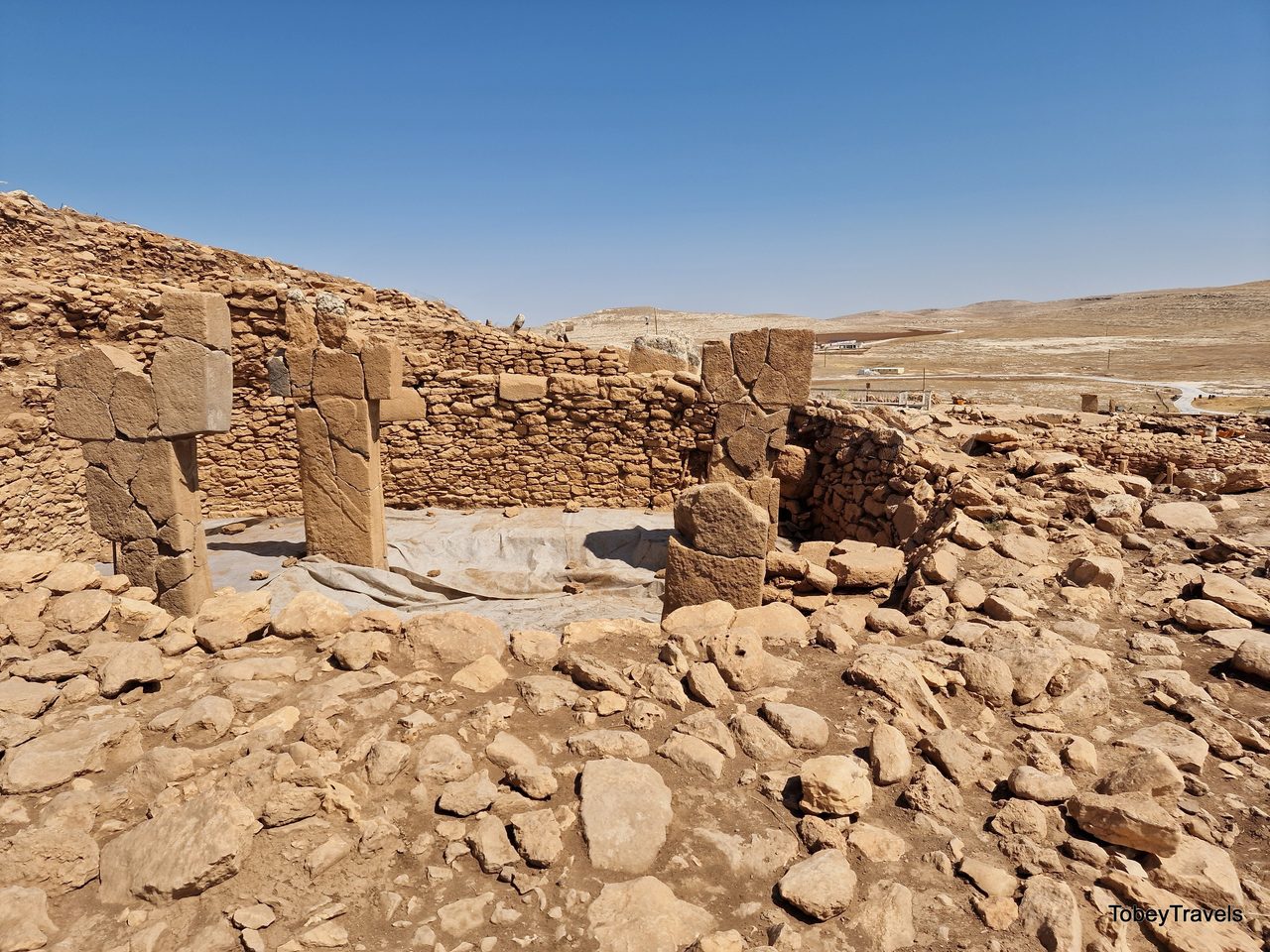
There is no pottery at Karahan Tepe and no farming. The animal bone is all wild (gazelle dominates, then aurochs, equids and wild boar) and the plant remains, wild einkorn wheat and wild barley, show none of the changes that mark domestication. This is monumental construction built entirely before agriculture, by people who still lived by hunting and gathering.
They were not isolated, either. The stone tools include obsidian carried from sources in eastern Anatolia, 250 to 400 km away, and faint traces of red ochre survive on some carvings, hinting the reliefs were once painted. An unfinished T-pillar still sits in the bedrock quarry next to the site, proof the stones were cut and raised locally rather than hauled in.
This is the part that unsettles the old textbook. The classic model (Childe's Neolithic Revolution) said farming came first and surplus food paid for temples, priests and monuments. Karahan and its neighbours flip the order on the table. A serious body of researchers now argues that the shared drive to gather and build may have helped push these people toward farming, not the other way around. The debate is live and genuinely unresolved.
05Where the fringe comes in, and why it fails
A site this strange, this old and this photogenic was never going to escape the lost-civilization treatment. The chamber gets called a stargate, the emerging head a portal, the whole complex the relic of some vanished advanced culture or visitors from elsewhere. It is worth separating the genuinely open questions from the claims that simply collapse.
Some ideas are speculative without being absurd. That the enclosures encode astronomical alignments has been argued for Göbekli Tepe (Sweatman and Tsikritsis, 2017) and stretched to Karahan, though no site-specific study exists. The head-through-the-wall has been read through cross-cultural shamanic imagery as a passage between worlds. And the whole Pre-Pottery Neolithic flowering sits right after the Younger Dryas cold snap, which may have pressured these societies into reorganizing. Suggestive, unproven, and honestly labelled as such.
The rest does not survive contact with the ground. There is no lost supercivilization and no extraterrestrial hand here: the toolkit is stone and antler, the quarrying is ordinary bedrock channel-and-wedge work, and every motif fits documented Pre-Pottery Neolithic culture. Claims that the site is 50,000 years old, or the literal oldest temple on Earth, misread the radiocarbon dates. The stargate and the encoded advanced mathematics are modern fantasies projected onto Neolithic stone, with no measurement or peer-reviewed analysis behind them.
Fast Facts
- Site
- Karahan Tepe, Şanlıurfa Province, southeastern Turkey
- Distance from Göbekli Tepe
- About 46 km southeast
- Date
- c. 9400 to 8200 BCE (Pre-Pottery Neolithic)
- Discovered / excavated
- Surveyed 1997; dug since September 2019
- Program
- Taş Tepeler (Stone Hills), dir. Necmi Karul
- Pillars mapped
- At least 250, most still buried
- Excavated so far
- About 5 percent of the site
- Economy
- Wild plants and hunting; no pottery, no farming
What we can actually stand behind
Karahan Tepe is real, it is roughly 11,000 years old, and it is genuinely monumental architecture built before farming existed. Its bench-lined rock-cut chamber, phallic pillars and emerging human head are documented, published finds.
What Structure AB was for, how tightly the Taş Tepeler sites were coordinated, and whether the urge to build drove the move to farming rather than following it, are all live and unresolved questions among archaeologists.
No lost supercivilization, no extraterrestrial builders, no 50,000-year-old temple, and no stargate. The head in the wall is astonishing sculpture, not a portal. Nothing excavated at the site supports any of it.
Which leaves the real cliffhanger buried in plain sight. About 95 percent of Karahan Tepe is still underground, at least 250 pillars remain unlifted, and the Stone Hills survey keeps finding more hills. Somewhere out on the Harran Plain, hunter-gatherers who had not yet planted a single seed built a whole world of these places, and we have opened the door on only a handful of rooms. What did they think they were doing down there in the rock? The face in the wall is not saying.
Sources & further reading
Everything above is drawn from our research library on Theories of Anything, deep-read in full rather than skimmed. The corpus files are where we worked from; the papers, reports and primary records listed beneath them are where you can check us independently.
Image credits
- Structure AB subterranean chamber at Karahan Tepe photograph via Wikimedia Commons (tobeytravels (Flickr, via tobeytravels)). CC BY-SA 4.0 Source.
- Close-up of the carved human head in 3D relief on the bedrock photograph via Wikimedia Commons (Tobey Travel (tobeytravels, Flickr)). CC BY-SA 4.0 Source.
- Wide daytime view of the excavated Karahan Tepe hilltop photograph via Wikimedia Commons (tobeytravels (Flickr, via tobeytravels)). CC BY-SA 4.0 Source.
- Card crop of Structure AB subterranean chamber at Karahan Tepe photograph via Wikimedia Commons (tobeytravels (Flickr, via tobeytravels)). CC BY-SA 4.0 Source.
,_Turkey_(2).jpg)
,_Turkey.jpg)
,_Turkey_(2).jpg)