Kukulkan: The Serpent of Shadow That Slithers Down a Pyramid
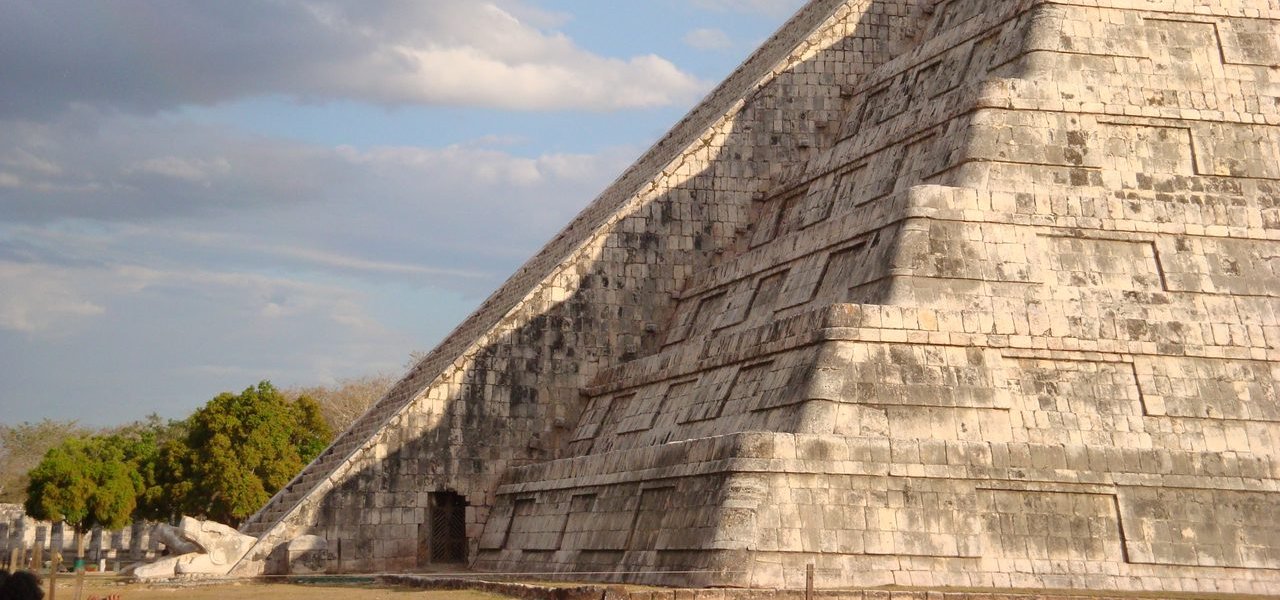
Twice a year, on the spring and autumn equinoxes, the afternoon sun turns the northern staircase of a Yucatan pyramid into a serpent. Seven triangles of light ripple down the stone and meet a carved snake's head at the base. This is El Castillo, the Temple of Kukulkan at Chichen Itza, and the descending serpent of shadow is real, measured, and photographed. Kukulkan is the Yucatec Maya feathered serpent, a relative of the Aztec Quetzalcoatl but not the same god, from a different people, a different language, and a different century. His own worship reaches back through the Classic Maya cities for centuries before this pyramid was ever raised. The one thing the evidence will not yet settle is the very effect that made him famous: did the builders design that serpent of shadow on purpose, or did it fall out of a pyramid they aligned to the sun for other reasons? Here is Kukulkan on his own terms, every claim wearing its tier.
Stand on the north plaza at Chichen Itza on the afternoon of the spring equinox and watch a shadow become an animal. As the sun drops, the stepped terraces of the pyramid called El Castillo throw a line of triangles onto the northern staircase, seven triangles of light that ripple downward until they meet a serpent's head carved in stone at the foot of the stairs. For a few minutes the building wears a snake of light and darkness sliding to the ground. This is the temple of Kukulkan, the feathered serpent of the Yucatec Maya, and the descending serpent is not a legend. It is a measured, photographed event that happens on schedule twice a year. What it means, and whether the people who raised the pyramid a thousand years ago meant it to happen at all, is the harder story.
01Two Serpents, One Family, Not One God
The feathered serpent is the longest-running idea in Mesoamerican religion, carved, painted, and prayed to across more than two thousand years and nearly every major culture of ancient Mexico and Central America. But it never had a single name, and it was never a single god. The Aztecs and the earlier Central Mexican peoples called their feathered serpent Quetzalcoatl, Nahuatl for the quetzal-bird serpent. The Yucatec Maya called theirs Kukulkan, K'uk'ulkan, feathered serpent in their own language. These are related regional figures from different cultures, different languages, and different centuries, not one deity wearing two interchangeable names for a single shared story. Kukulkan is Maya. Quetzalcoatl is not. Keeping the two apart is the whole point of this file.
The Aztec Quetzalcoatl already has his own dossier in this wing: three thousand years of him, from Olmec stone to the Morning Star, and the two colonial myths that still cling to his name. This file is its companion, and it keeps to the Maya side of the family. It is about Kukulkan, about the Yucatan, and above all about the pyramid at Chichen Itza that turned his worship into an instrument of the sun.
02The Shared Root, Before The Split
Before there was a Kukulkan or a Quetzalcoatl, there was just the feathered serpent, and it is old almost beyond belief. The earliest feathered-serpent imagery is Olmec, carved at sites like La Venta and Chalcatzingo more than three thousand years ago. From there the figure runs unbroken through the archaeological record: serpent-and-bird creation imagery at Izapa, the great feathered-serpent temple at Teotihuacan around 150 to 200 CE, feathered serpents on the stelae of the Classic Maya cities, the Toltec capital at Tula, the Pyramid of Kukulkan at Chichen Itza, the round wind-god temples of the Aztecs, and finally the Spanish chronicles that wrote the last of it down in the sixteenth century. That is more than two and a half thousand years of one symbol, which the research file calls one of the longest-lived religious symbols in human history.
| When | Culture | The Feathered Serpent There |
|---|---|---|
| ~1200 to 600 BCE | Olmec | The earliest feathered-serpent imagery, at La Venta and Chalcatzingo |
| ~400 to 100 BCE | Izapa | Serpent and bird imagery on Stelae 2 and 25, tied to creation |
| ~150 to 200 CE | Teotihuacan | The Temple of the Feathered Serpent, 366 heads, built over roughly 200 sacrifices |
| ~400 to 900 CE | Classic Maya (Tikal, Copan, Palenque) | K'uk'ulkan iconography on stelae, tied to the legitimacy of kings |
| ~900 to 1168 CE | Toltec (Tula) | Quetzalcoatl as patron deity, and the Topiltzin legend |
| ~1000 to 1200 CE | Chichen Itza | El Castillo, the Temple of Kukulkan, and the equinox serpent |
| ~1325 to 1521 CE | Aztec (Tenochtitlan) | The round temple of Quetzalcoatl-Ehecatl, the wind god |
| ~1540 to 1580 CE | Spanish chronicles | Sahagun, Duran, and Motolinia record the oral tradition |
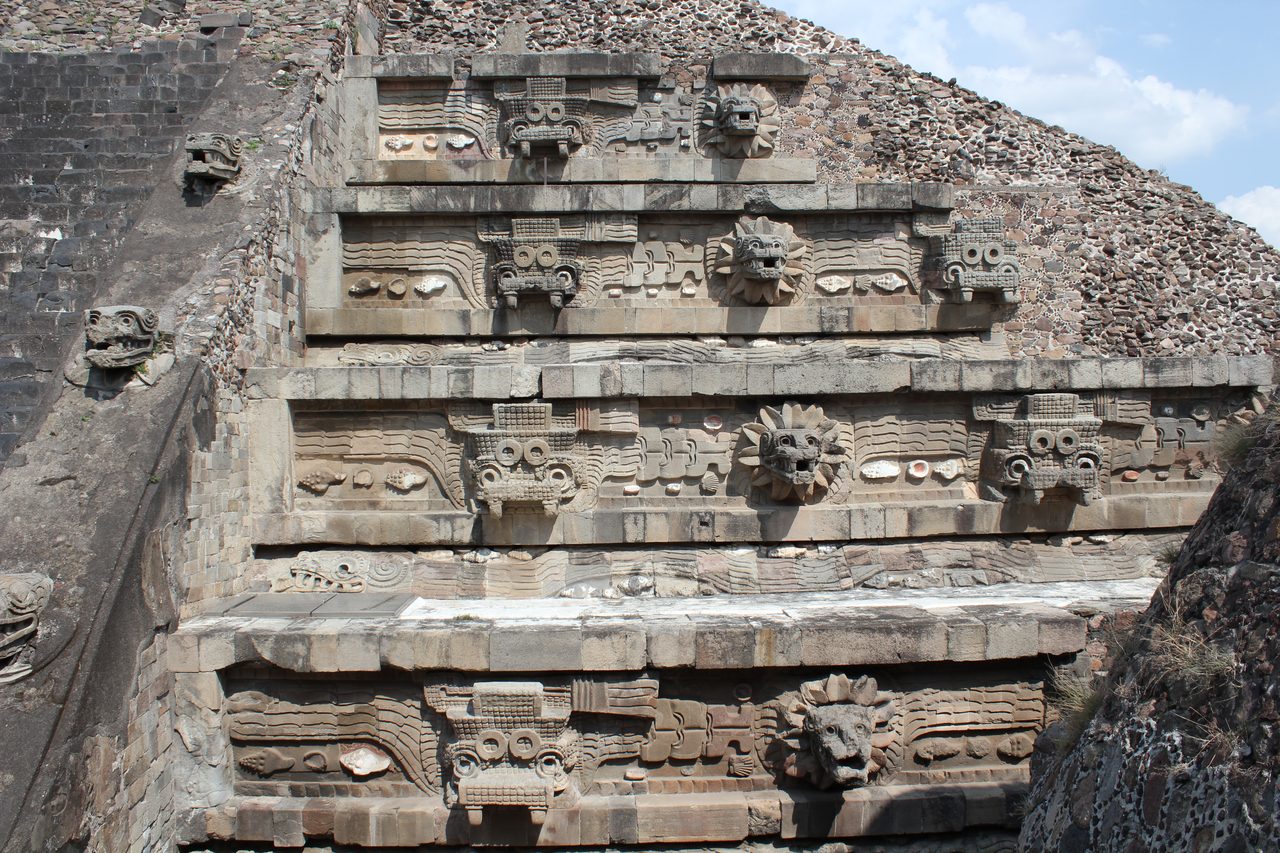
One monument on that timeline deserves a second look, because it is the direct ancestor of everything the Maya later did with the feathered serpent, and because it sits about 1,300 kilometers and some eight centuries away from Kukulkan's own pyramid. At Teotihuacan, near modern Mexico City and once the largest city in the pre-Columbian Americas, the Temple of the Feathered Serpent carries 366 sculpted feathered-serpent heads projecting from its facades. When Saburo Sugiyama and Ruben Cabrera Castro excavated it, they found roughly 200 sacrificed people buried around and beneath it, many of them warriors with their hands bound behind their backs, laid out in what looks like a single dedicatory event. This is the shared root of the tradition. It is not Kukulkan, and it is not the Maya.
And it did not yet mean what Kukulkan would later mean. At Teotihuacan the feathered serpent is a creature of warfare, sacrifice, and raw cosmic power, not the peaceful culture-hero of the later legends. Sometime in the third century CE its temple facade was deliberately defaced and buried under a new platform, which archaeologists read as the sign of a political crisis around the cult, perhaps its suppression. By the time the Toltecs took the figure up, some seven centuries on, it had been reworked into a patron of knowledge and an opponent of human sacrifice, an almost complete reversal of what the Teotihuacan evidence shows. The feathered serpent was never one fixed idea. It changed as it traveled, and the Maya received their own version of it.
03Kukulkan's Own Maya Line
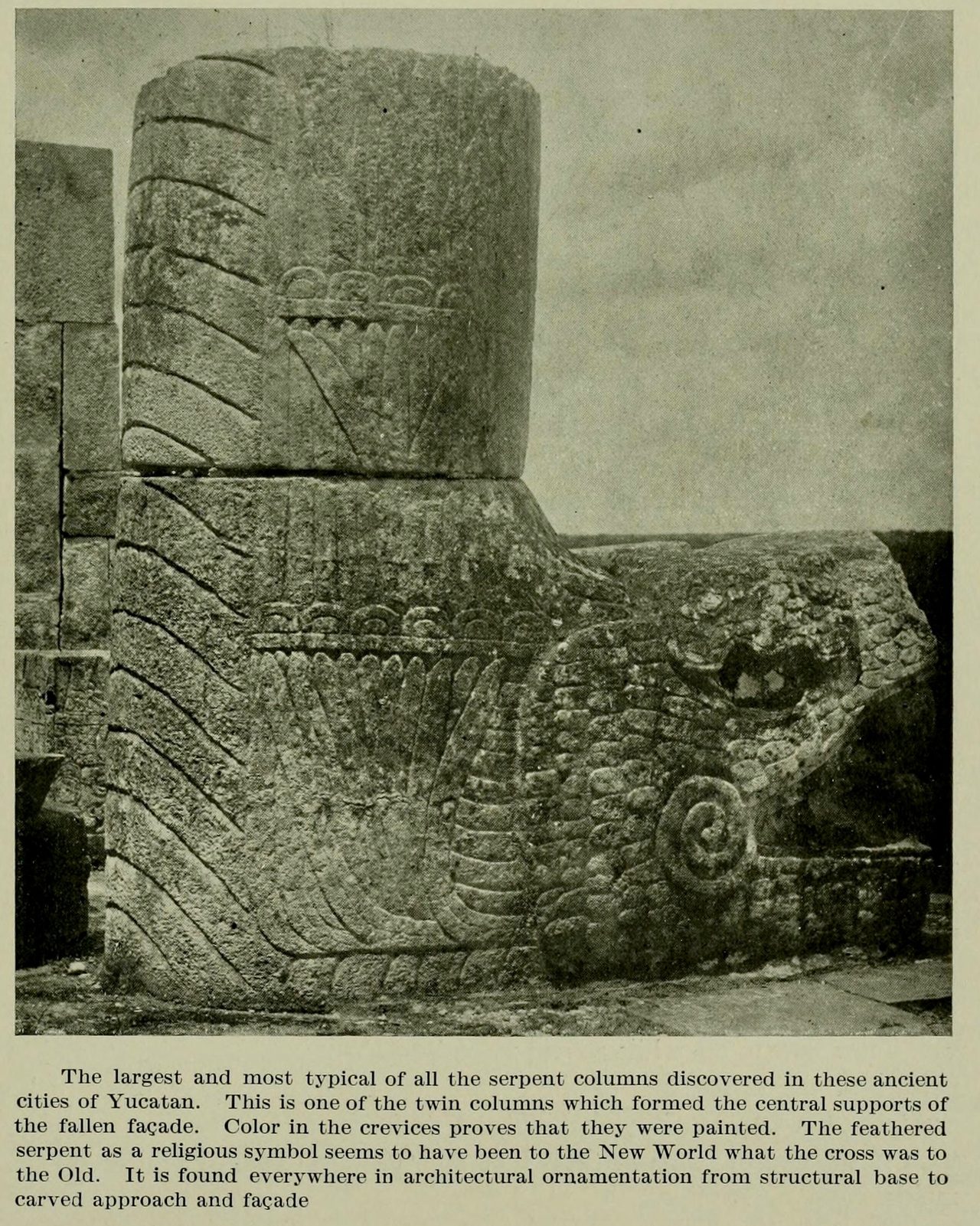
Here is the part the famous equinox photograph tends to hide: Kukulkan is not a Toltec import that the Maya simply borrowed at Chichen Itza. He has his own deep Maya lineage. Centuries before El Castillo was raised, feathered-serpent iconography under the name K'uk'ulkan, also written Waxaklahun Ubah Kan, appears at the great Classic Maya cities of Tikal, Copan, and Palenque, roughly between 400 and 900 CE, carved on stelae and architecture and bound up with the legitimacy of Maya kings. That means the Maya were worshipping their own feathered serpent for centuries before the Toltec-Maya fusion that produced the pyramid he is now most famous for. Whatever Chichen Itza later added, it was added to a tradition the Maya already owned.
04The Calendar You Can Climb
El Castillo, the Pyramid of Kukulkan, is a calendar in the shape of a building. The 30-meter stepped pyramid carries 91 steps on each of its four sides, and with the single platform step at the summit they total exactly 365, one for every day of the solar year. It is not a building decorated with the calendar. It is the calendar, cut into stone. The pyramid was raised between roughly 1000 and 1200 CE, in the era when Toltec and Maya styles blend at Chichen Itza so tightly that the two are hard to pull apart.
How that blend happened is a live argument. For a long time scholars explained it with a single clean story: that Toltec warriors from central Mexico invaded the Yucatan and imposed their culture, feathered serpent and all, on the local Maya. That invasion model is now increasingly doubted. The mixture may instead record long-distance trade, a shared elite fashion that spread across Mesoamerica, or the Maya of Chichen Itza developing the site largely on their own terms. The pyramid's date is firm. The question of who drove the fusion that built it is not.
05The Serpent Of Shadow
And twice a year the calendar performs. On the days around the spring equinox in March and the autumn equinox in September, the late-afternoon sun strikes the pyramid's northern staircase at exactly the angle needed to throw a row of seven triangles of light down its balustrade. The triangles link into an undulating band that appears to pour down the stone and connect to the carved serpent head at the base of the stairs, so that Kukulkan seems to descend the pyramid as living light. This is not a modern tourist legend or a trick of a single lucky photograph. Archaeoastronomers, among them Anthony Aveni in 2001 and Susan Milbrath in 1999, have confirmed that the solar alignment producing the effect is real.
06Designed, Or A Beautiful Accident?
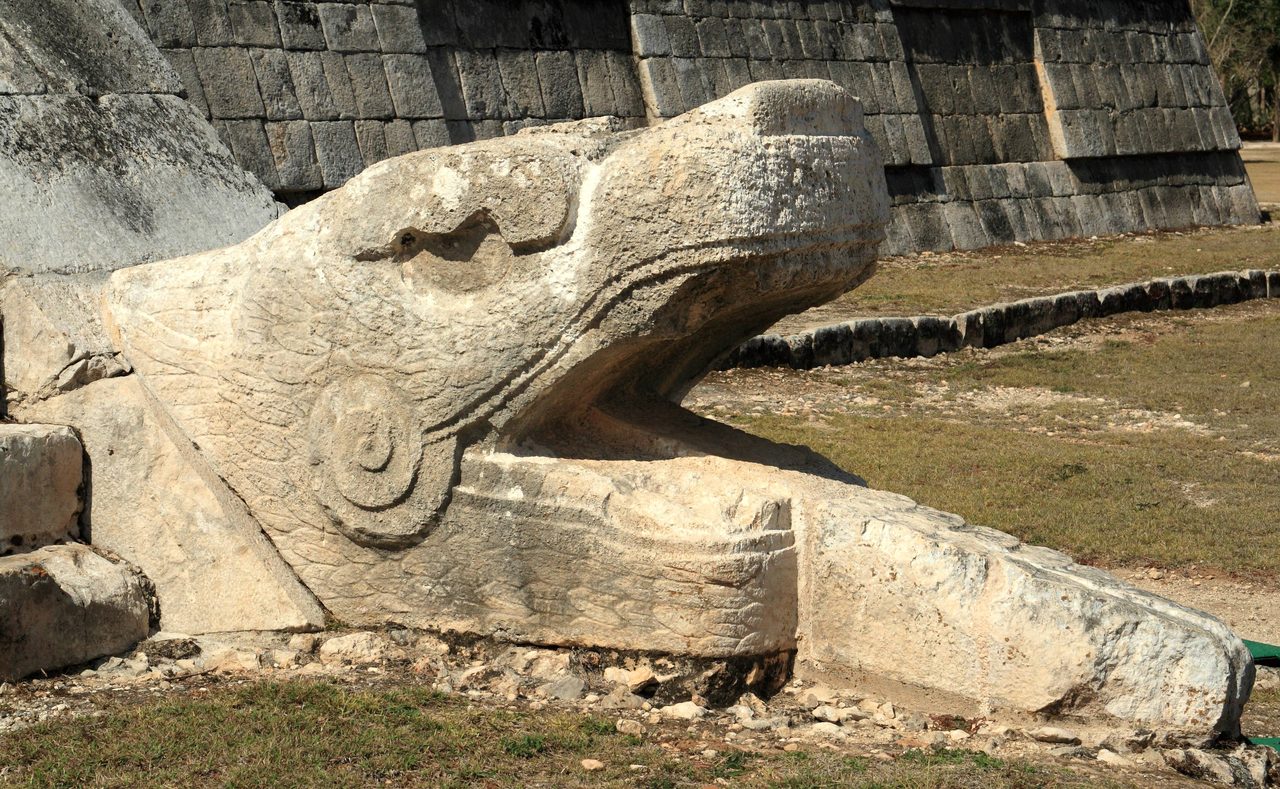
So the shadow serpent is real. The question the file leaves genuinely open is whether it was meant. Nobody doubts that El Castillo was built with the sky in mind. The pyramid is aligned roughly 17 degrees east of north, matching the sunset on the days the sun passes directly overhead, and its precision, the 365 steps included, points to deliberate astronomical design. What is debated is narrower and sharper: did the Maya architects set out specifically to make a serpent of shadow crawl down the staircase on the equinoxes, or is that spectacle a byproduct of a pyramid they oriented to the sun for broader calendrical reasons? The phenomenon itself is documented and beyond dispute. The specific intention behind the snake is not.
07The Sacred Well
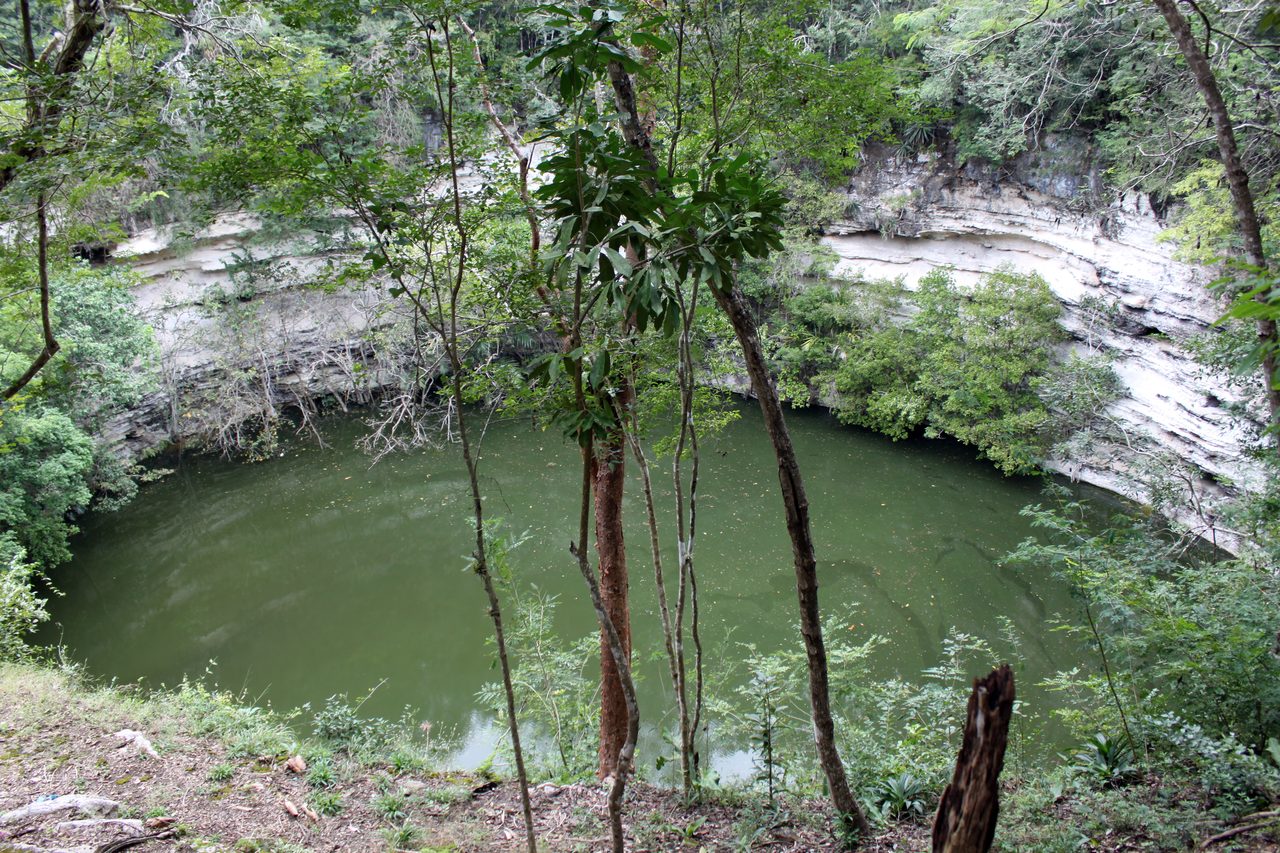
The pyramid does not stand alone. A raised stone causeway runs about 300 meters from the heart of Chichen Itza to the Sacred Cenote, a great natural sinkhole in the limestone, and the link between them is deliberate. Where the pyramid reaches up toward the sky and the sun, the cenote opens down into water and the underworld, and together they bind sky, earth, and water into a single sacred geography around Kukulkan. The cenote was a place of offering, human sacrifice included, and it swallowed jade, gold, copal incense, and pottery. Between 1904 and 1910 the American archaeologist Edward Thompson dredged it and pulled thousands of artifacts and human remains out of the mud, turning the old stories of sacrifice at the well into catalogued fact. Chichen Itza is now a UNESCO World Heritage Site, and the cenote is one of the reasons why.
08What Kukulkan Is Not
One story that famously attaches to the feathered serpent does not attach to Kukulkan at all, and the difference is worth naming. The Aztec Quetzalcoatl carried a legend that he sailed east across the sea and promised to return, and after the conquest a second story was welded onto that one: that the emperor Moctezuma froze because he mistook the conquistador Hernan Cortes for the returning god. That second story is a post-conquest fabrication, assembled to make the conquest look preordained, and it is ruled out by historians such as Matthew Restall and Camilla Townsend. It is treated in full in the companion Quetzalcoatl file, and nothing here softens it. What matters for Kukulkan is that his Yucatan cult produced no such returning-god legend and no equivalent conquest myth. The tale belongs to the Aztec figure alone, and reading it back onto Kukulkan would be exactly the blurring this file exists to prevent.
There is a larger claim to rule out, and it is the mirror image of everything this file has argued. In a popular strand of alternative history, Quetzalcoatl, the Andean Viracocha, the Egyptian Thoth, and the Egyptian Osiris are all said to be one civilizing god, a single wise stranger who seeded cultures around the world, an idea pushed by writers like Graham Hancock and Erich von Daniken. The research file rejects it outright. These deities have completely different attributes, stories, and settings. The few notes they share, wisdom, civilization, a departure, are among the most common motifs in all of mythology, and there is no evidence of any pre-Columbian theological traffic across the oceans. Each feathered serpent, each culture hero, each creator god has to be understood inside its own civilization. Which is precisely the case for reading Kukulkan as Kukulkan, a Maya god of the Yucatan, and not as one more interchangeable mask on a single global figure who never existed.
Fast Facts
- The name
- Kukulkan, K'uk'ulkan, 'feathered serpent' in Yucatec Maya; the Maya counterpart of the Aztec Quetzalcoatl, and not the same god
- The pyramid
- El Castillo at Chichen Itza, 30 meters tall, with 365 steps: 91 on each of four sides plus one platform step
- The equinox serpent
- Twice a year the afternoon sun throws seven triangles of light down the northern staircase to a carved serpent head at the base
- Older than Chichen Itza
- K'uk'ulkan iconography appears at Tikal, Copan, and Palenque from roughly 400 to 900 CE, centuries before El Castillo
- The sacred well
- A 300-meter causeway links the pyramid to the Sacred Cenote, dredged by Edward Thompson from 1904 to 1910
- The open question
- Whether the builders intended the serpent-shadow effect specifically, or it is a byproduct of the pyramid's broader solar design
- Ruled out
- That Kukulkan, Quetzalcoatl, Viracocha, Thoth, and Osiris are one global civilizing god; each belongs to its own civilization
What We Can Actually Stand Behind
What the evidence carries cleanly is most of what makes Kukulkan famous. El Castillo is real and measured: a 30-meter pyramid whose 365 steps count out the solar year. The equinox serpent of light and shadow is a real, documented, repeatable event, confirmed by archaeoastronomers, not a story told after the fact. Kukulkan's Maya lineage is genuinely deep, with K'uk'ulkan iconography at Tikal, Copan, and Palenque centuries before Chichen Itza was raised. The Sacred Cenote and its dredged offerings are excavated fact, and the pairing of pyramid and well binds sky, earth, and water into one sacred landscape. None of this needs a legend to prop it up.
Several real questions stay open, and the file keeps them open. Whether the builders intended the serpent-shadow effect specifically, rather than producing it as a side effect of a pyramid aligned to the sun for other reasons, is genuinely unsettled, even though the broad astronomical design of the building is beyond doubt. Whether the Toltec-Maya blend at Chichen Itza came from an actual invasion or from trade and shared fashion is contested, and the old invasion model is losing ground. And the reading of Teotihuacan's defaced serpent temple as the record of a religious crisis is a strong interpretation, not a settled fact. The stones are certain. Several of the stories we tell about them are not yet.
The one claim this file rules out flatly is the diffusionist one: that Kukulkan and Quetzalcoatl are the same being as the Andean Viracocha, the Egyptian Thoth, and Osiris, a single civilizing god carried between civilizations that never met. These deities share almost nothing but a handful of mythology's most common motifs, no evidence supports any pre-Columbian crossing of the oceans, and the comparison falls apart the moment the actual attributes are laid side by side. Each feathered serpent belongs to its own people. The related colonial-era myth that an Aztec emperor mistook Cortes for the returning Quetzalcoatl is likewise a post-conquest fabrication, ruled out by Restall and Townsend and treated in full in the companion Quetzalcoatl file, and it was never a Kukulkan story to begin with.
So strip Kukulkan back to what the stones actually say, and he stands as his own god: a Maya feathered serpent with a lineage older than the pyramid that made him famous, worshipped at a temple that is also a calendar, beside a well that opens down into the underworld. And once a year in spring, and once again in autumn, the sun still comes and lays a serpent of shadow down his staircase, exactly as it has for a thousand years. The Maya who raised that pyramid were astronomers precise enough to build the solar year into its steps and to set its corners against the turning sky. So here is the question to carry away from Chichen Itza: when people that skilled at reading the sun watched a serpent of light pour down their own temple twice a year, is it really likely they did not know it was coming, and if they did, what were they trying to say by inviting their god to descend the pyramid on the exact hinges of the year?
Sources & further reading
Everything above is drawn from our research library on Theories of Anything, and every claim traces back to the files below. The primary file is the feathered-serpent deep dive; the Aztec Quetzalcoatl gets his own full treatment in its companion. Open the full file to check the sourcing and go deeper.
Image credits
- The equinox shadow serpent on El Castillo, Chichen Itza photograph by ATSZ56, via Wikimedia Commons. Public domain Source.
- Facade of the Temple of the Feathered Serpent, Teotihuacan photograph by Arian Zwegers, via Wikimedia Commons. CC BY 2.0 Source.
- Serpent head at the base of El Castillo, Chichen Itza photograph by Frank Kovalchek, via Wikimedia Commons. CC BY 2.0 Source.
- Serpent columns, Upper Temple of the Jaguars, Chichen Itza (early 1910s) photograph by Edward H. Thompson and James Weston, via Wikimedia Commons. Public domain Source.
- The Sacred Cenote, Chichen Itza photograph by Anagoria, via Wikimedia Commons. CC BY 3.0 Source.
- Card crop of The equinox shadow serpent on El Castillo, Chichen Itza photograph by ATSZ56, via Wikimedia Commons. Public domain Source.

.jpg)


