Tutankhamun's Cosmic Glass
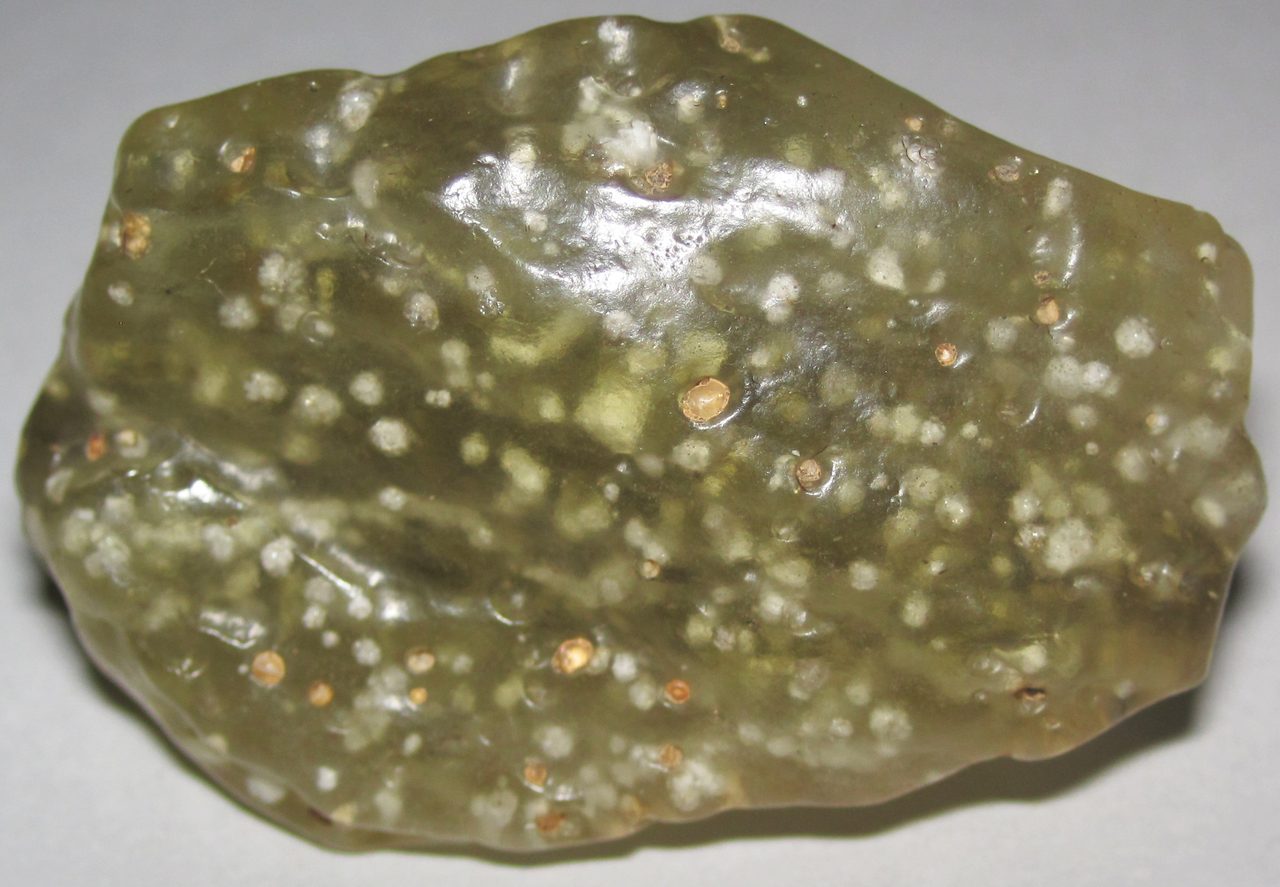
In 1922, Howard Carter lifted a pectoral out of a pharaoh's tomb, and the pale green stone at its center turned out to be glass that no craftsman had made. It is Libyan Desert Glass: close to 98 percent pure silica, scattered across 6,500 square kilometers of the Sahara, and locked inside it are minerals that form only when something hits the ground harder than any volcano or lightning bolt can manage. The glass is real. Its 28.5-million-year age is real. The one thing missing is the crater. Here is the file, every claim wearing its evidence.
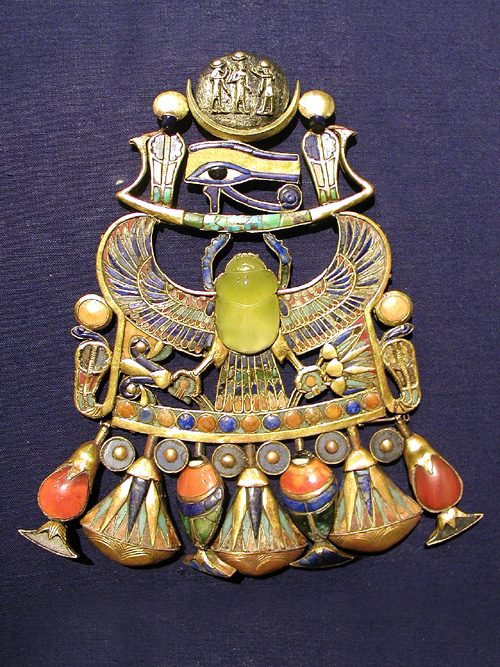
In 1922, in the Valley of the Kings, the archaeologist Howard Carter uncovered the tomb of Pharaoh Tutankhamun, who had reigned around 1332 to 1323 BCE. Among its treasures was a pectoral brooch, and at its center sat a carved scarab of a pale yellow-green stone. It is not lapis, and it is not any gem an Egyptian jeweler could have dug out of the ground. It is glass, but no craftsman melted it. It is Libyan Desert Glass, and it was already tens of millions of years old when it was set in gold. To understand how it reached a pharaoh's chest, you have to go looking for a hole in the desert that, to this day, no one has ever found.
01The Scarab In The Pharaoh's Collar
The scarab is not a legend, it is a catalogued museum object. Carter recovered it in 1922 among Tutankhamun's burial goods, mounted at the heart of a gold pectoral alongside colored glass and semiprecious stones. What makes it extraordinary is the raw material and where that material came from. The pale glass originates in the Great Sand Sea, on the border of Egypt and Libya in the western Sahara, roughly 700 kilometers west of the Nile Valley. Someone carried it that entire distance across open desert, valued it enough to set it on a king, and placed it among the richest materials Egypt possessed.
And Tutankhamun's jewelers were latecomers to it. Prehistoric stone tools worked from Libyan Desert Glass have been found at Saharan archaeological sites, which means people were shaping this material for thousands of years before the pharaoh's craftsmen ever handled it, predating the tomb by a wide margin. Long before it was treasure, it was raw stock: a hard, glassy stone lying loose on the desert floor, waiting to be picked up and knapped into a blade.
02The Purest Glass On Earth
So what is it? Begin with what a laboratory can measure, because on the chemistry there is no argument at all.
Libyan Desert Glass is almost pure silica. Analyses put it at roughly 97 to 99 percent SiO2, with only a percent or two of aluminum oxide and mere traces of iron, titanium, calcium, and magnesium. That makes it one of the purest natural glasses known anywhere on Earth, far cleaner than volcanic obsidian at about 70 to 75 percent silica, and cleaner than typical impact glasses at 60 to 80 percent. The purity is itself a clue: to make glass this clean you need a starting material this clean, and the Nubian sandstones beneath the Great Sand Sea are nearly pure quartz sand.
The physical properties are just as consistent. The glass runs from pale yellow to greenish-yellow, only rarely colorless or milky, its color traced to trace iron and possibly nanoscale inclusions. It is hard, about 6 to 6.5 on the Mohs scale, and unusually light for its kind, with a specific gravity around 2.21, well below the 2.65 of crystalline quartz, exactly what an amorphous glass with no ordered structure should weigh. It turns up in everything from small chips to blocks over 25 kilograms, and the total mass strewn across the desert is estimated at around 1,400 tonnes.
| Property | What The Evidence Shows |
|---|---|
| Composition | Roughly 97 to 99 percent silica (SiO2) |
| Purity vs others | Cleaner than obsidian (70 to 75 percent) or typical impact glass (60 to 80 percent) |
| Color | Pale yellow to greenish-yellow, rarely colorless |
| Hardness | About 6 to 6.5 on the Mohs scale |
| Specific gravity | About 2.21 (crystalline quartz is 2.65) |
| Largest pieces | Blocks over 25 kilograms |
| Estimated total mass | Around 1,400 tonnes |
| Age | About 28.5 million years (Late Eocene to Early Oligocene) |
| Strewn field | About 6,500 square kilometers of the Great Sand Sea |
03The Fingerprints Of A Cataclysm
Purity tells you the sand was clean before it melted. What tells you how it melted is sealed inside the glass, in three minerals that no gentle process on this planet can make.
Trapped inside the glass are inclusions of lechatelierite, a fused silica glass that forms only above about 1,700 degrees Celsius. Beside it appears baddeleyite, a zirconium oxide that shows up when zircon crystals break down at temperatures over 1,670 degrees Celsius. Both are thermometers frozen into the rock, and both read the same near-impossible range: the sand here was flash-heated past the point where quartz itself comes apart.
The third mineral is the clincher. Some specimens contain reidite, a high-pressure form of zircon that forms only above roughly 30 gigapascals, hundreds of thousands of times ordinary atmospheric pressure. No volcano, no wildfire, and no everyday geological process reaches that. Reidite is a diagnostic indicator of hypervelocity impact, the crushing shock you get only when something from space strikes the ground faster than a rifle bullet.
Put the three together and the easy explanations collapse. Lechatelierite, reidite, and baddeleyite are consistent with impact-generated conditions and nothing else on the menu. They are not the work of lightning: fulgurites, the glassy tubes a strike leaves in sand, are chemically dirty by comparison. They are not the work of volcanism. Whatever formed this glass brought extreme heat and extreme pressure to bear at the same instant, and on Earth only an impact or an airburst from space does that.
04A Field The Size Of A Small Country
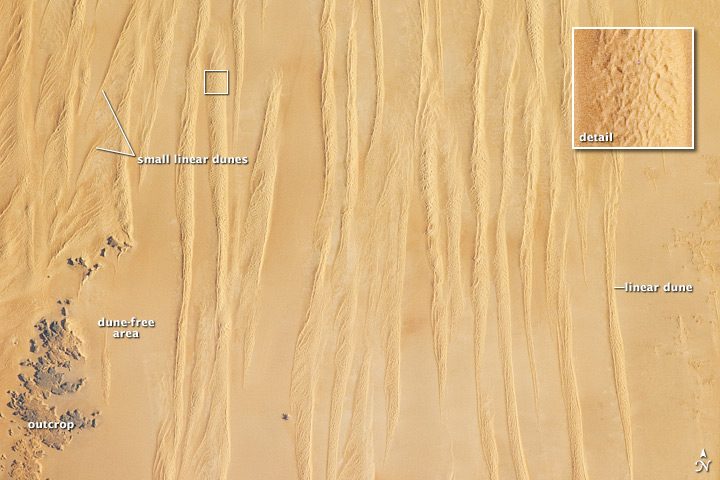
The glass is no rare curiosity clustered in one spot. It litters a strewn field of about 6,500 square kilometers in the Great Sand Sea, straddling the border of Egypt and Libya in the western Sahara and centered near 25.5 degrees north, 25.5 degrees east. Fission-track dating of specimen after specimen returns a remarkably consistent age of about 28.5 million years, placing the event at the boundary between the Late Eocene and the Early Oligocene. The fragments rest on or just below the surface, concentrated in the corridors between the dunes, where the wind has stripped away the sand and left the older deflation surfaces, and the glass, exposed.
05Impact, Or Airburst?
So something came out of the sky and fused this desert. Which something, and where its energy went, is the real scientific argument, and it is very much alive.
With no crater to point at, researchers work with two main scenarios. In the first, a meteorite or asteroid struck the desert directly and blasted out a crater, one that might now be buried under the dunes or eroded past recognition over 28 million years. In the second, a large meteoroid or comet fragment, perhaps 100 to 200 meters across, detonated low in the atmosphere without ever hitting the ground, a Tunguska-style airburst but vastly larger, driving a downward pulse of superheated gas that fused the surface sand into glass. The aerial-burst idea was put forward by Wasson and Moore in 1998 and modeled by Boslough and Crawford in 2008.
There is exactly one named candidate for a crater. The Kebira structure, a roughly 31-kilometer ring that Farouk El-Baz and Eman Ghoneim picked out from satellite and radar imagery and published in 2007, was proposed as the possible source. But field studies there have not confirmed the shock-metamorphism minerals that a genuine impact crater should carry. Kebira remains a proposal, not a proven origin.
The weight of recent work leans toward the airburst, or toward a very shallow oblique impact that spread its energy sideways across the ground rather than punching one deep round hole. But the airburst carries a problem of its own. When Boslough and Crawford ran their simulations, they found that airbursts struggle to hold the ground above the roughly 1,700 degrees Celsius needed, and to hold it there long enough, to melt the 1,400 tonnes of glass actually found. That difficulty is a large part of why many researchers still expect a real crater is out there, buried or eroded, waiting to be located.
| Idea | Tier | What It Would Explain | The Problem |
|---|---|---|---|
| Crater-forming impact | Tier 2 | The shock minerals; would leave a crater, now perhaps buried or eroded | No source crater has ever been confirmed |
| Low-altitude airburst | Tier 2 | Glass with no crater, like a giant Tunguska event | Modeling struggles to hold 1,700 degrees Celsius long enough to melt 1,400 tonnes |
| Cometary impactor | Tier 3 | The low metal signature and easy atmospheric breakup | Speculative; a minority reading of the chemistry |
| Ancient nuclear weapon | Tier 4 | Nothing; the glass is about 29 million years older than humanity | [PSEUDOSCIENCE]: no support, and the wrong chemistry |
| Volcanic glass | Tier 4 | Nothing; there is no volcanism in the region | [CONTRADICTED]: the purity and shock minerals rule it out |
06The Chemistry That Almost Fits
The glass carries a faint hint of whatever made it. Some specimens hold trace amounts of iridium and other platinum-group elements at levels above the normal terrestrial background, the kind of enrichment you expect when material from an asteroid or comet mixes into the melt. It is a whisper of an extraterrestrial contribution, though the concentrations sit lower than in most impact melts.
That faint signature is itself part of the puzzle. Libyan Desert Glass lacks the strong siderophile, or iron-loving, element enrichment that usually marks impact glass, and paired with its extreme chemical purity that makes it genuinely unusual next to other known impact products such as tektites and impactites. It refuses to sit tidily in any existing category.
One way to explain the thin metal signature is to change the impactor itself. Some researchers have proposed that the object was a comet, a low-density icy body, rather than a rocky asteroid. A comet is poor in metals to begin with, which would account for the low siderophile signature, and being more fragile than solid rock it may be likelier to shatter in the atmosphere, which would suit the airburst scenario. It is a reasonable idea, and no more than that, still firmly speculative.
07What It Is Not
Two other explanations circulate widely, especially online, and the research file rates both at the very bottom of the scale for the same blunt reason: the evidence does not merely fail to support them, it points the other way.
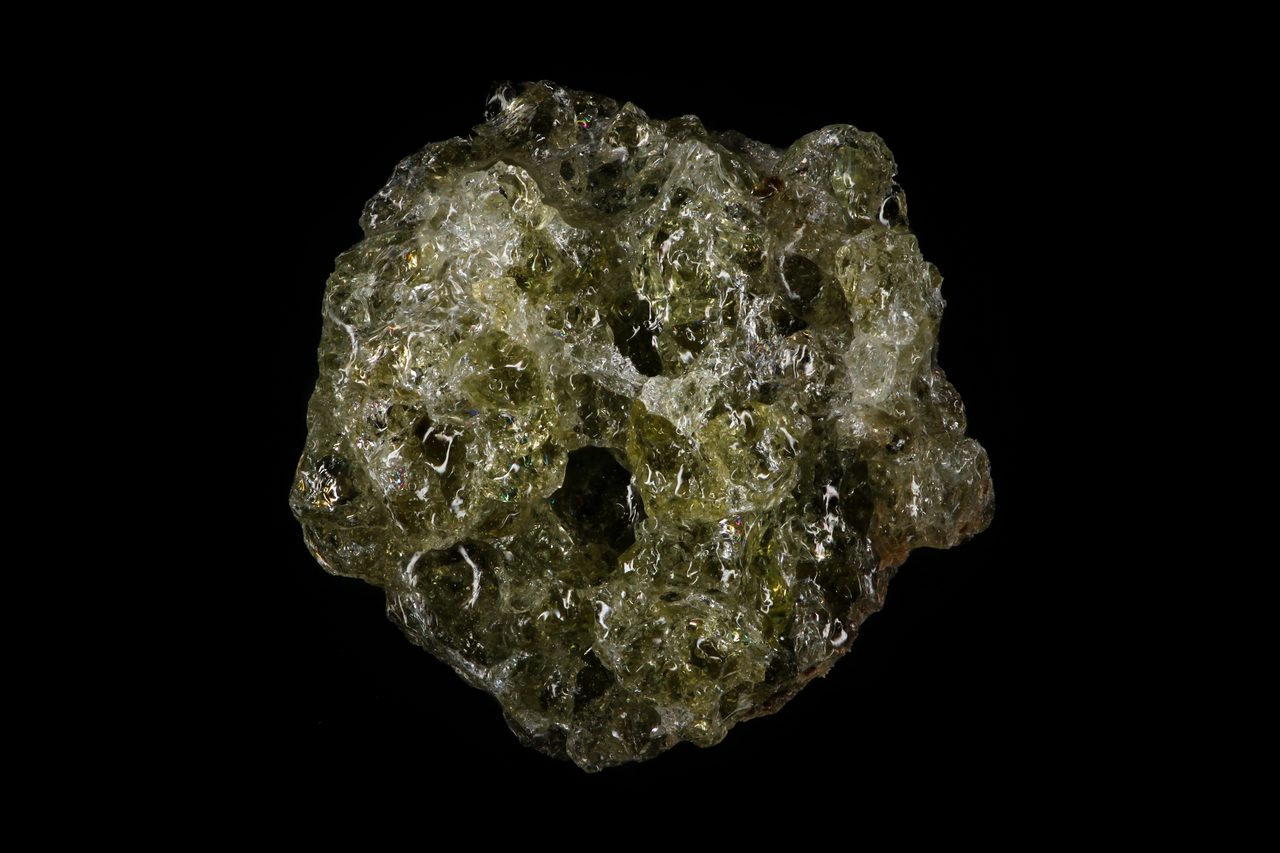
The first is the claim that the glass is the scar of an ancient nuclear war, sand fused by atomic weapons in deep prehistory, often set beside trinitite, the glassy crust left on the ground by the 1945 Trinity nuclear test in New Mexico. It has no scientific support whatsoever. Libyan Desert Glass predates the existence of human beings by roughly 29 million years, and its chemistry is inconsistent with anything a nuclear detonation produces. There was no one here to build a weapon, and no weapon made this.
The second is the claim that the glass is volcanic. It is not, and here the evidence does not just fall silent, it actively contradicts. There is no volcanic activity anywhere in this region, and the glass's extreme silica purity, together with the shock-formed minerals reidite and baddeleyite locked inside it, sets it apart from every known volcanic glass on record. Volcanoes do not make reidite. Only a shock does.
08Where Is The Crater?
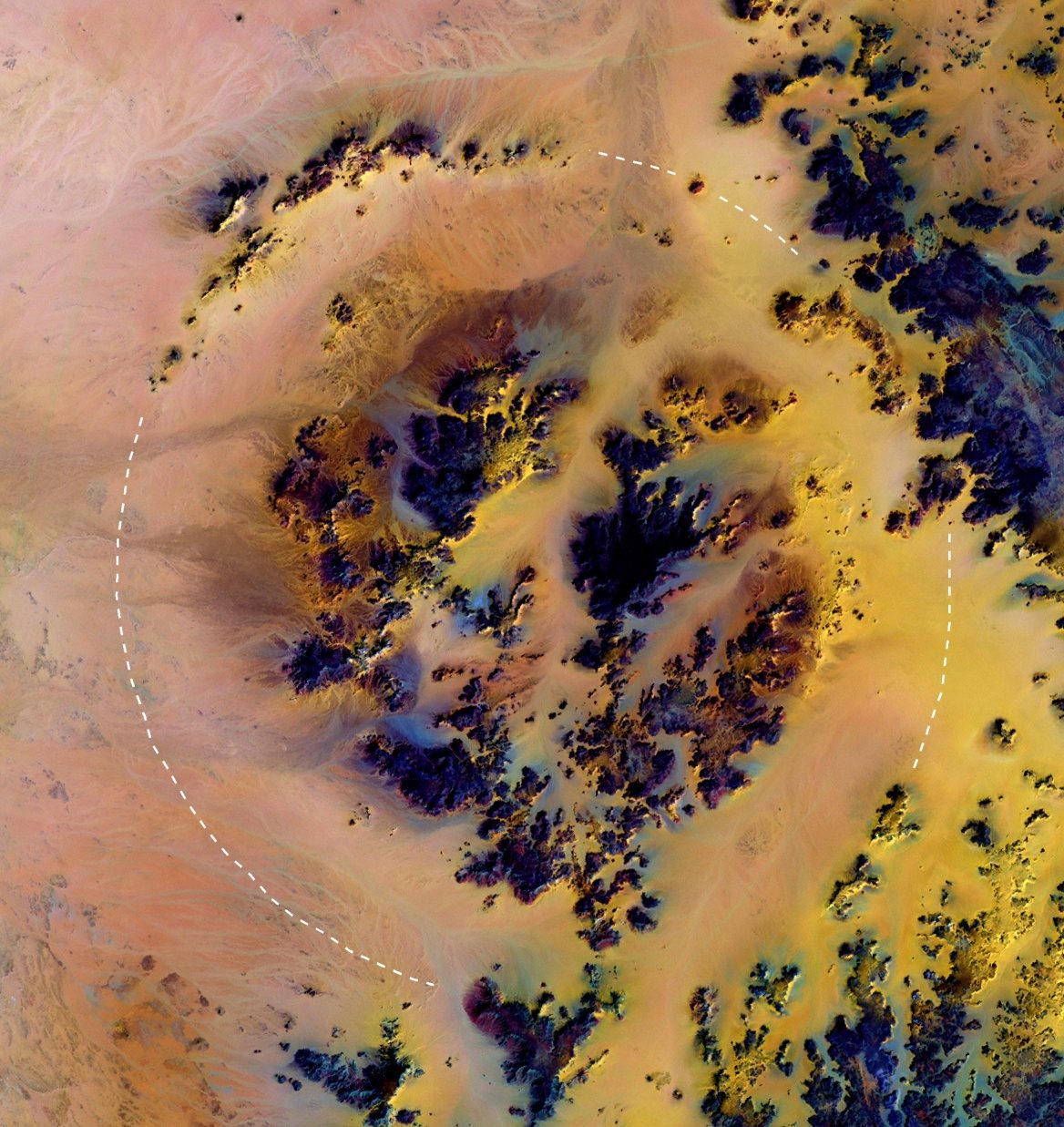
This is where the file stays open. The high-pressure minerals, reidite above all, strongly support a hypervelocity impact or airburst; on that point the science is close to settled. And yet no impact crater has ever been definitively identified as the source of the glass. The single serious candidate, Kebira, has not yielded the shock minerals a real crater should. So the heart of the Libyan Desert Glass mystery is not what the glass is, and not even, in broad strokes, how it formed. It is the missing hole itself: the place where, about 28.5 million years ago, the sky came down and turned a stretch of the Sahara to glass, and which no one has yet found on a map.
Fast Facts
- What It Is
- A natural glass, roughly 97 to 99 percent pure silica
- Where
- The Great Sand Sea, on the border of Egypt and Libya
- Strewn Field
- About 6,500 square kilometers
- Age
- About 28.5 million years (Late Eocene to Early Oligocene)
- Estimated Mass
- Around 1,400 tonnes
- The Smoking Gun
- Reidite, baddeleyite, and lechatelierite: minerals that need impact-level heat and pressure
- Famous Piece
- A scarab carved from it sits in Tutankhamun's pectoral, found by Howard Carter in 1922
- The Open Question
- No source crater has ever been confirmed
What The Evidence Will Actually Support
The glass is real, and so is everything measurable about it. Libyan Desert Glass is roughly 97 to 99 percent pure silica, about 28.5 million years old, scattered across some 6,500 square kilometers of the Great Sand Sea, and it holds lechatelierite, baddeleyite, and reidite, minerals that form only under impact-level heat and pressure. A scarab carved from it really does sit in a pectoral from Tutankhamun's tomb, found by Howard Carter in 1922. None of that is in dispute.
How the glass formed is a live scientific argument. A direct hypervelocity impact and a low-altitude airburst are both on the table, with recent work leaning toward an airburst or a shallow oblique impact, even as the airburst modeling struggles to melt the volume of glass we actually see. A cometary impactor is a reasonable but speculative way to explain the faint metal signature. And no source crater has been confirmed: the Kebira structure is a candidate, not an answer.
It was not the residue of an ancient nuclear war [PSEUDOSCIENCE]: the glass is tens of millions of years older than humanity, and its chemistry does not match a detonation. And it is not volcanic [CONTRADICTED]: there is no volcanism in the region, and its purity and its shock minerals rule out every volcanic glass. Neither claim is merely unsupported. The rock itself contradicts them.
So the oldest question about Libyan Desert Glass turns out to be the simplest. We can hold the glass, weigh it, date it, and read the exact heat and pressure that made it straight out of the crystals trapped inside, and we can follow a single carved scarab of it from a wind-scoured corridor in the Sahara all the way to the chest of a pharaoh. The one thing we cannot do is stand at the rim of the crater. About 28.5 million years ago something came out of the sky and fused a patch of desert into the purest glass on the planet. Where did it land?
Sources & further reading
Everything above is drawn from our research library on Theories of Anything. Open the full files to check the sourcing and go deeper.
Image credits
- A Libyan Desert Glass specimen, a pale yellow translucent natural glass Photo: James St. John (Wikimedia Commons). CC BY 2.0 Source.
- A pectoral from Tutankhamun's tomb, its central scarab carved from Libyan Desert Glass Photo: Jon Bodsworth (Egypt Archive). Public Domain (released by copyright holder)
- An astronaut photograph of the linear dunes of the Great Sand Sea in southwestern Egypt Photo: NASA Earth Observatory (ISS astronaut photograph). CC BY 2.0 Source.
- A Landsat satellite image of the proposed Kebira structure in Egypt's Western Desert Image: NASA / Boston University Center for Remote Sensing. Public domain
- Trinitite, a thin grayish-green glassy crust formed by the 1945 Trinity nuclear test Photo: H. Hiller (Wikimedia Commons). CC BY-SA 3.0 Source.
- Card crop of a Libyan Desert Glass specimen, a pale yellow translucent natural glass Photo: James St. John (Wikimedia Commons). CC BY 2.0 Source.
_6.jpg)

