Longyou Caves: A Million Cubic Meters, Not One Record
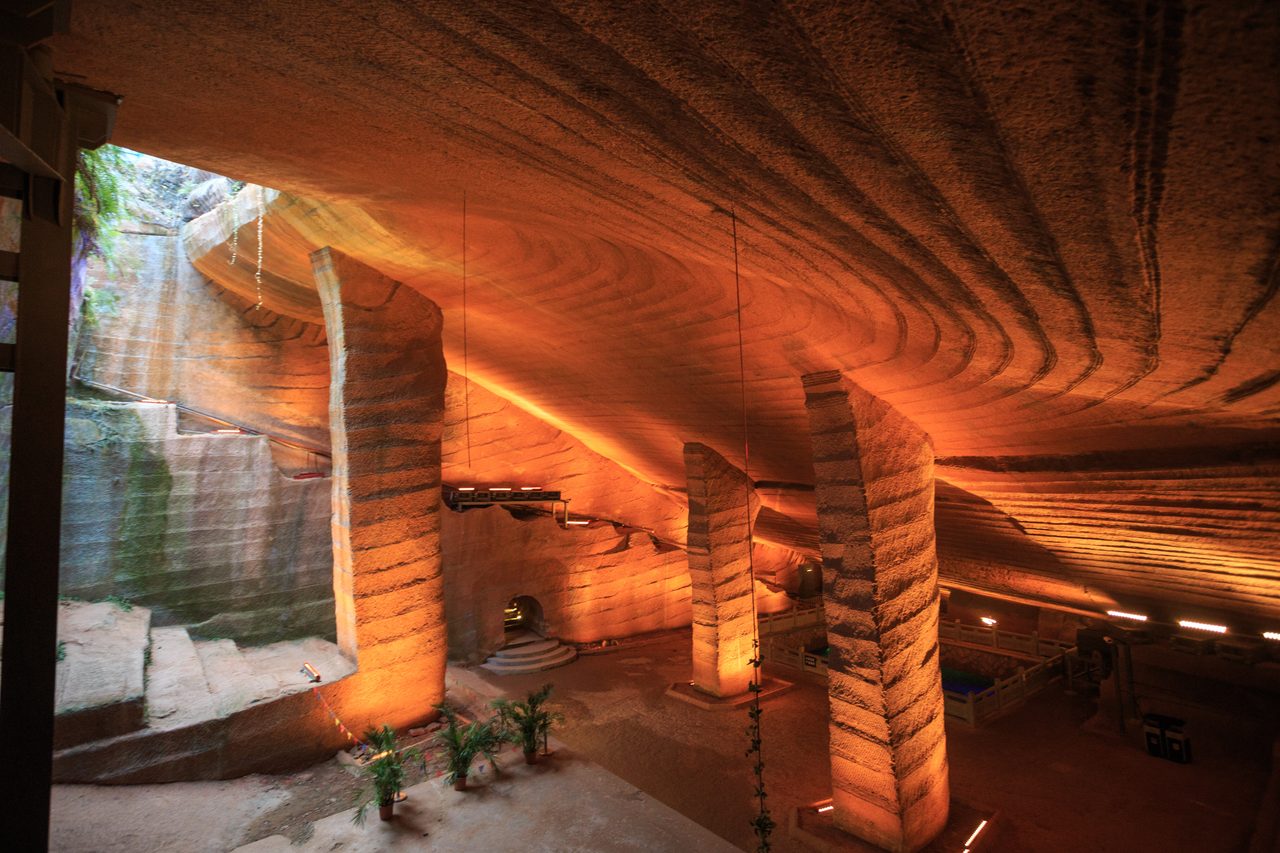
In 1992 a farmer near Longyou, China, pumped out a pond his village had always called bottomless and found an enormous hand-carved cavern beneath it. At least 24 of them honeycomb one low hill, some the size of a cathedral. Here is the strange part. No text in all of China's vast written history says who cut them, when, or why, and the roughly one million cubic meters of rock hauled out has never been found. Here is the file, opened claim by claim, every fact wearing its evidence.
Most ancient mysteries hand you a few fixed points to stand on. You know who built the thing, or roughly when, or at least what it was for, and the argument is about the rest. The Longyou Caves give you almost nothing. A civilization that wrote down everything, that logged the digging of its canals and the raising of its walls for thousands of years, left not one line about who carved this vast set of caverns, when, or why. We know they are real. We know they were cut by hand, because the tool marks are still on every wall. Past that, the record is silent about who, when, and why, and even the mountain of rock that came out of the ground has gone missing. Let us open the file.
01Pumped Out Of A Bottomless Pond
For as long as anyone in the villages near Longyou could remember, the local ponds were simply bottomless. In 1992 a farmer named Wu Anai decided to test that and organized a crew to pump one dry. It took four diesel pumps running for seventeen straight days. What emerged was not the bottom of a pond but the floor of an enormous chamber cut entirely by human hands. Further investigation identified at least 24 caverns honeycombing the hill, five of which have since been fully drained and opened for study.
The site sits inside Fenghuang Hill, beside the village of Shiyan Beicun on the Qu River, about 3 kilometers north of the Longyou county seat in Quzhou, Zhejiang Province, at roughly 29.06 degrees north, 119.18 degrees east. One low hill of soft red rock, riddled underneath with cathedral-sized rooms that nobody up top had known were there.
The count itself carries a small, honest wrinkle. At least 24 is the figure the peer-reviewed literature and the primary photographic survey use, and the last-numbered chamber in that survey is Cave No. 24. A wider county-level survey published by Longyou's own government instead reports 36 cavities detected across the roughly 0.38 square kilometer hill. Both counts agree that only five caves have been drained and opened. We use at least 24 as the working number and flag the higher survey figure rather than pretend the sources speak with one voice.
Secondary accounts differ on the exact sequence of the discovery. Some report that the first pumping exposed five linked caverns rather than one, before the wider survey turned up the rest. The total of at least 24 is not in dispute, only how many came to light in that first drained pit.
02The Scale Underneath
The caverns are big in a way photographs struggle to carry. Individual chambers run from about 500 to over 2,000 square meters of floor, with ceilings reaching 20 to 30 meters in the largest rooms. Cave No. 1 alone holds an estimated volume of more than 20,000 cubic meters. Taken together, cutting the caverns meant removing on the order of one million cubic meters of rock, roughly the volume of 400 Olympic swimming pools, all of it by hand.
The rock is a Cretaceous reddish siltstone, a fine-grained sedimentary stone that is soft and workable when freshly exposed and hardens as it weathers and oxidizes in the air. That is close to an ideal material for this kind of work. Soft enough to cut with hand tools while the digging is underway, tough enough to hold a ceiling once the surface has cured. Its evenness let the carvers open rooms on this scale without the rock crumbling on them.
| Feature | Detail |
|---|---|
| Known caverns | At least 24; a wider county survey cites 36 |
| Open to the public | 5, fully drained |
| Floor area per cavern | About 500 to over 2,000 square meters |
| Ceiling height | Up to 20 to 30 meters in the largest rooms |
| Rock removed | On the order of 1 million cubic meters, by hand |
| Rock type | Cretaceous reddish siltstone |
| Discovered | 1992, by pumping out flooded caverns |
| Location | Fenghuang Hill, Longyou, Quzhou, Zhejiang, China |
03The Marks On Every Wall
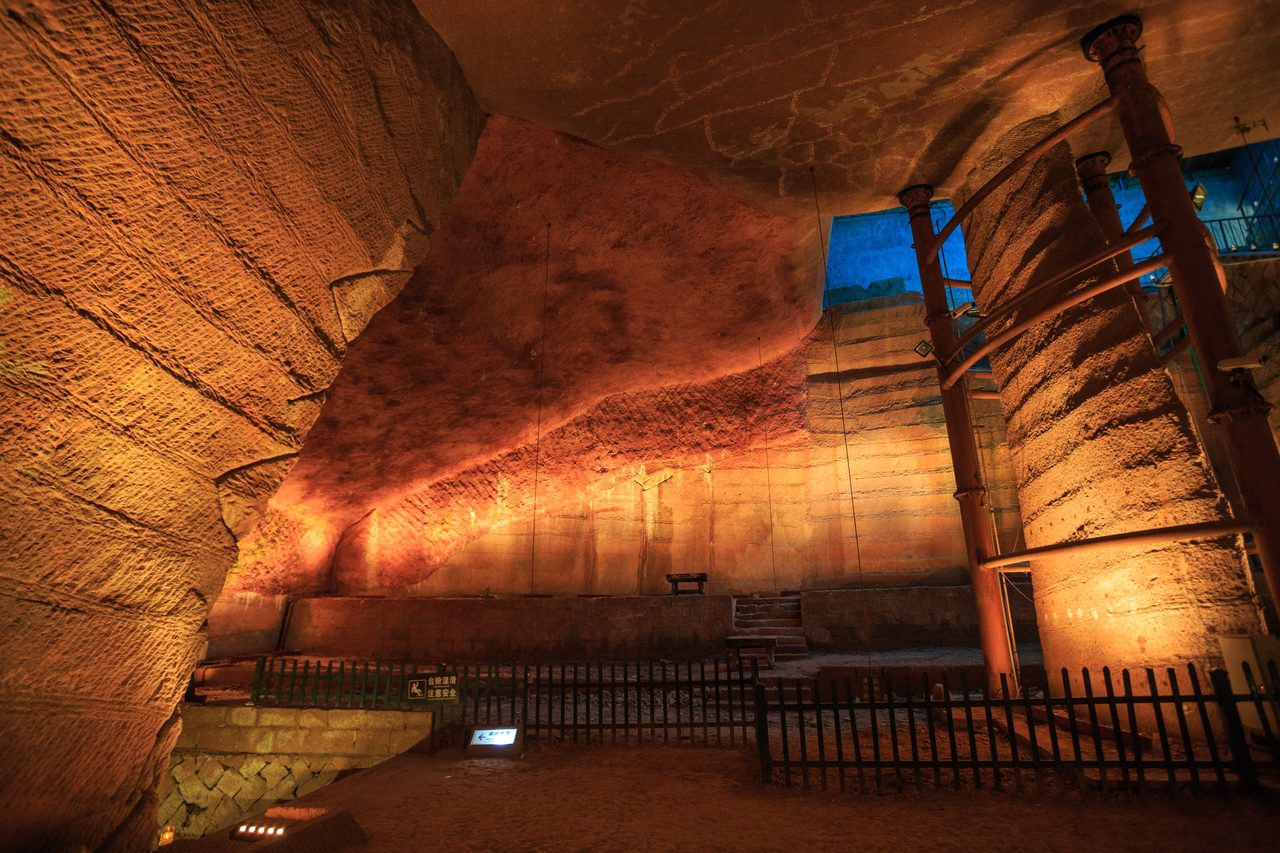
Look closely at almost any surface and the same signature is there. Parallel chisel marks, cut in a distinctive fish-tail or chevron pattern, running at a consistent angle of about 60 degrees. Individual strokes are roughly 15 to 20 centimeters long and 2 to 3 centimeters wide, and the pattern holds from one cavern to the next across every chamber examined. That uniformity is itself evidence. It points to organized crews working to a standardized method with standardized tools, not to a handful of freelancers each doing their own thing.
The sheer consistency of the pattern has tempted some researchers to read it as more than function, a deliberate and almost decorative marking bound up with the act of excavation itself. The plainer reading is that a regular, efficient chisel stroke simply looks regular. Nothing yet decides between the two.
04Engineered To Stay Standing
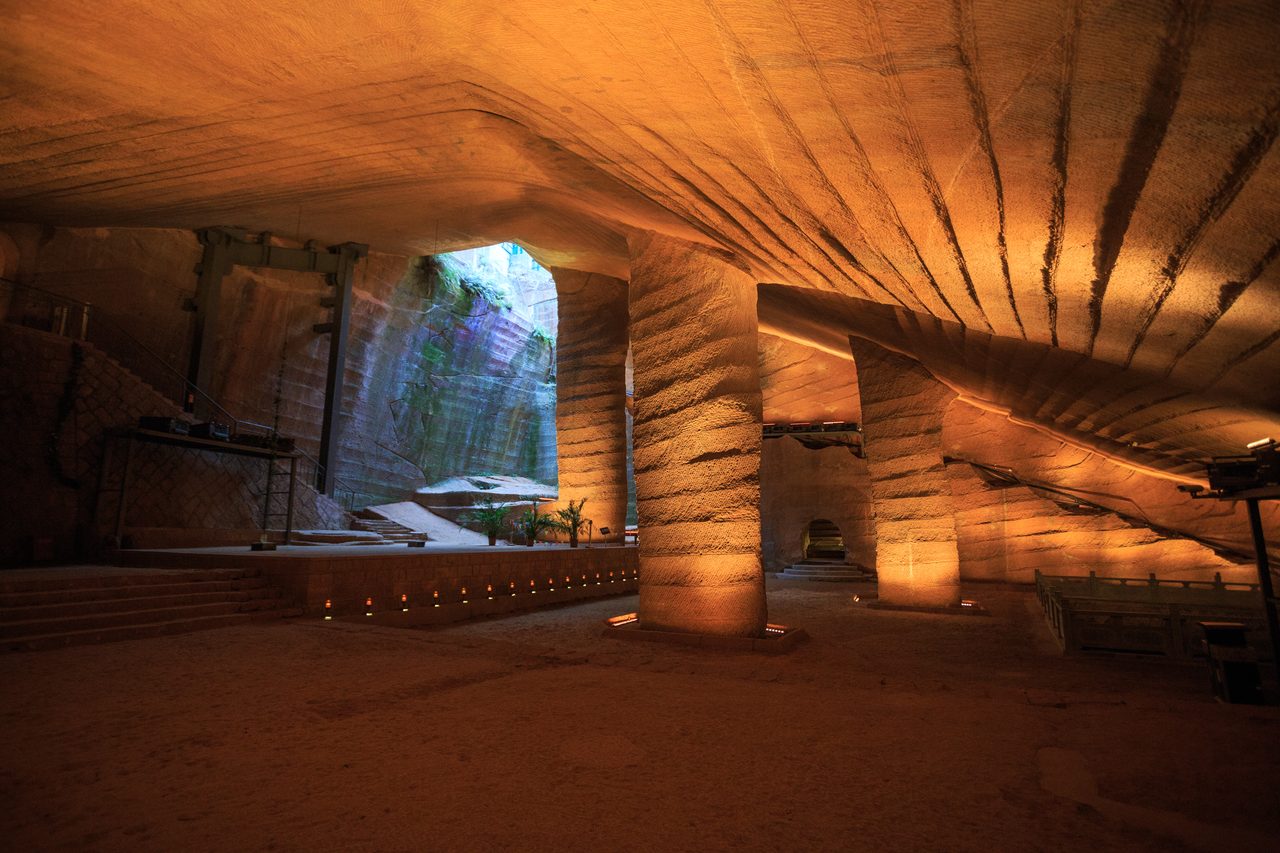
Whoever cut these rooms understood how to keep them up. Load-bearing pillars were left standing at structurally sensible intervals. Ceilings were pared down to calculated thicknesses, some as thin as 50 centimeters across spans of several meters, without collapsing. Walls lean outward, widening from floor to ceiling, which improves stability under the weight above. Floors are pitched to drain groundwater away. And no two neighboring caverns share a wall, so each chamber stands as its own structural unit. This is not accidental digging. It is design.
Those same features, the sloped floors, the drainage, and the deliberately thin ceilings that let groundwater seep through in a controlled way, suggest the builders read the local hydrology well. The caves sit in a high water table, and they were shaped to live in it rather than flood catastrophically. How much of that was intended and how much is fortunate is not settled, which keeps this a credible reading rather than a proven one.
05Two Things That Do Not Add Up
Strip away the theories for a moment and two hard facts remain, and they are the reason this site keeps its grip. Neither has an accepted answer.
The first is the silence. China has one of the deepest written records on Earth, a historiographic tradition that logged the digging of canals, the raising of walls, and the building of palaces in detail across thousands of years. Historians have combed the dynastic histories, the local gazetteers, and the oral traditions, and not one of them mentions the construction of these caverns. A project that swallowed a million cubic meters of labor left no paper trail at all.
The second is the rock. Cutting the caverns produced roughly one million cubic meters of siltstone, and no one has found it. There are no spoil heaps by the entrances, no debris fields in the surrounding landscape, nothing to mark where an entire hill's worth of stone was carried and dumped. Where the material went, and how it was moved, is an open question. The stone may have been hauled off to build something else, but that is a proposal, not a discovery.
06How Old Are They?
There is no direct date for the carvings. No radiocarbon, thermoluminescence, or optical dating has ever been achieved on the cut surfaces themselves, because the method needs the kind of organic or mineral clock the bare rock does not hand over. What researchers have instead is indirect. From the weathering rates of the exposed siltstone, from comparison with known quarrying practice, and from the regional archaeological context, the working estimate puts construction at roughly 2,000 to 2,500 years ago, in the late Warring States to early Han period. He and Yang even proposed dating the caves by the thickness of their weathering crust.
One physical clue comes from inside the caves. Archaeologists have pulled glazed pottery fragments from silt on the cavern floors, dated to the Western Han dynasty, roughly 206 BCE to 23 CE. It is worth being precise about what that dates. It fixes when silt and debris gathered on the floor, not when the walls were cut, so it is supporting evidence for the Han-era estimate rather than a direct date for the excavation. It lines up with the estimate without proving it.
The closest thing to a written mention is late and thin. A poem by the seventeenth-century writer Yu Xun, who lived around 1626 to 1676, refers to the caves as already there. That tells us only that they existed before his lifetime, a floor under the mystery, not a record of who made them. On the question the site actually poses, who and when and why, the poem says nothing.
One explanation for the total silence points at the Qin dynasty's burning of books and persecution of scholars in the late third century BCE, which destroyed vast stores of pre-imperial records. The caves lie in what was the old state of Yue, exactly the kind of pre-Qin territory whose archives were most thoroughly erased. If the construction was ever written down, that is a plausible place for the record to have died. Plausible, but unprovable, which keeps it speculative.
07Why? The Readings With Real Support
With no record and no builder to ask, every account of purpose has to be reconstructed from the stone, its scale, and its setting. Several are genuinely credible. None has won the field. Here is the honest scorecard.
Quarries. The most down-to-earth reading is that the caverns are what is left after people mined the siltstone for building projects elsewhere: walls, embankments, bridges, foundations. The fish-tail chisel pattern is consistent with systematic block extraction rather than any decorative aim, and if the stone really was carried off to distant sites, the missing debris stops being a mystery and becomes the whole point. It is the theory that explains the most with the least.
Storage or strategic works. Other Chinese archaeologists read the caverns as military installations, granaries, or strategic stores, hidden as they were beneath shallow ponds. The Warring States and Qin-Han centuries saw a great deal of underground construction for exactly these purposes, so the idea sits comfortably in its period even without direct proof for Longyou.
Whatever they were for, the labor was enormous. The scale implies organized crews of hundreds to thousands of workers over long stretches, possibly decades, and the uniform technique across chamber after chamber implies central planning and supervision. That points to a state or a powerful elite behind the work, the only kind of authority that could marshal effort on this scale.
There are hints of something stranger. Early observers noted unusual acoustics inside the chambers, reverberation and resonance, and wondered aloud about ceremonial or performative use. It is worth being blunt here. No formal acoustic study with modern instruments has been published, so this stays an intriguing observation, not a finding.
The caves are also alive in a literal sense. Researchers have documented microbial communities on the walls, biofilm-forming bacteria and algae, that are actively weathering the surfaces and eating into the ancient tool marks. That makes the microbes both a scientific subject and a conservation problem, a slow clock running against the very evidence the site depends on.
| Theory | Evidence tier | The main objection |
|---|---|---|
| Stone quarries | Tier 2 | Best fit for the missing debris, but no receiving site has been matched to the stone |
| Storage or military works | Tier 2 | Suits the period, yet rests on analogy, with no stores or fittings found |
| A state-scale labor project | Tier 2 | The scale demands it, but it names no builder or sponsor |
| Ceremonial or acoustic use | Tier 2 | Suggestive echoes, but no formal acoustic study has ever been run |
08Thinner Threads
Below the credible readings sits a set of ideas that are possible but poorly supported, resting on a single observation or on a test nobody has run.
Underground palaces or tombs. The grandeur of the chambers has led some to imagine them as subterranean palaces or elaborate tombs for regional rulers. The problem is what is not there. No burial goods, no human remains, and no palace fittings have ever been recovered from any of the caverns.
Astronomical alignment. A few investigators have suggested that certain entrances or internal axes point toward solstice sunrise or sunset positions. No systematic archaeoastronomical survey has been carried out, so the claim rests on scattered observation and stays anecdotal.
Part of a regional tradition. It is unclear whether Longyou is one of a kind or one example of a wider practice. Scattered reports of smaller artificial caves elsewhere in Zhejiang and neighboring provinces, including the Huashan Mystery Grottoes in Anhui, hint at a possible regional tradition of large subterranean excavation, though the link is not established.
Older than the estimate. Because there is no diagnostic artifact and no datable material fixed to the carving itself, the caverns could in theory be significantly older than the Warring States period. But nothing positively supports a pre-Iron-Age date, and the engineering sits comfortably within the documented skills of Warring States and Han China, so an earlier origin stays a possibility, not a case.
09Protected, Open, And Studied
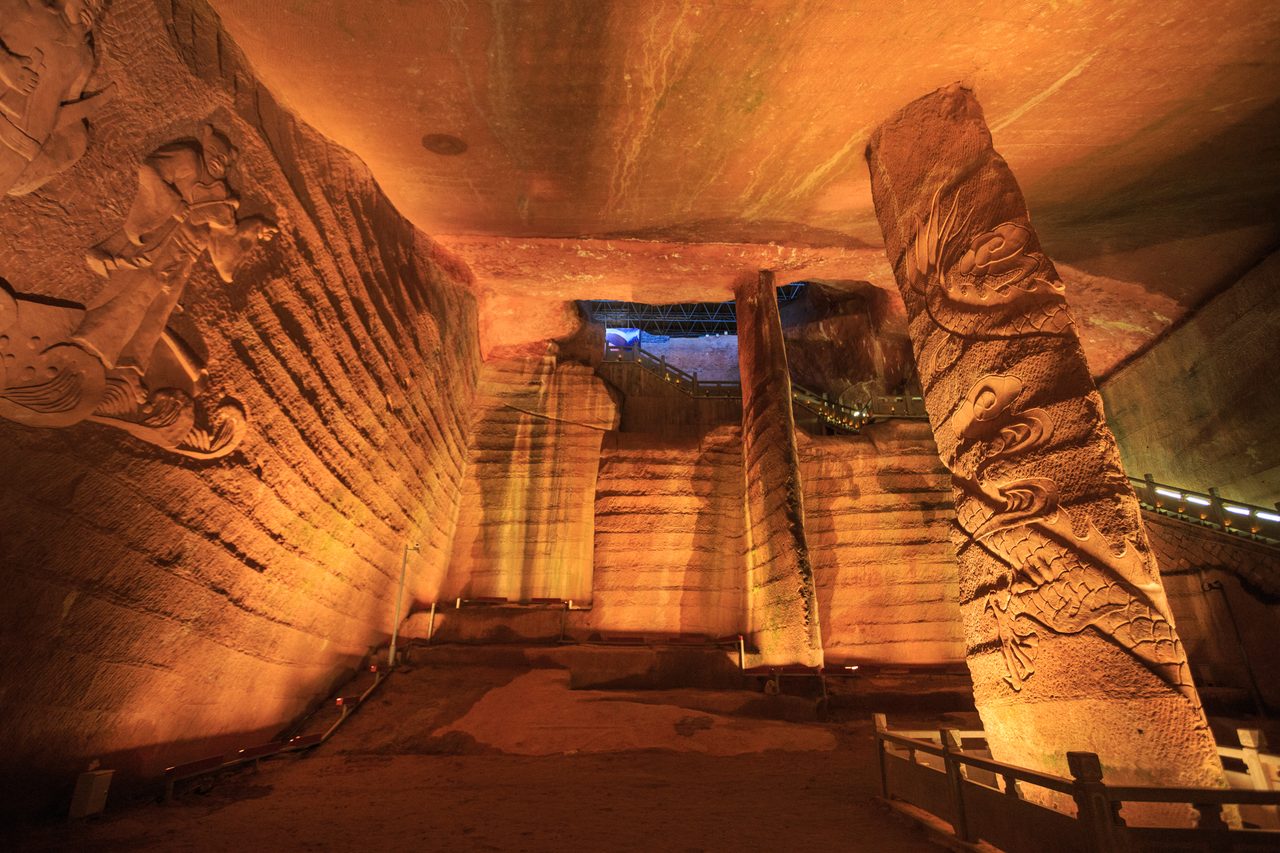
None of this is hidden. Zhejiang's authorities have designated the caves a protected cultural heritage site, China placed them on UNESCO's Tentative List in 2008 under reference 5344, and five of the drained caverns are open to the public as a tourist attraction, with environmental monitoring in place to manage their conservation. The caves are a working archaeological site, not a sealed one.
10Where The Fringe Comes In, And Why It Fails
A set of enormous, undocumented caverns is an open invitation to bigger stories, and the usual ones have all been told about Longyou. They lean on a single move, that the caves are too large, too precise, or too mysterious to be the ordinary work of ancient people. That move does not survive the walls.
Alien engineering. Ancient astronaut narratives have folded Longyou into a catalog of supposed alien construction. It fails on the most basic evidence in the caves. Every surface carries chisel marks, each one a recognizable impact from a hand tool, exactly what human labor with iron or bronze chisels leaves behind.
Lasers or sonic cutting. Claims that the caverns required laser cutting, sonic disaggregation, or some other advanced non-contact technology are contradicted by those same marks. Non-contact tools do not leave millions of individual percussive chisel strokes. Manual excavation does, and that is what covers every wall.
Impossible without modern tools. The claim that no ancient society could have dug on this scale ignores the rest of the world. The Wieliczka Salt Mine in Poland runs to 287 kilometers of hand-cut passages. The underground city of Derinkuyu in Turkey goes 18 stories deep and was cut roughly 2,700 years ago. The Ajanta and Ellora caves in India and the underground city of Naours in France are more of the same. Large-scale subterranean excavation is a documented human capability across cultures and centuries. Longyou is remarkable, not impossible.
A government cover-up. The idea that China is suppressing the truth about the caves collides with the caves themselves. They are a protected heritage site, an open tourist attraction, and the subject of published academic research in both Chinese and English-language journals. Whatever the caverns are keeping from us, no one is keeping it from us on purpose.
Fast Facts
- Object
- At least 24 hand-carved underground caverns
- Discovered
- 1992, by pumping out flooded caverns
- Location
- Fenghuang Hill, Longyou, Quzhou, Zhejiang, China
- Rock removed
- On the order of 1 million cubic meters, by hand
- Rock type
- Cretaceous reddish siltstone
- Estimated age
- Roughly 2,000 to 2,500 years (late Warring States to early Han)
- How made
- Cut by hand; chisel marks cover every surface
- Heritage status
- UNESCO Tentative List, 2008, Ref. 5344
- Record of construction
- None found in any Chinese text
- Excavated debris
- Never located
What We Can Actually Stand Behind
The caverns are real and their basics are settled. At least 24 enormous chambers were cut by hand into the soft red siltstone of one low hill near Longyou, some with ceilings 20 to 30 meters high, the whole complex removing on the order of a million cubic meters of rock. The chisel marks on every wall prove human hands did the cutting. And two facts are just as solid. No historical text records who built them, and the excavated stone has never been found.
When they were made, and what for, is not. The evidence points to roughly 2,000 to 2,500 years ago and to a state-scale project, most likely quarrying or strategic storage, but no direct date has ever been achieved and no purpose has won consensus. The most honest answer to when, who, and why is that we do not yet know.
The caves are not alien engineering, were not cut by lasers or sound, and are not being covered up. They are not even beyond ancient human skill, matched or exceeded by hand-cut works from Poland to Turkey to India. Every wall is covered in ordinary chisel marks. The how is thoroughly human. Only the who, when, and why are missing.
So the file closes where it opened, on a low hill of soft red rock with cathedral-sized rooms cut underneath it and almost nothing to say who cut them. We can measure the chambers, name the stone, read the chisel strokes one by one, and rule out the fantasies. What we cannot do is find a single line in the vast written memory of China that admits these caverns were ever dug, or point to the place a million cubic meters of stone was carried and left. A people moved a mountain by hand here, shaped the emptiness with real care, and then fell completely out of the record. What were they building under that hill, and where did both the answer and the rock go?
Sources & further reading
Everything above is drawn from our research library on Theories of Anything. Open the full file to check the sourcing and go deeper.
Image credits
- The interior of a large hand-carved chamber at the Longyou Caves Photo: Zhangzhugang, Wikimedia Commons. CC BY-SA 4.0 Source.
- Close-up of the fish-tail chisel-mark pattern covering a wall inside the Longyou Caves Photo: Zhangzhugang, Wikimedia Commons. CC BY-SA 4.0 Source.
- Load-bearing carved stone pillars left standing inside a wide chamber at the Longyou Caves Photo: Zhangzhugang, Wikimedia Commons. CC BY-SA 4.0 Source.
- A wide chamber at the Longyou Caves showing two support pillars Photo: Zhangzhugang, Wikimedia Commons. CC BY-SA 4.0 Source.
- Card crop of the interior of a large hand-carved chamber at the Longyou Caves Photo: Zhangzhugang, Wikimedia Commons. CC BY-SA 4.0 Source.


