Meteors & Asteroids: Earth's Cosmic Shooting Gallery
The sky has been throwing rocks at this planet for four and a half billion years, and it has not stopped. In 1908 one of them flattened more than two thousand square kilometers of Siberian forest and left no crater at all. In 2013 another blew out the windows of a Russian city and hurt nearly fifteen hundred people, and no telescope on Earth saw it coming, because it came straight out of the glare of the Sun. This is the file on the direct hits and the near misses at human scale: what has actually struck us, how often the sky falls, and the genuinely encouraging thing that has happened since, the first time in history we reached out and moved an asteroid on purpose. Every fact wears its evidence.
Some disasters are arguments you can never quite close. This one is not. The rocks are real, the flattened forests and the recovered fragments are real, and every few years the sky proves it again over somewhere on Earth. This file is the human-scale version of the story. Not the deep-time catalog of every scar on the planet, which is its own separate file, and not the single contested prehistoric strike that already has a file of its own next door, the Younger Dryas comet. This is the direct hits and the near misses that people alive today have actually lived through, counted, filmed, and dug out of the ground. Keep one honest thread in view as you read. Two of these events did real damage with no warning at all, and yet the most encouraging chapter in the whole story is the one being written right now, because for the first time in history we have started to hit back.
01The Sky Has Never Stopped Throwing Rocks
Start with the ground everyone stands on. Earth has been bombarded by asteroids, comets, and meteoroids for its entire 4.5 billion year history, and the Earth Impact Database maintained by the University of New Brunswick now lists more than 194 confirmed impact structures worldwide. That number is understood to be only a small fraction of the true total, because erosion, plate tectonics, and the slow subduction of the ocean floor have quietly erased most of the record. What survives is the recent, the lucky, and the large. This article is about the recent end of that list, the strikes close enough in time that we can put dates, energies, and eyewitnesses on them.
First, four words that get used interchangeably and should not be. An asteroid is a rocky remnant left over from the formation of the solar system, most of them orbiting in the main belt, and the combined mass of every asteroid we know of is still less than the mass of the Moon. A meteoroid is a smaller rocky or metallic body traveling through space. A meteor is the streak of light, the shooting star, that a meteoroid makes when it burns through the atmosphere. A meteorite is the piece that survives the fall and reaches the ground. On an ordinary day, roughly 48.5 tons of this material rains onto Earth, almost all of it dust that burns up harmlessly before it ever lands. The events in this file are what happens on the days that are not ordinary.
02Tunguska, 1908: The Warning Shot
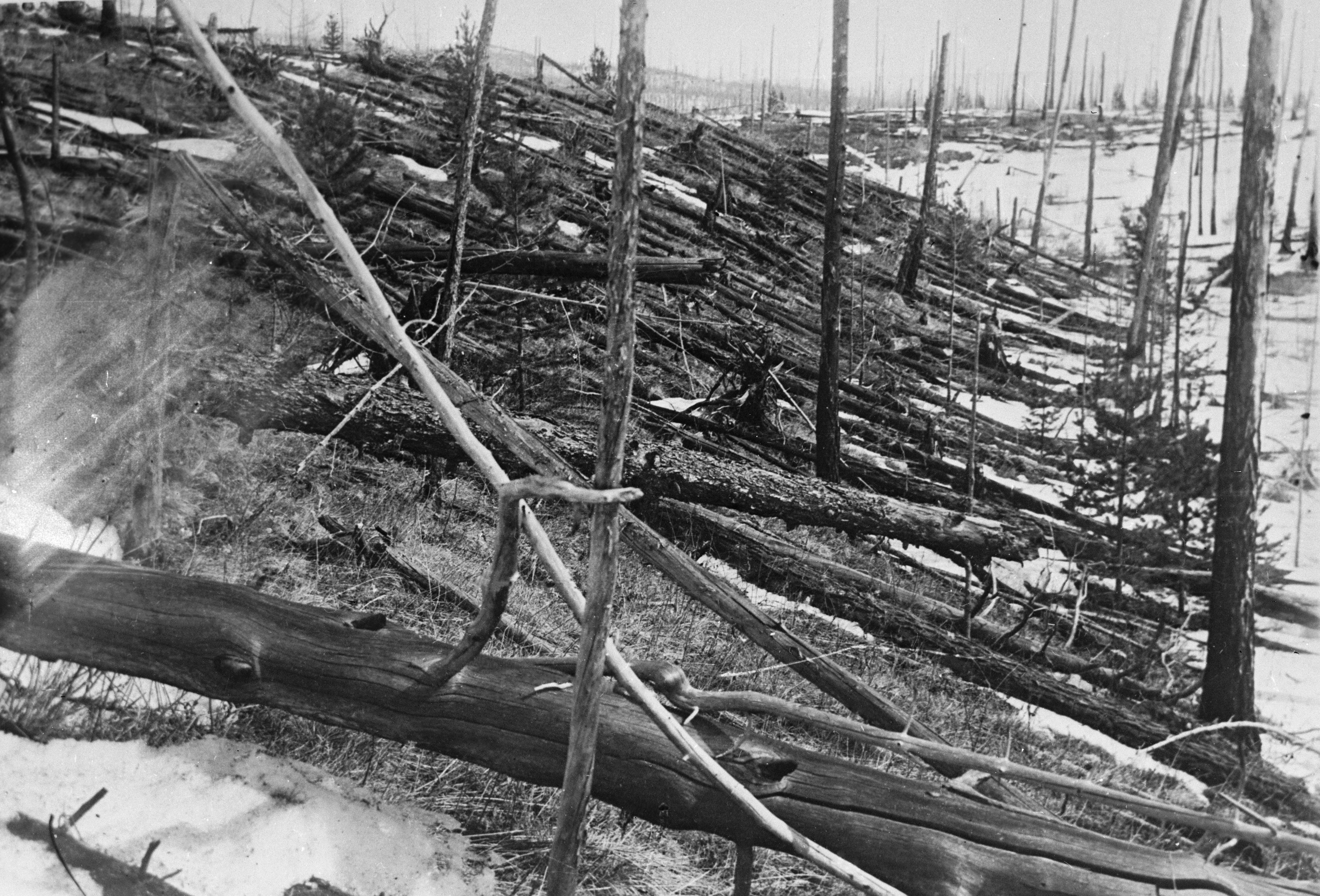
On the morning of June 30, 1908, something exploded over the Podkamennaya Tunguska River in remote Siberia. It was not a small something. The object is estimated at roughly 50 to 60 meters across, though published estimates across the scientific literature run anywhere from about 30 to 100 meters depending on the study and the assumed density, and it released the energy of an estimated 10 to 15 megatons of TNT, with some estimates ranging as high as 50 megatons. It never touched the ground. Instead it detonated as an airburst at an altitude of roughly 5 to 10 kilometers, and the shockwave flattened an estimated 2,150 square kilometers of forest, on the order of 80 million trees, in a vast radial fan pointing outward from the spot beneath the blast. Directly under the airburst the trees were left standing, stripped of their branches and scorched bare. There is no crater. This is the largest impact event in recorded history, and it happened with no warning at all.
What actually came down is still genuinely argued, more than a century later, and it is worth being precise about the state of that argument rather than pretending it is settled. The current majority view favors a stony asteroid. Chemical analysis of tree resin from the year of the event found elevated iron, calcium, aluminum, silicon, nickel, gold, and copper, a trace-element signature that fits a stony asteroid far better than ordinary local material. But the competing comet hypothesis has not gone away, because it explains something the asteroid reading struggles with: for several nights after the blast, the night skies across Europe and Asia glowed unusually bright. A disintegrating comet would have injected huge amounts of water vapor and fine dust high into the atmosphere, exactly the recipe for that kind of glow, while an asteroid would mostly have kicked up dust. The counter to the comet is atmospheric modeling suggesting a fragile comet would have broken up too high to do the damage that was actually done on the ground. No crater and no confirmed fragment of the object have ever been recovered, which is precisely why the question stays open. This one is Tier 2, credible and unresolved, not a closed case in either direction.
There is one more Tunguska loose end worth naming honestly. A body of water called Lake Cheko, near the blast site, was proposed by some researchers as a possible impact crater, gouged out by a surviving fragment of the object. More recent work cuts against that. Sediment cores and radiocarbon dating reported in 2024 and 2025 suggest the lake is considerably older than 1908, possibly by several centuries, which would mean it was already there long before the event. Other nearby lakes share its same funnel shape, hinting that this is an ordinary permafrost feature rather than an impact scar. Read the tier carefully here: the underlying dating is a real, reported finding, but this account rests on secondary science journalism rather than a primary paper we could open and check ourselves, and it postdates our own research file entirely. Tier 2 to 3, and flagged as such.
03Chelyabinsk, 2013: Out Of The Sun, With No Warning
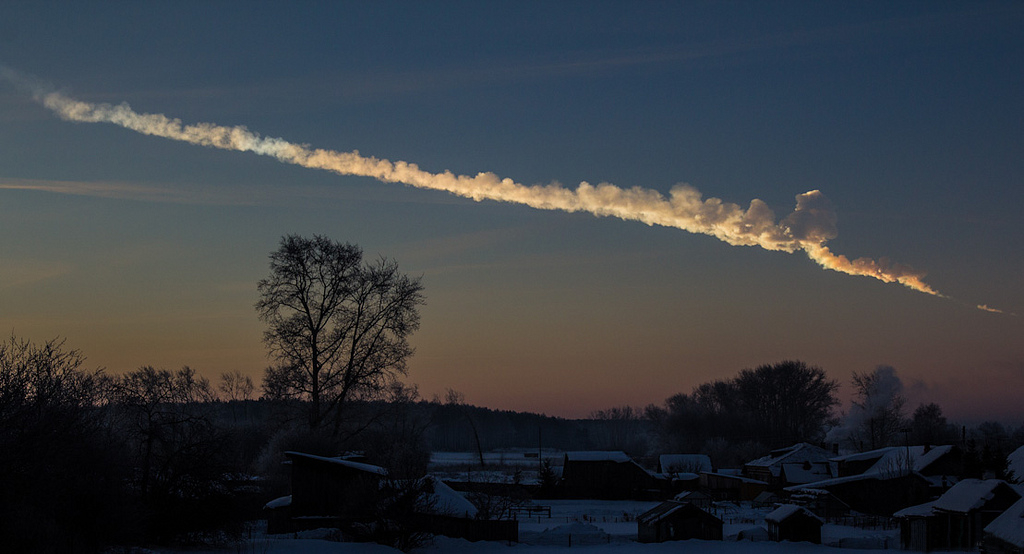
Just after 9:20 on the morning of February 15, 2013, a brilliant fireball tore across the sky over the southern Ural region of Russia. The object was a stony meteorite, an LL chondrite, roughly 17 to 20 meters across, and it hit the atmosphere at something like 18 to 19 kilometers per second before detonating in an airburst that released the energy of about 500 kilotons of TNT. That makes Chelyabinsk the largest recorded impact event since Tunguska in 1908. It was also the first one in history to be filmed extensively as it happened, captured from dozens of angles thanks to the dashcams that ride in nearly every Russian car.
The shockwave did real harm. It shattered windows and damaged roughly 7,200 buildings across the region, and it injured approximately 1,491 people. Almost all of those injuries came not from the meteor itself but from flying glass and debris thrown by the blast wave, along with some cases of skin and eye effects from the intense ultraviolet flash. Remarkably, no one was killed. A 20-meter rock detonated over a populated region, and the toll was measured in cuts and lacerations rather than lives, which owed as much to luck as to anything else.
Here is the fact that should keep planetary-defense planners up at night. Nobody saw Chelyabinsk coming. Not one observation program on Earth detected the object in advance, for a simple and unfixable reason: it approached from the direction of the Sun, out of the one patch of sky that no ground-based or space-based telescope can search, because the glare blinds them. And then the sky served up a coincidence almost too neat to believe. Roughly 16 hours after the Chelyabinsk airburst, a completely unrelated asteroid, 2012 DA14, made a long-scheduled close pass of Earth, sweeping within about 27,700 kilometers of the surface, inside the ring of geostationary satellites. The two objects had entirely different orbits and were confirmed to have nothing to do with each other. On the same day, the one we saw coming missed, and the one we never saw hit.
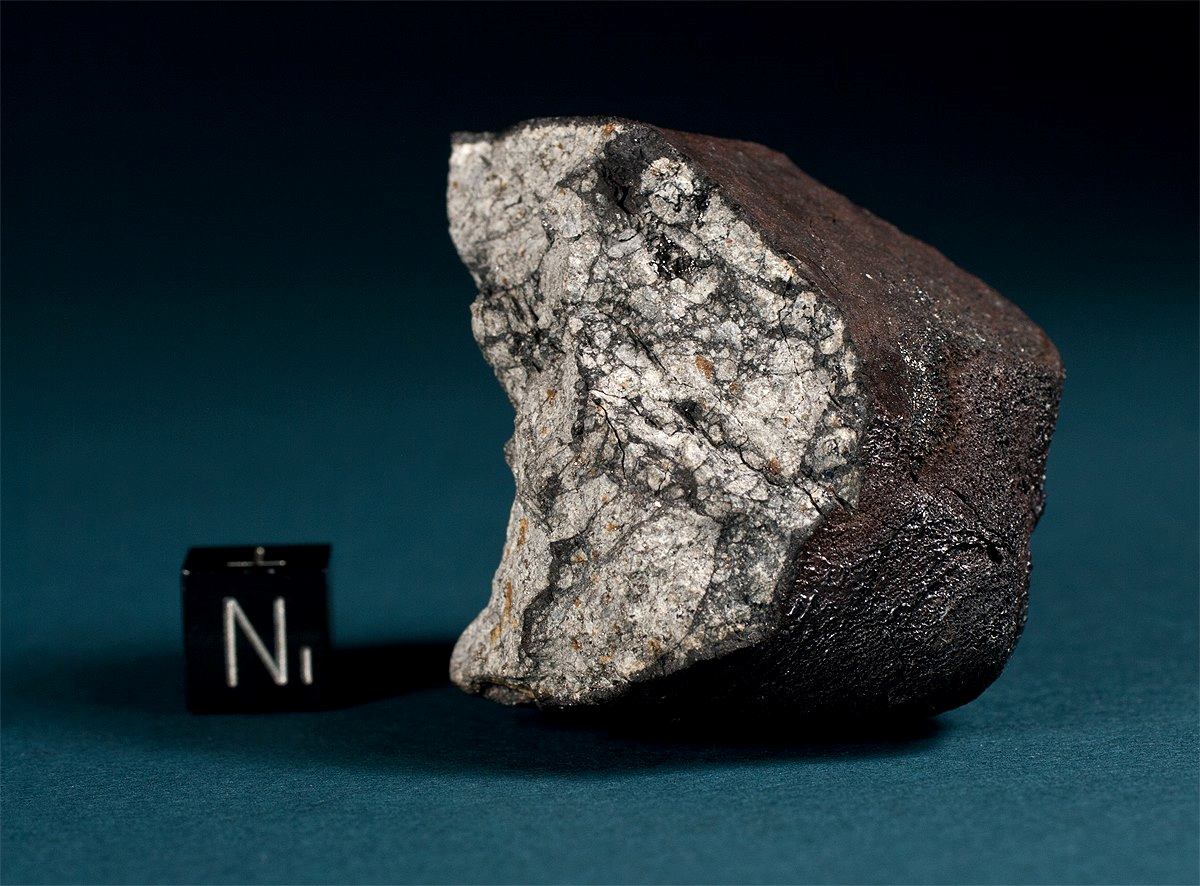
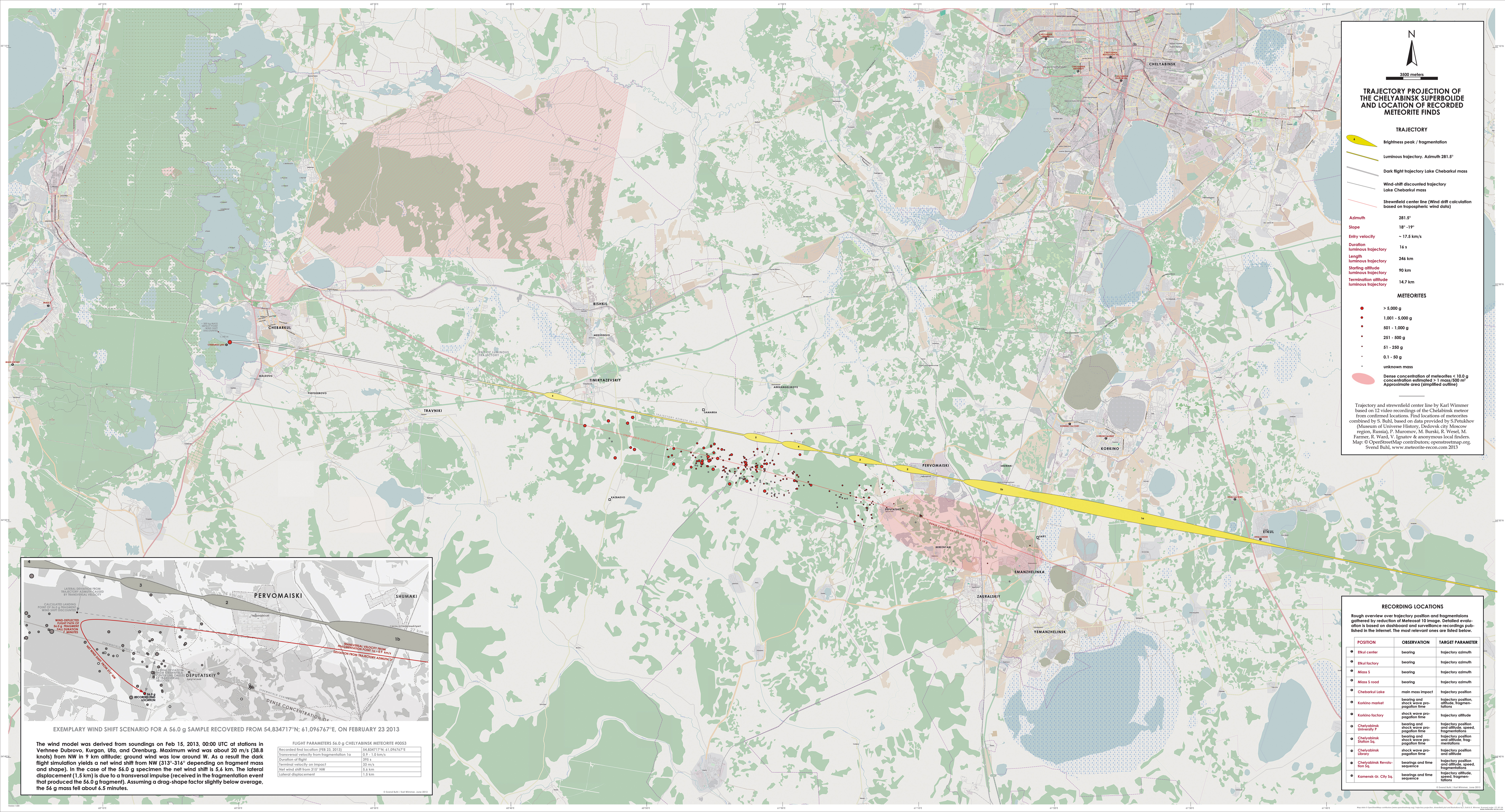
The object left more than broken glass behind. After the airburst, searchers found a hole about 6 meters wide punched through the ice of Lake Chebarkul, near Chelyabinsk. A magnetic survey located a large mass on the lake bed, and on October 16, 2013 it was hauled up: the single largest recovered fragment weighed roughly 540 kilograms, with some post-cleaning figures reported a little higher, around 570 to 654 kilograms. Another 84 kilograms or so came up in six or seven smaller pieces nearby, and residents pulled countless more fragments out of the snowdrifts along the fireball's path. All told, the known recovered weight of the entire Chelyabinsk fall comes to roughly 1,000 kilograms.
04The Rest Of The Recent Record
Chelyabinsk and Tunguska are the headline events, but they are not alone. On February 12, 1947, an iron meteorite came down in the Sikhote-Alin mountains of the Soviet Far East, releasing roughly 20 kilotons of energy as it broke apart in the air. It scattered more than 23 confirmed craters across the ground and left about 23 tonnes of recoverable meteoritic iron, one of the largest such recoveries ever documented.
On December 18, 2018, an object 9 to 14 meters across exploded over the open ocean near Russia's Kamchatka Peninsula, releasing roughly 173 kilotons of energy. That makes it the third-largest recorded impact event since 1900, behind only Tunguska and Chelyabinsk. Almost nobody noticed. Because it detonated over empty water far from any coastline, it did no damage, hurt no one, and drew a fraction of the attention its size deserved, a reminder of how many of these events the ocean simply swallows.
And on October 7, 2008, a small asteroid designated 2008 TC3 entered the atmosphere over Sudan, only about 4 meters across, releasing 1 to 2 kilotons of energy. Its size is not what makes it historic. It is that the Catalina Sky Survey spotted it in space on October 6, roughly 19 hours before it arrived, the first time in history an asteroid was ever detected before it hit. More than 600 fragments, the Almahata Sitta meteorites, were later collected from the Nubian Desert. A tiny object, but a genuine proof of concept: we can see one coming, predict where it will fall, and go pick up the pieces.
| Event | Year | Object | Energy | What Happened |
|---|---|---|---|---|
| Tunguska (Siberia) | 1908 | ~50 to 60 m, likely stony | 10 to 15 megatons | Airburst flattened ~2,150 sq km of forest; no crater |
| Sikhote-Alin (USSR) | 1947 | Iron meteorite | ~20 kilotons | 23+ craters; ~23 tonnes of iron recovered |
| Chelyabinsk (Russia) | 2013 | ~17 to 20 m, LL chondrite | ~500 kilotons | ~1,491 injured, ~7,200 buildings hit; undetected |
| Kamchatka Superbolide | 2018 | ~9 to 14 m | ~173 kilotons | Over open ocean; no damage, little notice |
| 2008 TC3 (Sudan) | 2008 | ~4 m | 1 to 2 kilotons | First object ever detected in space before impact |
05How Often Does The Sky Fall?
None of this is random in the long run. Astronomers can estimate how often Earth gets hit by an object of a given size, based on the known population of near-Earth objects and the observed rate of past impacts. A 4-meter object, a bright fireball with no ground damage, arrives about every 1.3 years. A 20-meter object, the Chelyabinsk class, comes about every 60 years. A 50-meter object, the Tunguska class, about every 764 years. A 100-meter object, capable of regional devastation, about every 5,200 years. A 1-kilometer object, the threshold where an impact becomes a global catastrophe, about every 500,000 to 1 million years. And a 10-kilometer object, the mass-extinction scale, about every 100 to 200 million years. That largest, deep-time class of impact is a story we hold for its own separate file. This one stays at human scale, where the numbers are small enough to feel.
| Object Size | Roughly How Often | What It Does |
|---|---|---|
| 4 meters | Every ~1.3 years | Bright fireball, no ground damage |
| 20 meters (Chelyabinsk class) | Every ~60 years | City-scale airburst, shattered windows |
| 50 meters (Tunguska class) | Every ~764 years | A region's forest flattened |
| 100 meters | Every ~5,200 years | Regional devastation |
| 1 kilometer | Every ~500,000 to 1 million years | Global catastrophe threshold |
| 10 kilometers | Every ~100 to 200 million years | Mass-extinction scale (held for another file) |
06The Watchers: Counting The Rocks
So we count them. As of a February 8, 2026 snapshot from NASA's Center for Near-Earth Object Studies, 40,853 near-Earth asteroids had been discovered. Of those, 882 are a kilometer or larger, the size that threatens global catastrophe, and 11,565 are 140 meters or larger, the size that would devastate a region. Broken down by band, roughly 12,433 are under 30 meters, 14,050 fall between 30 and 100 meters, 8,436 between 100 and 300 meters, and 5,052 between 300 meters and a kilometer. Read that as a photograph, not a final tally. The number climbs every week as the surveys find more, so it is a running count of what we have found, not a count of what is out there.
| Size Band | Number Known |
|---|---|
| Under 30 meters | 12,433 |
| 30 to 100 meters | 14,050 |
| 100 to 300 meters | 8,436 |
| 300 meters to 1 kilometer | 5,052 |
| 1 kilometer or larger | 882 |
| Total known | 40,853 |
| 140 meters or larger (the tracking-mandate size) | 11,565 |
Counting the ones that actually arrive is a separate job. NASA's Fireball Database has logged 1,051 reported fireball events between April 15, 1988 and January 31, 2026, drawing mostly on United States government sensor data. The database carries its own honest caveat, which our research file passes along: the data is not real-time and not every fireball gets reported, so the true number that have flared over Earth in that window is higher than the catalog shows.
To pull all of this into one coordinated effort, NASA stood up its Planetary Defense Coordination Office in 2016. Its job is to find, track, and characterize the potentially hazardous asteroids and comets, to run NASA's overall near-Earth object observation program, and to coordinate the United States response if a genuine impact threat is ever confirmed. For most of human history there was no one whose actual job was to watch for this. Now there is.
07Hitting Back: The DART Experiment
Watching is one thing. Doing something about it is another, and in 2022 that stopped being theoretical. NASA's DART mission, the Double Asteroid Redirection Test, launched in November 2021 and, on September 26, 2022, deliberately flew a spacecraft into Dimorphos, the small moonlet orbiting the near-Earth asteroid Didymos. Didymos is roughly 780 meters across; Dimorphos, the target, is roughly 160 meters. It was the first time anyone had ever tested the kinetic-impactor idea, hitting an asteroid hard enough to nudge its orbit, on a real celestial body instead of in a simulation.
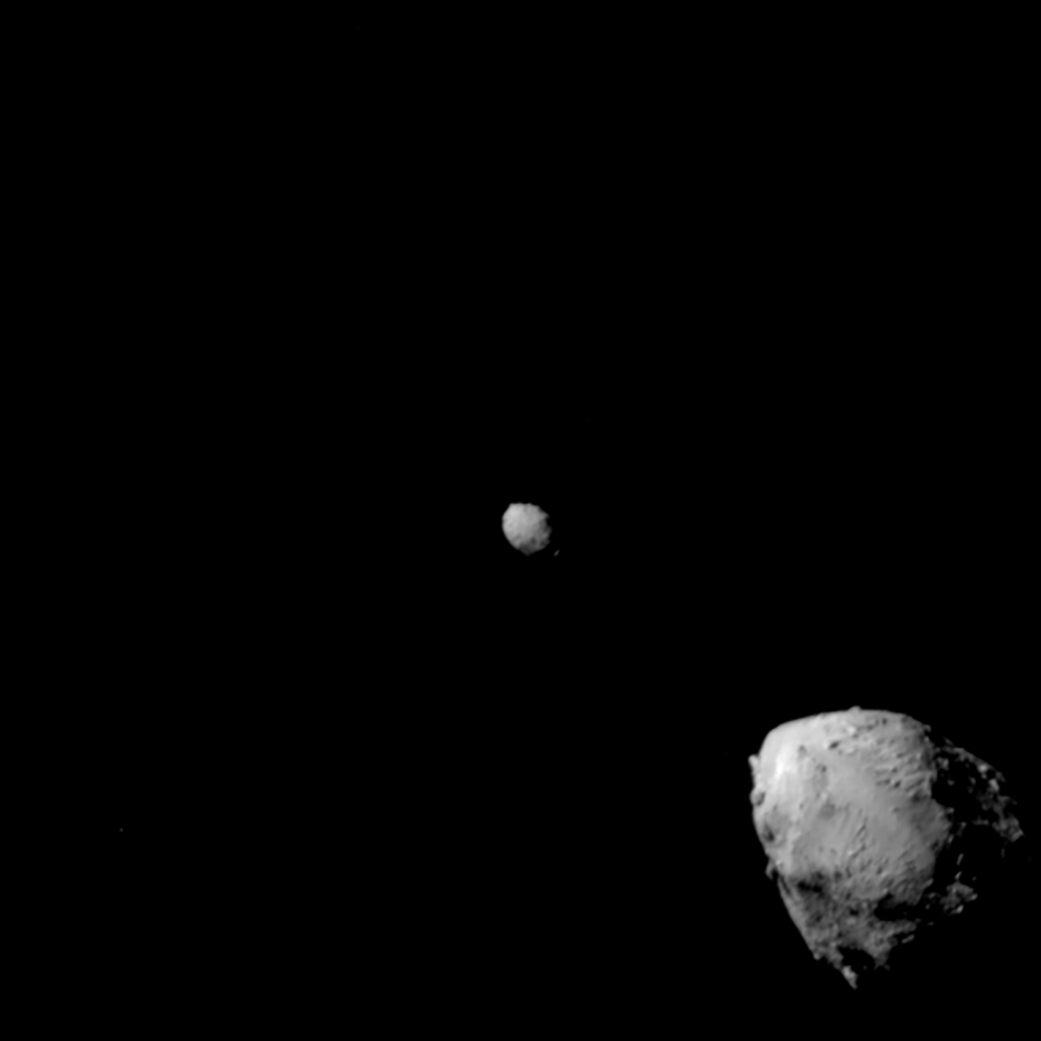
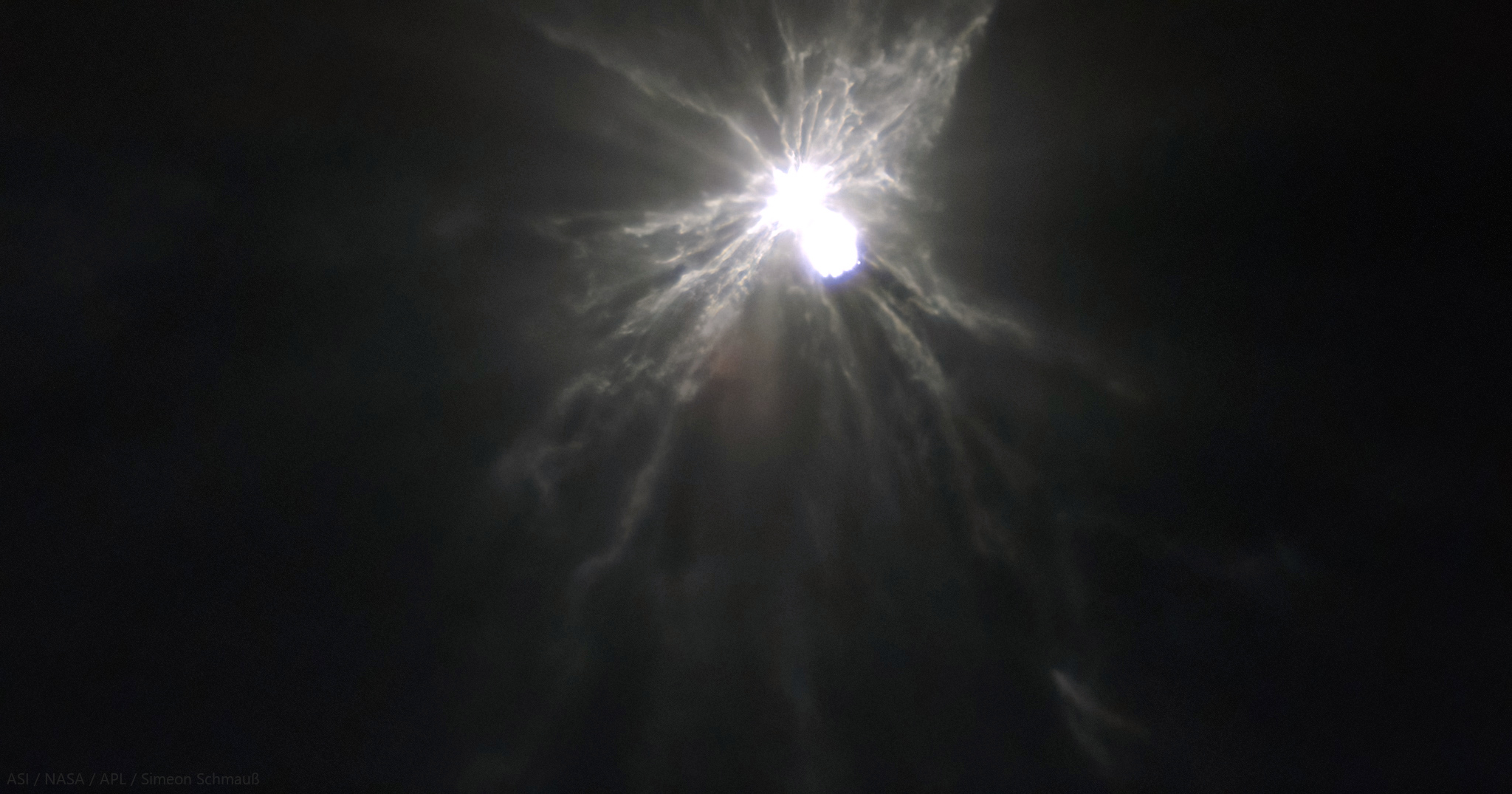
And it worked, and we can prove it to the minute. The follow-up study, published in Nature in 2023 by C. A. Thomas and colleagues, put a precise figure on the result: the impact shortened Dimorphos's orbit around Didymos by 33.0 plus or minus 1.0 minutes, from roughly 11 hours 55 minutes to roughly 11 hours 23 minutes. Two independent methods, Earth-based lightcurve photometry and radar, produced matching answers. Now set that against the bar NASA had set in advance. The minimum orbital change needed to call the mission a technical success was 73 seconds. The real result beat that floor by more than 25 times. A companion study in the same journal found something even more useful for the future: the spacecraft's own mass and speed should have accounted for only about 7 minutes of the change, which means the plume of rock blasted off Dimorphos carried away far more momentum than the spacecraft delivered by itself. That recoil, the ejecta kicking back like exhaust, is now a measured factor every future deflection mission will have to model. In one clean experiment, kinetic-impact deflection stopped being a hopeful idea and became a demonstrated fact. A spacecraft can measurably move a real asteroid, and we have now done it.
08The Follow-Through: Hera, NEO Surveyor, And A Piece Of Bennu
DART threw the punch; ESA's Hera mission is going to inspect the bruise. Hera launched on October 7, 2024, bound for the same Didymos and Dimorphos system, to measure exactly what DART did: the size of the crater it left, the mass and internal structure of Dimorphos, and the full accounting of how much momentum was transferred, all of which will sharpen the models for any real deflection someday. As of this writing the mission is genuinely current news. A Mars gravity-assist flyby in March 2025 went well enough to move Hera's arrival up by about a month, to November 2026, and a critical deep-space software upgrade clearing the spacecraft for its asteroid-approach phase was completed on July 8, 2026, just one week before these words were written. Hera will then spend roughly six months studying the system up close. The first mission to deflect an asteroid and the first mission to survey the aftermath in detail are, right now, mid-stride.
The gap that let Chelyabinsk through is the next thing to close. NEO Surveyor is a planned space-based infrared telescope, recommended by a 2010 United States National Research Council report and driven by a standing policy mandate, the George E. Brown, Jr. Near-Earth Object Survey Act of 2005, which directs NASA to find 90 percent of near-Earth objects 140 meters and larger. As of this writing it is in active integration and testing, on track to launch no earlier than September 2027, ahead of an earlier 2028 target. Once it is operating, its five-year baseline survey is designed to find at least two-thirds of the potentially hazardous objects larger than 140 meters. Because it hunts in the infrared from space rather than in visible light from the ground, it is built to catch objects that current telescopes miss, and in plain terms it exists to close the exact detection gap that let Chelyabinsk arrive unannounced.
One more mission ties the whole story together, and it hands us straight to the next section. NASA's OSIRIS-REx spacecraft traveled to the near-Earth asteroid Bennu, a carbonaceous rock about 500 meters across, and on September 24, 2023 it delivered a sample back to Earth: roughly 121.6 grams of Bennu, comfortably past the 60-gram goal. What was in it reaches well beyond planetary defense. The sample held water-bearing clay minerals, organic molecules including amino acids, and phosphate minerals, all of which strengthen the case that carbonaceous asteroids like Bennu could have delivered water and the raw chemistry of life to the early Earth. With its work at Bennu finished, the spacecraft was renamed OSIRIS-APEX and sent toward a new target, timed to arrive just after that target makes a historic close pass of Earth in 2029, to watch what the encounter does to it. That target is Apophis.
09Apophis: From The Highest Risk Rating Ever Recorded To Fully Cleared
No single asteroid has scared us quite like 99942 Apophis. It was discovered in June 2004, and within months the refined orbit calculations turned genuinely alarming. The estimated probability of an Earth impact in 2029 climbed to a peak of 2.7 percent on December 27, 2004, and Apophis was rated a 4 on the 10-point Torino Scale, with a matching extreme mark on the related Palermo Scale. That is the highest rating any real near-Earth object has ever received on either scale, before or since. It held that rating for about four days.
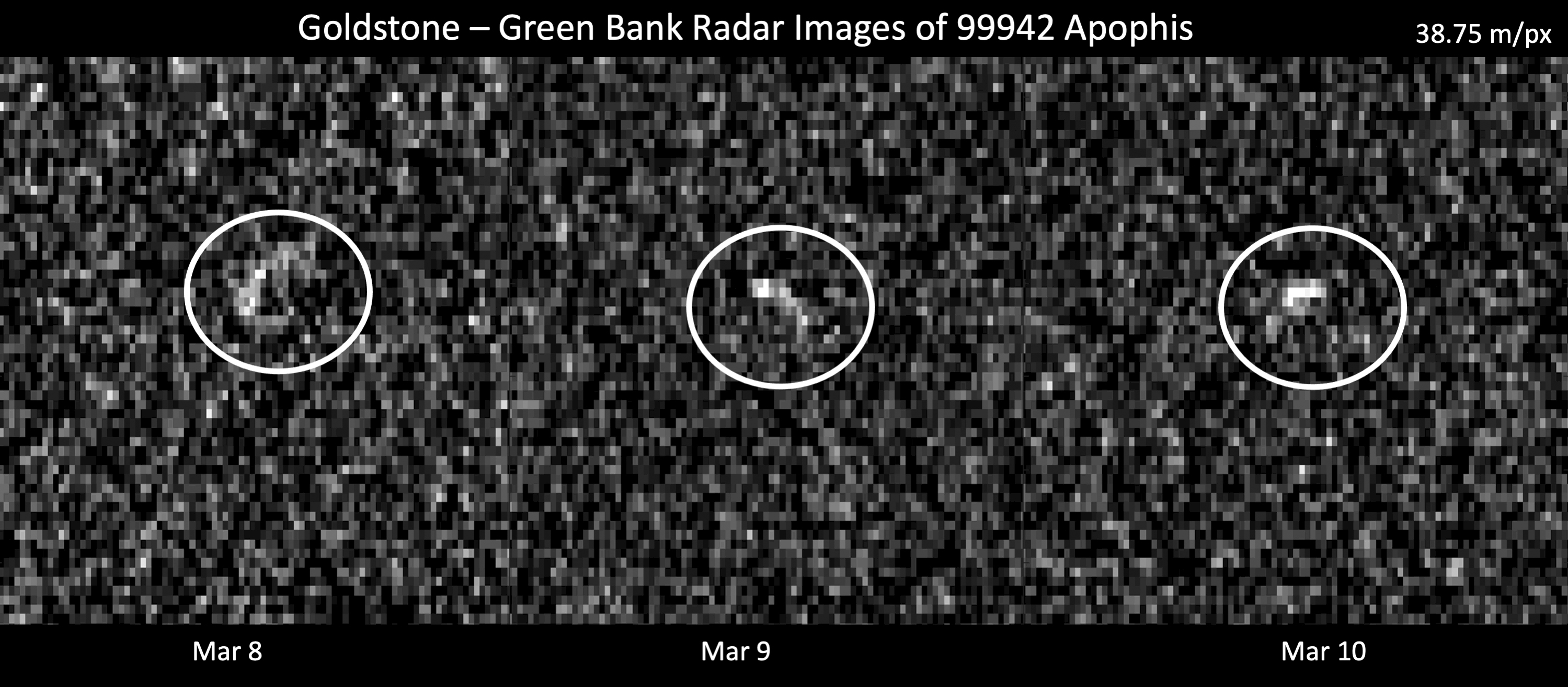
Then it evaporated, almost as fast as it had appeared. On that same December 27, 2004, astronomers dug a precovery image of Apophis out of archived survey data from the previous March, which stretched the object's known orbit far enough to essentially rule the 2029 impact out on the spot. By August 2006 Apophis had been downgraded all the way to Torino Level 0. A precise radar campaign in 2021, using NASA's Goldstone antenna together with the Green Bank Telescope, pinned the orbit down tightly enough to rule out any impact risk for at least a hundred years, through at least 2116. Apophis was formally struck from the European Space Agency's Risk List on March 26, 2021, and NASA independently confirmed the all-clear for the century ahead. An object that once carried the worst impact rating ever recorded is now one of the best-understood asteroids in the sky.
What is left is not a threat but an appointment. On April 13, 2029, Apophis, a rock roughly 340 to 370 meters across, will pass within about 31,600 to 32,000 kilometers of Earth's surface, closer than the ring of geostationary satellites that orbit at around 35,786 kilometers. It will be the closest approach of an asteroid this large that humanity has ever known about ahead of time, and from parts of Europe, Africa, and western Asia it will be visible to the naked eye, a slow star crossing the night. Because the trajectory is now known precisely and carries no impact risk, NASA and ESA treat the 2029 flyby as exactly what it is: a rare, close-range chance to study a real asteroid, and a moment to show the public what planetary defense is actually for.
| Moment | What Happened |
|---|---|
| June 2004 | Apophis discovered |
| December 27, 2004 | Impact odds peak at 2.7 percent; rated Torino 4, the highest ever recorded |
| December 27, 2004 | A precovery image from March is found; the 2029 impact is ruled out the same day |
| August 2006 | Downgraded to Torino Level 0 |
| March 26, 2021 | Radar refines the orbit; struck from ESA's Risk List, no risk for 100+ years |
| April 13, 2029 | A safe, naked-eye close pass inside the satellite ring |
Fast Facts
- The Warning Shot
- Tunguska, 1908: an airburst that flattened ~2,150 sq km of Siberian forest
- Tunguska's Size
- Roughly 50 to 60 meters (published estimates range 30 to 100)
- Still Unresolved
- Whether Tunguska was a stony asteroid or a comet
- The One We Never Saw
- Chelyabinsk, 2013: ~1,491 injured; it came out of the Sun undetected
- Biggest Since 1908
- Chelyabinsk, ~500 kilotons; the largest recorded impact since Tunguska
- Objects We Track
- 40,853 near-Earth asteroids known as of February 2026
- The Proof We Can Hit Back
- DART shortened Dimorphos's orbit by 33.0 minutes in 2022
- Coming Right Now
- ESA's Hera arrives at the DART target in November 2026
- The Cleared Threat
- Apophis, once Torino 4, now no impact risk for 100+ years
- The 2029 Date
- April 13, 2029: Apophis passes inside the satellite ring, no danger
What We Can Actually Stand Behind
The events are real, dated, and measured. Tunguska flattened more than 2,000 square kilometers of forest in 1908. Chelyabinsk blew out windows across a region and injured roughly 1,491 people in 2013. Sikhote-Alin, the Kamchatka superbolide, and 2008 TC3 all happened on the record. The impact-frequency estimates and the count of more than 40,000 known near-Earth asteroids are settled, dated observational science. The sky really does throw rocks at us, and it has not stopped.
Planetary defense is no longer only a plan. DART physically moved an asteroid in 2022 and the change was measured at 33.0 plus or minus 1.0 minutes, more than 25 times the minimum success threshold. ESA's Hera is en route to verify and refine that result and arrives in November 2026. NEO Surveyor is in testing toward a 2027 launch, built to close the detection gap that let Chelyabinsk through. This part of the story is genuinely encouraging, and it is Tier 1.
The one asteroid that ever earned the highest impact rating on record will not strike Earth. Apophis peaked at a 2.7 percent impact probability and a Torino rating of 4 in 2004, and precise tracking has since ruled out any impact for at least a hundred years, through 2116. Its 2029 pass, closer than our own satellites, is an appointment we can watch, not a threat we have to survive. When the system works, this is what the answer looks like: a clear, verified no.
Some of it stays honestly unresolved. What exactly came down over Tunguska, a stony asteroid or a fragile comet, is still argued in the current literature, with real evidence on both sides and no crater or fragment ever recovered to settle it. That is Tier 2, open in both directions, and anyone who tells you it is closed is overstating the case.
And at least one tidy story does not hold up. Lake Cheko, long floated as a Tunguska impact crater, is probably nothing of the kind: recent sediment dating suggests it predates 1908 by centuries and is likely an ordinary permafrost feature. We flag it at Tier 2 to 3, because that finding itself rests on secondary reporting we could not trace back to a primary paper.
So keep the human scale in view and the file reads clean. Rocks the size of buildings really do fall out of the sky, some of them with no warning at all, and twice in living memory one has done real damage over a populated place. That is not a story or an argument. It is the record. But the other half of the record is just as real and a good deal newer: we have started counting the rocks, we have learned to see some of them coming, and we have proven we can reach out and move one. Tunguska arrived when no one on Earth was watching for it. The next Tunguska-sized object is out there somewhere on its own orbit right now, and the only open question that really matters is the one we are finally, for the first time, in a position to answer: will we see it in time?
Sources & further reading
Everything above is drawn from our research library on Theories of Anything, which is where we worked from. The papers, reports and primary records listed beneath them are where you can check us independently.
Image credits
- Flattened Forest at the Tunguska Blast Site, 1929 photograph from Leonid Kulik's expedition via Wikimedia Commons. Public Domain Source.
- The Chelyabinsk Meteor's Smoke Trail, 2013 photograph by Alex Alishevskikh via Wikimedia Commons. CC BY-SA 2.0 Source.
- A Recovered Fragment of the Chelyabinsk Meteorite photograph by Svend Buhl / Meteorite Recon via Wikimedia Commons. CC BY-SA 3.0 Source.
- Strewnfield Map of the Chelyabinsk Meteorites map by Svend Buhl / Meteorite Recon via Wikimedia Commons. CC BY-SA 3.0 Source.
- The Last Image of Didymos and Dimorphos Together, DART Mission photograph by NASA / Johns Hopkins APL via Wikimedia Commons. Public Domain Source.
- DART Impact Ejecta, Captured by LICIACube image processed by Simeon Schmauß, data credit ASI / NASA / APL via Wikimedia Commons. CC BY 2.0 Source.
- NASA Radar Observations of Asteroid Apophis, 2021 image by NASA/JPL-Caltech and NSF/AUI/GBO via Wikimedia Commons. Public Domain Source.
- Card crop of Flattened Forest at the Tunguska Blast Site, 1929 photograph from Leonid Kulik's expedition via Wikimedia Commons. Public Domain Source.


.jpg)
