Mu & Lemuria: The Continents That Never Were (Or Were They?)
Two lost continents anchor a century of pseudoscience, and they did not start the same way. Lemuria began as real science: in 1864 a respected British zoologist proposed a sunken land to explain why lemurs live in Madagascar and India but nowhere in between, decades before anyone had heard of drifting continents. Mu was fringe from its first word, conjured out of misread Maya glyphs and clay tablets no one but their finder has ever been allowed to see. Then occultists stole the science, and the map filled with root races, sunken temples, and a colony living inside a California mountain. Modern geology has closed the case, and it did something sharper than deny every sunken continent: it found real ones, Zealandia in the Pacific and Mauritia under the Indian Ocean. They are just not these. Here is the file, every fact wearing its tier.
There are two lost continents in this file, and the fastest way to get them wrong is to treat them as one. They do not deserve the same verdict, because they did not start the same way. One was a real scientific idea that other people later stole and buried under mysticism. The other was invented whole, out of misread carvings and tablets that no one but their finder has ever been allowed to see. So we will keep them apart, tell each on its own terms, and only then bring the modern seafloor down on both. And the ending is sharper than the usual debunk, because the ocean really is hiding sunken continents. Just not these. Let us open the file.
01Lemuria Began As Real Science
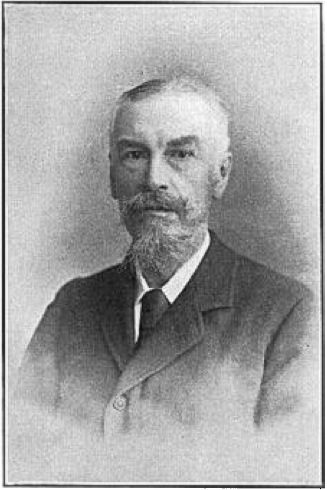
Start with the honest half. In 1864 the British zoologist Philip Lutley Sclater published a short paper, 'The Mammals of Madagascar,' in the Quarterly Journal of Science, and he was chasing a genuine puzzle. Lemurs live on Madagascar and turn up again in India and parts of Southeast Asia, yet they are absent from mainland Africa and from every scrap of land in between. How does one family of primates end up on two shores of the Indian Ocean and nowhere across the middle? Sclater's answer was a sunken continent. He proposed that a now-vanished landmass had once bridged Madagascar and India, let the lemurs spread across it, and then gone under. He named it after them: Lemuria.
This was not a crank talking. Sclater, who lived from 1829 to 1913, was one of the most respected zoologists of his century, an ornithologist who mapped the world's main zoogeographic regions and served as Secretary of the Zoological Society of London for 42 years, from 1860 to 1902. And his underlying instinct was not even wrong. India and Madagascar really had once been joined, as part of the ancient supercontinent Gondwana, so something really did connect the two regions in the deep past. Sclater simply reached for the only mechanism his era offered, a sunken land bridge, because the real one, drifting continents, had not been discovered yet.
His idea fit the science of the day. Before continental drift, land bridges were the standard way to explain why the same animals showed up on lands now separated by ocean, and serious names built on Lemuria. In 1870 Ernst Haeckel promoted it as the cradle of humanity, the place where primates first became human and where the 'missing link' between apes and people would eventually be dug up. Alfred Russel Wallace mapped the world's biogeographic regions with Lemurian connections folded in. For a while, a sunken Indian Ocean continent was a live scientific hypothesis, argued in journals, not in seance rooms.
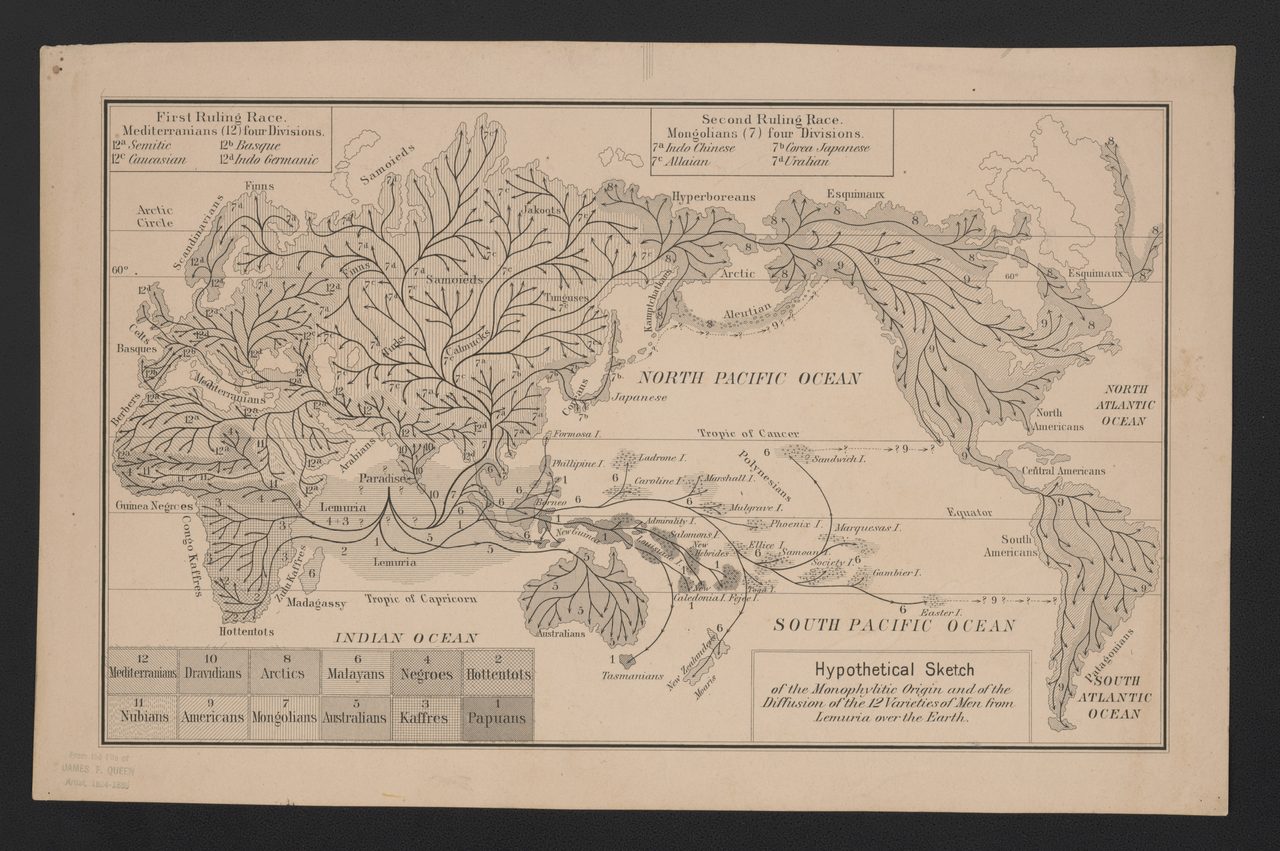
And it was modest. Sclater's Lemuria was a biogeographic proposal about the spread of animals, nothing more. There were no cities on it, no golden age, no lost race. It was treated as legitimate science for several decades and even steered early fossil-hunting for human ancestors toward South and Southeast Asia. Everything strange that would later attach to the name was added by people who came after, and who were not doing science at all.
02Then Theosophy Stole The Word
Here is the exact hinge of the whole story, and it is worth marking, because most retellings smear straight across it. Up to 1888, Lemuria was a wrong but respectable scientific hypothesis. After 1888, it was something else entirely.
The theft was committed by Helena Petrovna Blavatsky. In 'The Secret Doctrine' (1888) she lifted Sclater's term and refilled it with occultism. In her scheme humanity climbs through seven 'Root Races,' and the Lemurians were the Third: giant, hermaphroditic, egg-laying beings who lived on the Lemurian continent before the Fourth Root Race, the Atlanteans, replaced them, and before us, the Fifth. None of this had anything to do with lemurs, biogeography, or evidence. It was a cosmology wearing a scientist's word as a costume.

Blavatsky, who lived from 1831 to 1891, was the co-founder of the Theosophical Society, which she established in New York in 1875 alongside Henry Steel Olcott and William Quan Judge. She was its primary theoretician, and 'The Secret Doctrine' was her masterwork. It is the single document that converted Lemuria from a geological guess into a mystical lost world, and almost every later Lemurian fantasy traces back through it.
Blavatsky said her account came from the 'Stanzas of Dzyan,' an ancient text she claimed Tibetan 'Mahatmas' had shown her. No such text has ever been produced or independently confirmed to exist. The reader is asked to take the source entirely on her word.
That word does not hold up well. Contemporary critics and later biographers have argued that some or all of Blavatsky's claimed travels, including the Tibetan journeys that supposedly delivered the Stanzas, never happened. Her biographer Marion Meade, writing specifically about the Tibetan adventures, concluded that 'hardly a word of this appears to be true.'
This is the cleanest case study you could ask for in how pseudoscience is manufactured. A legitimate scientific hypothesis, Sclater's biogeography, got picked up by a non-scientific movement, stripped of its original meaning, and handed a brand new one. The word survived. The science did not come with it.
The Root Race scheme did not stay a curiosity, either. Rudolf Steiner and Alice Bailey elaborated it into sprawling spiritual cosmologies that still circulate in New Age circles, and darker offshoots, from Ariosophy to strands of Nazi occultism, folded its racial hierarchy into their ideologies, a lineage traced by Goodrick-Clarke's 'The Occult Roots of Nazism.' A stolen scientific word ended up seeding some genuinely poisonous mythology.
And to be flat about it: the Root Race idea is a pseudoscientific racial ranking with no basis in biology, genetics, or archaeology, and modern biology has explicitly repudiated it. Human populations vary continuously, with no discrete 'races' at all, let alone a ladder of sequential evolutionary 'stages.' There is nothing here to salvage.
03Mu Was Never Science At All
Mu gets no such fair opening, because it never earned one. Where Lemuria began in a journal and was corrupted later, Mu was fringe from its very first word, and it stayed fringe through every hand that touched it. There are two of those hands worth naming.

The first was Augustus Le Plongeon, who in 1896 announced that he had decoded Maya inscriptions at Chichen Itza describing the destruction of a lost land he called Mu. His timing matters: this predates the far more famous version by three decades. Mu, in other words, did not even begin with the man who made it famous.
His decoding was nonsense. Le Plongeon read the Maya script through a discredited phonetic key drawn from Diego de Landa's 'Relacion,' treating syllabic signs as if they were alphabet letters, and Mayanists reject his 'translations' universally. It is a textbook case of what scholars call wishful decipherment: reading the content you want into a script you cannot actually read.
None of which makes Le Plongeon, who lived from 1825 to 1908, worthless. He and his wife Alice were among the first people to photograph and systematically study Chichen Itza, and when they excavated the Platform of the Eagles and Jaguars they unearthed a large reclining statue Le Plongeon called 'Chaacmol.' The name was later corrected to 'Chac Mool,' and it remains the standard archaeological term for that whole class of Mesoamerican sculpture to this day, arguably his one lasting, uncontested contribution. His theories, though, were rejected by mainstream archaeology by the 1880s, even as figures like Ignatius Donnelly and Blavatsky herself borrowed from them.
Le Plongeon even ran the usual diffusion story backward, claiming that Egyptian civilization had been founded by Mayan refugees fleeing the sinking of Mu. That is precisely upside down from the more common lost-continent tale, and no better supported by anything.
The couple's fieldwork itself was real and serious. Alice Dixon Le Plongeon, who lived from 1851 to 1910, had learned photography in her father's London studio and became a pioneering archaeological photographer, and the two of them spent twelve years living in the Yucatan, from 1873 to 1885, documenting Chichen Itza and Uxmal on wet glass-plate negatives developed inside unlit Maya interiors. The pictures still hold scholarly value. The theory they were built to prove does not.
The specific document Le Plongeon leaned on gives the game away. The codex he claimed recorded Mu's destruction, the Troano Codex, now known to be part of the Madrid Codex, is actually a divinatory almanac. It is a calendar for reading omens. It says nothing whatsoever about drowned continents.
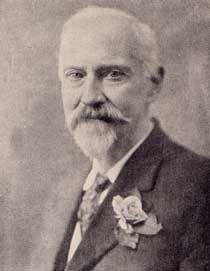
The second hand, and the one that made Mu famous, belonged to the retired British colonel James Churchward. In 'The Lost Continent of Mu' (1926) he claimed that a vast continent had filled the Pacific and sunk roughly 12,000 years ago. His evidence was a set of 'Naacal tablets,' ancient clay tablets he said an Indian priest had secretly shown him, written in a language that, conveniently, only Churchward himself could read.
Churchward, who lived from 1851 to 1936, was a Devon-born tea planter who genuinely did patent a nickel-chrome-vanadium steel used for armor plating on ships in the First World War, then retired on the proceeds to an estate in Connecticut where he wrote his Mu books. He published the first of them at the age of 75. Whatever else he was, he was not a scientist reporting fieldwork.
His Mu was enormous. It stretched from Hawaii to Fiji to Easter Island, he wrote, carried 64 million inhabitants, and was the mother civilization of every culture that followed, Egypt, Babylon, India, and the Maya included. Then it was annihilated when volcanic 'gas chambers' beneath the continent collapsed and dropped the whole thing into the sea.
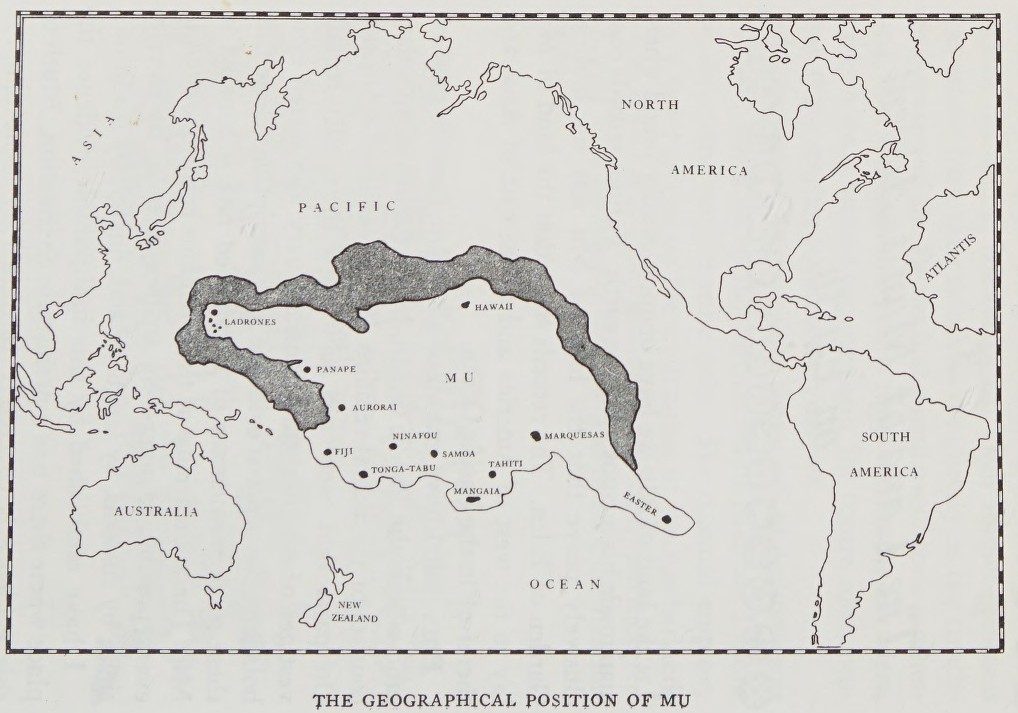
He kept going. Across five books published between 1926 and 1935, Churchward expanded Mu's empire, technology, and colonies, and claimed the Naacal tablets recorded a single monotheistic solar religion from which all the world's faiths descended. That last idea says far more about the comparative-religion fashions of Churchward's own century than about anything ancient.
And the tablets? No one else has ever seen them. The Naacal tablets have never been produced, photographed, or examined by any other researcher, ever. Their entire existence rests on Churchward's own uncorroborated say-so. A civilization of 64 million people, the mother of all human culture, and the only evidence is clay no second person has been allowed to touch.
The verdict from people who examined the actual work is not gentle. The science writer Martin Gardner noted that Churchward's books 'contain geological and archaeological errors' and are 'regarded by scholars as a hoax.' The archaeologist Stephen Williams, in 'Fantastic Archaeology' (1991), wrote that 'his translations are outrageous, his geology... is absurd.' The archaeologist Brian Fagan concluded simply that the evidence for Mu 'has never received scholarly or scientific support.'
They are right, and the refutation is not a matter of taste. Churchward's 'translations' are linguistically nonsensical, the Naacal tablets cannot be checked because they have never surfaced, and the floor of the Pacific is entirely young oceanic crust with no trace of any sunken continent in it. None of that has slowed the books down. They are still in print, and still feeding popular alternative history a century later.
04What Modern Geology Actually Says
Now bring down the hammer that closes both cases at once, because the geology does not care which lost continent it is refuting. The problem for Mu and Lemuria alike is not a shortage of searching. It is that continents physically cannot do the thing these stories require of them.
Start with the rock. Oceanic crust and continental crust are made of different stuff and behave in opposite ways. Oceanic crust is basaltic, dense, thin, and young. Continental crust is granitic, lighter, far thicker, and ancient, with its oldest cratons more than four billion years old. Because continental crust is so much less dense, it floats high on the mantle and simply cannot founder into it, a principle called isostasy. Continents drift, they collide, they buckle into mountains and split into new coastlines, but they do not sink to the bottom of the ocean. That single fact is fatal to a submerged continent of the kind Mu and Lemuria demand.
| Property | Oceanic Crust | Continental Crust |
|---|---|---|
| Rock type | Basaltic | Granitic |
| Density | ~3.0 g/cm3 | ~2.7 g/cm3 |
| Thickness | 5 to 10 km | 30 to 70 km |
| Oldest age | ~200 million years | Over 4 billion years |
| Fate | Recycled down into the mantle | Too buoyant to sink (isostasy) |
There is also a better explanation for Sclater's lemurs, and it arrived in the twentieth century. Wegener proposed drifting continents in 1912 and was rejected for decades, but seafloor spreading was demonstrated by Hess, Vine, and Matthews between 1960 and 1963, and the full theory of plate tectonics was assembled between 1965 and 1968. It gave the planet a documented history, including the Indian Plate's own journey: it rifted away from Madagascar roughly 88 million years ago and drifted north to slam into Asia around 50 million years ago.
That solves the lemur puzzle without a drop of sunken civilization. India and Madagascar shared their animals because they were once literally the same landmass, part of Gondwana, and then split, carrying related creatures apart on diverging plates. No bridge sank because none was ever needed. And the Indian Ocean floor, when we finally mapped it, turned out to be ordinary oceanic crust. The large submerged features that are down there, such as the Kerguelen Plateau, are volcanic, not the drowned remains of any continent.
It is worth heading off the obvious objection. Yes, land does go under the sea. Places like Sundaland and Doggerland were flooded within human memory. But that is rising water lapping over the shallow edges of a continent, the continental shelf, not an entire landmass dropping through the seabed. It is a completely different phenomenon from the one Mu and Lemuria describe, and confusing the two is where most of the mischief happens.
05The Real Sunken Continents Are Not These
Here is where the honest version of this debunk gets stronger than the lazy one. The lazy version says there are no sunken continents, full stop. That is not true, and saying it hands the mystics an easy win. The accurate version is more devastating: real drowned continents exist, geologists have found them, and neither one is Mu or Lemuria.
Take the Indian Ocean first, Lemuria's own claimed home. In 2013 a team led by Torsvik, publishing in Nature Geoscience, found three-billion-year-old zircon crystals in the young volcanic rock of Mauritius, crystals far too old to have come from the island itself. They could only have come from ancient continental crust buried underneath. The team named the lost fragment Mauritia, a microcontinent about the size of Greenland that broke apart when Madagascar, India, and the Seychelles rifted away from one another. In a strange way this partly vindicates Sclater: continental material really did once link the region. But it also kills the single 'Lemuria' landmass, because rifting shatters continents into scattered fragments rather than sinking one tidy continuous continent, and Mauritia has been underwater for tens of millions of years, long before any primate, let alone any person, existed to build on it.
Mauritia is not alone. Several such fragments sit beneath the Indian Ocean, real slivers of continental crust left over from Gondwana's breakup. They prove that pieces of continent can indeed lie under the sea. They also prove those pieces are geological debris tens of millions of years old, never habitable, never inhabited, and about as far from a lost civilization as it is possible to get. This distinction, real microcontinents versus imaginary sunken cities, is exactly the one that lost-continent books blur on purpose.
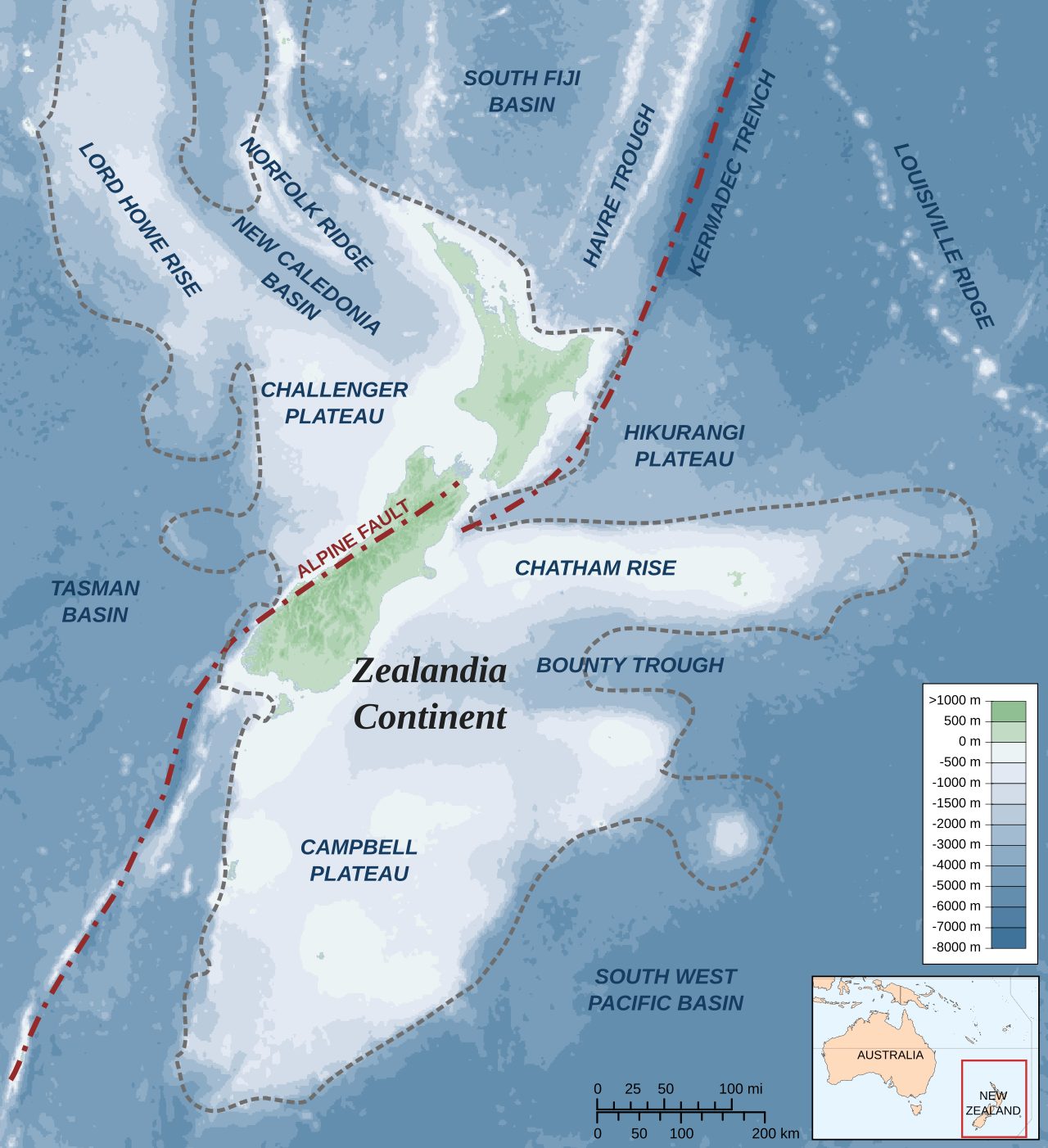
Now the Pacific, Mu's claimed home, where the case is even more spectacular. There is a genuine, scientifically confirmed continent down there: Zealandia. In 2017, a team led by Nick Mortimer laid out the evidence in GSA Today, the journal of the Geological Society of America, and showed that Zealandia passes all four tests geologists use to define a continent. It rises distinctly above the surrounding ocean floor, it is built from the full range of continental rock types, its crust is continental in thickness, and at 4.9 million square kilometers it is far too large to dismiss as a stray fragment. Roughly 94 percent of it lies submerged, in places under two kilometers of ocean. Only New Zealand, New Caledonia, and a few small islands break the surface.
So a real continent really is sunk in the Pacific. It is simply not, and could not be, Mu. Zealandia went under across tens of millions of years, with its deepest drowning in the Oligocene, roughly 35 to 25 million years ago, an event geologists literally call the Oligocene Drowning. That is not a catastrophe 12,000 years ago that swallowed a living empire. It happened before any human being existed anywhere on Earth, and its few exposed scraps never hosted anything remotely like Churchward's 64-million-person civilization spanning Hawaii to Easter Island.
The way Zealandia was confirmed is itself the sharpest possible contrast. Its name was first proposed in 1995, and it still took more than two decades of accumulating seismic, geological, and crustal evidence before the 2017 paper could formally certify it as a continent. That is what establishing a real sunken continent looks like: slow, measured, and evidence-first. Mu and Lemuria, in their mystical forms, were never subjected to any such test at all. One had tablets no one could see, the other a Tibetan book no one could find.
06Kumari Kandam: A Real Memory Under The Water
Not every drowned-land tradition in this story is fantasy, and honesty requires saying so clearly. One of them is built on something real.
Long before any European wrote the word Lemuria, Tamil literary tradition described Kumari Kandam, a land to the south of India that the sea swallowed. It was said to be home to an ancient Tamil civilization and to the legendary Sangam academies of Tamil poets. The tradition appears in medieval commentaries on the classical Sangam literature and in the epic Silappadikaram, and it describes three successive Sangam assemblies, each one driven north as the ocean advanced. That structure, a sea rising in stages and pushing people inland, is exactly what a real, slow flooding would leave in cultural memory.
And there really was land to lose. During the last Ice Age, sea level stood far lower, and the continental shelf south of Tamil Nadu is broad: bathymetric surveys show it reaching up to 130 kilometers beyond the modern coastline before it drops to true ocean depth. Large areas of the Gulf of Mannar and the Palk Strait were dry ground during the glacial low stand, and they flooded as the ice melted. Kumari Kandam, at its core, may well be a genuine folk memory of that drowning.
It matters, too, that this tradition is its own thing. Kumari Kandam predates the Western Lemuria concept and is independent of it, even though Tamil nationalists have sometimes fused the two. Off the Tamil Nadu coast, marine archaeologists have found submerged structures near Poompuhar, dated by some to around 9,500 years ago, and near Mahabalipuram, and India's National Institute of Oceanography has repeatedly surveyed man-made structures at depths of 5 to 40 meters in the Gulf of Cambay and elsewhere. The dating and interpretation remain provisional, but this is real underwater research, not channeling.
The catch is that Kumari Kandam now carries a heavy political charge. It has become a symbol of Tamil antiquity and pride, and in some hands a claim that Tamil civilization is the oldest on Earth. The DMK party and allied groups have at times promoted it as settled historical fact, which quietly erases the line between a credible folk memory of sea-level rise and a proven sunken civilization. Those are not the same claim, and only the first one has real support.
07The Real Places The Myth Steals
The lost-continent industry has a habit of pointing at genuine ancient sites and whispering that no mere islanders could have built them, so a vanished super-race must have. That move is not just wrong. It is an insult to the people who actually did the work.
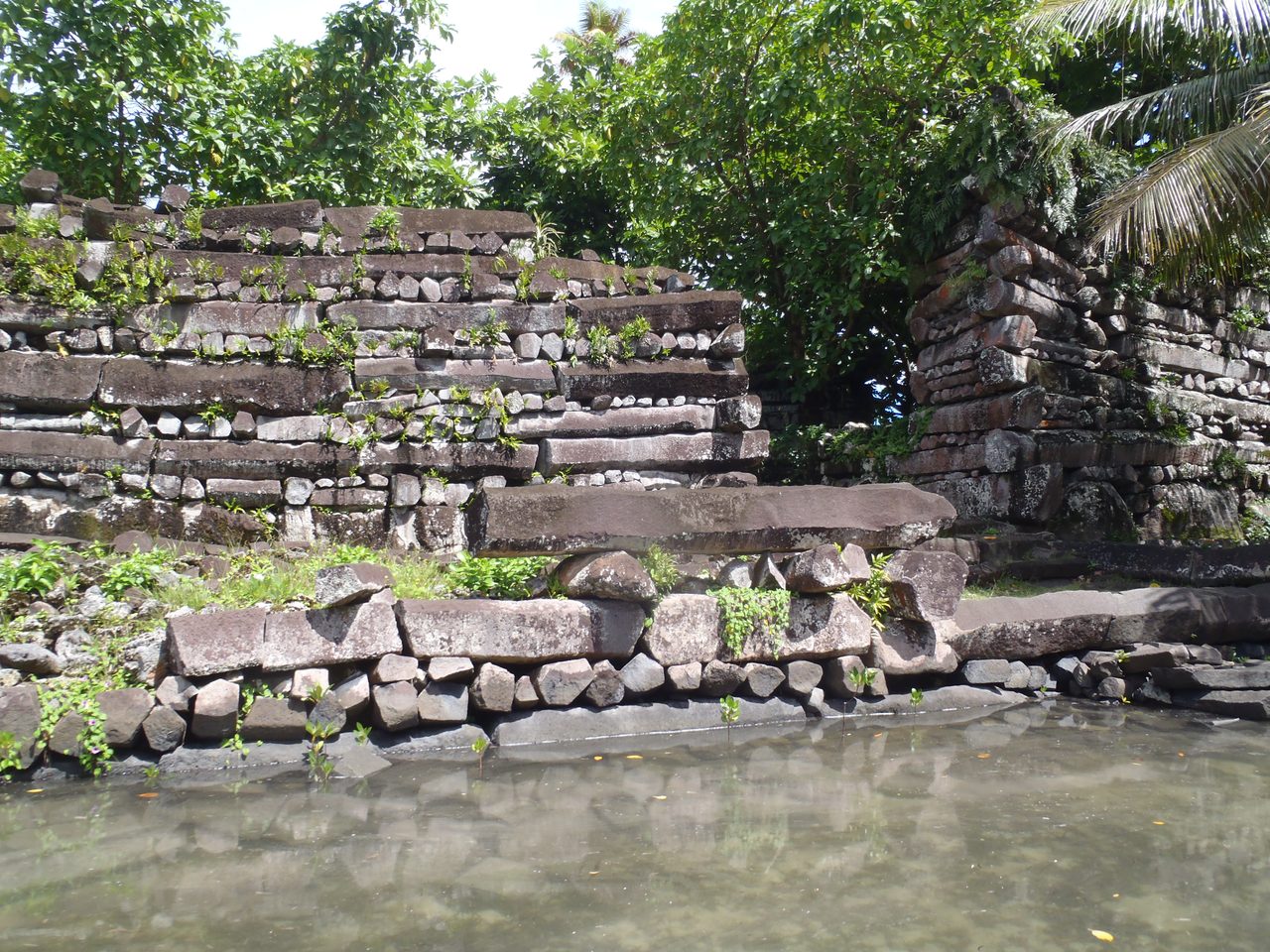
Consider Nan Madol, on Pohnpei in Micronesia, which alternative-history writers love to file as a 'remnant' of Mu or Lemuria. It is a complex of 92 artificial islets raised on a coral reef out of prismatic basalt columns, covering some 18 hectares and requiring the movement of an estimated 750,000 metric tons of stone. It was built by the Saudeleur dynasty, a documented Pacific power, between roughly 1200 and 1500 CE. Not 12,000 years ago, not by a lost race, but by known people within the last millennium.
The same goes for the moai, the great stone figures of Easter Island, which get attributed to a 'Lemurian' civilization about as often. They were carved and moved by Polynesian settlers between roughly 1200 and 1500 CE, and we know in detail how. In 2011 the archaeologists Hunt and Lipo showed experimentally that a moai could be 'walked' upright to its platform by a team of about 18 people using ropes to rock it forward, step by step.
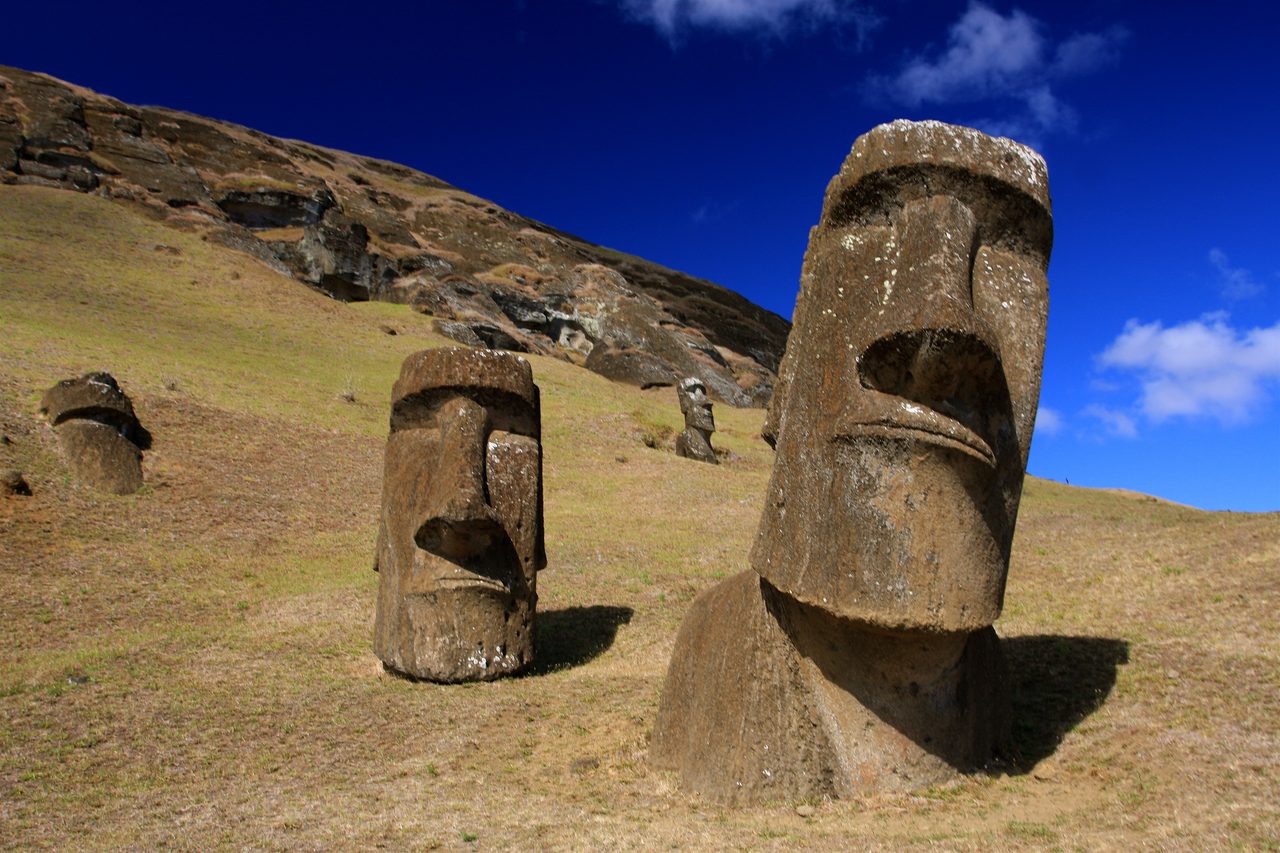
That result has only gotten stronger. A 2025 follow-up by the same researchers, using updated physics and a 4.35-ton replica, found that the statues' broad D-shaped bases and slight forward lean are precisely suited to a rocking, zigzag walk, and an 18-person team moved the replica 100 meters in 40 minutes. Easter Island's engineering now has a working, tested, human explanation. It needs no lost continent at all.
That is the real point buried under all the Mu talk. Nan Madol and the moai are proof that Pacific Islander peoples were extraordinary builders and navigators in their own right. Handing their achievements to an imaginary drowned race does not add wonder to the world. It steals wonder from the people who earned it.
08How A Dead Idea Keeps Breathing
So the science is settled and the origins are exposed. Why, then, are Mu and Lemuria more alive today than the lemurs that started it all? Because a good lost world was never really about geology.
Since the 1930s, Mount Shasta in northern California has been claimed as the home of a surviving Lemurian colony, living on inside the mountain. The story was seeded by Frederick Spencer Oliver's 1905 book 'A Dweller on Two Planets' and amplified by Guy Ballard's 'I AM' movement in the same decade, and from there Lemuria and Mu spread into fiction and pop culture: into H.P. Lovecraft, Clark Ashton Smith, and Lin Carter, into video games and anime. Japanese popular culture in particular took to Mu, which turns up across manga, anime, and game franchises from Getter Robo to Super Robot Wars.
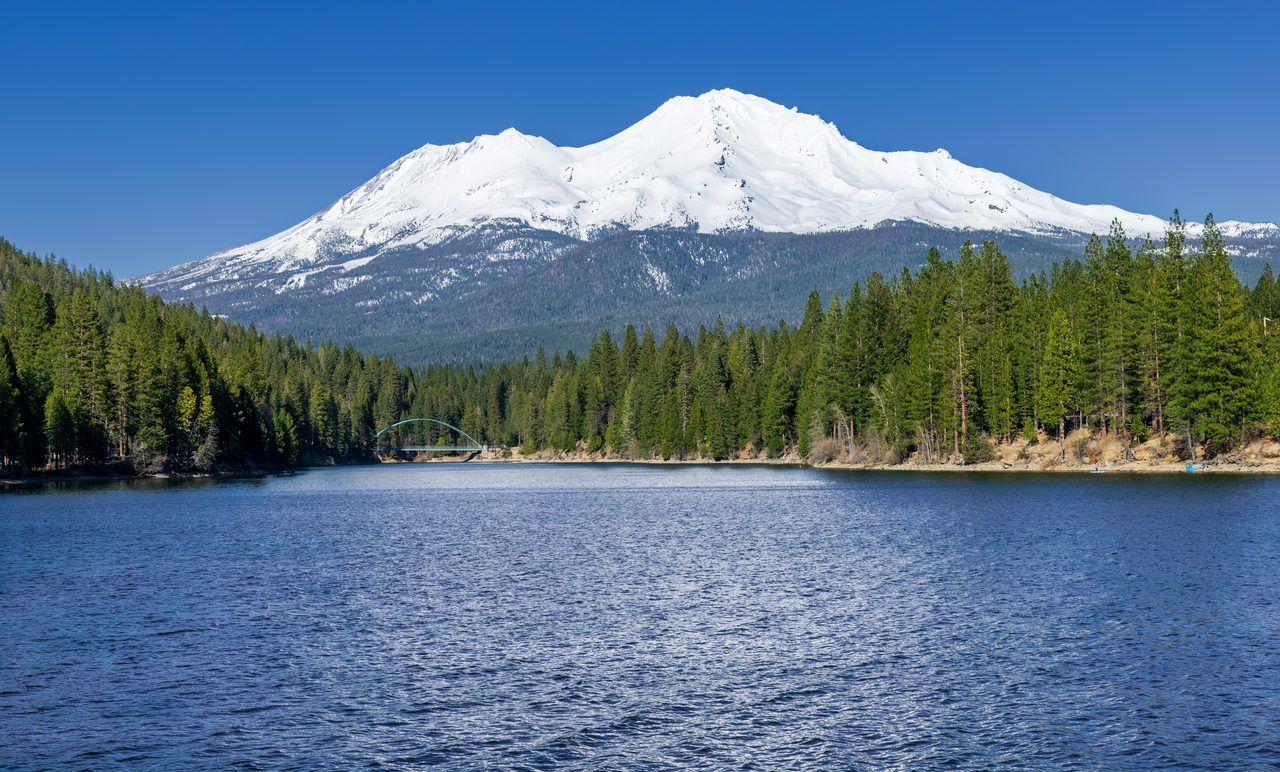
The Mount Shasta legend has a traceable origin. Frederick Spencer Oliver, born in 1866 and raised near the mountain, began writing 'A Dweller on Two Planets' as a teenager while surveying his family's mining claims, and the book, which billed itself as channeled, was published after his death in 1905. It contains the first known link between Mount Shasta and a hidden brotherhood, a tunnel to a secret city, Lemuria, and the 'I AM' idea. Guy Ballard later said he had met the Count of St. Germain while hiking the mountain, an encounter he made the founding story of his own 1930s 'I AM' movement, which critics say drew heavily, even plagiarized, from Oliver's earlier book.
Underneath all of it sits one very old human craving: the lost golden age. The belief that somewhere behind us there was a perfect civilization, wiser and greater than ours, tragically destroyed. Mu and Lemuria are perfect screens for that longing, which is exactly why the evidence against them barely dents their appeal.
The longing also manufactures false 'proof.' Underwater rock formations at Yonaguni off Japan and at Bimini in the Bahamas are regularly paraded as sunken ruins of Mu or Lemuria. They are natural. Geologists attribute Yonaguni to ordinary tectonic fracturing of sandstone and Bimini to beachrock. Even Robert Schoch, who once entertained the possibility that Yonaguni had been artificially modified, came around after later analysis: the formations are consistent with nature, not masonry.
The rest of the modern 'evidence' is thinner still. 'Channeled' messages from 'Lemurian masters,' a New Age staple since the 1980s, carry no evidentiary weight whatsoever. And the occasional claim that satellite maps reveal 'streets' or 'foundations' on the Pacific floor turns out to be a misreading of the grid patterns that sonar interpolation leaves behind. It is an artifact of the mapping software, not a city.
None of which has dislodged the idea. Search interest in Lemuria and the Mu continent stays steady and spikes with each new documentary, and 'Ancient Aliens' has carried both to millions of viewers. Serious scholarship has quietly changed the question it asks: Ramaswamy's 2004 study 'The Lost Land of Lemuria' treats Lemuria not as a claim to refute but as a cultural phenomenon to explain, a story about why the myth endures and whom it serves. Wound into identity politics, as with Kumari Kandam, a debunked continent can stay culturally load-bearing indefinitely.
09Every Claim, Every Tier
Here is the whole file on one page, each claim wearing its tier, because the surest way to flatten this story into one lazy sneer is to let Sclater's real science, Kumari Kandam's real memory, Churchward's invented empire, and the flat falsehoods all blur together. They are not the same, and the tiers are what keep them apart.
| The Claim | Tier | The Basis |
|---|---|---|
| Sclater proposed Lemuria in 1864 to explain lemur distribution | Tier 1 | A real biogeographic hypothesis, Sclater 1864 |
| India and Madagascar were once joined in Gondwana | Tier 1 | Plate tectonics; they rifted ~88 million years ago |
| Continental crust cannot sink beneath the ocean floor | Tier 1 | Isostasy; oceanic crust is denser than continental |
| Real sunken continents exist: Zealandia and Mauritia | Tier 1 | Mortimer et al. 2017; Torsvik et al. 2013 |
| Neither Zealandia nor Mauritia is Mu or Lemuria | Tier 1 | Wrong age, wrong place, never any civilization |
| Kumari Kandam echoes real post-glacial sea-level rise | Tier 2 | Tamil Sangam tradition; a ~130 km drowned shelf |
| Nan Madol and the moai are real Pacific engineering | Tier 2 | Saudeleur and Polynesian builders, ~1200 to 1500 CE |
| Blavatsky recast Lemuria as an occult 'Root Race' in 1888 | Tier 3 | Her Secret Doctrine; the Stanzas of Dzyan unverified |
| Le Plongeon 'read' Mu in Maya glyphs in 1896 | Tier 3 | His claim; rejected universally by Mayanists |
| Churchward's Mu, a 64-million-person Pacific continent | Tier 3 | His own claim across five books, 1926 to 1935 |
| Mount Shasta hosts a surviving Lemurian colony | Tier 3 | A 20th-century belief, Oliver 1905 / Ballard 1930s |
| The Root Race schema is a pseudoscientific racial hierarchy | Tier 4 | Repudiated by modern biology and genetics |
| Churchward's Naacal tablets recorded a lost continent | Tier 4 | Never produced, photographed, or verified by anyone else |
| Yonaguni and Bimini are sunken Mu or Lemuria ruins | Tier 4 | Natural sandstone jointing and beachrock |
| 'Channeled' Lemurian messages and seafloor 'streets' | Tier 4 | No evidentiary value; sonar-grid artifacts |
| A continent of the right age lies where Mu or Lemuria are placed | Tier 4 | No; that ocean floor is young oceanic crust |
Fast Facts
- The Legitimate Start
- Sclater's 1864 Lemuria, a real hypothesis for why lemurs live in Madagascar and India but nowhere between
- The Hijack
- Blavatsky's 1888 Secret Doctrine recast Lemuria as an occult 'Root Race,' where the science ends and the myth begins
- Mu's Origin
- Fringe from the first word: Le Plongeon's misread glyphs (1896), then Churchward's unseen Naacal tablets (1926)
- The Physics
- Continental crust is too buoyant to sink beneath denser oceanic crust; continents drift and collide, they do not drop through the seabed
- The Real Ones
- Zealandia (Pacific, confirmed 2017) and Mauritia (Indian Ocean, 2013) are genuine sunken continental crust
- Why They Are Not Mu
- Submerged for tens of millions of years, long before any human existed, and never home to any civilization
- The Real Memory
- Kumari Kandam likely preserves a genuine folk memory of post-glacial sea-level rise off Tamil Nadu
- The Afterlife
- Mount Shasta colonies, channeled 'masters,' Ancient Aliens, and a century of manga, anime, and pulp fiction
- The Verdict
- No submerged continent of the right age or type lies where Mu or Lemuria are claimed
What We Can Actually Stand Behind
The geology is beyond dispute, and so is Lemuria's honest beginning. Sclater really did propose Lemuria in 1864 as legitimate science, to explain lemur distribution before continental drift existed as an option. India and Madagascar really did share the supercontinent Gondwana, and plate tectonics explains the lemurs with no sunken land at all. Continental crust cannot sink beneath the ocean because it is too buoyant, a matter of measured density and isostasy. And real drowned continents do exist: Zealandia in the Pacific, confirmed in GSA Today in 2017, and Mauritia beneath the Indian Ocean, identified in Nature Geoscience in 2013. They are simply the wrong age, in the wrong condition, and never carried anyone.
One drowned-land tradition holds something real. Kumari Kandam, the Tamil memory of a land lost to the sea, plausibly preserves a genuine recollection of post-glacial flooding across a broad continental shelf, and the submerged-structure surveys off Tamil Nadu are real, if still provisional, research. So is the archaeology the myth tries to steal: Nan Madol and the Easter Island moai are documented human achievements, and the 2011 and 2025 walking-moai experiments show exactly how the statues moved, no lost race required.
The famous versions are reported as claims, not facts. Blavatsky's occult Root Race Lemuria, Le Plongeon's and Churchward's Mu, and the surviving colony inside Mount Shasta are described here as what their authors asserted and as real cultural phenomena, never as established history. The pull of the 'lost golden age,' and the myth's stubborn survival in pop culture and identity politics, are genuine patterns worth naming, but they are sociology, not geology.
And several claims are simply false, so say it flatly. No, the Naacal tablets do not exist in any checkable form; their entire case rests on one man's word. No, the Root Race scheme is not biology; it is a pseudoscientific racial hierarchy that modern genetics repudiates. No, Yonaguni and Bimini are not sunken ruins; they are natural sandstone and beachrock. And no, there is no submerged continent of the right age or type under the Pacific or the Indian Ocean where Mu and Lemuria are claimed to lie. The real sunken continents are elsewhere, and they are not them.
So hold the layers apart and the honest picture is sharper than either the true believer or the easy skeptic will tell you. Lemuria was a real scientist's wrong answer to a real question, stolen and mummified by mystics. Mu was a fever dream from the start, resting on tablets no second person has ever seen. And the ocean floor, when we finally went and looked, turned out to be hiding drowned continents after all, just not the ones anyone was praying for. The map is read, the seabed is charted, the case is closed. And still the legend swims. So the question the deep leaves us with is not really where Mu went. It is why we keep needing a perfect world to have drowned, when the true history under the water is already stranger than the one we made up.
Sources & further reading
Everything above is drawn from our research library on Theories of Anything, which is where we worked from. The papers, reports and primary records listed beneath them are where you can check us independently.
Image credits
- Nan Madol, Pohnpei photograph via Wikimedia Commons. CC BY-SA 4.0 Source.
- Philip Lutley Sclater portrait via Wikimedia Commons. Public Domain Source.
- Ernst Haeckel's 1876 Lemuria Dispersal Map map via Wikimedia Commons, Library of Congress. Public Domain Source.
- Helena Petrovna Blavatsky portrait via Wikimedia Commons, Library of Congress. Public Domain Source.
- Augustus Le Plongeon portrait via Wikimedia Commons. Public domain Source.
- James Churchward portrait via Wikimedia Commons. Public domain Source.
- James Churchward's 1926 Map of Mu map via Wikimedia Commons. Public domain Source.
- Map of Zealandia map via Wikimedia Commons. CC BY-SA 3.0 Source.
- Moai at Rano Raraku, Easter Island photograph via Wikimedia Commons. CC BY 2.0 Source.
- Mount Shasta, Northern California photograph via Wikimedia Commons. CC BY-SA 4.0 Source.
- Card crop of Nan Madol, Pohnpei photograph via Wikimedia Commons. CC BY-SA 4.0 Source.
_5.jpg)


.jpg)


.jpg)
