Naga Kings: The Serpent Gods That Hold Up a Universe and Sheltered a Buddha
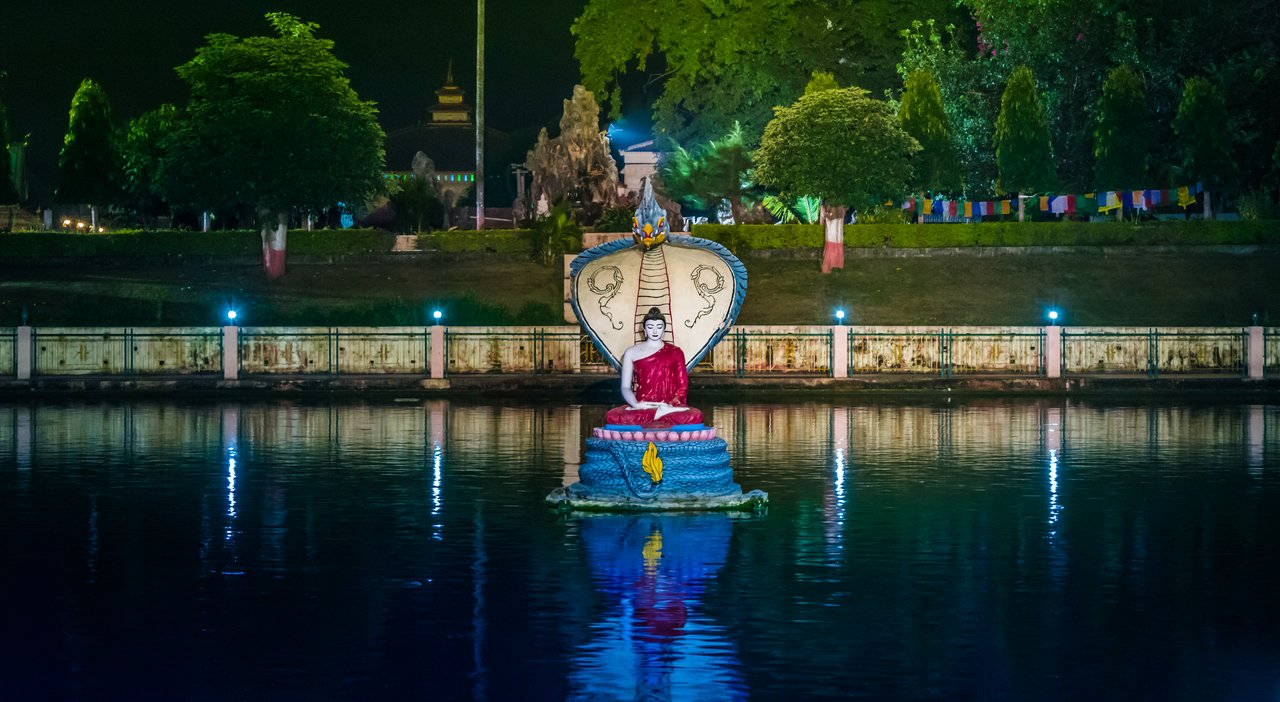
Walk the causeway into Angkor Wat and a stone serpent runs the length of the balustrade beside you. Kneel at Mucalinda Lake in Bodh Gaya, where the Buddha reached enlightenment, and you find him carved in meditation beneath the flared hood of a giant cobra. These are nāgas: divine serpent-beings who hold up the Hindu universe, sheltered the newly awakened Buddha, guard the deepest scriptures of Mahāyāna Buddhism, and still bring the monsoon rains across South and Southeast Asia. They are not one god, and not one story. The Hindu cosmic serpent, the Buddhist protector, and the Southeast Asian royal ancestor are three distinct traditions that happen to share a shape, and flattening them into a single Asian snake myth is exactly the mistake this file refuses to make. Every claim below wears its tier. And the one question the evidence genuinely cannot close is the largest of all: whether the nāga, the Chinese dragon, and the feathered serpent of the Americas grew from one ancient idea, or whether they are the same human answer to the snake, arrived at over and over in places that never met.
There is a stone serpent at the entrance to almost every great temple in mainland Southeast Asia, and a serpent holding up the sky at the center of Hindu cosmology, and a serpent hooded protectively over the Buddha in shrines from India to Laos. The being is the nāga, and it is one of the most durable religious ideas on Earth. What follows is the nāga on its own terms, tradition by tradition, with each claim carrying the weight the evidence actually gives it.
01One Word, Not One Serpent
Across every tradition that honors it, the nāga governs the same domains: water, rain, and rivers; agricultural fertility; the treasures and the secret knowledge hidden beneath the earth. It occupies a liminal position, divine and dangerous at once, benevolent and vengeful by turns, and that ambivalence mirrors the real human relationship with actual serpents, feared and revered in the same breath. This shared function is what makes the nāga recognizable from the Ganges to the Mekong. It is also where the danger lies for anyone studying it: the common shape tempts you to treat the nāga as one thing, and it is not.
A Hindu cosmologist, a Buddhist monk, and a Khmer king would each have told you a different story about the serpent, in a different language, for a different reason. Keep them apart and the nāga becomes far more interesting than a single snake god. Here are the three traditions this file follows, each on its own ground.
| Tradition | What the Naga Is There | Its Anchor Figure |
|---|---|---|
| Hindu | The cosmic serpent who supports the universe and pillows the sleeping Viṣṇu | Ananta Śeṣa, the thousand-headed serpent king |
| Buddhist | Protector of the Buddha and guardian of the deepest scriptures | Mucalinda, and the tradition of Nāgārjuna |
| Southeast Asian | Royal ancestor and rain-bringer, carved into the temple itself | The balustrades of Angkor and the naga princess Soma |
02The Serpent That Holds Up the World
In Hindu cosmology the universe rests on a snake. Ananta Śeṣa, the Endless One, also called Ādi Śeṣa, the First Serpent, is the thousand-headed serpent king of the Viṣṇu Purāṇa and the Bhāgavata Purāṇa, and he supports the entire cosmos on his hoods. Between the cycles of creation, when one universe has dissolved and the next has not yet begun, the god Viṣṇu sleeps upon Śeṣa's coils on the surface of Kṣīra Sāgara, the cosmic ocean of milk. Śeṣa is three things at once in that image, and the layering is the point: he is Viṣṇu's servant, he is Viṣṇu's throne and bed, and he is the very substrate the cosmos floats on. Not a mount with a rider, but the ground of being itself, shaped like a snake.
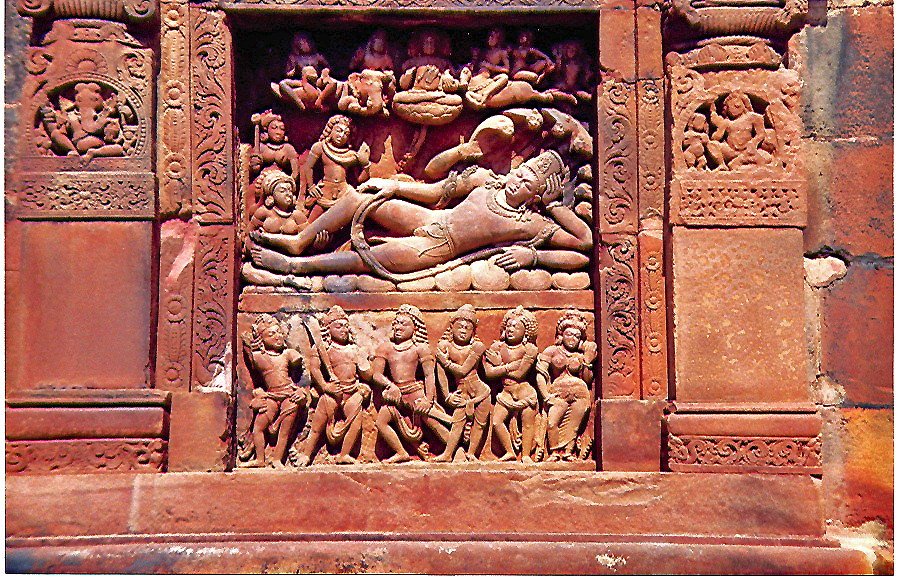
This is not a marginal image. The reclining Viṣṇu on the serpent, known as Anantaśayana, reclining on the Endless One, is one of the most common motifs in all of Hindu temple sculpture. It runs from the relief at the Dashavatara Temple at Deogarh, carved in the fifth century CE, to the colossal reclining Viṣṇu at the Padmanabhaswamy Temple in Thiruvananthapuram. And the serpent's reach extends into the divine family tree: Balarāma, the elder brother of Kṛṣṇa, is regarded as an incarnation of Śeṣa himself. The snake who holds up the world also walks the earth as a man.
03The Cobra Who Sheltered the Buddha
The most beloved naga story in Buddhism is recorded in the Vinaya Piṭaka, in the Khandhaka. In the days after the Buddha reached enlightenment at Bodh Gaya, a great storm broke, and it rained without stopping for seven days. From beneath his tree rose the naga king Mucalinda, who wound his enormous body seven times around the seated, meditating Buddha and spread his multi-headed hood above him like a canopy, sheltering the newly awakened one from the wind and rain until the sky cleared. It is one of the rare moments in scripture where the natural world protects the sacred rather than testing it.
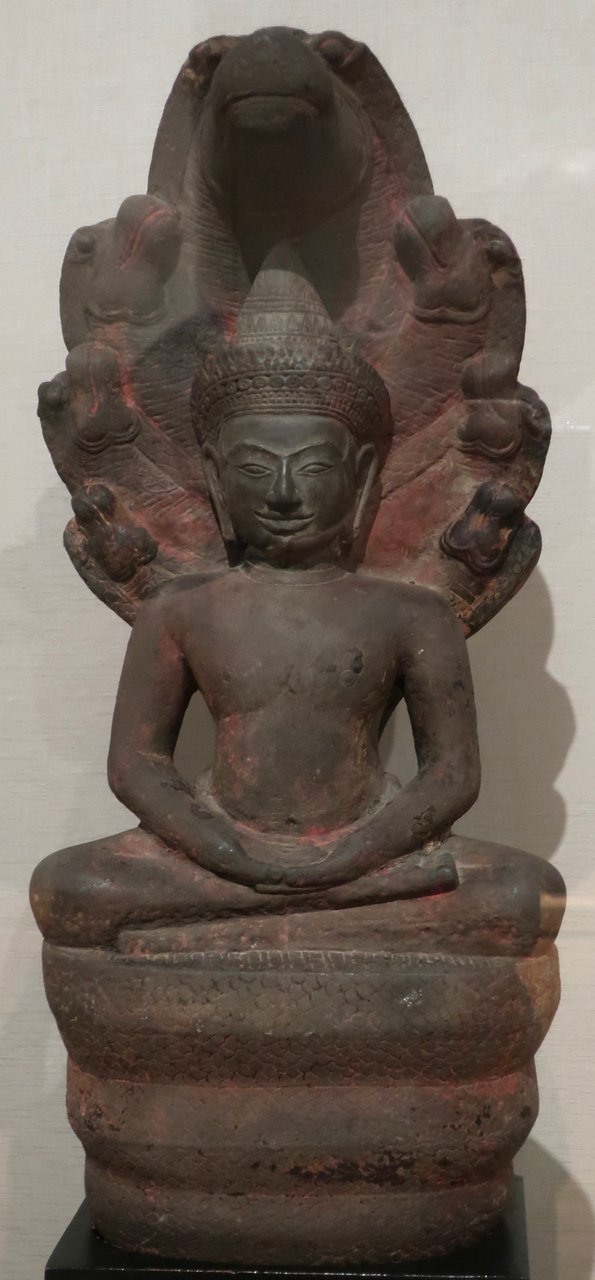
That single episode became one of the most widespread images in all of Buddhist art. The nāga-sheltered Buddha, the serpent's coils forming a throne and its fanned hood a halo, is carved and cast across mainland Southeast Asia, and it reaches its peak in the Khmer, Thai, and Lao workshops. The nāga-enthroned Buddha of Angkor-period Cambodia, produced in the twelfth and thirteenth centuries CE, is one of the signature forms of Southeast Asian sculpture. A story that began under one tree in northern India ended up defining how much of a continent pictured its Buddha.
04The Philosopher With a Serpent's Name
The single most important philosopher in the history of Mahāyāna Buddhism carried a serpent in his name. Nāgārjuna, who lived in South India around 150 to 250 CE, systematized the concept of śūnyatā, emptiness, the teaching that nothing possesses an independent, self-standing essence, and founded the Madhyamaka school that grew from it. His name means, quite literally, Nāga-Arjuna: the serpent-hero. In the person who reshaped Buddhist thought more than anyone after the Buddha himself, the serpent and the highest philosophy are fused at the level of a name.
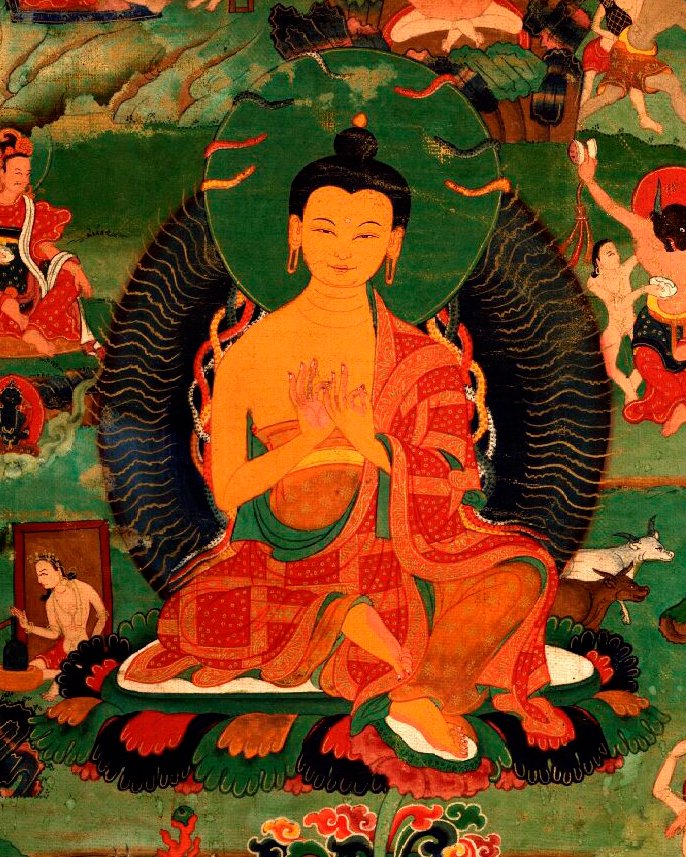
Buddhist tradition tells why. According to the hagiography, Nāgārjuna did not compose the Prajñāpāramitā Sūtras, the Perfection of Wisdom texts at the heart of Mahāyāna, but recovered them. They had been hidden since the Buddha's own lifetime in the realm of the nāgas beneath the ocean, and the nāgas surrendered them to Nāgārjuna when the world was finally ready to receive them. The honest tier here is narrow: what is verified is that this tradition exists and says exactly this, not that the recovery historically happened. That last part is legend, and this file keeps it labeled as legend. But the tradition did real work. It established the nāgas as the guardians of esoteric wisdom and bound serpentine beings to the very highest teachings in Buddhist thought. The serpent, in this telling, keeps the deepest truths safe until minds are ready for them.
05Serpents Built Into the Stone
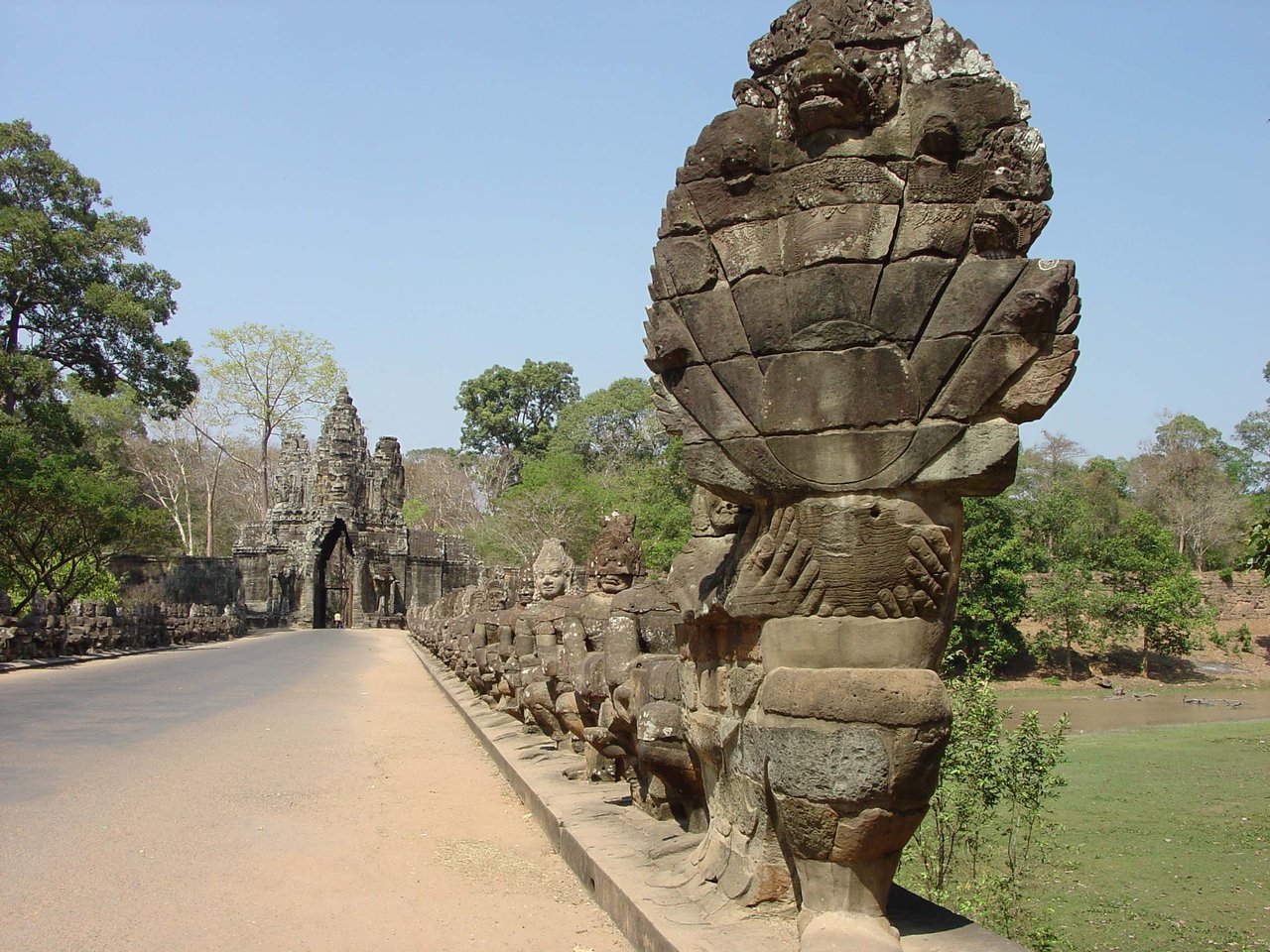
In Southeast Asia the nāga did not just enter the temple. It became the temple's architecture. Naga balustrades, stairway guardians, and bridge railings are the single defining feature of Khmer temple building, from Angkor Wat in the twelfth century to the great causeways of Angkor Thom, where rows of gods and demons haul on the body of an enormous serpent in a permanent stone tug-of-war. That scene is the Samudra Manthana, the Churning of the Ocean of Milk, the Hindu creation myth in which the serpent itself is the rope wound around the mountain that stirs the cosmic sea. To cross into Angkor Thom is to walk between two teams churning the universe into being.
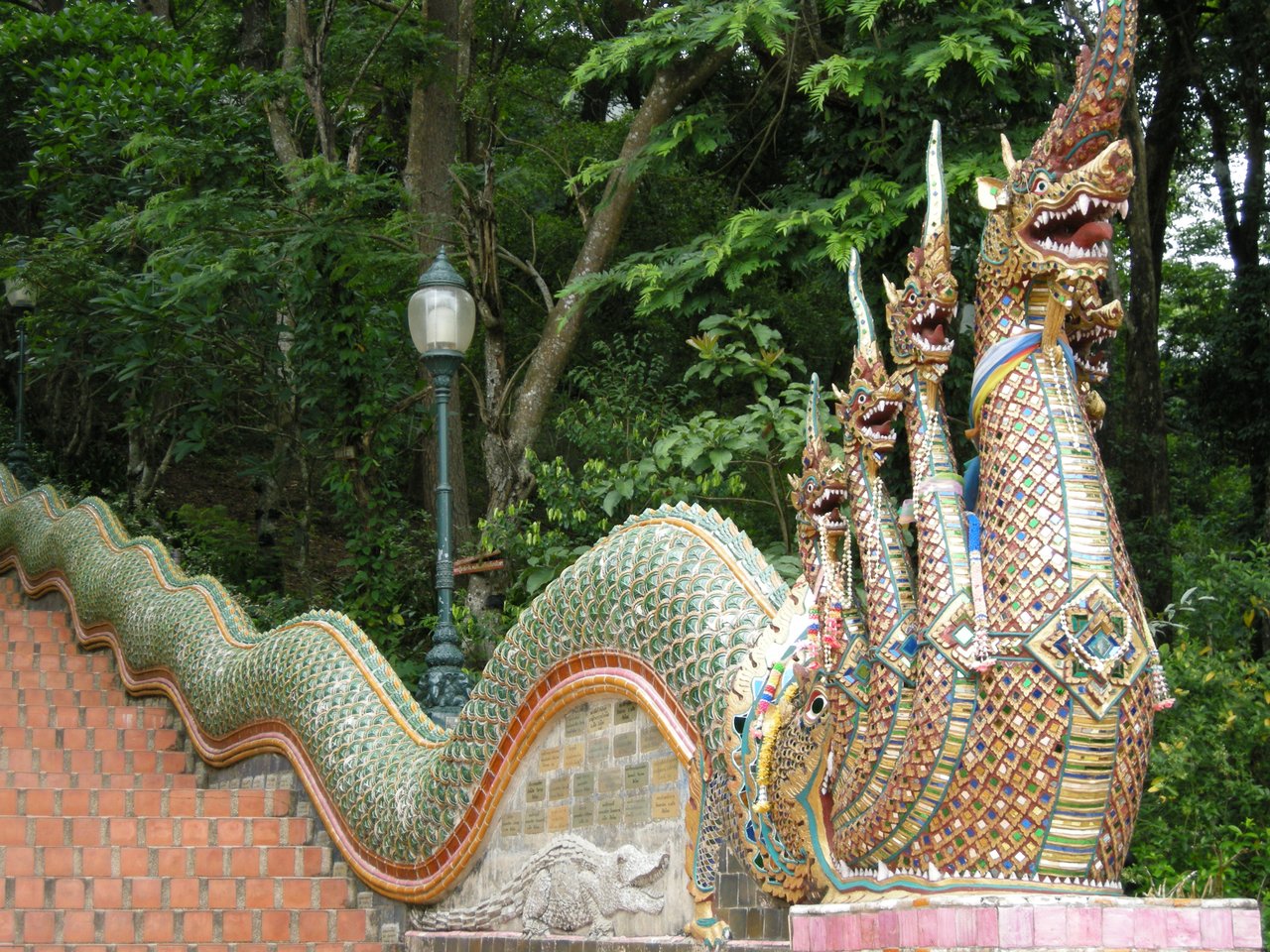
The pattern runs across the whole region. In Thailand, multi-headed nāgas guard temple entrances, most famously flanking the long stairway that climbs to Wat Phra That Doi Suthep above Chiang Mai. In Laos, the Boun Bang Fai rocket festival fires homemade rockets into the sky to propitiate the nāgas and call down the rains. Scholars of the region, Paul Mus in his 1935 study of Barabudur and George Coedès in his work on the Indianized states of Southeast Asia, read all of this as a genuine synthesis: Indian naga theology laid over, and fused with, the indigenous serpent and water-spirit traditions that were already there. The naga you meet at an Angkor gate is Indian and local at once.
| Where | Site or Rite | The Naga There |
|---|---|---|
| Cambodia | Angkor Wat | Naga balustrades line the causeways, the defining feature of Khmer temple architecture |
| Cambodia | Angkor Thom | Gods and demons haul on a giant naga in the Churning of the Ocean of Milk |
| Thailand | Wat Phra That Doi Suthep | Multi-headed nagas flank the monumental stairway to the temple |
| Laos | Boun Bang Fai | Rockets are fired to propitiate the nagas and summon the monsoon rains |
06Older Than the Veda?
Where did the nāga come from? One influential theory says it is older than the religion that made it famous. Scholars including D.C. Sircar and Nagaswami have argued that naga worship in India predates Vedic Aryan religion altogether, that it is an indigenous Dravidian or tribal serpent cult the incoming Brahmanical system absorbed rather than invented. The evidence they marshal is circumstantial but suggestive: the deep prominence of naga worship among South Indian and Adivasi tribal communities; the built-in antagonism between the nāgas and Garuḍa, the Vedic sun-bird who serves as Viṣṇu's mount and the serpents' natural enemy, which reads like an older cult being subordinated to a newer one; and the persistent link between nāgas and pre-Aryan fertility and water cults. J.P. Vogel catalogued the archaeological and textual case for the antiquity and independence of naga worship in his 1926 study Indian Serpent-Lore, and the argument has run ever since. It is credible and well-defended. It is not settled, which is why it sits at Tier 2.
07Serpents of Rain and Royalty
Whatever its origin, the nāga's central job across South and Southeast Asia is water. Nāgas are the deities of rain, rivers, springs, and the fertility of the fields. Offerings made to them are meant to protect water sources, secure the monsoon, and hold off both drought and flood, the two ways water kills. In a farming world entirely at the mercy of the rains, a god who controls the water is a god you cannot afford to neglect.
The nāga also makes kings. In Khmer tradition, the founding myth of Cambodia is a marriage: the Indian Brahmin Kaundinya weds the naga princess Soma, and from that union the royal line of Cambodia descends, its legitimacy grounded in serpent blood. The motif is not unique to Cambodia. The same nāga-and-human royal marriage surfaces independently in Sri Lankan tradition, in the legend of Prince Vijaya, and in the Pallava and Funan royal traditions as well. A serpent bride at the root of the dynasty was, across the region, one of the standard ways to say that a king's right to rule came from something older and deeper than politics.
08Neither Guardian Nor Demon, but Both
The nāga is not a good god or an evil one, and pretending otherwise misses what it is. Unlike beings that are purely benevolent or purely malevolent, the nāga sits in the middle: it is a fierce protector of dharma and of buried treasure, and it is also proud, jealous, and vengeful, fully capable of striking back. Disease in particular was traditionally read as a naga's retaliation. Skin diseases especially were attributed to a naga-curse in the classical Āyurvedic texts, the mark of a serpent power offended. You honor the nāga not only because it blesses, but because it can wound.
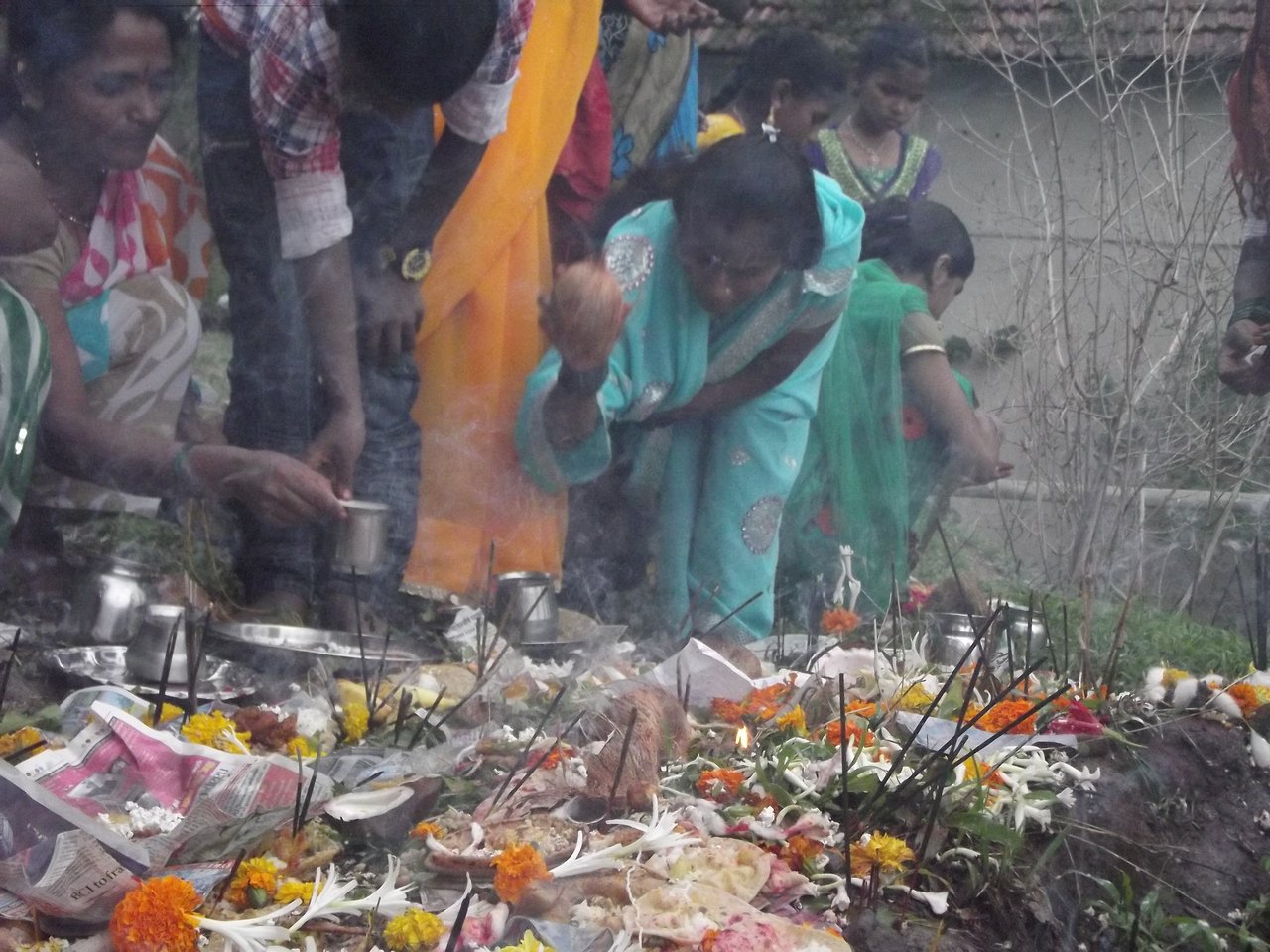
That double posture is written into ritual. The festival of Nāga Pañcamī, observed across India on the fifth day of the bright half of the month of Śrāvaṇa, is at once worship and appeasement. It honors the nāgas and it placates them, treating them as powers that must be both revered and kept satisfied. It is still observed today, which means the ambivalent serpent is not an artifact of the deep past. It is a living relationship, renewed every year.
09The Dragon Question, and the World Below
Now the genuinely open question, and it is a big one. The Indian nāga is not the only great serpent in the world. There is the Chinese long, the dragon; the feathered serpent of Mesoamerica, Quetzalcoatl and Kukulkan; the Rainbow Serpent of Aboriginal Australia; the dragon of Europe. Do all of these descend from one ancestral serpent-idea carried out of deep prehistory, or did human cultures independently arrive at the same symbol again and again, because the snake provokes the same awe everywhere? Robert Blust, in his 2000 paper The Origin of Dragons, argued for a deep common prototype. Others insist these figures are far too culturally specific, too rooted in their own worlds, to be collapsed into one source. This file keeps the question squarely at Tier 3, speculative and unresolved, and does not pretend it has an answer yet. It is one of the real open problems in comparative mythology.
A second, smaller speculation concerns the nāga's home. Puranic literature places the naga kingdom of Pātāla, also called Nāgaloka, in a subterranean paradise of jeweled palaces beneath the surface of the earth. Some have suggested this underworld of serpents is a mythologized memory of real underground water: the aquifers, underground water systems, and geothermal activity that feed the world from below and that a serpent-of-water might plausibly be imagined to rule. It is a hypothesis about metaphor, not a claim of literal correspondence, and it stays at Tier 3 for exactly that reason. Suggestive, unprovable, and honest about being so.
10Two Cautions From the Scholars
This file has kept three traditions apart on purpose, and there is a scholarly reason for the discipline. The study of nāgas carries two well-earned warnings, and neither is boilerplate.
The first is over-homogenization. Treating the nāga as a single unified concept across Hinduism, Buddhism, Jainism, and the many traditions of Southeast Asia flattens real and significant differences. Khmer naga symbolism, Thai nak traditions, and Indian naga-puja each grew in their own context and carry their own distinct meanings, and a study that blurs them into one generic serpent loses precisely what makes each one what it is. The shared shape is real. So is the difference, and the difference is not decoration.
The second is colonial-era interpretive bias. Early European scholars routinely filed naga worship under primitive animism or serpent totemism, importing a nineteenth-century evolutionary theory of religion that ranked serpent veneration below the higher, monotheistic faiths on an imagined ladder of progress. Modern scholarship has largely thrown that framework out. But its residue lingers in popular accounts, where the nāga still gets described as a superstition to be explained away rather than a sophisticated theology to be understood. Reading the nāga clearly means reading it without that inherited condescension.
11What the Naga Is Not
Two claims have to be ruled out, and the first is the loud one. In a strand of New Age and ancient-astronaut writing, the nāgas are said to have been literal reptilian humanoid beings, an actual serpent-people remembered as gods. There is no evidence for this, of any kind: not archaeological, not biological, not textual. Naga mythology is a theological and cultural phenomenon. It encodes the human relationship with water, power, fertility, and the dangerous-sacred, the forces that are bigger than us and can save or destroy us. It is not a garbled zoological record of reptilian aliens, and reading it as one throws away everything the tradition is actually about.
The second false reduction runs the opposite direction. It is tempting to explain the nāga away as ophiolatry, plain snake worship, people bowing to cobras. This misrepresents a complex theological system just as badly. The nāgas of the texts are fully divine beings with courts, kingdoms, kings, moral agency, and cosmic functions that vastly exceed anything attributed to a literal cobra. Yes, some ritual practice does involve living snakes. But the theological nāga is categorically distinct from the animal in the grass, and collapsing the god into the reptile is its own kind of failure to look.
Fast Facts
- The being
- The nāga: a class of divine serpent-beings, able to take human, serpentine, or hybrid form, honored across Hindu, Buddhist, and Southeast Asian traditions
- The world-serpent
- Ananta Śeṣa, the thousand-headed serpent king of the Viṣṇu and Bhāgavata Purāṇas, on whose coils Viṣṇu sleeps between the cycles of creation
- The Buddha's shelter
- The naga king Mucalinda, who coiled seven times around the meditating Buddha at Bodh Gaya and hooded him against seven days of rain (Vinaya Piṭaka)
- The philosopher
- Nāgārjuna (c. 150 to 250 CE), founder of Madhyamaka, whose name means Nāga-Arjuna and whose tradition says he recovered scripture from the naga realm
- Carved in stone
- Naga balustrades define Khmer temples, from Angkor Wat to Angkor Thom's Churning of the Ocean of Milk causeways
- Still observed
- Nāga Pañcamī, the Hindu serpent festival on the fifth day of the bright half of Śrāvaṇa, both worship and appeasement
- Ruled out
- That nāgas were literal reptilian beings; the mythology encodes water, power, and fertility, not a zoological record
- The open question
- Whether the nāga, the Chinese dragon, and the feathered serpent share one ancient root, or converged independently
What We Can Actually Stand Behind
The core of the tradition is solid. Ananta Śeṣa as the cosmic serpent of the Viṣṇu and Bhāgavata Purāṇas, and the Anantaśayana image at Deogarh and Padmanabhaswamy, are textbook Hindu cosmology. The Mucalinda episode is recorded in the Vinaya Piṭaka and its site at Bodh Gaya is real. Nāgārjuna is a historical philosopher whose name means serpent-hero, though the recovery of the Prajñāpāramitā Sūtras from the naga realm is verified only as a tradition that exists, not as history that happened. And the naga architecture of Angkor Wat, Angkor Thom, Wat Phra That Doi Suthep, and the Lao Boun Bang Fai festival, read by Mus and Coedès as an Indian-and-indigenous synthesis, is documented fact. None of this needs embellishing.
A second layer is well-argued but genuinely contested. That naga worship predates Vedic religion as a pre-Aryan substrate is a serious, well-defended theory, not a proven one. The nāga's role as a rain-and-fertility deity and as the serpent ancestor of Khmer, Sri Lankan, Pallava, and Funan royal lines is credible and widely attested, as is its moral ambivalence and the still-living festival of Nāga Pañcamī. The two scholarly cautions belong at this tier too: do not homogenize Hindu, Buddhist, and Southeast Asian nāgas into one thing, and do not read the tradition through the colonial primitive-animism lens. All real, all Tier 2, none of it closed.
One large question and one small one stay open. Whether the nāga, the Chinese dragon, the feathered serpent, and the Rainbow Serpent share a single ancestral prototype, as Robert Blust proposed in 2000, or represent independent convergence on the same symbol, is unresolved and argued in good faith on both sides. And the reading of Pātāla, the subterranean naga kingdom, as a mythologized memory of real underground water is a hypothesis about metaphor, suggestive and unprovable. Neither is settled, and this file does not pretend either is.
One claim is ruled out flatly. The nāgas were not literal reptilian beings, not a serpent-people remembered as gods. There is no archaeological, biological, or textual evidence for it, and the ancient-astronaut reading throws away everything the tradition actually encodes about water, power, and the dangerous-sacred. The mirror-image error is nearly as bad: the nāga is not simple snake worship either. It is a full theology of divine beings with kingdoms and moral agency, categorically distinct from the cobra in the grass. The serpent kings are neither aliens nor merely animals. They are gods, and they deserve to be read as gods.
So strip the nāga back to what the evidence carries, and it stands as three distinct things that share one unforgettable shape: the serpent who holds up the Hindu universe, the cobra who sheltered the Buddha, and the royal ancestor carved into the gates of Angkor. That much is real, dated, and still worshipped. What remains open is the oldest question the serpent asks. Half the world raised a great serpent over its temples and its myths, in places that had never heard of one another, and called it the lord of the waters and the keeper of the deep. Is that because the memory of one serpent traveled with us out of some shared prehistory, or because the snake, coiled at the edge of every human life, was always going to become a god wherever people stopped to look at it? The nāga will not tell us. But it is still there at the temple gate, hood spread, waiting for the rains.
Sources & further reading
Everything above is drawn from our research library on Theories of Anything, and every claim traces back to the files below. The primary file is the naga deep-dive, B_3_17; the serpent-lineage and India-specific naga files go deeper on the royal-descent traditions and the Indian material. Open the full file to check the sourcing and go further.
Image credits
- Mucalinda sheltering the Buddha, Mucalinda Lake, Bodh Gaya, India photograph by Alok Kumar, via Wikimedia Commons. CC BY-SA 4.0 Source.
- Muchilinda Buddha, Bayon-style sandstone sculpture, Angkor kingdom, 12th century, Honolulu Museum of Art photograph by Hiart, via Wikimedia Commons. CC0 1.0 Source.
- Anantasayi Vishnu relief, Dashavatara Temple, Deogarh, India, 5th century CE photograph by Bob King, via Wikimedia Commons. CC BY 2.0 Source.
- The naga balustrade causeway at the South Gate of Angkor Thom, Cambodia photograph by Michael Gunther, via Wikimedia Commons. CC BY-SA 4.0 Source.
- The naga balustrade staircase, Wat Phra That Doi Suthep, Chiang Mai, Thailand photograph by Cloudcolors, via Wikimedia Commons. CC BY-SA 3.0 Source.
- Nagarjuna with the 84 Mahasiddhas, traditional thangka painting, circa 1700 CE unknown traditional artist, circa 1700 CE, via Himalayan Art Resources and Wikimedia Commons. Public domain Source.
- Naga Panchami festival observance, Pune, India photograph by Pankajkatware, via Wikimedia Commons. CC BY-SA 3.0 Source.
- Card crop of Mucalinda sheltering the Buddha, Mucalinda Lake, Bodh Gaya, India photograph by Alok Kumar, via Wikimedia Commons. CC BY-SA 4.0 Source.


.JPG)