The Nazca Lines: Art for an Audience in the Air
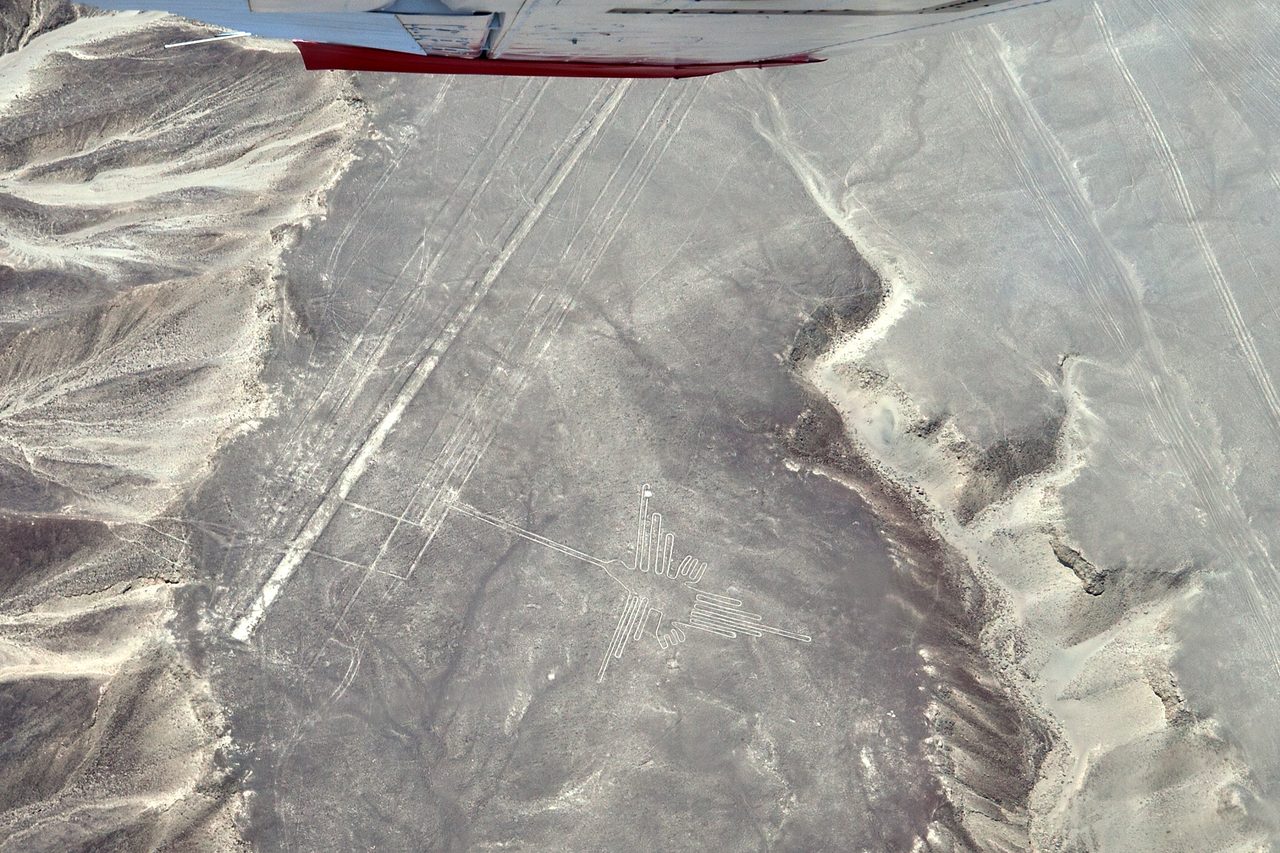
Giant animals and arrow-straight lines are scratched across 450 square kilometers of Peruvian desert, and for a century we have argued about who they were drawn for. Here is the file, opened figure by figure, every claim wearing its evidence.
Picture the postcard version: enormous animals carved into a desert so cleanly they can only be read from a plane, a gallery built for an audience in the sky. It is a beautiful idea, and it is half wrong. The Nazca Lines are real, they are gigantic, and the honest question was never how anyone drew them. It is who they were drawn for. Let's open the file.
| Figure | Length across the desert |
|---|---|
| Condor | ≈ 134 m |
| Hummingbird | ≈ 93 m |
| Monkey | ≈ 93 m |
| Spider | ≈ 46 m |
| The “astronaut” (owl man) | ≈ 30 m, on a hillside |
| Longest straight lines | over 9 km |
01Drawings the size of a neighborhood
More than 1,500 geoglyphs are etched across roughly 450 square kilometers of the Nazca Plateau in southern Peru, about 400 kilometers south of Lima. They were made by clearing the dark, iron-oxide-coated pebbles off the surface to expose the pale yellow-grey ground 10 to 30 centimeters beneath. No digging, no carving into rock, just sweeping a line clean. This is settled, mapped, UNESCO-listed archaeology (a World Heritage Site since 1994).
The catalog splits three ways. Geometric lines (straight runs, triangles, trapezoids and spirals) are by far the most numerous, some over 9 kilometers long. Biomorphic figures are the famous animals and plants, usually 50 to 300 meters across. A handful of rarer human-like shapes round out the set. The technique is almost insultingly simple. The scale is what stops you.
02Who made them, and when
The bulk of the figures were made by the Nazca culture, roughly 200 BCE to 600 CE, with some of the simpler lines possibly reaching back to the earlier Paracas culture (around 500 to 200 BCE). The dates come from pottery found beside the lines, radiocarbon on nearby organic material, stylistic matches to Nazca ceramic art, and optically stimulated luminescence dating of the disturbed soil itself.
The Nazca were not a mystery people. They left elaborate polychrome pottery, fine textiles, trophy heads, and a huge ceremonial center at Cahuachi, about 28 kilometers from the lines and busiest at exactly the time the geoglyphs were being made. The drawings sit inside a living ritual landscape, not floating outside history.
03The audience in the air that never needed a plane
Here is the myth the postcard sells you: the figures are so big they are invisible from the ground, so someone up there, gods or visitors, must have been the intended audience. It is the single most repeated claim about Nazca, and it is false.
The lines are not “only visible from the air.” The long geometric lines read clearly from the surrounding hills and from the many elevated ray centers on the pampa. The animal figures are harder to take in from ground level, but they are not invisible, and the surveying methods that would let people lay them out at full scale from the ground are well understood. You do not need to fly to see Nazca. You never did.
04The sky calendar that mostly wasn't
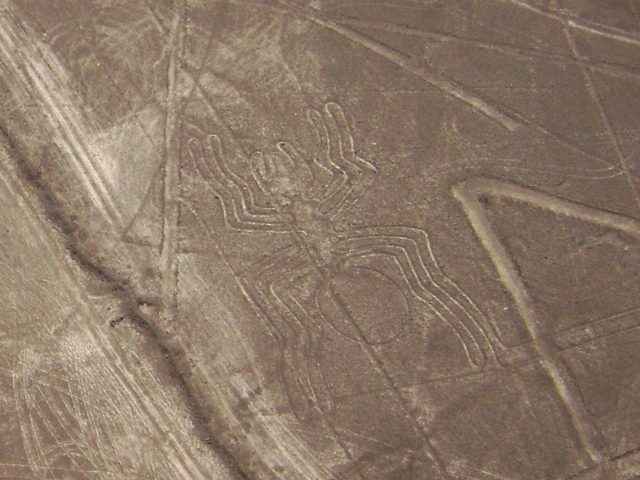
The oldest serious theory is astronomical. Paul Kosok in the 1940s, then Maria Reiche across five decades living on the pampa, argued the lines were a giant calendar, aligned to solstice sunrises and sunsets and to the rising points of stars, tracking the seasons for farmers. Reiche read the spider figure as the constellation Orion.
In 1968 and again in 1973, astronomer Gerald Hawkins ran the line orientations through statistical analysis and found no more celestial alignments than random chance would produce. That gutted the idea of Nazca as one enormous observatory.
It did not kill the astronomy entirely. Clive Ruggles (2015) notes that some directions, solstice alignments in particular, do turn up more often than chance predicts. So a subset of lines may well point at the sky on purpose. The calendar theory survives as a piece of the answer, not the whole of it.
05Follow the water
In one of the driest deserts on Earth (under 2.5 centimeters of rain a year), water is the thing worth praying to. Katharina Schreiber and Josué Lancho Rojas showed that many lines point straight at water: the puquios, the ingenious underground aqueducts the Nazca engineered and which still run today, plus river valleys and mountain springs. Johan Reinhard (1985) read the whole system as a sacred map, linking settlements to the mountains that made the water.
| Figure | What it may stand for |
|---|---|
| Hummingbird | rain |
| Spider | water and fertility |
| Whale | the ocean |
| Monkey | the rainforest, water in abundance |
The water reading is not only about which way the lines point. Offerings (pottery shards, seashells, agricultural produce) turn up at the intersections and end points of the lines, exactly where you would leave them if the lines were ritual pathways for petitioning rain. And several of the animals map onto water itself: rain, the ocean, the wet forests over the mountains.
06Meant to be walked
Anthony Aveni (1990, 2000) argued the lines were built to be walked, processional routes for ceremonies that moved across the landscape. The cleared strips are wide enough for a file of people, and they converge on more than 60 “ray centers,” raised points from which lines radiate like spokes. Walk the line, petition the mountain, ask for water. This fits the water theory hand in glove, and it needs no audience in the sky at all.
07Where the aliens come in, and why they crash
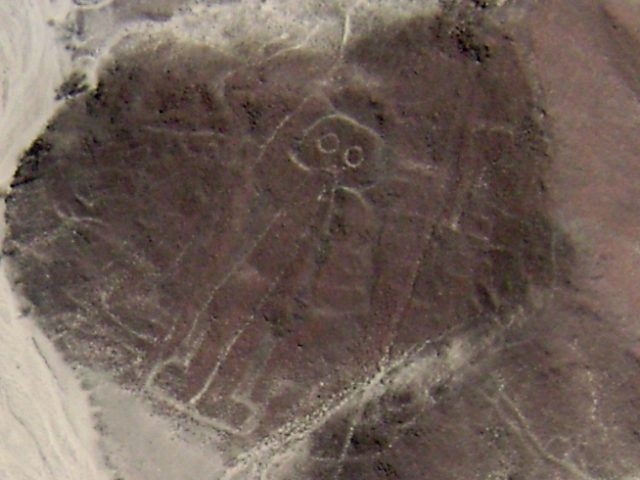
Erich von Däniken put Nazca in Chariots of the Gods? in 1968: the lines were landing strips for extraterrestrial spacecraft, the pampa an alien airfield. It is the version most people have heard. It fails on contact with the actual desert.
The cleared surfaces are soft desert soil that could not bear the weight of a heavy vehicle. Many of the supposed runways are curved, wavy, or wound into tight spirals. And no aircraft needs a 93 meter hummingbird painted beside the strip. The famous “astronaut” is an owl-headed human figure, its rounded head standard in Nazca ceramic art, not a helmet.
The gentler cousin, Jim Woodman's 1977 idea that the Nazca flew hot-air balloons to admire their own work, is creative and equally unsupported. No balloon fabric, no launch sites, no hint of human flight anywhere in the culture has ever been found.
08The desert that keeps them, and the machine that reads them
The lines survive because the Nazca Plateau is one of the most stable surfaces on the planet: almost no rain, almost no wind at ground level (the dark “desert pavement” warms the air and stills it), and quiet tectonics. The same emptiness that preserves them also leaves them fragile. In 2014 a Greenpeace stunt near the hummingbird scarred the pavement, a reminder that a single careless footprint can last for centuries.
Since 2019 a Yamagata University team led by Masato Sakai has been training machine-learning models on known geoglyphs and turning them loose on aerial and satellite imagery. By 2024 they had found 303 previously unknown figures, close to doubling the count of figurative geoglyphs (Sakai et al., PNAS, 2024).
The new figures quietly change the story. Many are small, 5 to 20 meters, and cluster along footpaths and near where people actually lived, not out on the open ceremonial desert. They look less like messages to the sky and more like something closer to home: markers, wayfinding, private ritual, art at human scale. A century into the argument, the ground is still handing us new evidence.
Fast Facts
- Site
- Nazca Plateau (Pampa de Nazca), southern Peru
- Count
- 1,500+ geoglyphs, and rising
- Area
- ≈ 450 km²
- Made by
- Nazca culture, ≈ 200 BCE to 600 CE
- Technique
- Clearing dark pebbles to expose pale ground, 10 to 30 cm deep
- Longest lines
- over 9 km
- AI discovery
- 303 new figures, 2019 to 2024 (Yamagata University)
- UNESCO status
- World Heritage Site since 1994
What we can actually stand behind
The Nazca Lines are real, vast, and man-made by the Nazca culture using a simple clearing technique. That much is not in doubt anywhere in archaeology.
Their purpose is unsettled and probably plural: ritual pathways toward water and the mountains, a subset of real astronomical alignments, processions walked across a sacred landscape. The evidence points to people and their gods, not to one tidy answer.
They are not alien landing strips, and they are not proof that anyone needed to fly to see them. Von Däniken's runways fail on the soft soil, the curved lines, and the animal figures. The “only visible from the air” claim is simply false.
So who was the audience in the air? The likeliest answer is the one the postcard never prints: the mountains and the rain gods the Nazca walked out to petition, watched from above by nobody with a plane. And yet the machines keep finding figures the Nazca never aimed at any sky at all. What were those smaller ones for, drawn at the scale of one person on a footpath? A century in, the desert has not finished answering.
Sources & further reading
Everything above is drawn from our research library on Theories of Anything, deep-read in full rather than skimmed. The corpus files are where we worked from; the papers, reports and primary records listed beneath them are where you can check us independently.
Image credits
- The Nazca hummingbird geoglyph photograph by Unukorno, via Wikimedia Commons. CC BY 3.0 Unported Source.
- The Nazca spider geoglyph photograph by (WT-shared) Shoestring (Wikivoyage), via Wikimedia Commons. CC BY-SA 1.0 Generic Source.
- The Nazca 'astronaut' (owl man) geoglyph photograph by (WT-shared) Shoestring (Wikivoyage), via Wikimedia Commons. CC BY-SA 1.0 Generic Source.
- Card crop of The Nazca hummingbird geoglyph photograph by Unukorno, via Wikimedia Commons. CC BY 3.0 Unported Source.


