The 2-Billion-Year-Old Nuclear Reactor
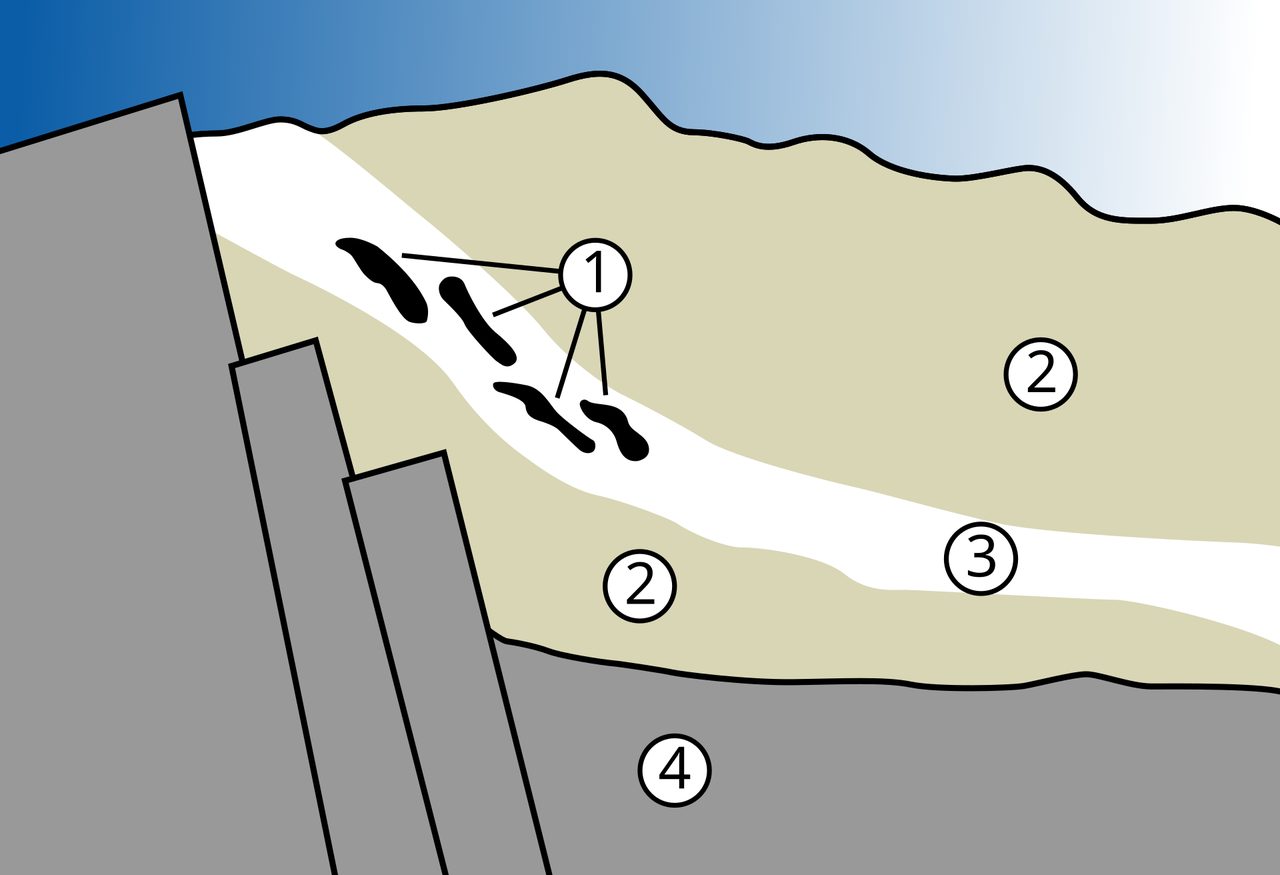
In 1972, a French analyst noticed that a batch of uranium from Gabon was missing some of its U-235, the fissile isotope, in amounts that should not be physically possible. The answer turned out to be the strangest fact in geology. Roughly two billion years ago, a seam of uranium ore in what is now Gabon soaked up enough groundwater to go critical, and it ran as a working nuclear reactor, on and off, for a few hundred thousand years. Nobody built it. Nobody designed it. Nature did it first, and left a flawless set of receipts in the rock. This is not a fringe claim being weighed for and against. It is mainstream, peer-reviewed, airtight geology and nuclear physics, and it is one of the most beautiful things we have ever found underground. Here is exactly how it worked, tier by tier, including the one claim about Oklo that the evidence flatly refuses.
Every uranium atom on Earth today, in every mine and reactor and ordinary rock, carries the same fixed proportion of its fissile isotope: 0.7202 percent U-235, and almost all the rest U-238. It is one of the most reliable numbers in geochemistry, the same everywhere on the planet, because both isotopes have been decaying steadily since the Earth formed. So when a sample refuses to show that number, something has physically taken the U-235 away. In 1972, a batch of Gabonese uranium did exactly that, and the only explanation that survived was one nobody was looking for: the ore had already been a nuclear reactor.
01The Number That Should Never Change
In June 1972, an analyst named Francois Perrin at France's Commissariat a l'energie atomique was checking uranium hexafluoride processed from ore mined at Oklo, in Gabon. The U-235 reading came back at 0.7171 percent instead of the universal 0.7202 percent. A gap of three thousandths of a percent sounds trivial, but at that level of precision it is an alarm bell, because that number does not vary. Follow-up sampling made it stranger still: some zones in the ore ran as low as 0.440 percent U-235, far below anything found anywhere else on Earth. The uranium was depleted, in exactly the way a reactor depletes its fuel, and the only natural process that strips out U-235 like that is fission.
The proof was written in the ash. When researchers looked closely at the depleted ore, they found the unmistakable fingerprint of a chain reaction: isotopic anomalies in neodymium, samarium, cerium, ruthenium, zirconium and other elements, in precisely the proportions you get from splitting U-235 with slow neutrons. These were not ordinary rocks with an odd uranium reading. They were spent nuclear fuel, and they had been sitting in the ground since a time when life on Earth was nothing but microbes.
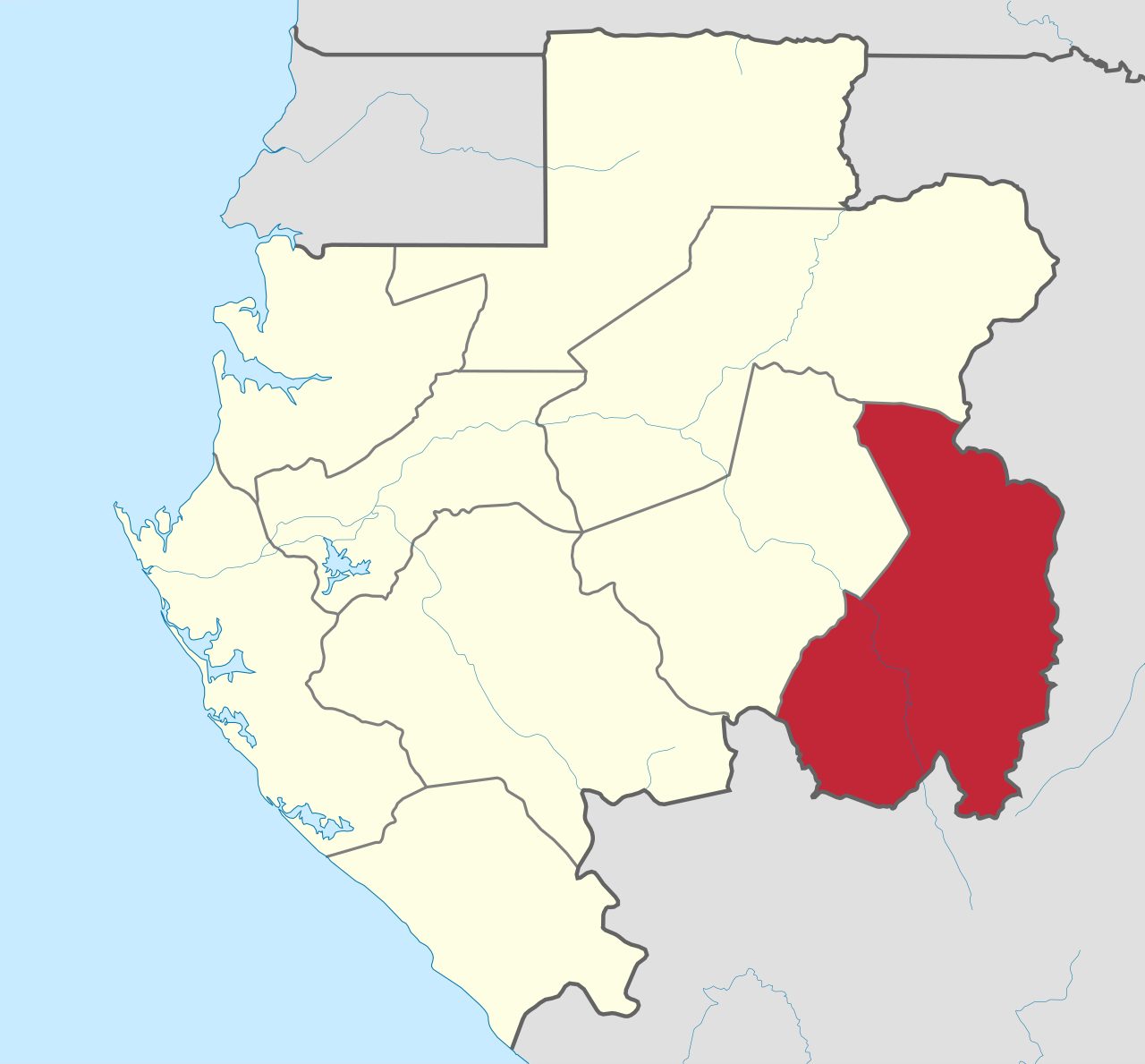
In all, sixteen separate reactor zones have been identified at Oklo and neighboring Okelobondo. Each is a thin tabular layer of exceptionally rich uranium ore, ten to fifty centimeters thick, sitting inside sedimentary rocks of the Francevillian formation that are roughly 2.1 billion years old, concentrated along ancient drainage channels in Haut-Ogooue Province, in the southeast of Gabon. Sixteen natural reactors, in one small corner of one African province, and so far the only ones like them known anywhere on the planet.
02Why It Could Happen At All
For a pile of rock to sustain a nuclear chain reaction, several things have to be true at once, and today, on the modern Earth, they essentially never are. Two billion years ago, every one of them fell into place in that seam of Gabonese ore. That is the real marvel of Oklo. Not that it happened, but that the planet quietly arranged all the preconditions on its own.
Start with the fuel. A modern power reactor runs on uranium enriched to between three and five percent U-235, because natural uranium at today's 0.72 percent is too dilute to sustain a chain reaction in ordinary conditions. But 0.72 percent is only today's figure. U-235 decays more than six times faster than U-238: its half-life is 704 million years against U-238's 4.47 billion. Run the clock backward and the mix gets steadily richer. Isochron dating of the fission products, using the samarium-neodymium system, pins the reactors' operation to about 1.78 billion years ago, and at that moment natural uranium was roughly 3.7 percent U-235. In other words, the ore was already enriched to reactor grade, for free, simply by being ancient. Dig up that same seam today and it would be far too lean to ever ignite.
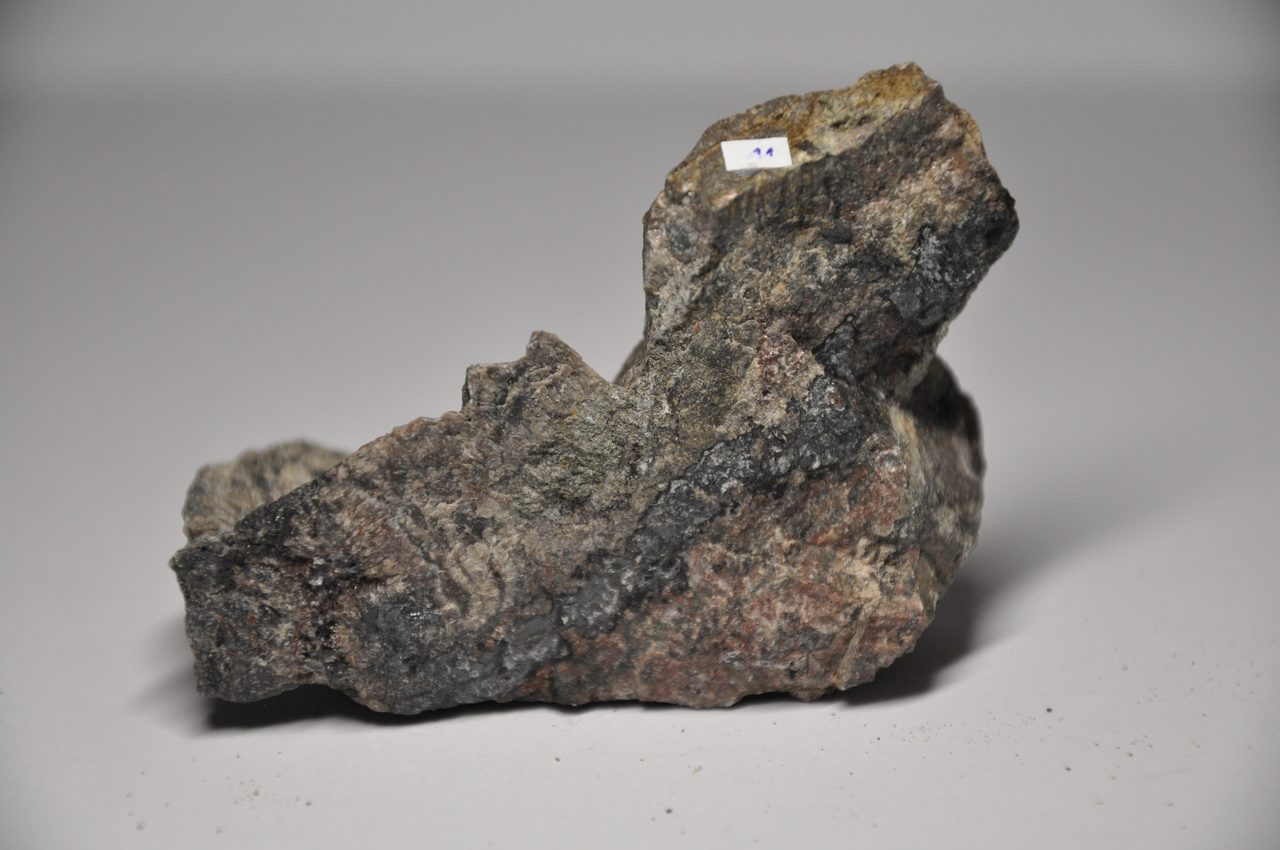
Rich isotopes are not enough on their own; you also need the uranium packed tightly together. At Oklo the ore reaches over ten percent U3O8 in the reactor layers, an extraordinary concentration, and geochemistry did the packing. Uranium is soluble when it is oxidized, so oxygenated groundwater dissolved it, carried it through the rock, and then dropped it wherever the chemistry turned reducing, precipitating it as dense uraninite at that boundary. Organic matter and anaerobic microbes may have helped force that reaction. Water sorted and concentrated a fissile metal into ore bodies rich enough to burn.
And there is a deeper prerequisite still, one that ties Oklo to the history of the very air we breathe. Uranium only dissolves and travels when there is oxygen around to oxidize it, and for most of Earth's early history there was almost none. It was the Great Oxygenation Event, about 2.4 billion years ago, that first flooded the atmosphere and oceans with free oxygen, and only after that could uranium be mobilized, transported and reconcentrated into deposits rich enough to go critical. Oklo could not have existed on the older, oxygen-poor Earth. It is a direct consequence of the planet learning to breathe.
The last ingredient was ordinary water. Fission neutrons come off fast, too fast to reliably split the next U-235 nucleus, so a reactor needs a moderator to slow them down, and at Oklo the moderator was groundwater soaking the ore. The same water was also a mild neutron absorber, which turns out to matter enormously for how the reactors behaved. The rule was simple: no water, no reaction. The seams only ran while they were saturated.
03How A Rock Runs A Reactor
Here is where Oklo stops being merely astonishing and becomes almost unbelievable, except that the evidence is airtight. Xenon isotopes, a telltale fission gas, are trapped inside aluminum phosphate grains in the reactor zones, and their pattern preserves the reactors' actual operating rhythm. Oklo did not burn steadily. It pulsed. The ore would go critical and run for roughly thirty minutes, heating the groundwater until it boiled away. With its moderator gone as steam, the reaction shut itself down. Then, over about two and a half hours, the rock cooled, water seeped back in, and the reactor switched on again. A thirty-minute pulse, a two-and-a-half-hour rest, over and over, governed by nothing more than the boiling point of water. Meshik and colleagues read that cycle straight out of the trapped xenon and published it in Physical Review Letters in 2004.
The output was modest and the endurance was staggering. Averaged over its lifetime the Oklo system put out around 100 kilowatts of thermal power, about what a small research reactor produces, nothing like a power station. But it kept that up, on and off, for somewhere between 150,000 and 300,000 years, and then fell silent well over a billion years before the first city was ever built.
The totals are just as concrete. Across all sixteen zones the reactors fissioned roughly five to six tonnes of U-235, and in doing so they produced about two tonnes of fission products and around six tonnes of plutonium-239. That plutonium is long gone now, decayed away through its own chain over the eons since, but it was really made, in the ground, by a natural reactor, more than a billion years before anyone knew plutonium existed.
04The Reactor That Buried Its Own Waste
Oklo is not just a curiosity. It is the closest thing science has to a finished, full-scale, two-billion-year experiment in what happens when you leave nuclear waste in the ground, and that makes it quietly important to one of the hardest problems of our own century.
For two billion years, the transuranic elements and fission products that Oklo created have mostly stayed put. In the clay-rich sedimentary rock around the reactor zones, most of the fission products migrated less than a few meters from where they were born, held in place by nothing more elaborate than ordinary geology. That is a remarkable result, because keeping radioactive material contained across deep geological time is the central engineering challenge of modern waste disposal, and Oklo is a case where the rock did exactly that, on its own, for two billion years.
The plutonium tells the cleanest version of the story. Oklo's roughly six tonnes of plutonium-239 did not leak away and spread. It stayed inside the ore body and decayed there, in place, exactly where a waste engineer would want it to stay. For anyone trying to design a repository that can hold its contents across geological time, Oklo is direct, physical evidence that a well-chosen geological barrier really can do the job. It is why the site is studied by the nuclear-waste community and not just by geologists.
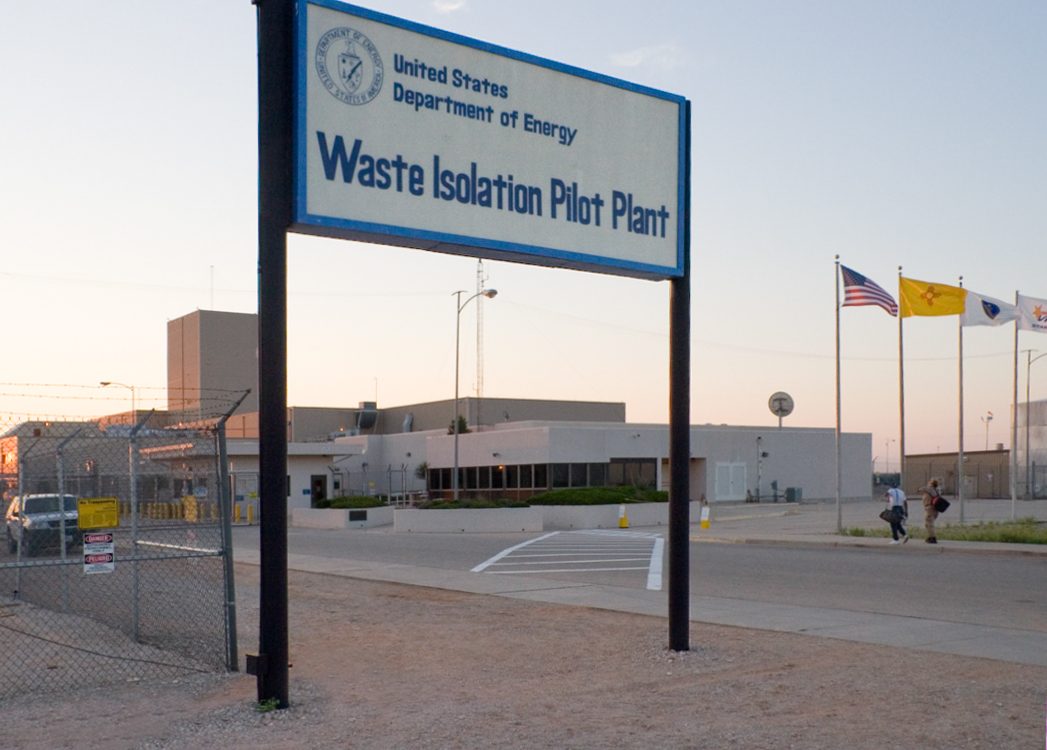
But Oklo is honest about the limits too, and this is the part that makes it genuinely useful rather than just reassuring. Not everything stayed home. Some of the more mobile fission products, cesium, rubidium, iodine and xenon among them, did travel farther from the reactor zones than the rest. That is exactly the kind of element-by-element detail a modern repository has to plan for, because a barrier that traps one isotope beautifully may let another slip through. Oklo does not just say containment is possible. It shows which elements are the ones to watch.
05Did Life Help Build It?
There is a strange possibility folded into how the ore formed in the first place. Concentrating uranium out of groundwater and fixing it in place is exactly the sort of chemistry that certain microbes drive, by reducing dissolved uranium into an insoluble solid, and modern bacteria do precisely this today. The Francevillian sediments that host Oklo are rich in organic carbon, a signature of ancient life, and the idea that microbial activity helped pile up the uranium is debated but genuinely supported. If it is right, then living things had a hand in gathering the fuel, which means that nearly two billion years ago, life on Earth may have unknowingly helped assemble a working nuclear reactor. It would not learn it had done so until 1972.
06Why Only Here?
The obvious question is whether Oklo was a one-off or just the one we happened to find. In principle it need not be unique: other high-grade uranium deposits from the same Paleoproterozoic era, when U-235 was still abundant, could in theory have met the same conditions. Researchers have gone looking. A handful of uranium deposits in Australia and Canada have shown mildly anomalous isotope ratios worth a second look, but none has ever been confirmed as a fossil reactor. After more than fifty years of searching, Oklo and its neighbor Okelobondo remain the only natural nuclear reactors known anywhere on Earth.
07The Reactor Someone Put At The Center Of The Earth
Oklo proved that nature can run a reactor near the surface, and that raised a bolder question, one a serious scientist took all the way to the planet's core. In 2001 the geochemist J. Marvin Herndon proposed, and in 2003 published in the Proceedings of the National Academy of Sciences, that a natural fission reactor might be burning at the very center of the Earth, helping to power the planet's internal heat and generate its magnetic field. This is not fringe pseudoscience. It is a real, peer-reviewed, minority hypothesis, argued carefully in a top journal. It is also, by the current weight of evidence, wrong. Mainstream geophysics expects far too little uranium to be concentrated in the core to sustain such a reactor, and direct measurements settle it: the KamLAND neutrino detector, which watches the faint stream of neutrinos coming out of Earth's interior, sees nothing like the signal a georeactor of the proposed size would produce. Herndon's idea is a clean example of how real science handles a real disagreement. Someone published a bold, testable claim, the data came in, and the data said no.
08The One Thing Oklo Was Not
There is exactly one claim about Oklo that this file refuses outright, and it deserves a flat answer, because the internet loves it: the notion that the reactors were built or operated by some ancient or extraterrestrial civilization. They were not, and the evidence against it is total. The reactor zones are ordinary uranium ore, layered by groundwater chemistry, with no machined parts, no shaped structures, no engineering of any kind. The reactors ran about two billion years ago, more than a billion years before complex multicellular life existed, let alone anyone to design a power plant. And every feature of how they worked, the enrichment, the concentration, the water moderator, the pulsed cycle, is fully and precisely explained by ordinary geochemistry and nuclear physics, with nothing left over for a builder to account for. Oklo is more wonderful than the ancient-astronaut version, not less. It says the universe can build a reactor with no one in charge at all. [DEBUNKED]
09Nature Got There First
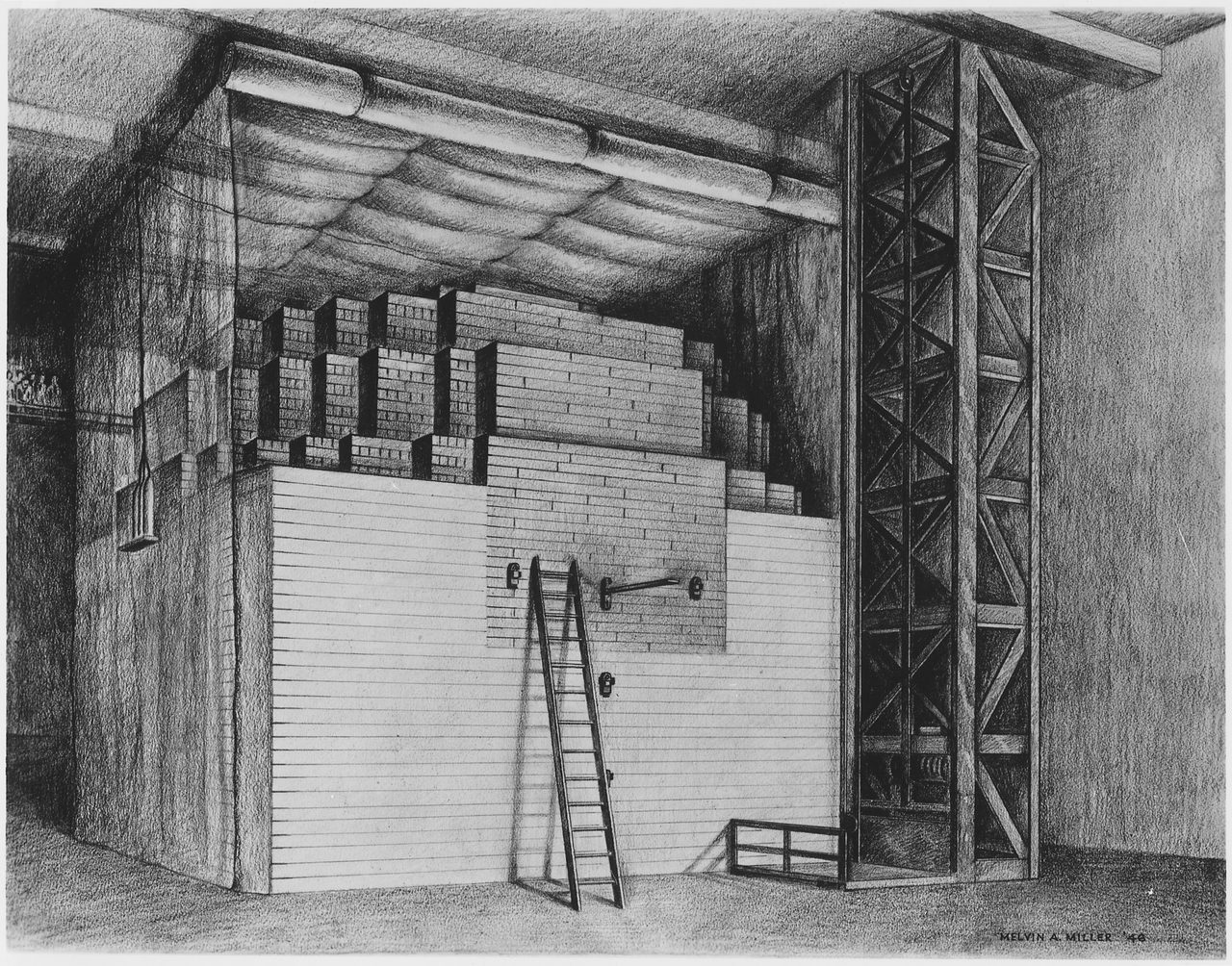
Which leaves the fact this whole story keeps circling back to. On December 2, 1942, beneath the stands of Stagg Field at the University of Chicago, Enrico Fermi and his team brought Chicago Pile-1 to life: the first controlled, self-sustaining nuclear chain reaction ever produced by human beings. It was one of the defining achievements of the twentieth century, the moment our species learned to run a reactor. Oklo had already done it, unsupervised, roughly two billion years earlier. Fermi was not the first to build a nuclear reactor. He was the first to build one on purpose.
None of which means Oklo is a perfect key to our own nuclear problem. The natural-analogue argument for burying waste has real limits that honesty demands we state: the chemistry of Oklo's host rock, the temperatures it reached, and the way groundwater moved through it are not the same as the conditions at any repository we might build today. Oklo shows that geological containment can work over immense spans of time. It does not prove that any particular modern site will, and the comparison has to be made carefully, element by element and site by site, not waved through as a simple guarantee.
And in the end, Oklo's rarity may be the most instructive thing about it. To make a natural reactor you need a very specific coincidence: uranium enriched above roughly three percent, which only the deep past provides; ore concentrated past ten percent, which takes an oxygenated planet and the right groundwater chemistry; and a geometry of rock and water able to slow neutrons just enough to sustain the reaction. Line all of that up and the Earth ignites a reactor on its own. Miss any one of them and nothing happens. That razor-thin set of requirements is precisely why, after half a century of looking, Oklo is still the only confirmed example we have ever found.
Fast Facts
- The Discovery
- June 1972: CEA analyst Francois Perrin found Oklo uranium reading 0.7171 percent U-235 instead of the universal 0.7202 percent, with some zones as low as 0.440 percent. Fission had consumed the missing U-235.
- The Site
- Sixteen natural reactor zones at Oklo and Okelobondo in Haut-Ogooue Province, southeastern Gabon: thin, high-grade ore layers in Francevillian rock about 2.1 billion years old.
- When It Ran
- About 1.78 billion years ago, dated by samarium-neodymium isochrons of the fission products. Natural uranium was then roughly 3.7 percent U-235, reactor grade, purely from being ancient.
- How It Ran
- Groundwater as moderator, in pulses of about 30 minutes on and 2.5 hours off, at roughly 100 kilowatts thermal, intermittently for 150,000 to 300,000 years.
- The Totals
- Roughly 5 to 6 tonnes of U-235 fissioned, producing about 2 tonnes of fission products and about 6 tonnes of plutonium-239, all of it long since decayed.
- Why It Matters
- For two billion years the waste mostly stayed put, most of it within a few meters, making Oklo a real-world test of geological nuclear-waste containment.
- The Refused Claim
- That Oklo was built by an ancient or alien civilization. Contradicted by everything: ordinary ore, no engineering, and an age predating complex life by over a billion years.
- The Punchline
- Nature ran a self-sustaining nuclear reactor about two billion years before Enrico Fermi built the first artificial one on December 2, 1942.
So Did Nature Really Run A Nuclear Reactor?
Yes, and it is not in the slightest doubt. The depleted U-235, the fission-product isotopes in neodymium and samarium and the rest, the sixteen reactor zones, the 3.7 percent enrichment of ancient uranium, the water moderator, the thirty-minute pulsed cycle read out of trapped xenon, the roughly 100 kilowatts sustained for 150,000 to 300,000 years, the tonnes of plutonium made and gone: every piece is measured, peer-reviewed, mainstream fact. Oklo is one of the best-verified extraordinary things in all of geology.
The consequences are well supported and still being worked out. That the reactors' waste stayed geologically contained for two billion years, most fission products within a few meters, is solid and directly relevant to modern nuclear-waste disposal, with the more mobile elements like cesium and iodine the honest caveat. That the Great Oxygenation Event was a prerequisite, and that microbes may have helped concentrate the ore, are credible, evidence-backed readings rather than proven certainties.
Two real questions stay open. Whether other natural reactors are waiting to be found is plausible but unconfirmed: a few Australian and Canadian deposits have hinted at it, none has been verified, and Oklo still stands alone. And J. Marvin Herndon's published proposal of a fission georeactor at Earth's core is genuine minority science, not crankery, but it runs against the expected uranium budget of the core and against the KamLAND neutrino data, and by the current evidence it does not hold.
One claim is refused outright. Oklo was not built or operated by any ancient or alien civilization. [DEBUNKED] The zones are ordinary ore with no trace of engineering, the reactors ran two billion years ago when life on Earth was microbial, and every detail is fully explained by geochemistry and physics with nothing left for a builder to do. The honest verdict is the more astonishing one: no one built it, and that is exactly what makes it extraordinary.
So the planet, it turns out, stumbled into nuclear fission on its own, ran with it for ages, buried the evidence, and waited two billion years for someone to dig it up and understand what they were looking at. It did it once, in one seam of rock in Gabon, and as far as we can tell nowhere else, because the conditions that allowed it have almost never lined up again. Which leaves the question worth sitting with. If a working nuclear reactor could assemble itself out of ordinary rock and water and deep time, with no design and no designer, what else has the Earth quietly done across its four and a half billion years that we simply have not found the ash for yet?
Sources & further reading
Everything above is drawn from our research library on Theories of Anything, which is where we worked from. The papers, reports and primary records listed beneath them are where you can check us independently.
Image credits
- Geological cross-section of the Oklo natural reactor zones, Gabon diagram by MesserWoland, built from source data by the US Department of Energy, via Wikimedia Commons. Dual-licensed GNU Free Documentation License v1.2 or later and Creative Commons Attribution-ShareAlike 3.0 Unported (also offered under 2.5, 2.0, and 1.0 Generic) Source.
- A uraninite (pitchblende) specimen, representative of the ore type photograph by H238, via Wikimedia Commons. Creative Commons Attribution-ShareAlike 4.0 International Source.
- Locator map of Haut-Ogooue Province within Gabon map by Wikimedia Commons user Profoss, from a base map by Uwe Dedering, via Wikimedia Commons. Dual-licensed Creative Commons Attribution-ShareAlike 3.0 Unported and GNU Free Documentation License v1.2 or later Source.
- Chicago Pile-1 reactor structure, University of Chicago (1946 illustration) illustration by Melvin A. Miller of Argonne National Laboratory, via Wikimedia Commons. Public domain (work of a United States Department of Energy employee, created as part of official duties) Source.
- The entrance to the Waste Isolation Pilot Plant, New Mexico photograph by the US Department of Energy, via Wikimedia Commons. Public domain (work of a United States Department of Energy employee, created as part of official duties) Source.
- Card crop of Geological cross-section of the Oklo natural reactor zones, Gabon diagram by MesserWoland, built from source data by the US Department of Energy, via Wikimedia Commons. Dual-licensed GNU Free Documentation License v1.2 or later and Creative Commons Attribution-ShareAlike 3.0 Unported (also offered under 2.5, 2.0, and 1.0 Generic) Source.


