OOParts: The Greatest ‘That Shouldn’t Exist Yet’ Hits
Seventeen “that shouldn’t exist yet” artifacts, sorted honestly from the four that genuinely pass peer review down to the famous fakes that fell apart. Every claim on this page wears its evidence tier.
“Out-of-place artifact” is a phrase that does a lot of heavy lifting, most of it dishonest. It gets stamped on the Antikythera Mechanism, a genuine 2,000-year-old analog computer, and on the Dropa Stones, which almost certainly never existed. Both ride the same late-night documentary, wearing the same word, as if they carried the same weight. They do not. So here is the whole catalog, 17 of the famous ones, sorted the only way that matters: by how much evidence actually stands behind them. The sorting is the story.
| Artifact | The real anomaly | Status |
|---|---|---|
| Antikythera Mechanism | 30+ bronze gears, eclipse prediction | Tier 1 · peer-reviewed |
| Nebra Sky Disc | Oldest realistic sky map, ~1600 BCE | Tier 1 · authenticated |
| Iron Pillar of Delhi | 1,600 years, almost no rust | Tier 1 · explained |
| Lycurgus Cup | Color-changing nanoparticle glass | Tier 1 · peer-reviewed |
01The four that actually pass
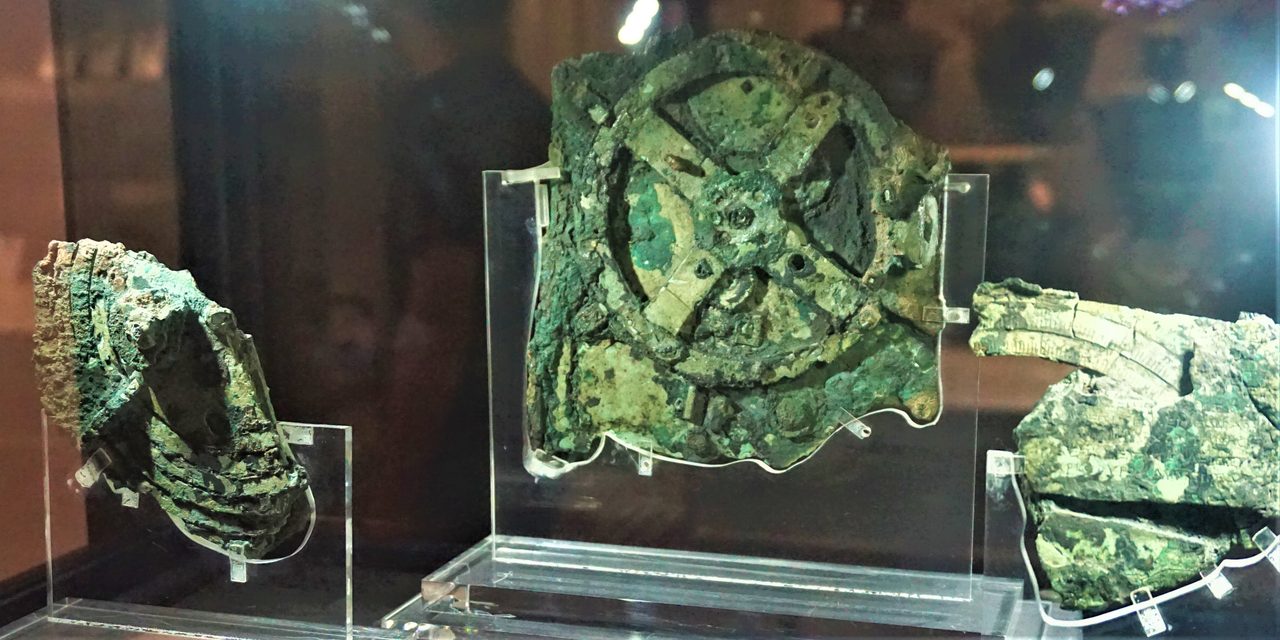
The Antikythera Mechanism is the real thing and then some. Recovered from a Roman-era shipwreck off the Greek island of Antikythera, it packs more than 30 interlocking bronze gears, including differential gearing, into a shoebox-sized case that modeled the Sun, Moon, and planets and predicted eclipses. Nothing of comparable complexity appears again for roughly 1,400 years. It is the single most impressive OOPart in existence, and it is settled, heavily peer-reviewed science (Freeth et al., Nature 2006 and Scientific Reports 2021).
That is the top of the pile, and it earns its place without a single appeal to the impossible. Three more artifacts stand right beside it.
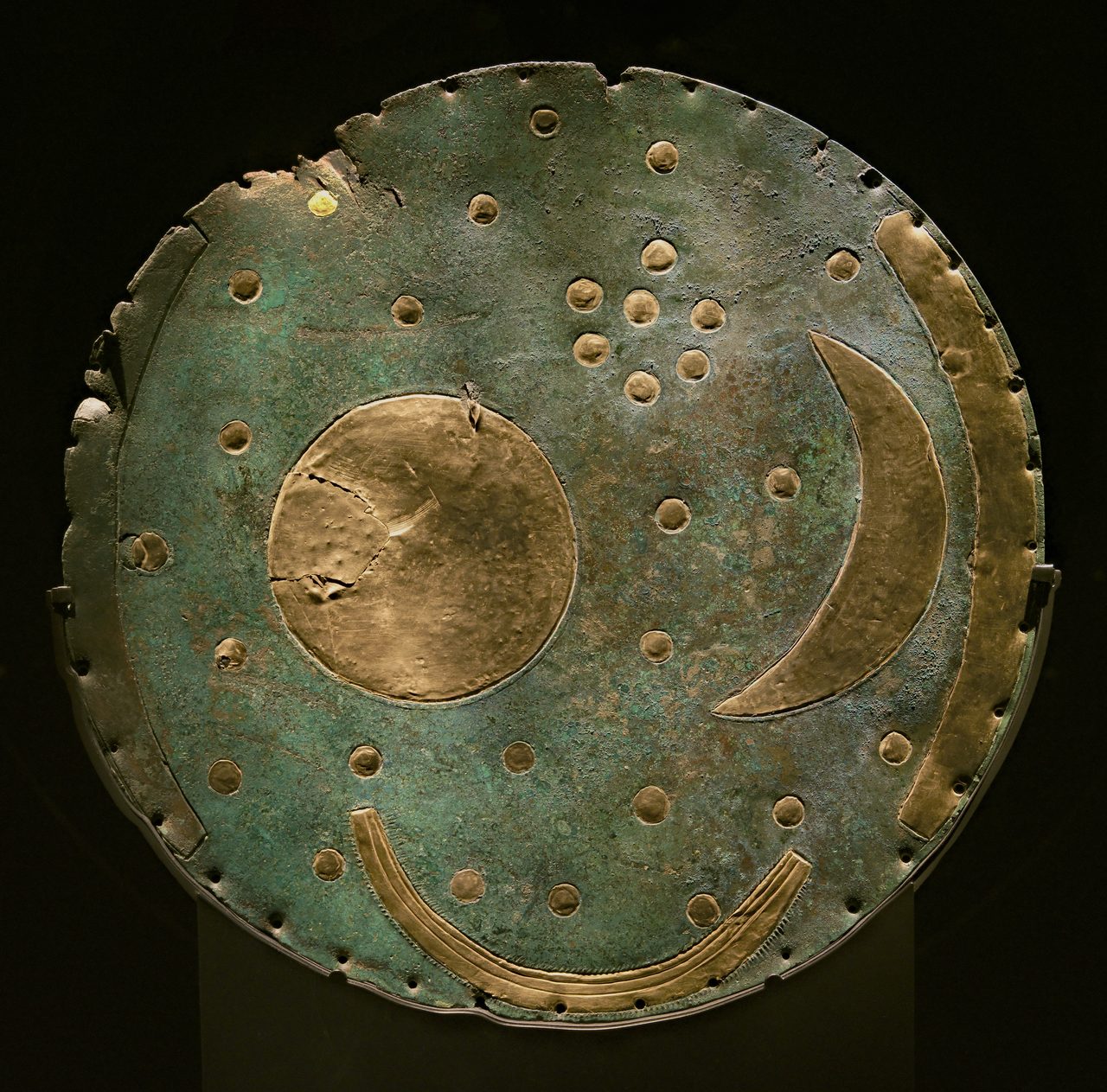
The Nebra Sky Disc, a bronze disc about 30 cm across inlaid with gold, is the oldest known realistic depiction of the cosmos: a sun or full moon, a crescent, a cluster read as the Pleiades, horizon arcs, and a solar barque. Authenticated to roughly 1600 BCE in Bronze Age Central Europe (the Únětice culture), it now sits on the UNESCO Memory of the World Register.
The Iron Pillar of Delhi, 7.2 meters of wrought iron that has stood about 1,600 years with almost no rust, is genuinely anomalous and completely explained. Its high phosphorus content forms a thin passive layer (misawite) that seals the surface. This is superb ancient metallurgy, not alien intervention, and the explanation is the interesting part.
The Lycurgus Cup, a Roman glass that glows green in reflected light and blood-red when lit from behind, owes its color to gold and silver nanoparticles around 70 nanometers wide suspended in the glass. It is empirical nanotechnology, achieved a millennium and a half before anyone had the theory to explain why it worked.
Notice what these four share. Every one is unambiguously real, unambiguously ancient, and unambiguously made by human hands. They are anomalous because they are better than we expected, not because they are impossible. That is the honest top of the pile, and it is worth sitting with before we go down a floor.
02The genuinely unsolved middle
Below the verified four is a tier of objects that are real, well-provenanced, and honestly unexplained. These are the ones that deserve the word “mystery,” because no consensus answer exists yet. None of them requires anything more exotic than a gap in our knowledge.
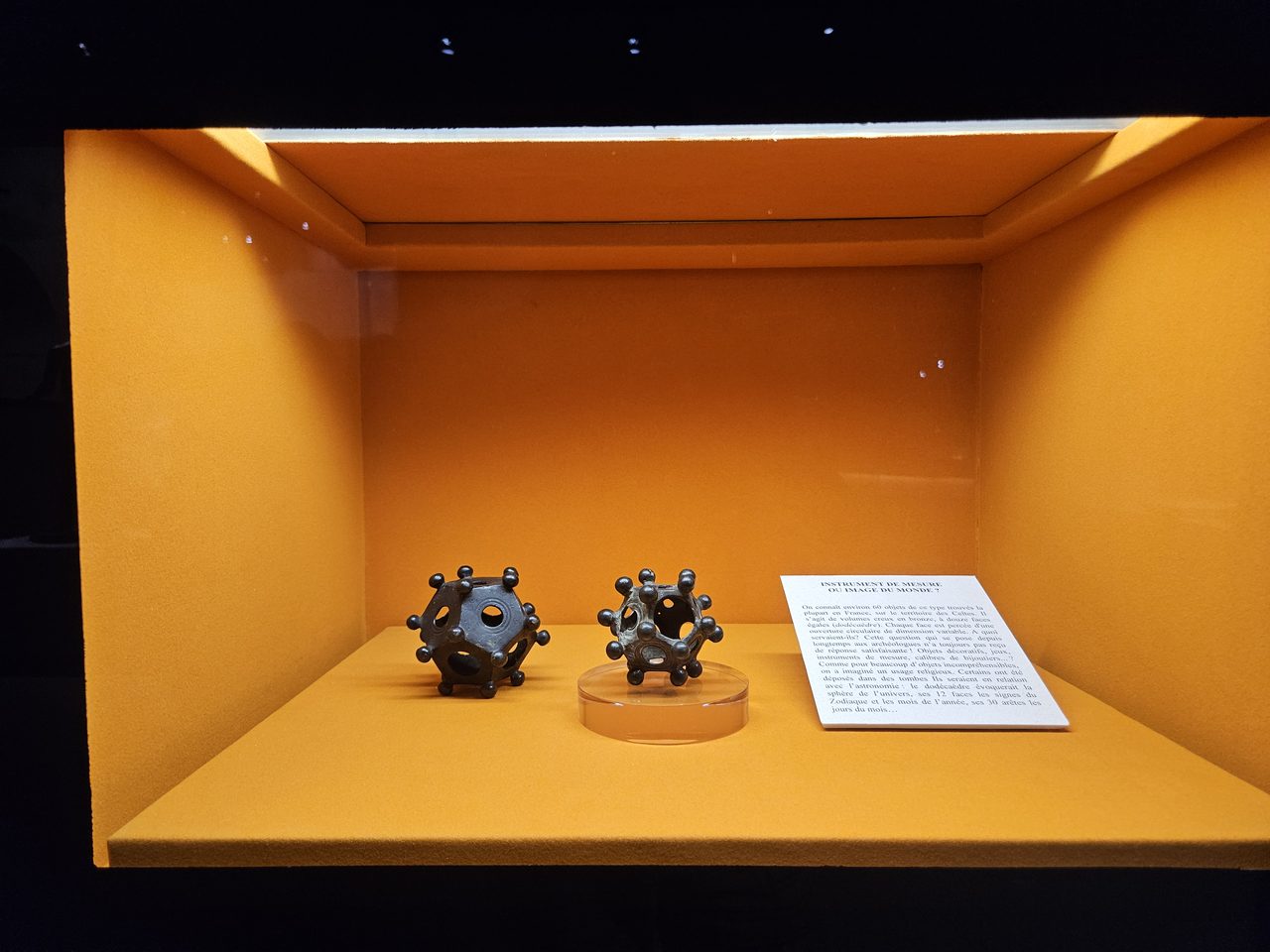
More than 100 hollow bronze dodecahedra (twelve pentagonal faces, a different-sized hole in each, a knob at every corner) have turned up across Roman Europe, dated to the 2nd through 4th centuries CE. They are skillfully cast and well provenanced, yet no Roman or Greek text mentions them and no fresco or mosaic depicts one. Surveying tool, candlestick, knitting gauge, ritual object: nobody knows. This is a real archaeological mystery, and it is still plainly Roman workmanship.
The Voynich Manuscript is 240 pages of an unknown script, radiocarbon dated to roughly 1404 to 1438 CE and never deciphered, not by Bletchley Park veterans, not by the NSA, not by modern machine learning. Its text carries the statistical fingerprints of a real language (Zipf’s law, a natural word-length distribution), so it is probably not simple gibberish. A genuine unsolved medieval puzzle, with nothing paranormal about it.
The Nazca Lines are real, enormous (some figures reach 370 meters), and a UNESCO World Heritage Site. Scholars read them as ceremonial pathways, an astronomical calendar, or water ritual. Von Däniken’s alien-runway version (Tier 4) collapses on a single fact: the lines are clearly visible from the surrounding foothills, no aircraft required.
The Piri Reis Map of 1513, an Ottoman admiral’s compilation of older charts, is sometimes said to show an ice-free Antarctic coast. Gregory McIntosh showed the disputed stretch is far better read as the South American coast duplicated and distorted, a routine cartographic error for the period. Real map, ordinary explanation.
The same middle tier holds the Phaistos Disc (an undeciphered clay stamp, arguably the earliest movable type, its very authenticity debated) and the Costa Rican stone spheres (near-perfect, up to 16 tons, and reproducible by demonstrated pecking and grinding). Odd, yes. Impossible, no.
03Where the evidence gets thin
The Quimbaya “airplanes,” pre-Columbian Colombian gold figurines from about 500 to 1000 CE, really do have swept wings and what looks like a tail fin. But pre-Columbian goldsmiths stylized insects, fish, and birds constantly, and that is the far likelier subject. Yes, modelers built flying replicas, but a model that flies is not evidence that ancient Colombians had aircraft.
The Saqqara Bird, an Egyptian wooden object promoted as a glider model, is almost certainly a bird figurine whose aerodynamic claims do not survive scrutiny. The Baigong Pipes in China, pitched as technology inside 150,000-year-old sediment, match the well-documented geology of pedogenic pipes (fossilized tree roots and mineral casts). Evocative, unsupported.
04The famous ones that fell apart
| Artifact | The claim | What it really is |
|---|---|---|
| Dropa Stones | Alien-encoded discs from a cave | Likely fabricated; never examined |
| Klerksdorp Spheres | Machined in Precambrian rock | Natural pyrite concretions |
| London Hammer | Tool in dinosaur-age rock | Concretion around a modern hammer |
| Dorchester Pot | Vessel in 100,000-year rock | Single unverifiable 1852 report |
The Dropa Stones, alien-encoded discs supposedly found in a Chinese cave, trace to a single 1962 magazine article written under an apparent pen name. No disc has ever been examined by a scientist, no matching “Dropa” people has ever been located, and the story carries every hallmark of fabrication. Almost certainly fiction.
The rest fall the same way. The Klerksdorp Spheres are natural pyrite concretions from a 3-billion-year-old South African deposit, not machined parts. The London Hammer is a modern hammer that a mineral concretion grew around, not a tool from the age of dinosaurs. The Dorchester Pot rests on a single unverifiable 1852 newspaper report. These are the OOParts that circulate the loudest and have the least behind them.
05The pattern behind the pattern
Line the whole catalog up and a pattern jumps out, and it is not the one the documentaries sell. The strongest OOParts need no alien at all. Antikythera, the Lycurgus Cup, the Nebra disc: peer-reviewed, accepted, and every one a proof that ancient people were more capable than we tend to credit. The weakest ones (Dropa, London Hammer, Klerksdorp) are the ones that trend, precisely because the truth is a letdown.
Call it OOPart inflation. The Iron Pillar of Delhi looked supernatural until corrosion chemistry explained it, and the same quiet fate has caught most items on this list. “Out of place” usually means “not yet understood,” not “impossible.” The honest move is to sort by evidence and let the pile shrink as the science comes in.
Fast Facts
- Catalog size
- 17 major OOParts, individually rated
- Genuine (Tier 1)
- Antikythera, Nebra Sky Disc, Iron Pillar, Lycurgus Cup
- Debunked (Tier 4)
- Dropa Stones, Klerksdorp Spheres, London Hammer, Dorchester Pot
- Most impressive
- Antikythera Mechanism, ~1,400 years ahead of its time
- Best mystery
- Roman Dodecahedra: 100+ found, zero ancient references
- Voynich Manuscript
- Radiocarbon dated 1404 to 1438 CE, still undeciphered
- Iron Pillar
- 7.2 m, ~1,600 years, sealed by a phosphorus passive layer
How the catalog actually sorts
Four OOParts are the real deal: the Antikythera Mechanism, the Nebra Sky Disc, the Iron Pillar of Delhi, and the Lycurgus Cup. Every one is verified, peer-reviewed, and made by human hands that were simply better than we expected.
A handful sit honestly unsolved: the Roman Dodecahedra that no ancient text explains, and the Voynich Manuscript that no cryptographer has cracked. Real mysteries, clearly human, no consensus answer yet.
The alien-artifact reading fails. The Dropa Stones are fiction, the London Hammer and Klerksdorp Spheres are natural concretions, and not one OOPart on this list requires extraterrestrial hands. Not because anyone refuses to look, but because the evidence keeps pointing at human ingenuity instead.
Which leaves the question the whole catalog circles back to: if the genuine anomalies are the ones that turned out to be human all along, how much of what we still call “impossible” is just science we have not finished doing? Somewhere in that middle tier, a bronze dodecahedron is still waiting for its own corrosion-chemistry moment. Nobody yet knows which one goes next.
Sources & further reading
Everything above is drawn from our research library on Theories of Anything. Open the full files to check the sourcing and go deeper.
Image credits
- The main (largest) bronze fragment of the Antikythera photograph via Wikimedia Commons (Joyofmuseums). CC BY-SA 4.0 Source.
- The Nebra Sky Disc photograph via Wikimedia Commons (Shonagon). CC0 1.0 Universal (Public Domain Dedication) Source.
- A hollow cast-bronze Gallo-Roman dodecahedron with twelve photograph via Wikimedia Commons (John Samuel (Jsamwrites)). CC BY-SA 4.0 Source.
- Card crop of The main (largest) bronze fragment of the Antikythera photograph via Wikimedia Commons (Joyofmuseums). CC BY-SA 4.0 Source.


