The Paracas Candelabra: A Trident on the Cliff
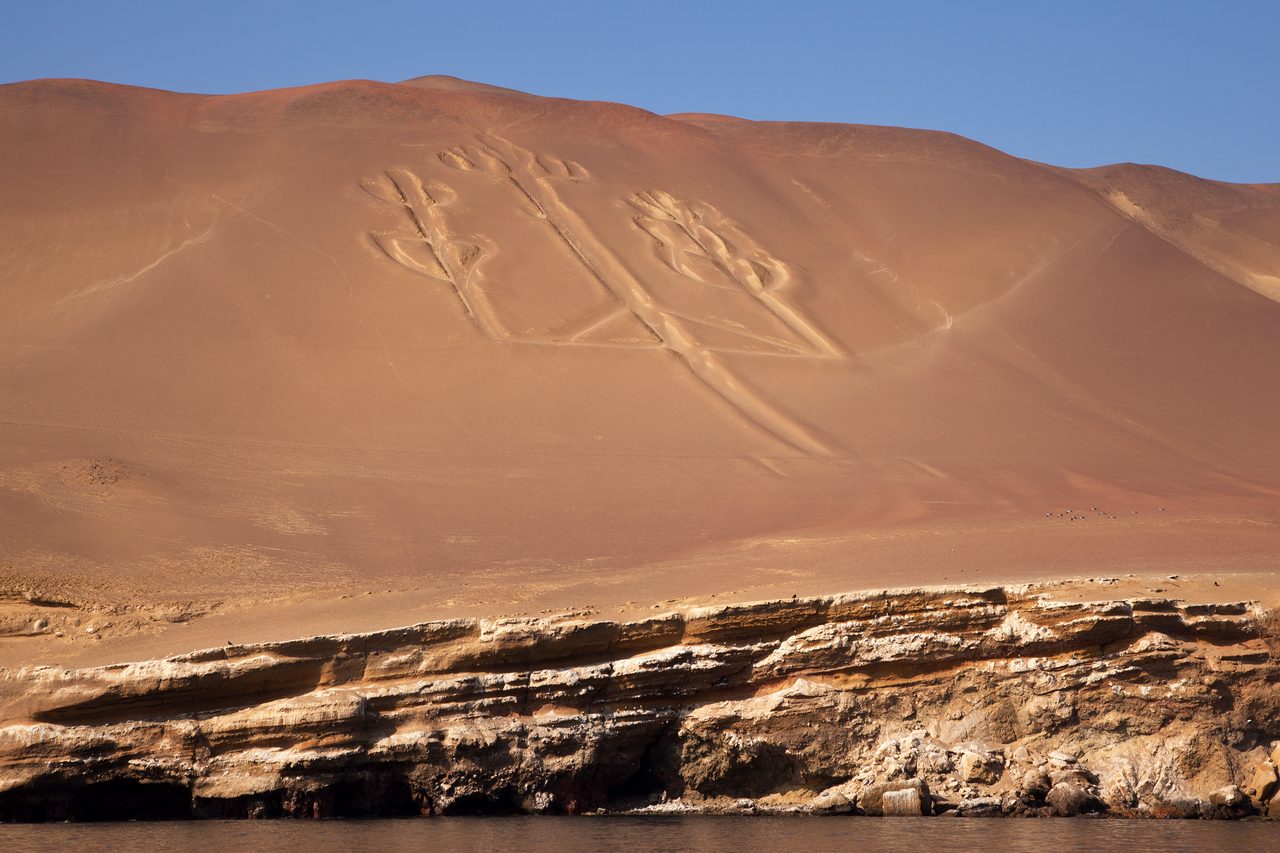
A giant three-pronged figure is cut into a coastal cliff in Peru, big enough to see from twenty kilometers out at sea, and nobody can say for certain what it was for. Here is the file, opened from the sand up, every claim wearing its evidence.
Sail up the coast of Peru toward Pisco Bay and, long before you reach land, a shape resolves on the cliff face: three great prongs branching out of a central stem, cut into a desert hillside that runs straight down toward the Pacific. Passing sailors have noticed it for generations. It has been called a candelabra, a trident, and a cactus, and the honest truth is that nobody can say for certain who carved it or why. Let's open the file.
| Measure | Figure |
|---|---|
| Height, top to base | ≈ 180 m (595 ft) |
| Width at broadest | ≈ 60 m (200 ft) |
| Trench depth | ≈ 60 cm (2 ft) |
| Visible from sea | up to ≈ 20 km (12 mi) |
01The figure on the cliff
The Paracas Candelabra is carved into the northern face of the Paracas Peninsula, at 13.7637° S, 76.2973° W in Pisco Province, Ica Region, Peru. Its form is three main prongs branching from a central base or trunk, each prong carrying its own secondary branches, which is why it has been read at different times as a candelabrum, a trident, or a cactus.
The figure runs roughly 180 meters (595 feet) from top to base and about 60 meters (200 feet) across at its widest span. The design was cut roughly 60 centimeters (2 feet) deep into a sandy hillside capped by a hardened caliche crust of calcium sulfate and gypsum.
For all that size and its perch on a steep coastal hillside, the figure faces northwest toward the open sea. That orientation is exactly why it reads so clearly from the deck of a passing ship.
02Why it is still there
A design scratched two feet into loose desert soil should not survive two thousand years. This one has, and the reason is a small collaboration between climate and physics.
The Paracas Peninsula receives almost no rain, on the order of 2 millimeters a year, and the hardened surface crust resists wind erosion. The prevailing onshore winds do not scour the figure away; they fill its trenches with pale beach sand, so the design stays visible as a tonal contrast against the darker hillside rather than being erased.
In clear conditions the Candelabra can be seen from up to roughly 20 kilometers (12 miles) out to sea, with some sailors reporting sightings from farther still.
03The people who cut it
The figure sits in the homeland of the Paracas culture, and everything we can responsibly say about who made it starts there.
The Paracas were a pre-Columbian civilization of Peru's southern coast, flourishing from roughly 800 to 100 BCE across two phases, Paracas Cavernas earlier and the later Paracas Necropolis. They are remembered for the finest pre-Columbian weaving known, textiles running to more than 200 distinct color variations, for practicing trephination, the surgery of the skull, and for elongated skulls.
The Necropolis of Wari Kayan yielded 429 mummy bundles wrapped in elaborate textiles. Their imagery includes geometric and mythological figures, staff-bearing deities, serpents, and, tellingly, figures crowned with three-pronged head ornaments.
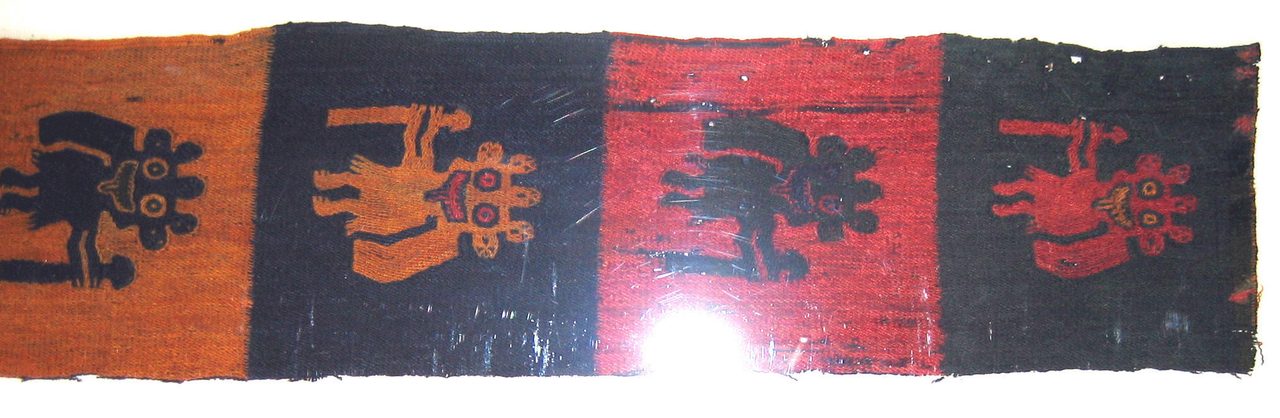
That three-pronged motif matters, because it drops the Candelabra's most distinctive shape squarely inside the Paracas visual world. What it does not do is put a date on the geoglyph.
The Candelabra itself cannot be directly dated. Pottery fragments found nearby are Paracas-era, around 200 BCE, and some researchers argue for a greater antiquity from erosion patterns, though the research file explicitly flags that reading as speculative. The figure may also have been maintained or reworked by later cultures, whether Nazca, Chincha, or Inca.
Whatever its precise date, the Candelabra is a different kind of thing from the Nazca Lines, and the clearest difference is one of form and setting: the Candelabra is cut into a steep coastal hillside facing the ocean, while the Nazca Lines are drawn on a flat inland desert pampa roughly 80 kilometers to the southeast. That contrast is not in doubt. The chronology is another matter. Its own nearest hard evidence points to roughly 200 BCE, so while the figure is sometimes said to predate the Nazca geoglyph tradition, that ordering rests on the speculative erosion argument flagged above rather than on firm dating, and the two readings sit in open tension.
04The detour into the skulls
Any file on Paracas eventually runs into the skulls, because the internet did. It is worth separating what is solid from what is being sold.
Over 300 elongated skulls have been recovered from the Paracas region, most showing clear evidence of artificial cranial deformation, the head-boarding or binding of infants. The finds trace back to excavations led by Julio Tello beginning in 1925 and 1929.
A subset of these skulls is said to show more unusual features: a single parietal plate where there are normally two, a differently positioned foramen magnum, and roughly 25 percent greater cranial volume. Here the ground gets soft. The research file itself calls these anomalies debated, and the headline attached to them, a 2014 mitochondrial DNA analysis by Brien Foerster and Juan Navarro reporting haplogroups traced to Eastern Europe, the Middle East, and possibly unknown populations, is described as incomplete, with full peer-reviewed genomic analysis still pending. Until that analysis exists, the finding cannot carry the weight the claim wants to load onto it.
Cranial binding, on its own, is a well-documented human practice across several continents. It reshapes a skull; it does not require a stranger to have supplied the DNA. Until a peer-reviewed genome says otherwise, that is where the evidence honestly sits.
05What it was for
No surviving record explains what the Candelabra was for, so its purpose is genuinely open, and there are three serious readings on the table, none of them proven, none able to rule the others out.
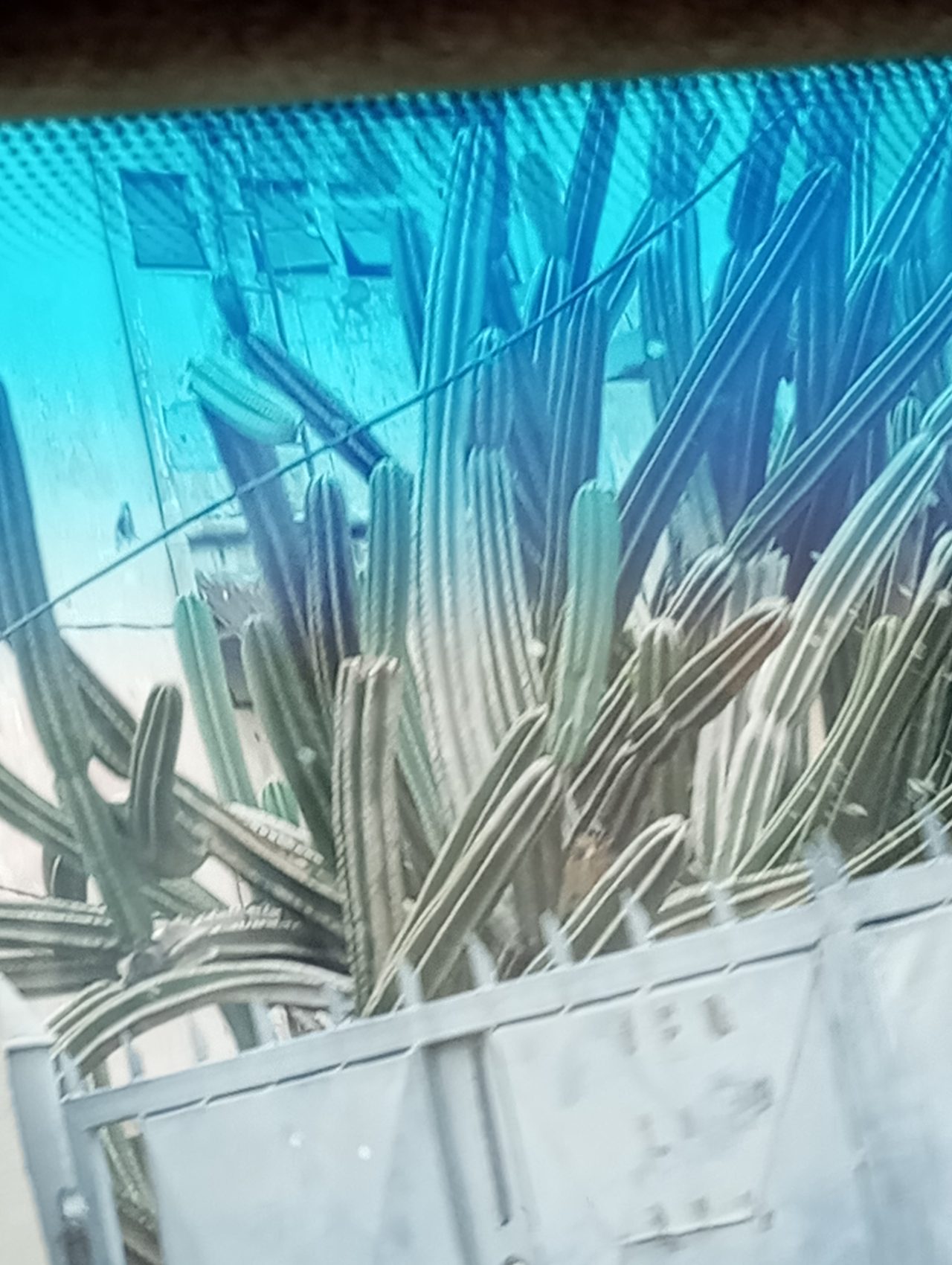
The first reading is botanical. The three-pronged shape may represent Brugmansia suaveolens, the angel's trumpet, or the three-ribbed profile of the San Pedro cactus, Echinopsis pachanoi, both central to Paracas shamanic practice. San Pedro use in this cultural sphere is documented back to around 2000 BCE at Chavín de Huántar. On this reading the geoglyph is a monumental, sea-visible announcement of shamanic power.
The second reading is practical. The figure may have served as a navigational marker, a kind of proto-lighthouse for Pisco Bay, one of the most important harbors on the Peruvian coast and later a base for the balsa-raft fleets of the maritime-trading Chincha culture.
The third reading is religious. Staff-god and trident-bearing figures recur on Paracas and Nazca textiles and pottery, and the same figure was later formalized as Viracocha at Tiwanaku, sometimes shown wearing a three-pronged headdress that may stand for the axis mundi, the three cosmic levels of underworld, earth, and sky.
Threaded through all three is a bigger pattern. The Paracas are understood to have evolved into the Nazca culture, roughly 100 BCE to 800 CE, with overlapping territory in the Ica and Nazca valleys, continuous pottery and textile motifs, and a shared geoglyph tradition. That has led to the (still speculative) suggestion that the Candelabra, if it is the earliest figure in that tradition, marks a move from coast toward inland desert that ended in the Nazca Lines.
| Tradition | Form |
|---|---|
| Greek | Poseidon's trident |
| Roman | Neptune's trident |
| Hindu | Shiva's trishula |
| Buddhist | The triratna |
| Mesopotamian | Adad / Hadad's lightning fork |
| Etruscan | Nethuns' trident |
| Polynesian | Maui / Tangaroa's triple fish-hook |
| Andean | The Staff God / Viracocha |
06The trident that shows up everywhere
The same three-pronged shape turns up in traditions with no plausible contact between them: Poseidon and Neptune, Shiva's trishula, the Buddhist triratna, the lightning fork of the Mesopotamian storm-god Adad, the Etruscan Nethuns, the Polynesian triple fish-hook of Maui and Tangaroa, and the Andean Staff God. The research file notes the pattern is overwhelmingly tied to maritime and aquatic power; in Shiva's case specifically, the three prongs are read as will, knowledge, and action, or as the three gunas.
Why the same fork keeps reappearing has two speculative answers, both worth naming and neither established.
The first answer is contact. On this view the Candelabra was a landmark in a wider Pacific maritime network, with Thor Heyerdahl's Kon-Tiki voyage of 1947 and his Ra crossings of 1969 to 1970 offered as proof the journeys were at least feasible, and the trident-versus-fish-hook echo taken as a cultural fingerprint. The research file answers plainly: no definitive archaeological evidence of trans-Pacific contact has been confirmed at Paracas specifically. The well-established sweet-potato transfer between South America and Polynesia, around 1000 CE, is a separate matter and does not put anyone at this cliff.
The second answer needs no boats at all. Drawing on Jeremy Narby and on Lewis-Williams and Dowson's 1988 'entoptic phenomena' theory of trance-state imagery, it holds that the three-pronged form is a pattern the human nervous system generates in altered states, which different cultures then encode into cosmology independently, without ever meeting. If that is right, the trident is shared because the wiring is shared, not because anyone sailed.
07Where the fringe comes in, and why it fails
Two claims travel much further than the evidence, and both deserve a straight answer.
The most repeated one is that the Candelabra 'points to' the Nazca Lines, as if it were a signpost. It is geometrically false. The figure faces northwest, out toward the sea; the Nazca Lines lie to the southeast, behind it. It cannot point at something it has its back to.
The other is that aliens cut it as a landing marker. There is nothing to support this. The geoglyph is well within the documented capabilities of the Paracas culture using only human labor and the removal of sand, and it requires no technology beyond that. Big and strange is not the same as impossible.
Fast Facts
- Site
- Paracas Peninsula, Pisco Province, Ica Region, Peru
- Coordinates
- 13.7637° S, 76.2973° W
- Size
- ≈ 180 m (595 ft) tall, ≈ 60 m (200 ft) wide
- Trench depth
- ≈ 60 cm (2 ft)
- Visible from
- up to ≈ 20 km (12 mi) out at sea
- Likely makers
- Paracas culture, ≈ 800 to 100 BCE
- Direct date
- None; nearest pottery ≈ 200 BCE
- Purpose
- Genuinely unknown
What we can actually stand behind
The Candelabra is real, it is large, and it is the work of the Paracas culture, preserved by a bone-dry climate and a hardened crust and visible far out to sea. All of that is solid.
What it was for, a shamanic plant, a navigational marker, or a deity symbol, is unresolved. All three readings are live, and with no writing and no colonial record, none of them can be called settled.
It does not point to the Nazca Lines; it faces the opposite way. And nothing about it needs alien builders. Both claims fail on the geometry and the evidence, not on any shortage of imagination.
Which leaves the real question sitting where the Paracas left it, cut two feet deep into a cliff that faces nothing but ocean. Someone wanted this shape seen from the water, badly enough to carve it 180 meters tall into stone-hard sand and trust the wind to keep it clean. We can measure every inch of it and still not say what they meant by it. Who, out on that water, was the message on the cliff ever meant to reach?
Sources & further reading
Everything above is drawn from our research library on Theories of Anything. This particular file leans mostly on general Paracas and Nazca scholarship rather than studies of the Candelabra itself, so open the full file to weigh the sourcing for yourself.
Image credits
- The Paracas Candelabra geoglyph photograph by Unukorno, via Wikimedia Commons. CC BY 3.0 Source.
- Paracas textile border fragment via the Metropolitan Museum of Art / Wikimedia Commons. CC0 (Public Domain) Source.
- San Pedro cactus (Echinopsis pachanoi) photograph by Grace789, via Wikimedia Commons. CC BY-SA 4.0 Source.
- Card crop of The Paracas Candelabra geoglyph photograph by Unukorno, via Wikimedia Commons. CC BY 3.0 Source.


