Pleiadians
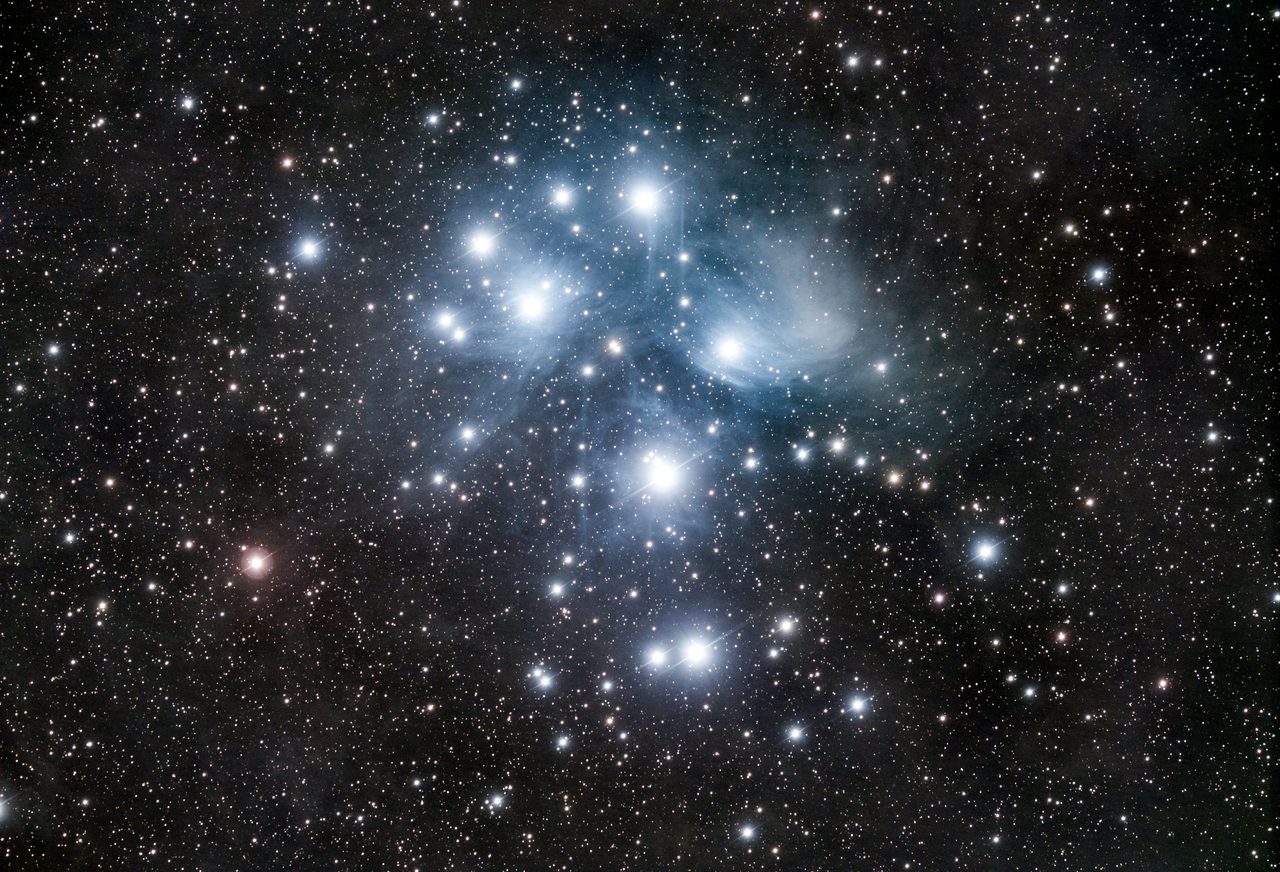
The Pleiadians are the beautiful aliens: tall, blonde, benevolent, and beamed here from a star cluster that genuinely exists. Everything past 'the cluster is real' is where the evidence thins. Here is the whole file, every claim wearing its tier.
Every alien has a look, and the Pleiadian's is the one central casting would pick. Where the Grey is small and cold and clinical, the Pleiadian is tall, golden-haired, blue-eyed and kind, a being that arrives not to abduct you but to warn you, teach you, and save you from yourself. It is the most flattering alien we have ever described. And it claims to come from a place that, unlike almost every other alien homeland, you can walk outside tonight and see with your own eyes. That last fact is the most interesting thing on this page, and also the trap. The star cluster is real. Everything hung upon it is a separate question, so let us open the file and take those questions one at a time.
01The most flattering alien we ever drew
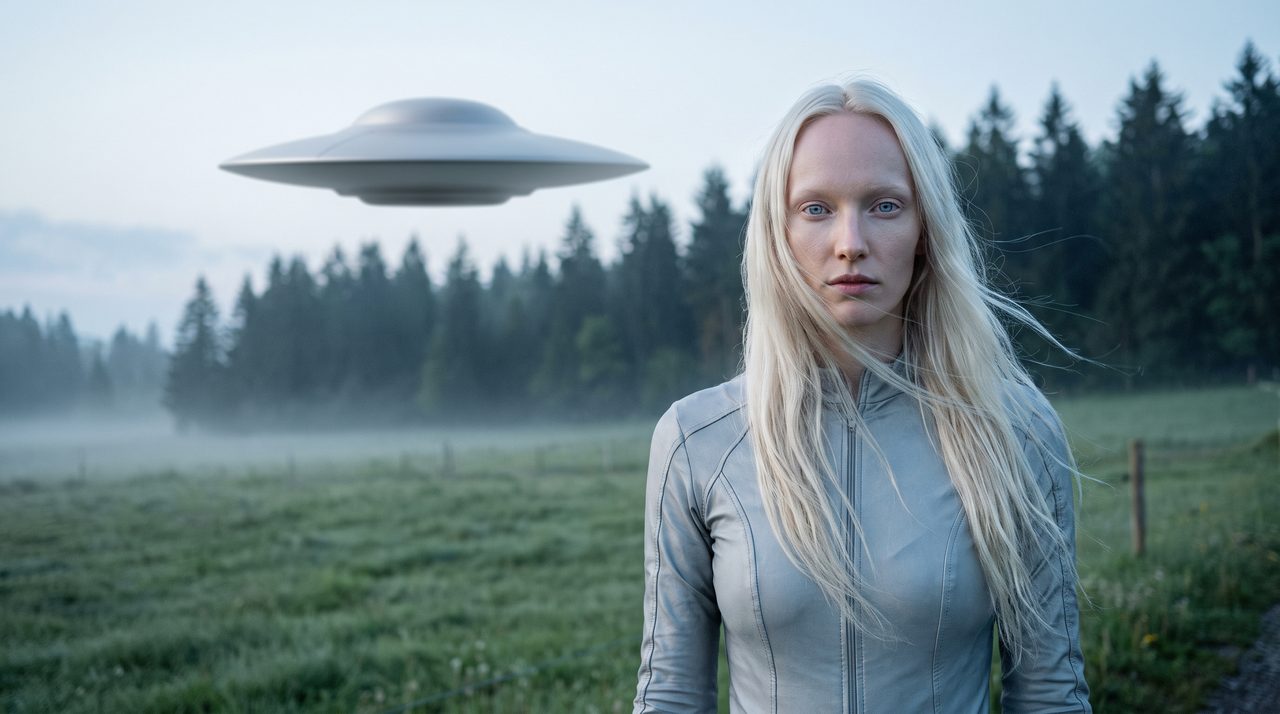
The Nordic or Pleiadian archetype in contactee and abduction literature is remarkably fixed: 6 to 7+ feet tall, pale-skinned, blond or light-haired, blue-eyed (sometimes described as 'luminous'), athletic and human-passing, communicating telepathically and sometimes verbally, and behaving throughout as a benevolent guide who has come to warn or spiritually instruct humanity. It is less the description of a creature than the portrait of an ideal.

The claimed home is the Pleiades open star cluster, though the tradition never quite settled the address: some contactee and channeled sources name the constellation Lyra instead, as an alternate or ancestral point of origin. A being precise enough to cross interstellar space, strangely vague about which star it actually left.
Here is the detail the source document itself flags. The Nordic/Pleiadian descriptions carry a strong cultural and racial projection bias: they track mid-twentieth-century European beauty ideals far more closely than they track any independently corroborated physical type. The 'superior visitor from the stars' looked, suspiciously, exactly like the people describing him.
Modern writers have reached backward as well, matching the Pleiadian against older 'tall, fair, advanced' figures in unrelated traditions: Viracocha of the Inca, the Tuatha De Danann of Irish myth, the Patupaiarehe of the Maori. The source document lists these but is explicit about what they are: retrospective pattern-matching by modern researchers, not independent corroboration handed up from those older cultures. Finding the shape you went looking for is not the same as finding evidence.
02The one homeland you can actually see
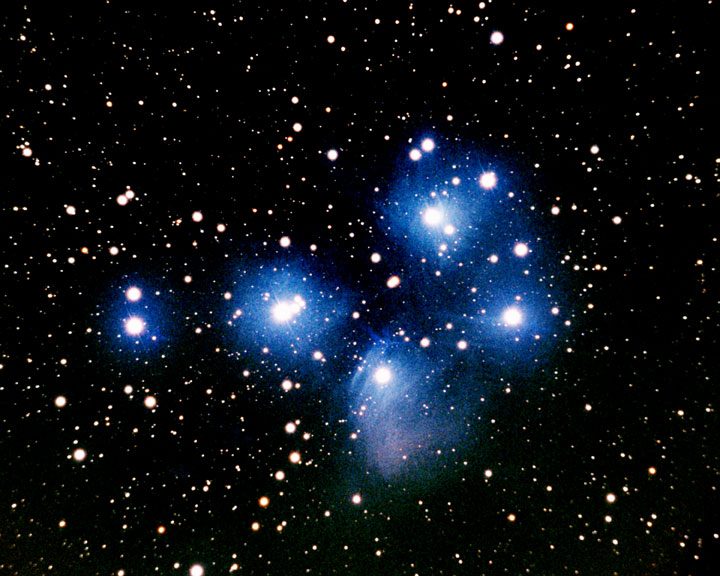
Strip away the visitors and the destination is genuinely real. The Pleiades, catalogued as Messier 45 and known for millennia as the Seven Sisters, is a naked-eye open star cluster in the constellation Taurus, containing more than a thousand gravitationally associated young stars and sitting roughly 444 light-years from Earth. Every Pleiadian-contact tradition, from Meier to Marciniak, names this one real object as home. That is the fact that gives the whole subject its strange gravity.
And here is the ceiling on all of it. No peer-reviewed physical evidence, biological, photographic, or material, of a Pleiades-originating visitor has ever been independently verified. The source document behind this file rates its own alien-races catalog Confidence: Very Low (3 out of 5), and rates this specific Nordic/Pleiadian entry Tier 3 to 4. A real star, a real cluster, and not one real specimen that ever left it to visit us.
The visitors themselves arrive through three separate doors, and it pays to keep them apart, because a shared name has quietly fused three very different kinds of claim into one.
| The tradition | Its source | Physical evidence offered | Tier |
|---|---|---|---|
| Contactee sightings | Billy Meier (1975 on) | Photographs (Meier's, later debunked) | Tier 4 |
| Channeled teaching | Barbara Marciniak (1992) | None claimed | Tier 4 |
| Older oral tradition | Lakota / Sioux Star People | None (mythological) | Tier 3 · myth |
03Billy Meier, the man who kept count

The most extensive Pleiadian contact claim on record belongs to a single Swiss farmer. Eduard Albert 'Billy' Meier says his non-human contact history began in 1942, when he was five years old, with an elderly Plejaren man named Sfath. After Sfath's death in 1953 the contact continued through a non-Plejaren being called Asket, lapsed in 1964, and resumed on January 28, 1975 with a Plejaren woman named Semjase, said to be Sfath's granddaughter and to hail from the planet Erra in the Pleiades.
| When | What Meier says happened |
|---|---|
| 1942 (age five) | First contact, an elderly Plejaren named Sfath |
| 1953 | Sfath dies; contact passes to a non-Plejaren being, Asket |
| 1964 | The contacts lapse |
| January 28, 1975 | Semjase arrives, said to be from the planet Erra in the Pleiades |
Meier claims more than 700 contacts with Plejaren beings since 1975, primarily with Semjase, making his the most extensive single-source Pleiadian contactee record in all of modern ufology. Extensive, and single-source: every one of those 700 encounters runs through the same one man.
The case had its champion. In 1979, investigator Wendelle Stevens, working with Lee and Brit Elders and Tom Welch, published the photo journal UFO... Contact from the Pleiades, arguing for the authenticity of Meier's photographs. It was the primary pro-authenticity publication, and, crucially, it came out before the findings that would gut the case in the late 1990s.
04When the photographs met the investigators
For twenty years the photographs were the case. Meier's images of beings and 'beamships' were the physical evidence that lifted him above every armchair contactee. Then two of them were run down, and what turned up on the other end was not a spacecraft.
In a 1998 investigation, researcher Kal Korff, working with Swiss magazine editor Luc Buergin, identified two of Meier's most striking photographs. The women Meier had presented as the extraterrestrials 'Asket' and 'Nera' turned out to be ordinary photographs of Michelle DellaFave and Susan Lund, two performers from The Golddiggers, a 1960s to 1970s American dance troupe familiar from The Dean Martin Show. Not beings from another star. Backup dancers from network television.
The craft fared no better. Meier's 'beamship' photographs, including the widely reproduced 1975 silver-disc image, have been reconstructed by independent skeptics and model-makers out of ordinary household objects: trash-can lids, pie pans, carpet tacks, wedding-cake decorations, suspended on wires or poles. Meier's own ex-wife, Kalliope, stated in a 1997 interview that he built the 'UFO' models from exactly such materials.
| The evidence | Presented as | What investigation found |
|---|---|---|
| The 'Asket' and 'Nera' portraits | Two extraterrestrial women | Dancers Michelle DellaFave and Susan Lund (The Golddiggers), 1998 |
| The 1975 'beamship' photos | A Pleiadian silver-disc craft | Household objects on wires; the models described by his ex-wife in 1997 |
05The Pleiadians who never posed for a camera
There is a second, entirely separate 'Pleiadian' contact, and it is important not to fold it into Meier's, because it makes no photographic claim at all. It offers something harder to test and easier to believe: a voice.
In 1992, Barbara Marciniak published Bringers of the Dawn: Teachings from the Pleiadians (Bear & Company), presenting material she says she compiled from more than 400 hours of her own trance channeling of a collective that calls itself, simply, 'the Pleiadians.' There are no photographs here and no physical evidence of any kind. This is a spiritual-teaching claim, and it asks to be judged as one.
The teaching itself is specific. Marciniak's channeled Pleiadians hold that the original human template carried twelve strands of DNA and twelve chakra centers, and that humanity is now moving through a guided shift in consciousness. It is presented, and received by its readers, as spiritual instruction, not as a historically or scientifically verifiable account of the past. Taken on those terms it is a belief system. Taken as history or biology, it has nothing underneath it.
06The cases that got folded in by mistake
Two well-known stories are routinely shelved under 'Pleiadian' and do not belong there. One was never Pleiadian to begin with. The other is far older than the label and deserves to keep its own name.
The contactee case most often dragged backward into the 'Nordic' file was never about the Pleiades at all. George Adamski announced in the fall of 1953 that on November 20, 1952, near Desert Center, California, he had met a human-like being named Orthon, whom Adamski identified as a Venusian, not a Pleiadian. His famous 'saucer' photograph did not survive scrutiny either: critics, including German rocket scientist Walther Riedel, said it resembled the top of a poultry incubator fitted with General Electric light bulbs. A founding image of the benevolent visitor, and it may have been a chicken-brooder lid.
A second confusion runs the other way, and it deserves more respect. The Lakota and Sioux tradition of 'Star People' who came from the Pleiades bearing sacred knowledge is a genuine, pre-existing oral tradition, catalogued separately in the source document as mythology rather than modern testimony. It predates the flying-saucer era entirely, and it should not be quietly absorbed into the twentieth-century contactee and channeling movement that later borrowed the 'Pleiadian' name. Older, and not the same thing.
07What the record will actually hold
Step back from any single case and the pattern is what indicts the whole category. Academic researchers Susan Clancy (Abducted, Harvard University Press, 2005) and Thomas Bullard (The Myth and Mystery of UFOs, University Press of Kansas, 2010) documented that alien-contact descriptions, the Nordic type very much included, correlate with and shift alongside the science fiction and popular imagery of their moment, rather than staying stable across independent witnesses. Real visitors would look the same to everyone. These change with the movies.
That is the quiet verdict of the whole subject. The Pleiadian is not consistent the way a real animal is consistent. It is consistent the way a cultural wish is consistent, updated in each decade to match what we most wanted a rescuer to be.
Fast Facts
- The look
- 6 to 7+ ft, pale, blonde, blue-eyed, telepathic, benevolent
- Claimed home
- The Pleiades (Messier 45); sometimes the constellation Lyra
- The real cluster
- 1,000+ young stars, about 444 light-years away, in Taurus
- Central case
- Billy Meier, 700+ claimed contacts since January 28, 1975
- The photographs
- 'Asket' and 'Nera' were dancers; 'beamships' were household objects
- Channeled strand
- Barbara Marciniak, 'Bringers of the Dawn' (1992)
- Confirmed evidence
- None; source confidence rated Very Low (3/5)
What we can actually stand behind
The Pleiades is real: Messier 45, a genuine open star cluster of more than a thousand stars, about 444 light-years away in Taurus. That is the one solid fact, and it cuts both ways, because no verified specimen, photograph, or craft has ever been shown to have come from it.
The physical evidence that once anchored the field, Billy Meier's photographs, has not held. His 'Asket' and 'Nera' beings were identified as real dancers from The Golddiggers, and his 'beamships' as ordinary household objects. And the archetype's uncanny resemblance to mid-century beauty ideals is, as the source itself notes, a projection tell rather than a fingerprint of anything real.
As a record of what people report, and of what an older culture like the Lakota long described, the Pleiadian archetype is real testimony and real folklore worth studying. As confirmed biology from a specific star, it is nothing of the kind. Keep those two readings in separate hands.
The single least-supported claim on the page is that Billy Meier's photographs document genuine extraterrestrial craft and beings: it is not merely unproven but actively debunked, matched piece by piece to dance-troupe performers and household objects. Barbara Marciniak's channeled twelve-strand-DNA teaching sits beside it with no physical evidence of any kind. Neither earns a place among the things we can stand behind.
So the Pleiadians leave us with the strangest residue in the whole field: a real star cluster you can find tonight in Taurus, a genuine human hunger for a visitor who is beautiful and benevolent and finally here to help, and, in between, not one photograph that survived a second look. Why this cluster, and why this face? Why does the species we most want to be real keep arriving dressed as our own reflection? The star will still be there long after the last beamship photo is forgotten. The open question is whether we were ever really looking at the sky, or only at ourselves.
Sources & further reading
Everything above is drawn from our research library on Theories of Anything, which is where we worked from. The papers, reports and primary records listed beneath them are where you can check us independently.
Image credits
- The Pleiades open star cluster, Messier 45, the bright blue stars of the Seven Sisters photograph by Stephen Rahn, via Wikimedia Commons. CC0 1.0 Universal (Public Domain Dedication) Source.
- Wide-field telescope image of the Pleiades open star cluster (Messier 45, NGC 1432) photograph by Peter Kennett, via Wikimedia Commons. CC BY-SA 3.0 Source.
- Black-and-white portrait photograph of Swiss contactee Eduard Albert 'Billy' Meier photograph by FIGU (Freie Interessengemeinschaft für Grenz- und Geisteswissenschaften und Ufologiestudien), via Wikimedia Commons. CC BY-SA 2.5 Source.
- An AI-generated artist's impression of a tall, blond, blue-eyed Pleiadian woman on the AI-generated artist's impression, Google Flow, 2026-07-21. AI-generated
- An AI-generated artist's impression of a Pleiadian woman standing at the edge of a Swiss AI-generated artist's impression, Google Flow, 2026-07-21. AI-generated
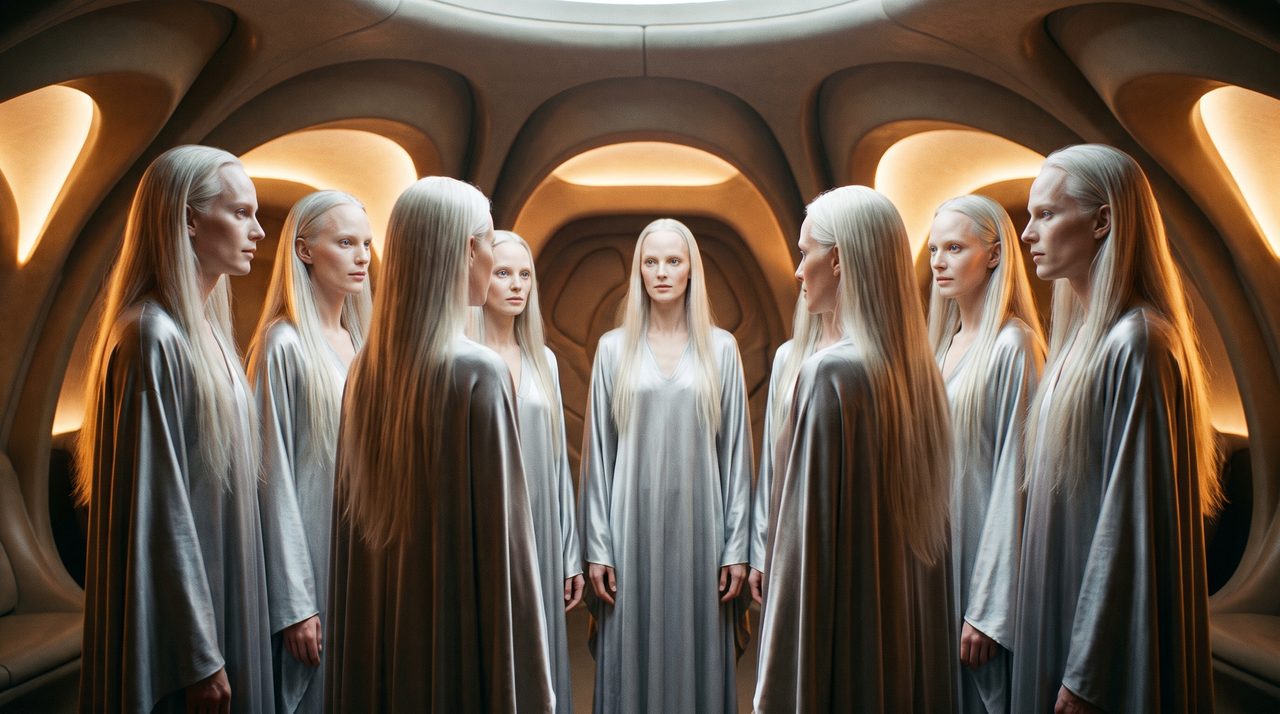
- An AI-generated artist's impression of seven Pleiadians gathered in a semicircle aboard AI-generated artist's impression, Google Flow, 2026-07-21. AI-generated
- Card crop of the Pleiades open star cluster, Messier 45 photograph by Stephen Rahn, via Wikimedia Commons. CC0 1.0 Universal (Public Domain Dedication) Source.
.jpg)
_(NGC1432).jpg)
