Puma Punku: The H-Blocks That Look Machine-Pressed
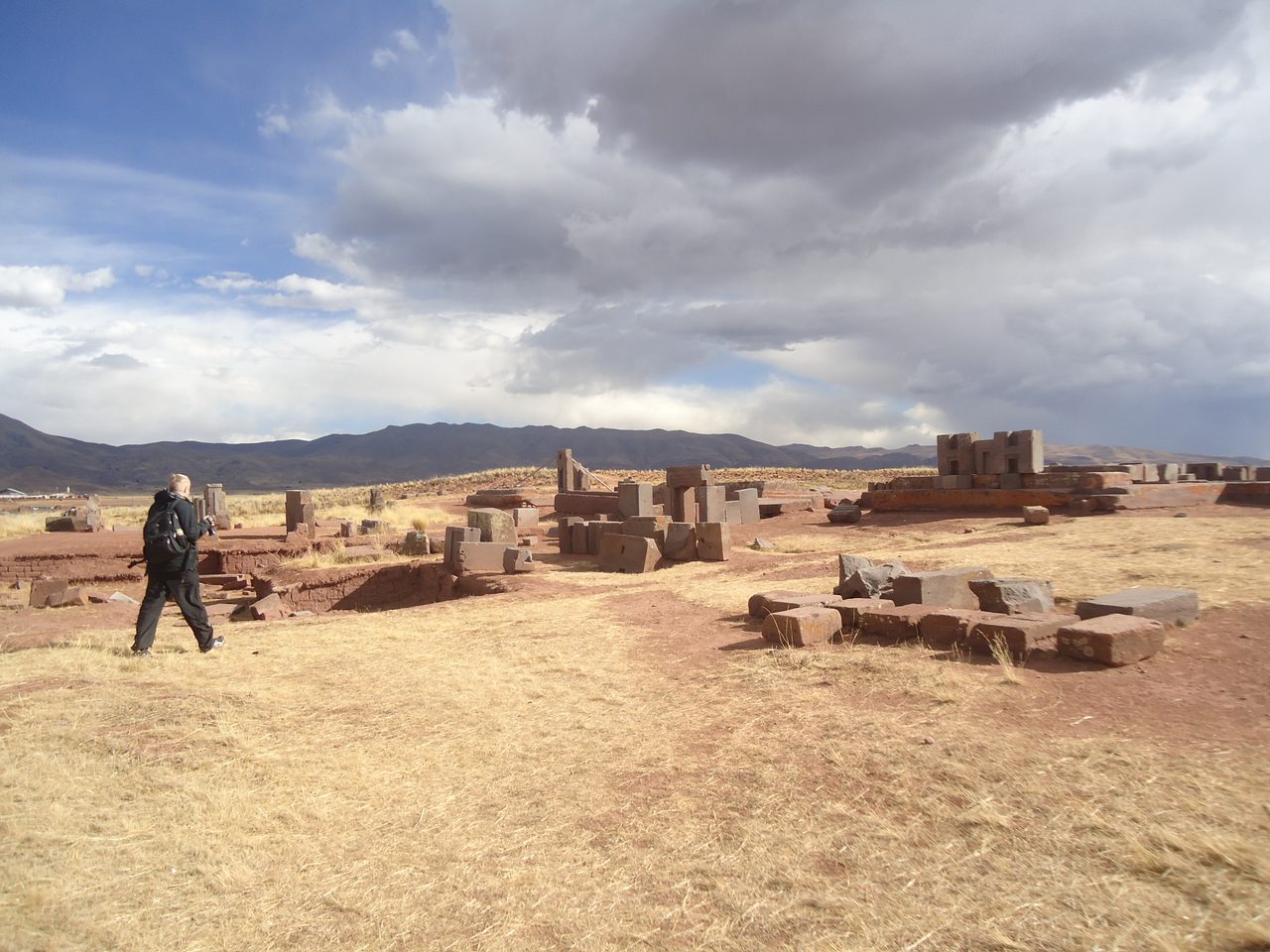
More than a hundred blocks of andesite and sandstone lie scattered on a Bolivian plateau at 3,850 meters, cut so cleanly and so alike they look stamped from a single mold. Here is the file, opened block by block, every claim wearing its evidence.
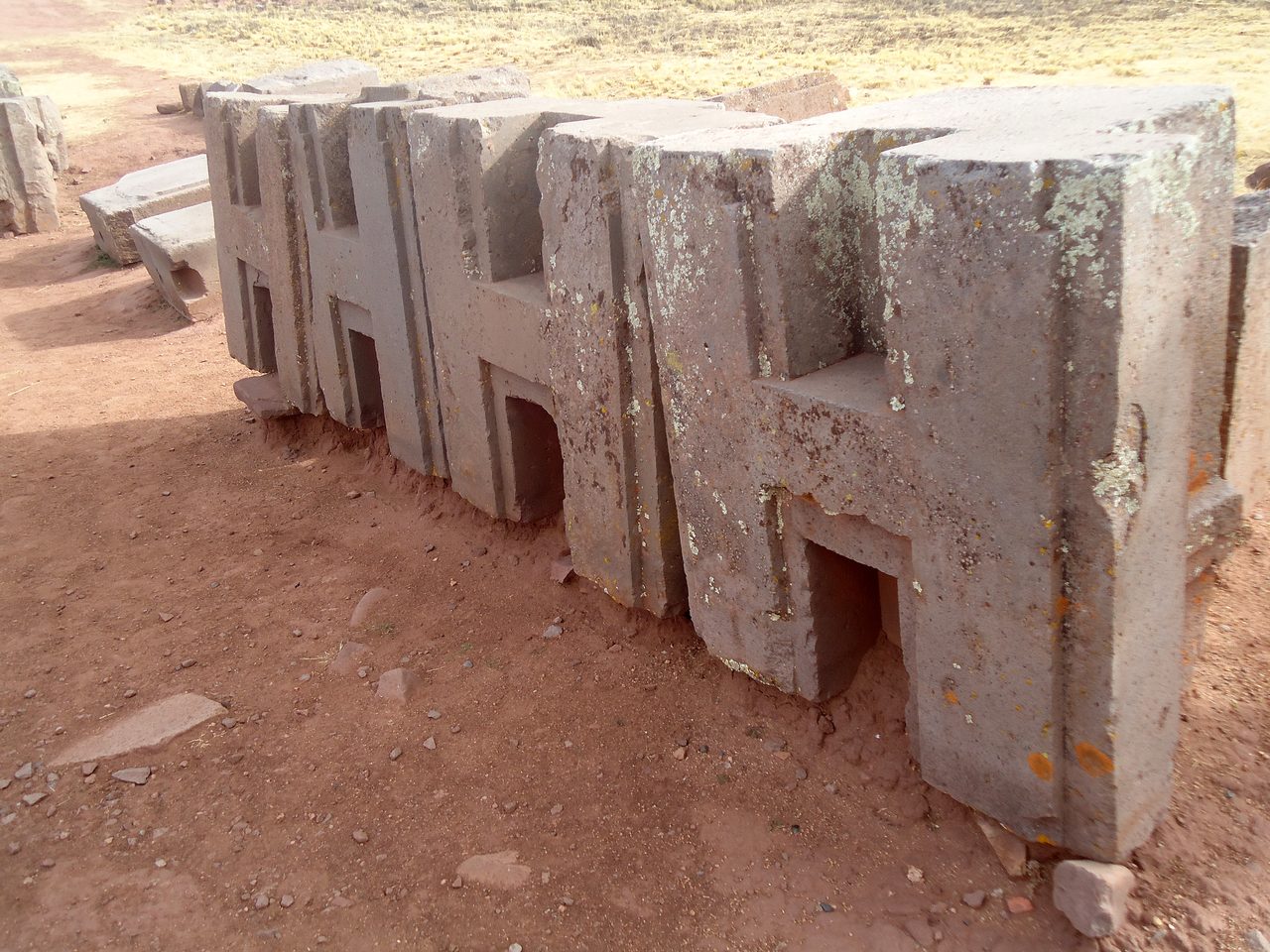
Line the H-blocks up and they look like they came off a factory floor. The same H silhouette, the same recessed channels, the same crisp inside corners, cut so alike you could almost believe they were pressed from one mold. They lie scattered across a Bolivian plateau at 3,850 meters, toppled and broken, and for more than a century people have looked at that precision and concluded a machine had to be involved. Let's open the file and see what the stones actually say.
| Feature | Measurement |
|---|---|
| Altitude | ≈ 3,850 m (12,631 ft), Bolivian altiplano |
| H-blocks | Red sandstone, ≈ 2.5 × 1.0 × 0.6 m, 100+ fragments |
| Sandstone quarry | ≈ 10 km away |
| Largest andesite block | ≈ 131 tonnes (some estimates up to 144) |
| Andesite quarry | Copacabana Peninsula, ≈ 90 km away |
| Built | ≈ 536 to 600 CE (radiocarbon) |
01The blocks that look stamped from a mold
Puma Punku is a real, well-documented terraced platform mound at Tiwanaku in western Bolivia, about 72 km west of La Paz and roughly 1 km from the Kalasasaya temple. Radiocarbon dates from organic material in the mound's deepest layers place construction at roughly 536 to 600 CE, inside the Tiwanaku civilization that ran from about 300 to 1000 CE. None of that is in dispute.
The signature H-blocks are carved from red sandstone hauled from a quarry about 10 km away. Each is roughly 2.5 by 1.0 by 0.6 meters, cut with recessed channels, notches, and niches that let them interlock. More than 100 H-block fragments have been cataloged, and they repeat the same design closely enough that the site reads like a kit of standardized parts.
The chaos you see in photographs is not how it was built. After Tiwanaku was abandoned around 1000 CE, the site became a quarry for its own stone. Local communities, Inca builders, and later Spanish colonial crews all carted blocks away, and centuries of earthquakes finished the disarray. What survives is the wreckage of a once-ordered structure, which is exactly why the intact joints look so startling when you find them.
02How precise it actually is
In 1997 the architectural historians Jean-Pierre Protzen and Stella Nair did what almost nobody in the alternative literature bothers to do: they measured the stones. Their survey is still the benchmark, and the numbers are genuinely impressive.
Protzen and Nair documented flat surfaces ground to within 1 to 2 mm of true flatness across several meters, right angles accurate to within 1 degree, and repeating cut features matched to within a few millimeters. The internal corners are cut crisp, not rounded off the way pure sand-and-stone abrasion usually leaves them.
03The clamps and the modular kit
The biggest stones at Puma Punku are not the sandstone H-blocks but slabs of andesite, a hard volcanic rock quarried from the Copacabana Peninsula on Lake Titicaca, roughly 90 km away. The largest single andesite block is estimated at 131 tonnes, with some estimates as high as 144. Moving that across the altiplano, and possibly across water, took serious organized labor.
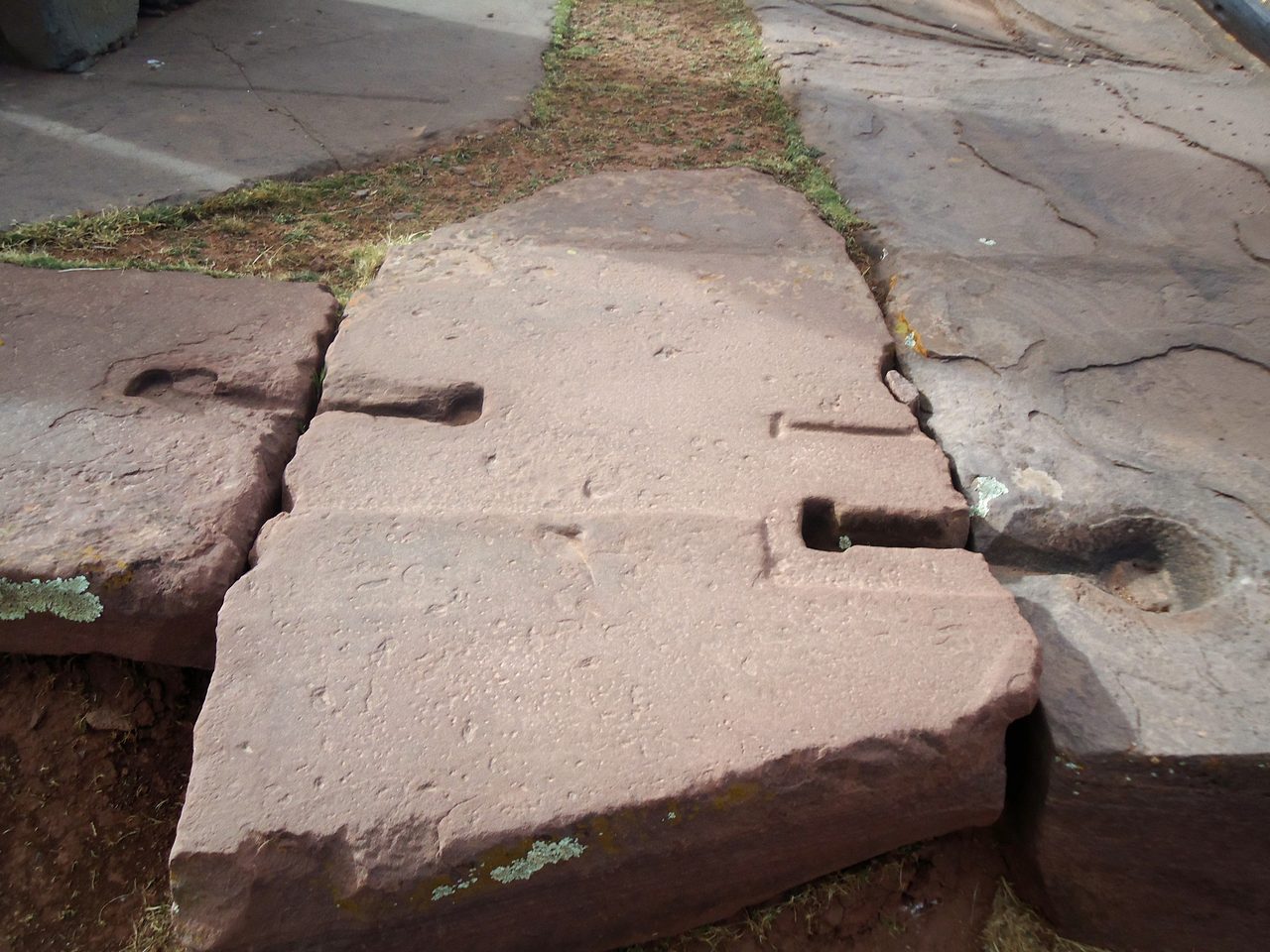
Tiwanaku builders locked adjacent blocks together with I-shaped metal clamps, poured as molten metal straight into carved recesses. Analysis identifies the metal as copper-arsenic bronze, and because each clamp conforms exactly to the irregular walls of its channel, we know it was cast in place, on site, at 3,850 meters (Lechtman and MacFarlane, 2005). The same pour-in-place clamping turns up independently in ancient Greece, Rome, and India.
Alexei Vranich's reconstruction studies (2006) argue the H-blocks and their neighbors formed a modular system: prefabricated, standardized components meant to interlock like a three-dimensional puzzle. That is unusual for pre-Columbian building, which normally fitted stones in place, and it implies templates, planning, and a shared unit of measure. It is also, notably, a human explanation for why the blocks look mass-produced.
04So how did they cut it?
If not a machine, then what? The honest answer is that we have a strong candidate toolkit and a couple of loose ends that specialists are still arguing about.
Protzen and Nair reproduced much of the precision experimentally. Diorite and quartzite hammerstones found at the site handle rough shaping; flat stone plates used as reference surfaces produce the flatness; abrasive sand does the polishing. In 2013 they demonstrated the flat-plate-and-sand method directly. The known Tiwanaku toolkit can, in principle, get you there.
The loose ends are real. Debate continues over whether abrasion alone accounts for the crispest internal corners, and over the sheer speed implied by the volume of finished stone. This is a live, unresolved conversation among the people who measured the site, not a closed case in either direction.
One step further out, some argue the corners point to a cutting technique not yet reproduced, perhaps hard metal tools that simply did not survive. It is worth stating plainly that no metal cutting tools have ever been recovered at Tiwanaku, and its metallurgy leaned toward ornamental bronze, gold, and silver rather than heavy industrial blades.
A milder, separate claim holds that Puma Punku had an earlier building phase reaching back into the first millennium BCE. Current radiocarbon does not support it, but the dated organic material comes from the mound fill rather than the stone blocks themselves, which leaves a sliver of interpretive room.
05Where the machines and aliens come in, and why they don't hold up
Now the loud claims. Puma Punku is a fixture of the ancient-astronaut circuit, offered as proof of CNC-grade milling, a lost super-technology, extraterrestrial contractors, or a site tens of thousands of years old. Here is where each one meets the evidence.
| The claim | What the evidence shows |
|---|---|
| Impossible precision for ancient hands | 1 to 2 mm tolerance is reachable with stone hammers and grinding (Protzen and Nair, 1997) |
| A 15,000-year-old site | Radiocarbon consistently shows roughly 536 to 600 CE (Kolata, 1993) |
| No known tools could cut the corners | Tools may not have survived; experimental archaeology has not exhausted the options |
| Too heavy to move without machines | Organized labor, ramps, and sledges move 100-tonne blocks at many sites (Vranich, 2006) |
| Modular design proves a lost super-civilization | Modular systems appear across pre-industrial cultures worldwide (Vranich, 2006) |
Machine-tool precision is the load-bearing phrase, and it is an exaggeration. A tolerance of 1 to 2 mm is remarkable, but it is not CNC milling, which works to a small fraction of that. It sits right alongside other pre-industrial stonework: Inca polygonal masonry, Egyptian granite, medieval cathedral joinery. Extraordinary human craft, not modern machining.
Extraterrestrial or Atlantean builders have no support at the site. Puma Punku fits neatly into the documented arc of Tiwanaku, which grows from early villages to monumental architecture over centuries. Nothing in the ground points anywhere off-planet.
Arthur Posnansky's early-1900s astronomical dating of Tiwanaku to around 15,000 BCE, still quoted online, has been decisively overturned. Radiocarbon, ceramic seriation, and stratigraphy all put the site firmly in the first millennium CE.
Fast Facts
- Site
- Puma Punku, Tiwanaku complex, western Bolivia
- Altitude
- ≈ 3,850 m (12,631 ft) on the altiplano
- Built
- ≈ 536 to 600 CE (radiocarbon)
- H-blocks
- Red sandstone, ≈ 2.5 × 1.0 × 0.6 m, 100+ fragments
- Largest block
- Andesite, ≈ 131 tonnes (up to 144)
- Measured precision
- Flatness within 1 to 2 mm; right angles within 1 degree
- Clamps
- Copper-arsenic bronze, poured in place
- Builders
- The Tiwanaku civilization, c. 300 to 1000 CE
What we can actually stand behind
Puma Punku is real, it is Tiwanaku, and its stonework is some of the finest in the pre-Columbian Americas: measured flatness of 1 to 2 mm, cast metal clamps, and a genuine modular design.
Exactly how the crispest corners were cut, and how such a volume of stone was finished so precisely, is still debated by the specialists who measured it. The candidate toolkit works; the last details are not fully nailed down.
The blocks were not milled by machines, not shaped by lost or alien technology, and Tiwanaku is not 15,000 years old. Every one of those claims runs on how the stones feel, not on anything found at the site.
So the mystery that is left is a better one than the machines. A people with stone hammers, sand, and molten bronze, working more than two miles up in thin cold air, chose to standardize their blocks, cut them to a millimeter or two, and lock them with poured metal, and then, within a few centuries, walked away and left the kit half-assembled on the plateau. Who worked out that system, how fast could they really cut, and why did it stop? The stones are still holding those answers, exactly where they fell.
Sources & further reading
Everything above is drawn from our research library on Theories of Anything, deep-read in full rather than skimmed. The corpus files are where we worked from; the papers, reports and primary records listed beneath them are where you can check us independently.
Image credits
- Wide site view of the Puma Punku platform mound at Tiwanaku photograph via Wikimedia Commons (Janikorpi). CC BY-SA 3.0 (Creative Commons Attribution-ShareAlike 3.0 Unported) Source.
- Close-up of a single H-shaped block at Puma Punku showing photograph via Wikimedia Commons (Janikorpi). CC BY-SA 3.0 (Creative Commons Attribution-ShareAlike 3.0 Unported) Source.
- Close-up of a block at Puma Punku photograph via Wikimedia Commons (Janikorpi). CC BY-SA 3.0 (Creative Commons Attribution-ShareAlike 3.0 Unported) Source.
- Card crop of the wide site view of the Puma Punku platform mound at Tiwanaku photograph via Wikimedia Commons (Janikorpi). CC BY-SA 3.0 (Creative Commons Attribution-ShareAlike 3.0 Unported) Source.


