Before They Were Monsters
For five thousand years, nearly every civilization on Earth imagined intelligent serpent-people — and revered them as creators, teachers, and healers. Here is how the world's most beloved non-human archetype became its most feared, and why the modern "reptilian elite" myth is a dangerous impostor.
01The Serpent Every Civilization Remembers
Start pulling the thread of serpent-people and it never ends. A feathered snake taught the Aztecs to write. A serpent-bodied goddess in China patched a broken sky. A race of jewel-crowned Nagas rules an underground kingdom in Hindu cosmology. A cobra rears on the pharaoh's crown as the very emblem of divine authority. These traditions grew up thousands of miles apart, in cultures that never met — and yet they keep describing the same kind of being: intelligent, scaled, wise, and, at first, beloved.
Reptilian/serpent beings are the single most widespread non-human archetype in human civilization. Every major culture independently developed traditions of intelligent serpentine entities as creators, teachers, healers, guardians, and rulers — a pattern spanning Sumer, Egypt, India, China, Mesoamerica, West Africa, Aboriginal Australia, and the Andes.
How you read that pattern depends on the lens. The corpus borrows a three-way frame: the mythic (symbolic figures encoding wisdom about nature, power, and knowledge), the literal (actual beings that interacted with early humans), and the symbolic (serpent imagery projected onto human traits like cunning and sovereignty). All three have some evidentiary footing — but they are not equally supported.
The strongest scholarly consensus favors the mythic/symbolic reading. The literal reading — physical serpent beings — remains unverifiable, though it is the framework the ancient texts themselves use when they speak of these entities as real.
02A Roll Call of Serpent Gods
The names change; the job description barely does. What is striking is not just how many serpent deities exist, but how consistently they occupy the same handful of roles — maker of people, keeper of water, giver of knowledge. A representative slice of the corpus's civilization-by-civilization catalog:
| Being(s) | Culture | Role in the tradition |
|---|---|---|
| Enki | Sumer / Mesopotamia | God of wisdom and water; credited with creating humanity |
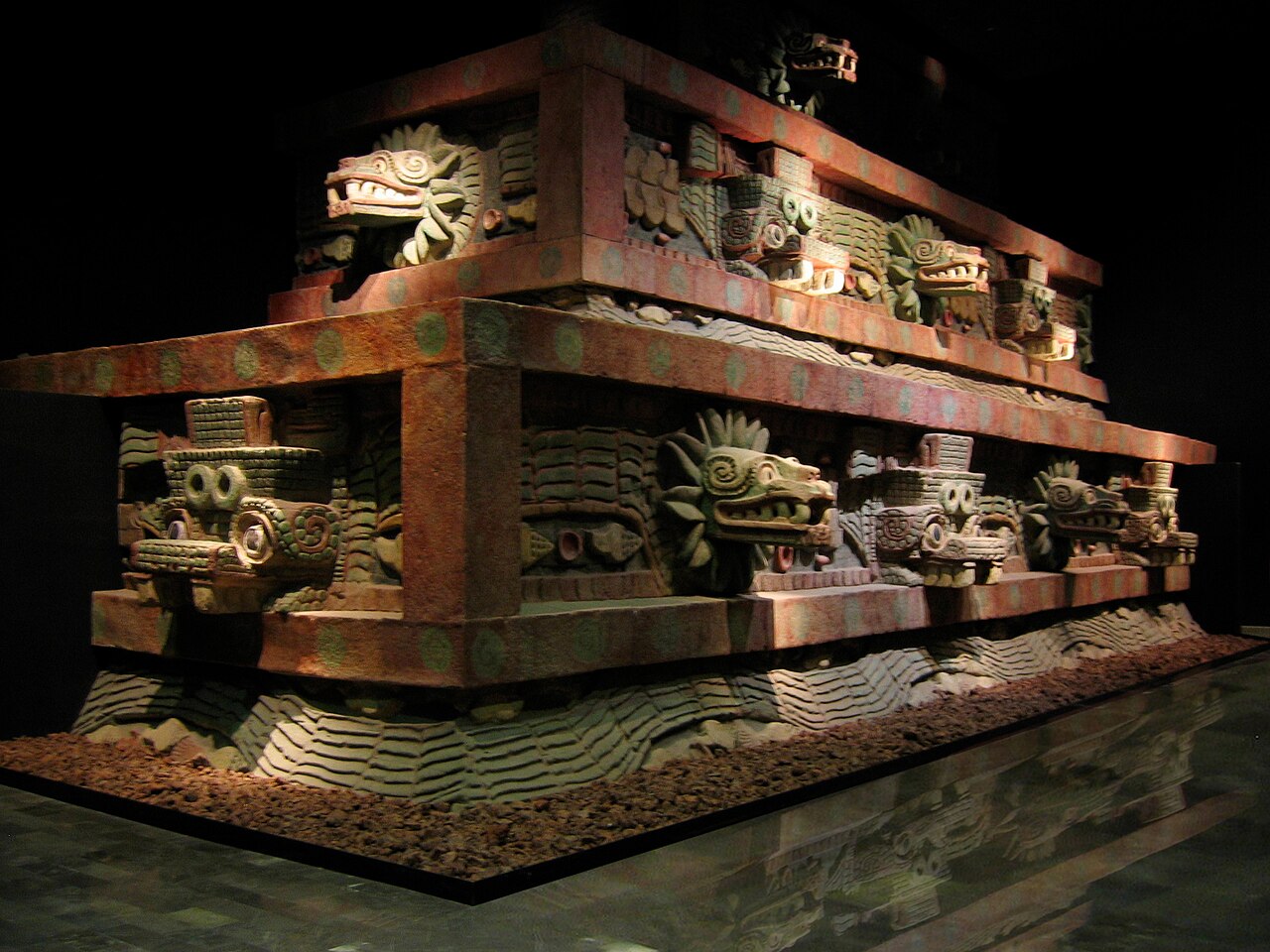
| Quetzalcoatl / Kukulkan | Aztec / Maya | Feathered Serpent; brought writing, the calendar, and agriculture |
| Nuwa & Fuxi | China | Serpent-bodied creators; Nuwa mended the sky, Fuxi taught writing and fishing |
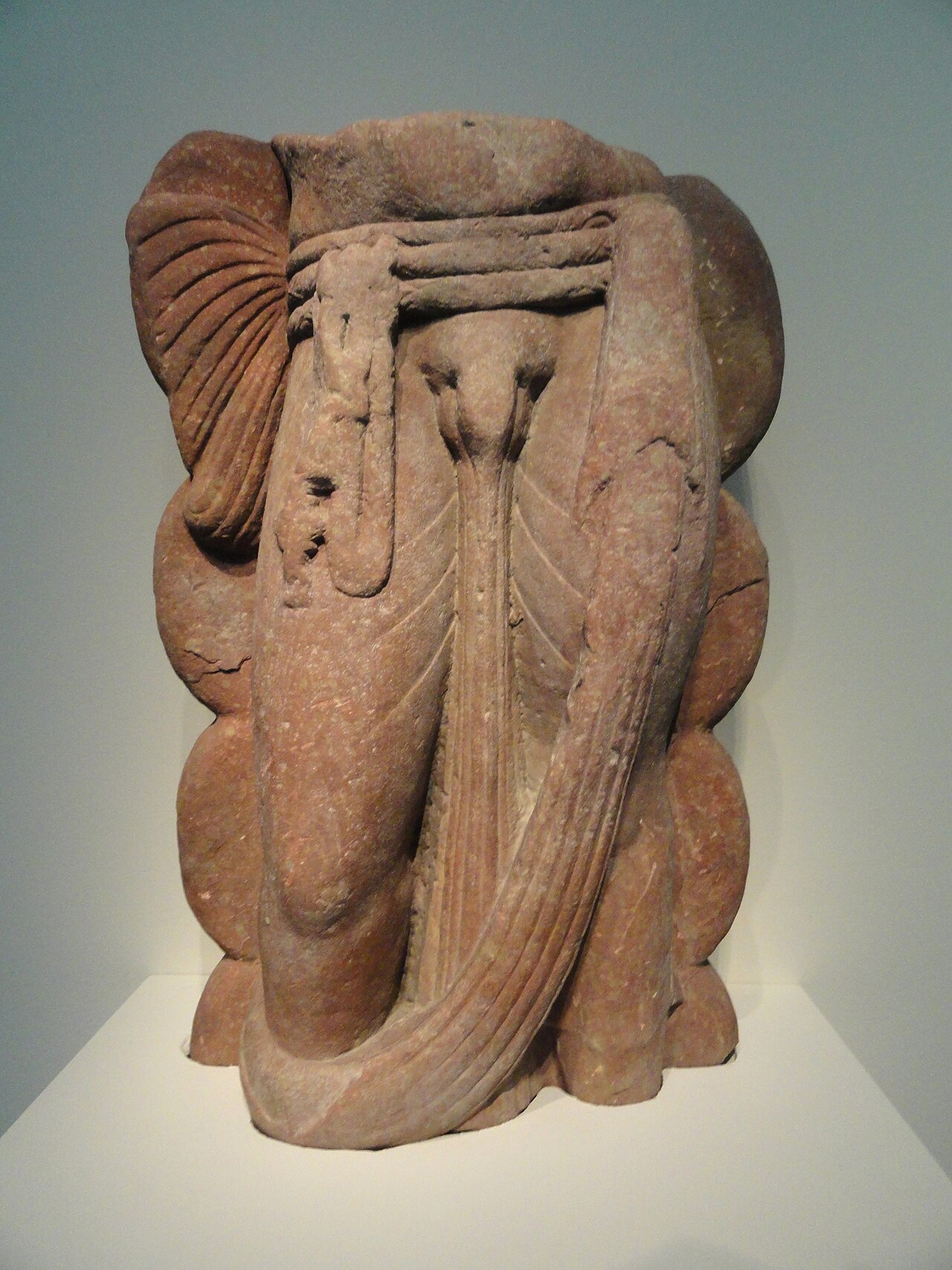
| Nagas (Vasuki, Shesha) | Hindu / Buddhist | Serpent race of the realm of Patala; Shesha is the cosmic foundation on whom Vishnu rests |
| Asclepius | Greece | God of medicine; his serpent-entwined staff is still medicine's emblem worldwide |
| Damballah / Aido-Hwedo | West Africa / Vodou | Creator serpent who shaped the earth and carries it |
| Rainbow Serpent | Aboriginal Australia | One of the great creation figures; shaped the land and governs water |
| Amaru | Andean (Inca / Quechua) | Serpent-dragon of water, subterranean power, and transitions |
Despite vast geographic separation, physical descriptions recur: a humanoid body, scaled skin, shapeshifting ability, superior intelligence, and large or compelling eyes are attested across Sumerian, Hindu, Mesoamerican, Chinese, and African traditions alike.
These are living traditions, not museum curiosities. The Rainbow Serpent, Mami Wata across West and Central Africa, the Zambezi's Nyami Nyami, and the Andean Amaru are still held sacred by the communities that carry them — and predate any colonial contact. They deserve to be read on their own terms, not flattened into a Western monster template.
03Creator, Teacher, Healer

Here is the part the modern reboot leaves out. In the ancient record, the serpent is overwhelmingly a figure of gift, not threat. It makes humanity, then hands us the tools of civilization: agriculture from Quetzalcoatl and Oannes, writing from Fuxi, medicine from Asclepius, sovereignty from the Egyptian Uraeus.
The serpent is the most universal symbol of knowledge and wisdom in human civilization — the giver of enlightenment in Genesis, the liberator-hero in Gnostic texts, the coiled Kundalini energy of Hindu and Buddhist practice, and the emblem of healing knowledge on the physician's staff.
The link survives intact into the present: the Rod of Asclepius — a single serpent wound around a staff — remains the internationally recognized symbol of medicine, an unbroken thread from antiquity to the ambulance on your street.
That positive reading has textual muscle behind it. In the Gnostic writings recovered at Nag Hammadi — texts excluded from the biblical canon at the Council of Nicaea — the serpent of Eden is recast as the hero who frees humanity from an ignorant lower god. The corpus reads this as a clue: the serpent's later demonization tracks closely with institutions that had a stake in restricting knowledge.
04The Great Reversal
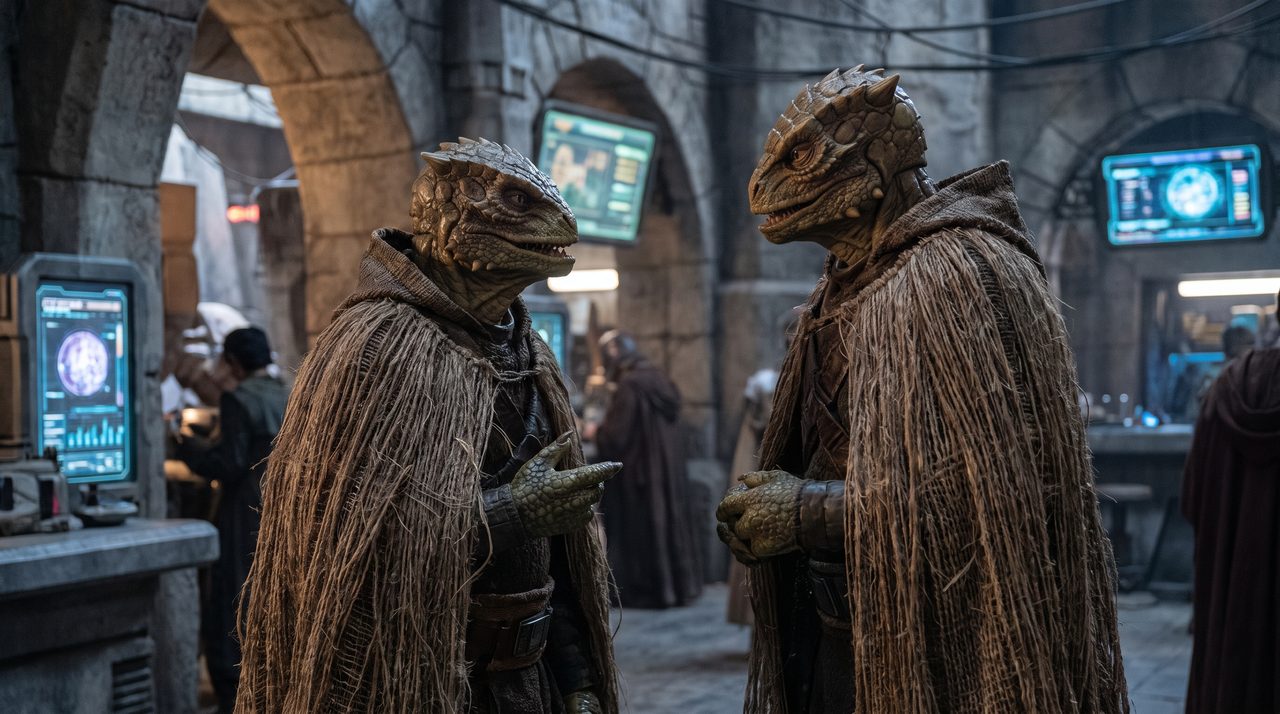
So how did the healer become the devil? Not overnight, and not because anyone found new evidence. The corpus lays the shift out as a slow, political process — each power structure with a reason to recast the old teacher-serpent as an enemy.
| Period | Development | Effect on the serpent |
|---|---|---|
| Pre-3000 BCE | Serpent worship widespread globally | Creators, teachers, protectors |
| ~3000 BCE | Rise of Zoroastrianism (Persia) | First strong good-versus-evil dualism |
| ~600–500 BCE | Babylonian exile; Zoroastrian influence on Jewish thought | Serpent recast as the adversary |
| ~325 CE | Council of Nicaea | Pro-serpent Gnostic texts excluded from the canon |
| ~400–600 CE | Christianity becomes a state religion | Systematic demonization of pagan serpent traditions |
| 1500–1700 CE | Colonial period | Mesoamerican and African serpent traditions actively destroyed |
| 1888 | Blavatsky, The Secret Doctrine | A 'Serpent Race' concept enters Western occultism |
| 1999 → | David Icke, The Biggest Secret | Serpent recast as an evil reptilian overlord |
The demonization of serpent beings was a gradual process spanning millennia, driven by religious and political power consolidation — not by any new discovery about the beings themselves. The record inverts from overwhelmingly positive to overwhelmingly negative while the underlying figures stay the same.
05Explaining the Enigma: Skeptics and Speculators
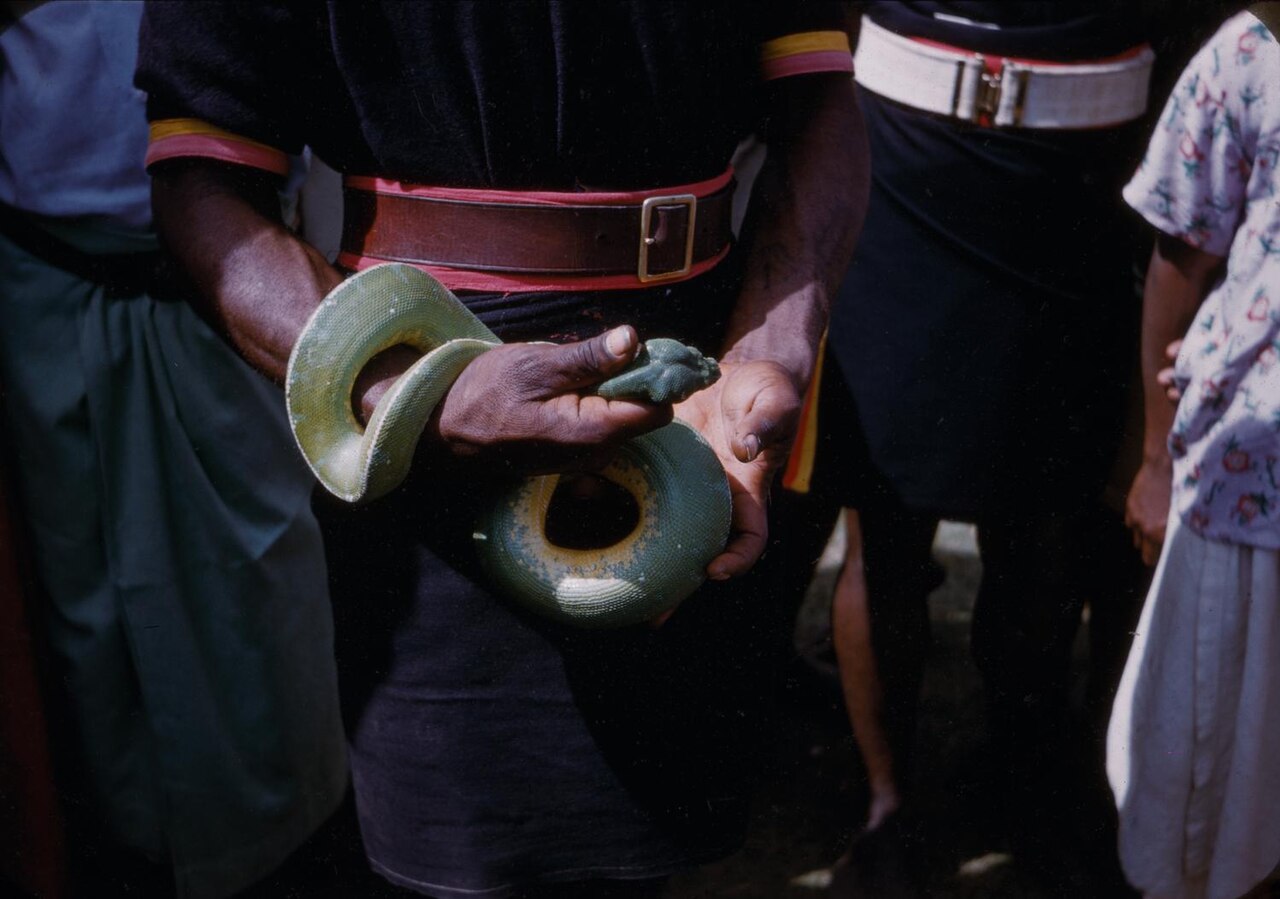
Why would minds the world over converge on the same scaled figure? The most grounded answers are not paranormal at all — they are wired into the primate brain.
Humans and other primates carry an innate, evolved fear of snakes. Natural selection favored ancestors who reacted instantly to serpentine shapes, leaving us biologically primed to read 'reptilian' features as dangerous — a bias that could be projected onto figures we already distrust.
Reptilian features grafted onto a humanoid body — slit pupils, scaled skin, a cold expression — trigger the 'uncanny valley,' a deep revulsion at the almost-but-not-quite-human. That visceral disgust can be misread as sensing 'evil' when it is really a neurological reflex.
Modern 'sightings' lean on pareidolia and confirmation bias — the mind's habit of finding faces and agency in noise, then remembering the hits and forgetting the misses. No verifiable evidence supports reptilian sightings or human-reptile hybrids, which are genetically impossible with Earth biology.
Neuroscience once labeled the oldest structures of the brain the 'reptilian complex' governing survival reflexes. Note the caution: the triune-brain model behind that name is now considered outdated and oversimplified by modern neuroscience.
Then there are the speculative readings — clearly flagged as unproven. Some propose the beings were a real species: paleontologist Dale Russell's 1982 dinosauroid thought experiment imagined what a humanoid dinosaur might look like had the Troodontid lineage survived.
Hypotheses that reptilian beings are a surviving saurian branch, interdimensional visitors, or evolved dinosauroids are speculation only — no physical evidence supports any of them. The same goes for the claim that the double-helix of DNA encodes ancient serpent knowledge; the visual echo is most likely coincidence, since spiral shapes are common in nature.
Zecharia Sitchin (1976) read Sumer's serpent-linked Anunnaki as extraterrestrial engineers of humanity — a reading mainstream scholars reject, particularly his cuneiform translations. Whatever the tablets mean, they are the achievement of Sumerian scribes; crediting 'aliens' with their civilization erases the people who actually built and wrote it.
06The Modern Impostor — and the Line We Won't Cross
The version most people have heard is barely a century old and largely inherited from fiction. The corpus traces a documented genealogy: Blavatsky's 1888 'Serpent Race,' Robert E. Howard's 1929 pulp story of shapeshifting serpent-men, mid-century pseudo-esoteric writings and the pulp-magazine 'Deros,' Sitchin's alien Anunnaki, and finally David Icke's 1999 The Biggest Secret, which welds it all into the full modern conspiracy.
David Icke's theory — that shapeshifting reptilians from the Alpha Draconis system have infiltrated royalty, politics, and banking to control Earth — rests entirely on testimonial and speculation. No verifiable evidence supports any part of it.
The 'reptilian elite' conspiracy recycles the secret-cabal and blood-ritual tropes of the fabricated antisemitic Protocols of the Elders of Zion (1903), swapping 'lizard' for older slurs to grant deniability. Labeling any group 'non-human monsters' is a well-documented step toward justifying violence against them. Alien Life Creations names this framing and rejects it outright: the serpent traditions in this article are mythology, never a coded attack on any real people.
This is the crux. The ancient traditions and the modern conspiracy are not the same thing. The originals describe benevolent creators, teachers, and protectors; the modern theory describes hidden overlords who feed on fear. Every fear-based element — the shapeshifting infiltration, the world-controlling parasites — was added in the last hundred-odd years and is absent from the traditions it claims to descend from.
Fast Facts
- Reach
- Serpent/dragon beings appear in nearly every major world civilization, independently
- Named beings
- Dozens catalogued across 11+ culture groups (Sumer to the Andes)
- Ancient verdict
- Overwhelmingly positive: creators, teachers, healers, guardians
- The turn
- Reframed as evil only after 1888 (Blavatsky) and 1999 (Icke)
- Still with us
- The Rod of Asclepius remains medicine's global symbol
- Scholarly read
- Mythic/symbolic archetype carries the strongest consensus
- Evidence
- Tier Mixed 1–4 · 11 sources · confidence Low
Honest Verdict
The cross-cultural serpent-being archetype is real, ancient, and overwhelmingly positive in the original record — a documented pattern, not a fringe claim.
Ophiophobia, the uncanny valley, pareidolia, and confirmation bias plausibly explain both the archetype's grip and modern 'sightings' — grounded, if not the whole story.
Literal reptilian beings — dinosauroids, interdimensionals, ancient-astronaut engineers, or DNA-encoded serpents — have zero physical evidence and stay firmly in the 'legends say' column.
The David Icke 'reptilian elite' conspiracy is unsupported and recycles antisemitic tropes from the Protocols forgery. We name it, and we reject it. Mythology, not a slur.
Sources & further reading
Everything above is drawn from our research library on Theories of Anything. Open the full files to check the sourcing and go deeper.
Image credits
- Standing Nagaraja (Serpent King). Wikimedia Commons. source CC0
- The feathered serpent Quetzalcoatl at Teotihuacan — knowledge-bringer, not monster. The people who carved this credited it with writing, the calendar, and the harvest.. Wikimedia Commons. source CC BY 2.0
- The Rod of Asclepius: a single serpent, a healer's staff, and an unbroken thread from the temples of antiquity to the badge on a modern ambulance.. The Met. source Public domain (CC0)
- The slit pupil that unsettles us. Our fear of the reptilian eye may be older than any myth — a survival reflex wired deep into the primate brain.. Wikimedia Commons. source CC BY 4.0
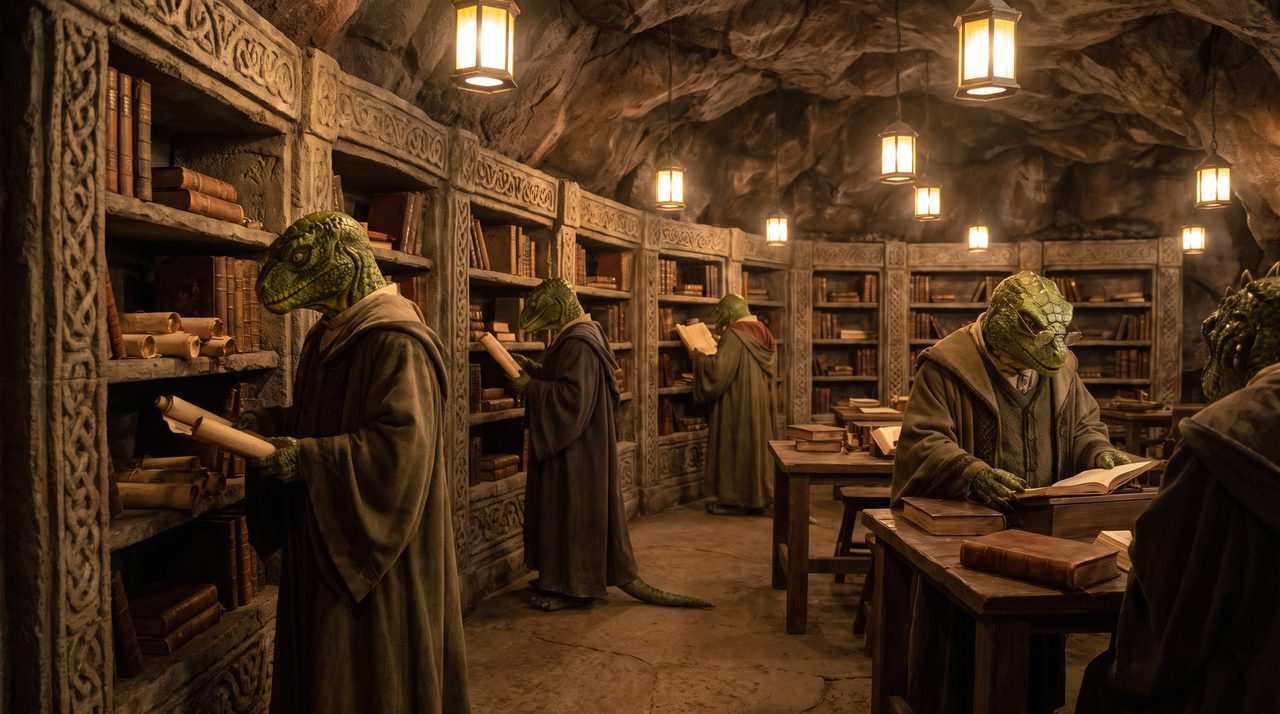
- Robed reptilian humanoids in a library — AI-generated artist's impression grounded in the serpent-as-knowledge-guardian thesis; not a documented being. AI-generated
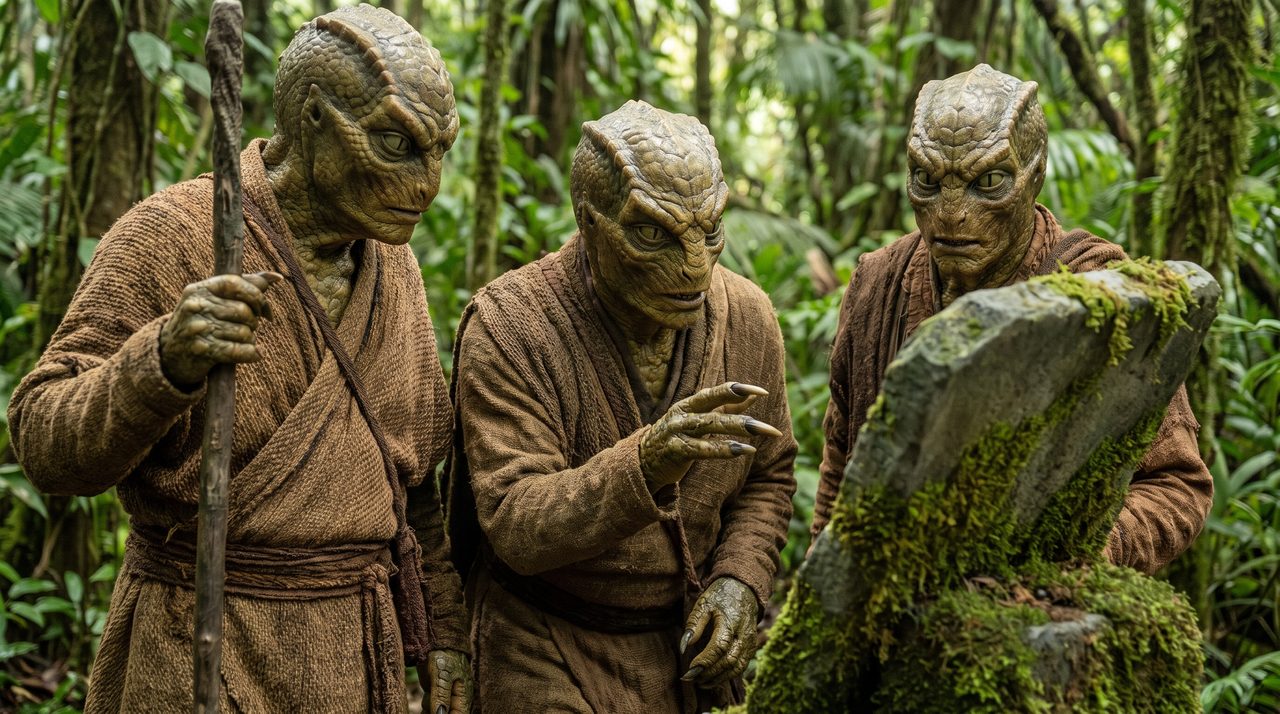
- Reptilian humanoids examining a stone tablet in jungle ruins — AI-generated artist's impression; not a documented being. AI-generated
- Reptilian humanoids in a lantern-lit marketplace — AI-generated artist's impression; not a documented being. AI-generated