Roman Dodecahedra: The Object Rome Never Wrote Down
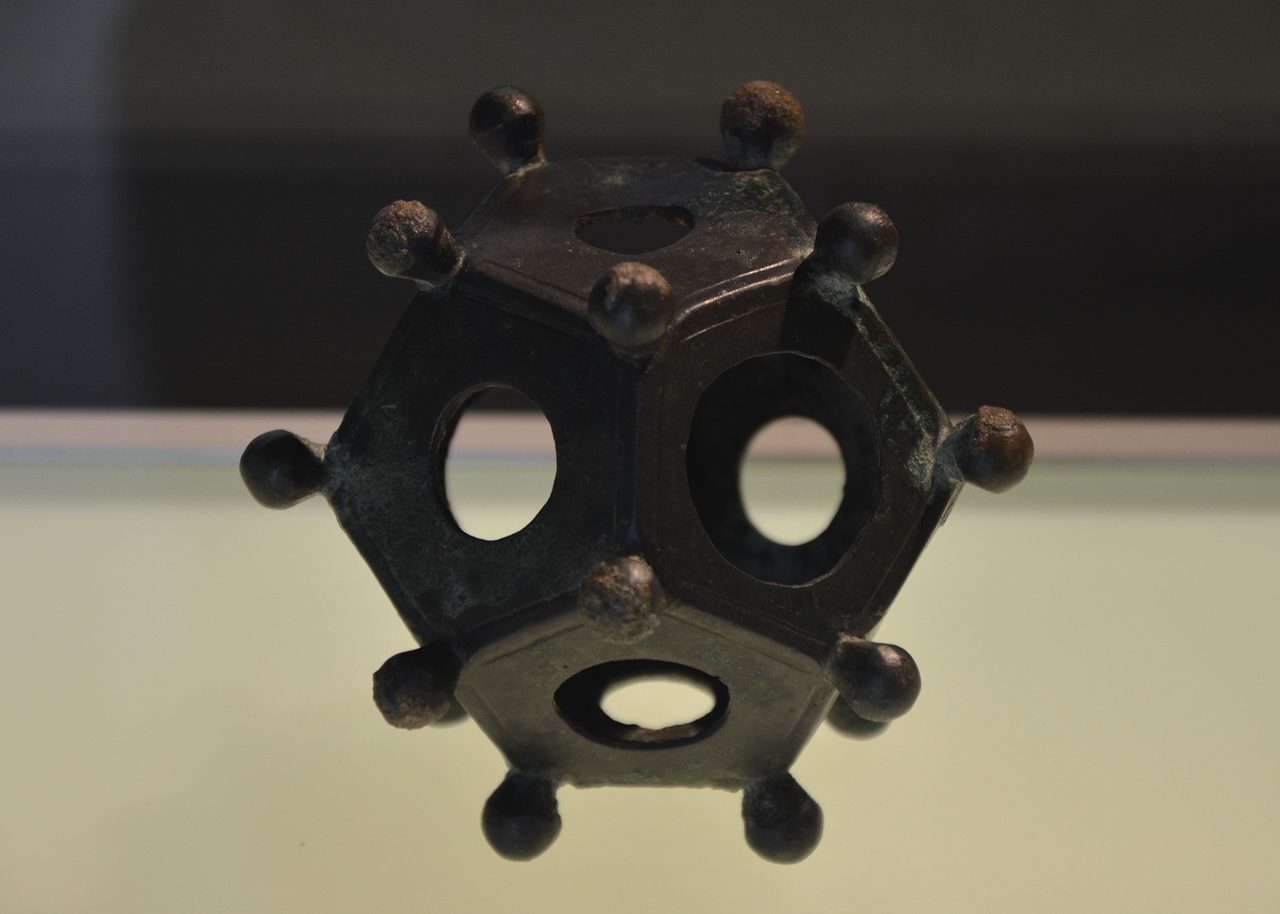
More than 120 hollow bronze twelve-sided objects have come out of the ground across the northwest of the Roman Empire. Not one ancient text, inscription, or drawing describes what they were for. Here is the file, opened claim by claim, every fact wearing its evidence.
The Romans wrote down almost everything. Siege engines, aqueduct gradients, troop rosters, tax records, the correct way to prune a vine, the mystical geometry of Plato's solids. We have engineering manuals, military archives, religious texts, and administrative paperwork by the shelf-load. And in all of it, across the entire surviving corpus, there is not one line about the small bronze object you are about to meet. Over 120 of them exist. Every one was made by hand. Nobody who made them ever, as far as we can find, described what they were for. Let's open the file.
01The Silence In The Sources
No surviving ancient Roman text, inscription, or illustration mentions or describes these objects. That silence holds across the extensive surviving corpus of Roman literature, engineering manuals, military records, religious texts, and administrative documents. This is not a gap waiting to be filled by more research. The total textual silence is itself one of the most well-established facts about the entire artifact class. Their function is genuinely, verifiably unknown.
Sit with that. A civilization that documented its world in obsessive detail produced a bronze object in quantity, buried it in temples and graves, carried it from Britain to the Danube, and left no written trace of what it was called or what it did. Whatever these were, they were so ordinary to the people who used them, or so deliberately unrecorded, that nobody bothered to write it down. That is the real mystery here, and it comes before any theory about candles, gloves, or surveying.
02What The Object Actually Is
A Roman dodecahedron is a small hollow object, most commonly cast in bronze, with rare examples in stone or lead. It has 12 pentagonal faces, each pierced by a circular hole of a different diameter, and 20 vertices, each topped with a rounded knob. This basic form is consistent across the known examples.
They range from about 4 to 11 cm in diameter, most often 6 to 8 cm, and typically weigh 50 to 400 grams. On a single object the circular holes range roughly 0.6 to 4 cm across, and that variation is consistent from example to example, which points to the differing hole sizes being intentional rather than accidental. Whatever the holes were for, they were meant to be different.
| Feature | Detail |
|---|---|
| Faces | 12 pentagonal, each with a circular hole of a different diameter |
| Vertices | 20, each capped with a rounded knob |
| Material | Usually bronze; rare stone or lead |
| Diameter | 4 to 11 cm (most commonly 6 to 8 cm) |
| Weight | 50 to 400 grams |
| Hole sizes | Roughly 0.6 to 4 cm, consistently varied |
03Where They Turn Up, And Where They Never Do
Over 120 examples have been documented across the former Roman Empire, and the distribution is lopsided. The largest concentration is in Roman Gaul (modern France and Belgium). Roman Britain has around 30. Germania and Raetia (modern Germany, Switzerland, Austria) hold significant numbers. Pannonia and Dacia (modern Hungary, Romania) have a few.
None have been found in the Italian peninsula, in North Africa, or in the eastern Mediterranean. This is not empire-wide Roman kit. It points to a specifically Gallo-Roman and northwest-provincial cultural context, which is itself a strong clue that gets ignored whenever someone proposes a universal explanation.
Contextual dating of the associated finds places most examples in the 2nd to 4th centuries CE, roughly 100 to 350 CE, with a few possibly as early as the 1st century CE. Find contexts include villa foundations, temples, and graves. Objects deliberately placed in temples and burials are not usually casual household junk.
04The Theories, And Why Each One Cracks
Because the sources are silent, every explanation has to be reverse-engineered from the object and its find spots. Several are genuinely credible. None has scholarly consensus. Here is the honest scorecard, and for each idea, the evidence that argues against it.
Surveying instrument. The varying hole diameters could be sighting ports for measuring angles or distances, with the knobs acting as stable rest points, and the concentration in frontier and military provinces is cited as circumstantial support. Against it: no ancient Roman surveying text mentions any such device, and the well-documented Roman surveying tools, the groma and the chorobates, include nothing dodecahedral.
Candleholder. The different hole sizes could hold candles or tapers of different diameters, and wax residue has been reported on some examples. Against it: many holes are too small for any practical candle, the knobs would make the object an unstable stand, and no soot deposits have been found inside most examples.
Religious or ritual object. Some dodecahedra were found in temple contexts or clear ritual deposits, buried in foundations or placed in graves, and the dodecahedron carried mathematical and mystical weight in Pythagorean and Platonic thought, with Plato's Timaeus tying it to the cosmos. The northern distribution is read as consistent with Celtic-Roman syncretic religion. Against it: no specific deity, cult, or ritual is documented as using dodecahedral objects.
Knitting or glove-sizing tool. A viral 2014 demonstration showed a dodecahedron could work as a peg-based tool for knitting glove fingers at different sizes. Against it: no textile residue has ever been found on any actual dodecahedron, bronze is an expensive choice when wood would do the same job, and the idea explains neither the knobs nor the ritual-deposit find contexts.
Agricultural calendar. A 2012 self-published proposal (Wagemans) argues the objects determined planting dates by watching sunlight pass through specific holes at specific times of year. Geometrically possible in principle, but it has never been archaeoastronomically tested at any actual find site, and simpler calendar methods were widely available across the Roman world.
Military range-finder. Varying hole sizes could let a soldier estimate distance to a target of known size, such as a military standard, by finding which hole it fits when held at arm's length. It remains untested and purely conjectural, and no military text supports the use.
Toy or game piece. The manageable size and playful geometric look have led some to suggest a gaming or toy function. Against it: many examples come from contexts that signal deliberate value (temple deposits, burials, hoards), and the design's consistency across hundreds of kilometers argues against a mere toy.
| Theory | Evidence tier | The main objection |
|---|---|---|
| Surveying instrument | Tier 2 | No surveying text mentions it; the known Roman tools are not dodecahedral |
| Candleholder | Tier 2 | Holes often too small; no soot inside most examples |
| Ritual or religious object | Tier 2 | No documented deity, cult, or rite uses one |
| Knitting or glove-sizing tool | Tier 2 | No textile residue; bronze is a strange, costly choice |
| Agricultural calendar | Tier 3 | Never tested at a find site; simpler calendars existed |
| Military range-finder | Tier 3 | Untested, conjectural; no military text backs it |
| Toy or game piece | Tier 3 | Find contexts suggest value, not play |
05The Twenty-Sided Cousin
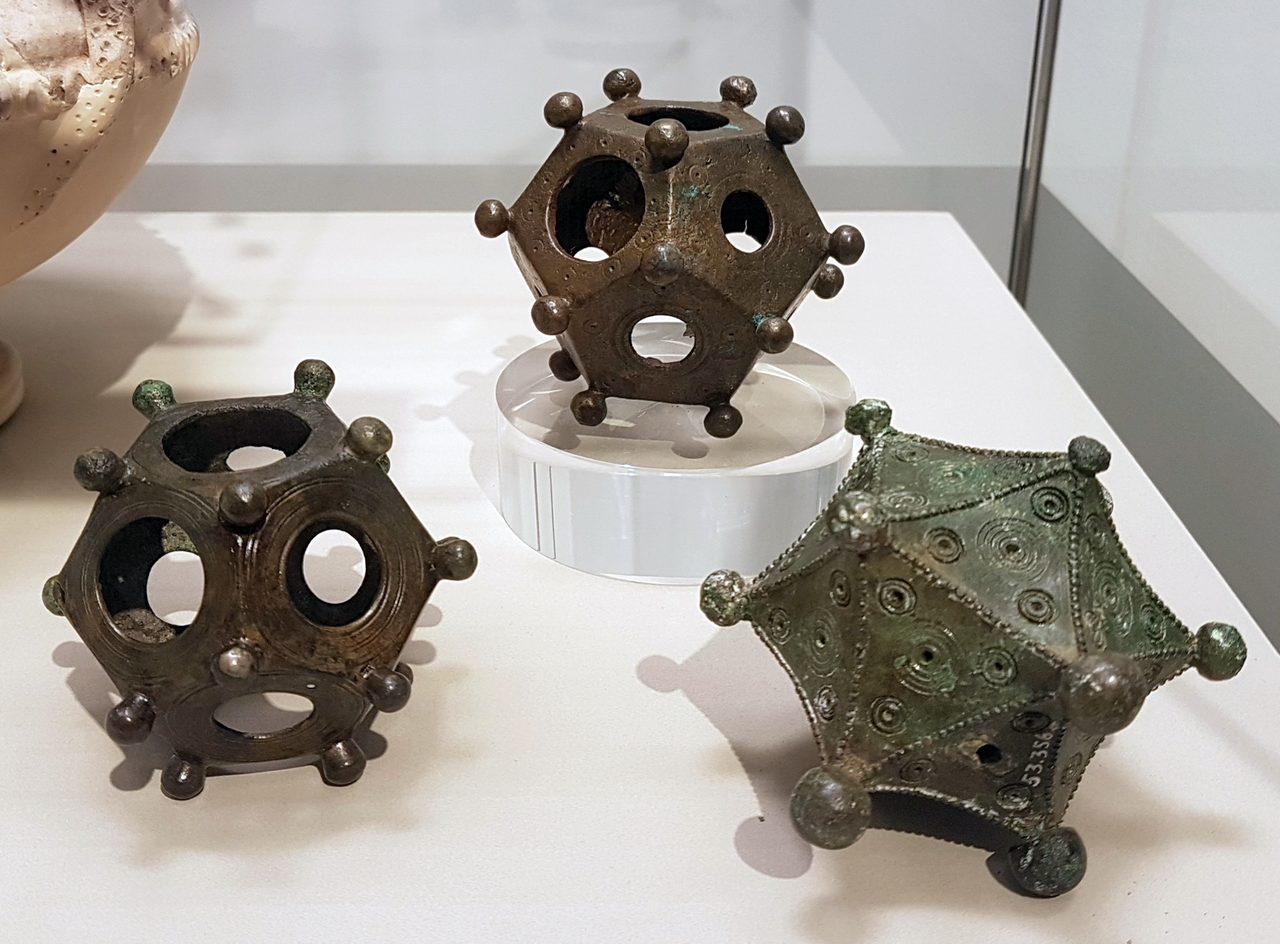
A smaller, distinct class of related bronze icosahedra, 20 triangular faces, some with numbered faces, has also turned up in Roman contexts. The numbering on some hints at possible use as dice or divination tools, but the icosahedra are a separate artifact class from the dodecahedra and should not be folded into the same explanation.
The sole known example of the bronze icosahedron, excavated near Arloff, Germany, is displayed alongside two bronze dodecahedra, from Bonn and from Frechen-Bachem, at the Rheinisches Landesmuseum Bonn, all dated to the 3rd century CE. Every museum label on every example, including the Gallo-Roman Museum of Tongeren piece pictured above, carries the same honest wording: purpose undetermined.
06Where The Fringe Comes In, And Why It Fails
An object nobody can explain is catnip for bigger claims. If Rome never wrote it down, the argument goes, maybe Rome did not make it, or could not have. That leap does not survive contact with the metal itself.
Claims that the dodecahedra represent lost advanced technology, or science beyond documented Roman capability, are unsupported. Casting a dodecahedral shape in bronze by the lost-wax method is well within known Roman metallurgical skill. The genuine mystery is about function, not about how the thing was made.
Claims of extraterrestrial or non-human origin have no supporting evidence at all. The objects are made of standard Roman-era bronze alloys, cast by standard lost-wax technique. The manufacturing story is completely ordinary. Only the purpose is unknown.
Fast Facts
- Object
- Hollow bronze dodecahedron, 12 holed pentagonal faces, 20 knobbed vertices
- Known examples
- Over 120 documented
- Heartland
- Roman Gaul; Britain has about 30
- Never found in
- Italy, North Africa, the eastern Mediterranean
- Date
- Mostly 2nd to 4th centuries CE
- Ancient descriptions
- None. Zero texts, inscriptions, or images
- Function
- Unknown; no theory has scholarly consensus
What We Can Actually Stand Behind
The objects are real and well-studied. Over 120 bronze dodecahedra exist, concentrated in the northwest provinces, dated mostly to the 2nd through 4th centuries CE, and no ancient source describes them. All of that is settled.
No theory wins. Surveying tool, candleholder, ritual object, knitting aid, calendar, range-finder, toy: each is at best credible and unproven, each has a real objection standing against it, and none holds scholarly consensus. The honest answer to what they were for is that we do not yet know.
Lost advanced technology and non-human origin both fail. Not because scholars refuse to look, but because the metal is standard Roman bronze cast by standard Roman methods. The mystery is the purpose, never the making.
So the file closes where it opened. A people who wrote down almost everything made this thing more than a hundred times over, buried it with their dead, set it in the foundations of their temples, and never once told us why. If it was that useful, or that sacred, why is it not in a single line they left behind? And if it was that ordinary, why can nobody today agree on what it did?
Sources & further reading
Everything above is drawn from our research library on Theories of Anything. Open the full file to check the sourcing and go deeper.
Image credits
- A bronze Roman dodecahedron from the Gallo-Roman Museum of Tongeren, Belgium photograph by Carole Raddato, via Wikimedia Commons. CC BY-SA 2.0 Source.
- Two bronze Roman dodecahedra and one bronze icosahedron at the Rheinisches Landesmuseum Bonn photograph by Kleon3, via Wikimedia Commons. CC BY-SA 4.0 Source.
- Card crop of A bronze Roman dodecahedron from the Gallo-Roman Museum of Tongeren, Belgium photograph by Carole Raddato, via Wikimedia Commons. CC BY-SA 2.0 Source.
.jpg)
