Sacsayhuamán: Boulders Fitted Tighter Than a Razor
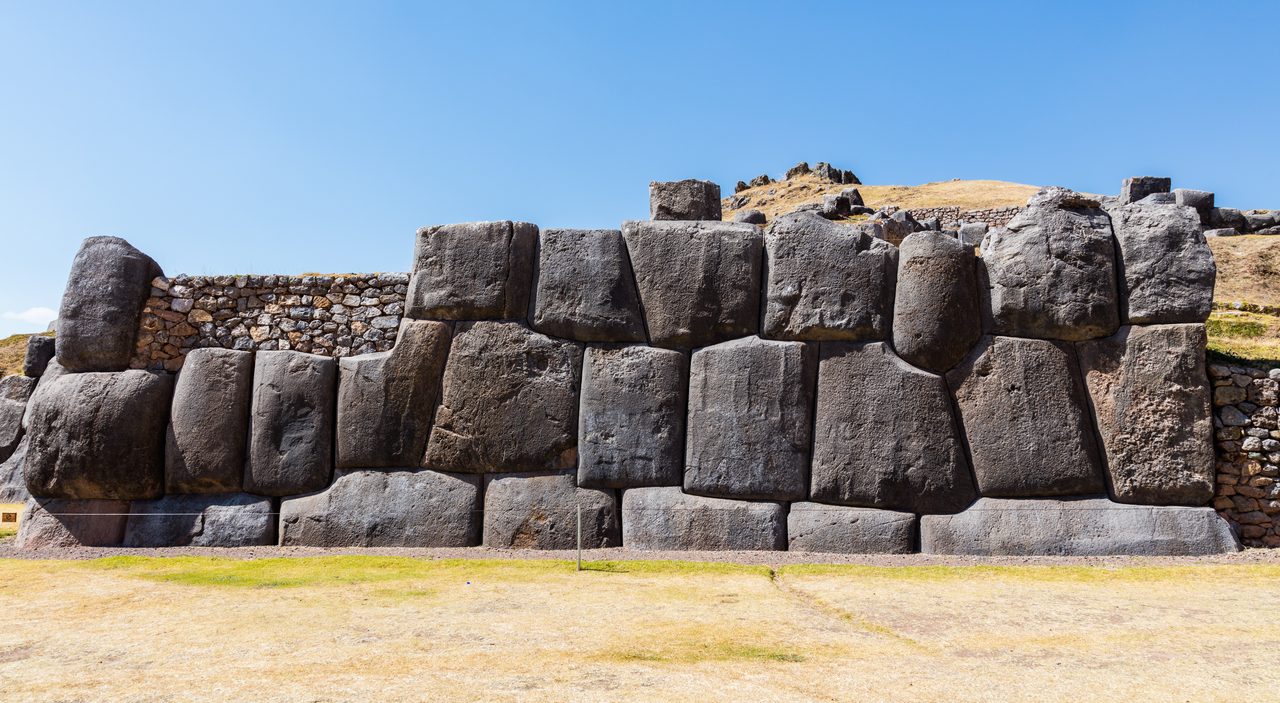
A wall above Cusco holds limestone boulders of up to 128 tons together with no mortar at all, fitted so tightly a knife blade will not enter the seam. Here is the file, opened from the ground up, every claim wearing its evidence.
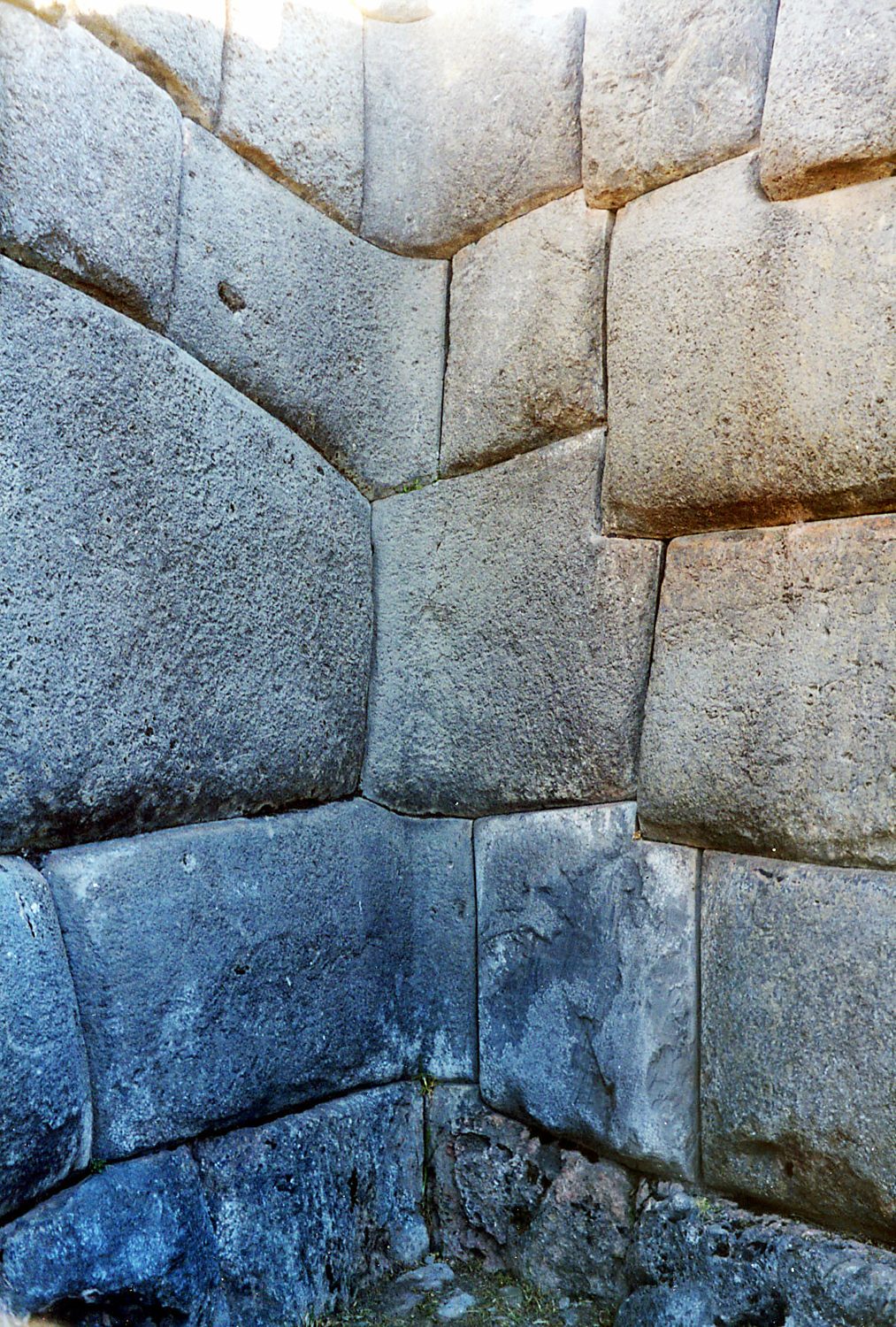
There is a wall above Cusco where a builder's oldest test still works. Slide a knife against the seam between two stones, each one bigger than a car, and the blade will not go in. No mortar holds them. Nothing was ever poured between them. They were simply cut and ground until they touched along every face, and they have kept that grip for more than five hundred years, through the earthquakes that flattened the Spanish city built below. Let's open the file.
| Feature | Measurement |
|---|---|
| Zigzag walls | 3 parallel terraces, ≈ 400 m each |
| Combined height | ≈ 18 m across the three terraces |
| Largest block | ≈ 128 tons (≈ 8.5 × 5 × 4 m) |
| Angles per wall | ≈ 20 to 22 zigzag teeth |
| Platform behind the walls | ≈ 3,600 m² |
01The wall a knife will not enter
Sacsayhuamán's three parallel walls run roughly 400 meters each, rise across three terraces to a combined height near 18 meters, and are built from polygonal blocks fitted without a trace of mortar. The largest, on the lowest terrace, is a single limestone boulder of about 128 tons. In most places the joints are tight enough that a knife blade will not enter the seam. This is the plain archaeological record, measured and published.
For scale, that biggest block runs roughly 8.5 by 5 by 4 meters, taller on its long side than a two-story house, and it was not dropped into a rough foundation. Every face that meets a neighbor was ground until the two stones touched along their whole length. Do that once and it is remarkable. Sacsayhuamán does it across three walls and thousands of blocks, no two shaped alike.
02Who actually cut them
The builders are not a mystery, and never really were. Sacsayhuamán crowns the hill above Cusco, the Inca capital, and Spanish chroniclers who arrived within a lifetime of its building (Cieza de León, Garcilaso de la Vega, Bernabé Cobo) recorded who raised it and how. It went up under the Inca state, begun in the reign of Pachacuti and continued by Tupac Inca Yupanqui, using the mita, the rotational labor tax that every subject of the empire owed.
The chronicles record a workforce of 20,000 to 30,000 laborers building over roughly 60 to 80 years, dating the main construction to about 1440 to 1530 CE. Garcilaso de la Vega names the labor of 20,000 men. And the Inca were not the first on the hill: the earlier Killke culture occupied it from around 900 to 1200 CE, and Killke walls sit underneath the Inca stone.
The zigzag plan, roughly twenty to twenty-two sharp angles per wall, is widely read as the teeth of a puma. Cusco itself was laid out in the shape of that animal, with Sacsayhuamán sitting where its head would be. The reading is scholarly and well supported, though a symbolic intent can never be proven the way a measurement can.
| Style | Where | What it looks like |
|---|---|---|
| Polygonal / cyclopean | Lowest terrace | Massive multi-sided boulders up to ≈ 128 tons, each uniquely shaped, joints too tight for a blade |
| Coursed ashlar | Upper sections, interior | Rectangular blocks in regular courses, the standard Inca imperial style (also at the Qoricancha and Machu Picchu) |
03How you grind a 128 ton jigsaw
So how do you shape a 128 ton block exactly enough that it locks to its neighbors with no gap? The honest answer is slower and stranger than any laser: you do it by hand, and you do it over and over.
The architect Jean-Pierre Protzen showed in 1993 that the whole effect is reproducible with Inca-era tools: river-cobble hammerstones, bronze chisels, and abrasive sand. A block was lifted against its neighbor, the high spots that touched first were marked with pigment, then the stone was lowered and ground down, and the cycle repeated until the faces met everywhere. It is punishing, patient work, but it needs no technology the Inca did not have.
The fitted faces are subtly convex meeting subtly concave, so each stone seats into the one beside it like a joint rather than resting on a flat seam. That interlock is not just for looks. It is exactly what keeps the wall from sliding apart when the ground moves.
04Built to ride an earthquake
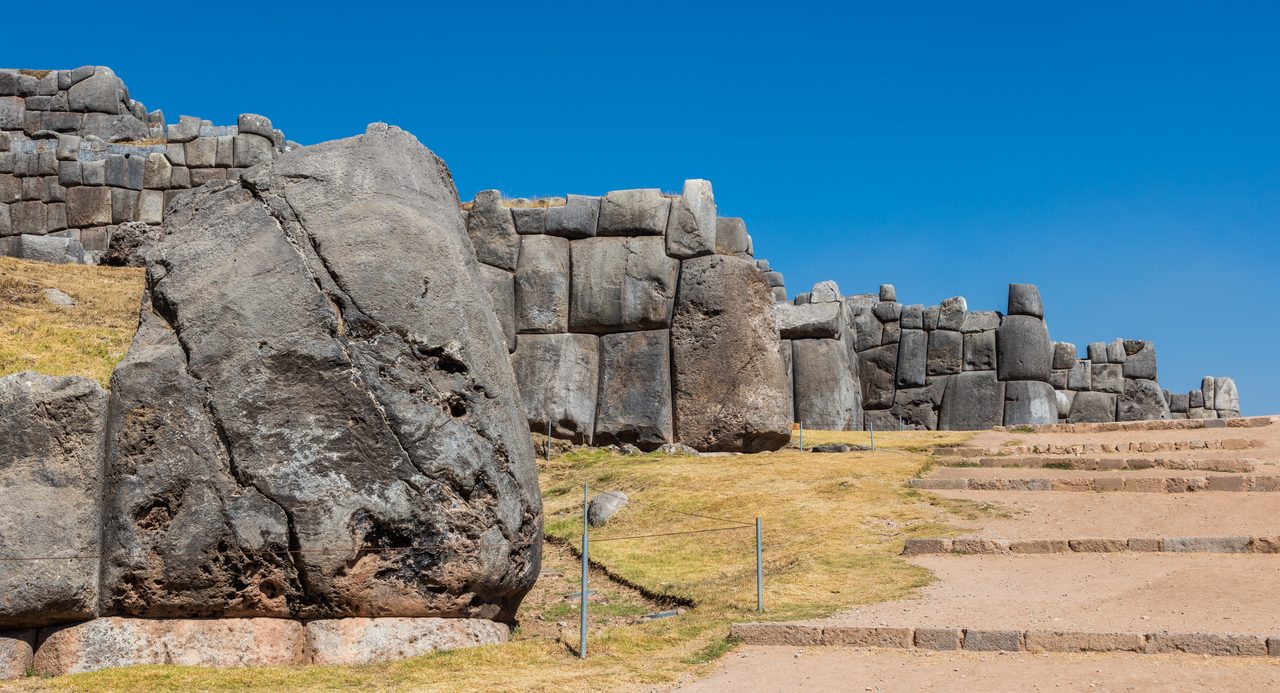
Polygonal masonry is quietly earthquake-engineered. The mortar-free, interlocking joints let individual stones shift a little during a tremor and then settle back into place, where a rigid mortared wall would crack and fall. Each terrace also leans slightly inward (an inward batter) so gravity pulls the wall into the hillside rather than away from it.
The proof is in Cusco's own record. The major earthquakes of 1650 and 1950 brought down colonial-era buildings across the city while the Inca walls beneath and beside them stood intact. The design was tested for real, and it held.
05Fortress, temple, or both
Then there is the oldest argument about the place: what was it for? The name and the European memory of it both say fortress. The evidence is more divided than that.
The siege is history. In 1536, during Manco Inca's rebellion against the Spanish, Sacsayhuamán became the anchor of a desperate battle. Spanish cavalry charged uphill against the Inca defenders and eventually took the walls at heavy cost in lives. That single event, lived by the men who wrote the first accounts, fixed the word fortress to the site for centuries.
But the growing scholarly reading is that Sacsayhuamán was first of all a ceremonial center. It stands at the puma-head of the sacred city, it hosted the Inti Raymi festival of the sun, and behind the walls the carved Rodadero outcrop (with its polished slides, seats, and channels) points to ritual, not artillery. The purely military picture may be the conquerors' projection, shaped by the one day they had to fight for it.
Some researchers report that the corridors between the zigzag walls seem to amplify sound, and wonder whether the acoustics were designed for ceremony (drums, massed voices). It is a real observation, but whether the effect is intentional or an accident of the geometry is unknown.
06Where the lost civilization comes in
All of which sets up the claim the walls are most famous for outside archaeology: that they are simply too precise for the Inca, and therefore the work of someone else. That claim comes in two strengths, and it is worth pulling them apart.
The milder version holds that the largest polygonal blocks belong to an earlier, lost pre-Inca civilization, and that the Inca merely built on ruins they inherited. The trouble is the dirt. Excavation finds no stratigraphic or material-culture break marking a construction phase separate from the documented Killke and Inca periods, and the biggest blocks match Inca polygonal style. The theory rests on how the stones feel, not on anything recovered from the ground.
The stronger version, that the Inca softened stone with a secret plant chemical, or used laser cutting, anti-gravity, or alien machines, has no archaeological, chemical, or botanical support of any kind. It also misreads the fitting as superhuman when hands-on experiment shows it is merely extraordinary. This is the same move that repeats at almost every site on this wing: the stone is big, therefore the builders are unknown. It feels like evidence. It is not.
Fast Facts
- Site
- Sacsayhuamán, on the hill above Cusco, Peru
- Builders
- Inca, chiefly Pachacuti and Tupac Inca Yupanqui
- Built
- ≈ 1440 to 1530 CE
- Largest block
- ≈ 128 tons (≈ 8.5 × 5 × 4 m), Yucay limestone
- Labor
- 20,000 to 30,000 workers over ≈ 60 to 80 years (mita tax)
- Earlier occupants
- Killke culture, ≈ 900 to 1200 CE
- The joints
- Mortar-free, too tight for a knife blade
- Famous siege
- 1536, Manco Inca's rebellion
What we can actually stand behind
The walls are real, they are Inca, and the mortar-free polygonal fitting is among the finest stone-working ever done by hand. The chroniclers named the builders, the labor, and the years.
Whether Sacsayhuamán was chiefly a fortress or chiefly a ceremonial center is a live scholarly question, argued from real evidence on both sides, not a settled fact in either direction.
There was no lost pre-Inca civilization, no chemically softened stone, and no alien or laser technology. Not because scholars will not look, but because every tool mark, every unfinished block, and every eyewitness account points to Inca hands.
Which leaves the question the stones never answer out loud. We know who cut them, we know roughly how, and we know close to when. What we cannot fully recover is the mind of a state that judged a single wall worth tens of thousands of people and most of a century, then let the towers on the terrace above be carried off for church walls without, it seems, much of a fight. The joints still hold a knife out. Why they were ever set this tight went into the ground with the people who set them.
Sources & further reading
Everything above is drawn from our research library on Theories of Anything, deep-read in full rather than skimmed. The corpus files are where we worked from; the papers, reports and primary records listed beneath them are where you can check us independently.
Image credits
- The great polygonal lowest-terrace wall of Sacsayhuaman above photograph via Wikimedia Commons (Diego Delso (Poco a poco)). CC BY-SA 4.0 Source.
- Tight close-up of the mortar-free polygonal joints between photograph via Wikimedia Commons (Håkan Svensson (Xauxa)). CC BY-SA 3.0 (also GFDL 1.2+, CC BY 2.5) Source.
- The three parallel zigzag/sawtooth terraces of Sacsayhuaman photograph via Wikimedia Commons (Diego Delso (Poco a poco)). CC BY-SA 4.0 Source.
- Card crop of the great polygonal lowest-terrace wall of Sacsayhuaman photograph via Wikimedia Commons (Diego Delso (Poco a poco)). CC BY-SA 4.0 Source.


