The Sea Peoples: History's Great Whodunit
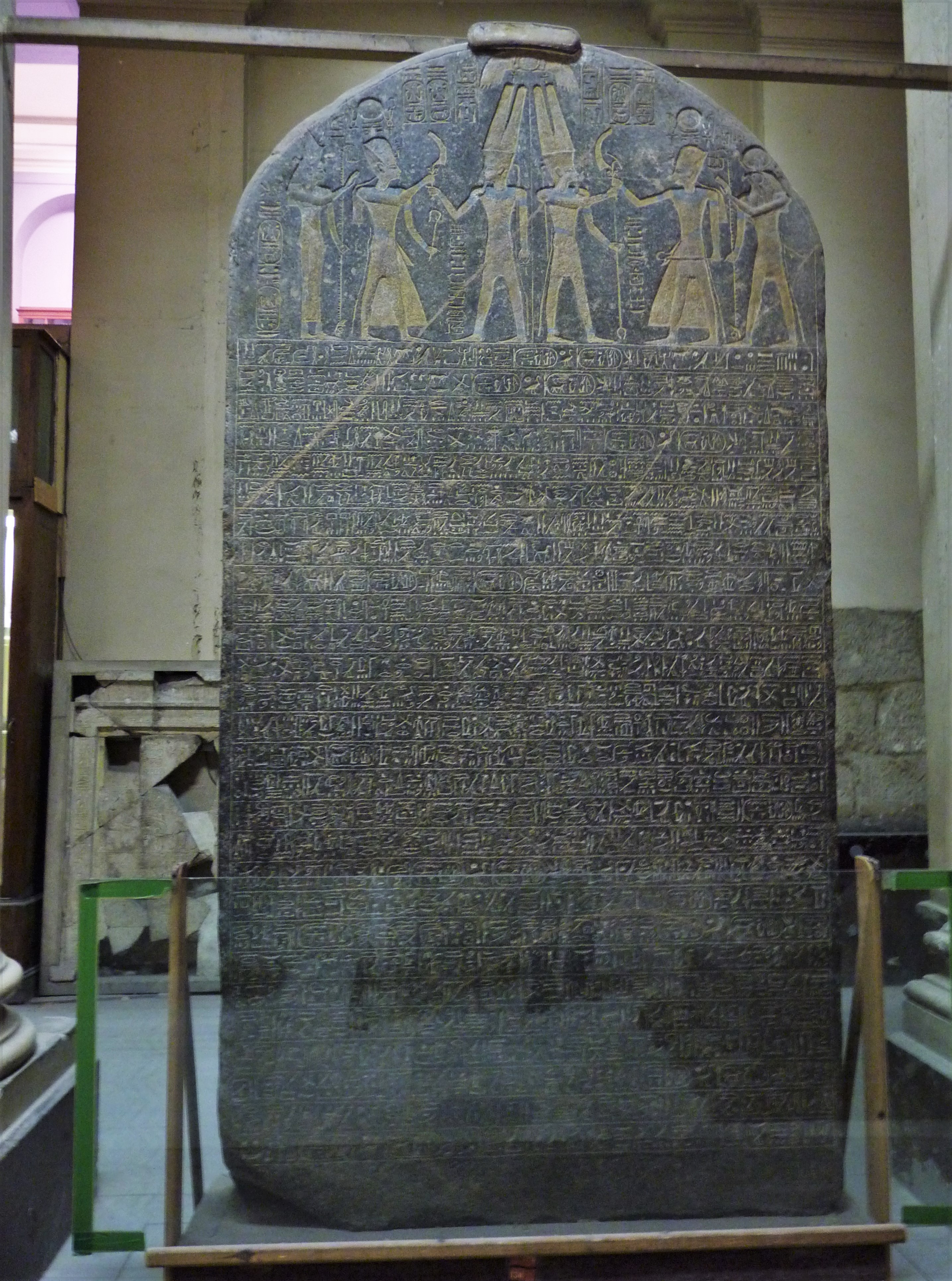
Nine names, carved into two Egyptian temple walls a generation apart, and for more than a hundred and fifty years scholars have been trying to match each one to a real people on a real map. This is the identity mystery underneath the Bronze Age Collapse, and the honest answer is that the cases are not equally solved. One name, Lukka, is nailed down by a Hittite paper trail centuries deep. One, the Peleset, is the Philistines, confirmed by ancient DNA, and we make that case in full in our sister file on the collapse itself. Several sit in genuine, still-open debate: Sherden, Denyen, Ekwesh, Shekelesh, Tjeker, each with rival homelands and dueling philologists. One old favorite, the Tursha as ancestors of the Etruscans, has been actively killed off by modern genetics, not merely left open. And one, the Weshesh, has never been identified at all, with not even a face on a wall to go by. Here is the whole roster, suspect by suspect, every identification wearing its tier.
Start with the crime scene, because it is the one part of this file that is not in dispute. Two Egyptian pharaohs, a generation apart, left records naming the foreign peoples who came at Egypt by land and sea around 1200 BCE. Merneptah's account names five. Ramesses III's Year 8 confederation names five more, one of them shared with the older list, for nine distinct names in all. Our sister file on the Bronze Age Collapse tells the story of those records, those battles, and the wider world that was coming apart around them. This file asks the narrower and stranger question underneath: each of those nine names was a real people, somewhere, who spoke a language and buried their dead and left things in the ground. So who were they? A hundred and fifty years of scholars have tried to answer, and the surprise is how unevenly they have managed it. Let us take the suspects one at a time, best solved first.
01How These Cases Get Made, And Why They Wobble
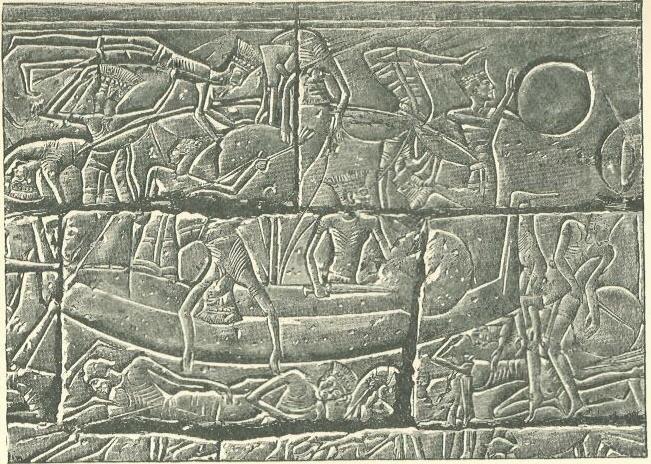
Every one of these identifications begins the same way, and it is worth being honest about how thin the starting thread is. The Egyptians wrote a foreign name in their own script, and a modern scholar matches that spelling to some later people or place whose name sounds similar. That is the whole method for most of the nine: phonetic resemblance, one ancient word set beside another. The corpus doc flags the weakness plainly, and the history of the field proves it, because the same handful of names has sent nineteenth-century philologists off toward Sicily, Sardinia, Anatolia, and the Aegean, each certain, each reading the same syllables and landing somewhere different. This is why the confidence attached to these names runs the whole way from almost certain down to no idea, even though nearly every case rests on the same kind of clue.
So this file uses one rule throughout. Phonetics alone is the baseline, and a name that has nothing but a sound-alike behind it sits in the credible-but-unproven middle at best. A group climbs toward Tier 1 only when something harder backs it up: an independent paper trail centuries long, matching objects pulled out of the ground, or ancient DNA. And a group falls toward Tier 4 when its identification was never really evidenced in the first place, or when newer evidence has actively turned against it. Two of the nine climb. Two of them fall. The rest sit in the honest middle, which is exactly where the evidence leaves them.
| Group | In Merneptah's List (c. 1208 BCE) | In Ramesses III's Year 8 Confederation (c. 1177 BCE) |
|---|---|---|
| Lukka | Yes | No |
| Peleset | No | Yes |
| Ekwesh | Yes | No |
| Denyen | No | Yes |
| Sherden | Yes | No |
| Shekelesh | Yes | Yes |
| Tjeker | No | Yes |
| Tursha | Yes | No |
| Weshesh | No | Yes |
02Lukka: The One Name That Is Nailed Down
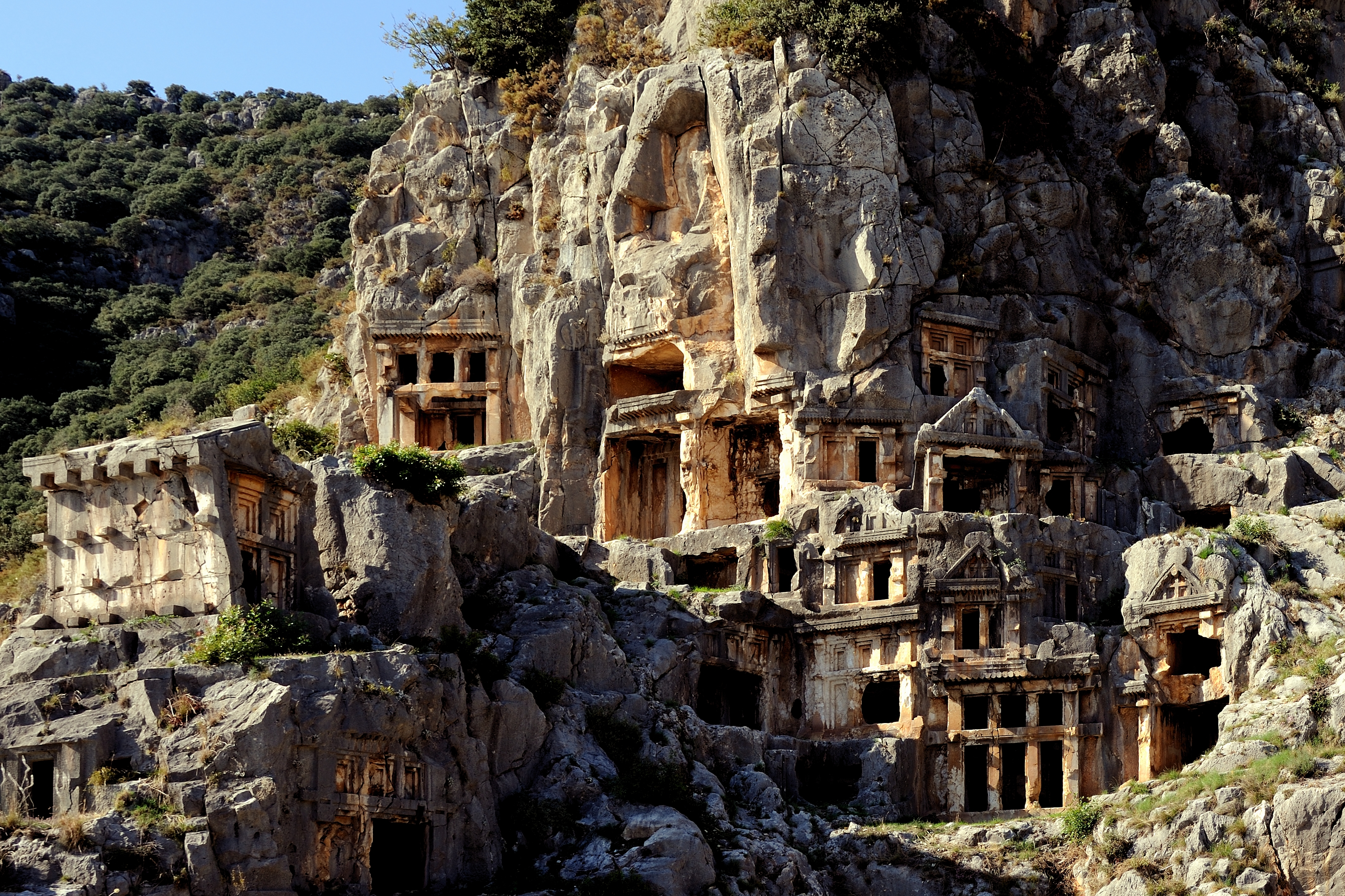
Begin with the one case that barely belongs in a mystery at all. It is commonly accepted that the Bronze Age name Lukka is the same word as classical Lycia, the mountainous coast of southwest Anatolia, and the reason this identification is so much firmer than the others is that it does not lean on Egyptian spelling at all. Lukka turns up, again and again, in the royal archives of the Hittite Empire, for centuries before the Sea Peoples crisis ever happened. This is the difference between a sound-alike and a paper trail.
That trail runs across generations. A Hittite treaty with Alaksandu of Wilusa, around 1280 BCE, references potential campaigns toward Lukka. Soldiers from Lukka fought for the Hittites at the Battle of Kadesh, around 1274 BCE, and are recorded as later turning against Hittite authority. The last Hittite king, Suppiluliuma II, tried and failed to subdue them. And a Hieroglyphic Luwian stela raised by King Tudhaliya IV, who reigned roughly 1237 to 1209 BCE, commemorates his own conquests in the lands of Lu-ka, naming specific subjugated towns: Tlos, possibly Pinara, Xanthos, and Patara. Those are real place names that persist unbroken into classical Lycia. You can still find them on a map.
Then the Egyptian record folds this well-attested Anatolian people directly into the crisis. Inscriptions from the reign of Merneptah, around 1208 BCE, name the Lukka among the invading Sea Peoples coalition. So this is not a lucky phonetic coincidence pointing at a place we know nothing else about. It is a region and a population documented for two centuries in a second empire's own archives, then recorded turning up in Egypt's list of raiders. Of the nine names, this one is the closest thing to solved.
The only real argument left is about size, not identity. Trevor Bryce reads the Lukka lands as a large territory taking in the later regions of Lycaonia and Pisidia as well as Lycia proper. Ilya Yakubovich argues that Lukka was limited to Lycia itself and that the Hittites never regarded it as a unified state at all, describing it instead as politically decentralized, a scatter of local powers. Rostislav Oreshko proposes two separate Lukkan centers, one near classical Lycia and a second in the eastern Troad. Notice what they are fighting over: how big Lukka was and how it was organized, never whether Lukka was Lycia. On the core question, they already agree.
03Peleset: The Case That DNA Closed
The Peleset are the Philistines. That one we can say flatly, and after Lukka it is the best-proven identification in the roster, because it does not rest on a sound-alike either. The 2019 ancient-DNA work at Ashkelon, which our sister file on the collapse lays out in full, found a genuine pulse of southern-European ancestry arriving on the Levantine coast in exactly the right century. We will not re-argue the genetics here. What is worth adding is the rest of the case, the part written in clay rather than in genomes.
At Ashdod, a rich assemblage of locally made Mycenaean IIIC:1b pottery, Aegean in style, was found right next to an actual potter's workshop. In the first generation of settlement, in the early twelfth century BCE, Philistine workshops were producing this Aegean-style pottery locally, out of local clays. That is the detail that matters. It is one thing to find imported Aegean pots, which only prove trade. It is another to find Aegean-trained potters working at the wheel with Canaanite mud, which proves that the people who made this pottery came with the settlers. The craft migrated, not just the goods.
The style tracks the newcomers across the map. This distinctive Mycenaean IIIC:1 pottery first appears along coastal Cilicia, Syria, and Philistia during the twelfth century BCE, arguably not before roughly 1125 BCE in Philistia itself, and it was manufactured locally in both Philistia and Cyprus. From there the Philistine ceramic tradition is conventionally divided into three phases, each one a further step away from its pure Aegean ancestors and toward a locally synthesized art blending with the Canaanite traditions already in place. You can watch a foreign people become a settled local one, phase by phase, in the pottery alone.
Daniel Master, who directs the Ashkelon excavations that produced the DNA results, described those results as direct evidence for the theory that the Philistines began as migrants from the west who settled at Ashkelon in the twelfth century BCE. It is a small, sharp point of history worth keeping in view: the cemetery that eventually yielded that DNA was only discovered in 2016, three years before the study was published. The single most decisive piece of evidence in this whole article was still in the ground, unfound, within living memory.
04Ekwesh: Almost Certainly Greek, Except For One Detail
The Ekwesh appear only in Merneptah's earlier list, not in Ramesses III's confederation, and they have long been read as a band of Bronze Age Greeks, the Achaeans. The bridge is the Hittite term Ahhiyawa, which appears extensively in Late Bronze Age Hittite royal correspondence and which sounds, to most ears, like a Hittite rendering of Achaea. Match the Egyptian Ekwesh to the Hittite Ahhiyawa to Homer's Achaeans, and you have a chain running from Egypt through Anatolia to the Greek mainland.
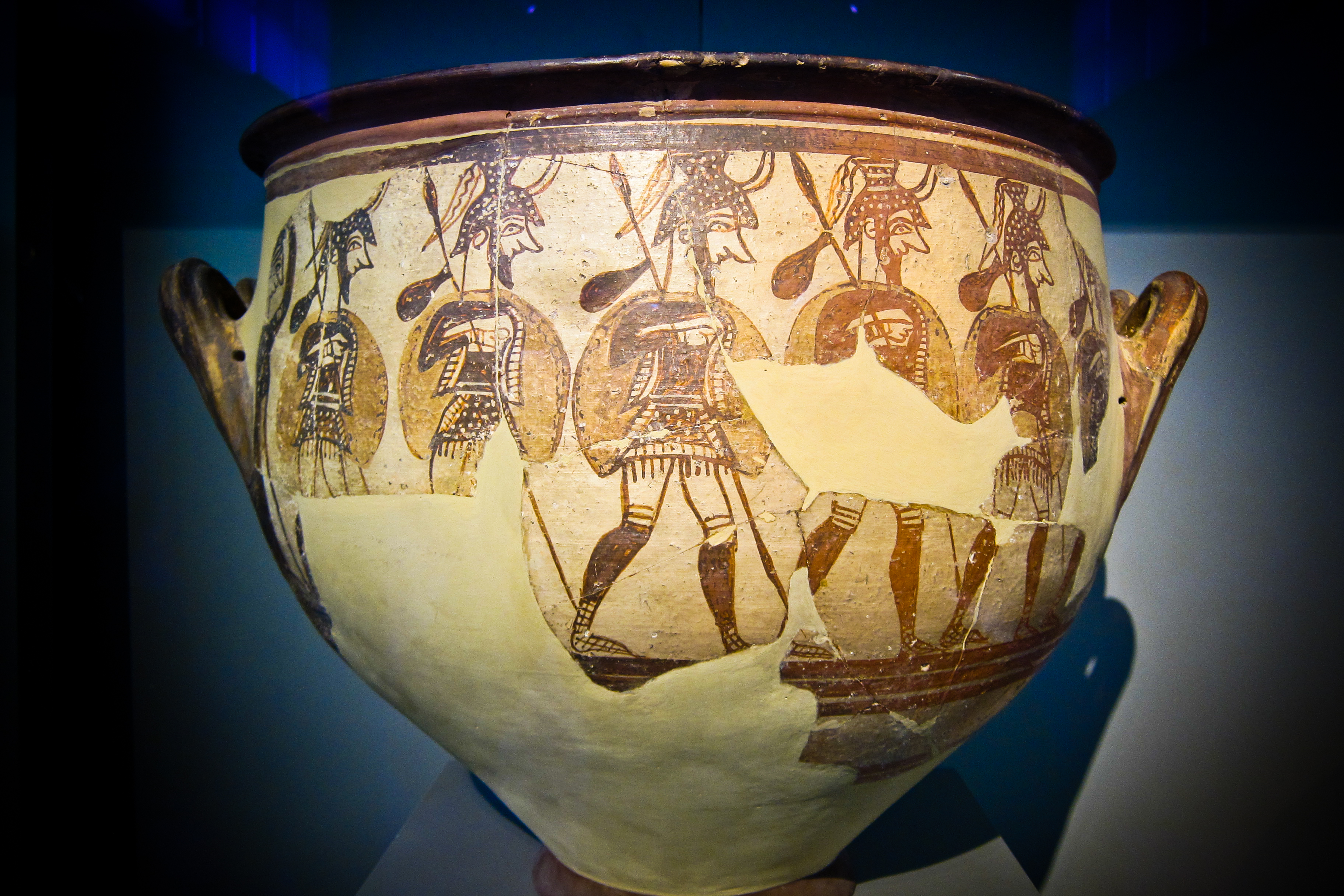
The strong end of that chain is genuinely strong. Independent of the Sea Peoples question entirely, the broader equation of Ahhiyawa with the Mycenaean Greek world is a widely supported conclusion in Hittitology, built over decades of re-reading Hittite diplomatic texts and cross-checking them against the material evidence for Mycenaean contact with the Anatolian mainland. The key document is the Tawagalawa Letter, a real, dateable text in which an unnamed Hittite king, most likely Hattusili III in the thirteenth century BCE, addresses the ruler of Ahhiyawa as a diplomatic equal, one Great King writing to another. Whoever Ahhiyawa was, it was a power Hatti treated as a peer.
The weak end of the chain is where the Ekwesh specifically get interesting. Egyptian inscriptions record that the defeated or captured Ekwesh were circumcised, a detail some scholars read as awkward for a straightforward Greek identification, since circumcision is not typically associated with Bronze Age Greek populations in the ancient sources. So there is real tension in the file: the macro-historical case that Ahhiyawa means the Greek world is well founded, while the micro-level Egyptian detail about these particular raiders does not sit comfortably with it.
It is worth adding that even the geography of Ahhiyawa is unsettled. Scholars have separately proposed Rhodes in the Dodecanese, Mycenae in the Argolid, and Thebes in Boeotia as its political center, and some suspect the center was never fixed in one place at all but shifted over time. So even where the broad identification holds, the map underneath it is still being drawn.
The honest verdict here comes in two layers, and they should not be collapsed into one. High confidence that Ahhiyawa broadly denotes the Mycenaean, Achaean Greek world in Hittite usage. Only moderate, genuinely contested confidence that the specific raiding group Egypt called the Ekwesh was that same population, given the circumcision detail and the general phonetic caveat that hangs over the whole roster. Strong at the top, wobbly at the bottom, and worth saying so.
05Denyen: Two Answers, And Maybe Both Are Right
The Denyen come with two competing identifications that are not variations on one idea but two separate claims resting on two separate bodies of evidence. The first connects them to the Danaans, Homer's own poetic name for the Greeks, the Danaoi, by way of the Egyptian toponym Tanaju. The second connects them instead to the Danuna, a real polity centered on Adana in Cilicia, in southeastern Anatolia, attested independently in Hittite-era and later records. Aegean Greeks, or Cilician Anatolians. Keep the two apart, because each has genuinely old evidence behind it.
The Tanaju thread reaches back centuries before the crisis. Egyptian records from the reign of Thutmose III, around 1437 BCE, roughly two and a half centuries before Ramesses III, mention messengers from the king of the Tanaju. A temple list from Amenhotep III then names specific Tanaju cities, and they are real Mycenaean Greek places: Mycenae, Nauplion, Kythera, and Messenia. The Egyptian evidence for a Bronze Age Greek Tanaju is solid. The further step, that this fifteenth-century Tanaju is the same people as the twelfth-century Denyen, is a reasonable inference but only that, an inference, not a proof.
The Danuna thread has an equally real anchor in a different archive. The earliest reference appears in the Amarna Letters, from the mid-fourteenth century BCE, which record the kingdom of Danuna and note the death of its ruler during the reign of Amenhotep III or Akhenaten. That is a functioning Cilician or northern Levantine polity, on the record, well over a century before the Sea Peoples crisis. Again the base evidence is firm, and again the leap that ties this Danuna to the later Denyen is the softer part of the argument.
The clearest later evidence for the Cilician thread is carved in stone. The Karatepe bilingual, the Azatiwada inscription of the eighth century BCE, written in Phoenician and in Luwian hieroglyphs on slabs at a hilltop site in Cilicia, names the king of the Danunians, dnnym in the Phoenician. And here the two threads brush against each other, because the kings of Adana in that inscription trace their lineage to the house of Mopsos, a legendary Greek seer-figure, and the surrounding region carries the place name Mopsuestia, Mopsus's hearth in Greek. That is a real toponymic link between Cilicia and Aegean Greek legend. It postdates the Bronze Age crisis by roughly four centuries, but it may preserve a much older tradition.
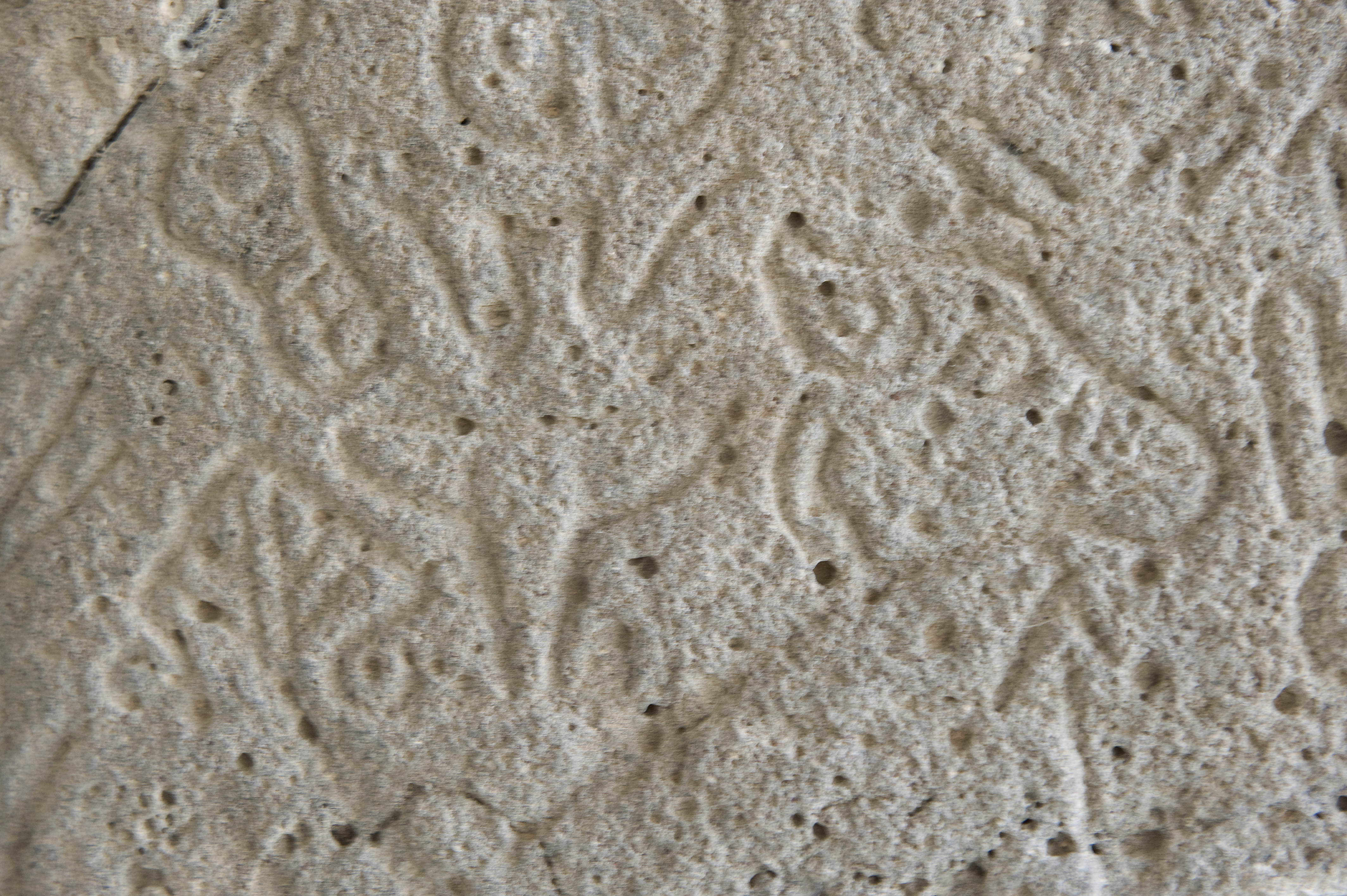
One further proposal can be set aside cleanly. Yigael Yadin argued for connecting the Denyen to the biblical Tribe of Dan, but by the sourcing's own account that identification has not been accepted by mainstream scholarship. It is a minority idea that did not hold, and it should not be given equal footing with the two evidenced threads above.
Here is a possibility worth floating, offered as a reading rather than a finding. The Danaan-Aegean and Danuna-Cilician threads may not be rivals fighting over a single answer at all. A Cilician polity that keeps its own Aegean-linked founding legend, the house of Mopsos, could plausibly be read as evidence of real population or dynastic movement from the Aegean world into Cilicia at some point. If so, both theories could be partly right, and the Denyen mystery would not be a matter of choosing the correct one but of seeing that the two ends of the story were connected all along.
06Sherden: A Debate That Will Not Settle
The Sherden are unusual because Egypt already knew them, and knew them as soldiers, before the crisis ever broke. The earliest possible reference sits in Amarna-era correspondence from Rib-Hadda, around 1350 BCE, though that text does not yet confirm any sea-raiding association. The first certain reference is sharper: Ramesses II defeated Sherden raiders in 1278 BCE, then turned around and folded the survivors into his own personal royal guard. An Egyptian inscription calls them the unruly Sherden whom no one had ever known how to combat. Egypt fought them, could not beat their kind cleanly, and hired them. They then shadow the whole crisis: named in Merneptah's Year 5 list, and still present under Ramesses III, serving as his troops and encamped in Amurru before the Year 8 campaign, even though the five names his scribes carved for that confederation itself were the Peleset, Tjeker, Shekelesh, Denyen, and Weshesh.
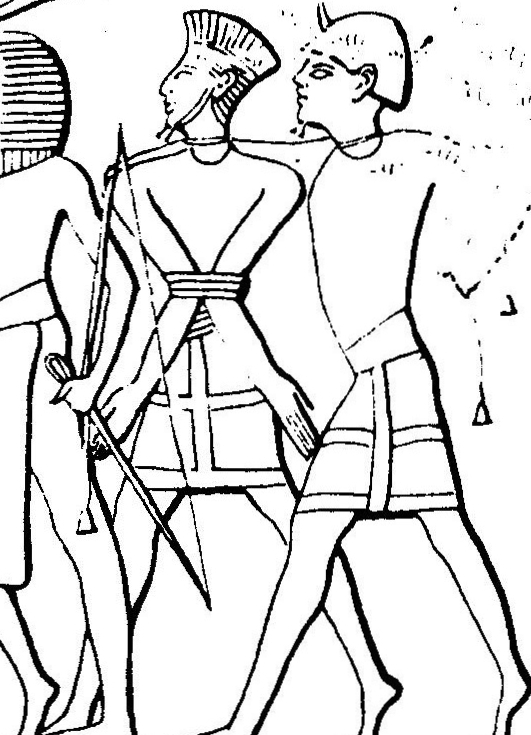
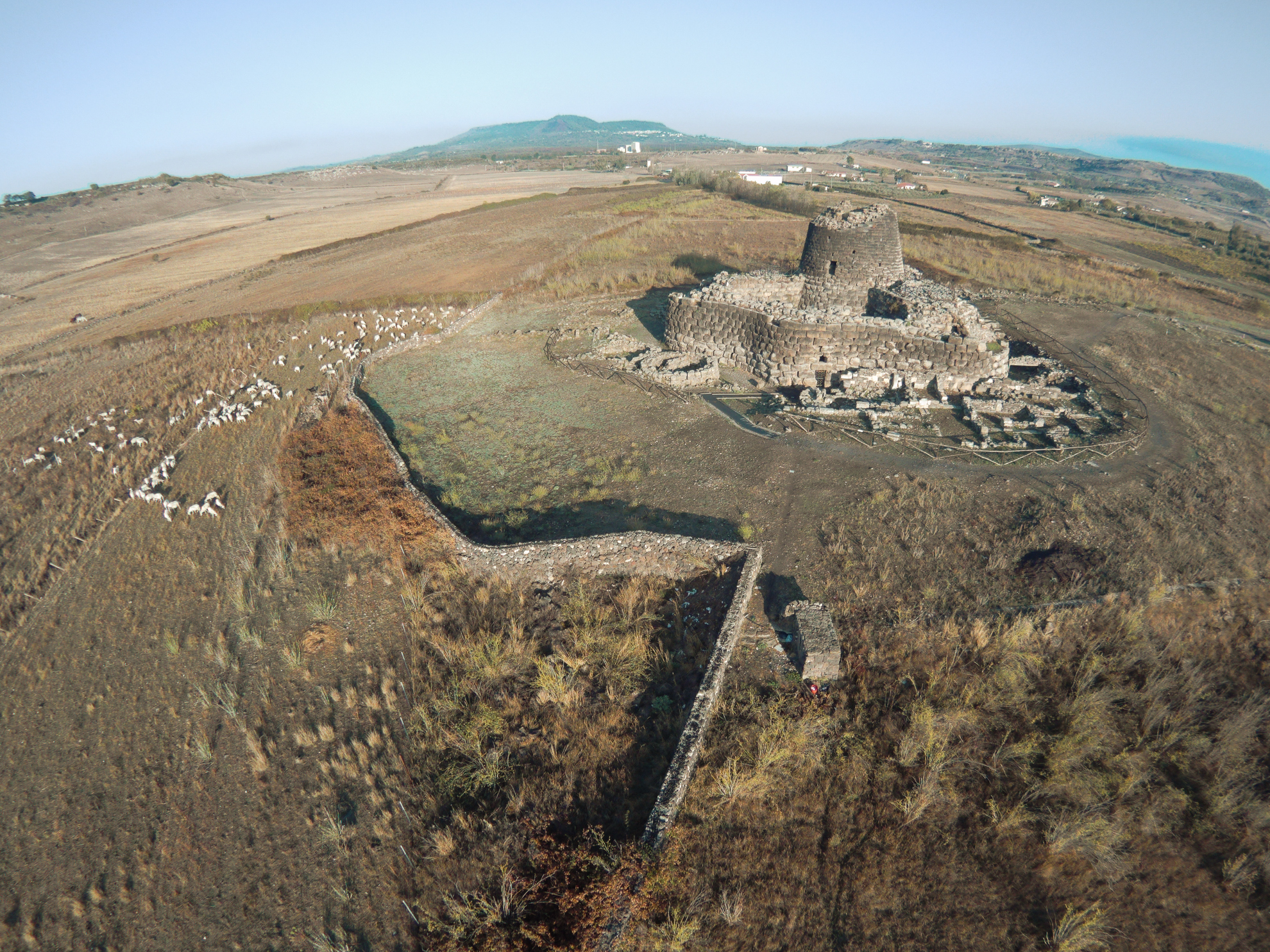
The homeland question points, famously, at Sardinia. A line of Italian archaeologists, from Antonio Taramelli and Massimo Pallottino to the more recent Giovanni Ugas, identify the Sherden with the island's indigenous Nuragic civilization. Ugas's excavation of the Hypogeum of Sant'Iroxi turned up arsenical-bronze swords and daggers dated to roughly 1600 BCE, evidence that Nuragic people were using matching weapon types since the middle of the second millennium BCE, well before the crisis. It is a real, named, seriously argued identification. It also rests on weapon typology and name resemblance rather than on any direct textual or genetic proof, so it belongs in the credible middle, not at the top.
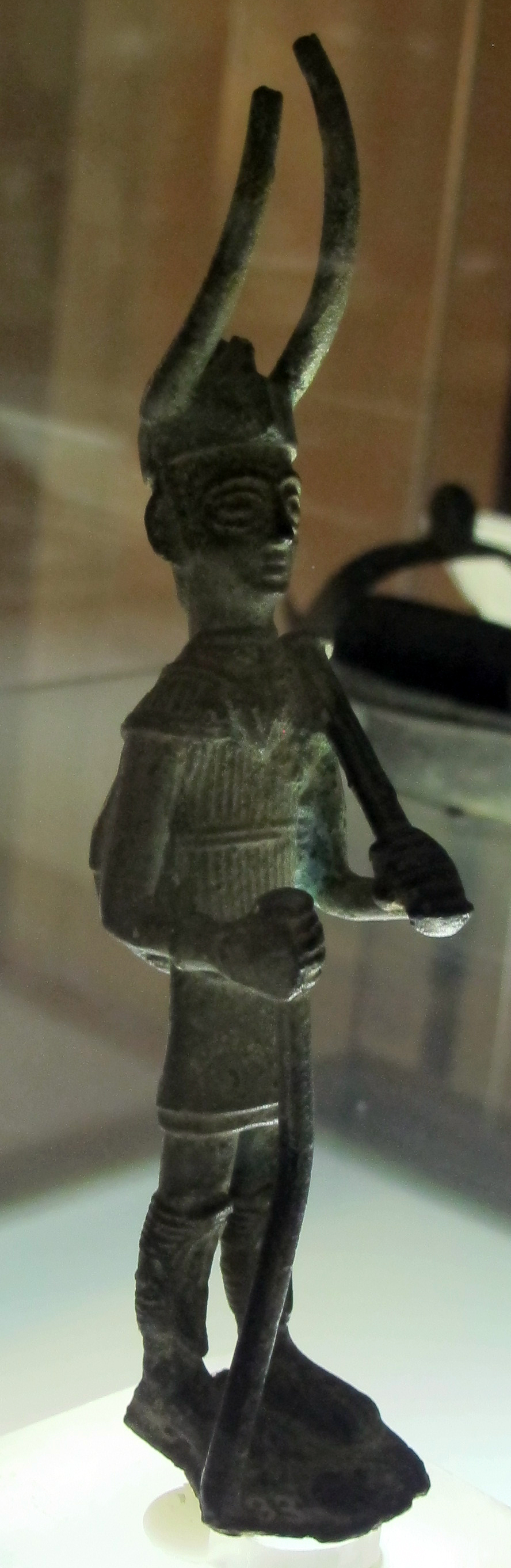
The most arresting piece of the Sardinian case is visual. Nuragic bronze figurines, the bronzetti, depict warriors in horned helmets carrying round shields, dated to roughly 1200 BCE, and they mirror the Egyptian reliefs of Sherden fighters closely enough to stop you in your tracks. The horned helmet is the Sherden's signature in Egyptian art, and here is the same distinctive headgear cast in bronze on the far side of the Mediterranean, in the right century. A parallel that good is genuine evidence. It is still not, by itself, a settlement of who moved which way, or whether anyone moved at all.
There is hard material traffic to go with the iconography. Nuragic-style pottery shows up at a string of eastern Mediterranean sites during exactly the crisis window: at Pyla-Kokkinokremos on Cyprus in the twelfth century BCE, and in thirteenth-century contexts at Tiryns, Kommos, Hala Sultan Tekke, and Minet el-Beida, the harbor of Ugarit, as well as in Sicily and at the Egyptian port of Marsa Matruh. This is real, dated, two-way connection between Sardinia and the collapse zone. What it is not is a single unambiguous migration story, because the same finds are consistent with several different explanations.
And here is where the case genuinely stalls, because the direction of travel is unresolved and honestly contested. Vassos Karageorghis represents the western-origin view, with the Sherden as refugees moving east out of Sardinia. Margaret Guido argued the exact opposite as far back as 1963, an eastern origin in Ionia or Anatolia followed by later migration to Sardinia, and she did something rare in the process: she conceded, in her own work, that the evidence for the Sherden coming from the western Mediterranean is flimsy. That is a historiography tangled enough that a scholar arguing for one direction openly granted that the case against the other direction was weak. The right move for a reader is to hold it as a live, two-sided, unsettled debate, not to crown a winner the evidence has not crowned.
The most measured recent assessment available says as much out loud. Reinhard Jung, in 2017, states plainly that the Sherden-Nuragic hypothesis remains unproven. That is the honest anchor for how firmly to hold this identification, even where the horned helmets and the pottery are as striking as they are. Compelling, unproven, and still open.
One last strand belongs to the aftermath rather than the origin. The archaeologist Adam Zertal connected specific Sherden settlement sites to locations in northern Canaan in the wake of the crisis. That is a third geographic thread entirely: where the Sherden may have ended up, kept carefully separate from the still-disputed question of where they began.
07Shekelesh: Sicily, Disputed Since 1873
The Shekelesh have a distinction none of the others quite share: theirs is the one name that appears in both confederation lists, Merneptah's Year 5 record and Ramesses III's Year 8 confederation, a full generation apart. Whatever population this name marked was apparently a factor across the entire span of the crisis, not a single flash in one campaign. That much is a plain textual fact. The trouble is everything downstream of it.
In 1867 the Egyptologist Emmanuel de Rouge, the same scholar who had coined the label Sea Peoples in the first place, a story our sister file tells, proposed identifying the Shekelesh with Sicily on purely phonetic grounds. Francois Chabas concurred in 1872. In 1928 Eduard Meyer sharpened it, naming the Sicels, the indigenous Bronze Age population of Sicily, as the precise match. Shekelesh, Sicels, Sicily: the resemblance is real, and it is also the entire argument.
It was disputed almost immediately. In 1873, only six years after de Rouge floated it, Gaston Maspero rejected the Sicily reading and argued for an Anatolian origin instead. The identification has never reached consensus in the century and a half since. It remains genuinely uncertain where the Shekelesh actually came from, and even the scholars who accept some Sicily connection cannot agree on the direction of travel, whether the Shekelesh moved from the Near East toward Sicily or from Sicily toward the Near East, or whether Sicily was their true homeland at all rather than a stop along the way.
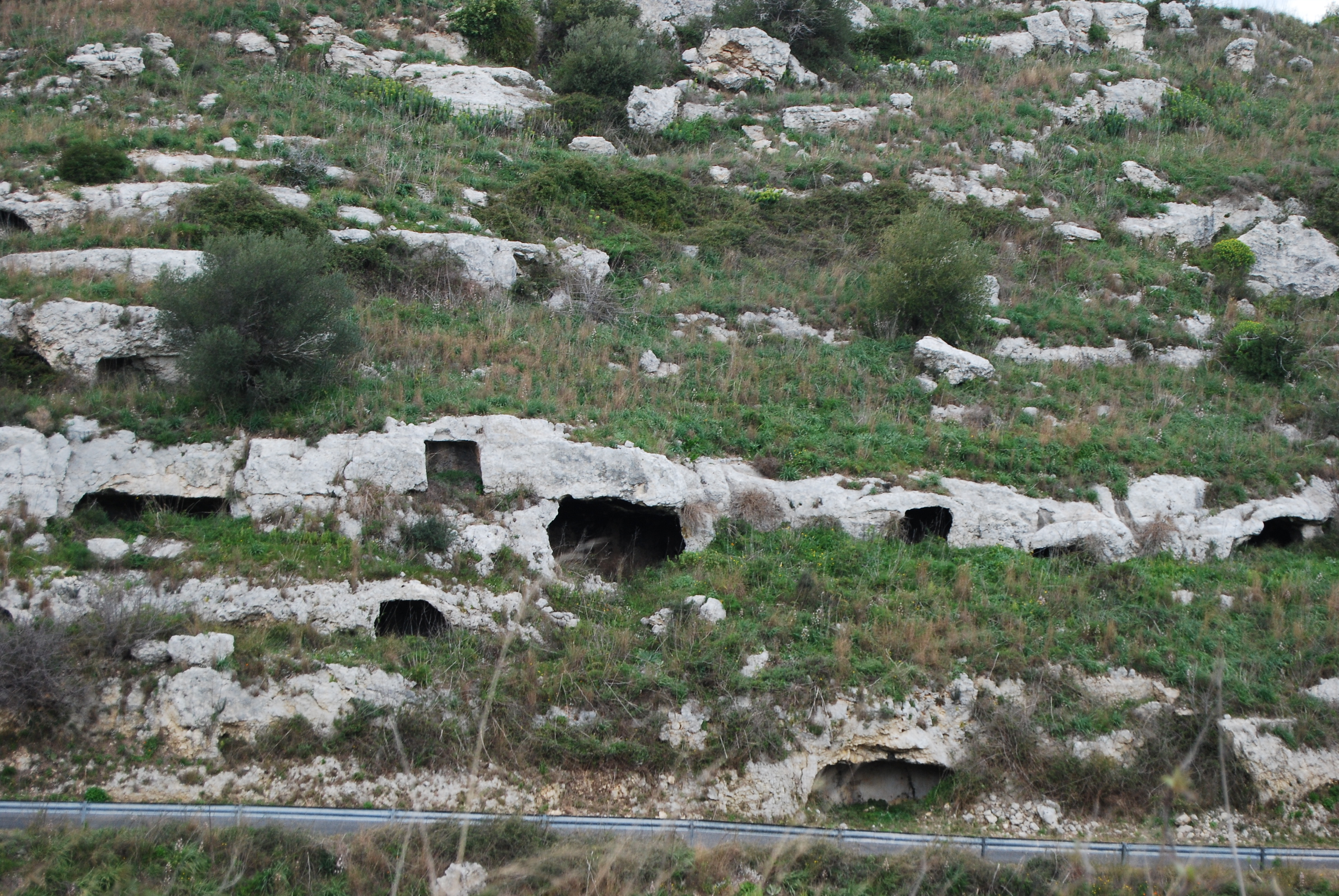
What is not in doubt is the Sicels themselves. They are a real, well-documented Bronze and Early Iron Age indigenous Sicilian people, known above all from the Necropolis of Pantalica, a vast rock-cut cemetery of roughly four to five thousand tombs carved into a limestone plateau in southeastern Sicily, dated mainly to the thirteenth through the seventh centuries BCE and excavated principally by the Italian archaeologist Paolo Orsi between 1895 and 1910. This tells you what the proposed homeland actually looked like on the ground. It says nothing, by itself, about whether the Shekelesh were ever there. The archaeology of the Sicels is solid; its link to this Egyptian name is not.
08Tjeker: A Prince Named Beder
The standard identification of the Tjeker points at the Teucri, or Teukroi, a tribe that ancient sources place in northwest Anatolia south of Troy, tied in Greek legend to the mythical archer Teucer. The idea was first made by Lauth in 1867 and repeated by Chabas in 1872, and it has ridden along in the literature ever since on the strength of the name.
But this is one of the rare cases where a leading modern specialist does not merely doubt one of the old phonetic identifications, he throws it out. The Hittitologist Trevor Bryce, a foremost authority on Late Bronze Age Anatolia, has dismissed the Tjeker-Teucri link as pure speculation. That an expert on exactly this region and period calls the identification speculation is itself a verifiable fact, independent of whether the underlying guess is right, and it is a warning against treating the Teucri answer as anything settled.
The irony is that while the Tjeker's origin is shaky, their later history is one of the better-anchored stories in the whole roster. They are thought to have developed or taken the port city of Dor, on the coast of Canaan near modern Haifa, into a large, fortified center, the archaeological Dor XII, flourishing roughly 1150 to 1050 BCE and confirmed as the seat of a Tjeker kingdom in the northern Sharon plain. The city was violently destroyed in the mid-eleventh century BCE, the fire baking its mud bricks red and leaving a thick layer of ash and debris. That the Tjeker themselves founded Dor, as opposed to merely occupying it, is flagged even in the sources as not fully certain, which is why the settlement-and-destruction facts sit at Tier 2 rather than Tier 1.
The Tjeker also hand us one of the only Sea Peoples figures with an actual name. Under Ramesses XI, around 1100 BCE, the Tjeker and their prince Beder are named in the Story of Wenamun, an Egyptian priest's own account of his voyage to Byblos to buy cedar wood. Beder, ruler of Dor, is one of a mere handful of individuals from this entire coalition whose personal name survives at all. Even that comes with a live complication: the scholar Edward Lipinski reads Beder not as a personal name but as a title, a local governor serving as a deputy of the King of Tyre, which would change how much the passage really proves about Tjeker independence. The papyrus is real and firm; what one word in it means is still argued.
There is a fainter, more legendary strand pointing at Cyprus. Homeric tradition holds that Salamis, on the island's east coast, was founded after the Trojan War by the archer Teucer. Some scholars read that story as a possible echo of the real Sea Peoples' occupation of Cyprus around 1193 BCE, with Teucer standing in as a legendary memory of the Tjeker themselves. It is a connection of literature to history, not of evidence to evidence, and it verges on Tier 4. Suggestive, and no firmer than that.
09Tursha: The Etruscan Theory The DNA Killed
This group is written Tursha in Ramesses III's inscriptions and Teresh of the Sea on the Merneptah Stele, and its old identification was one of the most seductive in the entire field. Some scholars matched them to the Tyrsenians, the Tyrsenoi, a name commonly equated with the Tusci, the Latin exonym for the Etruscans, which is where the name Tuscany itself comes from. The apparent linguistic support was real and specific: the Tyrsenian language family groups Etruscan together with Lemnian, a language once spoken on the Aegean island of Lemnos and attested in inscriptions down to the sixth century BCE. On paper, that looked like a genuine bridge carrying a people from the eastern Aegean all the way to central Italy. For a long time it was a popular answer.
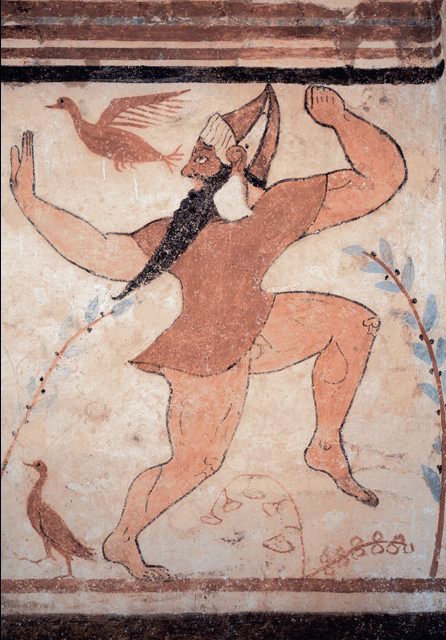
Modern scholarship rejects it outright, and not gently. In the plain words of the sourcing, the equation of the Teresh or Tursha with the Tyrrhenians, and by extension with the Etruscans, is not accepted by modern scholarship; there is no archaeological or linguistic evidence supporting it. This is not a case that has merely gone quiet for lack of interest. It has been examined and set aside.
The most famous prop under the old theory has fallen too. The classical story, recorded by Herodotus, that the Etruscans migrated to Italy out of Lydia in Anatolia, has itself been shown to be a politically motivated legend, likely fabricated at the Lydian court in the early sixth century BC and lacking any claim to historical truth. It was never a folk memory of a real Bronze Age migration. It was a piece of court propaganda that later readers mistook for history.
And then the physical evidence did something the other contested cases in this file have never had done to them: it directly contradicted the premise the theory depended on. Ancient-DNA studies of Etruscan origins confirm that the Etruscans were autochthonous, locally originating in central Italy, and genetically similar to their Latin neighbors, with no detectable Anatolian admixture dateable to the Bronze or early Iron Age. The Tursha-Etruscan idea required a migration from the eastern Mediterranean into Italy. The genome of the people it invoked shows no such migration. This is the sharpest epistemic difference in the whole roster. Most of these identifications are unproven; this one is disproven. It is not an open question the evidence has failed to answer. It is a closed question the evidence answered no.
10Weshesh: The One That Was Never Solved
The Weshesh are the group the puzzle never cracked, and the honest thing is to treat that as a real finding rather than an embarrassment to paper over. Here is the whole of what is genuinely known. They are attested only in sources from the reign of Ramesses III, specifically the second pylon of his mortuary temple at Medinet Habu and the Great Harris Papyrus. They never appear in Merneptah's earlier record, or in any other Late Bronze Age source at all. According to the inscriptions, they were camped in Amurru, in the Levantine and Syrian region, alongside the Peleset, Tjeker, Sherden, and Denyen before Ramesses III's Year 8 campaign. That single geographic fact is essentially the entire independent dossier on the Weshesh.
It gets more striking. No visual representation of the Weshesh has ever been confidently identified in the Medinet Habu reliefs. The Peleset have their feathered headdresses; the Sherden have their horned helmets; scholars can point at them on the wall. The Weshesh have neither a confident textual identification nor even a confirmed face in the carvings. Of the nine names, they are the only one that is a blank on both counts. That is precisely why, unlike every other group in this file, there is no ancient image of them to show you. There is nothing confirmed to show.
The proposals that do exist only prove how empty the case is. Across roughly fifty years, scholarship offered three mutually exclusive answers, none of them evidenced beyond a resemblance of sound. Francois Chabas, in 1872, proposed the Oscans, a South Italic people. Gaston Maspero, in 1873, proposed a connection to the Carian settlement of Wassos in western Anatolia. Henry R. Hall, in 1922, proposed the Waksioi of Crete. A separate and even thinner suggestion links the name to Wilusa, the Hittite name for Troy, a link the sourcing itself calls tenuous. Italy, Anatolia, Crete: three different regions, no convergence whatsoever. When three careful scholars reading the same name land on three different continents, the honest reading is not that one of them is secretly right. It is that the name does not carry enough information to place at all.
And this is not a gap that better research is about to fill. Our own web-verified check lands word for word where the corpus doc already sat: no convincing identification, confidence very low. When the research library and the current secondary literature independently arrive at the same non-answer, that is not two sources each failing separately. That is the field itself telling you, in stereo, that it does not know. The Weshesh are the one case in this whodunit with no suspect at all.
11So Where Did The Whole Coalition Come From?
Step back from the individual names and a bigger question waits behind them: where did this coalition come from as a whole? The traditional answer, that the collapse of Aegean-centered systems displaced populations who then joined the raiding and migrating wave moving south and east, is the mainstream multi-causal framework our sister file on the Bronze Age Collapse already lays out, and we will not re-derive it here. But it is no longer the only serious model on the table.
An ongoing University of Gothenburg project, directed by Peter M. Fischer and launched in 2016 under the title The Collapse of Bronze Age Societies in the Eastern Mediterranean: Sea Peoples in Cyprus?, proposes a broader and longer-range picture. It describes a south-eastward migration of peoples from southern Europe, traveling by land and sea over the Balkans, Anatolia, Greece and the eastern Mediterranean islands including Crete and Cyprus, toward the Levant and Egypt. The material evidence it cites for this route is specific: Naue II swords identical to types from northern Italy, Handmade Burnished Ware, sometimes called Barbarian Ware and assumed to originate in Italy, Italian-type violin-bow fibulae, and cylindrical loom weights. It is a real, current, named-director research program, not a fringe claim, and it points the arrow of origin further west and north than the standard Aegean model does.
Cyprus turns up in that research as a genuine waystation. The site of Hala Sultan Tekke shows a destruction just after 1200 BC, then a rebuilding phase whose recovered foreign objects most likely came from Italy, while the site's earlier, pre-crisis Mediterranean trading partners are conspicuously absent from the layers after the destruction. Read through this project, that pattern is not just a fire and a rebuild. It is the old trade network breaking and being replaced by a different set of connections reaching back toward the central Mediterranean.
The same project is refreshingly blunt about how thin the ground still is under all of it. Its own page states that well documented proofs of the physical presence of the Sea Peoples at various sites are scanty or even totally absent. That is a statement from inside the field, about the field, and it is worth carrying to the end of this article as a corrective: for all the names and lists and reliefs, the direct archaeological trace of these peoples on the ground is far fainter than the drama of the Egyptian inscriptions makes it feel.
So the honest synthesis is not a choice between models but a recognition that both are in the literature and neither is complete. The Aegean-collapse-displacement account and the broader pan-Mediterranean, Italian-linked migration account are not mutually exclusive, and the most defensible summary is that the coalition the Egyptians recorded almost certainly drew on several different regional populations, moving for different reasons at different times. That is precisely why a single, tidy, one-line answer to who were the Sea Peoples has stayed out of reach for more than 150 years. The elusiveness is a property of the question's own structure, a coalition never had one address, not merely a temporary shortage of evidence.
One last caution belongs at the close of the origin question, and it too lives in our sister file rather than here. A 2023 reassessment by Jesse Millek found that a large share of the destructions conventionally pinned on the collapse around 1200 BCE were misdated, thinly evidenced, or did not occur at all. Hold that beside everything above, and the mental image of a single named coalition sweeping through the eastern Mediterranean and burning it to the ground gets noticeably harder to defend as a tidy story. The reality was patchier, slower, and stranger than the reliefs suggest.
12The Whole Roster At A Glance
Here is the whole investigation on one page, each name wearing its tier, because the fastest way to get this story wrong is to let a nailed-down case, a genuinely open one, a dead theory, and a total blank all blur into the same vague ancient mystery. They are not the same, and the tiers are what keep them apart.
| Group | Leading Identification | Tier | Where The Case Stands |
|---|---|---|---|
| Lukka | Lycia, southwest Anatolia | Tier 1 | The strongest case; centuries of Hittite records name it independently of Egypt |
| Peleset | The Philistines | Tier 1 | Settled; 2019 ancient DNA and locally made Aegean pottery (see our sister file) |
| Ekwesh | Mycenaean Achaean Greeks (Ahhiyawa) | Tier 2 | The broad Greek link is strong; the specific group is muddied by one odd detail |
| Denyen | Aegean Danaans and/or Cilician Danuna | Tier 2 | Two real threads with old evidence; possibly both are partly right |
| Sherden | Nuragic Sardinia | Tier 2 to 3 | A striking horned-helmet parallel, but unproven, and the direction is disputed |
| Shekelesh | Sicily and the Sicels | Tier 3 | Proposed in 1867, contested since 1873, still no consensus on homeland or direction |
| Tjeker | The Teucri of northwest Anatolia | Tier 3 | The identification is 'pure speculation' (Bryce); their later kingdom at Dor is solid |
| Tursha | The Etruscans (Tyrrhenians) | Tier 4 | Ruled out; archaeogenetics shows the Etruscans were local Italians, not migrants |
| Weshesh | None proposed convincingly | Tier 4 | No accepted identification exists, and not even a confirmed depiction survives |
Fast Facts
- The Suspects
- Nine names on two Egyptian temple walls: Peleset, Tjeker, Shekelesh, Denyen, Weshesh, Sherden, Lukka, Tursha, and Ekwesh
- The Method
- Almost every identification rests on matching an Egyptian spelling to a later people or place, which is why confidence runs from near-certain to hopeless
- The Strongest Case
- Lukka is Lycia in southwest Anatolia, anchored by centuries of Hittite records that owe nothing to Egypt
- The Settled Case
- The Peleset are the Philistines, confirmed by 2019 ancient DNA and locally made Aegean-style pottery (argued in full in our sister file)
- Still Open
- Sherden, Denyen, Ekwesh, Shekelesh, and Tjeker all have real, competing homelands and no consensus
- The Dead Theory
- The Tursha as ancestors of the Etruscans, once popular, now falsified by archaeogenetics showing the Etruscans were locally Italian
- The Unsolved One
- The Weshesh have no convincing identification at all, and not even a confirmed image on any wall
- The Verdict
- There is no single answer to who the Sea Peoples were, and the shape of the question is why
What We Can Actually Stand Behind
Two of the nine are as close to solved as this kind of question gets. Lukka is Lycia in southwest Anatolia, and it earns Tier 1 because it rests not on Egyptian phonetics but on a Hittite paper trail running for centuries, from the Alaksandu treaty and the Battle of Kadesh to Tudhaliya IV's stela naming towns, Tlos, Xanthos, Patara, that still stand on the map. And the Peleset are the Philistines, proven by the 2019 Ashkelon ancient DNA and backed by locally made Aegean-style pottery and a three-phase ceramic sequence, the full genetic case laid out in our sister file on the collapse.
Several cases are genuinely open and actively argued, and that is the honest verdict, not a failure to reach one. The Ekwesh are very likely tied to the Mycenaean Greek world through the well-supported Ahhiyawa equation, even as the circumcision detail keeps the specific group in doubt. The Denyen carry two real, old-evidenced threads, Aegean Danaans and Cilician Danuna, that may both be partly right. The Sherden-Nuragic parallel is striking in bronze and pottery alike, yet a current specialist calls it unproven and the direction of migration is unsettled. And the newer pan-Mediterranean migration research out of Gothenburg is credible, current work, not fringe.
Some identifications rest on little more than a resemblance of sound, with real dispute on top. The Shekelesh-Sicily reading has been contested since 1873, down to which way anyone was moving. The Tjeker-Teucri link is called pure speculation by a leading authority, even though the Tjeker's own later kingdom at Dor is solid archaeology. These are worth reporting as live proposals, never as settled history, and the migration directions behind several groups stay genuinely unresolved.
And two answers should be said flatly. No, the Tursha were not the ancestors of the Etruscans. That once-popular theory is not merely unresolved, it is falsified: modern archaeogenetics shows the Etruscans were autochthonous to central Italy with no detectable Anatolian admixture in the Bronze or early Iron Age, and the Herodotus migration legend it leaned on was court propaganda, not memory. And no, the Weshesh have not been identified at all. No convincing candidate exists in the literature, the three proposals on record point at three different continents with zero convergence, and not even a confirmed image of them survives on any wall. One suspect the evidence ruled out, and one it never let us name.
So the great whodunit does not resolve into a single culprit, and after a hundred and fifty years the reason is finally clear enough: it was never one crime with one perpetrator. The Egyptians carved nine names because at least nine different somethings, from the coast of Anatolia to the mountains of Sardinia to the Greek mainland, were pushed loose in the same convulsion and washed up on the same shore. Some of those names we can now put a real face and a real homeland to. Some we can only argue about, honestly, in the credible middle. One we can strike off the list for good. And one has slipped the record entirely, a people who came at Egypt, camped in Amurru, and then walked out of history without leaving a single feature a scholar can hold. The real question the temple walls leave us with is not which one people the Sea Peoples were. It is whether a coalition assembled from a dozen shattered corners of a collapsing world was ever going to leave behind an answer tidy enough to satisfy us, or whether the mess is the truth, and the tidy answer is the fiction we keep reaching for.
Sources & further reading
Everything above is drawn from our research library on Theories of Anything, deep-read in full rather than skimmed. The corpus files are where we worked from; the papers and primary sources listed beneath them are where you can check us independently.
Image credits
- The Merneptah Stele, Cairo Egyptian Museum photograph by Alyssa Bivins via Wikimedia Commons. CC BY-SA 4.0 Source.
- A Philistine Ship of War (1903 line drawing after a Medinet Habu relief) drawn by Faucher-Gudin from a photograph by Beato, published in G. Maspero's History of Egypt, 1903, via Wikimedia Commons. Public Domain Source.
- Peleset and Sherden Prisoners, Medinet Habu Relief photograph by Oltau via Wikimedia Commons. CC BY-SA 4.0 Source.
- Lycian Rock Tombs at Myra, Turkey photograph by Saffron Blaze via Wikimedia Commons. CC BY-SA 3.0 Source.
- The Warrior Vase, Mycenae, 12th Century BCE photograph by Sharon Mollerus via Wikimedia Commons. CC BY 2.0 Source.
- The Karatepe (Azatiwada) Bilingual Inscription, 8th Century BCE photograph by Dosseman via Wikimedia Commons. CC BY-SA 4.0 Source.
- Nuragic Bronze Statuette of a Warrior in a Horned Helmet, 8th Century BCE photograph by Sailko via Wikimedia Commons. CC BY 3.0 Source.
- Nuraghe Santu Antine, Torralba, Sardinia aerial photograph by Antonio Figoni via Wikimedia Commons. CC BY-SA 4.0 Source.
- The Necropolis of Pantalica, Sicily photograph by DQSMAMA via Wikimedia Commons. CC BY-SA 4.0 Source.
- Phersu Figure, Tomb of the Augurs, Tarquinia, 525-500 BCE photograph of a public-domain Etruscan wall painting via Wikimedia Commons. Public Domain Source.
- Card crop of The Merneptah Stele, Cairo Egyptian Museum photograph by Alyssa Bivins via Wikimedia Commons. CC BY-SA 4.0 Source.


