Sirians
One man said tall human beings from the Sirius system are quietly overseeing Earth and preparing to switch on our DNA. He also named the date the starships would land: December 17, 1996. Here is the Sirian story, laid over the real star, with every claim wearing its evidence.
Somewhere overhead, brighter than every other star in the night sky, sits Sirius. According to one man, tall human beings from that system have been quietly overseeing Earth, waiting to switch on dormant strands of our DNA and usher us into a galactic federation of light. It is a stirring story. It also traces, in every last specific, to a single self-published channeler who once named the exact date the starships would arrive. That date came and went. So let us open the file the honest way: the real star first, then the story laid over it.
01The star this is all named for
Before a word about the beings, look at what is actually up there. Sirius is real in a way nothing else on this page is: a specific point of light with a measured brightness, a measured distance, and a companion whose physics turns out to matter enormously to the story.
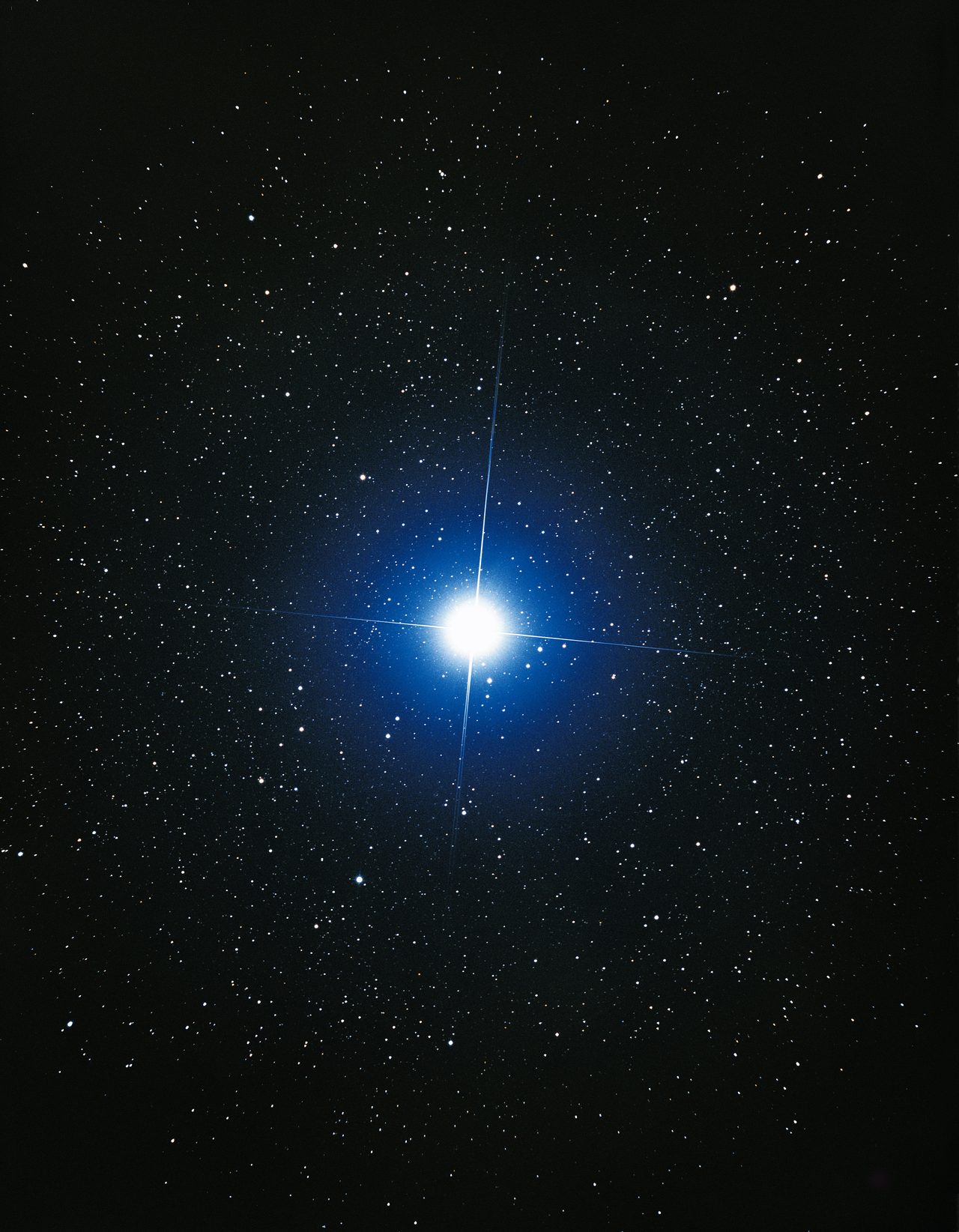
Sirius, formally Alpha Canis Majoris, is the brightest star in Earth's night sky, shining at an apparent magnitude of about -1.46 from a distance of roughly 8.6 light-years. It is a real, physical, photographable object. You can point a camera at it tonight. That is exactly why an honest telling of this story reaches for a genuine photograph of the star and never a drawing of the beings said to live there, because only one of the two has ever been photographed.
| The object | What it actually is |
|---|---|
| Sirius (Alpha Canis Majoris) | Brightest star in the night sky, magnitude about -1.46, roughly 8.6 light-years away |
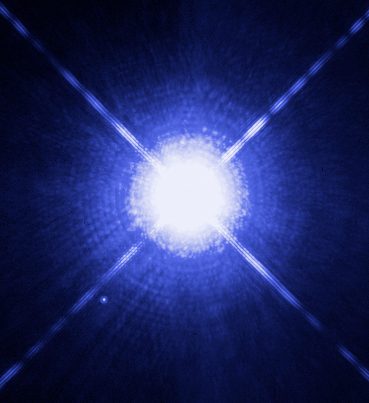
| Sirius B | A white dwarf, the collapsed remnant of a star once about twice the Sun's mass |
| Sirius B surface | Near 25,000 K; the companion was identified by Alvan Graham Clark in 1862 |
| Known planets | None |
Here is the physics the story cannot get around. Sirius B, the very companion the narrative pins its 'regional council' to, is a white dwarf: the collapsed, burned-out remnant of a star that was once roughly twice the mass of our Sun, with a surface temperature near 25,000 K and, so far as astronomy can tell, no known planets. It was identified by Alvan Graham Clark in 1862. A dead stellar cinder that hot, with no world to stand on, is physically incompatible with the habitable, humanoid-inhabited home the Sirian narrative requires.
02The story laid over it
Now the story. It is specific, internally detailed, and entirely the work of one author. In his channeled cosmology, the beings of Sirius are not the amphibious teachers of older traditions. They are something else, and the difference matters.
In the channeled cosmology of Sheldan Nidle, the Sirians are tall, human-like 'galactic human' overseers based in the Sirius system. This is worth pinning down, because it is routinely confused with an older and separate tradition: the amphibious Nommo of Dogon lore, popularized by Robert Temple's 1976 book, which is the thesis our own field-guide document happens to cite instead. The two are not the same story and must not be conflated. Nidle's Sirians are humanoid, not amphibian.
In Nidle's telling, the Sirians staff a regional council of a self-described 'Galactic Federation of Light,' tied specifically to Sirius B, and their messages reach the public through his Planetary Activation Organization (PAO), founded in late 1997. Note the address on that council: it is pinned to the exact companion star that astronomy identifies as a dead white dwarf with no planets.
The doctrinal heart of the whole system is a claim about us. Humans, the narrative holds, carry dormant '12-strand DNA' that the Sirians and their allied Galactic Federation races are preparing to 'activate,' reframing humanity as an emerging 'galactic human' species. It is a flattering promise, and like the landing date further down this page, it keeps its payoff permanently in the future.
Even inside Nidle's own material the beings are not a faceless species. He credits a specifically named channeled entity, 'Washta,' described as a Sirian counselor-figure, speaking alongside the generic 'Sirians' collective. The narrative individuates its sources, which is worth noticing: a named informant lends the account the texture of testimony without adding a single independent witness.
03One author, no second witness
Which brings us to the man himself. Strip the cosmology back and you find not a movement of contactees but a single biography, and a surprisingly ordinary one underneath the extraordinary claims.
The entire Sirian galactic-human narrative traces to one named individual: Sheldan Nidle, born November 11, 1946 in New York City and raised in Buffalo, who reports that his contact with the Sirians began in early childhood. Across roughly seven decades of the account, no second contactee and no independent witness has ever corroborated it. It is not a body of testimony. It is one testimony, repeated.
Set against the cosmic claims, Nidle's verifiable biography is mundane, and documented in a way the contact never is. He earned an M.A. in Political Science from the University at Buffalo (1968) and an M.A. in Southeast Asian Government from Ohio University (1970), then pursued but did not complete a Ph.D. at the University of Southern California (1974 to 1976). These are ordinary, checkable facts. The contact claims are layered on top of them, and do not share their footing.
| When | What is on the record |
|---|---|
| 1946 | Sheldan Nidle born in New York City, later raised in Buffalo; contact claimed from early childhood |
| 1968 | M.A. in Political Science, University at Buffalo (documented) |
| 1970 | M.A. in Southeast Asian Government, Ohio University (documented) |
| 1974 to 1976 | Pursued but did not complete a Ph.D. at the University of Southern California |
| 1980s | Co-founded the Ground Crew Project (moved online in 1996) |
| Nov 1996 | Channeled bulletins begin predicting a mass starship landing by December 17 |
| Late 1997 | Split from co-founder Valerie Donner; founded the Planetary Activation Organization |
The organizational history is just as single-threaded. Nidle co-founded the Ground Crew Project in the 1980s, moved it online in 1996, split from co-founder Valerie Donner around late 1997, and founded the Planetary Activation Organization that same year to keep distributing 'Galactic Federation' channelings under his own name. One man, one channel, one continuous output.
04The prediction that had a date on it
Most channeled cosmologies are careful never to say anything a calendar could check. This one did not stay careful. In late 1996 it made a claim with a number and a deadline attached, and that is the moment the whole edifice became testable.
Beginning around November 1996, Nidle's channeled 'Galactic Federation' bulletins predicted a mass landing of 15 million starships on Earth no later than December 17, 1996, framed as part of humanity's passage through a so-called 'photon belt.' This is the rarest thing in the entire fringe canon: a specific, numbered, dated, checkable prediction.
It failed, unambiguously. On and by December 17, 1996, there was no landing, no fleet of starships, and no detectable 'photon belt' event of any kind. This is not a matter of interpretation or of a prophecy coming true 'in spirit.' A dated, physical claim was made, the date arrived, and nothing happened. That is about as clean as a falsification gets.
And it was documented by the toughest possible witness. In 1996, James Randi's James Randi Educational Foundation named Nidle a Pigasus Award recipient (Category 4, 'Performer') specifically for having, in the foundation's own words, 'predicted the end of the world on December 17, 1996, then explained that it came, but we were all unaware of it.' This is the strongest, most independent, dated documentation on the page that the claim was made and that it failed.
Then came the move that tells you what kind of claim this really is. When the landing did not occur, Nidle did not retract the prediction. He told followers that humanity had actually been shifted into a 'holographic' alternate timeline by unseen benevolent forces, as a 'second chance.' The failure was not conceded; it was absorbed, reframed as a rescue that conveniently leaves no evidence behind.
Critics have noted a quieter tell. Nidle later removed direct reference to the 1996 prediction from his own website material, though the original claim survives in third-party skeptic archives and, permanently, in the Pigasus Award record. A prophecy confident enough to name a date is rarely edited out of the story unless it failed.
Nor was it a one-time slip. For decades after 1996, Nidle kept issuing 'Galactic Federation of Light' channeled updates through PAO and later platforms, repeatedly forecasting imminent 'disclosure' and landings on new timelines that likewise did not occur as stated. The deadline keeps moving; the arrival never does.
05What actually survives scrutiny
So line the two halves up. On one side, a real star with real physics. On the other, a cosmology that made exactly one checkable claim and failed it. What is left standing when the two meet?
When you demand evidence, the whole structure comes apart in the same place every time. There is no physical, photographic, or third-party corroborated evidence for Sirius-based humanoid overseers of any kind. Every specific in the narrative, the appearance, the hierarchy, the DNA doctrine, the timelines, originates from Nidle's own self-published channeling across roughly seventy years of claimed contact, with no second witness. By our own field guide's reckoning this entire modern taxonomy rates very low confidence absent corroboration, and here there is nothing to corroborate.
The honest asymmetry is the whole lesson. The star is photographable and the beings are not. One of those facts has survived more than a century and a half of instruments pointed straight at it. The other has not survived a single calendar.
Fast Facts
- The story's author
- Sheldan Nidle, born 1946; the sole source of the account
- The beings
- Tall, human-like 'galactic human' overseers said to live in the Sirius system
- Named informant
- 'Washta,' a channeled Sirian counselor-figure
- Core doctrine
- Humans carry dormant '12-strand DNA' awaiting Sirian 'activation'
- The failed prediction
- 15 million starships to land by December 17, 1996
- Independent record
- 1996 Pigasus Award, for that failed doomsday date
- The real Sirius B
- A white dwarf, near 25,000 K, with no known planets
What we can actually stand behind
The star is real. Sirius is the brightest star in Earth's night sky, about 8.6 light-years away and photographable tonight; its companion Sirius B is a genuine white dwarf, discovered in 1862, near 25,000 K, with no known planets. That much is settled astronomy, and it is the one solid floor under the whole subject.
Sheldan Nidle's ordinary biography is independently documented: two master's degrees and an unfinished doctorate, earned between 1968 and the mid-1970s. The mundane man on the record is real. It is only the contact layered on top of him that is in question.
The Sirian galactic-human cosmology itself, the regional council, the counselor 'Washta,' the 12-strand DNA waiting to switch on, is a single channeler's self-published narrative with no second witness and no physical evidence. Speculative at the most generous, worth studying as a case in how such stories are built, not as biology.
The prediction we refuse outright. The December 17, 1996 landing of 15 million starships, and the after-the-fact claim that we were secretly shifted into a 'holographic' timeline so we could not notice it had failed, is the least-supported claim on this page: a specific, dated forecast that did not come true, then rewritten so it could never be wrong. The 1996 Pigasus Award memorializes it, and no physical evidence has ever supported a Sirius-based overseer. This is where the story stops being merely unproven and becomes simply false.
So the Sirians end as one of the cleaner cases in this whole guide, because for once there was a date. The star is still up there, still the brightest point in the night, and people are still watching it for a fleet that was promised and then quietly rescheduled onto a timeline we cannot see. Which leaves the question the star itself cannot answer: why do we keep naming our saviors after a light we can measure to the decimal, and then insist it holds a home no instrument can find? The photograph is real. The rest is still waiting on a landing date.
Sources & further reading
Everything above is drawn from our research library on Theories of Anything, which is where we worked from. The papers, reports and primary records listed beneath them are where you can check us independently.
Image credits
- Close-up of Sirius photograph by Akira Fujii, via Wikimedia Commons. Public Domain (NASA/ESA Hubble material) Source.
- Sirius A and B Hubble Photo photograph by NASA, ESA, H. Bond (STScI), M. Barstow (University of Leicester), via Wikimedia Commons. Public Domain (NASA/ESA Hubble material) Source.
- Card crop of Close-up of Sirius photograph by Akira Fujii, via Wikimedia Commons. Public Domain (NASA/ESA Hubble material) Source.

