The Hum

Somewhere within a few streets of you, right now, a handful of people are hearing a sound almost nobody else can. It is low and steady and mechanical, a soft diesel throb, like a truck idling two blocks over that never pulls away. It is worse at night, worse indoors, and worse the harder you try to shut it out. It has been reported from Bristol to Taos to a steel island in the Detroit River, and after fifty years of tape recorders, physicists, and government committees, it still does not have one answer. That is the first thing worth being honest about: it probably never had one. The strongest studies point the other way, toward the unsettling likelihood that the Hum is not a single phenomenon at all but a whole shelf of different sounds filed under one maddening name. Here is that shelf, taken apart tier by tier: the case where science actually found the source, the case where it only proved the hearers are not imagining it, and the two popular answers the evidence flatly refuses.
Somewhere within a few streets of where you are reading this, a handful of people are hearing a sound almost nobody else can. It is low and steady and mechanical, a soft diesel throb, like a truck idling two blocks over that never pulls away. It is worse at night. It is worse indoors. It gets worse, not better, the harder they try to shut it out, because closing a window and drawing the curtains does very little to a sound this deep. They have been hearing it for decades, in Bristol and Taos and a hundred other towns, and after fifty years of investigations, tape recorders, and government committees, nobody can tell them for certain what it is.
Here is the honest place to start, and it is not where most coverage starts. The strongest studies of the Hum do not point toward a single hidden source waiting to be exposed. They point the other way, toward the uncomfortable likelihood that the Hum is not one phenomenon at all. It is a label, a single tidy word laid over a whole shelf of unrelated low sounds with genuinely different causes, some of them out in the world, some of them inside the listener's own head, and a couple that were never really mysteries to begin with. Take the shelf apart, item by item, and the mystery does not vanish. It just stops pretending to be one thing.
01The Sound Itself
For all its strangeness, the Hum is described with remarkable consistency across countries and decades. The frequency sits low, roughly 30 to 80 Hz, usually clustered around 50 to 60 Hz. The character is not a pure tone but a throb, a pulsing or droning closer to an idling engine than a whistle. It is reliably louder indoors than outdoors. It is reliably worse at night and in quiet surroundings. And some hearers report that the sound changes when they tilt or turn their head, which is exactly what you would expect if the middle ear or the cochlea were part of the story rather than a bystander.
The other defining trait is who hears it. Only an estimated 2 to 11 percent of people in any given area perceive the Hum at all, depending on the locality, which means two people can lie in the same dark bedroom and disagree, night after night, about whether there is any sound in it. To the one who hears it, the noise is undeniable and maddening. To the one who does not, there is simply nothing there. That split is not a sign that anyone is imagining things. As the next section shows, it has been tested directly. But it is the first hint that the Hum's cause may live partly in the ear as much as in the air.
02Bristol and Taos, Where It Started
Two clusters turned a scattering of local complaints into a named phenomenon. The Bristol Hum came first, reported through the late 1970s in southwest England, where enough residents complained of a persistent low drone that the UK Department of the Environment opened a formal investigation in 1980. It closed without identifying a conclusive source. Then, in the early 1990s, the Taos Hum made the phenomenon famous. Residents of Taos, New Mexico reported the sound in numbers large enough to bring in scientists from the University of New Mexico and Los Alamos National Laboratory, who ran a field investigation in 1993 and, once again, found no external source anyone could point to. Those two are the anchors, but they are not alone: the Hum has also been reported from Largs in Scotland, Auckland in New Zealand, Bondi in Australia, Windsor in Ontario, and dozens of other places besides.
| Report Cluster | Reported From | Investigated By | Outcome |
|---|---|---|---|
| Bristol Hum (England) | The late 1970s | UK Department of the Environment, 1980 | No conclusive source identified |
| Taos Hum (New Mexico) | The early 1990s | University of New Mexico and Los Alamos National Laboratory, 1993 | No external source found; perception confirmed real in a double-blind test |
| Windsor Hum (Ontario) | Around 2011 | University of Windsor and Western University, 2013 to 2014 | Correlated with blast furnaces across the river; source site never directly accessed |

Taos is a small town at high altitude in northern New Mexico, and by the early 1990s a fraction of its residents were reporting the same low, engine-like drone that Bristol had described a decade earlier. The case drew serious attention precisely because of who investigated it. When teams from a major research university and a national physics laboratory point their instruments at a sound and still cannot find its source, the sound has earned more than a shrug.
What the Taos investigation did establish, in a way no anecdote could, was that the people hearing the Hum were not making it up. That result came out of one of the most quietly important experiments in the whole subject.
During the Taos investigation, Mullins and Kelly ran a double-blind experiment in a sound-isolated chamber at the University of New Mexico. Some subjects could reliably report whether a signal matching their description of the Hum was present or absent, sorting it from silence better than chance, even though the chamber held no external acoustic source that could account for what they reported hearing. This is the strongest single piece of evidence in the entire file, and it is worth being precise about what it proves. It proves that these hearers are perceiving a real, consistent signal rather than confabulating one. It does not, on its own, say a single word about where that signal comes from.
That distinction is the hinge the whole subject turns on, and it is where careless coverage goes wrong in both directions. Skeptics point at the chamber result's lack of an external source and call the Hum imaginary, which the experiment flatly contradicts. Believers point at the same result and call it proof of a mysterious external signal, which it equally does not support. Real perception and real external cause are two separate claims. You can have the first without the second: a sound genuinely and consistently heard, generated somewhere the microphones in the room could not find, possibly inside the hearer. Keep those two apart and the rest of the evidence starts to sort itself.
03Windsor, the One Case With a Suspect
If the Taos chamber is the best evidence that the Hum is really heard, Windsor is the best evidence that at least some Hums have a real, external, physical source. Beginning around 2011, residents of Windsor, Ontario reported a low, rattling drone, and this time the investigation found a plausible culprit. Researchers led by Dr. Colin Novak measured the low-frequency acoustic and vibration signals across the city and correlated the Hum's episodes with blast-furnace and coke-oven operations at the US Steel complex on Zug Island, in River Rouge, Michigan, directly across the Detroit River. For once, the sound and a specific industrial source rose and fell together.
But even Windsor, the closest thing to a solved case, comes with an honest asterisk. The 2013 to 2014 study was a joint University of Windsor and Western University investigation, commissioned by the Canadian federal government and released in May 2014, and its central limitation is a matter of geography and jurisdiction. Zug Island sits on United States soil, and the investigators were denied direct access to it. They had to take their measurements from as close as they could get, roughly 50 metres offshore by boat. That is why the blast-furnace attribution has to be stated exactly as the researchers stated it: it is the study's best-supported hypothesis, the source that best fits the data they were allowed to gather, not a source they were ever permitted to stand on and confirm. The same border is why the sound has been so hard to stop, because the people it disturbs and the industry blamed for it answer to two different countries.

So Windsor is not a template. It is a single case where the source happened to be a giant, measurable industrial complex sitting in plain sight across a river. Most Hum reports have no such convenient suspect nearby, which is the whole reason the phenomenon stays open. If you gather every serious candidate explanation the research offers and lay them side by side, the real shape of the problem appears. There is no column marked the answer. There is a list.
| Proposed Source | Internal or External | What It Would Account For | Research File's Tier |
|---|---|---|---|
| Industrial low-frequency noise (compressors, furnaces, HVAC, traffic) | External | The louder-indoors pattern; many individual cases on investigation | Tier 1, a documented problem |
| Blast furnaces at Zug Island (the Windsor Hum) | External | One specific, measured local case | Tier 1 correlation, best-supported hypothesis |
| Spontaneous otoacoustic emissions (the cochlea itself) | Internal | The 2-to-11-percent prevalence; the night and indoor pattern | Tier 2 |
| Oceanic microseisms (Earth's 2-to-20-millihertz hum) | Geophysical, but below hearing | Nothing directly; it is inaudible | Tier 2 phenomenon, speculative sensing |
| Electromagnetic transduction (VLF, power-line harmonics) | External | Little; never demonstrated at Hum frequencies | Tier 2, unconfirmed |
| Gas pipelines and compressor stations (the World Hum Map) | External, distributed | The link to industrialization; the hard-to-localize character | Tier 3, untested |
| HAARP, 5G, or military sonic weapons | Alleged external | Nothing; contradicted by the timeline and geography | Tier 4, no evidence |
| Tectonic stress before earthquakes | Alleged geophysical | Nothing; no correlation with later seismic events | Tier 4, misleading |
04The Noise We Already Know About
The least exotic explanation is also the best documented, and it is not really about the Hum at all. Low-frequency noise, meaning sound under about 200 Hz, is a recognized environmental and public-health problem entirely independent of anyone using the word Hum. Its sources are mundane and everywhere: industrial installations like compressors, turbines, and transformers, along with HVAC systems, wind turbines, road traffic, and aircraft. Chronic exposure to it is linked to annoyance, disrupted sleep, difficulty concentrating, headaches, nausea, and, in a more debated formulation, a condition some researchers call vibroacoustic disease. Crucially, low-frequency noise is poorly blocked by ordinary building construction, which stops high frequencies far more effectively than low ones. That single fact explains one of the Hum's signature traits: it is so often reported as worse indoors because walls filter out the everyday clatter while the deep frequencies pass straight through and then resonate inside the dimensions of the room.

This is what a textbook low-frequency source looks like: heavy industry, running around the clock, moving enormous volumes of air and metal. Blast furnaces, coke ovens, gas compressors, and large ventilation plants all radiate energy in the deep band below 200 Hz, and that energy travels much farther through ground and structure than the higher, tinnier sounds our ears register first.
The reason this matters for the Hum is that a low-frequency source can be maddeningly hard to locate. High sound tells you where it is coming from. Deep sound seems to come from everywhere and nowhere at once, seeps through walls that would stop ordinary noise, and can be loudest in a bedroom several streets from whatever is actually making it.
05The Ear That Hums to Itself
The most comprehensive review of the Hum literature, published by David Deming in 2004, argues that many cases may not come from the outside world at all. The candidate is a real and measurable thing: spontaneous otoacoustic emissions, faint sounds the human cochlea generates on its own. Ever since Kemp demonstrated in 1978 that the inner ear actively emits sound rather than only receiving it, we have known these emissions can be picked up with a sensitive microphone placed in the ear canal. They are normally inaudible to the person producing them. But in individuals with unusually sensitive cochleae, or simply in very quiet conditions where little else is there to mask them, the argument runs, they might cross into perception. It fits suggestively well: the 2 to 11 percent of people who report the Hum is close to the proportion known to have unusually strong otoacoustic emissions or heightened low-frequency hearing, and an internally generated sound would naturally seem worse at night and indoors, as the outside world falls quiet enough to reveal it.
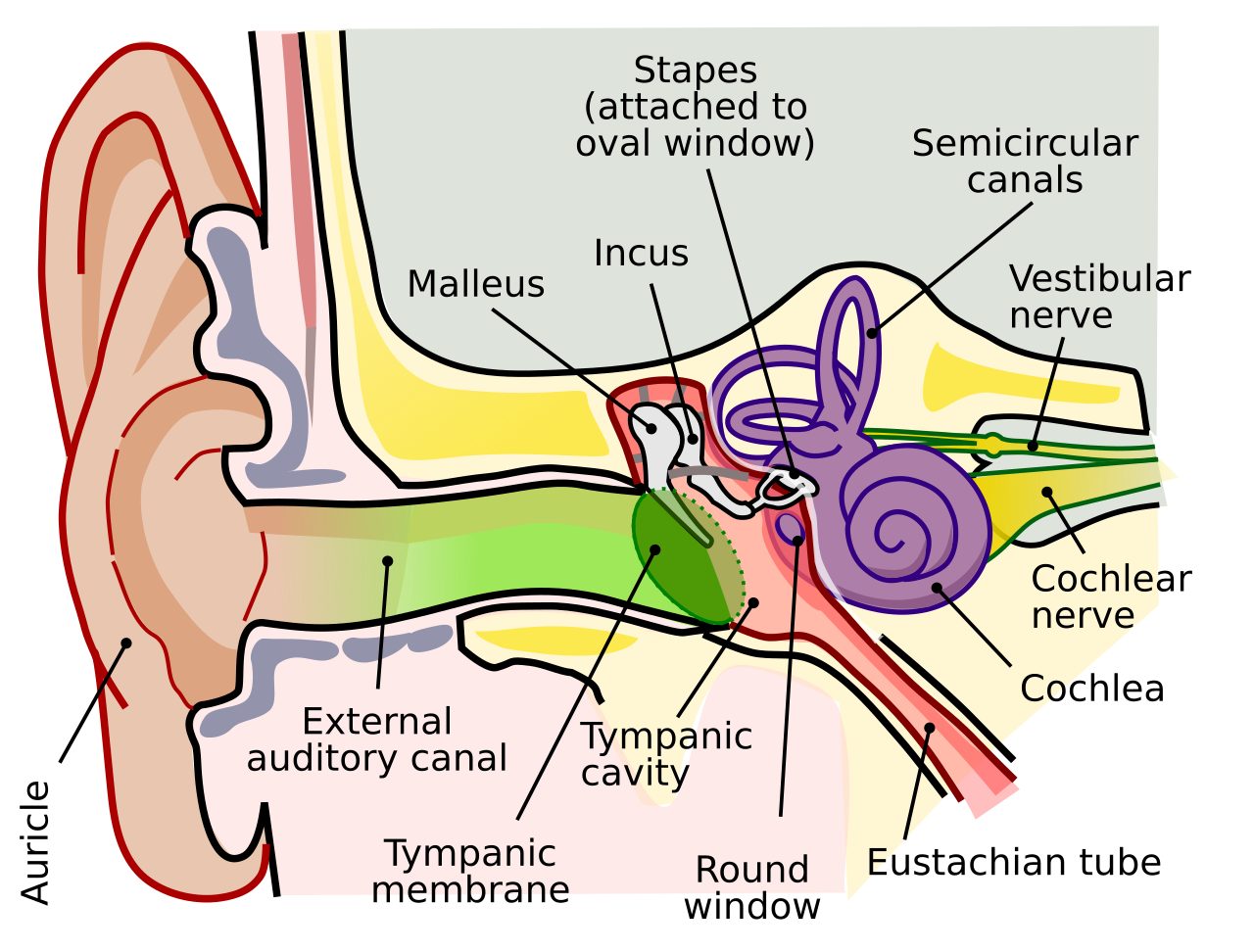
The internal-generation idea is genuinely powerful, and the research is careful to mark its edge. It cannot explain every case, and it explicitly fails at two of them. It does not account for situations where several independent people in the same area report the Hum at the same time, since separate cochleae do not coordinate. And it does not account for cases where instruments actually pick up an external low-frequency source that matches the reports, which is precisely what happened at Windsor. In other words, internal generation is very likely part of the answer for some hearers and no part of it for others, which is exactly what you would expect if the Hum were several phenomena rather than one.
06The Planet's Own Hum
There is a real, documented hum of the Earth, and it is worth naming carefully because it is constantly misused. Seismologists have measured a continuous low-frequency vibration of the whole planet, the free oscillations of the Earth, sometimes called Earth's hum, in the range of 2 to 20 millihertz, with periods of 50 to 500 seconds. It is generated mostly by oceanic microseisms, the endless pressure of ocean waves pushing on the seafloor. This is a genuine seismological phenomenon. It is also thousands of times too low to hear: the human hearing floor sits around 20 Hz, and these oscillations are down at thousandths of a single hertz. They cannot be the sound people report. The research does float one careful bridge, that in exceptionally sensitive individuals such vibrations might somehow be sensed indirectly, through bone conduction or the balance organs rather than ordinary hearing, but it flags that idea plainly as speculative and without direct experimental support. As it stands, Earth's hum is real, and it is not the Hum.

07The Electromagnetic Near Miss
Another proposal is that some Hum cases are not sound in the air but electromagnetic energy converted into sound inside the body, from sources like very low frequency transmitters or the harmonics of power lines. This one deserves care because it lives right next door to something real. The microwave auditory effect, discovered by Allan Frey in 1962 and often called the Frey effect, is a documented phenomenon: pulsed microwave radiation can genuinely make a person perceive clicks or buzzing. But the Frey effect operates at 300 megahertz to 3 gigahertz, a band millions of times higher than the 30-to-80-Hz range of the Hum. It is a real effect at the wrong frequency, and borrowing it to explain the Hum quietly swaps one for the other. The specific thing the Hum hypothesis needs, low-frequency electromagnetic energy transduced into sound inside living tissue, has never been demonstrated experimentally at anything like Hum frequencies. Real phenomenon, wrong address.
08Pipelines, and Why Only Some of Us
The most ambitious single-source idea comes from Glen MacPherson, who since 2012 has run the World Hum Map and Database, a crowd-sourced record now holding more than 30,000 entries. MacPherson has proposed that the global network of high-pressure natural gas pipelines and compressor stations is a major distributed contributor to the worldwide Hum: these systems generate low-frequency noise that propagates through the ground and couples into the structures of buildings far away. It is an elegant fit for two of the phenomenon's puzzles. It would explain why the Hum was rarely reported before the twentieth century, tracking the spread of heavy industrialization, and it would explain why no one can ever seem to localize a single source, because the source is a continent-spanning web rather than a point. The research is honest about its status: the idea is plausible, and it has not been systematically tested.
That leaves the oldest question of all, the one the prevalence figure keeps raising: why do only 2 to 11 percent of people hear the Hum when everyone shares roughly the same air? The research lists several plausible contributors and commits to none as decisive. Cochlear anatomy varies from person to person. So does the resting tension of the tiny muscles of the middle ear. Age-related hearing loss often spares the low frequencies selectively, which could leave some older listeners newly exposed to a band they used to ignore. There is likely a genetic component in auditory processing. And there is a psychological one: once a person notices the Hum, attention tends to lock onto it, and the sound can become self-reinforcing, harder to ignore precisely because it is now being listened for. No single one of these has been identified as the switch that decides who hears and who does not.
09What It Is Not
For all the genuine uncertainty above, two popular explanations are not uncertain at all. They are wrong, and the honest article says so plainly. The first is the online favorite: that the Hum is a government weapon, mind control from HAARP, radiation from 5G towers, or a covert military sonic device aimed at the population. There is no supporting evidence for any version of it. [NO EVIDENCE]. The chronology alone dismantles it. The Hum was being formally investigated in Bristol in 1980 and in Taos in 1993, decades before 5G existed, so 5G cannot be causing a sound that predates it by a generation. The geography finishes the job. The Hum is reported from quiet rural districts with no military base, no government installation, and no transmitter for miles. A cause has to be present where its effect is, and this one is repeatedly, verifiably absent.
The second wrong answer is more seductive because it wears the costume of science: the idea that the Hum is the sound of tectonic plates under stress, the Earth groaning just before an earthquake, a warning only sensitive people can catch. This one is misleading rather than baseless. [MISLEADING]. It is true that low-frequency acoustic emissions can accompany tectonic processes. But no study has ever established a correlation between Hum reports and any subsequent seismic event, and the sound is reported just as often in seismically dead regions as in active ones. A signal that does not actually track earthquakes is not an earthquake warning, no matter how much the framing flatters the person who hears it.
10The Honest Objections
An honest file has to make the case against itself, and there is a real one. Start with the heterogeneity this whole article has been building toward: because the Hum is almost certainly several different phenomena wearing one name, industrial noise here, a physiological quirk of hearing there, a genuinely unexplained low sound somewhere else, it is very hard to study as a single subject, and any study that treats it as one is partly doomed from the start. Then there is reporting bias. The existence of the World Hum Map and years of media coverage may themselves inflate the numbers, priming people to notice and attribute ambient low-frequency noise they would otherwise have tuned out. And there is the unglamorous truth that many reported cases, when someone actually investigates them, turn out to have thoroughly ordinary explanations: a nearby generator, a pumping station, traffic, an HVAC unit. Some of the mystery is not inexplicability. It is under-investigation.
There is also a reputational cloud over the subject, and it is worth naming rather than hiding. Deming's foundational 2004 review was published in the Journal of Scientific Exploration, a venue devoted to anomalous phenomena with looser peer review than mainstream journals, and that pedigree has led some scientists to wave the entire topic away as fringe. But this is where the article's core distinction has to hold firm one last time. The venue of a review does not touch the strength of the underlying finding, and the finding that matters most is not exotic at all. That people are genuinely perceiving a real, consistent sound is about as well-supported as anything in the field, thanks to that double-blind chamber in New Mexico. Whether the cause of any given case is mundane or genuinely anomalous is the open question. Whether something real is being heard is not.
Fast Facts
- The Phenomenon
- A low drone, roughly 30 to 80 Hz, throbbing like an idling diesel. Heard by an estimated 2 to 11 percent of people depending on the locality, louder indoors, worse at night, and stubbornly resistant to soundproofing.
- The Real Thesis
- The strongest studies suggest the Hum is not one phenomenon but a single label laid over several distinct causes, some external, some internal, some inaudible, and two that are simply wrong.
- Proven Real (the Perception)
- A 1995 double-blind test in a sound-isolated chamber at the University of New Mexico showed some hearers reliably detecting a matching signal. It confirms the experience is real, not imagined. It says nothing about the cause.
- The Best External Case
- The Windsor Hum. A 2013 to 2014 University of Windsor and Western University study correlated it with blast-furnace operations on Zug Island, Michigan. A well-supported hypothesis, not a confirmed source: investigators were denied access to the US-side site and measured from a boat.
- The Leading Internal Idea
- Spontaneous otoacoustic emissions, faint sounds the cochlea makes on its own (Deming, 2004). It fits the 2-to-11-percent prevalence, but cannot explain cases where several people hear the Hum at once.
- Real, but Not the Cause
- Earth's own hum from ocean waves is genuine but sits at 2 to 20 millihertz, far below hearing. The Frey microwave-hearing effect is genuine but works at 300 MHz to 3 GHz, nowhere near Hum frequencies.
- Ruled Out
- Government mind control via HAARP, 5G, or sonic weapons: [NO EVIDENCE], the Hum predates 5G by decades and haunts places with nothing to broadcast it. Tectonic stress before earthquakes: [MISLEADING], no study links Hum reports to later quakes.
What the Hum Actually Is
Start with what is actually nailed down. In a 1995 double-blind test in a sound-isolated chamber at the University of New Mexico, some Hum hearers could sort signal from silence reliably, which proves the perception is real and not invented. The sound has a consistent acoustic signature, roughly 30 to 80 Hz, throbbing like an idling engine, louder indoors and worse at night. Low-frequency noise is a genuine, well-documented environmental and public-health problem, and it is poorly blocked by ordinary walls, which is why the Hum is so often worse inside. And in Windsor, a 2013 to 2014 University of Windsor and Western University study genuinely correlated the local Hum with blast-furnace and coke-oven activity on Zug Island across the river. All checkable, all real.
One step out, the leading mechanisms are credible and unproven. The internal-generation hypothesis, that many cases are spontaneous otoacoustic emissions from the hearer's own cochlea, fits the 2-to-11-percent prevalence and the night-and-indoor pattern well, but by its own logic cannot explain cases where several independent people report the sound at once. Oceanic microseisms, the real 2-to-20-millihertz hum of the Earth itself, are a documented seismological fact, but they sit far below the roughly 20 Hz floor of human hearing, so the idea that a few exceptional people feel them through bone conduction stays unconfirmed. And the electromagnetic route is a near miss: the Frey microwave-hearing effect is real, but it works at 300 megahertz to 3 gigahertz, nowhere near Hum frequencies, and low-frequency electromagnetic-to-acoustic transduction has never been shown in a living body.
Two threads stay speculative. Glen MacPherson's proposal that the global gas-pipeline and compressor network is a distributed low-frequency source is plausible, would explain both the tie to industrialization and the difficulty of ever pointing to one origin, and has never been systematically tested. And the oldest question, why only 2 to 11 percent of people hear it, has no settled answer, only a list of contributing factors: cochlear anatomy, middle-ear muscle tension, age-related hearing change, genetics, and the way attention feeds on a sound once it has been noticed.
And two answers are refused outright. That the Hum is government mind control from HAARP, 5G, or sonic weapons is [NO EVIDENCE]: it predates 5G by decades and haunts places with nothing to broadcast it. That it is tectonic stress announcing a coming earthquake is [MISLEADING]: no study links Hum reports to later quakes, and it is heard as often on stable ground as on shaking ground. The quietest honest note sits under all of it. Many single cases, chased down, turn out to be a generator or a pump or an HVAC unit, and Deming's foundational review appeared in the Journal of Scientific Exploration, a venue soft enough that some scientists wave the whole subject off. But dismissing the cause as unremarkable is not the same as dismissing the experience. That people are hearing something real is the best-supported fact in the entire file.
So the honest answer to what is the Hum is that you are asking about the wrong noun. There is no the Hum, singular, waiting to be unmasked. There is a steel furnace in Michigan, and a cochlea firing in the dark, and a pipeline network breathing under the continent, and an ocean leaning on the seafloor, and a scatter of unexamined generators, all of them low, all of them worse at night, all of them filed for fifty years under one word because one word is easier to say than seven. What ties the cases together is not a source. It is a kind of ear, and a kind of quiet, and a very human insistence that a sound this persistent must mean one single thing. The most useful move anyone has made on this mystery was to stop hunting for the answer and start sorting the answers. So the question worth leaving open is not whether the Hum is real, because the people who lie awake inside it settled that a long time ago, but how many different real things we have been calling by its one name, and which of them might be filling your own room on the next quiet night, if you happen to be one of the few who can hear it at all.
Sources & further reading
Everything above is drawn from our research library on Theories of Anything, which is where we worked from. The papers, reports and primary records listed beneath them are where you can check us independently.
Image credits
- A wide daytime view of Zug Island, an industrial island in the Detroit River Photo: Notorious4life, via Wikimedia Commons. CC0 1.0 Source.
- A parking lot scene under warm evening light with a dog sitting on a pickup truck Photo: Einar Einarsson Kvaran, via Wikimedia Commons. CC BY-SA 3.0 Source.
- The Detroit skyline and Zug Island's industrial structures seen across the water Photo: Jamie (Toronto, ON), via Wikimedia Commons. CC BY 2.0 Source.
- A 1942 black-and-white photograph of a Great Lakes Steel Corporation blast-furnace Photo: Arthur S. Siegel, Library of Congress / U.S. Office of War Information, via Wikimedia Commons. Public domain Source.
- A labeled cross-sectional diagram of the human ear Diagram: Lars Chittka and Axel Brockmann, via Wikimedia Commons. CC BY 2.5 Source.
- Ocean waves rolling in open water toward a beach Photo: Sean O'Flaherty, via Wikimedia Commons. CC BY-SA 2.5 Source.
- Card crop of a wide daytime view of Zug Island, an industrial island in the Detroit River Photo: Notorious4life, via Wikimedia Commons. CC0 1.0 Source.
.jpg)

_-_Zug_Island_(3902119833).jpg)


