UFOs Before the Word Existed
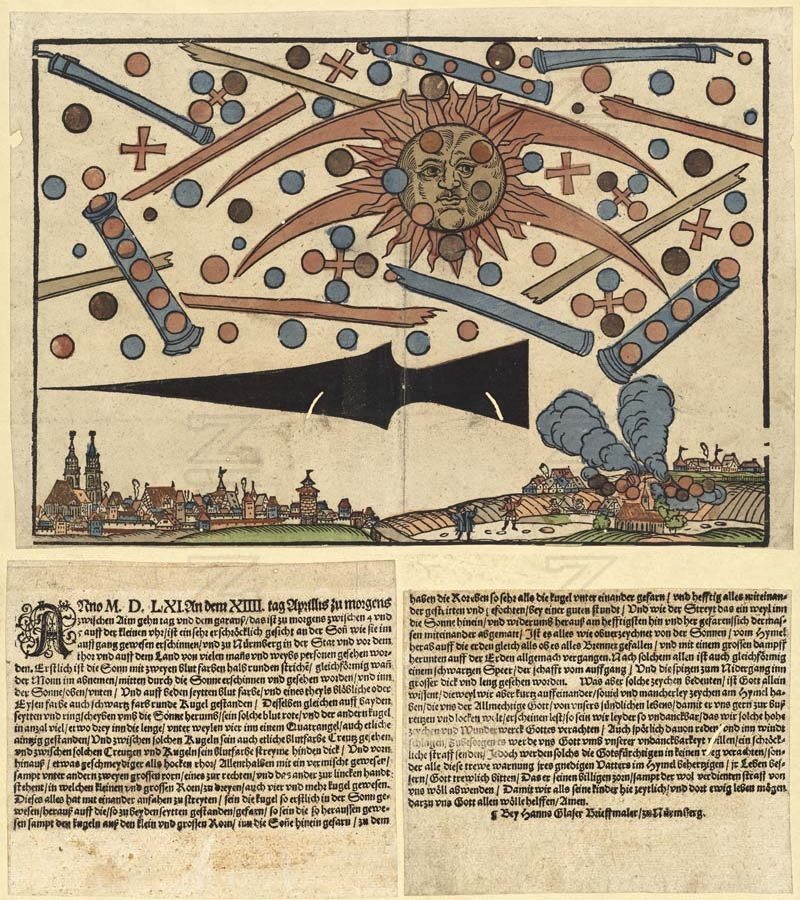
On the morning of April 14, 1561, people across Nuremberg looked up and saw the sky fill with spheres, crosses, and cylinders that seemed to fight one another and then fall to earth as if burning. A local printer named Hans Glaser cut a woodcut of it, and that woodcut still exists, catalogued in a library in Zurich, exactly where you can go and look at it. This is the strange, stubborn fact underneath every ancient UFO story: the documents are real. People genuinely wrote these accounts down, centuries before anyone had a word for a flying machine, let alone a flying saucer. But here is the catch the whole subject is built to make you miss. The moment you call the Nuremberg broadsheet a UFO report, you have already made a choice the witnesses never made. They did not see a spacecraft of unknown origin. They saw a warning from God. Here is the honest record of the skies before the word existed, graded tier by tier, and the real question of what we are doing when we read our own century back into theirs.
Every few years a viral post makes the rounds with a woodcut of a medieval sky full of spheres and cross shapes, captioned something like 'proof they were here in 1561.' The woodcut is real. That is the part almost nobody checks and almost nobody needs to, because it happens to be true. People really did stand in real streets in real cities and write down strange things in the sky, centuries before anyone had a word for a flying machine, let alone a flying saucer. The documents survive. You can pull them up in a library catalog. The honest problem starts one step later, at the caption, because the instant you write 'UFO' over a 16th-century sky you have translated the witnesses into a language they never spoke, and answered the question before you asked it.
01The Documents Are Real. The Word Is Not.
Here is the thesis this whole subject is built to make you skip. A UFO is, by definition, an unidentified flying object, a modern category that assumes there is an object, that it flies, and that its identity is an open scientific question. A Nuremberger watching the dawn sky in 1561 assumed none of those things. He was not looking at a craft of unknown identity. He was looking at a sign from God, a warning to a sinful city to repent, and he would have found the idea of a 'flying object' with a 'nature still to be determined' not merely wrong but unintelligible. Reading his account as a UFO report does not decode what he saw. It overwrites it with our own century.
So there are two separate questions here, and the entire field depends on quietly fusing them. First: is the document authentic? Very often, yes, and those documents earn Tier 1, because they genuinely exist and genuinely say what they are quoted as saying. Second: does the document record something anomalous, something outside the known behavior of the sky? That is a completely different claim, and it almost never climbs above Tier 2, because sundogs and sunspots and aurora and meteors and the conventions of a good story explain the overwhelming majority of it. Keep those two questions apart and the pre-modern sky stops being a UFO archive and becomes something more interesting: a record of how every age describes the unknown in the vocabulary it already owns.
And there is a selection trap under even that. Millions of pages of chronicles survive from the pre-modern world. The handful that get reprinted in UFO anthologies were chosen precisely because they resemble modern sightings, which means the pattern was drawn around the hits after the fact. It is the Texas Sharpshooter Fallacy in library form: fire a thousand rounds at the barn wall of history, then paint the target around the tightest cluster and call it proof of marksmanship.
02The Two Broadsheets Everyone Cites
If you have seen one pre-modern UFO image, you have seen these two. They are the flagships of the whole genre, and they deserve to be taken seriously precisely because they are real, datable, locatable objects rather than rumors of objects.
On April 14, 1561, the Nuremberg printer Hans Glaser issued a broadsheet, a single illustrated news sheet, describing a spectacle seen in the dawn sky. The woodcut shows the sun flanked by dozens of shapes: spheres, some in rows of four, cylinders with spheres inside them, crosses, two large crescents, a black arrowhead, and a big dark sphere low near the horizon. The text says the objects appeared to battle one another and then fell to earth 'as if consumed by fire.' The sheet still exists, catalogued in the Wickiana Collection at the Zentralbibliothek Zurich. This is not a story about a document. It is the document.
Crucially, nobody in 1561 called it a fleet. The broadsheet reads the event the way its culture read every strange sky: as a divine sign, a warning from God to a wicked people to mend their ways. That interpretive frame, celestial wonder as heavenly message, is the standard grammar of 16th-century German broadsheets, not an eccentric outlier.
It is also worth knowing what a broadsheet was. It was commercial media, the tabloid of its day, printed to be hawked in the street, and its publisher had every financial incentive to make the sky as dramatic as the woodblock could carry. An authentic 16th-century document and a reliable observation report are not the same thing, and this is squarely the first without being the second.
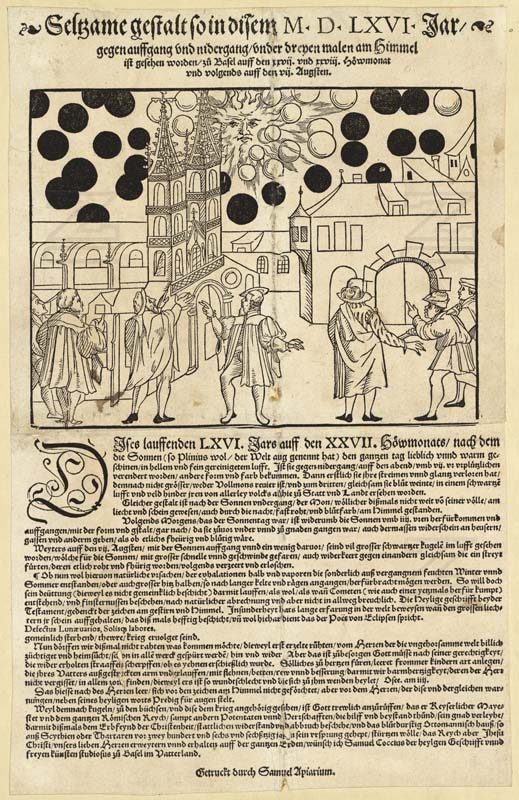
Five years later the pattern repeated in Switzerland. On August 7, 1566, a Basel broadsheet, printed by Samuel Apiarius and Samuel Coccius and also preserved in the Wickiana Collection, described 'many large black balls' rushing across the sky near the sun, 'turning against each other as if fighting,' for several hours in front of many witnesses. Same shape of story, same commercial medium, the same religious reading of it, a different city.
So what did they actually see? For Nuremberg, the leading natural candidate is an atmospheric optical display. Ice crystals high in the air can bend sunlight into a startling geometry of bright spots, arcs, crosses, and rings, the family of effects that includes sun dogs, or parhelia. A complex parhelion event at dawn can throw crosses and circles and glowing shapes across the sky at once, which is close to a shopping list of what the woodcut shows. The researcher Jason Colavito, among others, has argued exactly this reading of the Nuremberg print.
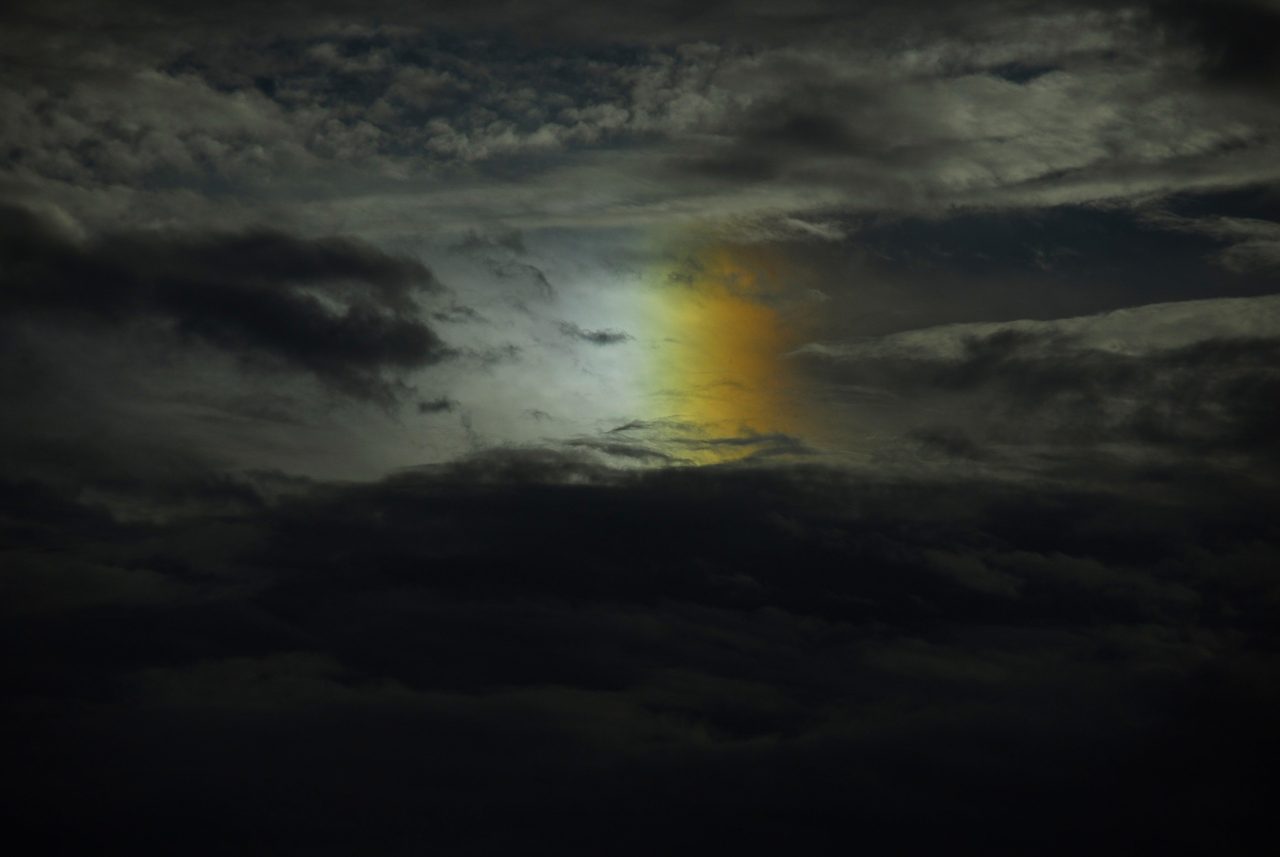
This is the counter-argument that quietly dismantles most of the pre-modern catalog. Parhelia, parhelic arcs, auroras, noctilucent clouds, bolide meteors, ball lightning, even earthquake lights and volcanic lightning can throw genuinely bizarre, hard-to-describe displays across the sky. Before modern atmospheric science named and sorted them, each of these was a raw, uncategorized wonder, and a frightened witness reaching for words would reach for the ones he had: shields, ships, dragons, armies, the wrath of heaven.

Basel points somewhere just as ordinary. 'Large black balls' clustered near the sun and slowly shifting is a strong match for sunspots, dark blemishes on the sun's face, seen with the naked eye through thin haze or cloud during a stretch of high solar activity, and the date sits in exactly such a stretch of the solar record. Dark artifacts thrown by parhelia or atmospheric refraction could add to the effect. Either way, the 'battle of black spheres' over Basel has a plausible home in the normal behavior of the sun.
03Rome Wrote Its Wonders Down By Law
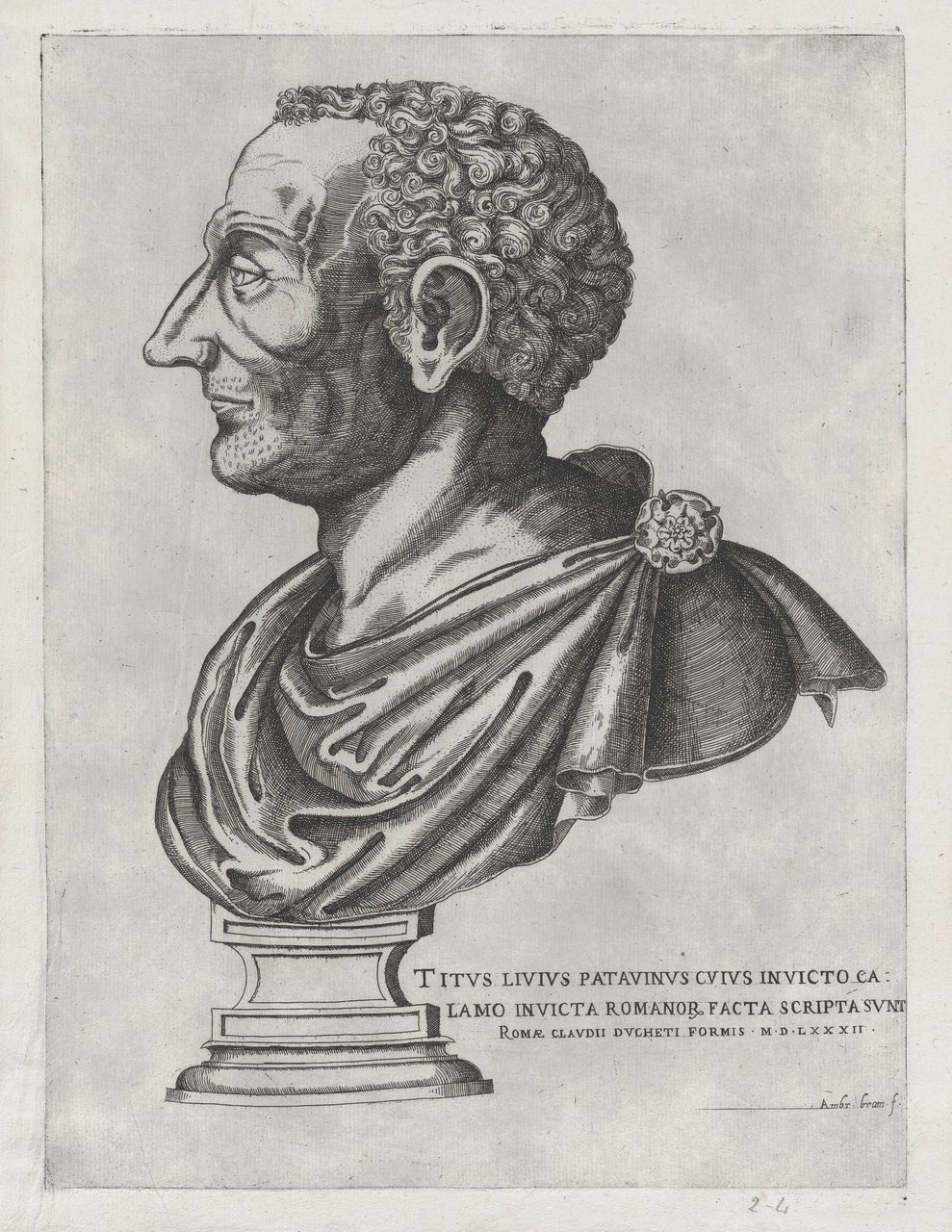
Go back further and the sky fills again, this time in the most respectable sources antiquity has. The historian Livy, in his monumental history of Rome, logged aerial prodigies by the dozen: 'phantom ships gleaming in the sky' in 218 BCE, the sky itself appearing to catch fire, 'the shape of a great ship' overhead in 214 BCE, and shields and phantom armies seen in the air in 193 and 173 BCE.
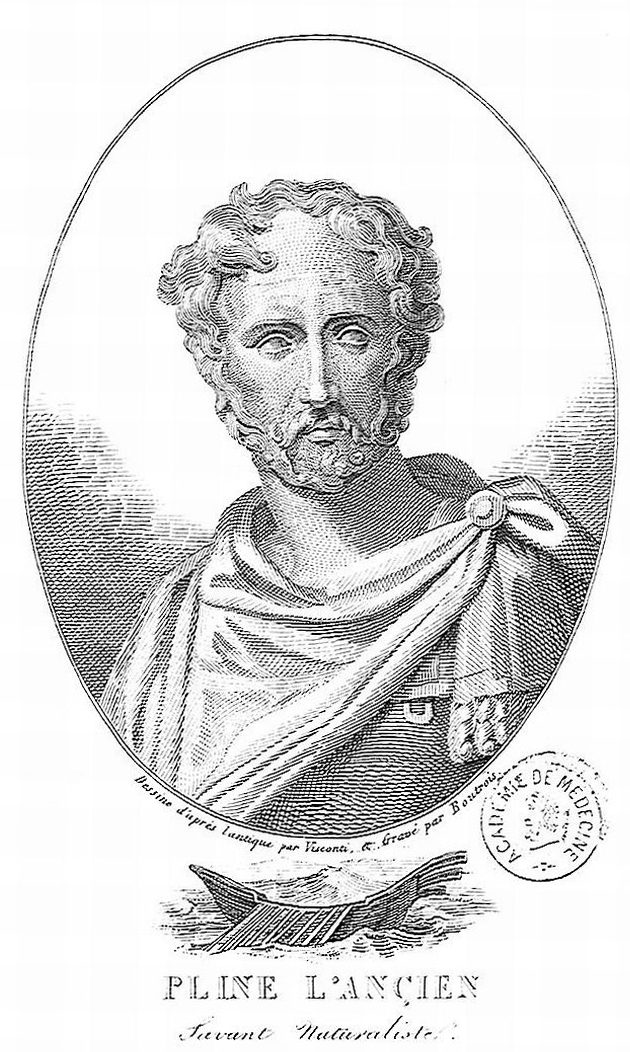
Pliny the Elder, in his Natural History, catalogued the same kind of thing as natural science, giving fiery sky objects names: clipeus ardens, the 'burning shield,' and trabes, 'beams' of fire. Julius Obsequens, centuries later, compiled a whole Book of Prodigies out of this tradition, thick with flying shields, phantom battles, and fires in the sky.
But here is the context that changes how you read every line of it, and it is the heart of the Roman case. Recording prodigies was not journalism and it was not science. It was a duty of the state. A prodigy was an official signal that the gods were displeased, so it had to be reported to the Senate, entered in the record, and ritually expiated to set the relationship with the gods right again. The incentive built into the whole system was to log and catalog omens, never to investigate or explain them. A great deal of what got logged is exactly what you would expect from that machine running for centuries over the Mediterranean sky: halos, aurora, bright meteors, noctilucent clouds, passing comets, meteor storms, all faithfully recorded as messages from heaven, because recording messages from heaven is what the system existed to do.
And now watch the machinery of the myth work in real time. One of the most repeated 'ancient UFO' stories has Alexander the Great menaced by great shining silvery shields that dove at his troops during a river crossing, usually attributed to Plutarch. Go to the standard critical editions of Plutarch's Life of Alexander and the passage is not there. It appears to come not from history at all but from the Alexander Romance, a wildly embroidered literary tradition, or from later medieval retellings. The most famous classical UFO encounter turns out to be a story about a story, and the source that supposedly proves it does not contain it. That is not a footnote. It is the whole problem in miniature.
04The Hollow Ship
Not every pre-modern account is a light in the sky. One of the best-loved cases in the whole literature is a boat.
In several early 19th-century Japanese texts, the Toen Shosetsu of 1825, the Ume no Chiri of 1844, and a manuscript called Hyoryu Kishu, a strange vessel washes ashore in 1803 at Harayadori, on the coast of what is now Ibaraki Prefecture. The utsuro-bune, the 'hollow ship,' is drawn as a round craft with a domed upper section of glass or crystal, and inside it a young woman with unusual features, clutching a box, speaking no known language, her cabin marked with writing in an unreadable script. It is genuinely eerie, and it is genuinely old.
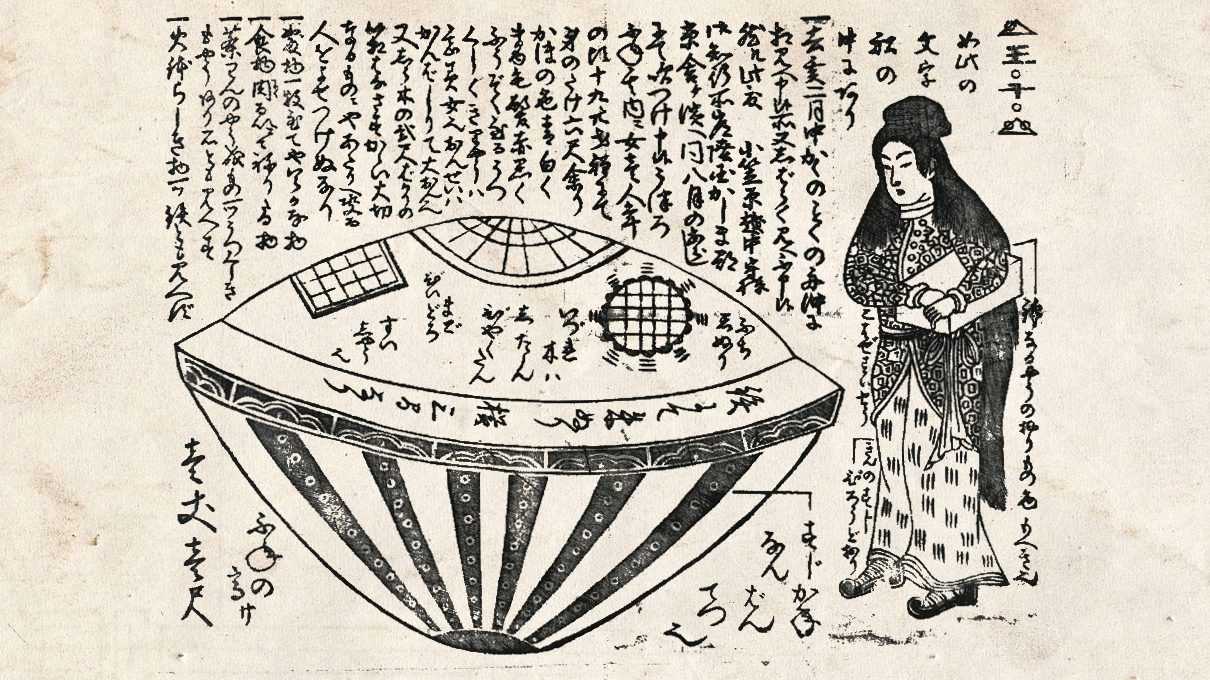
Here the scholarship does its patient work. The folklore researcher Kazuo Tanaka and others have shown that the utsuro-bune story sits neatly inside a well-established Japanese literary form, the hyoryu-ki, or castaway tale, a popular genre with its own stock beats. The domed vessel closely resembles the incense burners, koro, painted in the art of the period. The most economical reading is not a spacecraft but a folktale: a real memory of some drifting foreign castaway, a Russian or Southeast Asian vessel perhaps, worked over and stylized through a storytelling tradition that already had a shape ready for it.
And this is the counter-argument that recurs across the whole record. Many 'sighting' accounts are not observation reports at all. They follow the rules of their genre, the prodigy list, the sermon example, the folktale, the sensational broadsheet, rather than the rules of someone carefully writing down what they saw. The utsuro-bune is a clean case of it, but it is far from the only one.
And the UFO reading of it is not old at all. Nobody connected the hollow ship to spacecraft until the 1960s and 70s. The original texts do not reach for the stars. We did, and then we handed the idea back to them and called it ancient.
05The Year America Saw Airships
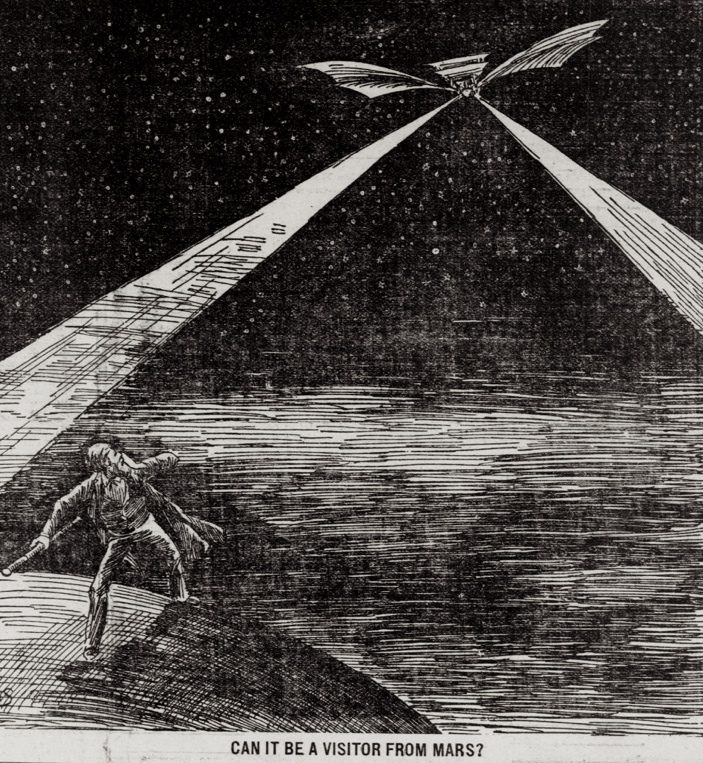
In the winter and spring of 1896 into 1897, before anyone had built a working aircraft, thousands of Americans reported an airship. It showed up first over California, around Sacramento and San Francisco, then drifted east across the Midwest as the newspapers chased it: a long, cigar-shaped craft with lights, sometimes propellers and wings and a gondola, occasionally landing, occasionally crewed by an affable inventor who spoke perfect English and promised to unveil his machine any day now.
No such machine existed. The Wright brothers were still six years from their first flight. No craft was ever recovered, no inventor ever unveiled his airship, no physical trace of any of it turned up. Historians read the wave as a blend of misidentified Venus and bright stars, newspaper editors inventing stories to sell papers, and plain social contagion, a report that spread because everyone had just read that everyone else was seeing it.
That is the anachronism thesis stated as a fact about ourselves rather than about the sky. The sky is a screen. What gets projected onto it is whatever the age has most recently learned to imagine, and the sightings drift, decade by decade, to keep pace with the machines we are dreaming about.
06Fiery Dragons, a Skeptical Voice, and Ezekiel's Wheel
The medieval record has its own famous lines. The Anglo-Saxon Chronicle, under the year 793, reports 'fiery dragons flying across the firmament' over Northumbria, most likely a vivid aurora or meteor display, and possibly sharpened by a later copyist retelling it.
The chronicler Matthew Paris, around 1250, records 'a large star like a torch' seen across England.
And then the genuinely delicious one. In the 9th century, Agobard of Lyon writes about a folk belief in sky-ships, navigantes in nubibus, 'sailors in the clouds,' from which beings supposedly descended. He raises it only to pour scorn on it. He thinks it is peasant nonsense. So one of the earliest clear European references to something like sky-ships is not a believer's report at all. It is a 9th-century writer openly debunking the idea, a useful reminder that pre-modern people were perfectly capable of skepticism, and that not every old writer swallowed every wonder whole.
This is the interpretive challenge in one place. Medieval chroniclers filed sky events under divine signs, portents, and the coming end of the world. A meteor was an omen; a strange light was angelic or demonic. To pull a clean 'UAP data point' out of one of these entries, you first have to strip away everything it actually meant to the person who wrote it and swap in a category he never had. That is not reading the source. It is editing it.
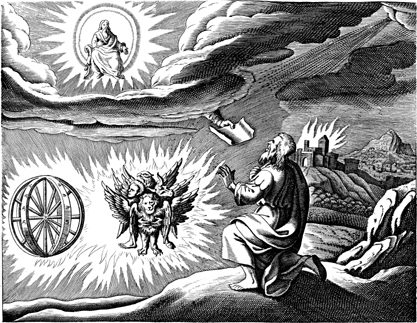
No passage gets cited more than Ezekiel's. In chapters 1 and 10 the exiled prophet describes a vision of a 'wheel within a wheel,' living creatures with four faces and many wings, fire and gleaming metal and a crystal dome overhead. It is strange, specific, and mechanical-sounding, and it has been read as a landing craft more times than anyone can count.
In 1974 a NASA engineer, Josef Blumrich, wrote a whole book, The Spaceships of Ezekiel, arguing the vision described a helicopter-like landing vehicle. It got attention. It has also been criticized hard by biblical scholars as a mechanical misreading that ignores what the text is actually doing.
The scholarly reading is more grounded and, honestly, more interesting than a helicopter. Ezekiel's vision belongs to a recognizable ancient Near Eastern genre, the prophetic throne vision, a theophany, a manifestation of the divine. Its imagery echoes Mesopotamian motifs: the melammu, the divine radiance of a deity, and the wheeled throne-chariots of the astral gods. The wheels within wheels are not landing gear. They are the mobile throne of a God rendered in the visual language of the very empire the prophet is exiled among. Read in its own world, it is a masterpiece of theology, not a technical observation report.
07The Foo Fighters and the Ghost Rockets
By the time we reach living memory the accounts get harder to wave off, because they come from trained observers. During the Second World War, in 1944 and 1945, Allied and Axis pilots in both the European and Pacific theaters reported luminous balls and discs pacing their aircraft. They called them foo fighters, after a nonsense word from the Smokey Stover comic strip. Each side suspected a secret weapon of the other. After the war, investigators confirmed that neither side had possessed any such thing.
Then, in 1946, over 2,000 reports of cigar-shaped objects streaked across Scandinavia, mostly Sweden. Swedish military and US intelligence both investigated the 'ghost rockets.' The obvious first guess, Soviet tests of captured German V-2 rockets, did not survive trajectory analysis. The Swedish Defence Staff's own conclusion was carefully worded and genuinely striking: roughly 200 of the reports described 'real physical objects which could not be explained as natural phenomena or as Swedish or foreign aircraft.'
These are the direct on-ramp to the modern era. They land in the record just before Kenneth Arnold's 1947 sighting gave the world the phrase 'flying saucer,' which means the phenomenon, or at least the reporting of it, was already there before the saucer archetype existed to shape it. Whatever the ghost rockets were, and much of that stays honestly unexplained, they were not people seeing what pop culture had told them to see. Pop culture had not gotten there yet.
08A Light on the Water
One more case belongs here, and it comes with a disclosure. The following is not drawn from our research file on pre-modern accounts, which never mentions it. We verified it independently against the primary source, because it is famous enough to belong in any honest version of this story, and because it shows the two-layer test working cleanly one more time.
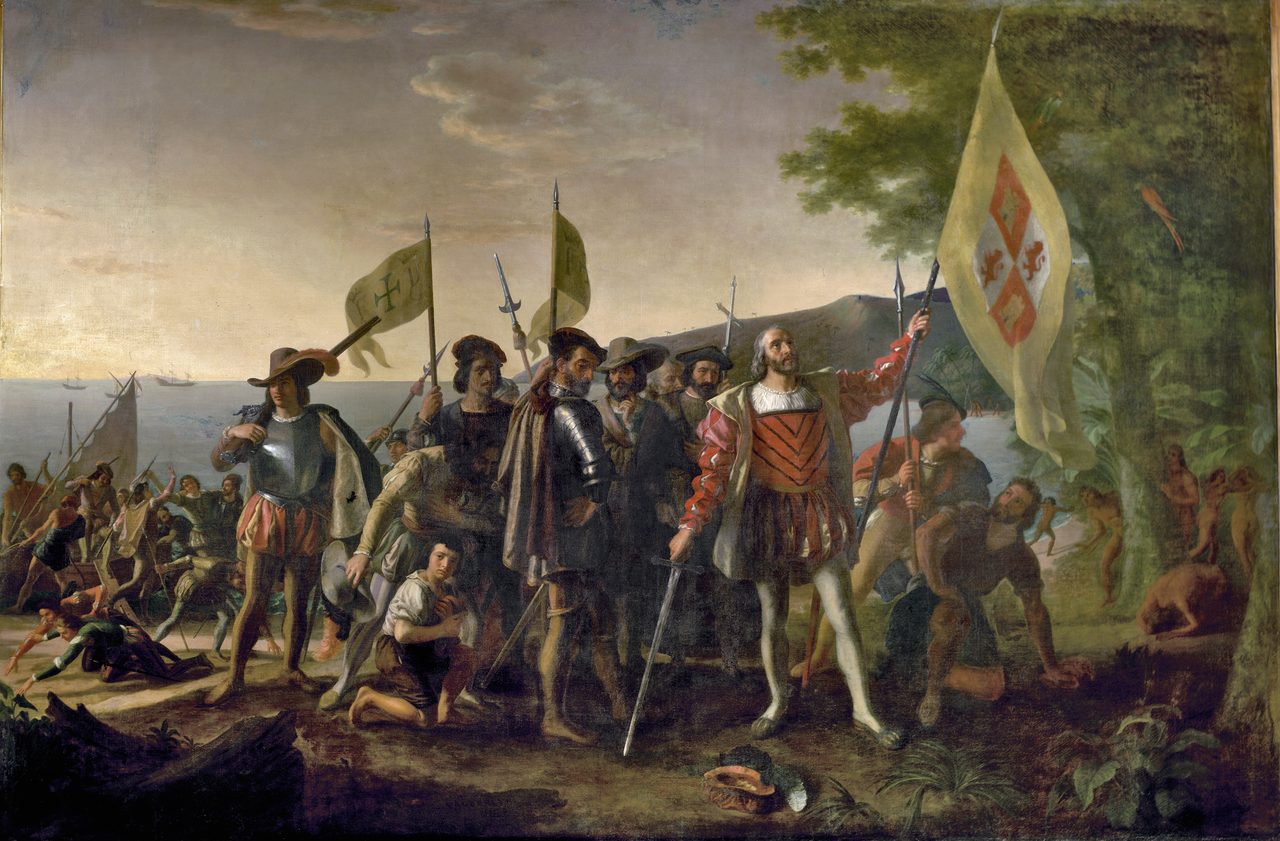
Late on the night of October 11, 1492, hours before landfall, Christopher Columbus recorded in his log a light out on the dark ocean, 'like a little wax candle rising and falling.' He called over Pero Gutierrez, steward of the king's dais, who saw it too. A third man, Rodrigo Sanchez de Segovia, was not positioned to see it and did not. Roughly four hours later, around two in the morning on October 12, the lookout Rodrigo de Triana aboard the Pinta sighted the actual coastline. The log survives through the abstract Bartolome de las Casas made of it.
And the explanations are firmly of this world. Historians have proposed torches or cooking fires carried by people on the shore, floating debris, or natural bioluminescence in the water. None of them is nailed down as the single answer, which is exactly the honest state of the case: a real, well-documented sighting by named witnesses, with a debated but entirely mundane range of causes, and no anomaly required to explain it. It carries a small human footnote too, that Columbus later claimed the crown's reward for first sighting land even though Triana saw the coast first, a dispute about money, not about lights.
Before the record thins out into the genuinely speculative, here is the documentary case laid out on one page and run through the two-question test that this whole subject depends on blurring together.
| The Document | Is It Authentic? | Anomalous Beyond Nature? | Leading Ordinary Explanation |
|---|---|---|---|
| Nuremberg broadsheet, 1561 | Yes, held in Zurich | Not required | A complex sundog (parhelion) display at dawn |
| Basel broadsheet, 1566 | Yes, held in Zurich | Not required | Naked-eye sunspots during high solar activity |
| Roman prodigies: Livy, Pliny, Obsequens | Yes, canonical texts | Not required | Halos, aurora, meteors, and comets logged as state omens |
| Japanese utsuro-bune, 1803 | Yes, in period texts | Not required | A castaway folktale in the hyoryu-ki genre |
| American airship wave, 1896 to 1897 | Yes, thousands of reports | Not required | Venus, bright stars, press invention, social contagion |
| Foo fighters and ghost rockets, 1944 to 1946 | Yes, wartime and military files | A real residue remains | Mixed; some ghost-rocket cases stay honestly unexplained |
09Where the Record Thins Out
Past the documents we can actually hold, the ground gets softer, and honesty means marking the line clearly.
The most-cited 'ancient Egyptian UFO' is the Tulli Papyrus, supposedly describing 'circles of fire' in the sky in the reign of Thutmose III, in the 15th century BCE. Treat it with both hands in your pockets. The original papyrus has never been located, never examined by scholars, never photographed. What survives is a transcription by one man, Boris de Rachewiltz, whose reliability has been questioned, and the Vatican, where the document was supposedly held, has stated that it possesses no such thing. Without the original there is nothing to authenticate. This is not evidence of an Egyptian sighting. It is a rumor of a copy of a document nobody can produce, and it should be treated as unverified and quite possibly spurious.
Then there is the most intellectually seductive idea in the whole field. Jacques Vallee, in Passport to Magonia and later in Wonders in the Sky with Chris Aubeck, proposed that pre-modern wonders, fairy encounters, demonic visitations, and modern UAP are all faces of a single underlying phenomenon, one that changes its costume to match each culture's expectations, what he called a 'control system.' It is a beautiful thought, and our file on Vallee's hypothesis carries the full argument. It also has a fatal flaw baked into it: it cannot be proven wrong. If the phenomenon is defined as inherently shape-shifting to fit whatever people expect, then every possible observation confirms it and none can ever count against it, and a theory that predicts everything forecasts nothing.
10The Leaps the Evidence Will Not Carry
And then there are the two moves the whole record is built to smuggle in, and that it cannot support. Our file grades them Tier 4 and refuses them outright.
The first is the ancient-astronaut leap, popularized by Erich von Daniken: from 'ancient cultures recorded strange things in the sky' straight to 'extraterrestrial beings visited ancient civilizations.' It does not follow, and the gap it jumps is enormous. That people wrote down aerial wonders establishes that they saw, or imagined, aerial wonders. It says nothing whatever about spacecraft. Known natural phenomena, artistic convention, literary genre, and the belief systems of the witnesses already account for the overwhelming majority of the accounts, with no visitors needed. The full rebuttal of the ancient-astronaut claim is its own case, and our dedicated file on that theory carries it in depth. Here it is enough to say the documents do not reach that far. [DEBUNKED as default explanation]
The second is subtler and, if anything, more important, because it is a claim about method. Take the whole sprawling body of pre-modern prodigies and you find that alongside the flying shields sit rains of blood, speaking animals, and monstrous births, all recorded in the same registers, by the same hands, with the same gravity. UFO anthologies quietly keep the flying shields and discard the talking cows. But you do not get to grade the same source reliable when it flatters your thesis and folklore when it does not. Cherry-pick the sky-wonders out of a record saturated with obvious folklore and you manufacture a pattern, an illusion of one persistent anomalous phenomenon threading through history, where the honest reading is a river of ordinary marvels and misread weather with a few resemblant lines fished out on purpose. [DEBUNKED as methodology]
Fast Facts
- The Nuremberg Broadsheet
- Printed by Hans Glaser on April 14, 1561, and preserved in the Wickiana Collection at the Zentralbibliothek Zurich (shelfmark PAS II 12/21). It shows spheres, crosses, cylinders, and crescents over the city and reads them, in its own text, as a divine warning, not a fleet. Leading natural explanation: a complex sundog (parhelion) display at dawn.
- The Basel Broadsheet
- Printed August 7, 1566, by Samuel Apiarius and Samuel Coccius, also in the Wickiana Collection. It describes 'many large black balls' near the sun that seemed to fight for hours. Leading natural explanation: naked-eye sunspots during high solar activity, seen through haze.
- Rome's Prodigies
- Livy, Pliny, and Obsequens logged flying shields, phantom ships, and sky-fires. But recording prodigies was a duty of the state, a religious obligation to report omens to the Senate and expiate them, not an attempt to observe or explain. The famous 'Alexander's flying shields' story is not actually in Plutarch.
- The Hollow Ship
- The Japanese utsuro-bune (washed ashore 1803, recorded 1825 to 1844) follows the conventions of the hyoryu-ki castaway-tale genre, and its domed vessel resembles a period incense burner. The UFO reading was invented only in the 1960s and 70s.
- The Airship Wave
- Thousands of 1896-97 US reports of a crewed 'airship,' years before the Wright brothers flew. No craft, no inventor, no evidence ever surfaced. The template it reveals: each era sees the edge of its own technology, airships then, saucers in 1947, Tic Tacs now.
- Foo Fighters and Ghost Rockets
- WWII pilots reported luminous balls (1944 to 1945); over 2,000 'ghost rockets' crossed Sweden in 1946. The Swedish Defence Staff judged about 200 of them 'real physical objects' it could not explain. These are the direct precursors to the 1947 flying-saucer era.
- The Tulli Papyrus
- The alleged Egyptian 'circles of fire' text has never been located, examined, or photographed; it survives only in one questioned transcription, and the Vatican says it holds no such document. Tier 3, unverified and possibly spurious.
- The Bottom Line
- The documents are real. Calling them UFO reports is not a finding, it is a modern label pinned onto witnesses who never used it, and known natural phenomena and literary convention explain the great majority of what they wrote.
So Were There UFOs Before the Word Existed?
Yes, the documents are unambiguously real. The 1561 Nuremberg and 1566 Basel broadsheets sit in a Zurich library. Livy, Pliny, and Obsequens really did catalogue flying shields and phantom ships. The utsuro-bune texts, the thousands of 1896-97 airship articles, and the WWII foo-fighter and 1946 ghost-rocket files all exist and say what they are quoted as saying. Human beings have described strange things in the sky for as long as they have written anything down at all. That much is not in doubt.
But 'real document' and 'record of something anomalous' are two different claims, and the second rarely holds. Sundogs, sunspots, aurora, meteors, and the conventions of a good story account for the great majority of these accounts. The strongest residue, the ghost rockets and some foo fighters, is genuinely unexplained and honestly reported as such, without needing to reach past 'we do not know.' The anachronism critique carries this whole tier: a 16th-century witness saw a sign from God, and translating him into a UFO witness overwrites what he actually meant.
A couple of famous pieces do not even reach credible. The Tulli Papyrus cannot be authenticated, because no one can produce it. Vallee's control-system idea, that one shape-shifting phenomenon underlies fairies, demons, and saucers alike, is fascinating and unfalsifiable in the same breath: it fits every observation because it is defined to, which means it forecasts none.
And two moves are refused outright. The jump from 'cultures recorded aerial wonders' to 'aliens visited the ancients' inserts a step the evidence never supplies; known nature, art, and belief already explain the accounts, and no visitor is needed. [DEBUNKED as default explanation] And the method that builds the whole ancient-UFO picture, keeping the resemblant lines while quietly discarding the rains of blood and speaking animals filed right beside them, manufactures a pattern rather than finding one. [DEBUNKED as methodology] The pre-modern sky is a record of how humans describe the unknown, not proof that the unknown was ever a spacecraft.
None of which means the file is closed, and the interesting part is how much of it stays genuinely open. The honest frontier is not 'were they aliens.' It is more careful and more answerable than that. Can we cross-match the great catalogs of historical aurora, meteor showers, and solar activity against specific dated prodigies and finally say what the sky was actually doing on a given night? How much of the pre-modern 'evidence' was embellished not by medieval scribes but by modern UAP writers reworking the originals? What is the true background rate of genuinely strange atmospheric optics, the baseline these accounts should be measured against before any of them counts as anomalous at all? Could the Nuremberg and Basel broadsheets be matched, definitively, to specific modeled atmospheric events? Those are the questions worth chasing. So the sky over Nuremberg is still worth looking at. The only thing worth dropping is the caption we keep writing over it before we have read the page underneath. What, exactly, were those people trying to tell us, in the only words they had?
Sources & further reading
Everything above, except the Columbus case, is drawn from our research library on Theories of Anything, principally file I_5_07, Pre-Modern UAP Accounts, which carries the Nuremberg and Basel broadsheets, the Roman prodigies of Livy, Pliny, and Obsequens, the Japanese utsuro-bune texts, the 1896-97 airship wave, the medieval chronicles and Ezekiel, the WWII foo fighters and 1946 ghost rockets, the Tulli Papyrus, and the anachronism and selection-bias critique that anchors this piece. The Columbus light of October 11, 1492 is not in that file; we verified it independently against Columbus's own log as preserved in Bartolome de las Casas's abstract, and flag it here as web-verified supplementary material rather than corpus material. Vallee's control-system hypothesis has its own file, I_5_05. The full rebuttal of the ancient-astronaut claim belongs to a separate file, I_5_03, Ancient Astronaut Theory, which will carry that argument in depth once it is published; here we state only the brief Tier 4 refusal. Sources in the text are named by author, work, and year. Open the full file to check the sourcing and go deeper.
Image credits
- The 1561 celestial phenomenon over Nuremberg, broadsheet woodcut woodcut by Hanns (Hans) Glaser, 1561 (Wickiana Collection, Zentralbibliothek Zurich), via Wikimedia Commons. Public domain (Creative Commons Public Domain Mark 1.0) Source.
- The 1566 celestial phenomenon over Basel, broadsheet broadsheet woodcut by Samuel Apiarius with text by Samuel Coccius (Samuel Koch), Basel 1566, via Wikimedia Commons. Public domain (Public Domain Mark 1.0; published before 1 January 1931) Source.
- Engraved bust portrait of Livy, from the Speculum Romanae Magnificentiae engraving by Giovanni Ambrogio Brambilla after Nicolas Beatrizet, published by Claudio Duchetti, 1582 (Metropolitan Museum of Art, Open Access), via Wikimedia Commons. CC0 1.0 Universal (public-domain dedication) Source.
- Engraved portrait of Pliny the Elder engraving by an unknown artist, digitized by the U.S. National Library of Medicine (National Institutes of Health), via Wikimedia Commons. Public domain (a work of the U.S. National Institutes of Health) Source.
- Ezekiel's chariot vision, engraving after Matthaeus Merian the Elder (1670) engraving after Matthaeus Merian the Elder, from Nicolas Fontaine's 'L'Histoire du Vieux et du Nouveau Testament,' 1670, via Wikimedia Commons. Public domain (Creative Commons Public Domain Mark 1.0; published before 1 January 1931) Source.
- The reported mystery airship, The Saint Paul Globe, April 13, 1897 newspaper illustration by an unknown artist, The Saint Paul Globe (Minnesota), 13 April 1897, via Wikimedia Commons. Public domain (published in the United States before 1 January 1931) Source.
- A parhelion (sun dog) beside the sun photograph by Andrea Westmoreland, near DeLand, Florida, 12 July 2008, via Wikimedia Commons. Creative Commons Attribution-ShareAlike 2.0 Generic (CC BY-SA 2.0) Source.
- Sunspot group 1302, photographed by NASA (2011) photograph by NASA of sunspot group 1302, 24 September 2011, via Wikimedia Commons. Public domain (a work of NASA, a U.S. federal agency) Source.
- The utsuro-bune (hollow ship), from the manuscript Ume-no-chiri (1844) illustration by Nagahashi Matajirou, from the manuscript Ume-no-chiri, 1844, via Wikimedia Commons. Public domain (published before 1931; the author's copyright term has expired) Source.
- Landing of Columbus, painting by John Vanderlyn (1847) painting by John Vanderlyn, 1847 (United States Capitol Rotunda, Architect of the Capitol), via Wikimedia Commons. Public domain (published before 1 January 1931; a U.S. Architect of the Capitol work) Source.
- Card crop of The 1561 celestial phenomenon over Nuremberg, broadsheet woodcut woodcut by Hanns (Hans) Glaser, 1561 (Wickiana Collection, Zentralbibliothek Zurich), via Wikimedia Commons. Public domain (Creative Commons Public Domain Mark 1.0) Source.


_April_13_1897.jpg)
_-_Flickr_-_Andrea_Westmoreland.jpg)


.jpg)