Ummites: The People of Ummo
In 1966 a Madrid contactee began receiving typed letters from a people who said they came from the planet Ummo. The correspondence ran past a thousand pages and fooled scientists for decades. Then a Spanish technician said he wrote every word. Here is the file, with each claim wearing its evidence.
In 1966 a postal clerk in Madrid opened his mail and found a letter from another planet. Over the years that followed, the letters kept coming: typed, formal, running eventually to more than a thousand pages, all signed by a people who called themselves the Ummites and gave a return address on a world named Ummo. Scientists read them. A quiet cult of readers grew up around them. And then, decades later, a Spanish technician stood up and said he had typed every page himself. This is the file on the Ummites, opened the way it deserves: claim by claim, each one wearing its evidence.
01The clerk who got mail from a star
The Ummo affair began in Madrid in 1966, when a contactee-circle organizer named Fernando Sesma Manzano started receiving long typewritten letters and photographs that claimed to come from a spacefaring people, the Ummites, of the planet Ummo. What grew out of that first delivery became one of the largest documentary hoax corpora in the history of European ufology.
Sesma was no random recipient. A Spanish postal-service employee, he had already founded a Madrid contactee organization, Los Amigos de los Visitantes del Espacio (Friends of Space Visitors), back in 1954, more than a decade before the first Ummo letter reached him. The receptive circle was already built. The hoax simply walked into a room that had been waiting for it.

02Two landings, one emblem
Letters alone rarely convince anyone. What gave the Ummo story its physical grip were two events on the ground, both carrying the same strange mark, and both, in the end, staged by the same hand.
| Event | Date | Place | What was later admitted |
|---|---|---|---|
| Landed saucer | Feb 6, 1966 | Aluche, Madrid | Staged, by Jordán Peña's own admission |
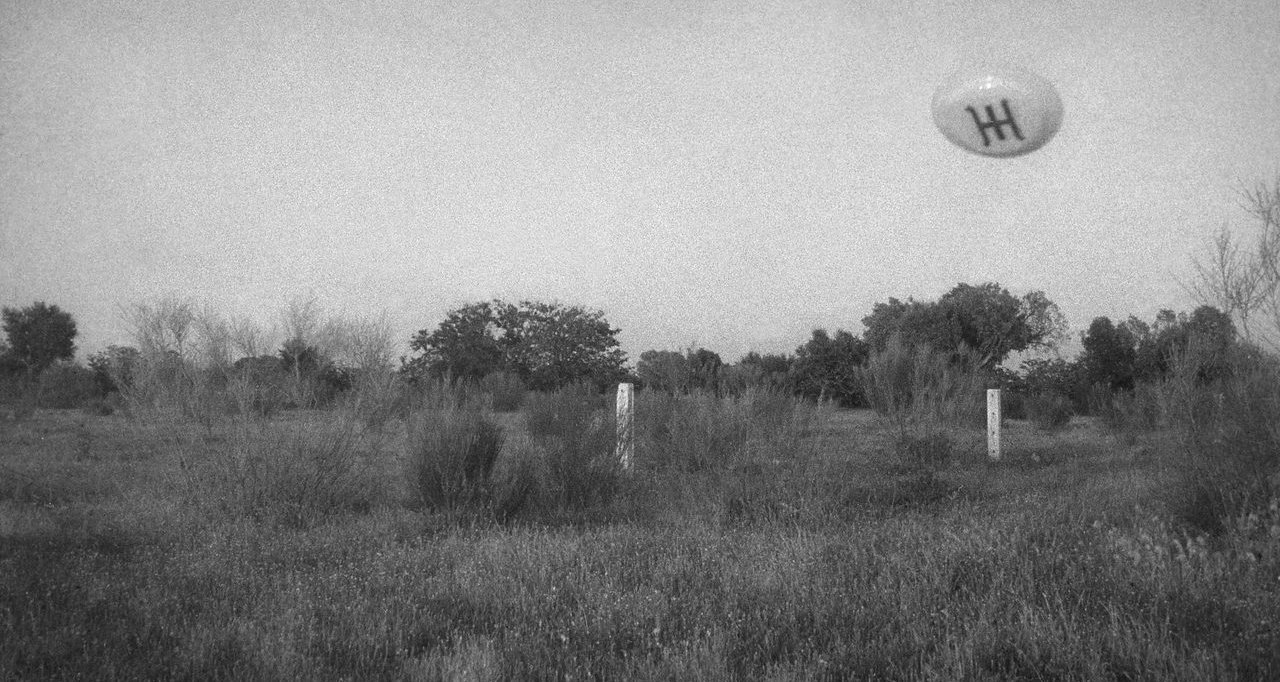
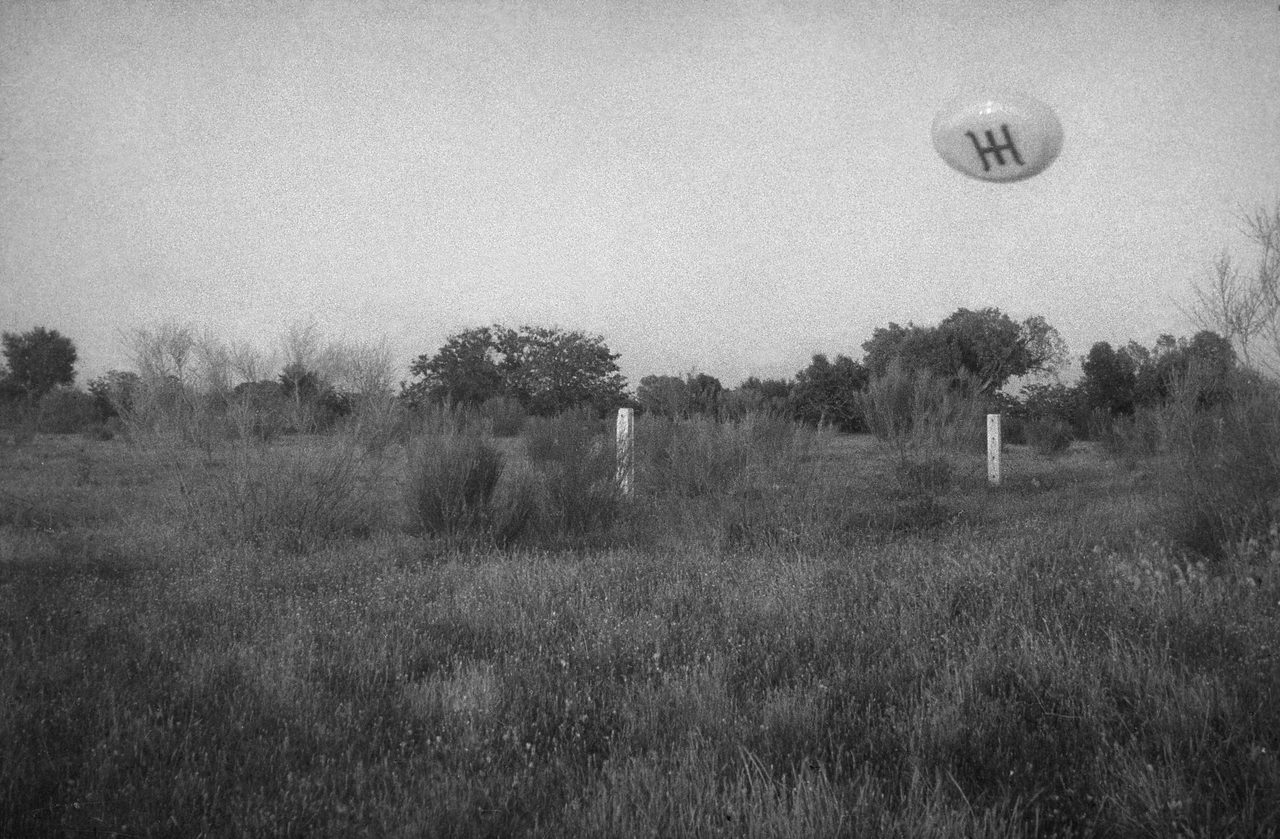
| Craft photographs | Jun 1, 1967 | San José de Valderas, Alcorcón | A small model hung on a wire |
On February 6, 1966, roughly half a dozen witnesses near the Madrid suburb of Aluche reported a landed, three-legged saucer-shaped craft about 33 feet across, marked with a distinctive emblem: three vertical bars joined by a single horizontal line. Among the witnesses was José Luis Jordán Peña, who would later admit that he staged the whole scene.
Sixteen months on, on June 1, 1967, four photographs surfaced of an alleged Ummite craft bearing that same emblem, taken over San José de Valderas in Alcorcón. The photographer was again Jordán Peña, and he later admitted the 'craft' was a small model suspended on a wire. The most reproduced images in the entire case were, by the confessor's own account, a toy and a thread.
03A home address that did not add up
The letters were generous with detail, and one detail turned out to be the tell. The Ummites named their sun, and in naming it they picked a real star that quietly contradicted their own story.
The correspondence, mostly in Spanish with some letters in French and other languages, eventually ran to well over a thousand typed pages. It claimed to originate with the Ummites of the planet Ummo, orbiting a star the authors called Iumma and tentatively identified with Wolf 424, a real star in the constellation Virgo. Crucially, the letters treat Iumma as a single sun.
Wolf 424 is genuine, and that is exactly the problem. It is a nearby red-dwarf binary system (components Wolf 424 A and B), roughly 14.3 to 14.4 light-years away in Virgo, and its close-binary nature was established by the astronomer Dirk Reuyl in 1941. The hoax borrowed a real object out of the astronomy of its day, then described it wrong.
Critics have singled that mistake out as a tell against extraterrestrial authorship. If the Ummites truly lived on a planet in the Wolf 424 system, they would grow up under two suns and would surely say so. The letters speak of only one. A civilization cannot misremember how many stars it orbits. A human author working from a 1960s star catalog easily can.
The letters also backdated the visit. They claimed the Ummites first landed on Earth covertly near Digne-les-Bains, in the Alpes-de-Haute-Provence region of southern France, in March 1950, sixteen years before the Madrid contacts began. There is no evidence for this at all beyond the letters that assert it.
04The people of Ummo, on paper
So who were the Ummites supposed to be? The letters built them out in surprising, and revealingly human, detail.

| Trait | What the letters claimed |
|---|---|
| Build | Tall, blond, high-foreheaded |
| Eyes | Proportionally smaller than a Terran's |
| Lifespan | Around 200 'Terrestrial' years |
| Voice | Vocal cords that fail with age, pushing elders toward telepathy |
The Ummites, as written, were close to Northern European humans: tall, blond, high-foreheaded, with proportionally smaller eyes than Terrans, a life expectancy of around 200 'Terrestrial' years, and vocal cords that degenerate with age, pushing older Ummites toward telepathy or speech-assist technology. It is a portrait, and a suspiciously flattering, suspiciously European one, resting on nothing but the letters.
The corpus grew to a scale unusual for a hoax. A 1988 letter referenced roughly 3,850 pages already in circulation, and some researcher estimates for the total theoretical output run as high as 160,000 pages. But only about 1,300 pages have actually been catalogued and verified by independent researchers. The larger totals rest on single, uncorroborated figures, and should be read as claims, not counts.

Believers took the apparatus seriously enough to build a whole constructed language out of it. Antonio Ribera catalogued about 403 Ummite words in 1978, and Jean Pollion's 2002 book Ummo, de vrais extraterrestres listed over 1,000. These are real publications, and they document how elaborate the internal machinery of the hoax became. They are evidence of craftsmanship, not of an alien tongue.
05The man who confessed
For twenty-seven years the question hung open. Then one of the original witnesses answered it in print.
In 1993, José Luis Jordán Peña (1931 to 2014), a Spanish telecommunications technician and former science teacher who also described himself as a psychologist and a onetime vice-president of the Spanish Society for Parapsychology, published a confession. Titled UMMO Special: el otro mito que hace crash ('UMMO Special: the other myth that crashed'), it ran in issue 29 of the rationalist magazine La Alternativa Racional, and in it he admitted that he had authored the Ummo letters and staged both the Aluche and Valderas sightings.
He gave a motive, too, and it was chilling in its own quiet way. Jordán Peña described the whole thing as a deliberate 'psychosociological experiment': a test of how far otherwise rational, credentialed people, scientists and military officers and journalists among them, could be drawn into sustained belief in a fabricated extraordinary claim. He said he had even manufactured physical props for it, including plastic fragments passed off as advanced alien material.
06The believers who never let go
A confession, you would think, ends a hoax. This one did not. A stubborn share of the Ummo world simply refused it.
One faction of longtime researchers has never accepted the confession as the whole truth. Their argument is that a single non-specialist could not plausibly have written the letters' more technical passages on cosmology and genetics on his own, and that Jordán Peña may therefore have fronted for a larger group, or simply overstated his own role. It is an argument from incredulity, unproven, but it is the reason the case never quite closed.
The confession's most prominent holdout is the French physicist Jean-Pierre Petit, a CNRS researcher. Despite Peña's 1993 statement, Petit said on French television in the 1990s that some of his own ideas in cosmology and magnetohydrodynamics had been inspired by material in the Ummo letters, and in 2018 he described personal 'contact' experiences that he linked to the case. It is a striking endorsement from a credentialed scientist, and it rests, so far, on his testimony alone.
Small devotee groups reportedly persisted for decades after 1993, including one nicknamed 'the Daughters of Ummo' in Bolivia. The detail gets repeated across secondary sources, but it has not been independently documented in any depth, so we hold it loosely.
07What the careful readers found
Set the true believers and the confessor both aside for a moment, and ask the flattest possible question: how good was the science in the letters, really? Two serious investigators had already answered before Peña ever confessed.
The independent analysts who studied the letters before the confession reached the same verdict. Ufologist Jacques Vallée, in Revelations: Alien Contact and Human Deception (1991), and researcher Mike Dash, in Borderlands (2000), both judged the scientific content to be, in Vallée's phrase, 'knowledgeable but unremarkable': plausible for the 1960s but visibly dated by the 1990s, exactly what you would expect from a well-read human author and not from an advanced civilization.
Beyond the confession, researchers have floated rival origin theories, none of them proven. Vallée raised the possibility of a Cold War intelligence operation, a disinformation effort tied to flushing out Western sympathizers of the dissident Soviet physicist Andrei Sakharov. Dash suggested some of the material may have worked as coded anti-Franco dissent, circulated under Spain's censorship regime. Both are speculation about a hoax whose author has already claimed sole authorship.
Fast Facts
- First letters
- Madrid, 1966, to contactee Fernando Sesma Manzano
- The claim
- A people called the Ummites, from the planet Ummo
- Named star
- Iumma, tied to the real binary Wolf 424 in Virgo
- Scale
- Over 1,000 verified pages; larger totals unconfirmed
- The confession
- Jordán Peña, 1993, in La Alternativa Racional no. 29
- Motive claimed
- A 'psychosociological experiment' on belief
- Status
- A confessed hoax; no Ummites, no planet Ummo
What we can actually stand behind
The Ummo letters are real objects with a real history: a Madrid contactee circle, a large corpus of typed letters, a constructed vocabulary, and a signed 1993 confession. The documentary record of the hoax is solid, and so is its ceiling. No Ummite and no planet Ummo has ever been shown to exist.
Jordán Peña's confession, and his account of a 'psychosociological experiment' complete with fabricated props, is credible and on the record, published under his name in a rationalist magazine. It explains the whole affair without a single alien. His stated professional credentials, though, come only from secondary sources, so lean on the confession itself, not on his authority.
The holdout theories stay unproven in every direction. That a hidden group co-wrote the letters, that Jean-Pierre Petit's inspiration points to something real, that the corpus ran to 160,000 pages, that intelligence services or anti-Franco coders were the true authors: each rests on a single thread, and none has been independently confirmed.
And the thing the letters actually asserted gets a flat no. There are no tall blond 200-year-old Ummites, and the least-supported claim in the whole file is the letters' own founding myth: a secret first landing near Digne-les-Bains in March 1950, a story with nothing behind it but the pages that make it. Wolf 424 has two suns the Ummites never mentioned, the craft was a model on a wire, and the man who mailed it all confessed.
So the file closes almost neatly, and that 'almost' is the interesting part. We know who typed the letters. We know the saucer was a toy and the star was borrowed. What we do not fully know is why it worked so well, and for so long, on exactly the careful, educated readers it was aimed at. If Jordán Peña really did run an experiment on our willingness to believe, the unsettling question is not whether the Ummites were real. It is what our decades of wanting them to be say about us. Would the Ummo letters, arriving fresh in an inbox today, land any differently?
Sources & further reading
This case has no Theories of Anything corpus file yet. The references below are the external sources this dossier was built from; open them to check the sourcing and go deeper yourself.
Image credits
- San José de Valderas UFO photograph (1967) photograph by unknown/anonymous photographer, via Wikimedia Commons. Public Domain (PD-anon-1967 / PD-old-reasons, Wikimedia Commons) Source.
- An AI-generated artist's impression of a Ummite, depicted as an ordinary fair-haired man AI-generated artist's impression, Google Flow, 2026-07-21. AI-generated
- An AI-generated artist's impression of an ordinary-looking man, claimed to be an Ummite AI-generated artist's impression, Google Flow, 2026-07-21. AI-generated
- An AI-generated artist's impression of several ordinary-looking people at a table of AI-generated artist's impression, Google Flow, 2026-07-21. AI-generated
- Hero crop of San José de Valderas UFO photograph (1967) photograph by unknown/anonymous photographer, via Wikimedia Commons. Public Domain (PD-anon-1967 / PD-old-reasons, Wikimedia Commons) Source.
- Card crop of San José de Valderas UFO photograph (1967) photograph by unknown/anonymous photographer, via Wikimedia Commons. Public Domain (PD-anon-1967 / PD-old-reasons, Wikimedia Commons) Source.
