Underground Cities and the Myths Beneath Them
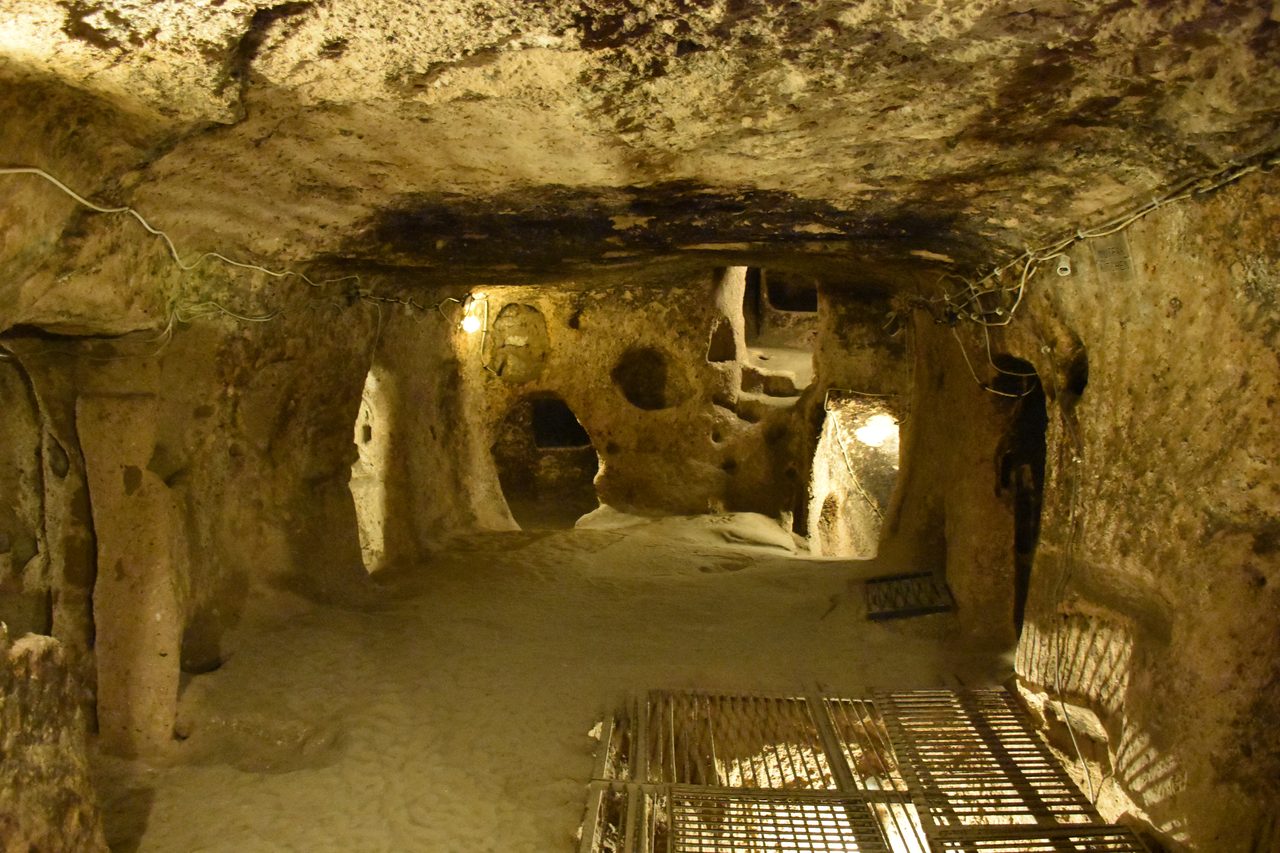
Two hundred real cities are carved straight down into the rock beneath Turkey. Agartha, Shambhala and the Hollow Earth are not. Here is the file, the solid rock and the legend kept in separate rooms, every claim wearing its evidence.
Say “underground city” and two very different pictures show up. One is a real place: rooms, corridors, wells and ventilation shafts cut straight down into solid rock, the kind you can still walk into today. The other is a legend: a hidden kingdom of masters and serpent-beings glowing somewhere beneath the mountains, waiting to be found. The strange part is how often the two get told as if they were the same story. They are not. Let's open the file, and keep the solid rock and the legend in separate rooms.
| Site | What makes it notable |
|---|---|
| Cappadocia region | 200+ underground cities, all carved from soft volcanic tuff |
| Beneath Nevşehir Castle | Found 2013; the file's own candidate for largest yet discovered |
| Kaymaklı + Derinkuyu | Linked by tunnel (the file gives conflicting lengths: 8 km vs ~5 km) |
| Özkonak | Ceiling holes for pouring hot oil on invaders; tube-based communication between levels |
01The cities that are really down there
More than 200 underground cities have been found in the Cappadocia region of Turkey, every one of them carved from soft volcanic tuff. This is real, mapped, visitable archaeology, not a rumor.
In 2013, a large and previously undocumented underground city turned up beneath Nevşehir Castle. The file calls it “potentially the largest ever discovered.” Treat that superlative as the file's own framing: the discovery is real, but the “largest” ranking is not independently confirmed inside the document itself.
Kaymaklı sits near Derinkuyu and is joined to it by tunnel, the two working as a single linked underground network. One honest wrinkle: the file contradicts itself on the tunnel's length, saying “8 km” in the main Kaymaklı entry and “~5 km” in a later engineering summary. We flag the gap rather than pick a number the document itself can't agree on.
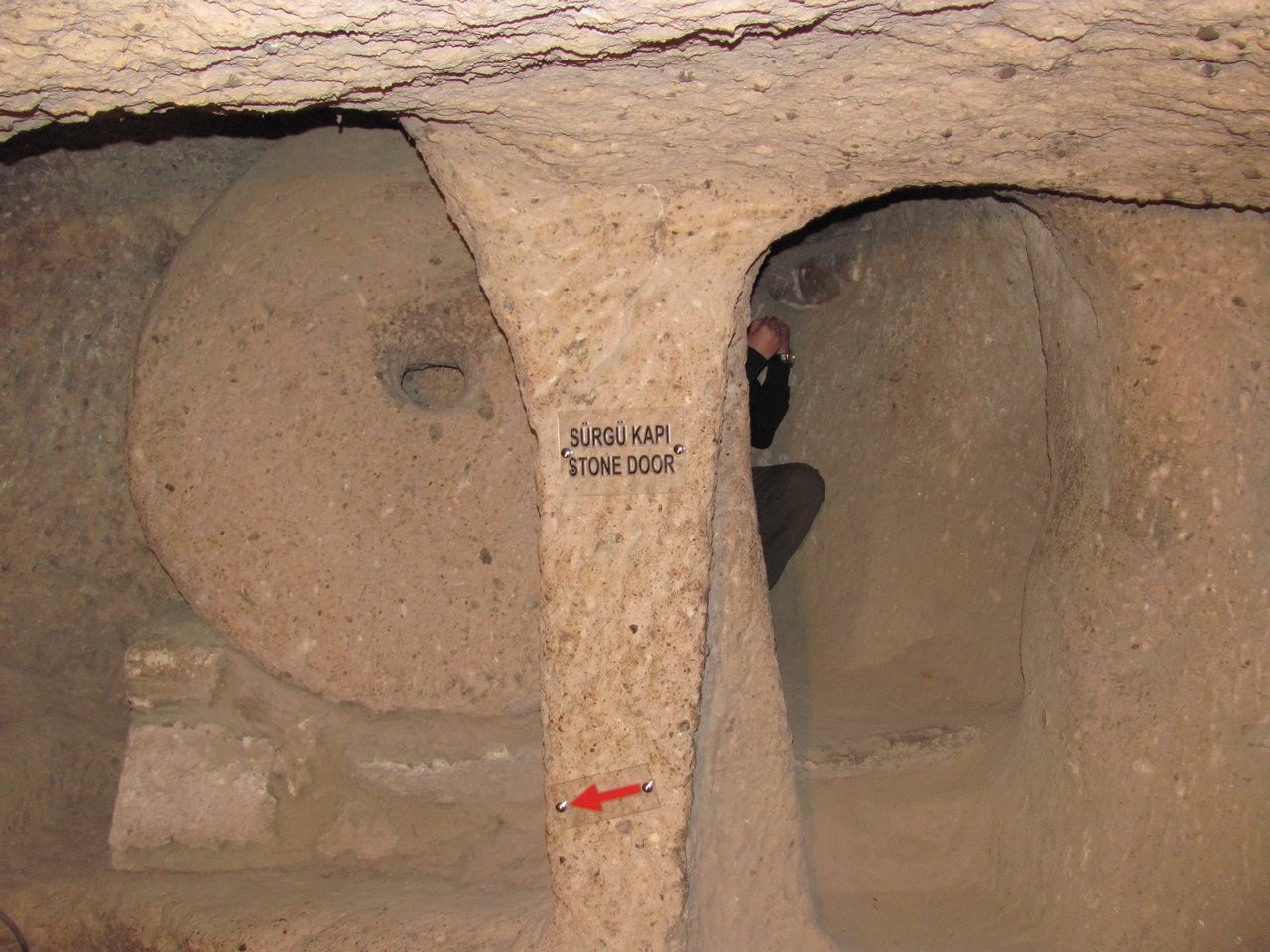
Özkonak, another of the large Cappadocian complexes, has holes cut into its ceilings for pouring hot oil down onto invaders and a tube-based system for passing messages between its levels. These are defensive features built for people expecting, at times, to be attacked.
02The newest find, and the question nobody has settled
The map is still being drawn. In 2020, construction crews in the city of Midyat, in Mardin Province in southeastern Turkey, cut into something old while working on the streets above it.
The Midyat underground city was discovered in 2020 during urban construction and holds multi-level rooms, corridors, water channels and storage areas carved from limestone, with excavation ongoing since 2020 under the Midyat Municipality and the Turkish Ministry of Culture. The file's own guess that it “may exceed Derinkuyu in extent” it rates only Tier 1 to 2, meaning: promising, but not yet settled. We report the site as confirmed and the ranking as open.
Why so many? Two hundred-plus complexes have produced a real argument. The mainstream, skeptical reading is that easily carved tuff let refuge-cities accumulate incrementally over centuries, each village digging its own bolt-hole for occasional wartime shelter. Critics counter that 200+ is far more than “occasional refuge” should ever require. This one is live and unresolved, and the file lists it in its own open questions.
03Beyond Turkey: real, and still unexplained
Cappadocia is the headline, but it is not alone, and the honest catalog includes sites where the fact of the place is rock-solid while the reason for it is a blank. Two things can be true at once: a site can be completely real and completely unexplained.
| Site | What is confirmed | What is not |
|---|---|---|
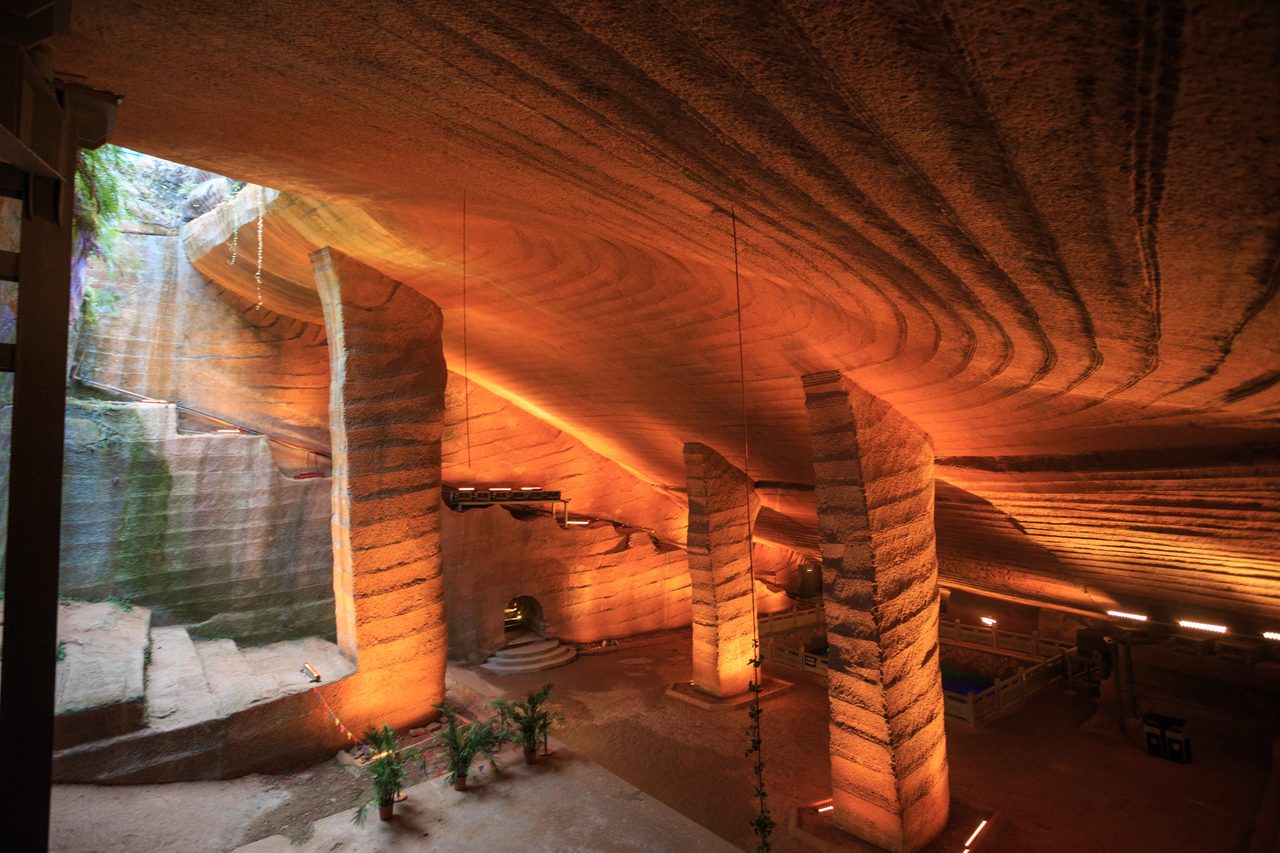
| Longyou Grottoes, China | 24 caverns, ~1,000,000 m³ of rock removed, found 1992 | Who built them, how, or why (no surviving record) |
| Erdstall tunnels, Central Europe | 700+ narrow passages; existence well documented | Their purpose (storage, defense, drainage all unproven) |
| Hypogeum of Ħal-Saflieni, Malta | Three levels, ~7,000 individuals, c. 4000 BCE | Whether it was truly built for ritual sound amplification |
| Barabar Caves, India | Mirror-polished rock surfaces, 3rd century BCE | How that finish was achieved with period tools |
The Longyou Grottoes in Zhejiang Province, China, are 24 hand-carved caverns found in 1992, with an estimated 1,000,000 cubic meters of rock removed and uniform chisel marks holding a consistent 60-degree angle throughout. They may be over 2,000 years old. And there is no surviving historical record of who cut them, how, or why. The caverns are Tier 1. The identity of their builders is a genuine blank.
Central Europe's Erdstall tunnels, over 700 narrow passages across Bavaria, Austria and neighboring regions dating to the Middle Ages or earlier, are well documented to exist. But many are too narrow for normal human use, and no clear purpose has ever been established. That the passages exist is Tier 1; why they were dug has no established answer, and the file leaves that question open rather than settling it.
The Hypogeum of Ħal-Saflieni in Malta, dated to roughly 4000 BCE, is a three-level subterranean complex holding the remains of an estimated 7,000 individuals, with architecture that researchers have proposed was designed for ritual sound amplification. The place and the bones are Tier 1; the acoustics remain a proposal, not a confirmed fact, and we hold them at that.
The Barabar Caves in India, cut in the 3rd century BCE, have interior rock surfaces polished to a mirror-like finish that the source document says remains unexplained given the tools available in that period. Note the split: the caves and the finish are Tier 1, plainly there and measurable. How it was done is a real open question, not a confirmed technique, and we do not fill that gap with a guess.
04The myths beneath: kingdoms that live in texts, not in rock
Now we cross into the second room, and the rules change. Everything below is a real tradition, genuinely recorded, genuinely believed. None of it is a confirmed physical place. Keeping that line bright is the whole job.
Agartha, a legendary underground kingdom said to lie beneath the Himalayas or the Gobi Desert and ruled by a “King of the World,” was first described in Western literature by Alexandre Saint-Yves d'Alveydre in his 1886 book “Mission de l'Inde en Europe.” Theosophists Helena Blavatsky and Nicholas Roerich later linked it to tales of underground spiritual masters. Note the date: as a Western idea, Agartha is a modern esoteric invention, not an ancient report.
The Buddhist Kalachakra Tantra tradition describes Shambhala as a hidden kingdom of enlightened beings. The source document links that legend to the broader Agartha mythos and to claims of Nazi-era expeditions sent to Tibet to hunt for its entrance. The Shambhala tradition is real; the notion that it names a findable door in a mountainside is not.
In Maya tradition recorded in the Popol Vuh, the underworld Xibalba was reached through caves and cenotes (natural sinkholes), and was pictured as a populated city with houses and ball courts, where the Lords of Xibalba tested and transformed the people who entered rather than simply punishing them. Tier 2 here means the tradition is well attested, not that a literal city sits under the limestone.
Hindu cosmology in the Vishnu Purana places Patala, home of the serpent-beings called Nagas, as the deepest of seven subterranean realms, and explicitly describes it as more beautiful than heaven, full of jeweled cities and gardens. That single detail quietly demolishes a Western reflex: “underground” does not automatically mean “hell.” In this tradition, the deepest world is the loveliest one.
05Why does everyone tell this story?
Cultures that never met each other all put something under the ground: a realm, a kingdom, a world of the dead. The tempting answer is a single lost civilization that seeded them all. The file rates that idea Tier 4, with no evidence. So what is left?
The document proposes several non-supernatural reasons unconnected cultures independently landed on underground realms: the practical refuge value of caves, their psychological and acoustic “sacrality,” a near-universal link between underground and death and burial, simple proximity to water sources, and a cognitive habit of mapping vertical space onto moral hierarchy. You do not need one vanished super-culture to explain a pattern that ordinary human minds and ordinary caves would produce on their own.
There is a hard limit on the romance of living underground forever. The file argues that permanent, multi-generational human habitation below ground is biologically punishing without advanced technology: vitamin D deficiency, the need for forced-air ventilation, sanitation and disease risk, and circadian-rhythm disruption. That biological cost is, on our own reading rather than any claim in the file, part of why Cappadocia's cities look like refuges people fled into and back out of, not permanent homes. From there the file's own “reptilian counter-argument” makes a leap: a hypothetical cold-blooded reptilian species, it speculates, would not face those same constraints. The document explicitly labels this whole line of reasoning speculative, and it should. It presumes a reptilian species whose existence is unestablished, so it cannot rescue a permanent-underground-civilization story. It is a hypothesis resting on a creature nobody has shown exists.
06Where it falls apart
First, a fair point for the wonder-seekers: genuinely vast natural cave networks are real, and entirely separate from Hollow-Earth mythology. Kentucky's Mammoth Cave has over 400 miles (650 km) of explored passages, the longest known cave system on Earth. The file offers this as a factual contrast, not as evidence: the planet has astonishing hollows in it, which is exactly why you never needed to hollow out the whole planet.
Hollow Earth theory, first floated by astronomer Edmond Halley in 1692 and popularized by John Cleves Symmes Jr. in the 1800s, is stated by the source document to be scientifically disproven as a literal hollow-planet claim. We treat it as refused, not as an open possibility. A planet with a molten core and measurable mass is not a shell around an inner world.
And the claim attributed to US Navy Admiral Richard Byrd, describing a 1947 discovery of a polar entrance to a subterranean civilization, is flagged by the source document itself as “likely fabricated.” We name it here only to refuse it. It is not an open question or a suppressed truth; it is a story the file's own sourcing marks as invented, and it goes nowhere near the confirmed archaeology above.
Fast Facts
- Cappadocia
- 200+ underground cities, all carved from soft volcanic tuff
- Nevşehir Castle
- Large city found beneath it in 2013 (file's “largest” claim, unconfirmed)
- Midyat
- Found 2020 in Mardin Province, carved from limestone, still being excavated
- Longyou Grottoes
- 24 caverns, ~1,000,000 m³ removed, found 1992, builders unknown
- Hypogeum, Malta
- c. 4000 BCE, three levels, remains of ~7,000 people
- Mammoth Cave
- 400+ miles (650 km), the longest cave system on Earth
- Hollow Earth
- Proposed by Halley in 1692; scientifically disproven
What we can actually stand behind
The carved cities are real: Cappadocia's 200-plus, Derinkuyu and Kaymaklı, the Longyou Grottoes, the Ħal-Saflieni Hypogeum, the Erdstall tunnels, the Barabar Caves. Solid rock, solid record. Several of them also keep genuine unsolved questions, and that is allowed.
Whether 200+ Cappadocian cities means more than incremental wartime refuge is a live, unresolved debate, and the recorded underworld traditions of the Popol Vuh and the Vishnu Purana are real traditions, not confirmed physical places.
Agartha and Shambhala are legends, not locations. As a Western idea, Agartha dates only to 1886, and the reptilian rescue for a permanent-underground civilization presumes a species nobody has shown exists.
Hollow Earth, floated by Halley in 1692, is disproven as a literal claim. Admiral Byrd's 1947 “polar entrance” is, by the source's own admission, likely fabricated. And the idea that a single lost civilization built every underground city has no evidence at all. Named, and refused.
So the honest mystery was never a glowing kingdom under the Himalayas. It is smaller, and harder: nobody knows who cut a million cubic meters of rock out of Longyou, or why hundreds of Erdstall passages were dug too narrow to move through, or whether the Hypogeum was really engineered to bend sound the way some researchers propose. The real cities kept their secrets better than the legends ever did. What were they for?
Sources & further reading
Everything above is drawn from our research library on Theories of Anything. This file is broad but thinly cited, so we have leaned on its per-claim tiers rather than its cover banner. Open the full document to weigh the sourcing yourself.
Image credits
- Kaymakli Underground City, large room MusikAnimal, via Wikimedia Commons. CC BY-SA 4.0 Source.
- Rolling stone door, Kaymakli Underground City Slyronit, via Wikimedia Commons. CC BY-SA 4.0 Source.
- Interior of the Longyou Grottoes, Zhejiang Zhangzhugang, via Wikimedia Commons. CC BY-SA 4.0 Source.
- Card crop of Kaymakli Underground City, large room MusikAnimal, via Wikimedia Commons. CC BY-SA 4.0 Source.


