The Voynich Manuscript: 102 Leaves of Calfskin Nobody Can Read
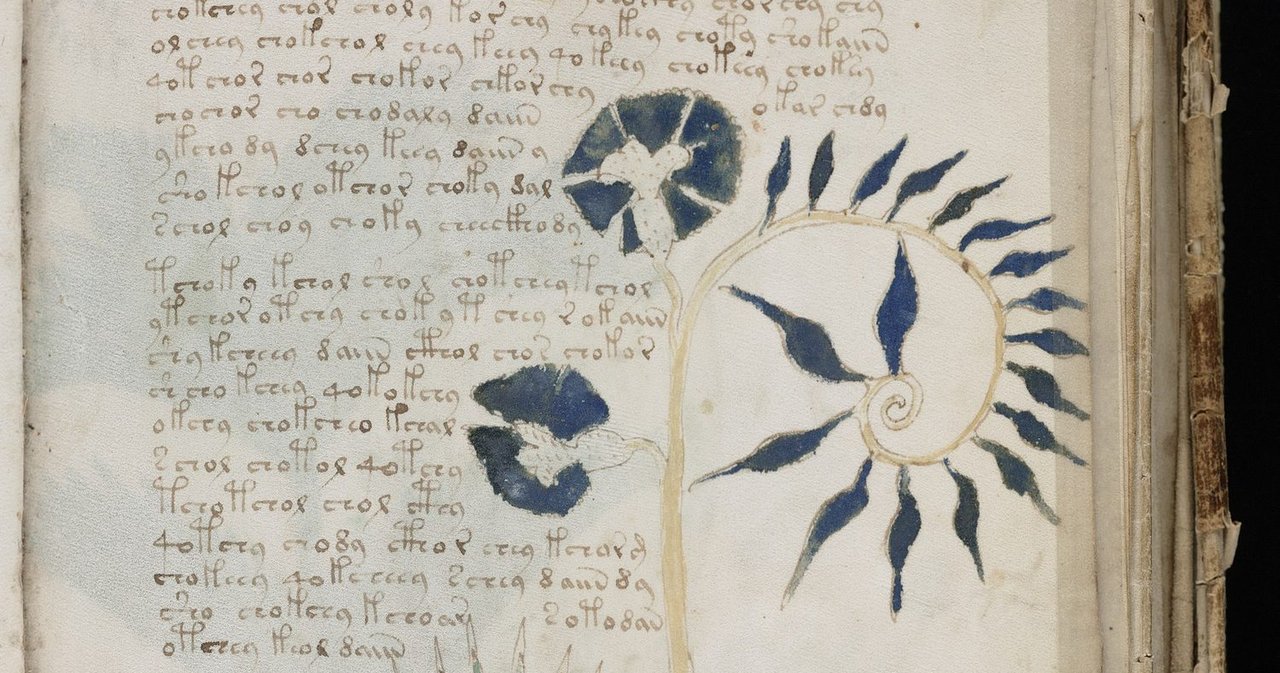
Yale holds it as MS 408. Four samples of its parchment came from animals that died between 1404 and 1438, its ink and pigments are ordinary materials of the period, and five separate scribes wrote it. Not one line of it has an agreed reading. The open question is not which language it is in. It is whether it is in a language at all.
In 1639 a man in Prague wrote to the loudest reputation for decipherment in Europe about a book he owned and could not read. Georg Baresch was an alchemist. He called the thing a sphinx that had been taking up space uselessly in his library for years. He had heard that Athanasius Kircher, the Jesuit polymath in Rome, had published a Coptic dictionary and claimed to have deciphered Egyptian hieroglyphs, so he copied out some of the strange script, sent it south twice, and asked for help. Kircher did not solve it. Nobody since has either.
That has been the situation for 387 years. The book is real, it sits in a university library, and anyone with a browser can see every page for free. Its parchment has been radiocarbon dated, its ink analysed in a laboratory, five scribal hands identified in the writing. And not one line has an agreed reading. Here is the file, every claim wearing its tier, with a finish you may not expect: the open question is not which language this book is in, but whether it is in a language at all.
01The First Man Who Could Not Read It
The book is Beinecke MS 408, held by the Beinecke Rare Book and Manuscript Library at Yale University. The library's own highlights page describes it as produced 'in Central Europe at the end of the fifteenth or during the sixteenth century', written 'in an unidentified script by an unknown author'. High-resolution images of the entire manuscript are free to view in Yale's digital library, so every claim here about what is on a page can be checked against the original.
The earliest confirmed documentary mention of the manuscript is Baresch's 1639 letter to Kircher. On Baresch's death the book passed to his friend Jan Marek Marci, rector of Charles University in Prague, who sent it on to Kircher in 1665 with a covering letter. It entered the Jesuit collections, and by the early twentieth century sat at the Villa Mondragone near Frascati, outside Rome, where the rare-book dealer Wilfrid Voynich bought it in 1912 and gave it its name. Hans P. Kraus gave it to Yale in 1969.
Before that letter the record thins to one erased signature and a good deal of hearsay, both of which get a section below. One piece of honesty about the holding library, too: Yale's catalogue record still gives the origin as Central Europe, fifteenth or sixteenth century, and its highlights page says only that 'scientific testing suggests material consistency with manuscripts produced in the fifteenth century'. That record predates the 2009 radiocarbon work, so Yale is not endorsing a tighter date than it publishes, and this file will not put one in its mouth.
02What The Object Physically Is
The Beinecke's pre-1600 manuscripts catalogue records MS 408 as: 'Parchment. ff. 102 (foliation, s. xvi, Arabic numerals; not every leaf foliated) + i (paper), including 5 double-folio, 3 triple-folio, 1 quadruple-folio and 1 sextuple-folio folding leaves. 225 x 160 mm.' In plain terms: 102 surviving leaves, numbered by a sixteenth-century hand, ten of them fold-outs, one opening six panels wide. Each leaf is about 22.5 by 16 centimetres, and opened out the leaves come to roughly 240 pages.
| Feature | What The Catalogue Says |
|---|---|
| Shelfmark | Beinecke MS 408, Yale University |
| Support | Parchment, the catalogue's only word for it (the calfskin identification comes from the published physical findings, not the catalogue) |
| Leaves | 102 surviving, foliated in a sixteenth-century hand |
| Fold-Outs | Ten, one of them opening to six panels |
| Leaf Size | 225 by 160 mm, about 22.5 by 16 cm |
| Missing | At least fourteen numbered leaves, stubs still in the binding in two places |
| Binding | Eighteenth or nineteenth century vellum case, not original |
| Quire Signatures | Lower right corner, verso, and sometimes recto; written in ordinary numerals, not the unknown script |
The collation statement names the missing leaves one by one. Folio 12 is gone. The leaves foliated 59 through 64 are gone from the centre of a gathering. Folio 74 is gone, followed by the stubs of its conjugate leaves. Folios 91, 92, 97 and 98 are gone, with two stubs left between 94 and 95, and so is the central bifolium of the last gathering, folios 109 and 110. At least fourteen numbered leaves are absent, and in two places the stubs of the removed leaves are still in the binding.
The cover is not original either: the catalogue records the binding as 's. xviii-xix. Vellum case. Remains of early paper pastedowns', three or four centuries after the parchment. It also records 'Quire signatures in lower right corner, verso, and sometimes on recto'. Somebody numbered the gatherings to keep them in order, in ordinary numerals. With the sixteenth-century foliation, those numbers are among the very few marks in this book anybody can read.
The parchment itself is calfskin. The Beinecke records the support simply as 'Parchment'; the calfskin identification and the judgment of its quality come from the published physical findings as gathered on Rene Zandbergen's specialist research site rather than a refereed paper, so take the quality judgment softly. The skin was ordinary stock, not luxury stock, though prepared with care. The present cover is a later replacement, so any description of this book's binding material describes the eighteenth or nineteenth century, not the fifteenth.
03The Date Is On The Skin, Not On The Ink
In 2009 the accelerator mass spectrometry laboratory at the University of Arizona radiocarbon dated the parchment. Four samples were taken from four different bifolios spanning different parts of the book, and the four probability curves came out consistent with one another. The combined result places the parchment between 1404 and 1438 at 95 percent probability. Greg Hodgins of the University of Arizona led the work, and the result was presented publicly on 8 December 2009. Yale's own facsimile edition summarises it as a parchment of roughly 1420, give or take a couple of decades.
| Folio Sampled | Uncalibrated Radiocarbon Age |
|---|---|
| Folio 8 | 1461, plus or minus 38 |
| Folio 26 | 1436, plus or minus 35 |
| Folio 47 | 1444, plus or minus 35 |
| Folio 68 | 1400, plus or minus 35 |
Now the sentence that makes the rest of this subject legible, and the one almost every account gets wrong. Radiocarbon dating of parchment dates the death of the animal whose skin was used. It does not date the writing. An unknown interval separates the moment the calf died from the moment somebody put ink on the finished skin, and blank parchment was expensive, so it was routinely kept, traded and reused. That gap can be years, and in documented medieval cases very much longer.
So the true sentence is that the parchment dates to the early fifteenth century. The version you will read everywhere else, that the manuscript has been carbon dated to 1404 to 1438, quietly asserts something nobody has measured. The correct one says what the result does: it fixes an earliest possible date for the writing, and no latest one at all.
04Ordinary Ink And Ground Minerals
McCrone Associates carried out a materials analysis of the inks and pigments in 2009 for the Beinecke Library, and the library still hosts the report. The writing ink is an iron gall ink, used throughout with only minor variation. The blue pigment is ground azurite with minor amounts of cuprite. The pigments are ground minerals for which recipes existed from the Middle Ages onward, and are mostly inexpensive. Nothing in the analysis was inconsistent with the fifteenth-century radiocarbon date of the parchment. There is no yellow pigment at all, most probably because organic yellow colourants faded. And the painting was applied after the writing.
That last detail is worth a moment: whoever coloured these pages was working over text already there. But the headline finding is negative. Nothing in this book's materials is anomalous, and whatever is strange about the Voynich manuscript is strange in the writing, not in the stuff.
05Two Famous Names, One Relayed Sentence
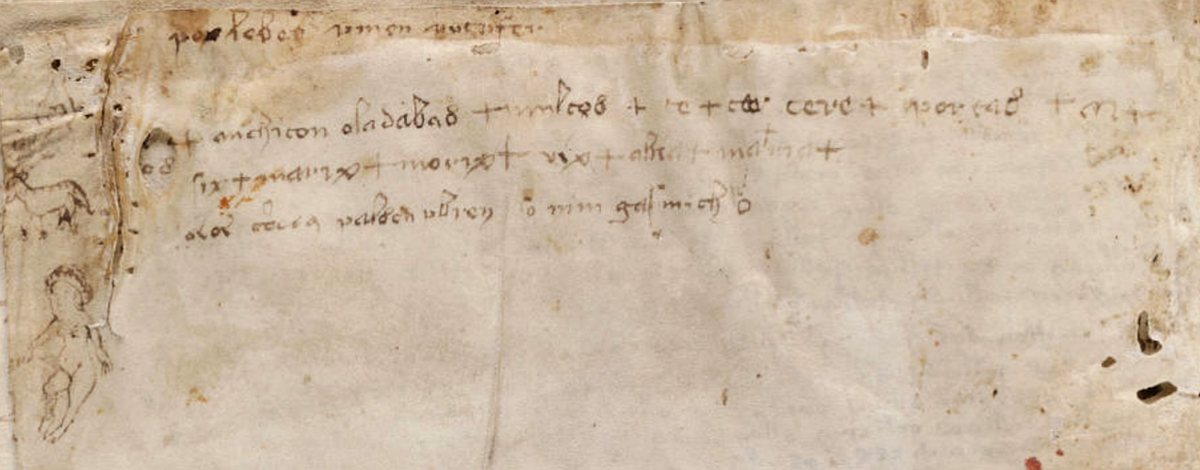
An ownership signature was scraped off the first folio at some point and is legible again under ultraviolet light. It reads as the name of Jacobus Horcicky de Tepenec, latinised as Jacobus Sinapius, who lived from 1575 to 1622 and served as imperial distiller and personal physician at the court of Rudolf II in Prague. It sits at Tier 2 for a specific reason: reading an erased name under ultraviolet is an interpretation, not a photograph of a plain signature. At that strength it puts the book in Prague in the early seventeenth century.
The most repeated story about the manuscript is that Emperor Rudolf II bought it for 600 gold ducats. The entire basis is one passage in Marci's 1665 letter, in which Marci relays three things Raphael Mnishovsky had told him: that the book had belonged to Emperor Rudolf, that Rudolf paid the bearer 600 ducats for it, and that Mnishovsky thought the author was Roger Bacon. Marci reports the gossip and pointedly declines to endorse it. The Beinecke's catalogue record still traces the provenance through Rudolf II and John Dee; it predates the radiocarbon work, and the Dee connection has no evidence behind it.
The attribution most people have heard is that the manuscript is the work of the thirteenth-century English friar Roger Bacon. Wilfrid Voynich promoted it, and it stuck. It rests on the same sentence: Marci reporting that Mnishovsky 'thought that the author was Roger Bacon the Englishman', which is hearsay about an opinion. The radiocarbon date settles it. Bacon died around 1292; the parchment comes from animals that died between 1404 and 1438, roughly a century and a half later.
So two of the most famous facts about this book, the 600 ducats and Bacon's authorship, come from one relayed sentence in one letter, by a man passing on what somebody else had told him and declining to vouch for it. A name recovered under ultraviolet light is evidence about the object. A sentence reporting an opinion is not.
06What Is Actually Drawn In It
The Beinecke's own description lists the contents as 'plant specimens; astronomical and astrological drawings; balneological drawings depicting baths and bathing; cosmological medallions; pharmaceutical drawings of herbs and roots; and unillustrated text'. Balneological is the library's word and worth keeping, because it names the fifteenth-century European spa culture that makes the bathing pictures ordinary rather than eerie. Researchers usually work with five sections rather than the library's six; the difference is that Yale counts the cosmological medallions separately.
| Section | What Is On The Pages |
|---|---|
| Botanical | Roughly 113 plant drawings, one to a page, text wrapped around the stems |
| Astronomical And Zodiac | Circular star diagrams, and emblems including recognisable figures such as Taurus and Pisces |
| Cosmological | Medallions, which the Beinecke counts as their own category |
| Biological, Or Balneological | Small nude female figures in pools and tubs, joined by a network of pipes |
| Pharmaceutical | Plant parts drawn beside jars and containers |
| Recipe | Dense unillustrated pages, in short paragraphs each marked with a star |
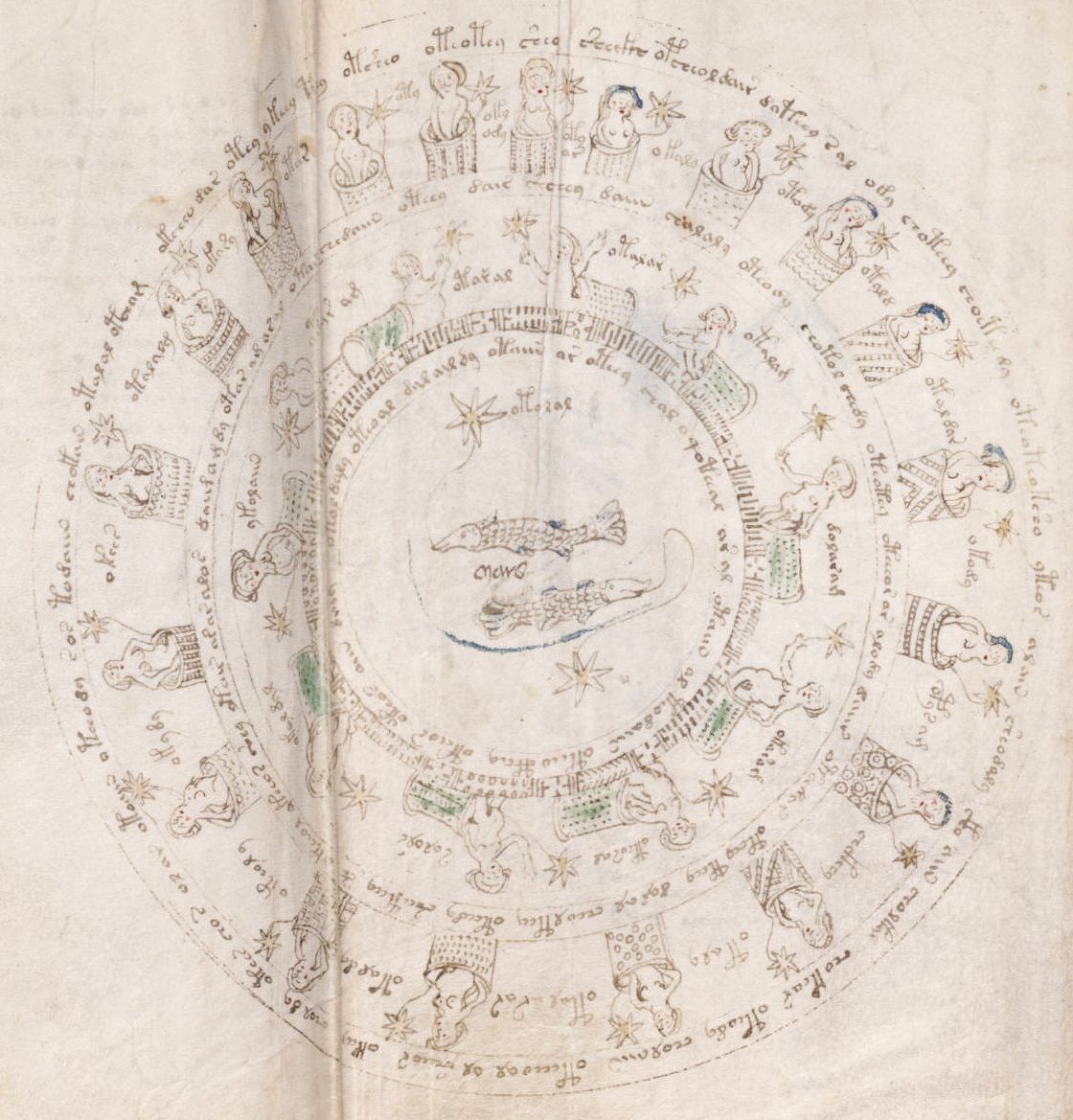
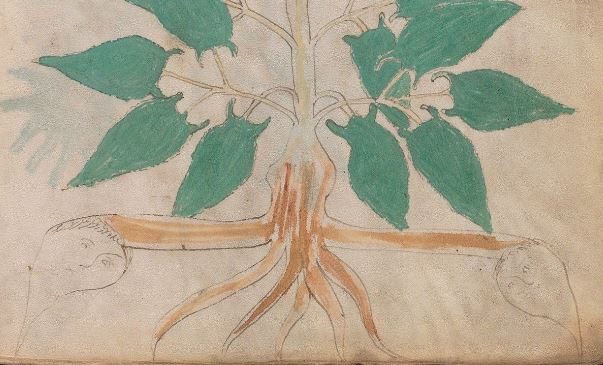
Most of the plant drawings match no known species. Some are composites, with the leaves of one plant on the root of another. Some roots are drawn as recognisable objects: a root on folio 33r has two human faces attached, and a root on folio 46v is shaped like an eagle with its wings spread. A handful of tentative identifications have been proposed and every one is disputed. The plant on folio 56r is often suggested to be a sundew, one of the oldest illustrations of a Drosera, and even that is stated as a 'might possibly'.
07The Script, And The Five Hands
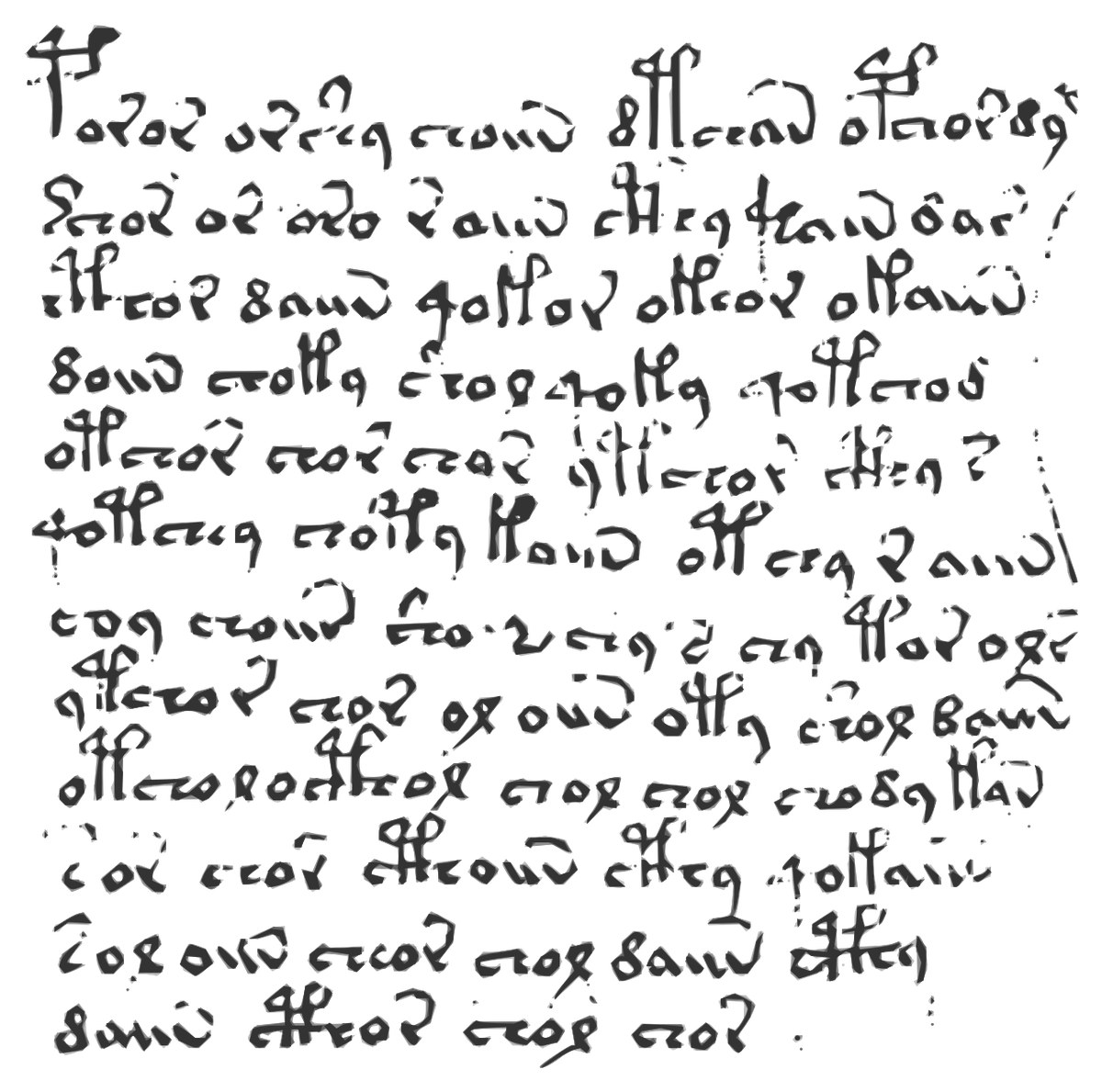
The text runs left to right in a fluent hand, with clear spaces separating word-like groups. The glyph inventory runs to roughly 20 to 30 distinct characters, depending on whether certain shapes count as variants of one sign or as separate signs; nobody prints a single number, because the counting method is itself unsettled. Some characters are conventionally called 'gallows' letters, after their tall, looped uprights. And there are no visible corrections and no visible hesitation.
In 1976 Prescott Currier, a retired United States Navy cryptanalyst, showed that the manuscript is not statistically uniform. Two different sets of statistics run through it, which he labelled 'A' and 'B', distinguished by things like the frequency of particular endings and character pairs. He also distinguished more than one handwriting style. Currier was explicit that these need not be two languages, only two statistical regimes, and that hedge is part of the finding. 'Currier language' and 'Currier hand' have been standard terms ever since.
In 2020 Lisa Fagin Davis, executive director of the Medieval Academy of America, published a digital palaeographic study in Manuscript Studies concluding that the manuscript was written not by one person but by five distinct scribes, extending Currier's identification of two hands. The scribes are separable by consistent habits: Davis describes Scribe 1 writing 'in a neat hand with widely-spaced, horizontal lines of writing', Scribe 2 'in a cramped hand with narrow, upwardly-sloping lines'. She notes that the collaborative arrangements all involve Scribe 2, which 'may suggest that she or he was in charge of the project'.
Five hands reshapes every hypothesis here, and the implication runs further than the finding. The finding is that five people wrote this book. The implication, and it is an implication, is that somebody taught the system to four others, so it was learnable. A lone eccentric scribbling nonsense is a harder picture to hold after that, and so is a private cipher.
08What A Century Of Measurement Found
The frequency distribution of the manuscript's word-like units follows Zipf's law. The most common unit occurs about twice as often as the second most common, three times as often as the third, and so on down the ranks. That pattern is a near-universal property of natural languages, and it is not what unstructured random text produces.
And it is not evidence of meaning. Gordon Rugg showed in Cryptologia in 2004 that meaningless text carrying a Zipf-like frequency distribution can be produced mechanically. Zipf conformance is evidence that the text has structure, not that it has content, and those two sentences have to travel together.
Measured character entropy in the Voynich text sits lower than in typical European-language texts, and lower than a simple substitution cipher of such a text would produce: letter by letter, the script is more predictable than ordinary writing. Information-theoretic analysis also finds long-range correlations of the kind natural language shows, with particular word-like units clustering in particular parts of the book rather than spreading evenly, the way real keywords behave in a real book about several subjects.
Those two results pull in opposite directions, which is why the subject is hard. The low entropy belongs in the objections column, not the encouraging one.
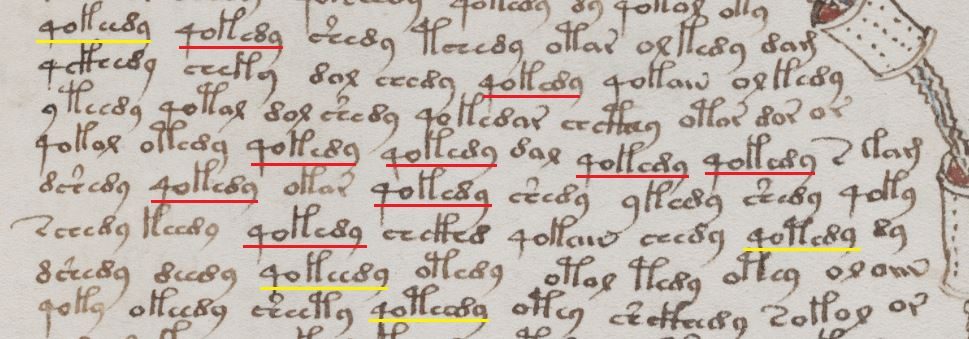
Then the measurement no natural-language reading has ever explained. Voynich word-like units cluster tightly around five to eight characters in length, with far less variation than European word lengths. Repetition rates are unusually high: the same unit, or a near-identical variant, can appear two or three times in a row within one line. The units are also highly constrained internally, particular characters appearing only in particular positions, so the vocabulary looks less like a natural lexicon than like a set of slots being filled.
Natural languages do not do that. They do not repeat a word three times in a row as a matter of course, and their words are not built from a small fixed set of slots. This is the feature every natural-language reading has to explain away rather than predict, and the readings that explain it easily are the ones in which the text says nothing.
09Three Families That Assume There Is A Message
Four families of explanation have been on the table for a century. Three of them assume there is something in there to find.
The first holds that the text records a real language, possibly a minority or extinct one, in a script invented for it. Candidates proposed over the years include early Romance varieties, Turkic languages, Hebrew and Nahuatl. None has yielded a reading that holds up when applied consistently across the manuscript. The family also carries an unresolved internal problem: the high repetition and rigid word structure are precisely what a natural language does not do, so every version has to explain them away.
The second holds that the text is an artificial language, invented rather than inherited. Jorge Stolfi's word-structure analysis, a widely-cited unpublished manuscript from the computer science department at Unicamp in 1999, found that Voynich units decompose neatly into a small set of prefixes, cores and suffixes combined by rule. That is what a designed notation looks like, and fifteenth and sixteenth century Europe produced a real tradition of philosophical and universal-language schemes. William Friedman, the most distinguished cryptanalyst ever to attack the manuscript, reached a version of this conclusion. The chronology is awkward: those schemes are mostly seventeenth century, later than the parchment.
The third holds that the text enciphers a known language such as Latin, German or Italian. Every standard tool of cryptanalysis has been thrown at it, by amateurs, by academics, and by cryptanalysts of the United States National Security Agency: William Friedman's two study groups in the 1940s and 1950s, John Tiltman's study of 1967, and Mary D'Imperio's declassified 1978 monograph. Nothing has broken it. Two cautions. Those were informal study groups of interested cryptanalysts rather than a national priority, so 'the NSA tried and failed' overstates the effort. And the entropy is a serious problem here, because a substitution cipher preserves the statistics of the language underneath it, and this text is far more predictable, letter by letter, than any European language.
10The Case That There Is No Message
The fourth family says there is nothing in it, and it has gained ground because it predicts the awkward measurements instead of apologising for them. It comes in three versions, reached independently.
Gordon Rugg argued in Cryptologia in 2004 that meaningless text with Voynich-like statistics, including a Zipf-like distribution, can be produced mechanically with a Cardan grille: a card with holes cut in it, laid over a table of syllables and moved from position to position to harvest strings. Rugg and Gavin Taylor extended the argument in 2017, hoaxing further statistical features the same way. The implication is not that the manuscript is a hoax. It is that the statistics cannot by themselves prove it is not one. Rugg, a serious academic making a serious methodological point, does not hide the costs: expensive parchment, careful illustration, and five collaborating scribes is a lot of labour for a joke.
Andreas Schinner published an independent statistical study in Cryptologia in 2007, titled 'The Voynich Manuscript: Evidence of the Hoax Hypothesis', reporting that features of the text are consistent with generation by a stochastic process rather than with the encoding of a meaningful message. That is a separate line of evidence from Rugg's, reached by a different method. It is still not proof: showing that a process could generate the text is not showing that it did.
Torsten Timm and Andreas Schinner published a proposed generating algorithm in Cryptologia in 2020, in which the scribe makes each new word-like unit by copying and slightly altering one already written nearby. That self-referential copying reproduces the manuscript's most awkward features at once: the tight word-length distribution, the similarity of neighbouring units, and the runs of near-repetition. They returned in 2023 with a broader discussion of text-creation hypotheses. It is the most current serious challenge to the meaningful-text position and the one proposal that handles the repetition without strain. It remains a mechanism that could have produced the text, not a demonstration that it did, and it does not explain five scribes sharing the habit.
None of this is happening at the fringe, which is the reframing this subject most needs. The standard modern peer-reviewed overview of the linguistic question is Claire Bowern and Luke Lindemann's 'The Linguistics of the Voynich Manuscript', in the Annual Review of Linguistics in 2021, whose abstract opens by calling the object plainly 'a fifteenth-century illustrated cipher manuscript'. Timm and Schinner reviewed it in Cryptologia the same year, weighing it against their own generative hypothesis. The disagreement is live, in print, and between named people.
11The Date Problem Cuts Both Ways
One fact about the parchment constrains three completely different hypotheses in the same way. The skins date to between 1404 and 1438, and nothing dates the ink, so the result fixes an earliest possible date for the writing and no latest one. Rugg's grille hoax needs a Cardan grille, described by Girolamo Cardano around 1550, more than a century after those animals died. The New World plant proposal needs a date after 1492. Voynich as forger needs 1912. Each survives only by assuming blank parchment sat unused for decades or centuries, which is a real cost, and each does survive, because the date refutes none of them by itself.
Arthur Tucker and Rexford Talbert argued in HerbalGram in 2013 that some of the plant drawings match New World species, and that the manuscript may originate in colonial Mexico. The proposal is heavily contested, and its central difficulty is chronological: it requires writing after 1492 on parchment whose animals died between 1404 and 1438, which means assuming blank skins sat unused for fifty to ninety years. HerbalGram is the journal of the American Botanical Council, a real publication with a real editorial process, and not a mainstream botanical or medieval-studies venue.
The recurring suggestion that Wilfrid Voynich, a rare-book dealer with the motive and the skills, forged the manuscript himself before announcing his 1912 discovery is refused here, and two independent lines of evidence do the refusing. The parchment dates to between 1404 and 1438, roughly five centuries before Voynich handled it, and the manuscript is documented in the Baresch, Marci and Kircher correspondence long before he was born. The honest residue: nothing dates the ink, so a determined sceptic could still argue about the writing.
12The Solutions, And Why They Fail
No decipherment of the Voynich manuscript has ever been accepted by the scholarly community. Not one line has an agreed reading. Dozens of solutions have been published, several with global press coverage, and every one has failed under scrutiny. Set that beside the obvious comparison: rongorongo, an undeciphered script from the other side of the world, has one passage with an accepted reading, the Mamari lunar calendar, the Mamari lunar calendar. The Voynich has none.
| Failure Mode | What It Looks Like |
|---|---|
| Gibberish | Apply the method consistently across the manuscript and the output stops being language |
| Selected Pages | The reading works on a small handful of favourable pages and nowhere else |
| Rules Made As You Go | Each new difficulty is met with a new ad-hoc rule, so the method can never fail |
| Circularity | The method assumes the conclusion it then reports, and the translator supplies the meaning by hand |
The whole class of announced decipherments is refused here, and the refusal is a statement about the record rather than about the people. Dozens of complete or partial solutions have been published, several announced as final. None has been accepted by specialists and none has been independently replicated. The failures are not random: they cluster into the four modes in this table, and the useful thing to do with any new claim, including one arriving with a press release attached, is to run it against those four first.
In 2019 Gerard Cheshire, then a research associate at the University of Bristol, published 'The Language and Writing System of MS408 (Voynich) Explained' in Romance Studies, claiming the text was a previously unknown 'proto-Romance' language he had cracked in about two weeks. The university publicised it, then removed the announcement after concerns were raised about the validity of the research. Specialists rejected it immediately. Lisa Fagin Davis said flatly that 'proto-Romance language is not a thing', and that once the substitutions are applied the reader has no choice but to translate subjectively, which is the circularity mode. Get the status right, because most of the internet does not. Bristol withdrew its press release and the field rejected the claim. The paper was not retracted, and the journal record carries no retraction notice.
In September 2017 Nicholas Gibbs, a television history researcher, published a solution in the Times Literary Supplement arguing that the script is an idiosyncratic version of a known system of medieval Latin abbreviations, and that the book is a compiled manual of women's medicine. It was rejected within days. Lisa Fagin Davis, as executive director of the Medieval Academy of America, pointed out that the sample lines Gibbs produced do not form grammatical Latin, which is the gibberish mode.
And the one almost everybody remembers wrong. Bradley Hauer and Grzegorz Kondrak published an algorithm for decoding anagrammed substitution ciphers in Transactions of the Association for Computational Linguistics in 2016 and ran it on the Voynich manuscript as a test case; the output pointed at Hebrew. In early 2018 this was reported worldwide as artificial intelligence having decoded the manuscript. The authors wrote no such thing. Their paper says the results 'could be interpreted either as tantalizing clues for Hebrew as the source language of the VMS, or simply as artifacts of the combinatorial power of anagramming and language models'. The method also assumes the text is anagrammed. A hedged paper became a headline its authors did not write.
How To Read A Voynich Headline
- Carbon Dated To The 1400s
- True of the parchment. The test dates the animal the skin came from. Nothing dates the ink.
- Decoded At Last
- No accepted reading exists for a single line, and no published solution has been independently replicated.
- The 2019 Paper Was Retracted
- No. Specialists rejected Cheshire's claim and Bristol pulled its press release, but the paper stands and the record carries no retraction notice.
- AI Cracked It
- Hauer and Kondrak's 2016 algorithm pointed at Hebrew, which their own paper called a possible artifact of anagramming and language models.
- Written By Roger Bacon
- Bacon died around 1292. The parchment comes from animals that died between 1404 and 1438.
- Bought For 600 Ducats
- One relayed sentence in one 1665 letter, reporting what a third party said. Its writer declined to endorse it.
- Written In Two Languages
- Currier found two statistical regimes and expressly refused to call them languages.
So here is the honest centre of the subject. The genuinely open question is not which language the Voynich manuscript is written in. It is whether it encodes a language at all. The measurements have pointed both ways for two decades. The Zipf conformance, the keyword clustering and the sheer labour of the object argue that something is being recorded. The low entropy, the rigid word structure and the runs of near-repetition argue that no natural language is, and independent teams have shown mechanical processes producing text with those properties and no content.
What We Can Actually Stand Behind
The object is genuine and ordinary. Its parchment is calfskin from animals that died between 1404 and 1438, dated from four samples across four different bifolios; the ink is iron gall and the blue is ground azurite; nothing in the materials is inconsistent with that period. The catalogue records 102 leaves, ten of them fold-outs, at least fourteen leaves missing with stubs still in the binding, in a cover added three or four centuries later. Currier's two statistical regimes are real, and Davis's 2020 study finds five scribal hands. So are the measurements: Zipf conformance, keyword clustering, low character entropy, word lengths at five to eight characters, and runs of near-identical repetition. And so is the central negative: no decipherment has ever been accepted, and not one line has an agreed reading.
Four families of explanation remain live and none is settled: an unknown natural language in an invented script, a constructed language, a cipher of a known language, and a generated text with no content. Rugg's Cardan-grille demonstration, Schinner's stochastic analysis and Timm and Schinner's self-copying algorithm each show that a mechanism could produce text like this, which is not the same as showing that one did. The erased signature reads as Jacobus Horcicky de Tepenec under ultraviolet light, placing the book in Prague in the early seventeenth century. And whether the text carries content at all is genuinely open, held open by measurements rather than by rhetoric.
Tucker and Talbert's New World plants and a colonial Mexican origin, which needs blank fifteenth-century parchment to have waited fifty to ninety years. That Emperor Rudolf II owned the manuscript and may have paid 600 ducats for it, which rests on one relayed sentence in Marci's 1665 letter that Marci declined to endorse. Hauer and Kondrak's Hebrew result, which the authors flagged as possibly an artifact of their own method.
That the manuscript has been deciphered: dozens of solutions, none accepted, none replicated. Cheshire's 2019 proto-Romance reading, which specialists rejected and whose university withdrew its own announcement, though the paper itself was not retracted. Gibbs's 2017 Latin-abbreviation reading, whose sample lines are not grammatical Latin. Roger Bacon as the author, refuted by roughly a century and a half. And Wilfrid Voynich as the forger, refuted by the parchment and by seventeenth-century letters, with the residue that nothing dates the ink.
Roughly 113 plant drawings, most matching no known species. Five scribes who never corrected themselves. Ten fold-outs, at least fourteen leaves cut out and gone, and ordinary iron gall ink on ordinary calfskin. A century of cryptanalysis, cryptanalysts of the NSA, and the strongest current proposal is a rule for copying a word you have already written.
The question this book poses is not what it says. It is whether anybody ever meant it to say anything, and the honest answer is that we do not know. Every page is online, free, at full resolution. See whether you can do better than Kircher did.
Sources & further reading
Our own research file M_1_09 is where this article was worked from, not where it can be checked. The checking is in the links below it: Yale's own catalogue record for MS 408, the library's free digital facsimile of every page, the library's collection page hosting the 2009 materials report, and the peer-reviewed papers each measurement and each proposal rests on. Six works are cited in the text by author, year and title only, with no identifier invented for any of them: Currier's 1976 seminar papers, Stolfi's unpublished 1999 analysis, Tiltman's 1967 study, D'Imperio's 1978 monograph, Tucker and Talbert's 2013 paper in HerbalGram, and Gibbs's 2017 piece in the Times Literary Supplement. All are named in full above so they can be found by title. Both are named in full above so they can be found by title.
Image credits
- DroseraVoynichManuscriptF56r Unknown, via Wikimedia Commons. Public domain Source.
- DroseraVoynichManuscriptF56r Unknown, via Wikimedia Commons. Public domain Source.
- Voynich manuscript astronomical example 70r crop Unknown, via Wikimedia Commons. Public domain Source.
- Voynich manuscript excerpt R.O.C, derivative work by Kbh3rd, via Wikimedia Commons. Public domain Source.
- Root f33r cropped Digited by Yale University Library, via Wikimedia Commons. Public domain Source.
- Detail of latest pag. 116 v. Voynich manuscript Beinecke Rare Book & Manuscript Library, Yale University Author Unknown, via Wikimedia Commons. Public domain Source.
- Voynich Manuscript f78r repeated words Marcos Okseniuk, via Wikimedia Commons. CC BY-SA 4.0 Source.


