Who Reached the Americas First, and How Many Times?
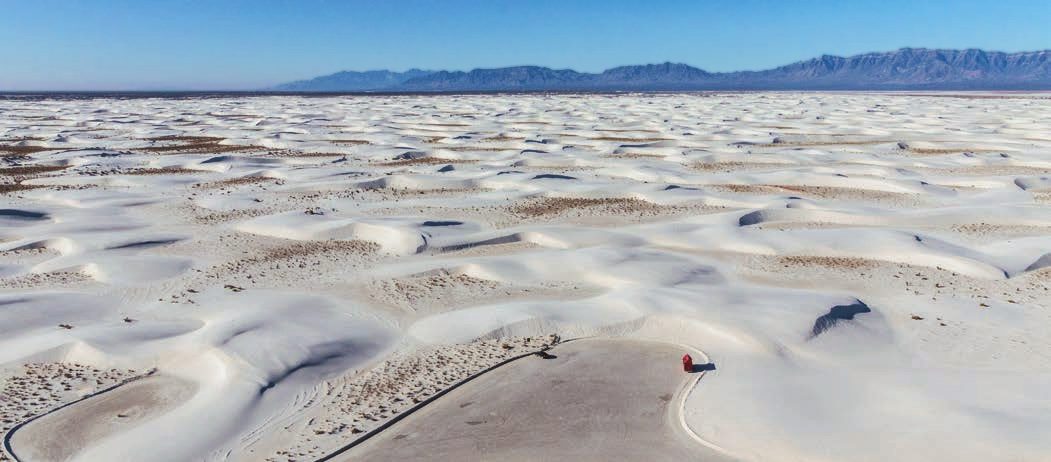
For most of the twentieth century the textbook answer was clean and confident: the first Americans were the Clovis people, big-game hunters who walked down an ice-free corridor about thirteen thousand years ago, and nobody had been here before them. That answer is now dead. It was killed by a peat bog in Chile, a creek bed in Texas, dried human waste in an Oregon cave, and stemmed spear points in Idaho that copy a Japanese toolkit, not Clovis at all. An even more dramatic site, still genuinely disputed, may push the story further still: bare footprints pressed into gypsum mud in New Mexico that could be twenty-three thousand years old. The real story is older, messier, and it happened more than once, by more than one road, carried by people whose descendants still live here and whose DNA proves exactly where they came from. Then there is the second question the first one keeps dragging in behind it: after those first arrivals, how sealed off was this hemisphere really, before Columbus? Norse boats reached Newfoundland in a year we can now name to the digit. Polynesian and South American DNA met somewhere in the Pacific centuries before any European saw either ocean. Here is the whole file, both halves, every fact wearing its evidence.
Keep the two questions apart, because they are not the same question and the evidence for them lives in different places. First: who got here first, and by what road? That is now, genuinely, mostly settled science, with a few real live edges. Second: once people were here, did anyone else ever cross an ocean to reach them before 1492? That is a patchwork of one certainty, several credible anomalies, and a handful of claims the evidence flatly refuses. Slide the two apart and the whole thing gets sharper. Let us open the file.
01The Textbook Everyone Was Taught
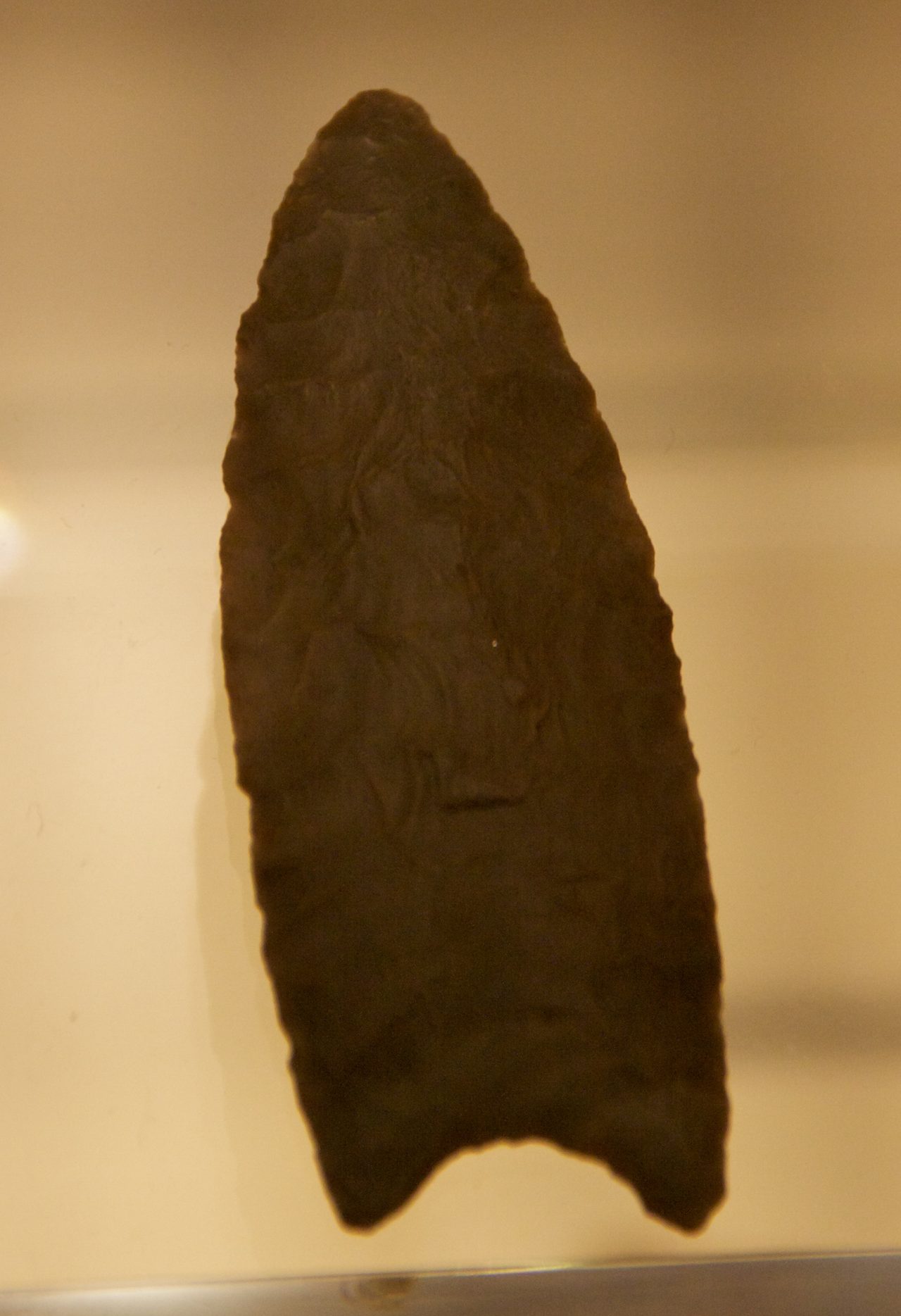
Start with the thing that turned out to be wrong, because it was taught as fact for two generations. The Clovis culture itself is real and beautifully documented: a toolkit defined by a distinctive fluted, bifacially flaked lanceolate spear point, first identified at the type site of Blackwater Draw near Clovis, New Mexico, and formally named in 1932 by Edgar Howard and John Cotter. More than ten thousand Clovis points have since been logged across North America, many of them lying in the butchered bones of mammoth, mastodon, and bison at kill sites like Murray Springs, Lehner, Naco, Kimmswick, and Dent. Dated to roughly 13,000 to 12,700 calibrated years before present, Clovis is one of the most solidly attested archaeological complexes on the continent. None of that is in dispute.
What was in dispute, and turned out badly, was the story built on top of it. From the 1960s through the 1990s the field ran on the Clovis-first model: the assumption that Clovis was the first human entry into the Americas, that nobody had come before. It was not a gentle consensus. It was enforced. Claims of older sites were rejected or minimized for decades, a piece of disciplinary gatekeeping that is now itself a documented historical fact about how the field behaved, separate from whether the model was ever true. It was not.
02The Sites That Broke Clovis-First
The wall came down in a waterlogged peat bog in southern Chile. Monte Verde, excavated by Tom Dillehay from 1977, sits at roughly 14,500 calibrated years before present, about a thousand years older than Clovis and thousands of miles south of it. The bog preserved what dry ground never could: wooden structures, hide-covered shelters, medicinal plants, mastodon bones with cut marks, worked stone. The site was attacked for years, until 1997, when a panel of senior archaeologists, including Clovis-first proponent C. Vance Haynes, visited in person and confirmed its integrity and its age. Monte Verde is now the site that broke the paradigm, the one nobody serious argues away. A deeper, far more tentative layer at the same locality has hinted at human presence as long ago as 18,500 years, but that lower level is not widely accepted and should be held much more loosely.
Then the confirmations stacked up, each from a different kind of evidence, which is exactly what makes them hard to wave away. At the Debra L. Friedkin site in Texas, Michael Waters and colleagues recovered more than fifteen thousand stone artifacts in a layer sitting directly beneath a Clovis occupation at the very same spot, optically stimulated luminescence dated to roughly 15,500 years before present. Older tools, physically underneath Clovis tools, in one undisturbed column of earth. That stratigraphy is about as clean an argument as this field ever gets.
At Paisley Caves in Oregon, Dennis Jenkins's team found something even more direct than tools: human coprolites, dried human feces, radiocarbon dated to about 14,300 years before present and carrying recoverable ancient DNA in mitochondrial lineages A2 and B2, both unmistakably indigenous American. Not artifacts that a skeptic can call natural, but the biological residue of actual people, older than Clovis.
Meadowcroft Rockshelter in Pennsylvania, dug by James Adovasio from 1973, pushes further and is honestly more contested. Its deepest levels returned radiocarbon dates of roughly 16,000 to 19,000 years before present, which would make it the oldest occupied site in eastern North America. Critics argued that carbon leaching from nearby coal seams could have contaminated the samples and made them read older than they are; Adovasio has defended the stratigraphy and pointed to supporting luminescence dates. The oldest layers remain genuinely debated, even as the site itself is now cited comfortably alongside Monte Verde and Paisley Caves.
Cooper's Ferry in Idaho added a technological twist. Loren Davis and colleagues dated stemmed projectile points there to roughly 16,000 to 16,560 calibrated years before present, and the points do not resemble later Clovis fluting at all. They resemble Upper Paleolithic stemmed-point traditions from Japan, independent evidence that an early population reached the interior Northwest carrying a toolkit that owes nothing to Clovis.
And at Bluefish Caves in the Yukon, cut-marked horse and mammoth bones have been dated to about 24,000 years before present, read as human butchery in eastern Beringia itself, before the coldest snap of the last Ice Age. That claim is increasingly accepted but has not yet reached the settled status of Monte Verde or Buttermilk Creek, so it belongs one notch down until it does.
Add it all up and the important thing is not any single date. It is that the question itself changed. Archaeologists no longer ask whether people were here before Clovis; they ask when, by which route, and in how many separate waves. That shift in the framing of the debate, not any one bone or point, is the real headline of the last thirty years of American archaeology.
| Site | Where | Age (Years BP) | Standing |
|---|---|---|---|
| Bluefish Caves | Yukon, Canada | ~24,000 | Tier 2, increasingly accepted |
| White Sands | New Mexico | ~21,000 to 23,000 | Tier 1 finding; Tier 2 whether it holds as a migration wave |
| Meadowcroft Rockshelter | Pennsylvania | ~16,000 to 19,000 | Tier 2, deepest layers debated |
| Cooper's Ferry | Idaho | ~16,000 to 16,560 | Tier 1, non-Clovis stemmed points |
| Debra L. Friedkin (Buttermilk Creek) | Texas | ~15,500 | Tier 1, stratified below Clovis |
| Monte Verde II | Chile | ~14,500 | Tier 1, broke the paradigm |
| Paisley Caves | Oregon | ~14,300 | Tier 1, human DNA in coprolites |
03White Sands: The Footprints That Should Not Exist
One site deserves its own moment, because if it holds it rewrites everything. At White Sands in New Mexico, Matthew Bennett and colleagues reported human footprints pressed into the ancient lakeshore mud of Lake Otero, layered among seeds of a ditchgrass, Ruppia cirrhosa, radiocarbon dated to roughly 21,000 to 23,000 years before present. That is squarely inside the Last Glacial Maximum, the coldest window of the Ice Age, when both the interior corridor and the coastal route were blocked or nearly so. If the dates are right, people were walking across New Mexico thousands of years before either proposed way in was open. It is the single most paradigm-shattering pre-Clovis find on the table, and it is bare human footprints, not tools a skeptic can call natural.
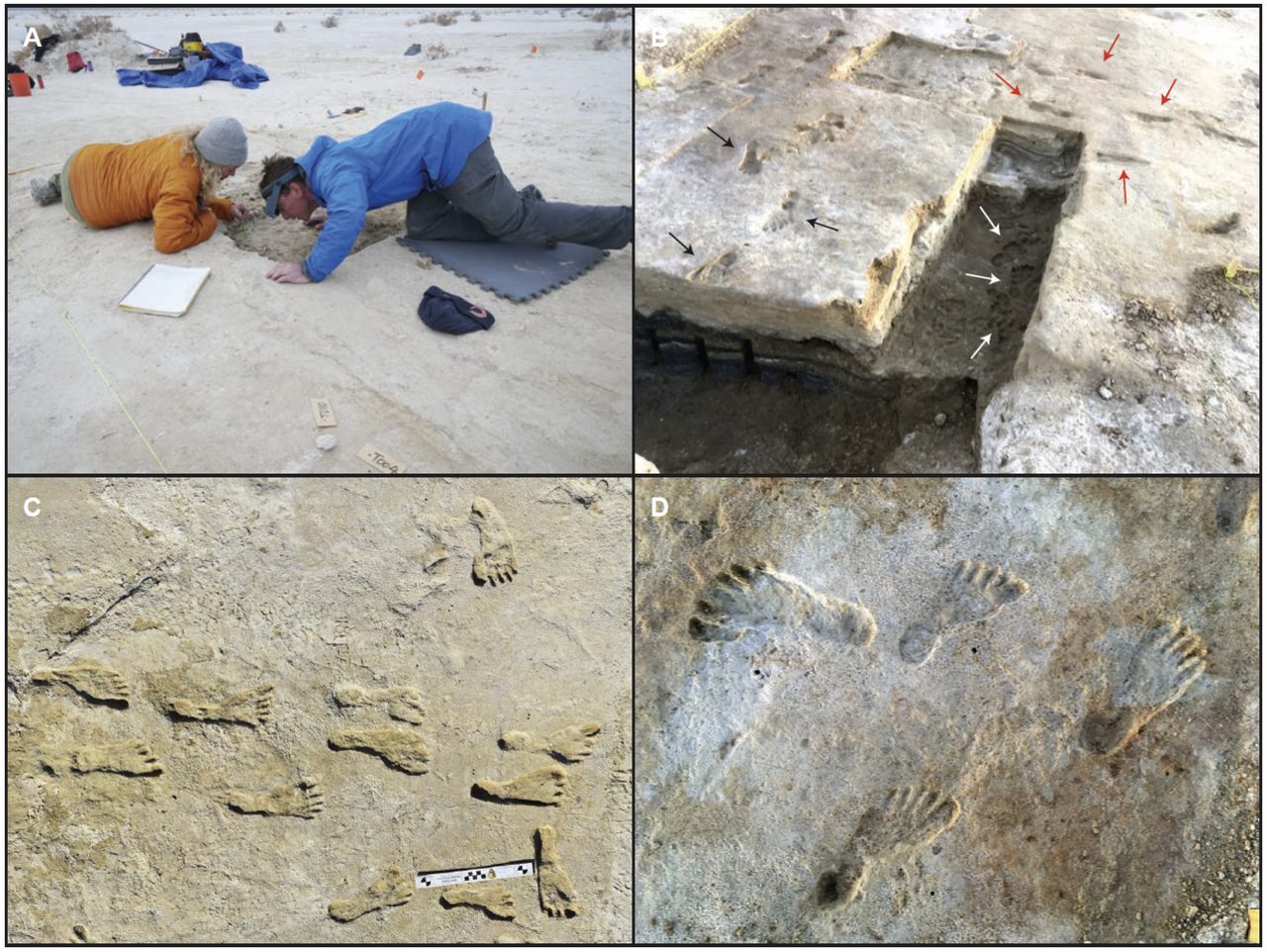
And it is not closed. This is the honest part, and both sides deserve it stated plainly. The original 2021 dating drew a real objection: the Ruppia seeds might carry a hard-water effect, pulling in old dissolved carbon and reading too old. So in 2023 an independent team re-dated the layers using two completely different clocks, optically stimulated luminescence on quartz and cosmogenic chlorine-36, and got the same Ice Age ages. That was a serious answer. But it did not answer everything. Vance Holliday, a co-author on the White Sands work itself, has publicly agreed that critics still have a fair and unanswered question: if people were living here, where is everything else? No stone tools, no hearths, no camp debris has turned up anywhere near the trackways, only the prints. Neither Holliday nor his team has yet published a peer-reviewed reply to that specific objection. This is a genuinely open scientific question, and anyone who tells you it is fully settled, in either direction, is selling something.
04The Genes Point One Direction: Beringia
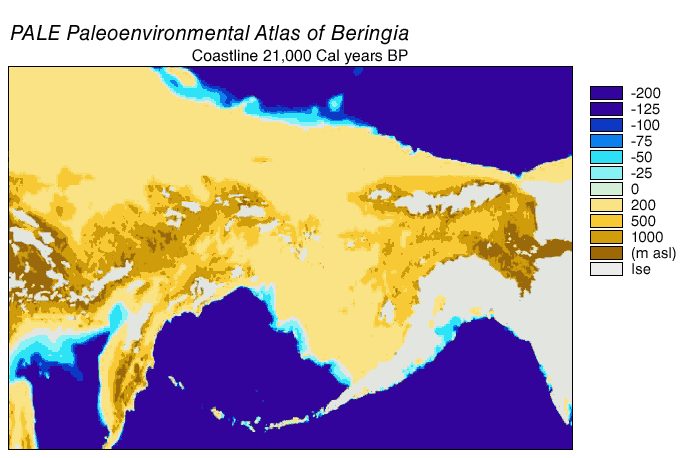
Whatever the exact dates, the genetics tell a strikingly consistent story about where the first Americans came from. Every Native American population descends from just five founding mitochondrial lineages, haplogroups A, B, C, D, and X, and all five trace back to Northeast Asia. That is an entirely independent line of evidence, separate from any dig in the ground, pointing at a Beringian and East Asian origin for the founding population.
The leading model for how that happened is the Beringian standstill. The ancestral population moved out of Siberia into Beringia, the now-drowned land bridge between Asia and Alaska, and then stayed put, genetically isolated from both the Asia behind them and the Americas ahead, for a long stretch before pushing south. During that isolation they accumulated the private mutations that now mark Native American ancestry off from every other group on Earth. The broad shape of the model, isolation then dispersal, is well supported across independent genetic studies. The exact numbers are not, and they vary study to study: entry somewhere around 25,000 to 20,000 years ago, isolation lasting anywhere from five to fifteen thousand years, dispersal beginning maybe 17,000 to 15,000 years ago. That spread is real, openly acknowledged scientific uncertainty about the timing, not a contradiction to paper over.
The standstill model made a prediction, and ancient DNA confirmed it. An infant buried at Upward Sun River in Alaska, about 11,500 years old, turned out to belong to a previously unknown 'Ancient Beringian' population, related to but distinct from the group that became all other Native Americans. The founding population was not one undifferentiated blob; it carried real internal structure inside Beringia itself, exactly as the model said it should.
Even Clovis fits inside the same family. The Anzick-1 burial in Montana, about 12,600 years old, is the only known Clovis-associated human burial, and its DNA ties directly into the same Native American founding lineage as everyone else in this story. The Clovis people were not a separate arrival from somewhere exotic. They were one branch of the population already here.
Pull the genetic threads together and they converge on a single founding population that split from its East Asian and Siberian relatives roughly 23,000 to 26,000 years ago. That divergence is older than most of the archaeological arrival dates south of Alaska, which is not a problem at all. It is precisely what the standstill model predicts: the split happened first, up in Beringia, and the move south came later.
05Kennewick Man: How The Science Corrects Itself
The single best case study in how this field polices itself is a skeleton found on July 28, 1996, on the bank of the Columbia River near Kennewick, Washington. Kennewick Man, called the Ancient One, is one of the oldest and most complete human skeletons ever found in the Americas, radiocarbon dated to roughly 8,340 to 8,400 years before present, calibrated to something like 9,300 to 9,500 years old, comfortably after Clovis but very old all the same. What followed was a years-long legal fight: the Army Corps of Engineers moved to repatriate the remains to five claimant tribes under the Native American Graves Protection and Repatriation Act, while a group of scientists led by Douglas Owsley and Dennis Stanford sued for the right to study them. A 2004 ruling let the study proceed, on the ground that a cultural link to any living tribe could not then be demonstrated.
And here is where it gets instructive. In 1996 the first analyst, James Chatters, described the skull as 'Caucasoid' and Ainu-like, using craniometric methods now known to be unreliable proxies for ancestry, and that description launched a decade of speculation about non-Asian first Americans. Then the genome settled it. In 2015 Morten Rasmussen and colleagues sequenced Kennewick Man's whole genome and found him genetically closest to living Native Americans, in particular the Confederated Tribes of the Colville Reservation. In 2017 the remains were repatriated and reburied by the Colville, the Yakama, the Nez Perce, the Umatilla, and the Wanapum. The morphology-based claim was not merely doubted; it was directly overturned by DNA, and the science published its own correction.
The lesson generalizes. Skull shape is a poor proxy for genetic ancestry, especially in ancient populations that carried a lot of morphological variety within a single group. The diversity of early American skulls that once got read as evidence of several separate homelands is now understood as ordinary variation inside one founding population. A face is not a passport.
06Which Road Did They Take?
For decades the assumed entry was the ice-free corridor, the gap that opened between the Laurentide and Cordilleran ice sheets as they melted apart. There is now a specific, decisive problem with that. The corridor did open physically around 14,000 to 13,500 years ago, but opening is not the same as being livable. Mikkel Pedersen and colleagues sampled ancient environmental DNA from lake cores along the corridor's floor and showed it could not support human travelers, too little plant and animal life, until roughly 12,600 years ago. Heintzman's team independently found that bison did not repopulate it until about 13,000 years ago. Both are far too late: people were already at Monte Verde by 14,500 years ago. The first Americans could not have walked down a corridor that was still a barren, foodless trench when they arrived.
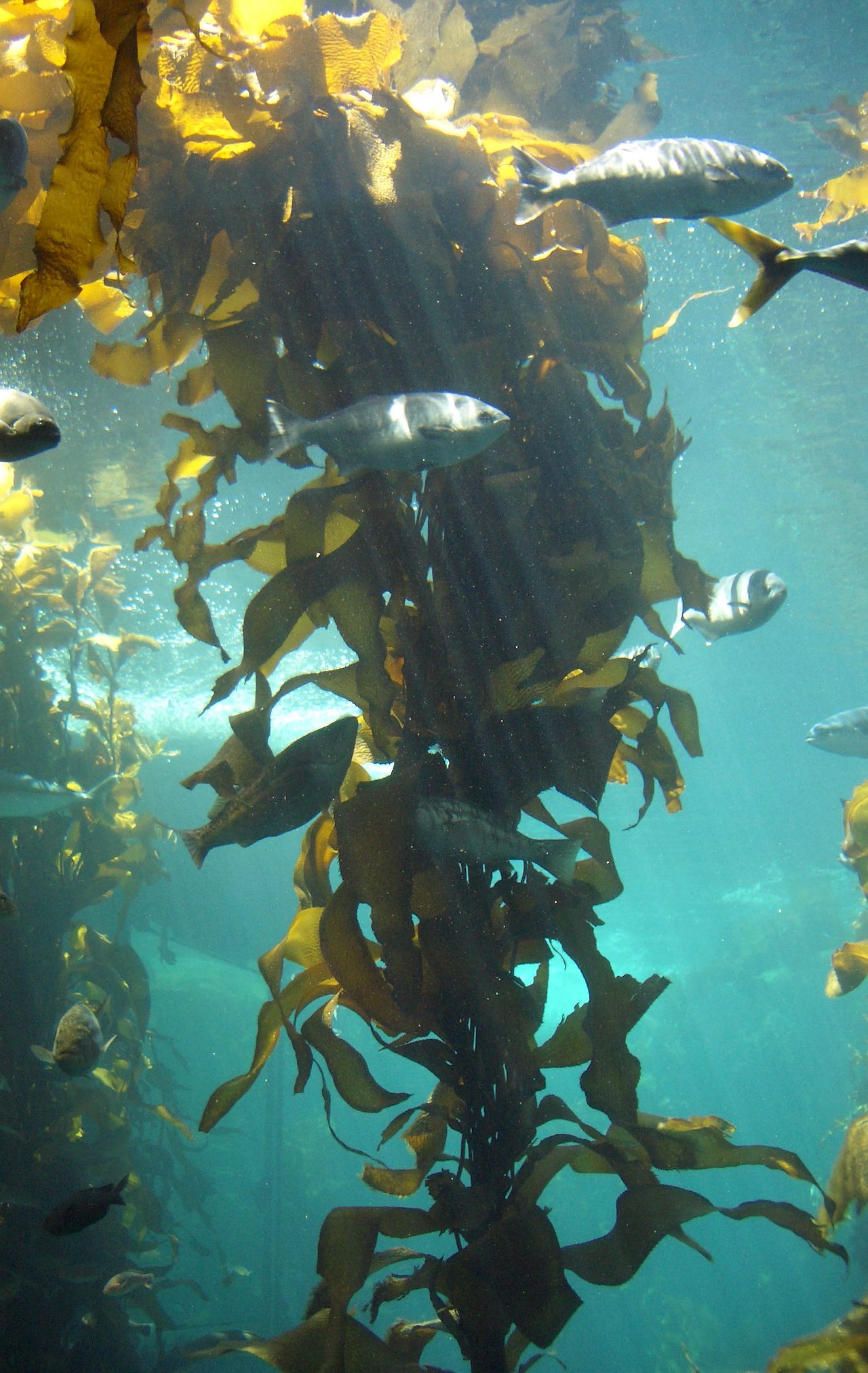
If not down the middle, then along the edge. The leading model now is the Pacific coastal route, the 'kelp highway' proposed by Jon Erlandson and colleagues: the first Americans traveling by boat down a nearly unbroken ribbon of kelp-forest coastline running from Northeast Asia through the Aleutians and Alaska and down through British Columbia, California, and Baja. The ecology behind it is rock solid. Kelp forests are among the most productive ecosystems on the planet, and they would have offered a stable, high-calorie larder of shellfish, fish, sea mammals, and seabirds the whole way, so travelers never had to relearn how to live each time the land changed. The route itself, though, is still the leading hypothesis rather than a proven fact, for one stubborn reason spelled out below.
The circumstantial case for the coast is genuinely strong. Arlington Springs Man, on Santa Rosa Island off California, dates to about 13,000 years ago on an island that could only ever be reached by boat, an eight-kilometer-plus crossing even at Ice Age sea levels. Daisy Cave on San Miguel Island holds some of the oldest shell middens in the Americas, complete with cordage. The Manis mastodon in Washington State, about 13,800 years old, has a bone spear point embedded in a rib, proof of hunters on that coast before the corridor was passable. Huaca Prieta in Peru, around 15,000 years old, is among the oldest coastal sites in South America. And the stone tools from the Channel Islands, crescents and stemmed points, look like Northeast Asian traditions, not interior Clovis.
Nobody needs to invent superhuman sailors to make this work, either. People had boats capable of open-water crossings tens of thousands of years earlier: the settlement of Australia, at least 50,000 to 65,000 years ago, required crossing a minimum of ninety kilometers of open sea even at the lowest Ice Age tides. The technology for a coastal Pacific migration plainly existed. No boat from this actual migration survives, of course, because organic materials do not last fifteen thousand years on a coast, but the capability itself is not in question.
So why is it still 'the leading hypothesis' and not simply the answer? Because the evidence that would clinch it is underwater. Since the Last Glacial Maximum, sea level has risen roughly 120 to 130 meters, and that rise drowned the entire Pleistocene Pacific coastline the first migrants would actually have walked and paddled. Their earliest campsites, if they exist, now sit tens of kilometers offshore on the continental shelf. Testing the kelp highway properly will take a new generation of underwater archaeology, autonomous vehicles and remote sensing, as Todd Braje and colleagues have argued. Until someone finds and excavates a drowned coastal site, the route rests on genetics, ecology, and the scatter of known early sites, not on the migration's own footprints. That is not a weakness anyone is hiding. It is stated openly in every serious treatment.
07The Outliers, And The Claims That Fail
Push past the well-supported sites and you reach the contested frontier, where the evidence gets thin and the claims get loud. Chiquihuite Cave in Zacatecas, Mexico, is the live one. Ciprian Ardelean and colleagues reported stone tools there dated to roughly 26,500 to 33,000 years ago, which would put people in the Americas well before the Last Glacial Maximum. The critique cuts two ways. First, the usual question of whether the 'tools' are really tools or just naturally fractured stone, geofacts. But James Chatters and colleagues added a sharper second blow in 2021: a population that old would have had to leave no genetic trace whatsoever, contributing not a single detectable gene to any Native American founding lineage ever sequenced, which they consider a serious strike on its own. Ardelean has defended the artifacts on their flaking and use-wear. It is unresolved, and it stays speculative until it is not.
Brazil's Pedra Furada goes further still, with claimed dates as old as 32,000 to 50,000 years, and most Americanist archaeologists do not buy it: the supposed artifacts may be stones shattered by natural rockfall, and the charcoal may come from wildfires rather than hearths. The nearby Toca da Tira Peia site reported cleaner luminescence dates around 22,000 years, but it too remains debated. These are minority positions, and they wear that label honestly.
Then there is the outlier that dwarfs all the others. The Cerutti Mastodon site near San Diego was reported in 2017 to show human-modified mastodon bones and stone 'hammerstones' dated to about 130,000 years before present. If that were real it would push human presence in the Americas back more than a hundred thousand years, and since our own species was not yet even outside Africa, it would demand some other kind of human entirely, Neanderthal, Denisovan, or unknown. The problems are large: the broken bones could come from natural pressure or trampling, or from the heavy equipment used in the 1992 excavation; the cobbles could be naturally deposited; no tools, cut marks, or hominin remains were found. And nowhere else in the entire hemisphere is there credible evidence of people before roughly 30,000 years ago. The dating method is sound; the behavioral interpretation is an extraordinary claim floating alone, and the field does not accept it.
Some claims are not merely contested but contradicted, and the honest move is to say so and say why, not to skip them. The most persistent is the Solutrean hypothesis, argued by Dennis Stanford and Bruce Bradley in 2012: that Ice Age Europeans of the Solutrean culture crossed the Atlantic along the pack ice and seeded the pre-Clovis population of eastern North America, on the strength of a resemblance between Solutrean and Clovis stone tools. It fails on the evidence, comprehensively. No Western European genetic contribution shows up in any ancient or modern Native American genome. A gap of about five thousand years separates the last Solutrean sites from the first supposedly Solutrean-influenced American ones. Mitochondrial haplogroup X, once waved around as European support, actually traces to Central and West Asia. And the tool resemblance is convergence, biface thinning being an obvious solution that unrelated stone traditions have hit on again and again. Specialists have called it, bluntly, archaeological fringe.
Older and deader is Calico Hills in California, where Louis Leakey championed crude stone objects as evidence of humans in the Americas millions of years ago. The more than eleven thousand specimens show none of the deliberate retouch, platform preparation, or use-wear that real tools carry. They are geofacts, naturally broken rock, and the claim is rejected.
And at the far end, some claims have no evidence at all. The notion that the Americas were peopled by 'Atlantean survivors,' or that Clovis technology was a gift from a lost advanced civilization, has zero archaeological support of any kind, not thin support, none. It is a story imposed on the evidence, not drawn from it.
08How Many Times? More Than Once
That answers 'who first.' The title's other half, 'how many times,' has its own real answer, and it is not 'once.' The current evidence fits multiple distinct migrations, not a single colonizing wave: a possible pre-Last-Glacial-Maximum entry, contested and riding on whether White Sands holds; a coastal migration around 17,000 to 15,000 years ago; the Clovis expansion around 13,000 years ago; and later the Na-Dene around 10,000 to 6,000 years ago and the Inuit-Aleut and Paleo-Eskimo around 5,000 to 4,500 years ago, each possibly on a different road with a different toolkit. A 2018 synthesis by Ben Potter and colleagues concluded the evidence is compatible with several of these models at once. The field has stopped hunting for the one correct migration and accepted a braided history. The broad multiple-waves shape is solid; the exact count and timing of each strand is still live research.
Two of those later strands are especially clear. The Na-Dene peoples, Navajo, Apache, Tlingit, show closer genetic and linguistic ties to Siberia than other Native American groups do, marking a distinct later migration, and the Inuit-Aleut and Paleo-Eskimo expansion of roughly 5,000 to 4,500 years ago brought a wholly Arctic toolkit, toggle harpoons, skin boats, oil lamps, across the top of the continent. One deeper idea here is more speculative: Edward Vajda's proposed Dene-Yeniseian link, tying Na-Dene languages to the Ket language of Siberia, which would imply either lingering contact across the Bering region or a more recent shared ancestor. That specific linguistic connection remains debated among historical linguists, and it sits a clear notch below the genetic evidence.
And one strand is genuinely strange. In 2015 Pontus Skoglund and colleagues found that two Amazonian peoples, the Surui and the Karitiana, carry a faint but real genetic affinity to Australasians, Aboriginal Australians and Papuans, that no North American group shows and that the standard single-founding-population model does not predict. They called the unseen source Population Y. It hints at either an early wave that genuinely carried Australasian ancestry, or a distinct southern coastal route the other first Americans never traveled. Either way, it is hard, published evidence that 'how many times' has more than one answer, and that no tidy single story covers every corner of the Americas.
It even leaves the door open, faintly, to a stranger possibility. If Monte Verde's deeper layer or comparable early South American dates were ever confirmed, the Americas could in principle have filled from south to north, or the Pacific coast of South America could have been reached before North America was fully open. That is speculation, clearly flagged as such, and it would need either a very early coastal entry or a route nobody has yet identified. But the fact that serious researchers can even entertain it shows how far the ground has shifted from the tidy single corridor of the textbooks.
| Migration | Roughly When | Signature | Confidence |
|---|---|---|---|
| Pre-LGM entry | before ~23,000 BP | White Sands footprints, if they hold | Tier 2, contested |
| Coastal / kelp-highway wave | ~17,000 to 15,000 BP | Early coastal sites, non-Clovis stemmed points | Tier 2, leading model |
| Clovis expansion | ~13,000 BP | Fluted points, the Anzick-1 burial | Tier 1 |
| Na-Dene | ~10,000 to 6,000 BP | Siberian genetic and linguistic affinity | Tier 1 (Dene-Yeniseian link Tier 3) |
| Inuit-Aleut / Paleo-Eskimo | ~5,000 to 4,500 BP | Arctic toolkit, toggle harpoons, skin boats | Tier 1 |
| Population Y | unknown, early | Australasian genetic affinity in Amazonia | Tier 2 |
09Part Two: How Sealed Off Was This Hemisphere?
Now the second question, the one the first keeps dragging behind it. The popular story says the Americas sat sealed off from the rest of humanity from about 11,000 BCE until Columbus in 1492, with a single asterisk for a brief Norse visit around 1000 CE. A growing body of chemical, genetic, botanical, and archaeological evidence is steadily challenging how absolute that isolation really was. Not by overturning the Beringian origin of the first Americans, which is rock solid, but by documenting real, scattered, non-continuous episodes of ocean crossing that touched the Americas long before Columbus. The hemisphere was not a sealed room. It was a room with a few doors that opened rarely.
10The One Nobody Disputes: The Norse, AD 1021
Start with the certainty, because there is exactly one. L'Anse aux Meadows on the northern tip of Newfoundland is the only confirmed Norse settlement in the Americas, and it is the strongest, least disputed case of pre-Columbian ocean crossing of any kind. Helge Ingstad found it in 1960; Anne Stine Ingstad excavated it through the 1960s; it became a UNESCO World Heritage Site in 1978. Eight Norse turf buildings, including a smithy that smelted iron and a carpentry workshop. And in 2022 Margot Kuitems and colleagues nailed the date to the year: AD 1021, read off a solar-storm spike, a Miyake event, frozen into the growth rings of wood the Norse cut for building. That is the most precise date anyone has fixed for any European presence in the pre-Columbian Americas. Butternut wood at the site, which grows no farther north than New Brunswick, shows they ranged well south of the settlement itself.
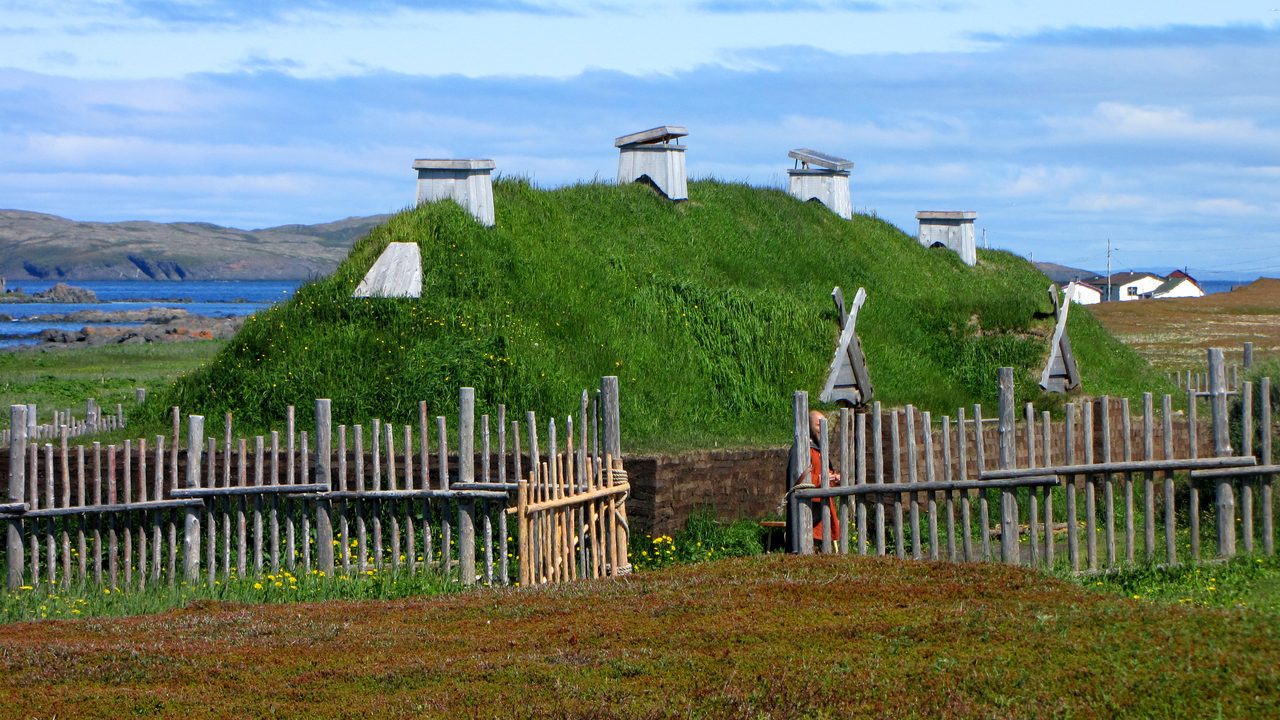
What makes it richer is that the story was written down before anyone dug it up. The Icelandic sagas, describing events around 1000 CE and committed to writing about 1200 to 1300, tell of voyages to Vinland, the 'wine land,' along with Markland and Helluland. Those saga accounts effectively predicted the archaeology decades before the site was found, a real case of oral tradition confirmed by later spades. The sagas plainly exist and predate the discovery, that much is certain; how precisely each saga place-name maps onto the excavated ground is credible rather than nailed down, and worth stating at that slightly lower confidence.
11The Pacific Door: Polynesia Met South America
The second-strongest case comes from DNA, and it is major. In 2020 Alexander Ioannidis and colleagues published a whole-genome analysis in Nature showing that living Polynesians and South Americans carry evidence of genuine pre-Columbian mixing, dated to around 1150 to 1230 CE, centuries before any European reached the Pacific. The Native American signal matches most closely to the Zenu people of coastal Colombia. Crucially, the finding shows the transfer was direct human contact, people crossing the ocean and having children, not merely seeds drifting on a current.
And there was a people fully capable of making that crossing on purpose. Polynesian voyaging is the greatest sustained feat of open-ocean navigation in the pre-modern world: the Polynesian Triangle from Hawaii to New Zealand to Easter Island spans some 28 million square kilometers, crossed without instruments, by reading star paths, swell patterns, and bird behavior, in double-hulled canoes. This is not theory. The Polynesian Voyaging Society's Hokule'a has sailed the roughly 2,400-mile Hawaii-to-Tahiti route since 1976 using only traditional navigation, proving the technique was good enough for intentional long-distance voyaging, not lucky drift. That is the mechanism behind the Ioannidis DNA.
A physical trace of that contact may already be in hand, though it is contested. In 2007 Alice Storey and colleagues reported Polynesian-lineage chicken bones at the El Arenal site in Chile, radiocarbon dated to about 1321 to 1407 CE, before Columbus. Critics have raised the possibility of later European chicken lineages contaminating or being mistaken for the sample, and the case has been neither cleanly refuted nor confirmed. It sits, honestly, as an open and still-cited debate.
Two of the most famous anomalies in this whole subject belong to files of their own, and this survey only points at them rather than reopening them. The sweet potato, unmistakably South American, was already growing across Polynesia when Europeans first arrived, carried there before contact and known by a name, 'kumara,' strikingly close to the Andean Quechua 'kumar,' a botanical fingerprint of the very contact the Ioannidis DNA describes. And an entirely separate puzzle: traces of cocaine and nicotine reported in Egyptian mummies in 1992, American plants turning up where they have no business being, a finding that after more than thirty years remains a genuinely unresolved dispute between contamination and real ancient exposure, settled in neither direction. Each is examined in full on its own, and each is really an example of the same larger question this half of the file keeps circling: how leaky was the ocean, actually?
12Plants That Crossed Before People Noticed
Not every plant anomaly points to daring voyagers, and the honest reading matters. The bottle gourd, originally African, was being grown in the Americas by about 10,000 years ago. But DNA work by Erickson and colleagues found the American gourds descend from an Asian rather than a directly African lineage, which suggests the plant came in very early, alongside or just after the first Beringian settlers, not on some later dramatic ocean crossing. Sometimes the strange plant has a duller, and much older, explanation.
American cultivated cotton is a genuine botanical puzzle in its own right. It is a natural hybrid, an allopolyploid, carrying chromosome sets from both an Old World and a New World wild cotton, which means the two parents' ranges had to meet somehow. The hybridization itself is settled genetics. The mechanism is not, and the leading guess is a rare natural long-distance seed dispersal across the ocean rather than any human hand. A puzzle worth naming, not a smoking gun.
13Could They Have? The Ships Existed
A lot of contact claims lean on the argument that ancient people could not possibly have crossed an ocean, so it is worth being clear that serious ancient seafaring is not in doubt. The Phoenicians reportedly circumnavigated Africa around 600 BCE, a roughly three-year voyage commissioned by Pharaoh Necho II and recorded by Herodotus. Hanno the Carthaginian sailed down the West African coast to at least modern Cameroon around 500 BCE. Egyptian expeditions reached the land of Punt for a thousand years, carved into the walls of Hatshepsut's temple around 1470 BCE. These voyages genuinely happened. But that cuts against how it usually gets used: the real question for any specific Americas claim was never whether an ancient ship could make the crossing, it is whether any specific voyage actually did, and capability is not evidence of a particular trip.
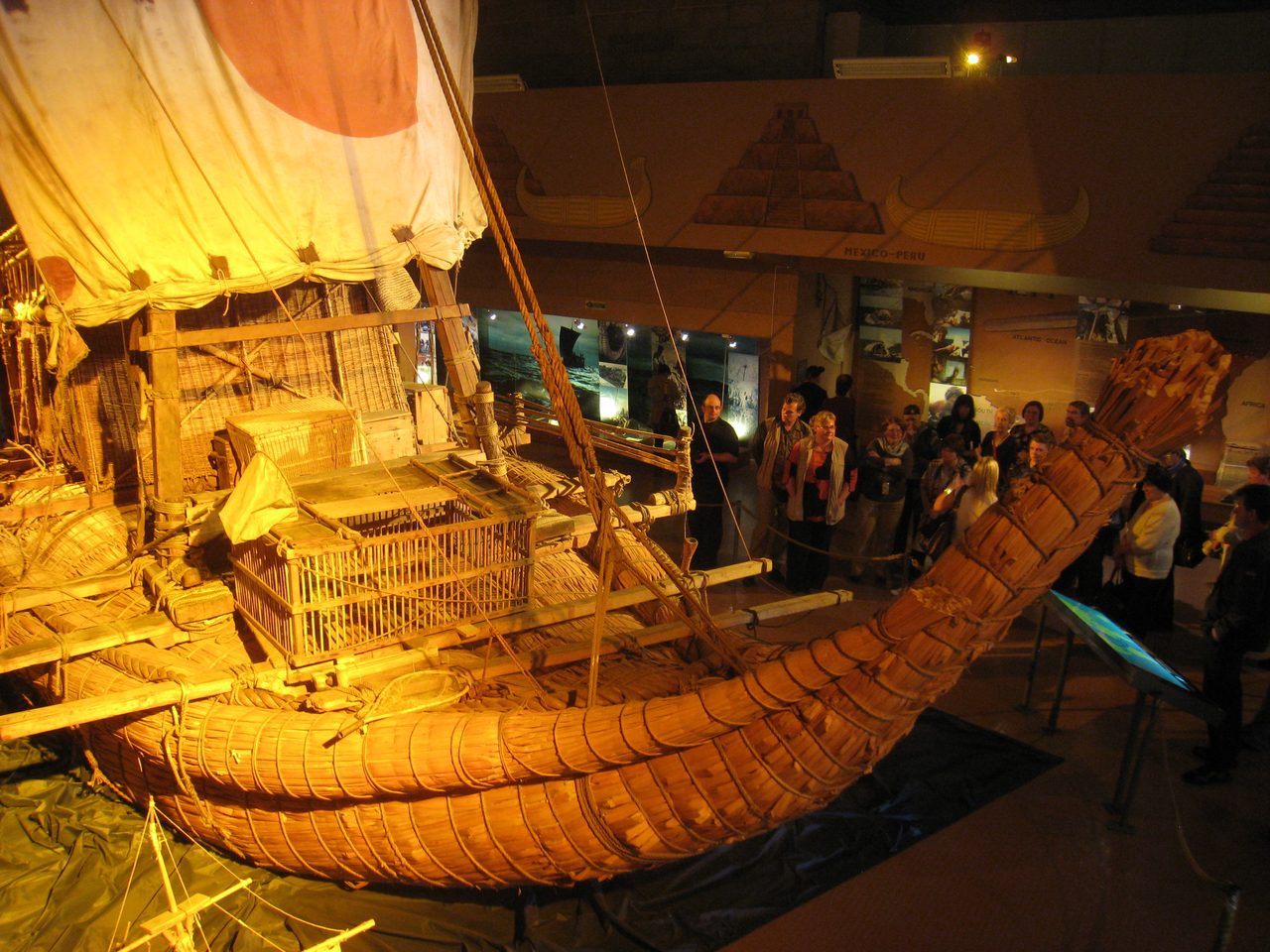
Thor Heyerdahl spent his life proving the 'could,' and only the 'could.' Kon-Tiki carried him nearly 6,900 kilometers from Peru to the Tuamotu Islands on a balsa raft in 1947. Ra broke apart short of Barbados in 1969; the improved Ra II crossed the Atlantic from Morocco to Barbados in 57 days in 1970; Tigris, a Sumerian-style reed boat, stayed seaworthy for five months in 1978 before he burned it in political protest. Every one of these voyages proved an ancient-style vessel could physically make such a crossing. Not one of them is evidence that any specific ancient voyage ever did. That distinction is the whole ballgame, and it is easy to lose.
14The Artifacts That Refuse To Resolve
Some objects are real puzzles that honest archaeologists cannot simply wave away. The Tecaxic-Calixtlahuaca head is a small terracotta head found in 1933 under three intact, undisturbed floors in a pre-Columbian burial in Mexico's Toluca Valley. Art historians identify it as genuinely Roman, in the Severan style of the second or third century CE, and thermoluminescence confirms it was fired in antiquity, not a modern fake. The dispute is entirely about how it got there. Skeptics argue it must be a planted hoax despite those undisturbed floors; others suggest a drift-voyage stray or a shipwreck heirloom passed along by intermediaries over centuries. There is no agreed answer, and it does not deserve to be filed away as fringe.
Others deserve more suspicion. The Fuente Magna Bowl, found by a farmer near Lake Titicaca with no controlled archaeological context at all, carries engravings some read as Sumerian cuneiform, with one claimed 'Proto-Sumerian' translation. Epigraphers describe the script as a gibberish mash of logographic and syllabic styles that never actually coexisted in real Mesopotamian writing. With no provenance and disputed marks, it is best treated as a likely pseudo-artifact, not evidence of anything.
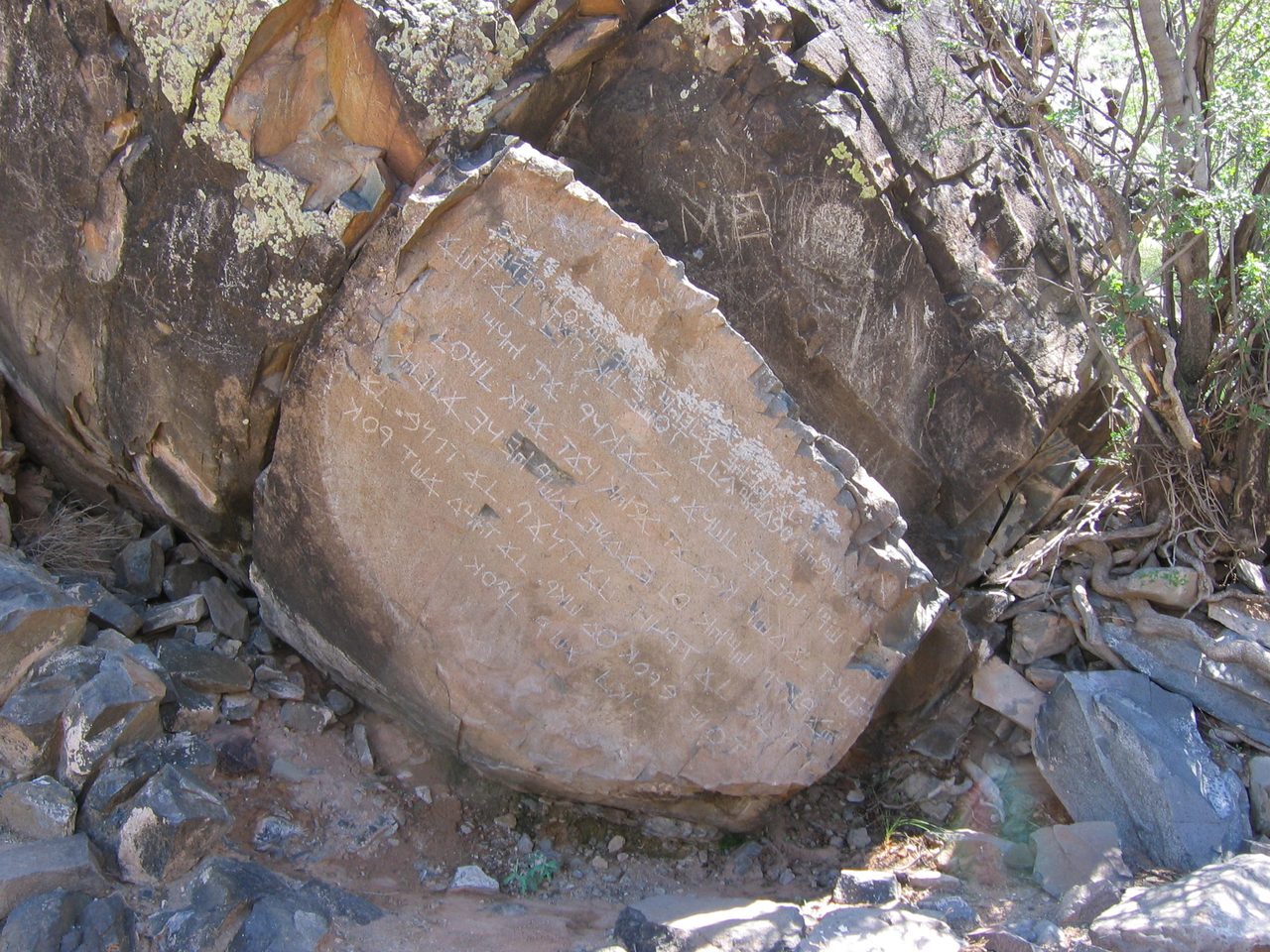
Then there is the cluster of contested inscriptions, and here the honest verdict is case by case rather than a blanket ruling. The Paraiba Stone, reported in Brazil in 1872 with a claimed Phoenician text, has since physically vanished, which makes it unverifiable forever. The Bat Creek Stone from Tennessee, found in 1889, has been read as Paleo-Hebrew by a few scholars but is widely regarded as either a misread Cherokee-syllabary inscription or a period forgery. The Los Lunas Decalogue Stone in New Mexico carries script stylistically consistent with 500 to 600 BCE Paleo-Hebrew, but its actual carving date is disputed, with many epigraphers favoring a modern origin. Not one of the three has come close to scholarly consensus for authenticity, and none is dismissed with total certainty either. Genuinely unresolved, and labeled so.
15The Olmec Heads, And A Claim That Fails Outright
The Olmec colossal heads are real and astonishing on their own terms, no contact story required. Seventeen monumental basalt sculptures, carved roughly 1500 to 400 BCE, each weighing between six and fifty tonnes, quarried and hauled as far as eighty kilometers from where the stone came out of the ground. Their existence, age, and sheer logistical difficulty are not in any dispute. They are a triumph of the Olmec civilization, full stop.
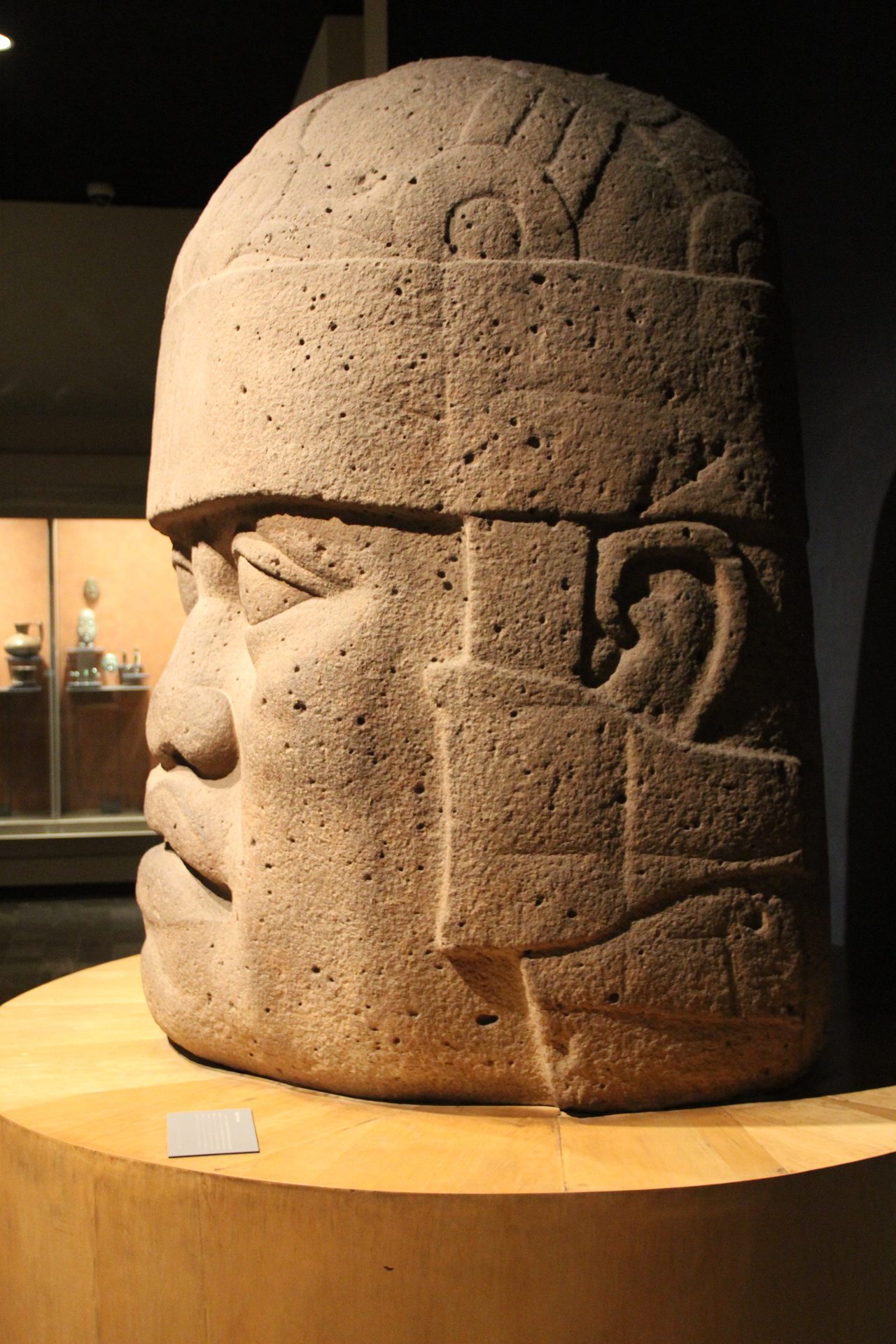
What is in dispute, and fails, is what Ivan Van Sertima made of their faces. In his 1976 book They Came Before Columbus he argued the heads' broad noses and full lips depict Africans, specifically Nubians, and therefore record a Nubian-Olmec contact event around 700 BCE. A peer-reviewed rebuttal took it apart point by point: Gabriel Haslip-Viera, Bernard Ortiz de Montellano, and Warren Barbour in Current Anthropology in 1997. Their case is concrete. No genuine African artifact has ever been recovered from a controlled excavation anywhere in the New World. The heads were carved centuries before Van Sertima's own proposed contact date. Actual Nubians, coming from a desert, characteristically have long, high-bridged noses that do not resemble the features he assigned them. And his argument leans heavily on the linguistics of Leo Wiener, whose work has been rejected by professional linguists for a century. Mainstream Mesoamerican archaeology holds that the heads' features are ordinary indigenous Mesoamerican variation, no ocean required. It is a hyperdiffusionist claim, and the evidence contradicts it.
Here is the whole second half on one page, each claim wearing its tier, because flattening a confirmed Norse settlement, a set of credible anomalies, and a debunked fringe theory into one vague 'ancient contact' blur is exactly how this subject goes wrong. The tiers are what keep them apart.
| The Claim | Tier | The Basis |
|---|---|---|
| Norse settled Newfoundland by AD 1021 | Tier 1 | L'Anse aux Meadows, Miyake-event tree-ring date |
| Polynesians and South Americans mixed before Columbus | Tier 1 | Ioannidis 2020, Nature, ~1150 to 1230 CE |
| Polynesian navigation could reach South America on purpose | Tier 1 | Hokule'a's demonstrated non-instrument voyages |
| Sweet potato reached Polynesia before European contact | Tier 2 | South American crop, Andean-linked name (own file) |
| Pre-Columbian Polynesian chickens in Chile | Tier 2 | Storey 2007, contested, not refuted |
| Cotton and bottle-gourd trans-oceanic origins | Tier 2 | Real genetics, uncertain mechanism |
| Cocaine and nicotine in Egyptian mummies | Tier 2 | Unresolved 30-year dispute (own file) |
| Tecaxic-Calixtlahuaca Roman head | Tier 2 | Genuine ancient object, disputed arrival |
| Ancient seafaring actually reached the Americas | Tier 3 | Real voyages, no proven American crossing |
| Fuente Magna Bowl and the epigraphic stones | Tier 3 | No provenance, disputed script |
| Solutrean Europeans seeded Clovis | Tier 4 | No European DNA in any Native genome |
| Van Sertima's African-Olmec contact | Tier 4 | Refuted point by point, Current Anthropology 1997 |
Fast Facts
- The Old Answer
- Clovis-first: one entry, about 13,000 years ago, down the ice-free corridor. Now dead.
- What Killed It
- Independent pre-Clovis sites: Monte Verde, Buttermilk Creek, Paisley Caves, Cooper's Ferry
- The Oldest Claim That Might Hold
- White Sands footprints, ~21,000 to 23,000 years old, still under active scrutiny
- The Likely Route
- The Pacific coastal 'kelp highway,' though the proof is drowned tens of kilometers offshore
- Where They Came From
- A single Beringian founding population, five mtDNA lineages, split ~23,000 to 26,000 years ago
- How Many Times
- At least a coastal wave, Clovis, Na-Dene, and Inuit-Aleut, plus the Australasian-linked Population Y
- The One Certain Ocean Crossing
- The Norse at L'Anse aux Meadows, dated to the year: AD 1021
- The Pacific Contact
- Polynesian and South American DNA mixed around 1150 to 1230 CE
- What Fails
- The Solutrean hypothesis, Calico Hills, Atlantean gifting, Van Sertima's Olmec theory
- The Verdict
- The first Americans came from Beringia, more than once; the ocean was leaky, not open
What We Can Actually Stand Behind
The core is settled, and it is a genuine scientific victory. Clovis-first is over: multiple independent pre-Clovis sites, Monte Verde, Buttermilk Creek, Paisley Caves, Cooper's Ferry, cross-checked and mutually consistent, put people in the Americas well before Clovis, and the field has moved from arguing whether to arguing when and by which route. The first Americans descend from a single Beringian founding population, five mitochondrial lineages of Northeast Asian origin, that split from its Asian relatives around 23,000 to 26,000 years ago. The ice-free corridor was too barren and too late to have been the first road in. Kennewick Man's genome overturned the old 'Caucasoid' misreading and tied him to living Native Americans. And in the contact half, one case is beyond dispute: the Norse were at L'Anse aux Meadows in AD 1021, and Polynesian and South American peoples mixed in the Pacific centuries before Columbus. All Tier 1.
The next layer is real but still moving, and it should not be oversold. The Pacific coastal kelp-highway route is the leading model for the first entry, but the sites that would prove it are drowned under 120-plus meters of post-Ice-Age sea, so it rests on genetics, ecology, and inference, not on the migration's own campsites. The White Sands footprints have survived a second, independent round of dating, yet a fair, unanswered question remains about why nothing else, no tools, no hearths, accompanies them, and a co-author of the work says so himself. The multiple-waves picture is solid in shape but not in exact count or timing. And the softer contact anomalies, the Polynesian chickens in Chile, the cotton and bottle-gourd genetics, the sweet potato and the cocaine-mummies puzzle each carried on their own files, and the Roman head under undisturbed Mexican floors, are credible and unresolved, neither proven nor dismissed.
Some claims are interesting and unconfirmed, and they stay exactly there. Chiquihuite Cave's 26,500-to-33,000-year tools face both the geofact objection and the harder point that such a population left no genetic trace at all. Pedra Furada's even older dates are a minority position. The Cerutti Mastodon's 130,000-year human interpretation is an extraordinary outlier no other site supports. The Fuente Magna Bowl and the epigraphic stones lack clean provenance or agreed readings. A south-to-north peopling remains a bare possibility, not a finding. Speculative, and flagged as such.
And some claims are simply contradicted by the evidence, so say it plainly. No, Ice Age Solutrean Europeans did not cross the Atlantic to seed Clovis; there is no European DNA in any Native American genome, a five-thousand-year gap sits in the dates, and the tool resemblance is convergence. No, the crude stones of Calico Hills are not million-year-old tools; they are naturally broken rock. No, the Americas were not peopled by Atlantean survivors or gifted their technology by a lost civilization; that has zero support of any kind. And no, the Olmec colossal heads do not record African contact; Van Sertima's claim was refuted point by point in a peer-reviewed rebuttal, and the heads are ordinary Mesoamerican faces. The real story needs none of these, and it is stranger and better evidenced than all of them.
So hold the two questions apart and the file stays honest. Who reached the Americas first: a Beringian people, older than the textbooks ever allowed, probably down a drowned Pacific coast, and the science that proves it also admits, out loud, exactly where its own edges are still soft. How many times: more than once, by more than one road, with at least one later ocean crossing we can date to a single year and another we can read straight out of living DNA. The hemisphere was never the sealed room we were taught. And every honest edge in this file, the footprints with nothing around them, the coastline we cannot dig, the Amazonian gene that should not be there, points at the same open question: how many more arrivals are still out there, waiting under the water or inside a genome, for someone to finally find the evidence that they happened?
Sources & further reading
Everything above is drawn from our research library on Theories of Anything, which is where we worked from. The papers, reports and primary records listed beneath them are where you can check us independently.
Image credits
- White Sands Dunefield, Aerial View photograph via Wikimedia Commons, U.S. National Park Service. Public Domain Source.
- Clovis Spear Point, British Museum photograph via Wikimedia Commons, Mike Peel (www.mikepeel.net). CC BY-SA 4.0 Source.
- White Sands Fossil Footprints, USGS Research Figure figure via Wikimedia Commons, U.S. Geological Survey. Public Domain Source.
- Beringia Land Bridge Map map via Wikimedia Commons, NOAA. Public Domain Source.
- Giant Kelp, Monterey Bay Aquarium photograph via Wikimedia Commons, Stef Maruch. CC BY-SA 2.0 Source.
- Reconstructed Norse Longhouse, L'Anse aux Meadows photograph via Wikimedia Commons, D. Gordon E. Robertson. CC BY-SA 3.0 / GFDL 1.2+ Source.
- Ra II, Kon-Tiki Museum, Oslo photograph via Wikimedia Commons, Daderot. Public Domain Source.
- Los Lunas Decalogue Stone, Vandalized State photograph via Wikimedia Commons, HuMcCulloch. GFDL 1.2+ / CC BY-SA 3.0 Source.
- Olmec Colossal Head, San Lorenzo photograph via Wikimedia Commons, Gary Todd. CC0 1.0 Source.
- Card crop of White Sands Dunefield, Aerial View photograph via Wikimedia Commons, U.S. National Park Service. Public Domain Source.


