The Dogon and the Invisible Star: Contact, Contamination, or Coincidence?
Two French anthropologists came back from the cliffs of Mali with a claim that refuses to die: that the Dogon had long known about a star no human eye can see. Sirius has an invisible companion, a tiny, crushingly dense white dwarf that takes about 50 years to circle it, and Western astronomers themselves did not see it through a telescope until 1862. So how did a West African people supposedly describe it in their oldest traditions? Only three answers are possible. Contact: they were told, by beings from the Sirius system. Contamination: they learned it from Europeans, and it only looked ancient by the time anyone wrote it down. Coincidence: the match was never as tight as the story needs. This dossier weighs all three as carefully as the evidence allows, keeps the spotlight on the ethnographers rather than the people they studied, and ends, honestly, without handing any single explanation the win the evidence refuses to give.
Two French anthropologists came down from the Bandiagara cliffs with a claim that has never stopped echoing: that the Dogon of Mali had long known about a star no unaided human eye can see. Sirius, the brightest star in our sky, has a companion. It is a white dwarf, small and unspeakably dense, and it swings around Sirius roughly once every 50 years. Western astronomers did not see it through a telescope until 1862. So how did a West African farming people supposedly describe an invisible star in their traditional knowledge? That single question launched one of the most cited controversies in the whole ancient-mysteries canon. This dossier is about the argument itself, not the wider Dogon world. The full ethnography, the cosmology, the Nommo, and the point-by-point comparison of the Dogon claims against modern astronomy already have their own home in our companion file, The Dogon, the Nommo, and the Secret of Sirius. Here we do one thing: weigh how the claim itself holds up.
There are exactly three ways to explain the puzzle, and the honest work of this article is to hold all three in view at once. Contact: the Dogon were told, by visitors from the Sirius system itself. Contamination: they learned it from Europeans, and the knowledge only looked ancient by the time anyone wrote it down. Coincidence: the astonishing match was never as tight as the famous version claims. Contact, contamination, or coincidence. Keep the three in mind, because the evidence points hard at some of them and quietly withdraws from others, and the most honest verdict at the end does not crown a single winner.
One thing has to be said before any of the argument, and it has to be said in the same breath as all of it. This is a dispute about ethnographers, not about the Dogon. The people at the center of the disagreement are the researchers who came to study the Dogon, and the real question is whether their methods recorded a tradition or helped author one. The Dogon themselves are a living West African people of roughly 800,000, and their broader tradition, the Sigui ceremony, the cosmological framework, and the Nommo, is authentic and predates Marcel Griaule's arrival entirely. None of that stands or falls with the Sirius B question. Whichever way the star argument resolves, it takes nothing away from a culture that was already whole long before a Frenchman first climbed the escarpment to write it down.
01The Claim That Came Down From The Cliffs
The controversy has a precise starting point. Marcel Griaule (1898 to 1956), a French anthropologist, first reached the Dogon in 1931 as leader of the Dakar-Djibouti Mission, a sweeping ethnographic expedition he ran with Michel Leiris straight across the width of Africa. He would return to the Bandiagara escarpment again and again until his death in 1956. No single researcher shaped what the outside world thinks it knows about the Dogon more than Griaule did, which is precisely why everything that follows turns on how he worked.

In 1946, an elderly, blind Dogon hunter and sage named Ogotemmeli spent 33 days initiating Griaule into what was described as the deep, esoteric layer of Dogon cosmological knowledge. Griaule published those conversations in 1948 as Dieu d'eau, translated into English as Conversations with Ogotemmeli. It is one of the most famous encounters in the history of anthropology, and it sits at the exact center of everything later disputed.
Griaule held that Dogon knowledge came in four levels of deepening secrecy, and that Ogotemmeli had opened only the third; the deepest layer, he said, was closed even to most Dogon. Notice what that framework does to any attempt at a fact-check. If a later researcher cannot confirm a specific claim, the framework has a ready answer built in: the researcher simply was not admitted deep enough. A claim that can never be disconfirmed has quietly stepped outside the reach of evidence, and this one structural feature haunts the entire controversy.
Griaule did not work alone. Germaine Dieterlen (1903 to 1999), his long-time collaborator, carried the fieldwork forward after his death and published Le Renard Pale in 1965 with an even more elaborate cosmology. The two of them had already brought the astronomical claims to scholarly attention in 1950, in a paper whose title says exactly what it promised: Un Systeme soudanais de Sirius, a Sudanese system of Sirius. Everything the world came to believe about Dogon astronomy flows from these publications.
Here is the claim itself, and it matters that we state it precisely as what Griaule and Dieterlen reported, not as established fact. Their Dogon informants, they wrote, described Sirius as having an invisible companion called po tolo: a star extremely small, extremely heavy, and circling Sirius about every 50 years, plus a disputed third star, emme ya tolo. Whether the Dogon independently held that knowledge is the entire question this article exists to weigh. The detailed side-by-side of every reported claim against modern astronomy lives in our companion file; we keep only the one line the whole dispute turns on.
02The Star You Cannot See
Everything hangs on how genuinely hidden Sirius B is, so be exact about the real astronomy. Sirius B is a real white dwarf orbiting Sirius A about once every 50 years, and it is savagely dense, on the order of a ton packed into a single cubic centimeter, a figure Walter Adams confirmed by spectroscopy in 1915. Alvan Graham Clark first resolved it through a telescope on January 31, 1862. And it was no easy target even for astronomers: the star was inferred before it was ever seen. Friedrich Bessel predicted its existence in 1844, a full 18 years before Clark glimpsed it, purely from a wobble the unseen companion dragged into Sirius A's motion across the sky.
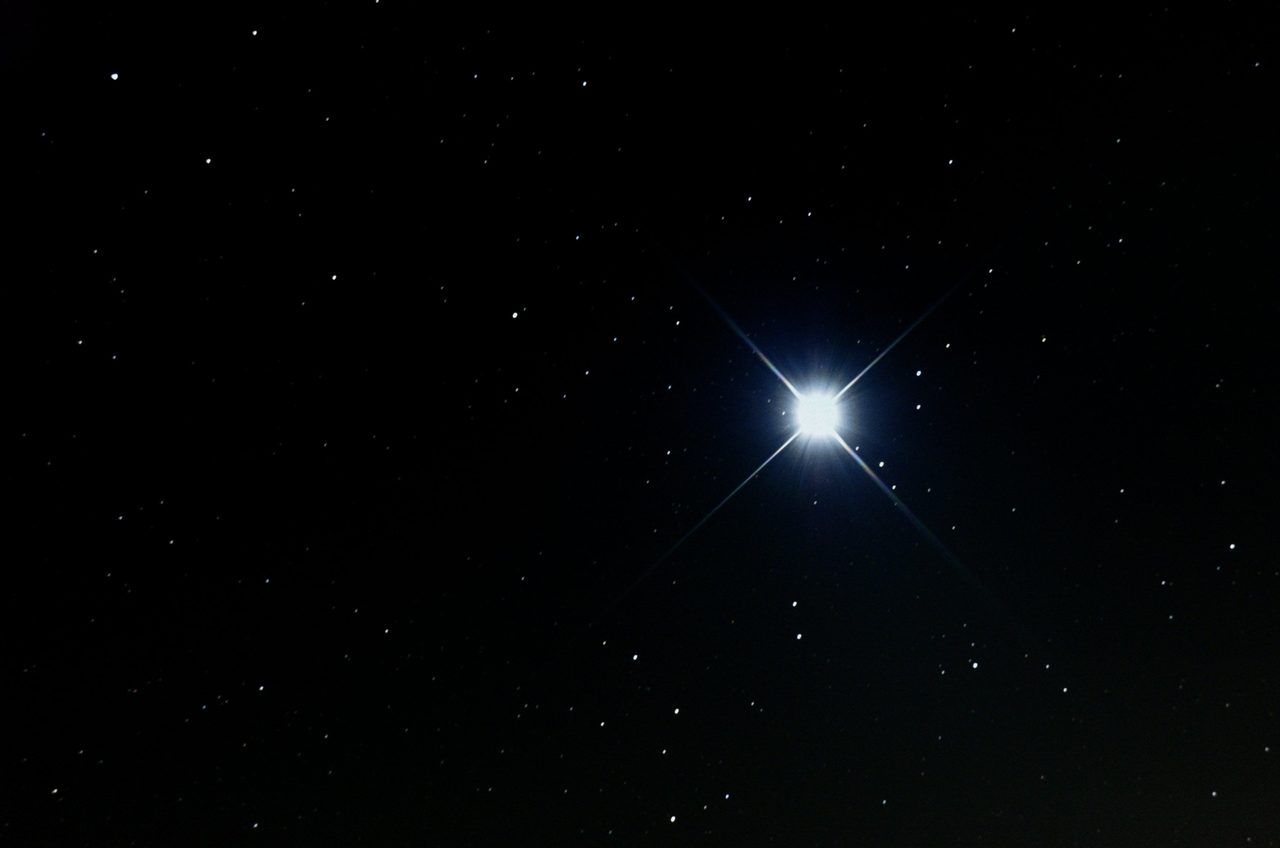
Now the crux. Sirius B is far too faint for any human eye to catch. It takes a telescope, and the Dogon had none. There is no evidence for any pre-colonial optical technology anywhere in West Africa that could have shown it to them directly. The photograph at the top of this page is what Sirius looks like to the naked eye, a single blazing point, and the companion this whole argument is about is simply not in it. It never could be. That is what makes the Dogon claim a genuine puzzle rather than a curiosity: nobody disputes that Sirius B is real and invisible, only how a people without a lens could have come to describe it.
The reported third star sharpens the strangeness and then complicates it. Emme ya tolo has no confirmed counterpart in the sky at all. A 1995 study by Daniel Benest and J.L. Duvent floated the possibility of a third body tugging on the Sirius system, but no later observation ever confirmed it. A claim with no verified referent is not evidence of secret knowledge; if anything, it counts against the idea that Griaule's informants were reading the real sky.
03The Turn: A Second Anthropologist Could Not Find It

For decades the whole edifice rested on Griaule's word, because no one had gone back to check. Then someone did. Walter van Beek, also known as Wouter van Beek, then of Utrecht University, carried out his own extensive fieldwork among the Dogon specifically to test Griaule's astronomical claims. It ran intermittently across roughly 11 years, from 1978 to 1991, in the very same Sanga region Griaule had studied, interviewing informants across several villages. He published his findings in 1991 in the journal Current Anthropology, under a title that leaves no doubt about the stakes: Dogon Restudied.
What he found, or rather did not find, is the hinge of the entire controversy. Van Beek's informants did not recognize po tolo as a traditional term carrying the meaning Griaule had reported. They disagreed with one another about which star Sigu Tolo even referred to. And crucially, none of them spontaneously described Sirius as a double star at all. The signature detail, the invisible companion, was simply not there to be collected.
Nor was it only the star. Van Beek could not consistently confirm the wider systematized cosmology either, the cosmic egg, the eight seeds, the vibrating act of creation. In his own fieldwork, Dogon accounts varied widely from one informant and one village to the next. Where Griaule had reported a single, magnificent, unified system, van Beek found something looser, more local, and more human.
Van Beek's explanation for the gap is an indictment of method, and it deserves to be weighed as exactly what it is, an interpretive judgment rather than a photograph of what happened in 1946. He concluded that Griaule's long, intense relationship with Ogotemmeli likely involved elicitation rather than neutral observation, a kind of leading-witness ethnography that unconsciously shaped answers through suggestive questions and quietly rewarded the correct ones. His overall verdict was that Griaule had probably co-constructed the esoteric system with his informants, blending genuine Dogon tradition with Western astronomical ideas, rather than simply recording a system that was already there.
This was not a quiet paper. Van Beek's Dogon Restudied ran in Current Anthropology's comments-and-replies format, printed alongside responses from other scholars, some of whom rose to defend Griaule's reputation and argued that van Beek had simply never been initiated into the deepest level of Dogon secret knowledge. That defense is real, and we will weigh it in full further down. But keep its shape in mind: it is the four-levels framework again, the argument that can absorb any negative result at all.
04Three Ways To Explain One Impossible Fact
Van Beek's restudy does not, by itself, close the case. What it does is reweight it. With the foundation shaken, the three explanations are no longer equal, and they are worth laying side by side before we walk through each in turn. Read the table as a scale, not a verdict: it shows what each answer needs to be true, where each is strongest, and exactly where each breaks.
| The Question | Contact | Contamination | Coincidence |
|---|---|---|---|
| The core claim | The Dogon learned of Sirius B directly from amphibious beings from the Sirius system, the Nommo (Temple, 1976). | The Dogon absorbed Sirius B from Europeans before or during Griaule's fieldwork, and it only looked ancient once written down (Sagan, 1979). | There is little anomalous knowledge to explain; the apparent match is loose translation, over-reading, and chance (Dougall, 2015; Ridpath, 1978). |
| What it needs to be true | Griaule's reported data must be accurate, and the Nommo mythology must be read literally. | A transmission channel must have existed through colonial contact, even without a documented paper trail. | The celebrated match must be looser than the famous version admits. |
| Its strongest support | The sheer specificity of the reported claims, if Griaule recorded them faithfully. | A 69-year window of published European knowledge (1862 to 1931), plus soldiers, schools, missionaries, and an 1893 eclipse expedition into the region. | Confirmable Dogon sky-knowledge needs no anomaly, and the Sigui-to-Sirius-B number match is imprecise. |
| Its fatal weakness | No physical evidence, and it rests entirely on Griaule's data, which van Beek could not replicate. | No documented smoking gun pinning exactly when and how the specific information passed. | It concedes some real correspondence may exist and cannot, by itself, fully rule out a specific transfer. |
| Tier | 4, the literal reading, rejected | 2, mainstream, honestly hedged | 2 to 3, credible and unsettled |
05Explanation One: Contact
The boldest answer is the one that made the Dogon famous. In The Sirius Mystery, published in 1976 and revised in 1998, Robert Temple argued that the Dogon's knowledge was real and came from direct contact with amphibious beings from the Sirius system itself, the Nommo, whom he lined up alongside the Sumerian Oannes and other amphibious civilizer figures worldwide. The book became a foundation stone of ancient-astronaut writing, and it is the reason most people have heard of the Dogon at all.
But the contact reading has a fatal dependency and a fatal method. Astronomers and anthropologists have criticized Temple for selecting his evidence, for taking Griaule's reports at face value, and for the loose comparative-mythology reasoning that lets any water-god anywhere become an alien. And the whole structure rests entirely on the accuracy of Griaule's original data, the very data van Beek could not replicate. As a literal claim, that extraterrestrial Nommo visited the Dogon, it is unsupported and rejected outright. It requires reading mythological symbolism as a flight log, which no serious method allows. Contact is the one explanation the evidence does not merely fail to support. It actively rules it out.
06Explanation Two: Contamination
The mainstream answer is less thrilling and far more powerful. In Broca's Brain (1979), Carl Sagan argued that if there is any real match between Dogon tradition and Sirius B's actual properties, the simplest explanation by far is contamination: that the Dogon, or Griaule's own informants and interpreters, picked up knowledge of Sirius B from Europeans, rather than carrying it independently from some deep past. It asks for nothing exotic. It asks only that a farming people who lived through the colonial era talked with the people colonizing them.
And the channels were wide open. France captured Bandiagara in 1893. French colonial schools reached the region in the early 1900s; Catholic missionaries, the White Fathers, were active in Dogon country from early in the century; and many Dogon served as tirailleurs senegalais, French colonial infantry, in both World Wars, coming home from a much wider world. Then there is the detail that reads almost too well: the total solar eclipse of April 16, 1893 cut its path of totality straight across Senegal, Mauritania, and Mali, and it drew French and British astronomical expeditions, telescopes, cameras, and spectroscopes and all, into the very region, in the very year France took Bandiagara. Astronomers with the newest instruments, in the region, talking about the stars.
Stack the dates and a window opens. From Clark's 1862 sighting of Sirius B to the start of Griaule's fieldwork in 1931 is 69 years, and across all of it the companion star's existence, density, and orbital period were established, published European knowledge. Sixty-nine years in which the information sat available, in principle, to be carried to a Dogon informant by a soldier, a teacher, or a missionary before Griaule ever asked his first question.
One more pathway runs even closer to Griaule himself. French-educated Dogon, or Griaule's own interpreters, could have carried Western astronomy into the conversation before or during the fieldwork. Sirius B was a popular-science talking point across Europe after Arthur Eddington's work on white dwarfs in 1924, and by the 1930s its properties were common knowledge among educated Europeans, which is precisely when and where Griaule was doing his most detailed work.
So contamination is the strongest explanation on the table. But honesty is the whole point of this file, and contamination has a real hole in it: there is no smoking gun. Nobody has produced the documented moment, the specific teacher or soldier or tract, that put Sirius B into a Dogon informant's mind on a datable day. It is the best available explanation on grounds of simplicity and opportunity, not a proven chain of custody. The mainstream position is strong. It is not sealed, and this article will not pretend it is.
07Explanation Three: Coincidence
The third answer is quietly the most deflating, and it is genuinely distinct from the other two. Paul Dougall argued in 2015 that whatever Dogon astronomical knowledge can actually be confirmed, recognizing Sirius as a bright and important star, tracking the seasons against its appearances, needs no anomalous explanation whatsoever. It is exactly what skilled naked-eye sky-watchers everywhere have always done. On this reading, much of the famous match between Dogon tradition and Sirius B may be an artifact of loose translation, retrospective over-reading, and ordinary coincidence, rather than either alien contact or a traceable transfer of European facts. There may simply be less to explain than the legend requires.
Ian Ridpath made a sharp version of the same point back in 1978. Some accounts credited the Dogon with knowing about Saturn's rings and Jupiter's four large moons too, treated as still more anomalous knowledge. But those are schoolbook facts, visible through the simplest telescope and printed in European texts since the 17th century. If the surrounding claims are ordinary knowledge that could have arrived by ordinary means, the pressure to treat the Sirius B claim as extraordinary drops right along with them.
And the single most quoted piece of the legend deserves a careful second look. The Sigui ceremony recurs roughly every 60 years, with reported figures spanning about 57 to 63, and it is popularly said to be timed to Sirius B's roughly 50-year orbit. Look at the two numbers. Sixty is not fifty. The deeper sources on this topic flag that celebrated correspondence as imprecise and unproven, not a confirmed match, and the tidy claim that the ceremony is timed by the orbit is exactly the kind of retrospective tightening the coincidence reading warns about. The match is looser than the famous version admits.
08The Argument That Will Not Settle

The scholarly fight around Griaule is older and wider than the Sirius question, and it cuts both ways. On the critical side, Andrew Apter argued in 2005 that Griaule's own theoretical hunger for a single, unified deep-knowledge system led him to over-interpret and over-systematize a set of genuinely diverse and fragmentary local traditions into one grand cosmology, a cosmology that mirrored his expectations as much as any Dogon reality.
James Clifford went to the foundation itself. In a 1988 essay that became a landmark in the study of how ethnography claims its authority, he read Griaule's own published account of being ritually initiated into Dogon knowledge as a power-laden piece of rhetoric, a story that positioned Griaule as the one Westerner finally let inside. When the initiation is itself a literary construction, the knowledge it supposedly unlocked has to be read with the same care.
The defense of Griaule is not empty, and fairness demands it be stated at full strength. Dogon esoteric knowledge, its supporters argue, is genuinely restricted to particular initiatory lineages and levels, so van Beek's failure to find it may reflect his own lack of access rather than its non-existence. The trouble, as we flagged earlier, is that this argument can explain away any negative result at all, which makes it very hard to disprove and, for exactly the same reason, weak as proof.
There are specific facts behind the defense too. Griaule was reportedly adopted into a Dogon family and given an honorary initiatory standing, the olu baru, which may have opened doors that a later, unadopted researcher like van Beek never reached. And Dieterlen, who kept working with Dogon informants for decades after Griaule's death, maintained to the end that the cosmology they had recorded was real.
A last point cuts against van Beek from the other direction. He did his fieldwork decades after Griaule, by which time the Dogon world had changed through modernization, through Islamization, and, pointedly, through growing awareness of the Sirius controversy itself. Genuinely esoteric knowledge could have gone underground, or become a politically sensitive thing to hand yet another Western researcher asking about the stars. The restudy is powerful, but it is not a clean replication of 1946 conditions, because those conditions no longer existed.
So where does that leave an honest reader? The research this article draws from makes a clean epistemic cut, and it is the right one to end on. That Griaule reported detailed Sirius B knowledge is documented fact. That the Dogon actually held that knowledge before any contact is disputed, and the weight of evidence, van Beek's restudy plus the sheer breadth of the contamination window, leans against it. That the Nommo were real visitors from Sirius rests on nothing but a literal reading of myth. Three claims, three very different grades, and the case once called the single most cited piece of evidence for ancient astronauts turns out to carry the least of all where it counts most.
Fast Facts
- The Two Ethnographers
- Marcel Griaule (1898 to 1956) first reached the Dogon in 1931 on the Dakar-Djibouti Mission and was initiated by the blind sage Ogotemmeli over 33 days in 1946. Germaine Dieterlen (1903 to 1999) continued the work after his death and published Le Renard Pale in 1965.
- The Invisible Companion
- Sirius B is a real white dwarf on a roughly 50-year orbit, first resolved through a telescope by Alvan Graham Clark in 1862 and confirmed as extraordinarily dense by Walter Adams in 1915. Friedrich Bessel had predicted it mathematically in 1844, 18 years before anyone saw it.
- The Restudy
- Walter (Wouter) van Beek's fieldwork ran intermittently from 1978 to 1991 in the same Sanga region. His informants disagreed about which star was even meant, did not spontaneously describe Sirius as a double star, and traced the idea back to Griaule himself.
- The Window
- From Clark's 1862 sighting to Griaule's 1931 arrival, 69 years passed in which Sirius B's properties were published European knowledge. France took Bandiagara in 1893, the same year a total solar eclipse drew telescope-equipped expeditions into the region.
- The Loose Match
- The Sigui ceremony recurs roughly every 60 years (reported at about 57 to 63) and is popularly tied to Sirius B's roughly 50-year orbit. The deeper sources flag that numeric match as imprecise and unproven, not confirmed.
- The Living Tradition
- The Sigui ceremony, the cosmological framework, and the Nommo tradition are authentic and predate Griaule's arrival entirely, whatever the answer to the Sirius B question turns out to be.
- The Rejected Reading
- The claim that the Nommo were literal extraterrestrials, and that the Dogon case proves ancient-astronaut theory, is explicitly unsupported. Without independent confirmation of Griaule's original data, the case is not evidence of extraterrestrial contact.
What The Evidence Actually Holds
Strip the argument down to what is simply documented, and a surprising amount survives, because a report is a fact even when its contents are in doubt. Griaule genuinely reported, from 1931 onward, that his Dogon informants described an invisible companion to Sirius; Dieterlen genuinely extended the account; van Beek genuinely returned between 1978 and 1991 and genuinely could not replicate it, with informants who disagreed about which star was even meant and who traced the whole idea back to Griaule. And the astronomy is rock solid: Sirius B is a real, invisible white dwarf, predicted by Bessel in 1844, first seen by Clark in 1862, its crushing density confirmed by Adams in 1915. All of that is Tier 1. None of it, by itself, tells us whether the knowledge was ever independently Dogon.
The contamination hypothesis holds at Tier 2, and it holds as the strongest explanation available. A 69-year window of published European knowledge, colonial schools and missionaries and returning tirailleurs, and an 1893 eclipse expedition that put telescopes in the region the same year France took Bandiagara, together make ordinary transmission not just possible but likely. The methodological critiques of Griaule ride alongside it at the same tier: Apter on his hunger to systematize, Clifford on the rhetoric of initiation, Ridpath on schoolbook astronomy dressed as revelation, and van Beek's own leading-witness reading of the Ogotemmeli sessions. This is the mainstream position, and it is credible. The one honest caveat is that it has no smoking gun: no documented moment when the specific fact of Sirius B passed to a specific Dogon mind.
The defenses of Griaule live at Tier 3, genuinely possible and genuinely unproven. Maybe the knowledge was real but locked in initiatory levels van Beek never entered; maybe his adoption and olu baru standing opened doors a later researcher could not; maybe the knowledge went underground as the Dogon world modernized and the controversy grew. Each is a coherent story. None is established, and the first of them has the awkward property of explaining every possible negative result equally well. The unconfirmed third star, emme ya tolo, sits here too: proposed once in 1995, never verified.
And here is the flat refusal the evidence earns. Did extraterrestrial Nommo visit the Dogon and hand them the secret of Sirius B? No. That claim has no physical evidence and survives only by reading mythological symbolism as literal history, which no scholarly method permits. Does the Dogon case prove ancient-astronaut theory? No. Without independent confirmation of Griaule's original data, and van Beek could not supply it, the case is not evidence of extraterrestrial contact at all, whatever its fame. Could a people without a single lens have telescopically observed an invisible star on their own? No. Three questions, three refusals, and not one of them is aimed at the Dogon. Every one is aimed at a Western story told about them.
Line the three explanations up one final time. Contact is ruled out. Contamination is the best answer we have and still cannot produce its receipt. Coincidence remains genuinely, stubbornly possible, because the celebrated match was looser than the legend ever admitted. That is not a tidy ending, and it is the true one: on the evidence we have, no single explanation deserves the crown, and pretending otherwise would be its own kind of dishonesty. The Sigui will be danced again on its own long rhythm, as it was danced long before Griaule climbed the escarpment and will be long after this argument is forgotten. So the question the Dogon case really leaves open was never about the Dogon at all. It is about the people who came to study them. When a Western science goes hunting for a hidden system, how would it ever tell the difference between finding one that was always there, and quietly helping to build the very thing it came to find?
Sources & further reading
Everything above is drawn from our research library on Theories of Anything, which is where we worked from. The papers, reports and primary records listed beneath them are where you can check us independently.
Image credits
- Sirius, the brightest star in the night sky (naked-eye photograph) photograph by Mellostorm, via Wikimedia Commons. CC BY-SA 3.0 Source.
- Members of the Dakar-Djibouti Mission, including Marcel Griaule, May 1931 photograph by Charles Mallison, via Wikimedia Commons. CC BY-SA 3.0 Source.
- Anthropologist Wouter (Walter) van Beek, Tireli, Mali, 1980 W.E.A. van Beek Collection, African Studies Centre Leiden, via Wikimedia Commons. CC BY-SA 4.0 Source.
- Germaine Dieterlen and Jean Rouch with local informants, Sangha, Mali, 1980 photograph by W.E.A. van Beek, African Studies Centre Leiden, via Wikimedia Commons. CC BY-SA 4.0 Source.
- Card crop of Sirius, the brightest star in the night sky (naked-eye photograph) photograph by Mellostorm, via Wikimedia Commons. CC BY-SA 3.0 Source.


