Enoch's Sequels: The Ten Heavens and the Angel Who Was Once a Man
Almost everyone has now heard of the Book of Enoch. Almost nobody knows it had two sequels, and the sequels go where the original never dared. In 2 Enoch the patriarch is carried not through seven heavens but ten, past a solar chariot pulled by phoenixes, past Watchers who mourn instead of burn, up to a seventh-heaven throne where the Lord's face blazes 'like iron made burning hot,' and higher still to a tenth heaven no earlier Enoch ever reached. In 3 Enoch the story finishes the job: the man who walked with God and vanished is revealed as Metatron, a being with a body the size of the world, seventy-two wings, and 365,000 eyes, crowned, enthroned, and given the most dangerous title in Jewish literature, the Lesser YHVH. This is the file on how a human prophet became, across three books and several centuries, something a rabbi could mistake for a second God. Every claim wears its evidence, and the biggest claims get ruled out.
There is a book almost everyone has now heard of. Two hundred angels come down on a named mountain, teach humanity forbidden arts, and father a race of giants; a Flood is sent to undo the damage. That is 1 Enoch, and this wing already carries the full file on it, The Book of Enoch. What almost nobody knows is that the story did not stop there. In the centuries after 1 Enoch, two more books took up the same patriarch and carried him somewhere the original never went. They are called, plainly, 2 Enoch and 3 Enoch, and they are not chapters of the first book. They are sequels, written in different languages, in different centuries, by different hands, and between them they finish a transformation the first book only began: the man who walked with God and simply vanished becomes, in the end, a being that heaven itself nearly mistakes for God. This is the file on the two sequels. Every claim wears its evidence, and the largest claims get ruled out at the end.
01Two Books That Kept Going
Start with what 2 Enoch physically is, because it is a strange survival. The text exists today only in Old Church Slavonic, in roughly twenty manuscripts, the earliest of which dates to the fourteenth century CE. It comes down in two recensions, a longer version and a shorter one, and scholars still argue over which is closer to the original: Vaillant favored the shorter, Andersen argued for the longer. No Greek, Hebrew, or Aramaic original has ever been found, though most scholars posit a lost Greek source text, a Vorlage, standing behind the Slavonic. Hold onto that missing original. By the end of this file it becomes the single most important fact in the whole case.
2 Enoch's text falls into three movements. First, Enoch's ascent through ten heavens (chapters 1 to 21). Then God's own revelation of how creation was made (chapters 22 to 38). Then Enoch's return to earth with moral instructions for his sons (chapters 39 to 68). The middle movement is remarkable on its own, a text in which God narrates the mechanics of creation in the first person. But it is the first movement, the ascent, that gives 2 Enoch its signature, and its signature is a number.
3 Enoch is a different animal entirely. It is written in Hebrew, not Slavonic, and it belongs to the Hekhalot corpus, the 'palaces' literature of early Jewish mysticism; its own title is Sefer Hekhalot, the 'Book of Palaces.' The standard scholarly text is Philip Alexander's 1983 critical edition, published in Charlesworth's Old Testament Pseudepigrapha, and the work is dated to roughly the fifth or sixth century CE, though some elements may run earlier. Its frame is not Enoch's ascent at all. It is Rabbi Ishmael who ascends, to the seventh heaven, the seventh palace, and there he meets an angel. That meeting is the reason 3 Enoch matters, and we will come back to it.
02Ten Heavens, Not Seven
Fix this in the first sentence, because the old catalog card for this topic got it wrong. 2 Enoch does not take Enoch through seven heavens. It takes him through ten. That ten-heaven scheme is unique to 2 Enoch across the entire Enochic tradition: 1 Enoch describes seven heavens, and the later Hekhalot literature, including 3 Enoch, typically uses seven palaces. Only 2 Enoch counts to ten. The scheme has possible parallels in some Gnostic texts and in Paul's own famously ambiguous claim of being 'caught up to the third heaven' in 2 Corinthians 12:2, but the full ten-tier ladder is 2 Enoch's own invention within the tradition.
And it is a specific ladder, not a vague stack of clouds. Each heaven has contents, functions, and residents, laid out almost like an inventory of the cosmos. The lower heavens run the weather and the stars; the middle heavens hold the fallen and the mourning; the upper heavens keep the records and turn the zodiac; and the top of the ladder holds the throne. Here is the full climb as 2 Enoch describes it.
| Heaven | What 2 Enoch places there |
|---|---|
| First | The rulers of the stellar orders, and the storehouse of snow, dew, and clouds |
| Second | The prison of the fallen angels: dark, in torment, awaiting eternal judgment, paralleling 1 Enoch's imprisoned Watchers |
| Third | Paradise, the Garden of Eden, to the north, and a place of punishment to the south; explicitly the home of the righteous dead, not the earth |
| Fourth | The courses of the sun and moon, run by elaborate machinery, including a solar chariot drawn by phoenixes and chalkydri |
| Fifth | The Grigori (Watchers): some fallen, some mourning their fallen brethren, whom Enoch urges to resume the liturgy |
| Sixth | Seven bands of archangels who govern the cosmic order and keep the records |
| Seventh | God's throne and the highest orders, Seraphim, Cherubim, and Ophanim; Enoch sees the Lord's face 'like iron made burning hot... terrible and frightful' |
| Eighth (Muzaloth) | The 'changer of seasons,' governing the zodiac |
| Ninth (Kuchavim) | The heavenly homes of the twelve zodiac signs |
| Tenth | God's face revealed directly; Enoch stands before the throne and God commands the archangel Michael to clothe him in garments of glory |
The top of the ladder is where 2 Enoch gets strange even by its own standards. The eighth heaven, Muzaloth, is the 'changer of seasons' and governs the zodiac; the ninth, Kuchavim, holds the heavenly homes of the twelve signs; and the tenth reveals God's face directly, where Enoch stands before the throne and is clothed by the archangel Michael in garments of glory. Read that last image slowly. A human being, robed by an archangel at the summit of creation, standing where the divine face is unveiled. That is the seed of everything the third book will grow.
03The God Who Narrates His Own Creation
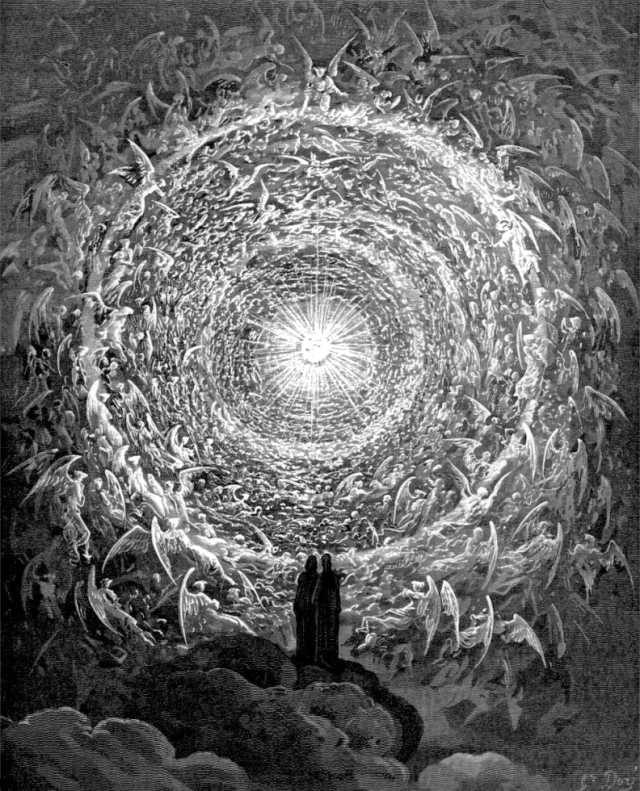
In chapters 24 to 30, 2 Enoch does something no other surviving Jewish pseudepigraphon does: God stops and narrates the creation directly to Enoch, in the first person. And the cosmogony he describes is not the one in Genesis. God commands a visible being called Adoil, a name read as 'God's eternity' or 'light of God,' to come forth from the invisible. 'And Adoil descended,' the text says, 'and became great, and his belly was a great light.' From Adoil's disintegration, all visible creation pours out, which may make this one of the earliest Jewish formulations of creation from nothing, creatio ex nihilo. A second primordial being, Archas, darkness and solidity, then emerges to form the lower foundations. This is neither Genesis nor the Babylonian Enuma Elish; it is creation as a spoken command producing primordial light-beings that differentiate into the world we see.
After the revelation, Enoch is sent back to earth for thirty days to hand his knowledge to his sons, and chapters 39 to 66 fill with moral instruction: care for the poor, just treatment of animals, the cosmic weight of ordinary human action. The anthropology is memorable. 'I created man from invisible and from visible nature,' God says at 2 Enoch 30:15, 'of both are his death and life and image.' And the ethics are cosmic, not merely personal: righteousness sustains creation, wickedness damages the very order of the cosmos, an idea that rhymes with the Zoroastrian asha, cosmic truth upheld by right action, and with the Egyptian Ma'at. The moral is not just be good. It is that the fabric of the world depends on whether you are.
04The Priest Born From a Corpse
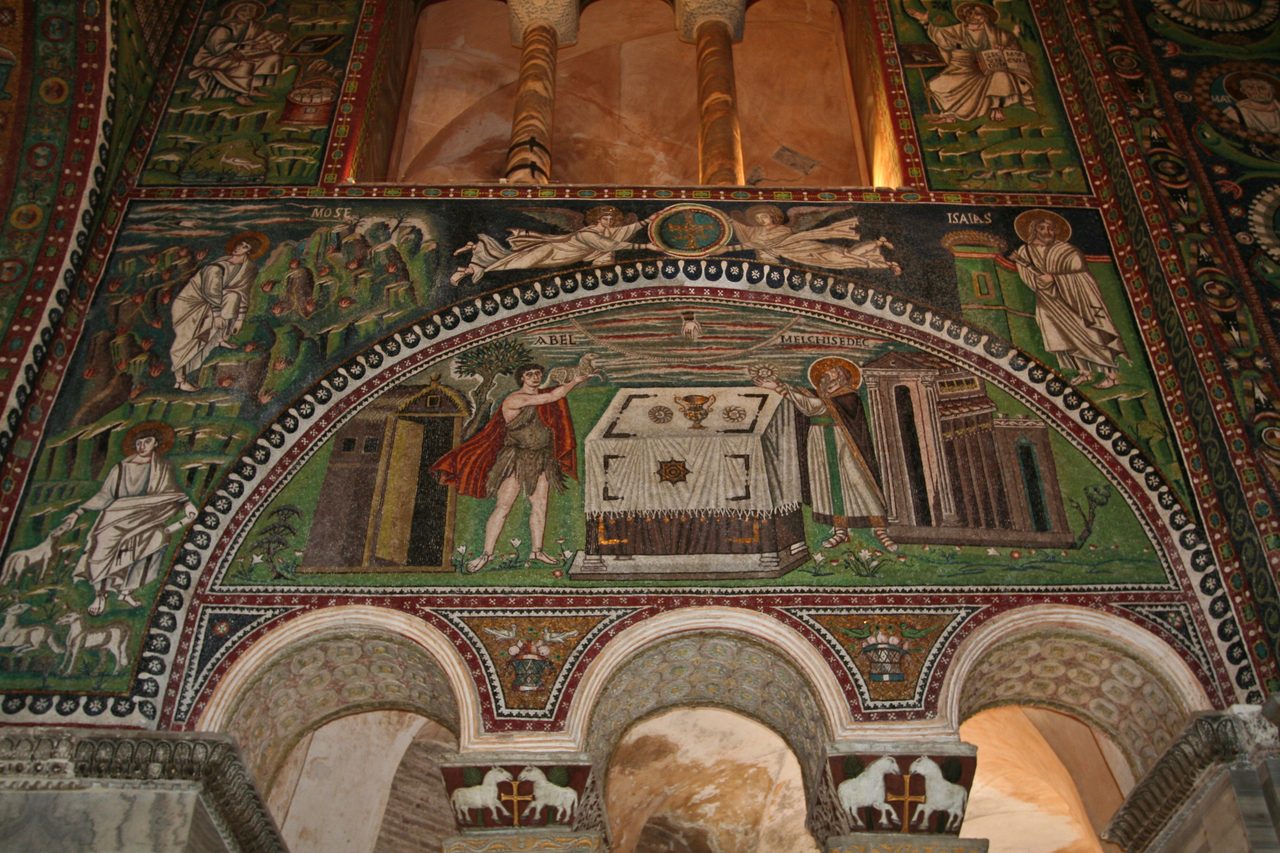
2 Enoch's longer recension carries a bonus narrative that has fascinated readers for centuries: the miraculous birth of Melchizedek. In chapters 69 to 73, Melchizedek is born to Nir, the brother of Noah, and his wife Sopanima, who dies before she can give birth. The child emerges from the dead Sopanima fully formed, already bearing the 'badge of priesthood' on his chest and speaking blessings from his first moment. God then sends the archangel Michael to carry Melchizedek to Paradise, the third heaven, to preserve him through the coming Flood and establish him as an eternal priest.
This is not an idle legend. It reaches straight for one of the strangest figures in the Bible. Melchizedek appears in Genesis 14 as a priest-king of Salem who blesses Abraham, and again in Psalm 110 as the model for an eternal priesthood, 'a priest forever after the order of Melchizedek.' The Dead Sea Scrolls' 11QMelchizedek fragment goes further, portraying him as a heavenly being. And Hebrews 7:3 describes him as 'without father or mother, without genealogy, without beginning of days or end of life.' 2 Enoch reads like a narrative engine built to explain exactly that theology: a priest with no ordinary birth and no ordinary death, delivered into the world already finished.
05The Man Who Became Metatron
Return to Rabbi Ishmael, standing in the seventh palace, face to face with the angel. The angel introduces himself, and the introduction is the hinge of the entire Enochic tradition. 'I am Enoch ben Jared' (3 Enoch 4:2). The greatest angel in the heavens is the antediluvian patriarch himself. He recounts his own transformation: God took him from the generation of the Flood, carried him up on the wings of the Shekhinah to the highest heaven, and turned his flesh into fire.
The ascent did not go unchallenged. In 3 Enoch 6, Enoch rises from earth on a storm chariot, and the ministering angels object: 'What is a human born of woman doing in the height?' God overrules them in a single sentence: 'I have chosen him alone from among all of them.' A human being is being promoted over the entire angelic host, and the host knows it.
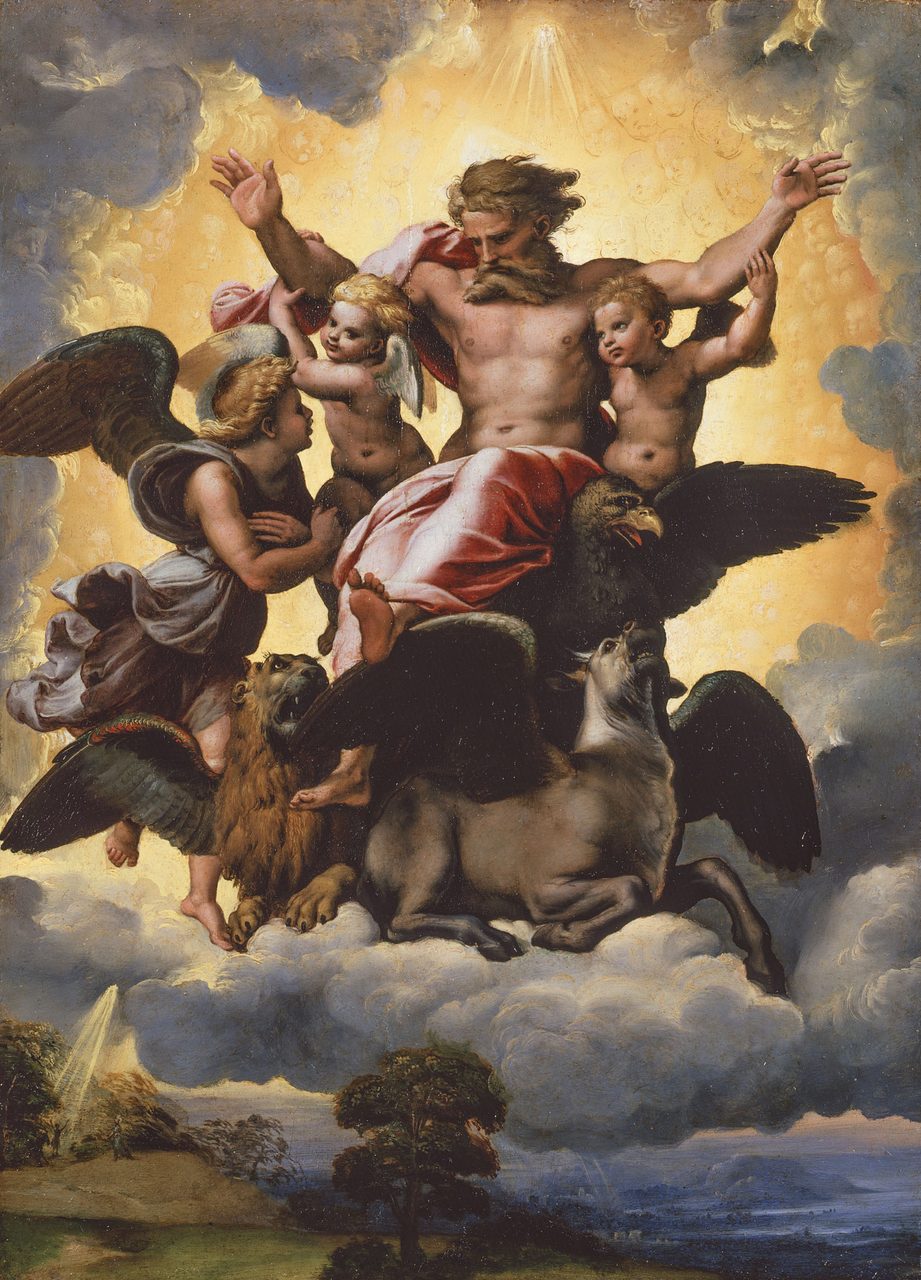
Then God rebuilds him on a cosmic scale. Metatron's body is enlarged until it is 'equal in length and width to the length and width of the world' (3 Enoch 9:2). He is given seventy-two wings, thirty-six pairs, and 365,000 eyes, each one, the text says, 'like the Great Light,' the sun. God sets on his head a crown engraved with the very letters by which heaven, earth, the seas, and all creation were made. The scribe who once recorded the heavens has become a second architecture of them: a figure whose dimensions are the world's dimensions and whose crown carries the alphabet of creation itself.
06Two Powers in Heaven
And then the promotion becomes a crisis. Metatron is given a title: 'the Lesser YHVH' (3 Enoch 12:5), the lesser bearer of the divine Name. Other angels heard it and asked the question that would haunt rabbinic Judaism for centuries: 'Are there then two powers in heaven?' The phrase, shtei reshuyot, 'two powers,' names a genuine theological emergency. A human being had been exalted so far that the heavenly court itself could look at him and see a second God.
The rabbis knew exactly how dangerous the figure was, and one Talmudic story stages the danger directly. In the Babylonian Talmud, Hagigah 15a, the heretic called Aher, Elisha ben Abuya, ascends to heaven and sees Metatron sitting, when every other angel stands in God's presence. Aher draws the forbidden conclusion out loud: 'Perhaps there are two powers in heaven.' The response is swift and physical: God has Metatron punished with sixty lashes of fire, a public demonstration that even the Lesser YHVH is a servant, not a second deity. The passage is the whole controversy compressed into one scene.
The same tradition runs through Sanhedrin 38b, which identifies Metatron as the angel of Exodus 23:20 to 21, the angel God sends ahead of Israel, 'for my name is in him.' An angel who literally carries the divine Name is precisely the kind of figure that keeps the two-powers anxiety alive, and the Talmud names Metatron as exactly that angel.
3 Enoch gives Metatron one more office. Before the divine throne hangs the Pargod, a cosmic curtain or veil on which every event of history, past and future, is depicted. Metatron is granted knowledge of the Pargod and made its custodian, which hands him something close to omniscience over the entire historical process. The transformed scribe is now the being who can read the record of time itself.
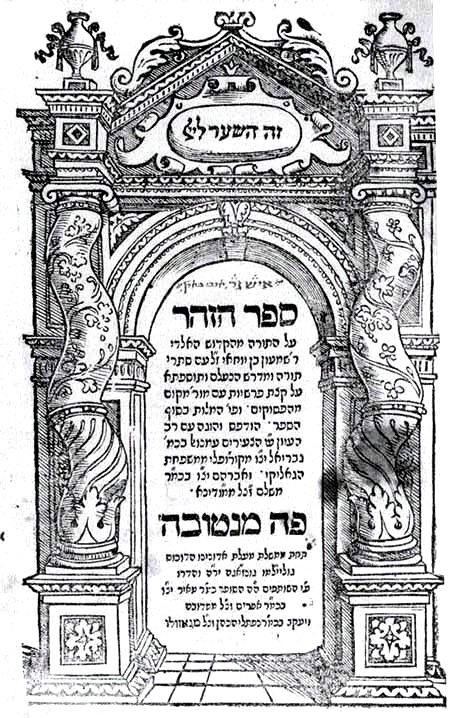
His names multiply too. 3 Enoch 48D lists seventy-two names of Metatron corresponding to seventy-two names of God, a number that would become central in later Kabbalah and in magical tradition. Seventy-two recurs across the traditions with almost suspicious regularity: the seventy-two disciples sent out in Luke 10, the seventy-two translators of the Septuagint, the seventy-two names of the Shemhamphorash. By the time of the Zohar, around the thirteenth century, Metatron has been absorbed fully into the Kabbalistic system, identified with the sefirah Keter (Crown) or with Malkhut (Kingdom) depending on the passage, and named the 'angel of the Shekhinah,' the presence of God in the lower worlds.
Even his name resists explanation. 'Metatron' has no universally accepted etymology. Proposals include the Greek meta thronon ('beside the throne'), the Latin metator ('measurer' or 'advance scout'), a constructed magical power-name, the Aramaic mat(t)ara ('guardian'), or, on one reading, a deliberately opaque syncretic construction built to resist any transparent derivation at all. None is proven. The most powerful angel in the tradition arrives without a settled name.
There may in fact be two Metatrons stitched into one. 3 Enoch actually carries two distinct origin traditions merged together: Metatron-Enoch, the promoted human of chapters 3 to 15, and Metatron as a pre-existing primordial angel suggested elsewhere in the corpus. Gershom Scholem argued in 1960 that these were originally separate figures, later fused in the Hekhalot literature. The 'Two Metatrons' hypothesis is a scholarly reconstruction, and it remains debated, but it explains a real seam in the text.
And the stakes reach beyond Judaism. Alan Segal, in Two Powers in Heaven (1977), showed that the Enoch-Metatron exaltation tradition was precisely what the Talmudic rabbis were working to contain. Larry Hurtado, in Lord Jesus Christ (2003), argued that the early Christian exaltation of Jesus may draw on the very same 'second power' traditions that produced Metatron. Both arguments rest on strong textual grounding, and both remain debated, but together they point at something striking: two religions confronting the same possibility, a human raised to share the divine identity, and answering it in opposite directions.
07The Three Enochs, Side by Side
Put the three books in a single frame and the trajectory becomes impossible to miss. This wing's own file on angels and celestial hierarchies maps where a figure like Metatron sits among the archangels; here is how the three Enochs stack against one another on the details that matter, from the number of heavens to what Enoch himself finally becomes.
| Feature | 1 Enoch | 2 Enoch | 3 Enoch |
|---|---|---|---|
| Heaven levels | Seven heavens | Ten heavens | Seven palaces |
| Highest angels | Michael, Gabriel, Raphael, Uriel | The same four, plus the recording angel Pravuil | Metatron above all, with Michael and Gabriel serving beneath him |
| The fallen | The 200 Watchers who descend Mount Hermon | The Grigori, imprisoned in the second heaven, some in the fifth mourning | The 'Princes' cast down in 3 Enoch 26 |
| The divine encounter | Enoch sees the 'Great Glory' on a crystal throne | Enoch sees God's face 'like iron made burning' | Ishmael sees the 'throne of glory' through Metatron |
| Enoch's own status | Prophet, scribe, heavenly tour guide | A transformed being seated at God's left with Gabriel | Metatron himself, the 'Lesser YHVH,' cosmic ruler |
Read down the last row and you have the whole story growing from a word into a sentence: prophet, then transformed being, then Metatron. The distance from a scribe touring the heavens to the 'Lesser YHVH' enthroned above the archangels is exactly the distance these three books travel, and each book hands the next one a slightly more exalted Enoch to work with.
08What The Pattern Might Mean, And What It Doesn't
Scholars have a name for that trajectory: an apotheosis tradition, the progressive deification of a human figure. 1 Enoch elevates a human prophet; 2 Enoch transforms and glorifies him; 3 Enoch makes him fully divine, the 'Lesser YHVH.' The pattern rhymes with other transformations in antiquity: Elijah translated to heaven, Moses given a face of light and, in some traditions, enthroned above, and arguably Jesus, moved from human to divine in early Christology. Andrei Orlov has argued that the Metatron tradition represents a 'suppressed theological option' within Judaism, the possibility of human-divine transformation, pushed to the margins precisely because it sat so close to Christian claims about Jesus. Whether that suppression actually shaped the hardening boundary between early Judaism and Christianity is genuinely debated, and it stays at Tier 3: a serious argument, not a settled finding.
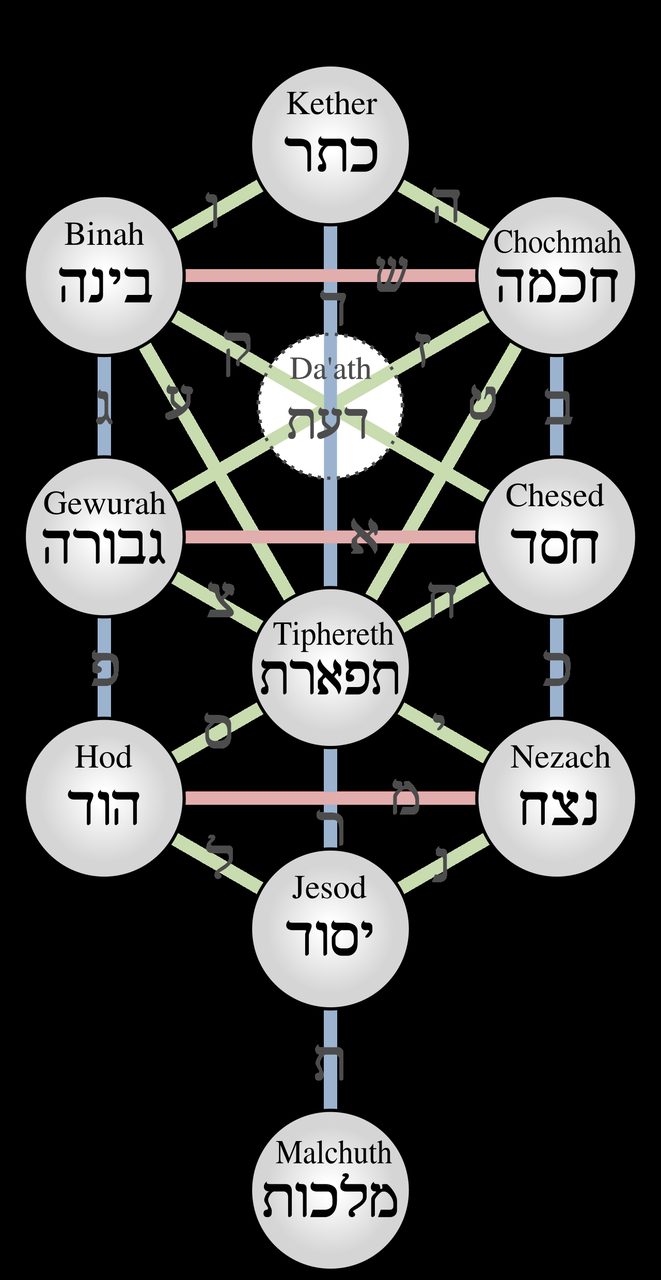
A second parallel is more seductive and needs more discipline. Scholars have noted a structural resemblance between 2 Enoch's ten heavens and the later Kabbalistic ten Sefirot: both describe a tenfold hierarchy of divine reality, topped by the direct presence of God. It is tempting to draw a line, to imagine 2 Enoch feeding into Sefer Yetzirah or early Kabbalah through some channel now lost. Resist it. The research file is explicit on this point, and so is this article: tenfold schemes are simply not rare in ancient cosmological writing, and the bare fact that two traditions both count to ten is nowhere near enough to prove a genetic link. Without a documented transmission path or shared distinctive content beyond the number itself, the parallel is suggestive at best. It is a resemblance, not a lineage.
One last note earns its Tier 3 grade, and it is the only place 2 Enoch touches the Watchers story that the first book owns. In 2 Enoch's fifth heaven, the Grigori are not the flatly condemned rebels of 1 Enoch. Some have fallen, but others merely mourn their fallen brothers and have fallen silent, ceasing the heavenly liturgy. Enoch encourages these mourning Grigori to take up their worship again, a redemptive beat that has no equivalent in 1 Enoch, where the fallen receive only judgment. It may preserve an alternate Watcher tradition in which the angels' sin admitted degrees: some fell entirely, some only grieved and withdrew. It is a speculative reading of a single narrative detail, and it stays there, but it is a genuine crack of daylight in a story usually told in black and white.
Fast Facts
- The Two Sequels
- 2 Enoch (Slavonic) carries the patriarch through ten heavens; 3 Enoch (Hebrew, Sefer Hekhalot) reveals him as the angel Metatron. Neither is the original Book of Enoch, which owns the Watchers narrative.
- Ten Heavens, Not Seven
- 2 Enoch's ten-heaven ascent is unique among Enochic texts; 1 Enoch uses seven heavens and the Hekhalot literature, including 3 Enoch, uses seven palaces.
- Creation From a Light-Being
- God commands a being called Adoil to come forth from the invisible; from his disintegration all visible creation pours out, possibly one of the earliest Jewish formulations of creation from nothing.
- The Priest Born From a Corpse
- In the longer recension, Melchizedek is born fully formed from the dead Sopanima, bearing the badge of priesthood, and is carried by Michael to Paradise ahead of the Flood.
- The Man Who Became Metatron
- In 3 Enoch, the great angel says 'I am Enoch ben Jared,' recounts his flesh being turned to fire, and is given a body the size of the world, seventy-two wings, and 365,000 eyes.
- The Lesser YHVH
- Metatron's title provoked the 'two powers in heaven' controversy; in the Talmud (Hagigah 15a) he is whipped with sixty lashes of fire to prove he is a servant, not a second deity.
- The Dating Problem
- No Greek, Hebrew, or Aramaic fragment of 2 Enoch survives; the earliest manuscript is 14th-century Slavonic, which leaves its date genuinely unresolvable with current evidence.
What The Evidence Actually Holds
The texts and their contents are documented, and they are extraordinary on their own terms. 2 Enoch survives in roughly twenty Old Church Slavonic manuscripts, in two recensions, structured as an ascent through ten heavens, a first-person creation revelation, and a return with moral instruction. 3 Enoch is the Hebrew Sefer Hekhalot, fixed by Philip Alexander's 1983 critical edition and dated to the fifth or sixth century CE, framed as Rabbi Ishmael's ascent to the seventh palace. The Metatron revelation's own lines are on the page: 'I am Enoch ben Jared,' the flesh turned to fire, the body 'equal in length and width to the length and width of the world,' the seventy-two wings and 365,000 eyes, the crown of creation's letters, and the title 'the Lesser YHVH.' And the rabbinic reaction is equally documented, in the canonical, critically edited Talmud: Hagigah 15a, where Metatron is whipped with sixty lashes of fire, and Sanhedrin 38b, which names him the angel who bears the divine Name. All of that is solid ground.
The interpretive and historical material holds at Tier 2, credibly but not beyond dispute. The Adoil and Archas creation cosmogony, the Melchizedek birth narrative and its links to Genesis 14, Psalm 110, the 11QMelchizedek fragment, and Hebrews 7:3, the seventy-two-names material and its afterlife in the Zohar and later Kabbalah, the etymology debate that never resolves, the 'Two Metatrons' hypothesis, and the Segal and Hurtado scholarship on the two-powers tradition are all textually attested and seriously argued, and all remain debated. The dating question sits here too, pulled three ways: early (Andersen, Bottrich), late (Vaillant, Milik), and mediating (Orlov). But one caveat outranks the rest, and the research file states it plainly: not a single Greek, Hebrew, or Aramaic fragment of 2 Enoch has ever been found, in sharp contrast to 1 Enoch's rich Dead Sea Scrolls attestation, which makes the dating genuinely unresolvable with current evidence. Every early-dating argument rests entirely on internal evidence. And the file's own Source Confidence is a modest 2 of 5, which this verdict will not round up into anything firmer.
The bigger patterns stay speculative, neither ruled out nor established. The apotheosis reading, that 1, 2, and 3 Enoch trace a single progressive deification and that this option was actively suppressed within Judaism, is a serious argument (Orlov) that remains debated. The structural parallel between 2 Enoch's ten heavens and the ten Sefirot is suggestive at best: tenfold schemes are common in ancient cosmology, and a shared count is not a documented lineage. The alternate Watcher tradition, the fifth-heaven Grigori who mourn rather than burn, may preserve a version in which angelic sin came in degrees. Each is worth holding as an open question. None is an answer, and this article grades all three exactly where the file does.
The literal readings fail. 2 Enoch was not written by the historical Enoch: like 1 Enoch, it is pseudepigraphical, attributed to a legendary antediluvian figure as a literary device. Metatron was not a 'real' being confirmed by genuine mystical contact: whatever altered-state experiences the Hekhalot practitioners had, the figure itself shows the fingerprints of theological construction, its attributes accumulating across texts over centuries rather than reflecting one consistent encounter. And the ten-heaven scheme is not literal cosmological knowledge: the expansion from seven heavens to ten is theological elaboration, and no ancient astronomical system corresponds to a ten-tier vertical cosmos. These are not live open questions. They are modern literalisms laid over ancient symbolic texts.
And 'Metatron's Cube' is not part of this story at all. The geometric figure of thirteen circles containing the five Platonic solids, sold everywhere as an ancient Kabbalistic emblem, is a twentieth-century sacred-geometry invention. It appears in no ancient or medieval Jewish text, it has no basis in the Hekhalot or Kabbalistic sources, and its very name is modern. When someone attaches it to Metatron as authentic Jewish mysticism, they are attaching a new object to an old name. Do not let the shared word fool you.
So follow the whole arc one last time. A man in Genesis walks with God and simply vanishes, four words of Hebrew and no explanation. One book gives him two hundred fallen angels and a Flood. The next carries him through ten heavens and clothes him in glory at the summit. The last seats him on a throne, gives him a body the size of the world and a crown made of creation's own letters, and calls him the Lesser YHVH, until heaven itself has to whip him sixty times to remind everyone he is not God. Every step of that is written down, dated, and graded above, and none of it requires that any of it literally happened. So here is the question these three books leave open, and it is a sharper one than 'was Metatron real': what was it in Second Temple and rabbinic Judaism that kept reaching for a human being who could be lifted all the way to the edge of divinity, and what made that same tradition, every single time, reach back and pull him down?
Sources & further reading
Everything above is drawn from our research library on Theories of Anything, and every claim traces back to the files below. The primary file is A_2_07, which carries 2 Enoch's manuscript tradition and ten-heaven ascent, the Adoil creation cosmogony, the moral teachings, the Melchizedek birth narrative, 3 Enoch's identification and the Metatron revelation, the dating controversy with its load-bearing caveat, and the tiered readings this article keeps at grade. The Metatron figure at the center of the 3 Enoch material has its own dedicated file, B_1_05, which supplies the Talmudic two-powers passages (Hagigah 15a and Sanhedrin 38b), the etymology debate, the 'Two Metatrons' hypothesis, the Segal and Hurtado scholarship, and the flat debunk of the modern 'Metatron's Cube.' The wing's flagship file on 1 Enoch and the Watchers, linked in the text above, owns the descent narrative this article deliberately does not repeat. Open the full files to check the sourcing and go further.
Image credits
- Mosaic of the sacrifice of Abel and the offering of Melchizedek, Basilica of San Vitale, Ravenna (6th century) photograph by Sharon Mollerus, via Wikimedia Commons. CC BY 2.0 Source.
- Raphael, Ezekiel's Vision (1518), oil on panel painting by Raphael (Raffaello Sanzio da Urbino, 1483-1520), via Wikimedia Commons. Public domain Source.
- Title page of the first printed edition of the Zohar, Mantua, 1558 early printer, Mantua 1558; digitized copy held by the Library of Congress, via Wikimedia Commons. Public domain Source.
- Diagram of the Kabbalistic Tree of Life (Sephiroth) modern didactic diagram by Wikimedia Commons user AnonMoos, via Wikimedia Commons. Public domain Source.
- Gustave Dore, illustration of the Empyrean, Dante's Paradiso Canto 31 engraving by Gustave Dore (1832-1883), via Wikimedia Commons. Public domain Source.
- Card crop of Mosaic of the sacrifice of Abel and the offering of Melchizedek, Basilica of San Vitale, Ravenna (6th century) photograph by Sharon Mollerus, via Wikimedia Commons. CC BY 2.0 Source.
_and_Offering_of_Melchizedek,_(right)_Basilica_of_San_Vitale,_Ravenna_(6098688702).jpg)


_2.svg)
