Rendlesham Forest: Britain's Roswell
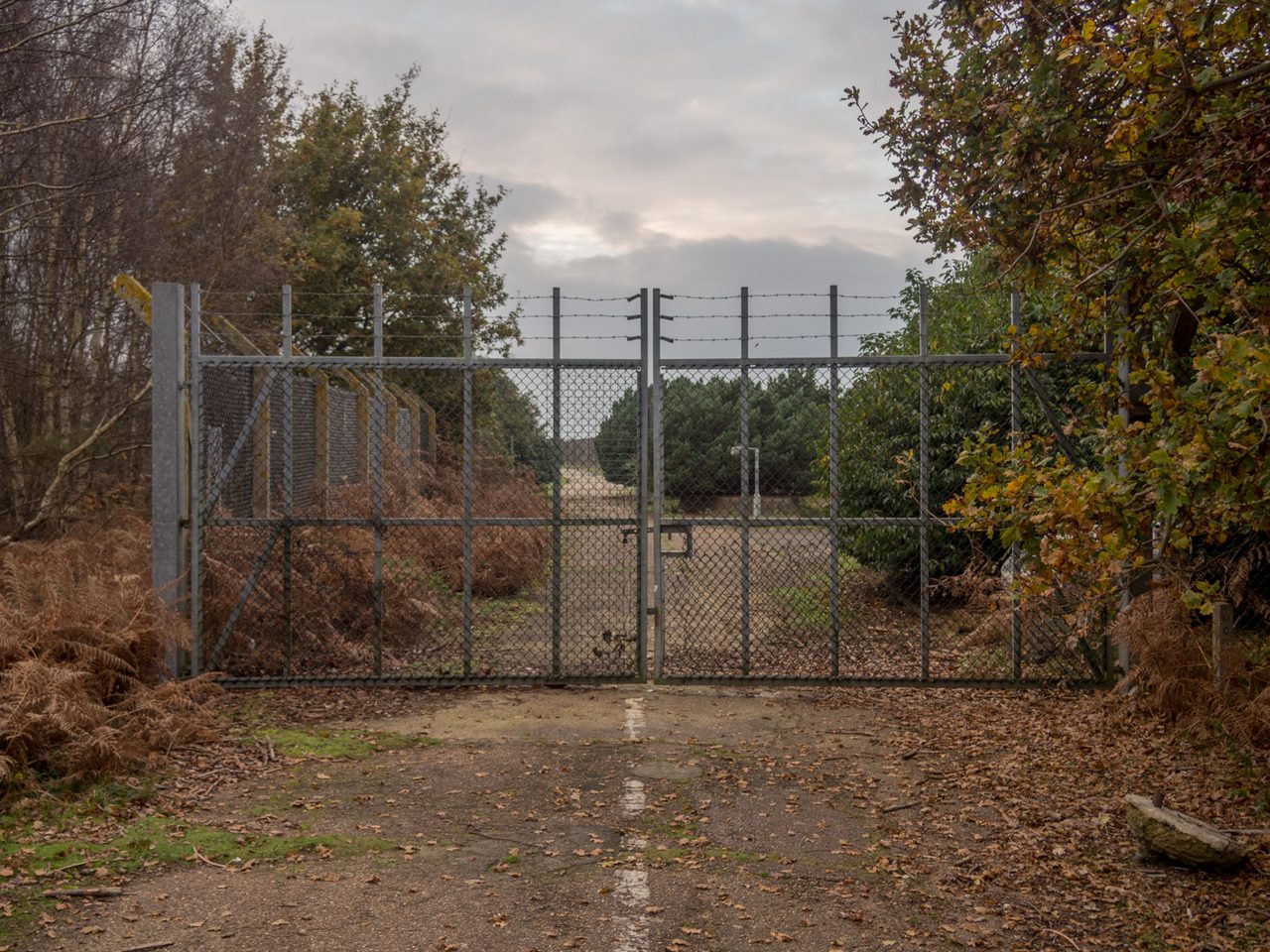
For two nights in December 1980, United States Air Force airmen guarding a nuclear-armed base in the Suffolk pines reported a small metallic craft down among the trees: glowing white, a red light pulsing on top, blue lights beneath. On the second night the deputy base commander walked in with a tape recorder running and narrated it as it happened. The memo he filed two weeks later was declassified in 1983 and has never been called a forgery. It gets compared to Roswell; unlike Roswell, the spine of this case is on paper. Here is the whole file, night by night and tier by tier, including the third night the rest of the record refuses to confirm.
Rendlesham Forest is a real place: a stand of Corsican pine on the Suffolk coast of England, wrapped around two Royal Air Force bases that in December 1980 were barely British at all. RAF Woodbridge and RAF Bentwaters were run by the United States Air Force under NATO arrangements, and the bases were widely understood to store nuclear weapons. Over two nights that December, American airmen guarding that ground reported a craft in the trees. One of them was the deputy base commander, and he brought a tape recorder.
You will see this case called Britain's Roswell. Treat that as a comparison, not a citation: it is a line that captures the fame, not a fact about the file, and it appears nowhere in the primary record itself. What the file actually holds is more interesting than the nickname. This is, on the record, the best-documented military UAP encounter in European history, and its spine is not fading eyewitness memory but paper and audio: an official memorandum, a running tape, a parliamentary record, a veterans' benefits settlement. This dossier walks it in order, and it is careful about one thing the popular retellings blur. Two nights are documented in the primary sources. A third night rests on a single, heavily disputed witness, and we will keep those apart.
01Night One: The Object In The Trees
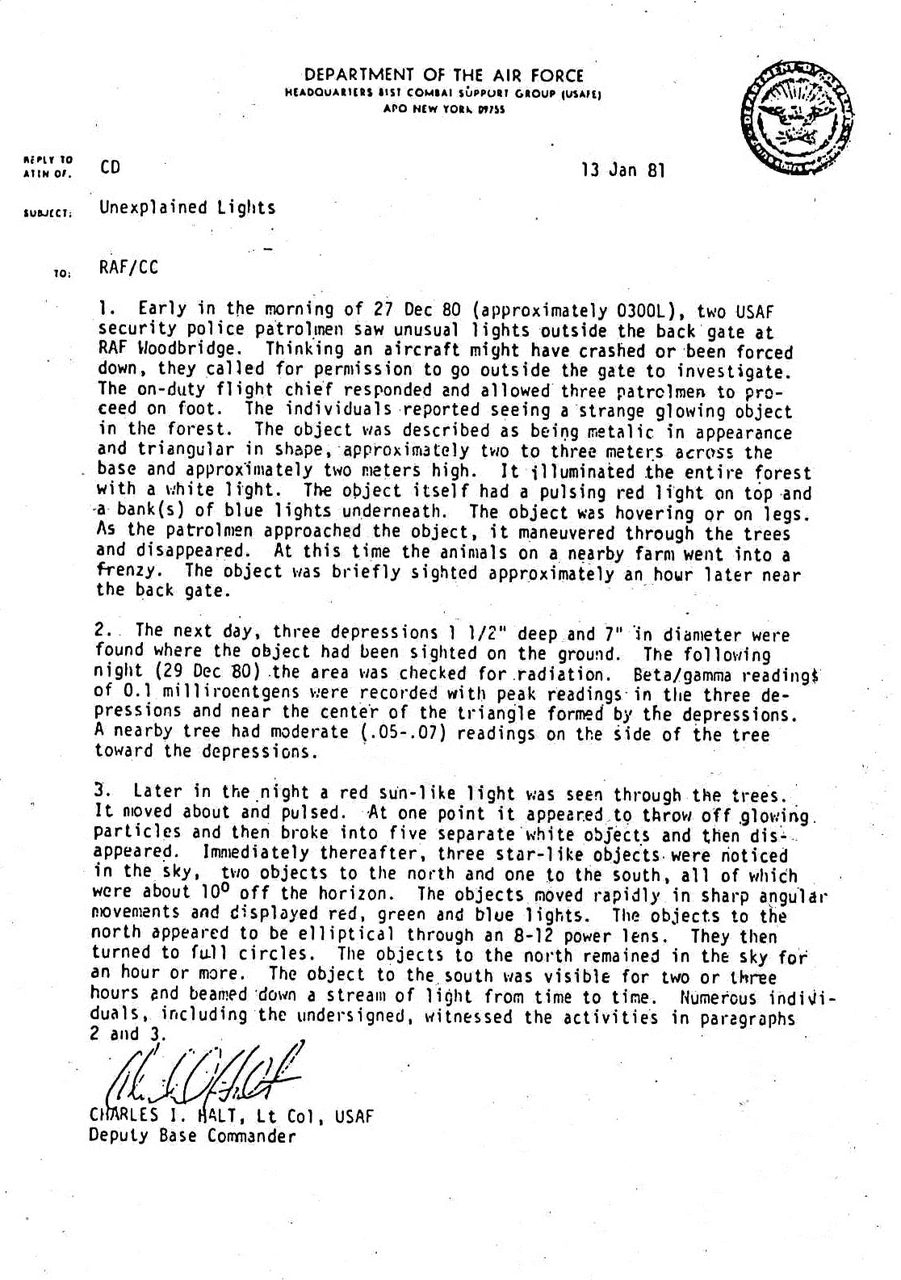
The spine of the whole case is one page of government letterhead. On January 13, 1981, Lieutenant Colonel Charles I. Halt, Deputy Base Commander at RAF Woodbridge, sent an official memorandum to the British Ministry of Defence under the subject line 'Unexplained Lights.' It is known universally as the Halt Memo, it was declassified in 1983 under the United States Freedom of Information Act, and it is the foundational primary source for everything that follows.
A few honest caveats come with it. The memo has never been challenged as a forgery; its authenticity is a matter of public record. But it is strikingly brief, a single page, and Halt wrote it roughly two weeks after the events it describes, not in real time. It is a primary document, and it is not a contemporaneous one. And the memo's own printed text actually misdates itself: it gives the first night as December 27 and the radiation check as December 29, dates Halt has since acknowledged were a mistake made writing two weeks on. The events happened the night of December 26 and the night of December 27 to 28, the dates this dossier and virtually every serious account of the case use throughout.
Here is what that page says about the first night. On December 26, 1980, two USAF security police patrolmen saw unusual lights beyond the back gate of RAF Woodbridge. Thinking an aircraft might have gone down, they asked permission to investigate outside the wire. Three patrolmen, among them Jim Penniston and John Burroughs, then reported a glowing object in the forest: metallic and triangular, roughly two to three meters across the base and about two meters high, throwing white light across the whole treeline, a red light pulsing on top and blue lights beneath, and either hovering or standing on legs.
02Night Two: The Deputy Commander's Tape
The second night is why this case outranks almost every other. On December 27, 1980, Halt led a larger team back into the forest to examine the landing site, and he carried a portable tape recorder, narrating what he saw as it happened. That recording, about eighteen minutes of audio, though Halt has said the original ran longer, leaked in 1984 and has been public ever since. It is called the Halt Tape.
The memo's account of that night reads like a sequence of escalating impossibilities. Halt and his team found three ground depressions in a triangular pattern where the object was said to have sat. They recorded radiation readings the memo puts at twenty-five times higher than the normal background. They watched a red, sun-like light break into five white objects and vanish. Later, three star-like objects moved across the sky with sharp, angular changes of direction, showing red, green, and blue lights.
But the tape is the thing. On it you can hear a senior officer's composure come apart in real time. "I see it too... it's back again... it's coming this way... there is no doubt about it, this is weird!" You can hear the radiation check: "The reading on the tree is up, wait a minute, 0.07... Getting a reading on the tree... Yeah, that's significant..." And you can hear him describe a beam: "Here he comes from the south... now we're observing what appears to be a beam coming down to the ground... this is unreal."
Strip away the eeriness and what remains is the evidentiary point the file rests on. This is a contemporaneous recording made by a senior military officer, an O-5, the Deputy Base Commander of a nuclear-capable NATO base, documenting anomalous observations as they occurred. That is an extraordinarily rare standard of evidence in UAP research, and it is why the Halt Tape cannot be waved off as a campfire story told years after the fact.
03The Landing Traces And The Radiation
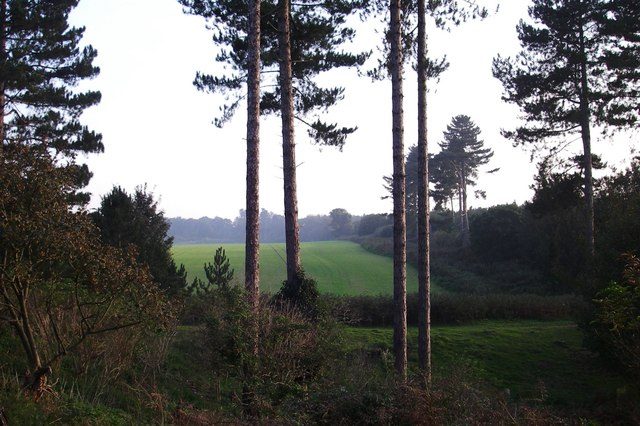
Back at the landing site, the memo logs something you can, in principle, measure. Three depressions, each about 1.5 inches deep and 7 inches across, sat in a triangular pattern on the forest floor, and they were examined not only by USAF personnel but by the United Kingdom's own Forestry Commission.
Beta and gamma radiation readings were then taken with an AN/PDR-27 detector at the depressions and on the trees beside them. The memo reports the readings as twenty-five times higher than the normal background. If that number holds, it is physical evidence that something was there. Whether it holds is exactly where the case gets argued.
The skeptics, Ian Ridpath foremost among them, take that number apart, and the file lets them do it inside its own Tier 1 section rather than hiding the argument in a footnote. Their case: the AN/PDR-27 was uncalibrated and near the end of its service life. The figure actually audible on the Halt Tape is 0.07 milliroentgens per hour, which is barely above ordinary background, not twenty-five times anything. The Ministry of Defence's own Defence Intelligence Staff, the DI55 desk, assessed the readings and called them 'not significant.' And the triangular depressions, on this reading, are likelier to be rabbit diggings or old plough marks than the footprints of a craft.
Halt and other witnesses push back, and the file lets them answer too. Their reply is that the full readings on the night were higher than the edited tape preserves, and that the instruments to hand were simply inadequate to the situation. Read their way, weak numbers argue for poor measurement, not for nothing to measure. The file does not adjudicate between these two readings, and neither will this dossier. The radiation is genuinely contested, and pretending otherwise in either direction would be dishonest.
04The Witnesses
Whatever it was, it was not seen by one person. The incident involved dozens of USAF personnel across the two documented nights. Five of them carry the case, and each deserves to be weighed on his own.
Staff Sergeant Jim Penniston made the closest approach on the first night. He reports that he reached the object, touched its surface, and saw markings on it that he likened to hieroglyphics. That much has been his consistent, decades-long core account.
He would later add a stranger claim, that he received a mental 'download' of binary code through that touch. That element surfaced roughly three decades after the incident, and it is treated with real skepticism even by researchers otherwise sympathetic to the case. It gets its own section below, at the low tier it has earned, and this dossier keeps it there.
Airman First Class John Burroughs was beside Penniston that first night, and the file calls him a consistent witness. His later story is documented in an unusual place: the United States Department of Veterans Affairs. Burroughs pursued VA medical claims for radiation-related health effects he traces to the encounter, and in January 2015 he settled with the VA and received benefits. The path there is worth spelling out, because it is more specific than the short version. Burroughs first sought help from Arizona Senator Jon Kyl's office; when Kyl's coming retirement and his inability to reach the classified portion of Burroughs' medical records stalled it, he referred the case to Senator John McCain's office. Attorney Pat Frascogna and McCain's staff then carried it. A physician the press called 'Dr. Green' attributed Burroughs' injuries to 'broad-band non-ionizing electromagnetic radiation.' The government did not concede a UFO. It did quietly compensate an airman.
Lieutenant Colonel Charles Halt is the reason the case has a spine at all. He witnessed the second night himself, produced the memo and the tape, and for more than forty-five years he has told the same story without wavering. His position has never softened into a maybe: he states flatly that what he saw was not conventional.
Colonel Ted Conrad was the Base Commander, Halt's own superior, and for decades he said almost nothing. What he did say arrived carefully. Before his death in 2022, through intermediaries, Conrad stated that he believed the airmen 'saw something,' but that 'the investigation was not sufficiently rigorous,' and that he was 'not convinced it was extraterrestrial.' It is worth noting how that reaches us: through intermediaries and news reports, not a first-person primary record, which is a weaker channel than Halt's own signed memo.
And then there is Larry Warren. Warren claims he was present for a third night of activity, on December 28 to 29, and he told that story at book length in Left at East Gate in 1997. Here the file draws its sharpest line. Warren's account is, in its own words, the single most contested piece of witness testimony in the entire case, 'with elements contradicted by other witnesses and base records.' This is the third night the popular versions fold in with the first two. It does not belong there. Two nights are documented in the primary sources; Warren's third rests on Warren, and the rest of the record will not confirm it.
| Witness | Role | What The File Says |
|---|---|---|
| Jim Penniston | USAF Staff Sergeant, closest approach on Night 1 | Touched the craft and saw hieroglyphic-like symbols, his consistent core. His later binary-code 'download' claim is Tier 3 and doubted even by proponents. |
| John Burroughs | USAF Airman First Class, with Penniston on Night 1 | A consistent witness; won a 2015 VA settlement over health effects after Senators Kyl and McCain helped reach his classified records. |
| Charles Halt | Lt. Col., Deputy Base Commander, witnessed Night 2 | Filed the memo, made the tape, and has said for more than 45 years that what he saw was not conventional. |
| Ted Conrad | Col., Base Commander, Halt's superior | Said through intermediaries before his 2022 death that the airmen 'saw something,' but the probe was not rigorous and he was 'not convinced it was extraterrestrial.' |
| Larry Warren | Claimed presence on a contested third night | The file's single most contested testimony, 'with elements contradicted by other witnesses and base records.' Published in Left at East Gate (1997). |
05What The Ministry Of Defence Did
The British government's response is itself a piece of evidence, and it can be read more than one way. Officially, the Ministry of Defence treated the whole affair as an American problem. The bases were USAF-operated under NATO arrangements, so even though the forest was British soil, London's position was that this was a United States military matter.
That is not the whole of it, though, because the MOD did assess the case. Files later released under the UK Freedom of Information Act show it was reviewed by DI55, the Defence Intelligence Staff's scientific and technical desk, which concluded the events posed 'no threat to national defence.' That is the standard formula the ministry uses to close a UAP file, and it closed this one.
It did not stay closed, because of one man. Lord Hill-Norton was no fringe figure: an Admiral of the Fleet, a former Chief of the Defence Staff, and a former Chairman of the NATO Military Committee. He raised Rendlesham in the House of Lords repeatedly, in 1997 and across at least three separate 2001 sessions, on January 25, January 30, and October 16. His argument was a fork with no comfortable prong: either something extraordinary had happened on British soil beside nuclear-armed assets, or senior USAF officers were delusional, and both possibilities demanded a real investigation. The government's reply, quoted verbatim from Hansard, refused the fork: "No additional information has come to light over the last 20 years to call into question the original judgment by the Ministry of Defence that nothing of defence significance occurred in the location of Rendlesham Forest in 1980. Accordingly there is no reason to hold an investigation now."
One more official voice belongs here, with a caveat. Nick Pope ran the MOD's UFO desk from 1991 to 1994, a decade after the incident, so he had no hand in the original response. But having later worked the ministry's files, he has called Rendlesham the strongest case in them. That is an insider's assessment, not a participant's, and it is worth exactly that.
06The Nuclear Base In The Pines
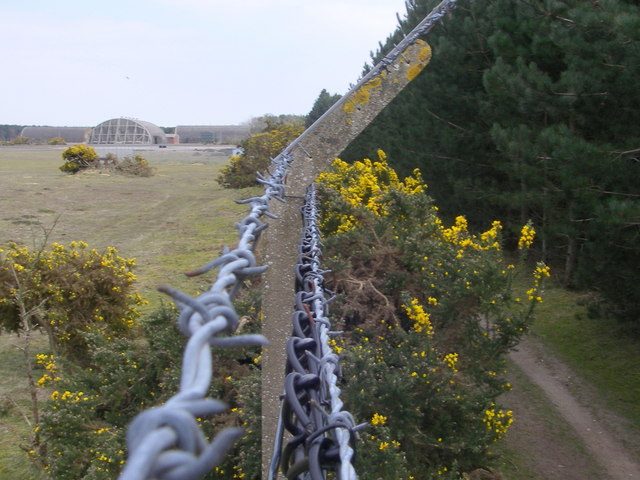
Now the detail that gives the case its charge. RAF Woodbridge and RAF Bentwaters stored nuclear weapons through the Cold War. This was widely known and officially unacknowledged at the time, and former base personnel have since confirmed that tactical nuclear weapons sat in hardened bunkers in what was called the Weapons Storage Area. The reported activity took place close to that ground.
That proximity is real, and it fits a pattern: UAP reports cluster around nuclear facilities often enough that researchers like Robert Hastings have built whole books, UFOs and Nukes among them, documenting the correlation, and Rendlesham sits squarely inside it. The file is careful here, and so are we: proximity is not causation. These were active military installations full of alert, primed security personnel whose whole job was to notice anything unusual, which is its own explanation for why unusual things get reported near them.
07The Threads That Do Not Close
Several more strands run through the file at lower confidence, credible or speculative rather than settled, and honesty means carrying them at their real weight.
John Burroughs' health effects are one. Beyond the documented VA settlement, Burroughs has said publicly that he suffered lasting harm, cardiac problems among it, that he attributes to radiation or energy exposure during the encounter. That his classified records required a senator to pry loose, and that the VA paid, suggests something in his file warranted compensation. It does not confirm the cause he assigns. The link to any UAP exposure is his account, not the VA's finding.
Jim Penniston reports psychological aftereffects, alongside his claim of receiving coded information at the craft. Medical examinations and polygraph tests run on him have produced mixed results, which is to say they neither confirm nor dismiss him.
Then the radar. Multiple witnesses say that RAF Bentwaters and the radar station at Watton tracked unexplained returns on the incident nights. This would be some of the strongest possible evidence, an independent instrument confirming a solid object, except that the December 1980 radar records have never been released. FOIA requests have failed, and the MOD's position is that the records were destroyed in routine file disposal.
One former radar operator, Ike Barker, has stated that he tracked an unknown target during the relevant window. If corroborated by the tapes it would matter a great deal. Without them it is single-witness testimony, uncorroborated, and the file grades it accordingly.
Some witnesses describe time itself behaving strangely, their sense of how long they were in the forest running much longer or much shorter than the clock. This echoes reports from other close-encounter cases, but subjective time is almost impossible to evaluate scientifically, and the file keeps it speculative.
And one earthbound hypothesis deserves a fair hearing: that the airmen watched a covert military test, a prototype stealth aircraft, a drone, or a directed-energy system, and that the secrecy around the records is ordinary defense classification rather than a UFO cover-up. It has a real virtue, it explains the official disinterest, since no one investigates their own test. But it strains against the specific witness descriptions, against the radiation readings, and against the plain fact that 1980's drone and stealth technology simply could not do what the object is described as doing.
08The Binary Code
This is the single most heavily hedged claim in the entire file, and it needs to be read at exactly the weight the file gives it, no more. Jim Penniston says that when he touched the craft, he received a mental download of binary code, which he later wrote out in a notebook. Decoded, as presented on a 2010 History Channel Ancient Aliens segment, the binary supposedly yields geographic coordinates pointing to several sites, among them Hy-Brasil, the legendary island off Ireland. Every part of that invites caution. The claim emerged publicly about thirty years after the incident. The original notebook is difficult to authenticate. Handwriting analysis has been inconclusive. The validity of the code itself has been challenged. And it is treated skeptically by researchers, including UAP proponents, precisely because of how late it arrived and how hard it is to verify. This dossier reports it as Tier 3 speculation and does nothing to dress it up as more.
09The Explanations This File Refuses
Two explanations get quoted as if they settled the case. The file refuses both, and it is precise about why.
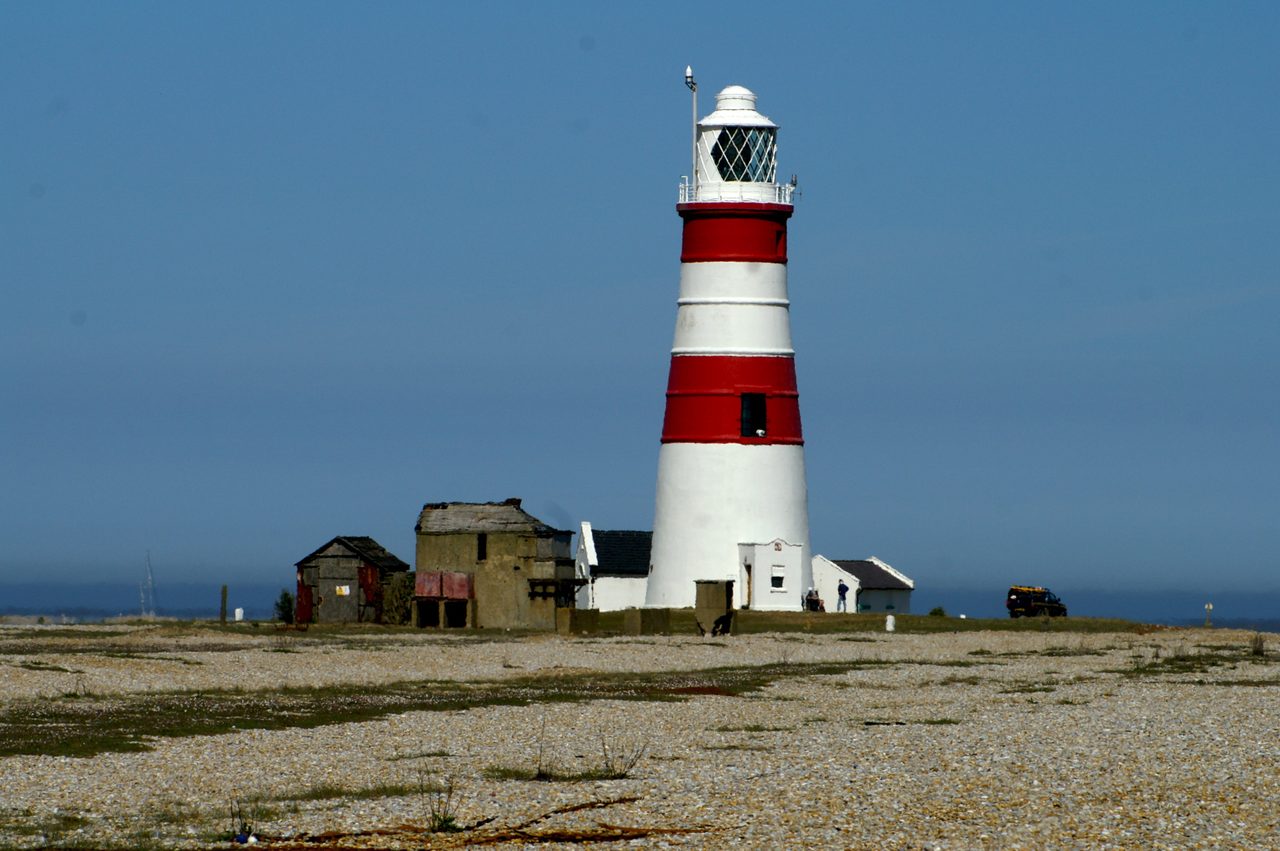
The first is the lighthouse. About five miles east of the forest stood the Orfordness Lighthouse, its beam flashing every five seconds, and from certain positions among the trees that light would have been visible. Ian Ridpath proposed it in 1983, and it has been the primary skeptical explanation ever since. The file's verdict is exact: [PARTIAL: lighthouse is a factor but not a complete explanation]. It is a factor because a rhythmic light through pines really can be misread. It is not complete because experienced security police knew that lighthouse well, because the first night's witnesses describe a close-range structured object rather than a distant flash, because Halt's second-night observations include lights in several directions rather than one fixed bearing, and because no lighthouse leaves ground depressions or moves a radiation needle.
The second is cheaper: that the witnesses were drunk or drugged. The file's verdict on that one is a single word, [DEBUNKED], and the reasons are practical. These were on-duty military security police guarding a nuclear-armed NATO base. Alcohol on duty in that role is a court-martial offense, and no disciplinary action for intoxication was ever filed against any of them. The claim has no evidence behind it and a great deal of procedure against it.
10The Skeptics, Taken Seriously
The serious skeptical case is not the drunk one, it is Ian Ridpath's, and it deserves its strongest form. Ridpath's reconstruction, first laid out in 1983 and refined ever since, does not rely on any single cause. It combines the Orfordness Lighthouse, the bright star Vega, a fireball meteor independently reported the same night, and ordinary misidentification of forest features by tired people under stress and poor light. Stacked together, he argues, they can account for the sightings without anything unknown. It is a coherent, evidence-based position, and the honest reader has to sit with it rather than dismiss it.
There is a second, subtler problem the skeptics press, and it is a fair one. Several of the witness accounts have grown in detail and strangeness over the decades. Penniston's in particular, the touching of the craft, the symbols, and eventually the binary code, became more elaborate from the 1990s onward. That is exactly the signature of confabulation and of a story absorbing influence from the wider UFO community, and it is a legitimate reason to trust the earliest accounts over the latest ones.
And the government's near-silence genuinely cuts both ways. To a proponent, a minimal official response beside nuclear weapons looks like a cover-up. To a skeptic, it looks like exactly what you would expect if the original assessment found nothing worth chasing. The same fact supports both stories, which is precisely why it settles neither. That is not a dodge; it is the honest shape of the evidence.
11What Stays Open
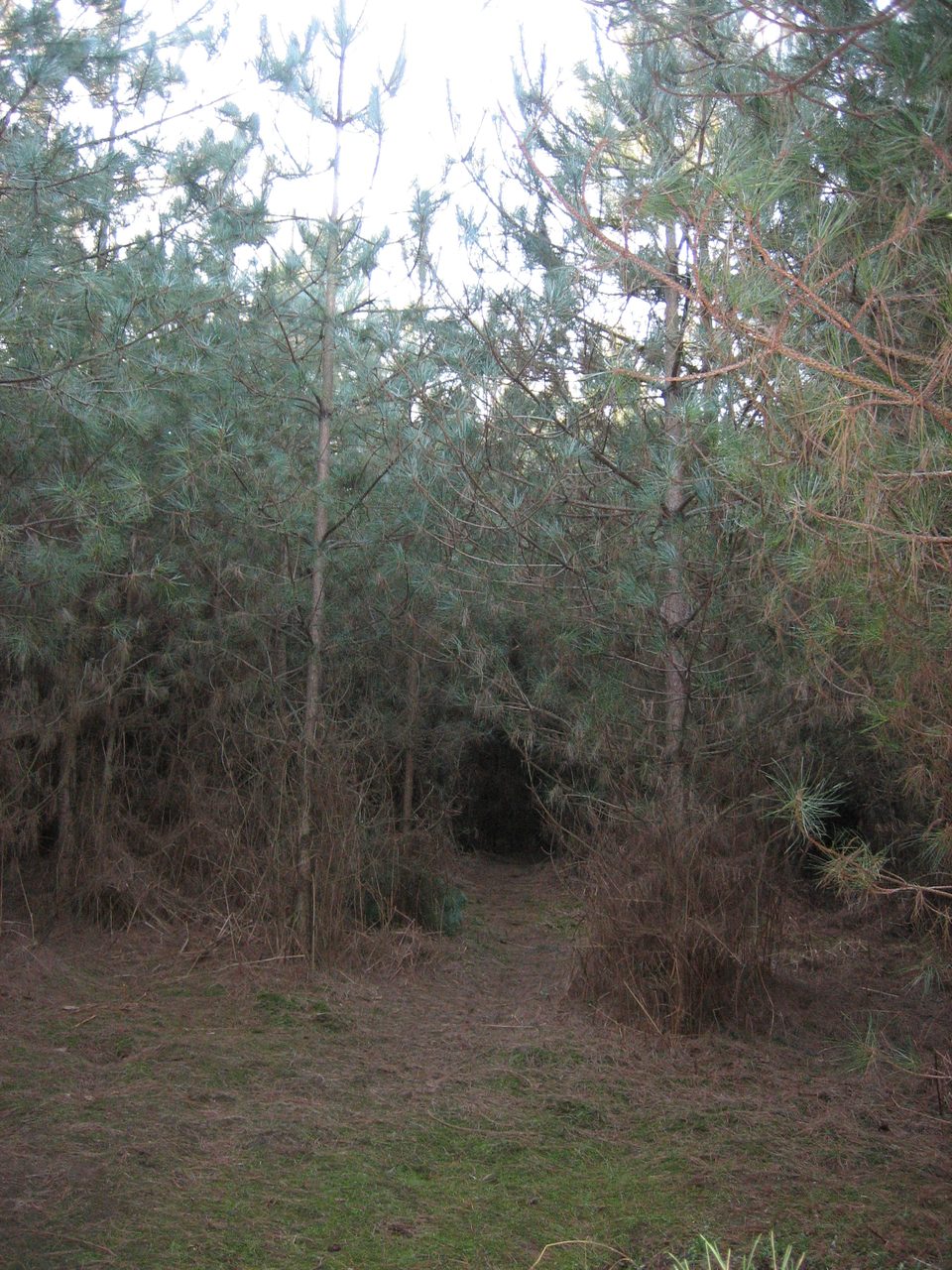
Rendlesham is a walking trail now, a commemorative UFO route through the pines that anyone can hike. But the file it left behind still names five specific questions, and every one of them could in principle be answered with records that already exist. Where are the original radar records from Bentwaters and Watton for late December 1980? What is actually in the classified portion of John Burroughs' medical file, the part it took a senator to reach? Can the radiation readings be validated against the detector's own calibration records? Were any satellite intelligence assets, American or Soviet, tasked to that coast during the incident? And did Colonel Ted Conrad keep contemporaneous notes, and if so, what do they say? None of these is a mystery of physics. They are questions of paperwork, and the paperwork is somewhere.
Fast Facts
- The Place
- Rendlesham Forest, on the Suffolk coast of England, wrapped around RAF Woodbridge and RAF Bentwaters, two USAF-operated NATO bases widely understood to store nuclear weapons.
- The Nights
- Two are documented in the primary sources: December 26 (Night 1) and December 27 to 28 (Night 2), 1980. A claimed third night, December 28 to 29, rests on a single contested witness.
- The Object
- On Night 1, three patrolmen reported a metallic, triangular craft roughly two to three meters across and two meters high, throwing white light, a red light pulsing on top, blue lights beneath, hovering or on legs.
- The Document
- The Halt Memo: one page, sent to the UK Ministry of Defence under the subject 'Unexplained Lights,' dated January 13, 1981, declassified 1983, authenticity never challenged.
- The Tape
- About eighteen minutes of Lt. Col. Charles Halt narrating Night 2 in real time, leaked in 1984. A senior officer recording anomalous observations as they happened.
- The Traces And Readings
- Three depressions in a triangle, 1.5 inches deep and 7 inches across. The memo puts the radiation at twenty-five times background; skeptics read the taped 0.07 milliroentgens per hour as barely above it.
- The Official Line
- DI55 found 'no threat to national defence.' In 2001 the government told the House of Lords there was 'no reason to hold an investigation.'
- The VA Settlement
- In January 2015, airman John Burroughs settled with the US Department of Veterans Affairs over health effects, after Senators Jon Kyl and John McCain helped reach his classified records.
So What Actually Happened At Rendlesham?
Start with what is documented, because a lot is. Over two nights in late December 1980, USAF airmen at RAF Woodbridge and Bentwaters reported an anomalous craft in Rendlesham Forest. Lt. Col. Charles Halt filed an official memo about it on January 13, 1981, declassified in 1983 and never challenged as a forgery, and on the second night he narrated his observations onto a tape as they happened. The Ministry of Defence's DI55 assessed the case; Lord Hill-Norton pressed it in the House of Lords; John Burroughs won a 2015 VA settlement over health effects with two senators' help. That an incident occurred, that dozens of airmen witnessed something, and that an official paper trail exists, all of it is Tier 1, and it holds.
Around that spine sits a credible middle layer. The bases stored nuclear weapons near the reported activity, a real proximity inside a wider documented pattern, though proximity is not cause. Burroughs' and Penniston's physical and psychological effects are on record, uncorroborated as to their source. Radar stations are said to have tracked the object, but the December 1980 records are gone, and Ike Barker's account is a single uncorroborated voice. Credible, specific, and not confirmed.
Three threads stay speculative, and this dossier keeps them there. Penniston's binary-code download, decoded to coordinates including Hy-Brasil, surfaced three decades late and cannot be authenticated; it is doubted even by proponents. The reported time distortions resist any scientific test. And the secret-technology hypothesis explains the silence but not the descriptions, the traces, or the era's actual engineering. Real questions, none of them established.
And two explanations get refused outright, because the file refuses them. It was not simply the Orfordness Lighthouse: the file's own verdict is [PARTIAL], a real factor but no account of a close-range structured object, of lights in several directions, of ground depressions, or of a radiation reading. And the witnesses were not drunk or drugged: the file marks that [DEBUNKED], on-duty security police at a nuclear-armed base, where alcohol on duty is a court-martial offense and no such charge was ever filed. Both are Tier 4, and this dossier rules them out with the file.
So here is where Rendlesham actually leaves us. This is not a lone figure on a dark road with a shaky photograph. It is an official memo, a tape running in a senior officer's hand, a parliamentary record, and dozens of airmen, set beside a real skeptical reconstruction that a fair mind cannot simply wave away, and a radiation reading that both sides claim. Two nights are documented. A third is disputed. A code arrived thirty years late. The one thing no memo, tape, or Hansard entry can yet tell you is the only thing that would settle it: what was in the trees at Woodbridge that night, and if it was ours, why has no one, in more than forty-five years, ever said so?
Sources & further reading
Everything above is drawn from our research library on Theories of Anything, which is where we worked from. The papers, reports and primary records listed beneath them are where you can check us independently.
Image credits
- The former East Gate of RAF Woodbridge, Suffolk, 2014 photograph by Taras Young, via Wikimedia Commons. Creative Commons Attribution-ShareAlike 4.0 International Source.
- The Halt Memorandum, January 13, 1981 declassified U.S. Air Force memorandum authored by Lt. Col. Charles I. Halt, via Wikimedia Commons. Public domain (a work of the U.S. Air Force) Source.
- The supposed UFO landing site at the eastern edge of Rendlesham Forest photograph by Simon Leatherdale, via Wikimedia Commons. Creative Commons Attribution-ShareAlike 2.0 Generic Source.
- Orfordness Lighthouse, Suffolk photograph by David Merrett, via Wikimedia Commons. Creative Commons Attribution 2.0 Generic Source.
- RAF Woodbridge perimeter fence amid Rendlesham Forest photograph by Simon Leatherdale, via Wikimedia Commons. Creative Commons Attribution-ShareAlike 2.0 Generic Source.
- A clearing on the Rendlesham Forest UFO Trail photograph by Wikimedia Commons user Bluewave, via Wikimedia Commons. Dual-licensed Creative Commons Attribution-ShareAlike 3.0 Unported and GNU Free Documentation License 1.2 or later Source.
- Card crop of The former East Gate of RAF Woodbridge, Suffolk, 2014 photograph by Taras Young, via Wikimedia Commons. Creative Commons Attribution-ShareAlike 4.0 International Source.


