The Tehran Intercept, 1976
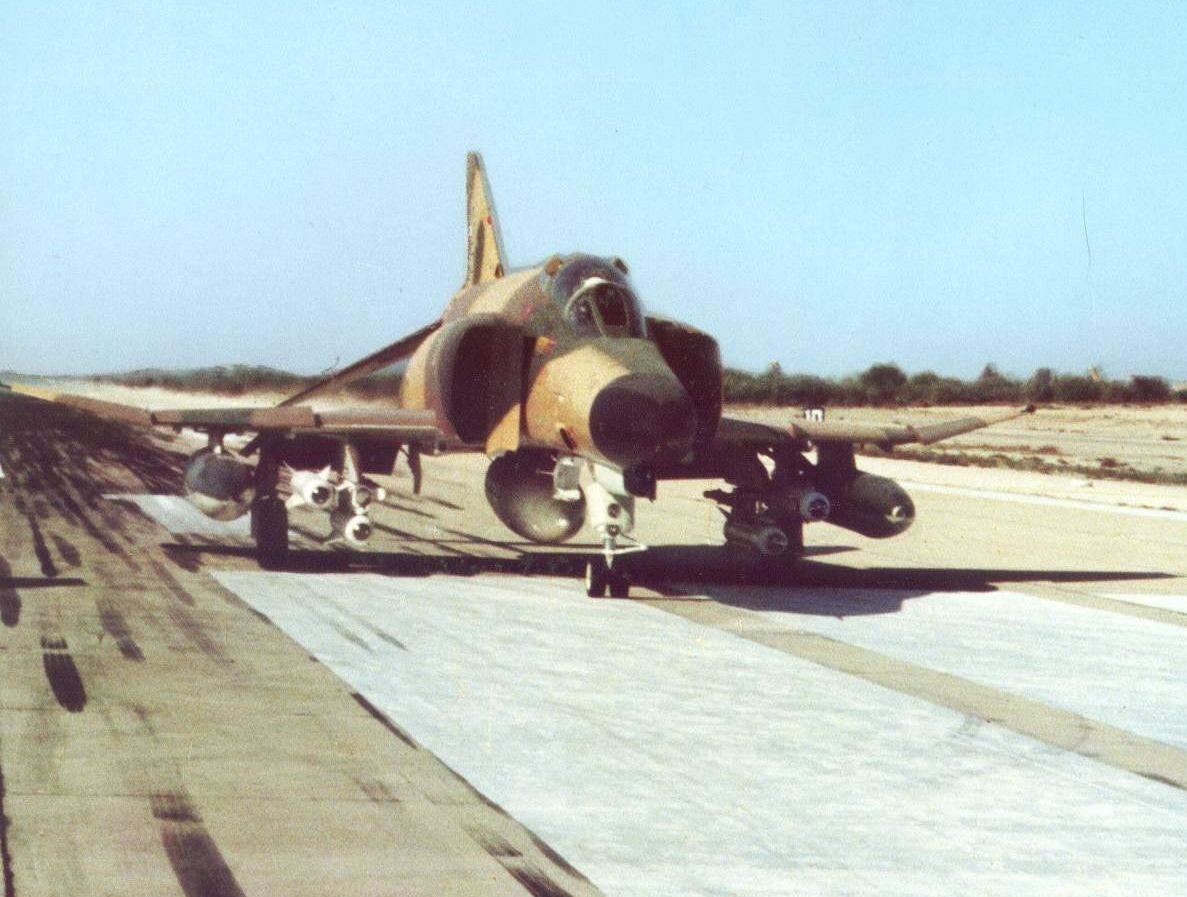
On the night of September 19, 1976, a brilliant multicolored light hung over Tehran, and the Imperial Iranian Air Force sent up an F-4 Phantom to meet it. The jet's instruments died on the approach and came back the instant it turned away. A second Phantom went up, caught the object on radar, and closed to fire. At the exact moment its pilot reached for the AIM-9 Sidewinder, his weapons panel and his radios went dead together, and no missile ever left the rail. Weeks later the United States Defense Intelligence Agency read the file, called it outstanding, a classic that met every criterion for a valid report, and circulated it to the White House. This is one of the best-documented military UFO cases on the official record. Here is exactly what the evidence holds, tier by tier, and the two tidy explanations the record refuses by name.
Most UFO stories are one person, one light, one grainy photograph, and an argument that goes nowhere. Tehran is not that. On a single night in 1976 an entire air force put two of its best fighters into the sky against something it could not name, tracked it on radar, watched it break apart and come back together, and lost the use of its own aircraft at the worst possible moments. Then a foreign intelligence service on the other side of the world read the file and graded it a model of its kind. Whatever was over the city that night, it left a paper trail two militaries could not ignore.
The research file behind this dossier rates the core of the encounter Tier 1, and this article will not hedge where the evidence does not. It will also not overstate it. So it tells the night in order, marks each piece with the tier the evidence actually earns, engages the skeptics at their strongest rather than their weakest, and refuses two tidy explanations by name, because the record refuses them too. No shots were fired here. That is precisely what makes it strange.
01The Light Over Tehran
It began with a switchboard full of calls. On the night of September 19, 1976, at around half past ten, people across northern Tehran looked up at a large, brilliant, multicolored light hanging in the sky and started reporting it. The calls reached Mehrabad Airport and the control tower of the Imperial Iranian Air Force, and the question they raised was blunt: what is that, and why is it just sitting there?
The man who took the question seriously was General Nader Yousefi, the assistant deputy commander of operations at the Air Force command post in Tehran. He checked with Mehrabad's tower, then stepped onto his own balcony to look for himself. What he saw was far brighter and larger than any star, and he refused to treat it as one. Yousefi ordered a fighter scrambled to intercept, and he would later confirm the events through official channels.
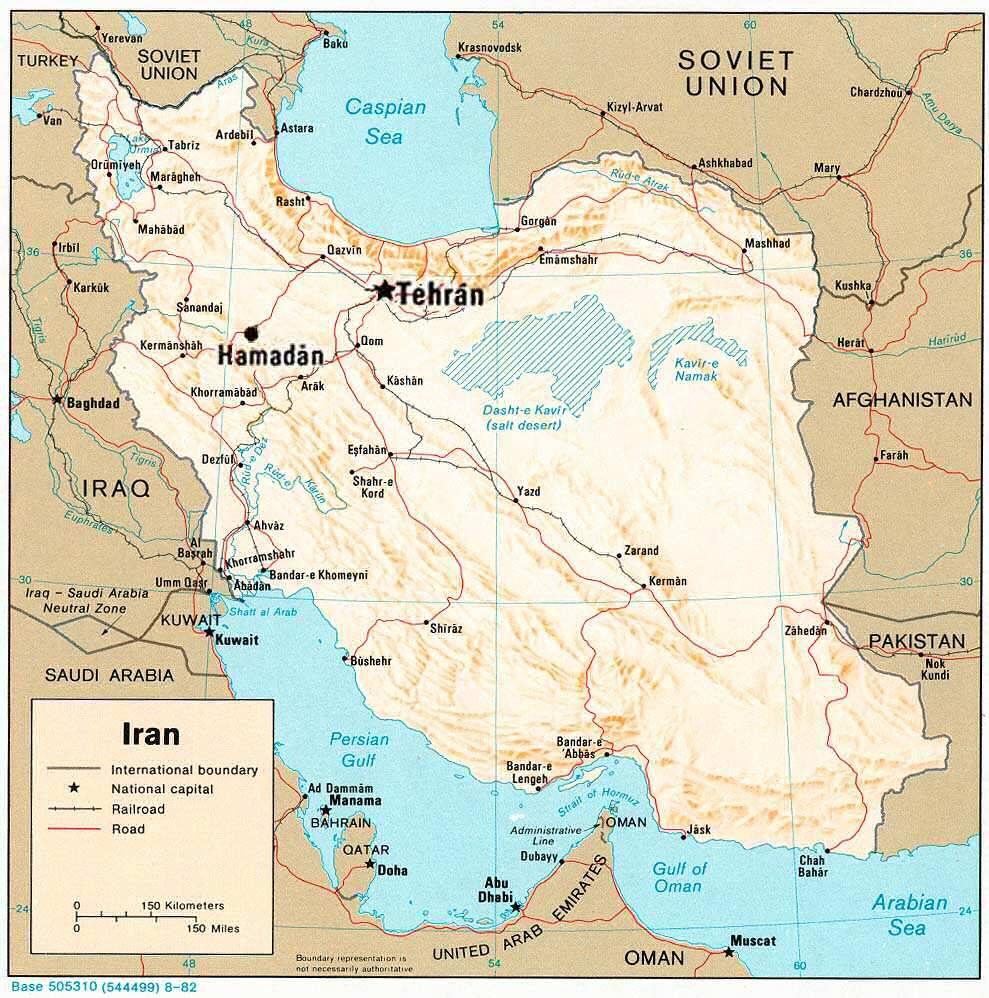
Tehran sits in the north of the country, and the fighters that answered the call climbed out of Shahrokhi Air Base, since renamed Hamadan Air Base. This is not a story about a single blurry photograph. It is a story about trained interceptor crews, their radar, and their aircraft, all pointed at the same object on the same night, and about what that object did to the machines sent to look at it.
02The First Phantom Loses Its Instruments
The first F-4 Phantom II reached the light, and its pilot could see it plainly, an intense glow he could not resolve into anything familiar. Then, as he closed to roughly 25 nautical miles, the aircraft began to fail him. His communications went out. His navigation instruments went with them. A modern fighter was going deaf and blind in the exact direction of the thing it had been sent to identify. The pilot broke off the intercept, turned away, and as he opened the distance his instruments came back to life as if nothing had happened.
03Jafari Closes In
So they sent a second one. This F-4 was flown by Major Parviz Jafari, and unlike the first crew he managed to hold the object on his own radar, acquiring it at about 27 nautical miles with a return so large it read like a Boeing 707 tanker. Up close it was extraordinary to look at: an intense light that cycled through red, green, and blue-white, flashing so fast the colors seemed to run together.
Then the object did something no tanker does. As Jafari bore in, a smaller luminous object detached from the primary and accelerated straight at his aircraft. He reacted the way a fighter pilot is trained to react, moving to fire an AIM-9 Sidewinder at the incoming shape. In that instant his weapons control panel went dead, and his UHF and internal communications died with it. No missile left the rail. Jafari threw the jet into a hard evasive turn; the smaller object followed him briefly, then broke off and rejoined the larger one.
The night was not finished. A second smaller object separated from the primary and dropped fast toward the ground. Jafari and his back-seat weapons officer, First Lieutenant Jalal Damirian, watched it descend, light up a wide stretch of terrain below, and then appear to settle gently onto the surface or hover just above it, still glowing.
04The Report That Reached The White House
Here is where the Tehran encounter separates itself from a thousand other lights in the sky. It did not stay a story. It became a document. A United States Defense Intelligence Agency evaluation of the report judged it a model of its kind: the source reliable, the information confirmed by more than one means. In the evaluator's own words it was 'an outstanding report,' and 'a classic which meets all the criteria necessary for a valid study of the UFO phenomenon,' its significance graded high.
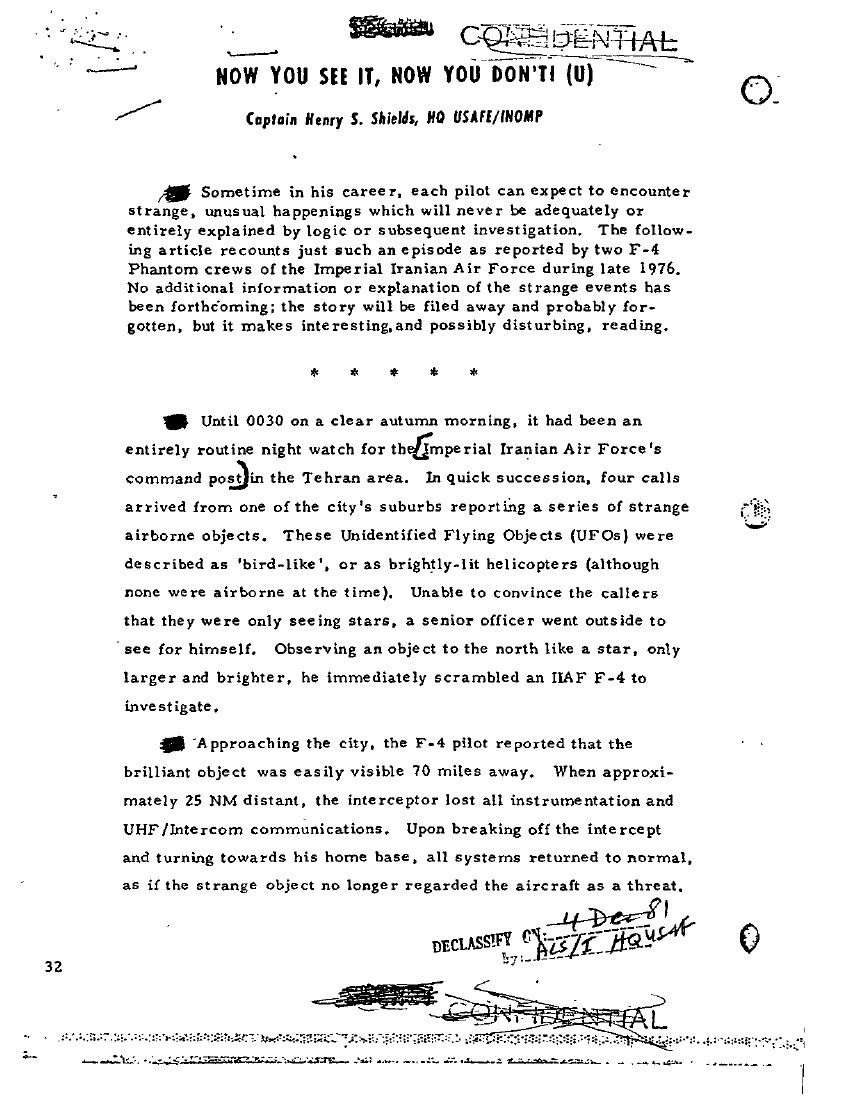
The paper trail was not confined to one agency. The incident was written up on the American side in a declassified U.S. Air Force MIJI newsletter, and on the Iranian side it moved through the Air Force's own standard reporting machinery. Two militaries generated files on the same night, from two directions, and neither one wrote it off.
| What The Report Documented | The Detail |
|---|---|
| Visual sightings | Multiple observers on the ground and in the air, from Tehran's citizens to the interceptor crews |
| Radar contact | The object held on radar by at least two aircraft |
| Electromagnetic effects | Instrument, weapons, and communications failures on two separate interceptors |
| Attempted weapons engagement | A move to fire that was cut short when the weapons panel lost power |
And then it was passed around. The report was distributed to the White House, the Secretary of State, the Joint Chiefs of Staff, the National Security Agency, and the CIA. The real circulation list ran wider still, reaching the individual service chiefs and U.S. commands in Europe and the Middle East. Whatever the object was, the account of it landed on some of the most powerful desks in the American government within weeks.
None of this depended on a single excitable witness. The Imperial Iranian Air Force acknowledged the incident officially, generating scramble orders, pilot debriefings, and radar tracking records through the ordinary chain of command, and inside Iranian military circles the event was discussed as a genuinely anomalous one that defied conventional explanation.
05The Pilot, On The Record
By 2007 Jafari had retired as a general, and on November 12 that year he walked into the National Press Club in Washington and told the story under his own name, alongside a lineup of other military and aviation officials describing their own encounters. He described an object that outclassed anything he knew how to fly: it held its distance no matter how hard he pushed his Phantom, it changed position as if acceleration meant nothing to it, and it released and reabsorbed the smaller objects he had watched come at him. His account is also set down in Leslie Kean's 2010 book, UFOs: Generals, Pilots, and Government Officials Go on the Record.
This is not a tale told once and dropped. Jafari held to the same account for decades, and the research file grades him a highly credible witness: a career military officer with extensive tactical aviation experience, trained to tell an aircraft from a planet, trained to stay calm under pressure, and with a professional reputation on the line.
It would be dishonest to leave the testimony there without the obvious objection, and the research file does not. Jafari's most detailed public account came in 2007, thirty-one years after the night in question, at a press conference organized by UAP advocacy groups, and scholars have reasonably questioned whether a memory told that long after the fact, in that setting, can be fully squared with the original 1976 debriefs. Underneath it sits a second open question: whether the DIA's internal evaluation was an official endorsement of something extraordinary, or simply routine paperwork documenting an unusual pilot report. Neither question has a settled answer, and the case is stronger for admitting it.
06A Weapon That Switches Off Your Weapons
Set the drama aside and look at just the electronics, because that is where the case gets genuinely hard to dismiss. Two separate fighters lost systems, and they lost them at the worst possible moments: the first as it closed to identify the object, the second at the precise instant it moved to fire. Both times, the systems came back once the aircraft opened the range. The research file reads that timing as the tell. A random malfunction does not wait politely for the trigger pull, and it does not heal itself the moment you retreat.
Follow the logic and it points somewhere uncomfortable. If the failures were real and targeted, then something over Tehran could reach out and switch off specific systems, weapons and radios, on specific aircraft, at a distance, in 1976, a capability no air force on Earth possessed. And because the systems recovered rather than burned out, the file argues it looks less like a destructive pulse and more like an active suppression field that simply stopped affecting the jets once they left its reach.
Tehran is not the only case with this fingerprint. Selective, unexplained failures of military hardware have been reported around other encounters with anomalous objects, from missile systems going offline at Malmstrom Air Force Base to the electronics interference described in the Nimitz Tic Tac encounter. The aviation researcher Richard Haines, in a 2001 NARCAP study co-authored with Dominique Weinstein, catalogued fifty-seven pilot reports of electromagnetic effects on aircraft systems. Tehran sits comfortably inside that pattern.
The skeptic's reply here is fair and worth stating at full strength: instrument and radio failures happen, and a fighter thrown into a high-stress night intercept is a plausible place for electromagnetic interference from ordinary sources, or plain equipment trouble, to strike. The difficulty is that the explanation has to do it twice, on two different aircraft, each time in the object's direction, and each time reversing on withdrawal.
One tempting conclusion has to be ruled out before it takes hold. If something could selectively disable an American-built fighter's weapons, was it simply an American secret weapon, a black-project test flown against an ally to see what it could do? [CONTRADICTED]. The research file rejects this outright, and the reasons are strong: the electromagnetic effects hit U.S.-supplied F-4s, the DIA expressed genuine intelligence interest rather than quiet familiarity, and the report was pushed to the very top of the U.S. government. A nation does not run a secret weapons test against an allied air force flying its own jets, then act surprised in writing at the highest levels.
07The Conventional Explanations, Weighed
A case documented this well earns real scrutiny, not a wave of the hand, so here are the ordinary explanations laid out honestly, with what each one can carry and where each one runs out.
The research file weighs the usual candidates. Jupiter was bright and well placed in the sky that night, and it is the explanation most often reached for. A re-entering satellite can throw a bright, descending light. A distant conventional aircraft can be misjudged. But the file finds each one wanting on the same grounds: Jupiter is a fixed point of light that produces no radar return, does not move, releases nothing, and disables no instruments; no satellite re-entry was on record for that date and place; and the men chasing the object were trained interceptor pilots holding it on radar, not stargazers guessing at a smudge.
Two further skeptical arguments deserve a place the file does not give them. Three meteor showers were active on September 19, which could account for isolated reports of falling lights that night. And the first F-4, according to later skeptical research, had a documented history of electrical problems, offering a mundane reason for that particular jet's failure. Both are worth taking seriously, and both fall short of the whole: neither explains the second fighter's independent failure, the radar corroboration, or the multicolored object that paced two aircraft and released smaller ones.
| Explanation | What It Could Cover | What It Leaves Unexplained |
|---|---|---|
| Jupiter | A bright, colorful point of light low in the night sky | No radar return, no motion, no smaller objects, and no dead instruments on two jets |
| Satellite re-entry | A bright object descending and burning up | None was on record for that date and place, and it cannot explain the radar lock or the close intercepts |
| Aircraft misidentification | A distant conventional aircraft taken for something exotic | The interceptor crews tracked it on radar at close range and knew what other aircraft look like |
| Meteor showers | Isolated reports of falling lights, from three showers active that night | Not the radar contact, the weapons and communications failures, or the object that held station on two fighters |
| First jet's electrical history | That one aircraft's prior record of electrical faults | Not the second jet's independent failure, the radar tracks, or the visual account |
That leaves the single most popular explanation to face directly, and the file does not let it pass. The idea that the crews were simply confused by Jupiter is [INSUFFICIENT]. Jupiter does not paint a radar return the size of a 707, it does not flash red and green and blue-white, it does not shed smaller objects that chase a fighter, and it certainly does not reach into a cockpit and switch off the weapons. The planet, at best, explains one bright light seen from the ground. It explains none of the rest.
08What Stays Open
What survives all of this is a hard core the easy answers cannot reach. Ground radar, airborne radar, and the eyes of two separate crews converged on the same object, which is exactly the corroboration that a lone malfunctioning sensor or a single rattled pilot cannot fake. The radar returns themselves were odd, matching neither known aircraft nor ordinary atmospheric tricks. And yet, for all of that, the case has a floor it never breaks through, and honesty means naming that too.
The morning after, a helicopter crew was sent to the area where the second object had seemed to come down. They reported picking up a beeping signal from an open patch of ground, but they recovered nothing, no wreckage, no scorch, no material. The signal has a plausible, on-record explanation the file leaves out: investigators later traced a beeper in that area to an emergency locator transmitter thrown from a C-141 transport aircraft, apparently shaken loose by turbulence on an unrelated flight. That resolves the beep. It does not resolve what two crews watched descend and glow on the ground, and with no physical trace ever recovered, the landing itself stays exactly where the file puts it: inconclusive.
The last open thread is what may still be sitting in a vault. It is entirely plausible that both American and Iranian intelligence gathered more on that night than has ever been released, signals intelligence, sensor data, records that would sharpen or shrink the whole case. Until any of it surfaces, this stays speculation, but it is the reason no one can honestly call the file closed.
Fast Facts
- The Date And Place
- The night of September 19, 1976, over northern Tehran, beginning around 10:30 PM local time.
- The First Jet
- An Imperial Iranian Air Force F-4 Phantom scrambled from Shahrokhi Air Base lost its communications and navigation systems on the approach, at about 25 nautical miles, and recovered them the moment it turned away.
- The Second Jet
- A second F-4, flown by Major Parviz Jafari, held the object on radar at 27 nautical miles as a return the size of a Boeing 707, and watched it flash red, green, and blue-white.
- The Weapons Failure
- As a smaller object broke off and came at his jet, Jafari moved to fire an AIM-9 Sidewinder. His weapons panel and radios died together in that instant, and no missile was launched.
- The Second Object
- A second luminous object dropped toward the ground, lit up a wide patch of terrain, and appeared to settle or hover near the surface.
- The DIA Verdict
- A U.S. Defense Intelligence Agency evaluation called the report outstanding, a classic meeting every criterion for a valid study, and it was circulated to the White House, the Secretary of State, the Joint Chiefs, the NSA, the CIA, and beyond.
- The Witness
- General Parviz Jafari (retired) put his account on the record at the National Press Club in Washington on November 12, 2007, and told it consistently for decades.
- Ruled Out
- That it was a U.S. black-project test (contradicted by the effects on American-built jets and the DIA's own interest) and that the crews merely mistook Jupiter (which makes no radar return and disables nothing).
What Tehran Actually Holds
Start with what is documented, because it is a great deal. On September 19, 1976, a multicolored light over Tehran drew two Imperial Iranian Air Force F-4 Phantoms into intercepts. The first lost its communications and navigation on the approach and recovered them on withdrawal. The second, flown by Major Parviz Jafari, held the object on radar, watched a smaller object break off toward his jet, moved to fire an AIM-9 Sidewinder, and lost his weapons panel and radios in that instant, with no missile fired. A second object descended toward the ground. A U.S. Defense Intelligence Agency evaluation graded the whole report outstanding and circulated it across the top of the American government, and the Imperial Iranian Air Force confirmed the incident through its own channels under General Nader Yousefi. That spine is Tier 1, and it holds.
The interpretation built on that spine sits at Tier 2. General Parviz Jafari (retired) put his account on the record at the National Press Club in 2007 and held to it for decades, a credible witness by any professional measure. The reading that the twin system failures were a targeted electromagnetic effect rather than coincidence, reversible suppression rather than damage, is a credible inference that fits a wider pattern of reports catalogued by Richard Haines and Dominique Weinstein and echoed at Malmstrom and in the Nimitz Tic Tac case. Credible, and resting on testimony and pattern rather than on a recovered device.
Two threads stay speculative, and this article keeps them there. The morning-after ground trace is inconclusive: the helicopter crew's beeping signal has a mundane, on-record explanation in an ejected aircraft beacon, but what the crews watched descend and glow was never found or identified. And the possibility that undisclosed American or Iranian intelligence data still exists on the encounter is plausible and unproven at once. Real questions, neither one settled.
And two explanations get refused outright, because the record refuses them. That this was a U.S. black-project test is [CONTRADICTED]: it would mean secretly firing an unknown weapon at an ally's American-built jets and then documenting genuine surprise at the highest levels of one's own government. That the pilots were merely confused by Jupiter is [INSUFFICIENT]: a planet makes no radar return, flashes no colors, sheds no smaller craft, and disables no weapons systems. And the largest honest 'no' is the one nobody has cleared. With no recovered material and no physical trace, the incident stands in the official record as unexplained, not as confirmed non-human technology, and even the DIA, calling the report outstanding, never concluded where the object came from.
So here is where Tehran leaves us, fifty years on. Two of an air force's own fighter pilots flew straight at a light that should have had a name, and came home with dead instruments, a weapons panel that quit at the one second it mattered, and radar tapes that backed up their own eyes. The United States read the file, called it outstanding, and passed it to the White House. No fragment was ever recovered, no official page ever said what the object was, and no one has explained why Jafari's Sidewinder went cold at the exact instant he reached for it. Was that the worst-timed malfunction in the history of air defense, or was it the whole point? What kind of thing turns off a fighter's weapons the moment the fighter decides to shoot?
Sources & further reading
Everything above is drawn from our research library on Theories of Anything, and every claim traces to the files below. The primary file is I_3_14, the 1976 Tehran incident, which carries the event sequence, the instrument and weapons failures, the DIA evaluation and its distribution, the Iranian Air Force's confirmation, Jafari's 2007 testimony, the electromagnetic-effect reading, the conventional explanations, and the Tier 4 refusals this article ends on. The broader UAP context and the Nimitz electronics-interference comparison have their own files. Open the full files to check the sourcing and go further.
Image credits
- An Imperial Iranian Air Force F-4E Phantom II fighter jet armed with missiles Imperial Iranian Air Force, via Wikimedia Commons. Public domain (Iran) Source.
- A CIA reference map of Iran showing Tehran in the north and Hamadan to the west Central Intelligence Agency, Perry-Castaneda Library Map Collection, University of Texas at Austin, via Wikimedia Commons. Public domain Source.
- Page one of a declassified United States Air Force document on the 1976 Tehran incident Capt. Henry S. Shields, U.S. Air Force (MIJI newsletter, October 1978), via Wikimedia Commons. Public domain Source.
- Card crop of an Imperial Iranian Air Force F-4E Phantom II fighter jet Imperial Iranian Air Force, via Wikimedia Commons. Public domain (Iran) Source.


