AARO and Congressional Oversight: The Office, The Mandate, And The Paper Trail
Most UFO stories are about a light in the sky. This one is about a statute, a web form, and a deadline. In the FY2022 defense authorization Congress wrote an office into law, gave it a name that sounds like a filing code, the All-domain Anomaly Resolution Office, and handed it five specific jobs: synchronize the collection, investigate, take reports from insiders, work the subject with allies, and answer to Congress in writing. This dossier is that office. Not the sightings it reviews and not the hearings it testifies at, but the machine itself: who created it and under what law, what the statute actually orders it to do, who is allowed to file with it, what its own paperwork says, and the one place the arrangement visibly strains, which is the set of named lawmakers who say they asked for the files and were refused.
Congress does not usually build the thing it is investigating. Here it did. The All-domain Anomaly Resolution Office exists because a defense authorization bill told the Pentagon to create it, and it stays in existence because the same body of law requires it to keep writing reports to the committees that wrote the law. That loop is the subject of this dossier. Not a light over a carrier group, not a witness with a raised hand, but the office in the middle: what it was ordered to do, what it has actually produced, and what a number of lawmakers say it still has not handed over.
Because this is the institution, the events live elsewhere. The long chronology of American UAP disclosure belongs to 1947 to Now: The Disclosure Timeline, which also carries AARO's inaugural director's own published account of why he left, and the full text and fate of the disclosure legislation. The two open hearings, who sat at the witness table and what they swore to, belong to Congressional UAP Hearings: What Was Said Under Oath. What follows is narrower and drier and, if what you want to know is whether anybody is actually holding this file, considerably more useful. Every claim below wears the tier our research file gives it.
01Before AARO: The Task Force Congress Ordered
The chain does not start with a sighting. It starts with committee language. In June 2020 the Senate Select Committee on Intelligence, then chaired by Sen. Marco Rubio of Florida, put wording into the Intelligence Authorization Act for FY2021 directing the Director of National Intelligence and the Secretary of Defense to produce an unclassified report on unidentified aerial phenomena within 180 days. Weeks later the Pentagon answered with an office. On August 4, 2020, Deputy Secretary of Defense David Norquist formally established the Unidentified Aerial Phenomena Task Force, housed under the Office of Naval Intelligence. That task force is AARO's direct institutional ancestor, and the committee's own comment on that authorization act is where the paper trail begins.
The task force delivered. On June 25, 2021, the Office of the Director of National Intelligence released Preliminary Assessment: Unidentified Aerial Phenomena, the report the 2020 Congressional directive had mandated. What was in it, the case counts and the categories the analysts sorted them into, is carried in full in 1947 to Now: The Disclosure Timeline. What matters here is the shape of the transaction rather than its contents. Congress set a deadline in statute. The intelligence community met it with a document. Everything AARO does now runs on that same mechanism, scaled up.
Behind all of it sat a program the Pentagon could not decide how to describe. AATIP was the DIA era program that Luis Elizondo says he ran day to day from the Office of the Under Secretary of Defense for Intelligence, a directorship claim some Defense officials have disputed and which we do not settle here. Elizondo resigned in October 2017, citing excessive secrecy. What followed was a public position that moved: first statements denying the program existed at all or denying it had anything to do with UAP, then an acknowledgment that a program existed while minimizing its scope, and finally, in AARO's own 2024 historical review, confirmation that AATIP had existed and had investigated UAP. Notice who closed that question. The office Congress built to examine UAP is the same office that eventually confirmed what an earlier Pentagon had denied.
02What The Statute Actually Tells AARO To Do
AARO is not a discretionary Pentagon project that a new administration can quietly fold. It is a statutory one. The National Defense Authorization Act for FY2022, at Section 1683, directed the establishment of a successor to the task force with a broader mandate, and on July 20, 2022 the All-domain Anomaly Resolution Office was established under the Office of the Under Secretary of Defense for Research and Engineering and the Office of the Director of National Intelligence jointly. The word doing the work in that name is the first one: the successor office was given a wider remit than the aerial task force it replaced.
One wrinkle, flagged rather than smoothed over. Our own disclosure timeline describes AARO as reporting to the Deputy Secretary of Defense, while the research file behind this dossier places it under the Office of the Under Secretary of Defense for Research and Engineering with the Office of the Director of National Intelligence as a joint partner. Those are not necessarily in conflict, since the Deputy Secretary sits above that office in the chain of command, but they are two different descriptions of the same box on the same org chart. We would rather show you the seam than paper over it.
Here is the passage almost nobody quotes, and it is the most useful thing in the whole story. Under the FY2022 act and as updated in FY2023, AARO's statutory mandate is five specific jobs. Synchronize and standardize UAP collection, analysis, reporting and response across the Department of Defense and the Intelligence Community. Investigate UAP events reported by military personnel and other US government employees. Establish a secure reporting mechanism for UAP related information, including historical reports. Coordinate with allied nations on UAP investigation. And report regularly to Congress, in both classified and unclassified form. Almost every argument in this dossier is really an argument about how well one of those five lines is being performed.
| The Duty | What The Statute Directs |
|---|---|
| Synchronize | Synchronize and standardize UAP collection, analysis, reporting and response across the Department of Defense and the Intelligence Community |
| Investigate | Investigate UAP events reported by military personnel and other US government employees |
| Receive | Establish a secure reporting mechanism for UAP related information, including historical reports |
| Coordinate | Coordinate with allied nations on UAP investigation |
| Report | Report regularly to Congress, in both classified and unclassified reports |
The fourth duty travels further than you would expect. The US legislative framework has prompted parallel movement among Five Eyes allies: Australia's Defence Intelligence Organisation has increased coordination, the UK has reopened some UAP investigation capacity, and Canada has seen parliamentary inquiries. The FY2023 NDAA specifically authorized AARO to coordinate with allied nations, which suggests UAP is increasingly being handled as a multilateral intelligence issue rather than a domestic embarrassment. Governments do not usually write allied coordination into law for a subject they intend to keep laughing off.
03The Portal, And Who Is Allowed To Use It
Duty three became a web form. AARO's public facing secure reporting portal opened through aaro.mil in late October 2023, and its eligibility rules are far narrower than most coverage of it suggested. It is open only to current or former US government employees, service members and contractor personnel who have direct firsthand knowledge of a US government program or activity relating to UAP, going back to 1945. It is explicitly not a channel for the general public to report a sighting, and explicitly not a channel for classified or otherwise sensitive information. According to AARO's own FY2025 report to Congress, the portal received 262 submissions during the period that report covers, of which 255 were judged out of scope and 7 people were selected for follow-up interviews. The launch date, the eligibility rules and the intake figures all come from AARO's own reporting and the coverage of it rather than from our research file.
Read those three figures together and the portal's real function comes into focus. It is not a tip line, and it was never built to be one. It is a legal channel for insiders with a filter at the front of it, and across a reporting year it produced seven follow-up conversations. Whether that is a filter working properly or a filter set too tight is exactly the sort of question the annual reports exist to let Congress ask.
04The Historical Record Report, And How It Was Built
AARO's largest single piece of homework arrived as a PDF. Volume I of the Report on the Historical Record of U.S. Government Involvement with Unidentified Anomalous Phenomena carries February 2024 on its own cover page and was released publicly on March 8, 2024. It runs 63 pages. It is the first of two volumes Congress mandated in Section 6802 of the FY2023 NDAA: Volume I covering the historical record up to the document's own late 2023 and early 2024 cutoff, Volume II intended to carry the account nearer the present.
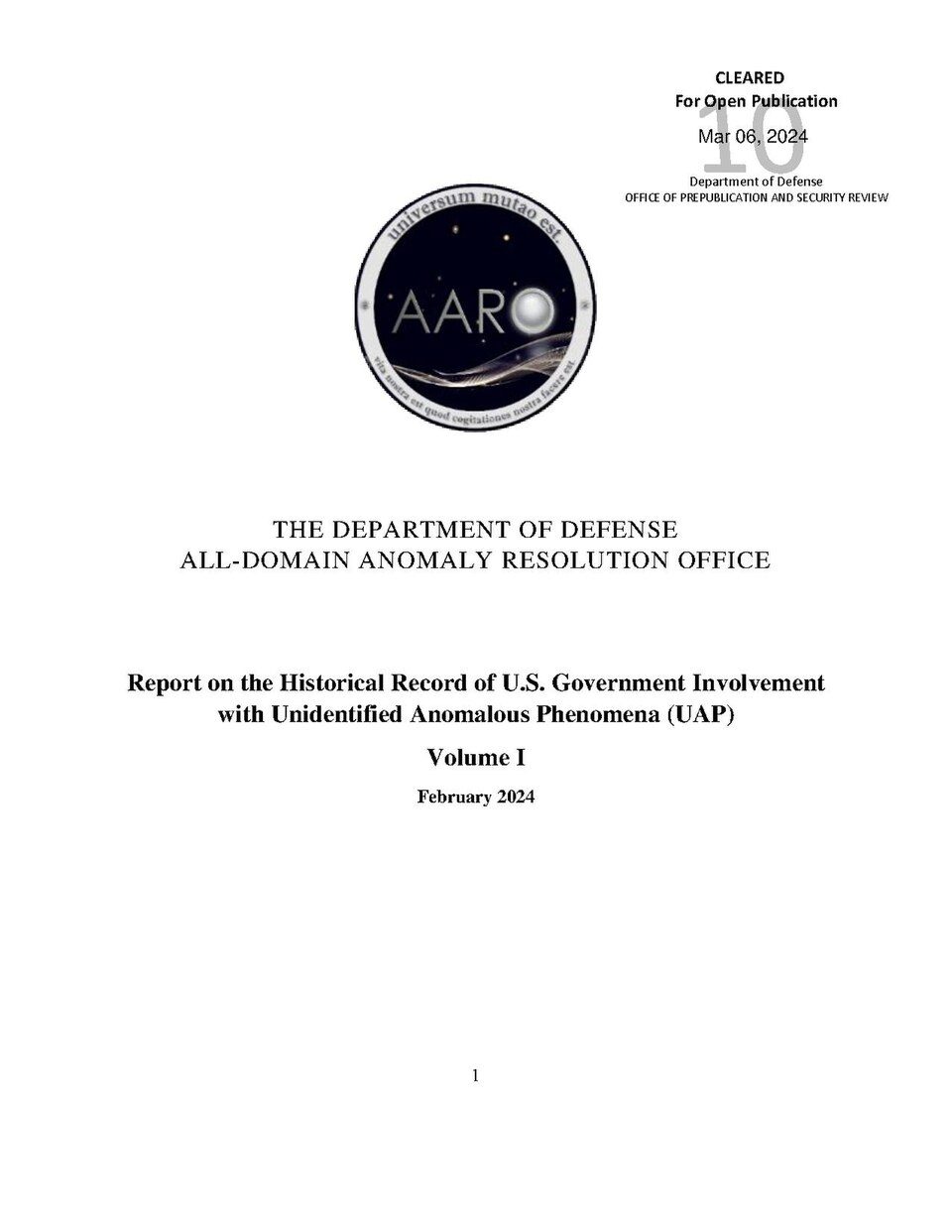
A completion date and a later release date on the same document is not a contradiction, and it is worth saying so plainly, because that gap gets quoted as though it were evidence of something. Government documents routinely carry an internal completion date and a later public release date. February is when the report was finished. March 8 is when the rest of us were allowed to read it.
What the report concluded, and the argument that broke out over the conclusion, live in 1947 to Now: The Disclosure Timeline, which carries the finding and its critics in full. This dossier is interested in a different thing: that the report exists at all, on a schedule Congress set, in a format Congress can read, produced by an office Congress created for the purpose. That is the oversight relationship functioning exactly as designed, whatever you make of the answer it produced.
05The Annual Report, Or What The Obligation Looks Like In Practice
Duty five, report regularly to Congress, is the one you can actually audit, because the reports carry dates. AARO's FY2025 Consolidated Annual Report to Congress, covering June 2, 2024 through May 30, 2025, was published on July 20, 2026, several months after the deadline the FY2023 NDAA set for it. Inside it: 319 newly logged UAP cases, 284 of them from the reporting period and 35 older cases added late; 370 resolved investigations, every single one attributed to a conventional explanation; and 9 cases still warranting additional analysis. That is a marked fall from the 757 cases reported for FY2024. The office also resolved 44 space domain reports as sunlight reflecting off satellites, using three dimensional modeling and all source analysis. These figures come from AARO's own report to Congress and the reporting on its release, not from our research file, which predates it.
Late is the detail worth holding. A statutory reporting deadline that slips by months is not proof of a cover-up, and treating it as one is how a real institutional story gets turned into a bad one. But it is a measurable fact about a legal obligation, published in a document anyone can pull, and it is precisely the kind of thing an oversight relationship is supposed to make visible. The system did not hide the lateness. The system is how you know about it.
| Date | What Happened | The Instrument |
|---|---|---|
| June 2020 | Senate Select Committee on Intelligence language directs the DNI and the Secretary of Defense to produce an unclassified UAP report within 180 days | Intelligence Authorization Act for FY2021, the committee's own comment |
| August 4, 2020 | Deputy Secretary of Defense David Norquist formally establishes the UAP Task Force under the Office of Naval Intelligence | Department of Defense establishment action |
| June 25, 2021 | ODNI releases Preliminary Assessment: Unidentified Aerial Phenomena, the report the 2020 directive mandated | The 2020 Congressional directive |
| July 20, 2022 | AARO established under the Office of the Under Secretary of Defense for Research and Engineering and ODNI jointly, with a broader mandate than the task force | NDAA FY2022, Section 1683 |
| FY2023 | Whistleblower protections for UAP reporting to Congress or AARO; allied coordination authorized; a two-volume historical review mandated | NDAA FY2023, Sections 1673 and 6802 |
| Late October 2023 | The secure reporting portal opens through aaro.mil, restricted to current and former government employees, service members and contractor personnel with firsthand knowledge | AARO, under the FY2022 mandate's reporting-mechanism duty |
| March 8, 2024 | Historical Record Report Volume I released publicly, dated February 2024 on its cover, 63 pages | NDAA FY2023, Section 6802 |
| July 20, 2026 | FY2025 Consolidated Annual Report to Congress published, several months past its statutory deadline | NDAA FY2023 annual reporting requirement |
One current development sits just outside this dossier's frame, and we flag it with its uncertainty attached rather than leave it out. Following a February 2026 administration directive and a formal launch on May 8, 2026, the Department of War, which has been the executive branch's secondary title for the Department of Defense since a September 2025 executive order and is not yet its legal name, since the formal renaming still requires Congressional action, began releasing declassified UAP files on a rolling basis through a public site, under an initiative styled the Presidential Unsealing and Reporting System for UAP Encounters. Four release tranches had been published by July 10, 2026, and secondary reporting names AARO as a source office for at least some of the material, including previously unseen military UAP videos. We could not fetch the official release page directly, so every word of this paragraph rests on independent news reporting rather than on the primary source. It is also, strictly, not an oversight story. It is a presidential initiative running alongside AARO's statutory duty to Congress, not a change to it.
06The Whistleblower Channel Congress Built
The FY2023 NDAA also built a door. Section 1673 established explicit whistleblower protections for individuals reporting UAP related information to Congress or to AARO, and it wrote them to survive the usual obstacles: the protections apply even where the information is classified or covered by a non-disclosure agreement. The reason for that design is stated in the record rather than inferred. The protections were specifically built to address claims that UAP information had been compartmented inside Special Access Programs and Waived Unacknowledged Special Access Programs, beyond the reach of Congressional oversight.
How that mechanism performed in its most famous single test, the Inspector General of the Intelligence Community's handling of David Grusch's complaint, belongs to Congressional UAP Hearings: What Was Said Under Oath, which carries what that determination did and did not mean. What belongs here is the standing statute itself, sitting on the books, available to the next person.
07The Gap
This is where the arrangement strains, and it is not a fringe complaint made by outsiders. Multiple members of Congress, among them Senators Rubio, Gillibrand and Schumer, have stated publicly that they were 'stonewalled' when they sought information about alleged UAP crash retrieval programs within the intelligence community. Rubio stated in 2023 that individuals with knowledge of UAP programs had approached Congress but were afraid to testify publicly because 'very senior' officials had threatened them. Follow that implication to its end and you reach the most serious institutional claim anywhere in this subject: that UAP related programs may have operated outside proper Congressional oversight. Confirmed, that would not be a scandal about aliens. It would be a violation of the National Security Act of 1947, which requires that Congress be notified of all Special Access Programs.
And here is the counterweight, which belongs in the same breath, because the research file puts it there. AARO's Historical Report concluded that it found no evidence of programs being hidden from Congress. Dr. Sean Kirkpatrick, a career intelligence community physicist who served as AARO's inaugural director from the office's July 2022 establishment through 2023, stated that UAP related funding allocations had legitimate explanations and that whistleblower claims were 'not substantiated by verifiable evidence.' Two Tier 2 positions, aimed directly at each other. Named lawmakers say they were refused. The office says there is nothing behind the wall to refuse them. Neither side has shown the public a document that settles it.
The thing being asked about deserves one plain statement, so the argument above has a subject. David Grusch's sworn testimony alleges a multi-decade crash retrieval and reverse engineering program involving 'intact and partially intact vehicles' and 'non-human biologics.' No physical evidence, no documentary proof and no program details have been publicly presented. That is Tier 3 in the file, and the full anatomy of what his testimony is and is not is the central content of Congressional UAP Hearings: What Was Said Under Oath. It appears here only because it is the reason Congress went looking, and therefore the reason the stonewalling complaint exists at all. Congressional frustration is not evidence that the underlying claim is true, and AARO's denial is not evidence that it is false.
Congress's answer to the gap was to try to build a stronger mechanism. The Schumer-Rounds UAP Disclosure Act of 2023 proposed an independent UAP Records Review Board with eminent domain authority over recovered UAP related material, and its strongest provisions were stripped during House and Senate conference. The full legislative anatomy of that bill, the model it was built on, the board it proposed and who blocked it in conference, lives in 1947 to Now: The Disclosure Timeline.
One clause in that bill is worth sitting with, because it is evidence about what its sponsors believed rather than about what exists. The eminent domain language specifically targeted private aerospace contractors. Legislators do not draft a seizure power aimed at companies unless somebody believes, or has been told, that companies are holding something. That is consistent with allegations made by Grusch, Elizondo and others, and it is not independent verification of any of them. What the clause demonstrates is the state of mind of a group of senators. It does not demonstrate the contents of a hangar.
08The Case Against Taking Any Of This At Face Value
AARO's own position, as its inaugural director stated it, is the mainstream skeptical one, and it is less a dismissal of the subject than a claim about resolution: that UAP reports are individually explainable through conventional means, that whistleblower claims are not substantiated, and that the proliferation of conspiracy theories has made rigorous analysis harder rather than easier. Our research file does not tier that position as a finding. It records it as the institution's stated view, which is what it is.
A sharper critique in the same file aims at the institution instead of the phenomenon. Some analysts argue that the UAP framework has created perverse incentives: Congressional attention attracts funding, funding creates an institutional interest in sustaining the topic, and whistleblower protections reduce the accountability cost of an unsubstantiated claim. Call it the UAP industrial complex argument. It requires nobody to be lying. It only requires the machine to reward being interesting, which machines reliably do.
And the most deflating alternative is the most ordinary one. The most prosaic explanation for the cases that stay unresolved may be intelligence collection failure rather than non-human technology: adversary drone systems, sensor artifacts, and mundane phenomena observed under poor conditions. February 2023 made that argument concrete in front of the entire country, when China's high-altitude surveillance balloon was confirmed as it crossed US territory, demonstrating that near-peer adversaries operate aerial platforms capable of evading initial detection and identification. Every unresolved case in AARO's files has to get past that possibility before it gets to be anything stranger.
09Two Things This Office Is Not
The lazy read is that Congress is doing all of this for the cameras. The research file refuses that outright, and so do we. Look at the actual pattern of activity: classified briefings with no press in the room, bipartisan co-sponsorship, specific legislative language carrying real legal consequences, statutory whistleblower protections, and a sustained multi-year effort running across multiple committees. Publicity stunts do not survive conference negotiations, and they do not generate statutory reporting deadlines that an executive branch office then misses by months. Whatever else is unresolved here, the institutional engagement is genuine. Marked unsupported in the file, and no.
The opposite lazy read fails just as hard. AARO has not resolved everything, and that is not a fringe position, it is AARO's own accounting: the office's reporting acknowledges that a significant percentage of cases remain unresolved. Its Historical Report's 'no evidence' conclusion has been challenged by multiple members of Congress who state that they received classified information contradicting AARO's public position. That does not make those members right. It makes the file open. Anyone telling you the government looked and closed the case is describing a document that does not exist. Marked misleading in the file, and no.
Fast Facts
- The Statute
- The National Defense Authorization Act for FY2022, Section 1683, directed the establishment of a successor to the UAP Task Force with a broader mandate. AARO was established July 20, 2022, under the Office of the Under Secretary of Defense for Research and Engineering and ODNI jointly.
- The Predecessor
- The Unidentified Aerial Phenomena Task Force, established August 4, 2020 by Deputy Secretary of Defense David Norquist under the Office of Naval Intelligence, after Senate Intelligence Committee language directed an unclassified UAP report within 180 days.
- The Mandate
- Five statutory duties: synchronize and standardize UAP work across DoD and the Intelligence Community; investigate reported events; establish a secure reporting mechanism including historical reports; coordinate with allied nations; and report regularly to Congress, classified and unclassified.
- The First Director
- Dr. Sean Kirkpatrick, a career intelligence community physicist, inaugural director from the office's July 2022 establishment through 2023. His own published account of why he left is carried in our disclosure-timeline dossier.
- The Portal
- Opened through aaro.mil in late October 2023 and restricted to current and former US government employees, service members and contractor personnel with direct firsthand knowledge of a government UAP program back to 1945. Not a channel for public sighting reports, and not for classified material.
- The Historical Review
- Report on the Historical Record of U.S. Government Involvement with Unidentified Anomalous Phenomena, Volume I: dated February 2024 on its cover, released publicly March 8, 2024, 63 pages, the first of two volumes mandated by Section 6802 of the FY2023 NDAA.
- The Whistleblower Route
- Section 1673 of the FY2023 NDAA protects individuals reporting UAP related information to Congress or AARO even where the information is classified or covered by a non-disclosure agreement, written to address claims of compartmentation inside Special Access Programs and Waived Unacknowledged SAPs.
- The Complaint
- Senators Rubio, Gillibrand and Schumer are among the members who have said publicly they were stonewalled over alleged crash retrieval programs. If such programs ran outside oversight it would implicate the National Security Act of 1947, which requires Congressional notification of all Special Access Programs.
- AARO's Answer
- Its Historical Report found no evidence of programs being hidden from Congress, and Kirkpatrick stated that UAP related funding allocations had legitimate explanations and that whistleblower claims were not substantiated by verifiable evidence.
- The Latest Filing
- The FY2025 Consolidated Annual Report to Congress, covering June 2024 to May 2025, published July 20, 2026, several months past its statutory deadline, with every resolved case attributed to a conventional explanation.
What AARO Actually Is, And What It Has Actually Done
The institution is documented end to end, and none of it is in dispute. Senate Intelligence Committee language in June 2020 ordered an unclassified UAP report within 180 days; Deputy Secretary of Defense David Norquist established the UAP Task Force under the Office of Naval Intelligence on August 4, 2020; ODNI delivered its Preliminary Assessment on June 25, 2021; Section 1683 of the FY2022 NDAA directed a broader successor, and AARO was established on July 20, 2022 under the Office of the Under Secretary of Defense for Research and Engineering and ODNI jointly. Its mandate is five statutory duties. Dr. Sean Kirkpatrick was its inaugural director from 2022 through 2023. Section 1673 of the FY2023 NDAA protects UAP whistleblowers reporting to Congress or AARO even through classification and non-disclosure agreements. Section 6802 mandated the two-volume historical review whose Volume I, dated February 2024 and released March 8, 2024, runs 63 pages. All Tier 1, all checkable against the statutes and the documents themselves.
One step down sits the working relationship and the fight inside it. Named members of Congress, Rubio, Gillibrand and Schumer among them, have publicly said they were stonewalled over alleged crash retrieval programs, and Rubio has described people with knowledge being afraid to testify after threats from senior officials. AARO's own Historical Report says it found no evidence of anything hidden from Congress, and Kirkpatrick said the funding allocations had legitimate explanations. Both of those are credible public positions by named people, and neither has been settled in public. Also Tier 2 and also credible: the allied coordination the FY2023 NDAA authorized, which the research file carries directly. Resting instead on AARO's own reporting and the coverage of it, and landing at the same tier for a different reason: the reporting portal's insider-only eligibility rules and its published intake figures, and the FY2025 annual report's case accounting and its months-late publication.
The thing under all of it stays speculative, and this dossier keeps it there. David Grusch's sworn allegation of a multi-decade crash retrieval and reverse engineering program, with intact vehicles and non-human biologics, has no publicly presented physical evidence, no documentary proof and no program details behind it. The Schumer-Rounds Act's eminent domain clause aimed at private aerospace contractors is consistent with that allegation and is not verification of it: it evidences what senators believed or had been told, nothing more. Tier 3 on both counts, and the Congressional frustration in the tier above does not lift either one.
Two claims are refused outright, one from each direction, because the file refuses both. Congress is not doing this for publicity: classified briefings, bipartisan co-sponsorship, binding legislative language, statutory whistleblower protections and a multi-year effort across several committees are not the behavior of a publicity exercise. And AARO has not resolved everything: its own reporting acknowledges that a significant percentage of cases remain unresolved, and multiple members of Congress say the classified information they received contradicts its public position. Anyone selling you either the cynical version or the closed-case version is selling you something the record does not contain. Tier 4 both ways, and no.
Strip it back and the story is smaller than the rumors and stranger than the shrug. A legislature ordered a report, got one, then built an office, gave it five duties and a schedule, and wrote a legal route by which insiders could step around their own non-disclosure agreements to reach it. Then several of that legislature's own members said out loud that they still could not get the files. The office says there are no files of that kind. Both statements are on the public record, and the public record does not adjudicate between them. The research file's own open questions are the honest place to leave you: what has Congress been told in classified session that differs from AARO's public position, whether any successor to the Schumer-Rounds Act ever passes with its Review Board and its seizure powers intact, where the Inspector General's inquiry now stands, whether the FY2025 NDAA advances or retreats from the year before it, and whether anyone ever comes forward with firsthand rather than secondhand knowledge. Until one of those moves, the honest position is the uncomfortable one: the office is real, the mandate is real, the reports are real, and the argument about what is missing from them is unfinished. So who is holding the version of the file that would end it, and what would it take for them to file it with the committee that is legally entitled to read it?
Sources & further reading
Everything above is drawn from our research library on Theories of Anything, which is where we worked from. The papers, reports and primary records listed beneath them are where you can check us independently.
Image credits
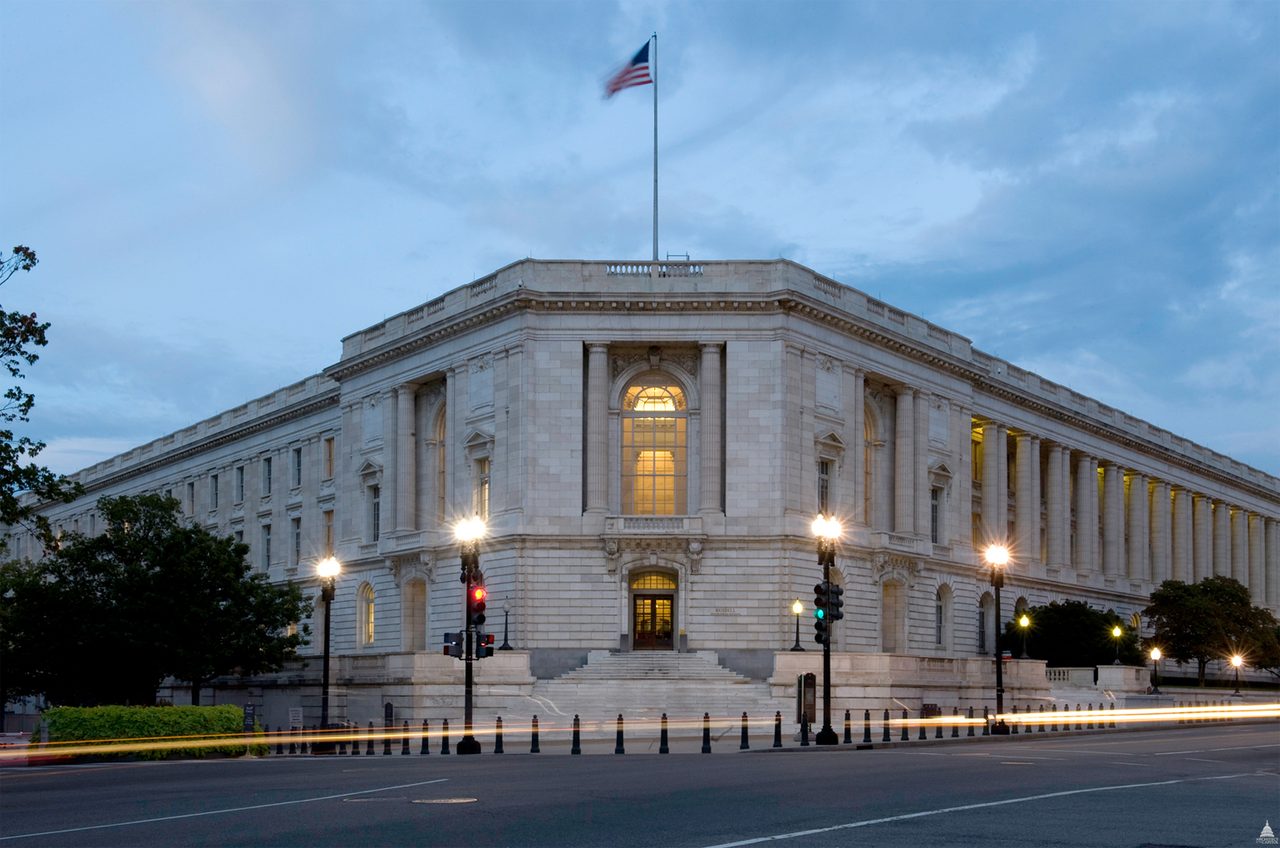
- Russell Senate Office Building, exterior at dusk USCapitol, the official U.S. Capitol Flickr account, via Wikimedia Commons. Public domain Source.
- AARO Historical Record Report Volume I, cover page All-domain Anomaly Resolution Office, U.S. Department of Defense, via Wikimedia Commons. Public domain Source.
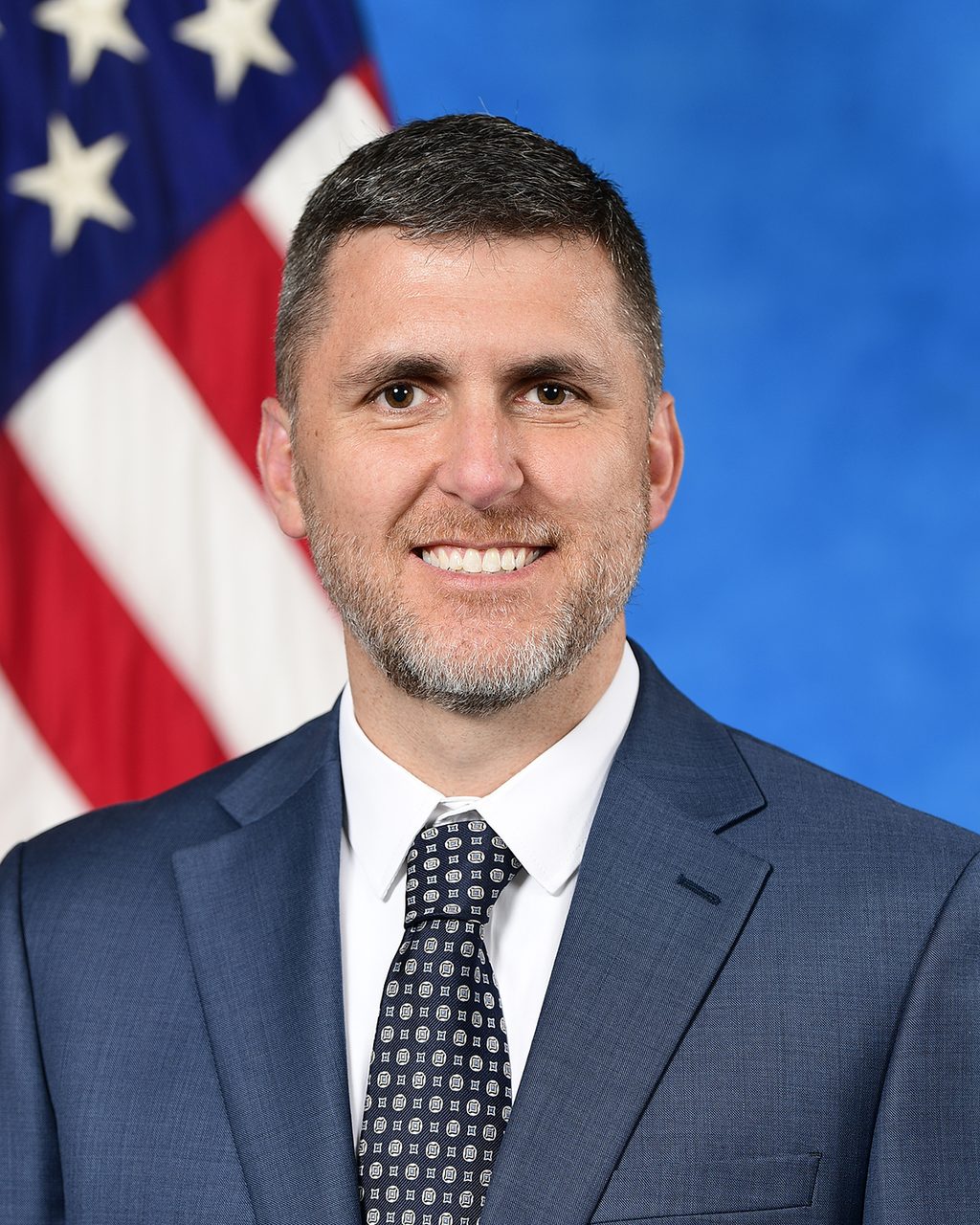
- Jon T. Kosloski, official portrait All-domain Anomaly Resolution Office official biography photo, via Wikimedia Commons. Public domain Source.
- Card crop of Russell Senate Office Building, exterior at dusk USCapitol, the official U.S. Capitol Flickr account, via Wikimedia Commons. Public domain Source.

