The Coffin Texts: When Eternity Stopped Belonging to Kings
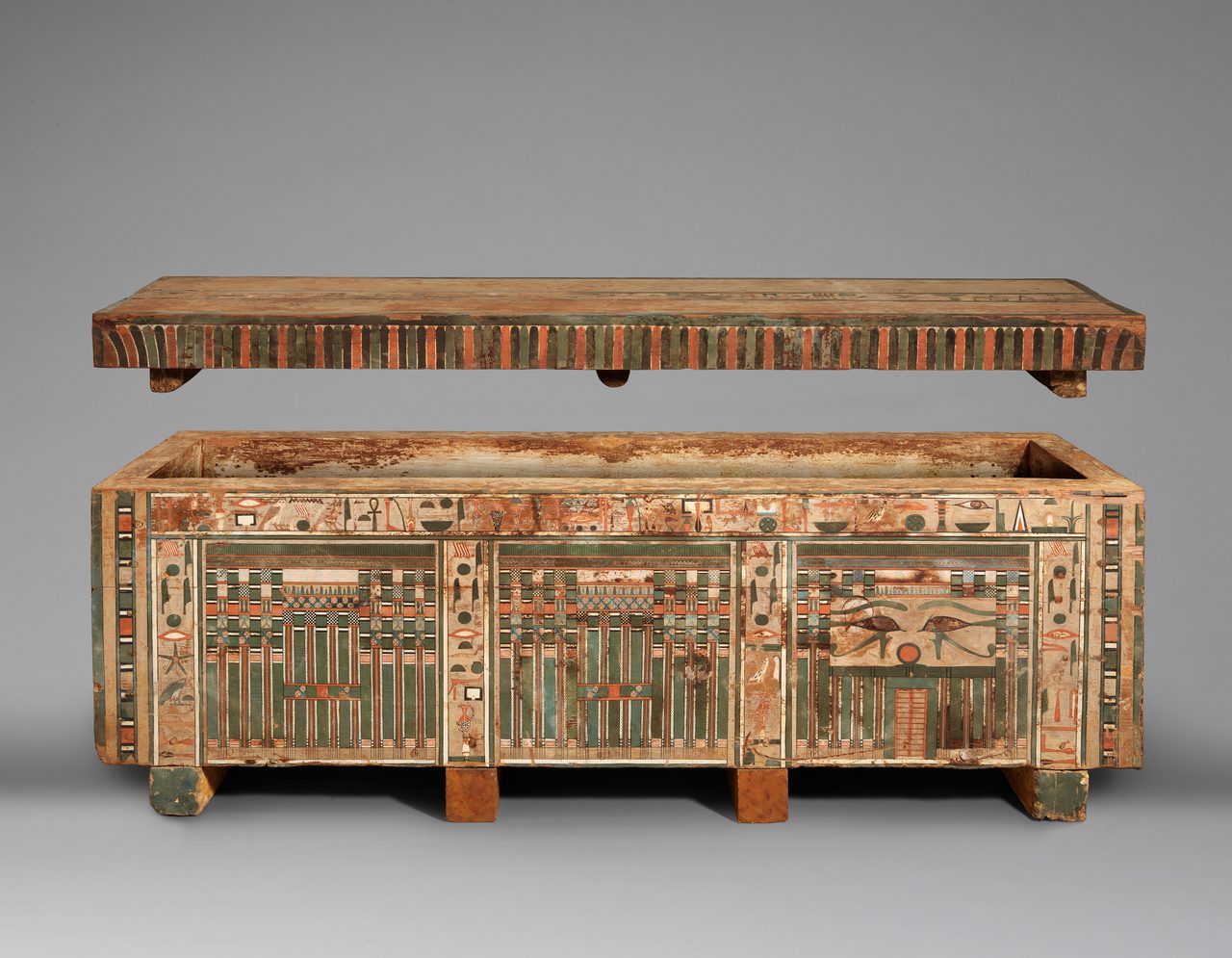
For most of Egyptian history the afterlife had exactly one customer: the pharaoh. The Pyramid Texts were carved inside royal tombs and nowhere else, and only the king was promised a life among the gods. Then, in the Middle Kingdom, something cracked. Provincial governors and estate managers, people who had never worn a crown, began painting funerary spells onto the insides of their own wooden coffins, and for the first time the non-royal dead could be addressed as a god in their own right. This corpus of roughly 1,185 spells is that break in the wall. It sits exactly between the royal-only Pyramid Texts and the mass-market Book of the Dead, and it is where eternity stopped being a privilege of the throne. It also holds the oldest map of the afterlife ever painted, a creation story a god narrates about himself, and spells to turn a dead official into a falcon, into fire, into the primordial waters themselves. This is the file on the middle stage, the moment the door to forever opened just wide enough for the rich to walk through.
This corpus only makes sense as a middle, so start with the ends. A thousand years before the Coffin Texts, the oldest religious writing on Earth was already cut into stone, and it belonged to exactly one man. Our file on the Egyptian Pyramid Texts covers that royal-only predecessor: spells carved inside Old Kingdom pyramids and nowhere else, sealed in the tombs of kings, promising the pharaoh and the pharaoh alone a life among the gods. A thousand years after the Coffin Texts, the very same journey would be sold on papyrus to anyone who could pay for a copy, the mass-market successor our file on the Egyptian Book of the Dead follows in full. Neither of those stories gets retold here. This is the file on what happened in between them.
And what happened in between was the actual revolution. The Coffin Texts are the hinge the whole arc turns on, and this file goes deep on everything the one-line version leaves out: the real size of the corpus and the excavated sites it came from, the exact spells that grew into named Book of the Dead chapters, the oldest map of the afterlife anyone has ever dug up, a creation story a god tells about himself, and a set of instructions for becoming a bird, a god, or a raw force of the cosmos. Every claim below wears the grade the research file gave it. Where the file hedges, this article hedges. Where the file refuses a claim outright, so does the verdict at the end.
01The Corpus Of 1,185
Here is the object at the center of everything. The Coffin Texts are a corpus of roughly 1,185 distinct funerary spells, painted and written primarily onto the interior surfaces of rectangular wooden coffins during Egypt's Middle Kingdom, from about 2055 to 1650 BCE, across Dynasties 11 through 13. But no single coffin carries the whole corpus, or anything close to it. Most coffins bear somewhere between 30 and 200 spells, selected and arranged according to local tradition and personal choice. That detail matters more than it looks: this was never one fixed scripture. It was a menu, and every family picked from it.
We can be this precise because of one monumental piece of scholarship. Between 1935 and 1961, the Egyptologist Adriaan de Buck published the Coffin Texts in seven volumes, working from coffins recovered at a specific set of sites: el-Bersha, Asyut, Beni Hasan, Meir, Thebes, Saqqara, and Lisht. These are not legendary locations. They are excavated cemeteries, and the coffins are real objects sitting in museums today. When this file talks about the Coffin Texts, it means de Buck's numbered spells, CT 1 through CT 1185.
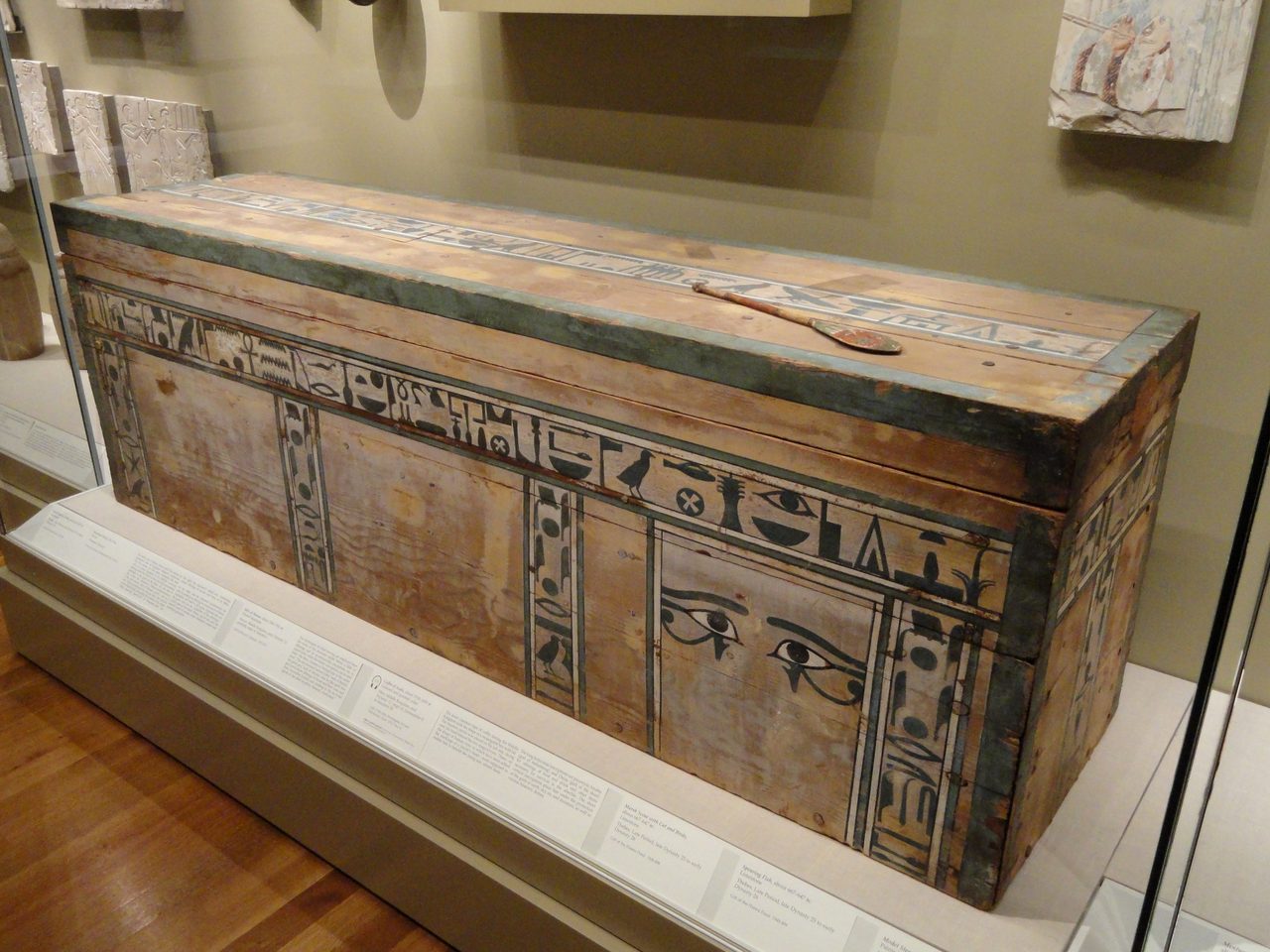
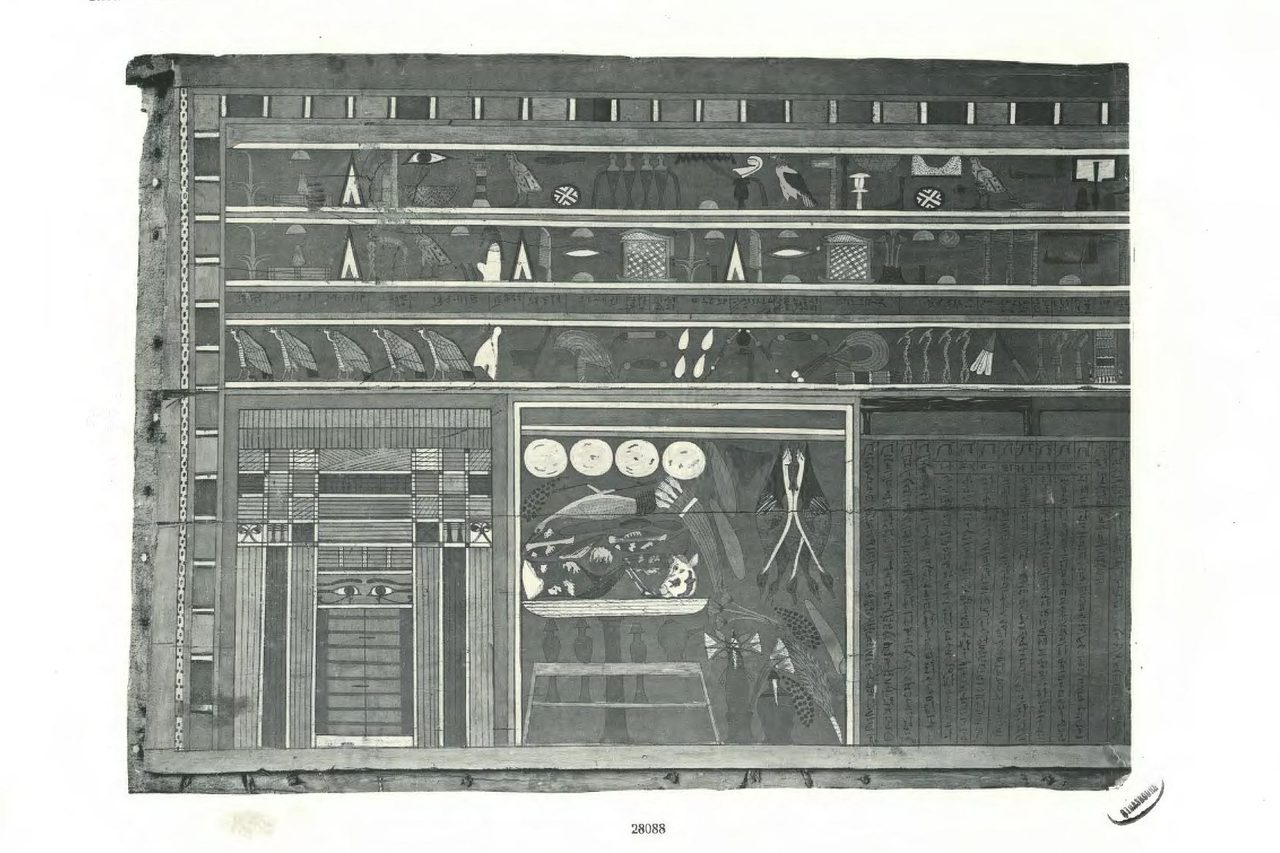
The texts themselves are written in Middle Egyptian, in cursive hieroglyphs, and shot through with rubrics, passages picked out in red ink that mark ritual instructions or the titles of individual spells. Red for the directions, black for the words to be spoken: the coffin was not just a container for a body. It was a working document, a set of instructions for a journey its owner had not yet taken.
02From The Pharaoh Alone To The Osiris [Name]
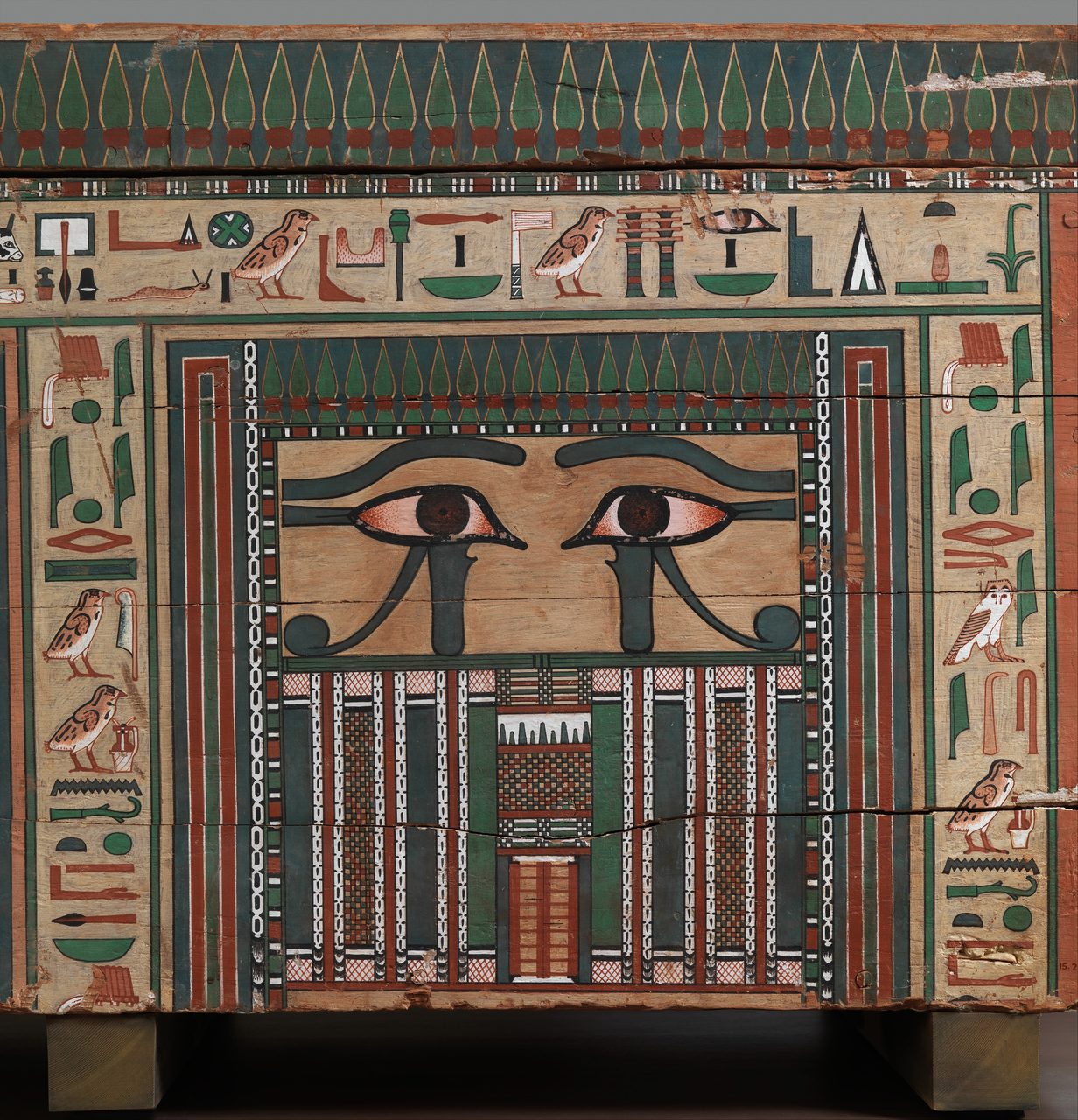
To feel the size of this shift you have to start with the world it broke. In the Old Kingdom, funerary texts were inscribed in exactly one kind of place: the royal pyramid. Only the pharaoh was guaranteed an afterlife, and he reached it through direct identification with the sun god Re. Everyone else, no matter how rich or powerful, was simply outside the system. Eternity had one door, and it opened for one family.
Then the door came off its hinges. By the First Intermediate Period and the early Middle Kingdom, provincial officials, the governors and administrators who ran Egypt's regions, began placing funerary spells on their own coffins. The privileges that had belonged to the king alone were suddenly being claimed by the non-royal elite, in their own tombs, in their own names. This is the change scholars call the democratization of the afterlife, and it is one of the most consequential ideological shifts in all of ancient Egyptian religion.
And here is the part that makes it a revolution rather than a filing change. The democratization was not merely textual, a matter of who got to copy which spells. It was theological. The non-royal dead could now be addressed as 'the Osiris [Name],' taking on the identity of the god of the dead himself. A provincial official, in death, did not just hope to meet Osiris. He became an Osiris. The barrier that had reserved divinity for the king was gone, and it never came back.
03The Spell Lineage
The Coffin Texts did not appear from nowhere, and they did not vanish either. They are a bridge with traffic running in both directions. Look upstream first. About 250 Coffin Text spells derive directly from, or closely parallel, the older Pyramid Text utterances. But they are not copies. The royal references are generalized so that a non-royal owner can use them, and the deceased is increasingly identified with Osiris, the god of the dead and resurrection, rather than exclusively with Re, the sun. The theology is already shifting inside the words themselves.
Now look downstream, to the corpus that made this whole family famous. Many Coffin Text spells evolved directly into chapters of the Book of the Dead, the New Kingdom successor our Book of the Dead file covers in full. The lineage is specific and traceable, spell by spell. This is exactly why the Coffin Texts hold such a strange and valuable position in the history of Egyptian religion: they are more elaborate than the Pyramid Texts that fed them, and more esoteric than the Book of the Dead they became.
| Coffin Text Spell | Book Of The Dead Chapter | What It Carries |
|---|---|---|
| CT 335 | BD 17 | The great cosmological spell |
| CT 159 | BD 64 | One of many direct descendants |
| CT 312 | BD 78 | One of many direct descendants |
Three lines, three survivals, and these are only the marquee cases among many others. When an Egyptian of the New Kingdom unrolled a papyrus and read the great cosmological spell that opens as chapter 17 of the Book of the Dead, they were reading words their ancestors had painted on the inside of a coffin lid a thousand years earlier.
04The Oldest Map Of The Afterlife
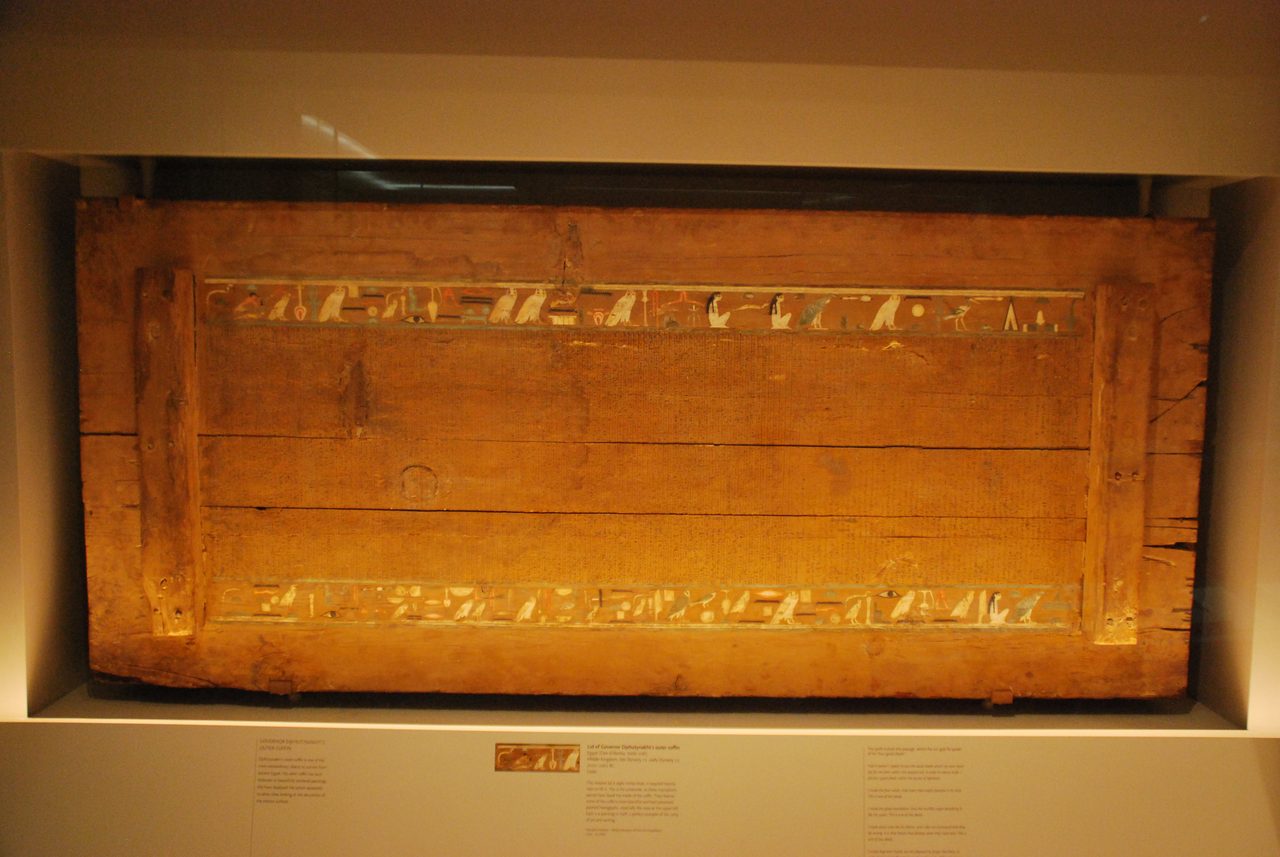
Buried in the corpus, in spells CT 1029 through 1130, is something that exists nowhere else in the ancient world. The Egyptians called it the Book of Two Ways, m3'.t r.wj, 'the two roads.' It survives mostly on coffins from el-Bersha, the burial ground of the nomarchs of the Hare nome, and it is exactly what its name says: two paths through the afterlife, one by water and one by land, both running toward the realm of Osiris, both guarded. Along the way lie obstacles, gatekeepers, and lakes of fire that the dead must know how to cross. It is a route description for a country no living person had ever visited.
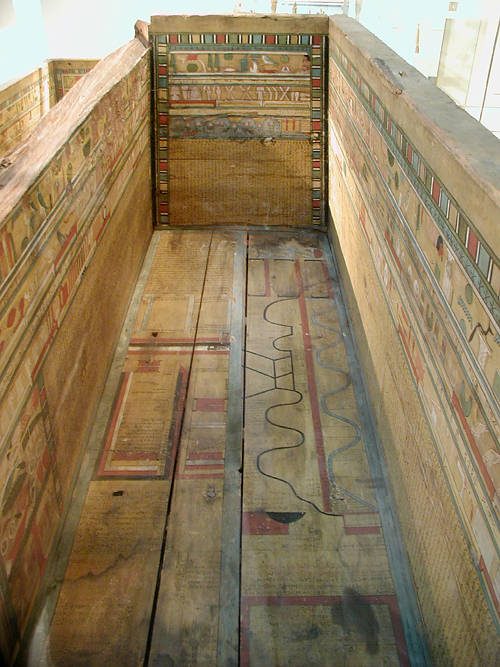
And this is what makes the Book of Two Ways one of the most remarkable objects in the whole history of writing. That map is not a metaphor. It is a literal cartographic image, painted on the floor of the coffin, showing routes, landmarks, and danger zones. Some scholars call it the first map in human history. Others reserve that title for earlier Mesopotamian clay tablets that chart real, terrestrial geography, and that caution is fair: the honest claim is that this is the earliest known cartographic representation of the afterlife, not a settled record for the first map of anything ever made. Hold it there, and it is still astonishing. It is humanity's oldest surviving attempt to chart the geography of somewhere no one has ever been.
For a long time the oldest known copy of that map was a matter of educated guesswork. Then, in 2012, a team from the Katholieke Universiteit Leuven, led by Harco Willems, the very scholar whose work anchors the democratization thesis, opened an undisturbed burial shaft at Deir al-Barsha. Inside was a coffin whose two surviving cedar floor panels carried what is now regarded as the earliest known copy of the Book of Two Ways, roughly 4,000 years old. There is a further twist that says a great deal about how the Egyptians thought. The occupant was first identified as a male official, the nomarch Djehutinakht I, but is now understood to be an elite woman named Ankh. Her own afterlife instructions still address her in the masculine, because the grammar of surviving the netherworld was written in male terms no matter who was actually lying in the box.
05The God Who Narrates His Own Creation
The Coffin Texts also preserve a creation story you will not find in the more famous Egyptian cosmogonies. In spells CT 75 through 83, the god Shu, the god of air and light, takes the lead in a version of how the world began that differs from both the Heliopolitan account of the Ennead and the Memphite theology. In it, the creator Atum brings forth Shu and his sister Tefnut, and Shu describes his own role in the founding act of Egyptian cosmology: the separation of the sky goddess Nut from the earth god Geb, prying heaven and earth apart to open a space for the world to exist in.
What makes these spells extraordinary is the voice. Shu narrates his own creation in the first person. The text is divine speech, a god describing, from the inside, the moment he came into being, which is a genuinely strange and rare thing to find in any ancient literature. Scholars also read Hermopolitan influence woven into this Heliopolitan frame, the Ogdoad of eight primordial deities surfacing inside a story about Atum's line. Egyptian theology was never a single system, and here you can watch two of its schools blend on the wall of a coffin.
06How To Become A Falcon
Then there are the spells that read like something out of a very old dream. A whole category of Coffin Text spells exists to let the dead transform, to shed one form and take another. And they are organized. One block of spells turns the deceased into gods. Another turns them into birds. A third turns them into cosmic forces, the raw elements of the universe itself.
| Spell Range | Transformation Into | Examples |
|---|---|---|
| CT 268-295 | Gods | Re, Atum, Osiris, Hathor |
| CT 296-321 | Birds | Falcon, swallow, heron, the phoenix (Bennu) |
| CT 322-336 | Cosmic forces | Fire, wind, the primordial waters |
Read as a group, these spells describe a startling idea about what a person even is. Identity, in this system, is not fixed. It can be assumed and shed like a garment, so that the same dead individual might move through the afterlife as a falcon, then as fire, then as a god. Scholars have noted that this fluid ontology has parallels in shamanic traditions around the world, where the boundary between a person and an animal or an element is treated as something that can be crossed. It is a parallel worth noticing, not an equation, but it does put the Egyptian material in interesting company.
07What The Coffins Might Remember
Everything above stands on firm ground. What follows does not, and the file is careful to say so, so this article will be too. The earliest physical Coffin Texts date to Dynasty 11, around 2055 BCE. But some spells carry archaic language and concepts that may point to much older oral antecedents, material spoken and remembered long before anyone painted it onto cedar. It is a reasonable inference from the texture of the language. It is not a dated manuscript, and it cannot be one, so it stays speculative.
There is a related and tantalizing possibility. The way the Coffin Texts relate to the regional funerary practices of the First Intermediate Period suggests that provincial traditions may have preserved religious material independently of the royal court. If so, the Coffin Texts could be a window onto older, non-Memphite religious thought, ideas that survived out in the provinces while a different official theology held the capital. Willems has argued along these lines. It is a genuinely interesting hypothesis, and it is still a hypothesis.
And then the boldest idea of all, which must always be stated with its own brakes attached. Some scholars have proposed that certain Coffin Text spells were not purely funerary at all, but were used by the living, as part of priestly initiation or temple ritual. The transformation spells in particular, they argue, resemble the initiatory practices described much later in the Greek mystery traditions. It is a seductive picture: the spells for becoming a god rehearsed by living priests, not just recited over the dead. But here is the brake, and it is not optional. Direct evidence for this initiatory use during the Middle Kingdom is absent. The idea draws what support it has from later New Kingdom temple evidence, read backward. State the possibility, and state its missing foundation in the same breath, or do not state it at all.
Fast Facts
- The Corpus
- Roughly 1,185 distinct funerary spells, painted mostly inside rectangular wooden coffins during the Middle Kingdom, about 2055 to 1650 BCE, across Dynasties 11 through 13. No single coffin carries more than a fraction; most bear between 30 and 200 spells, chosen by local tradition and personal choice.
- The Publication
- Systematically published by Adriaan de Buck in seven volumes between 1935 and 1961, from coffins recovered at el-Bersha, Asyut, Beni Hasan, Meir, Thebes, Saqqara, and Lisht.
- The Democratization
- In the Old Kingdom only the pharaoh was guaranteed an afterlife. By the First Intermediate Period and early Middle Kingdom, provincial officials placed the spells on their own coffins, and the non-royal dead could be addressed as 'the Osiris [Name],' assuming the god's own identity in death.
- The Spell Lineage
- About 250 spells descend from the older Pyramid Texts; many others climbed into the Book of the Dead. CT 335 became BD 17 (the great cosmological spell), CT 159 became BD 64, and CT 312 became BD 78, among many others.
- The Book Of Two Ways
- Spells CT 1029 through 1130, found mostly on el-Bersha coffins, map two routes to Osiris, one by water and one by land, past guardians and lakes of fire. It is the earliest known map of the afterlife, though some reserve the title of first map ever for earlier Mesopotamian tablets of real geography.
- The Earliest Copy
- In 2012, Harco Willems excavated an undisturbed shaft at Deir al-Barsha; the coffin's two cedar floor panels carry what is now regarded as the earliest known copy of the Book of Two Ways, roughly 4,000 years old. Its occupant is now understood to be an elite woman named Ankh, addressed throughout in the masculine.
- The Cosmogony Of Shu
- Spells CT 75 through 83 preserve a creation narrative in which the god Shu describes, in the first person, his role separating the sky goddess Nut from the earth god Geb, with Hermopolitan ideas blended into a Heliopolitan frame.
- The Transformation Spells
- Spells to become gods (CT 268-295), birds (CT 296-321), and cosmic forces (CT 322-336), describing a fluid ontology in which identity can be assumed and shed rather than fixed.
What The Evidence Actually Holds
The spine of this corpus is documented, and it is remarkable enough without a single embellishment. The Coffin Texts are roughly 1,185 funerary spells, painted mostly inside rectangular wooden coffins during the Middle Kingdom, published by de Buck in seven volumes from coffins found at el-Bersha, Asyut, Beni Hasan, Meir, Thebes, Saqqara, and Lisht, with most coffins carrying between 30 and 200 spells chosen by local tradition. The democratization they record is real, and it is double: textual, as royal spells were generalized for non-royal owners, and theological, as the non-royal dead came to be addressed as 'the Osiris [Name],' taking on the god's own identity. And the lineage is traceable in both directions: about 250 spells descend from the Pyramid Texts, and specific spells climb into the Book of the Dead, CT 335 becoming the great cosmological spell that is chapter 17, CT 159 becoming chapter 64, CT 312 becoming chapter 78. This is the middle term of Egyptian funerary literature, and it holds at Tier 1.
The corpus's strangest treasures sit one grade down, at credible, and this article keeps them there. The Book of Two Ways, spells CT 1029 through 1130, found mostly on el-Bersha coffins, maps two routes to Osiris, one by water and one by land, past guardians and lakes of fire, and it is the earliest known cartographic representation of the afterlife. That last point carries its own honest limit: some call it the first map in human history, but others reserve that title for earlier Mesopotamian tablets charting real geography, so the safe claim is earliest known map of the afterlife, not first map ever. The Cosmogony of Shu, spells CT 75 through 83, preserves a creation account in which the god narrates his own coming into being in the first person, with Hermopolitan ideas blended into a Heliopolitan frame. And the transformation spells let the dead become gods, birds, and cosmic forces, describing a fluid ontology whose loose parallels in shamanic traditions are worth noting, though not equating.
Three claims stay speculative, exactly where the research file grades them. That some spells preserve much older oral antecedents is a reasonable read of their archaic language, but it is an inference, not a dated text. That provincial traditions preserved older, non-Memphite religious thought independently of the royal court is a genuinely interesting hypothesis associated with Willems, and still a hypothesis. And the boldest, that certain spells were used by the living in priestly initiation on an analogy to later Greek mystery traditions, comes with a caveat that is not optional and travels with it everywhere: direct evidence for such initiatory use during the Middle Kingdom is absent, and the idea leans on later New Kingdom temple evidence read backward. Interesting, unproven, Tier 3.
And the claim to refuse outright, which the research file itself marks overstated. No, the Coffin Texts are not a systematic hidden curriculum of esoteric initiation deliberately concealed from the uninitiated. That reading overreads the evidence. The texts are funerary in function, even where their cosmology runs deep and strange, and the sheer variety and inconsistency among coffins from different sites argues directly against any single, unified, secret system. There was no lost school of the mysteries encoded in the woodgrain. There was a thousand-year-long, gloriously untidy human project to survive death, assembled spell by spell and coffin by coffin, by people who each chose what to take with them. The truth is stranger than the secret, and it does not need one.
Set the three corpora in a line one last time. The Pyramid Texts belonged to the king and no one else. The Book of the Dead belonged to anyone who could afford the papyrus. Between them stand the Coffin Texts, the exact moment the wall came down, when a provincial governor could paint a map to Osiris on the floor of his own coffin and call himself a god. That map is the oldest chart of the afterlife we have ever found, and it leaves a question hanging over the whole arc. One of the oldest surviving maps humanity has ever made charts no river, no coastline, no trade road, but the land of the dead. So which came first for our species: the urge to map the world we live in, or the need to map the one we were most afraid to enter alone?
Sources & further reading
Everything above is drawn from our research library on Theories of Anything, and every fact traces back to the files below. The primary file is A_3_10, the Egyptian Coffin Texts, which carries the corpus facts and find-sites, the democratization thesis in both its textual and theological forms, the spell lineage into the Book of the Dead, the Book of Two Ways with its hedged claim to the earliest map, the Cosmogony of Shu, the transformation spells, and the Tier 4 refusal this article ends on. The royal-only predecessor and the universal successor each have their own full dossier on this site, the Pyramid Texts and the Book of the Dead, both linked in the text above. Open the full files to check the sourcing and go deeper.
Image credits
- Coffin and mummy of the estate manager Khnumhotep, Dynasty 12, Metropolitan Museum of Art photograph by the Metropolitan Museum of Art, via Wikimedia Commons. CC0 1.0 Source.
- Coffin of Senbi, from Meir, mid-Dynasty 12, Cleveland Museum of Art photograph by Daderot, via Wikimedia Commons. CC0 1.0 Source.
- Detail of the eye panel and false door on the coffin of Nakhtkhnum, Dynasty 13, Metropolitan Museum of Art photograph by the Metropolitan Museum of Art, via Wikimedia Commons. CC0 1.0 Source.
- Outer coffin of the nomarch Djehutynakht, tomb 10A, Deir el-Bersha, Museum of Fine Arts, Boston photograph by Marcus Cyron, via Wikimedia Commons. CC BY 3.0 Source.
- Book of Two Ways on the floor of the coffin of Gua, Deir el-Bersha, 12th Dynasty, British Museum photograph by Jon Bodsworth, via Wikimedia Commons. Copyrighted free use (Egypt Archive) Source.
- Coffin of the steward Nefri, from Deir el-Bersha, Egyptian Museum, Cairo photograph by Pierre Lacau, via Wikimedia Commons. Public domain Source.
- Card crop of Coffin and mummy of the estate manager Khnumhotep, Dynasty 12, Metropolitan Museum of Art photograph by the Metropolitan Museum of Art, via Wikimedia Commons. CC0 1.0 Source.


