The Pyramid Texts: Spells to Turn a Pharaoh into a Star
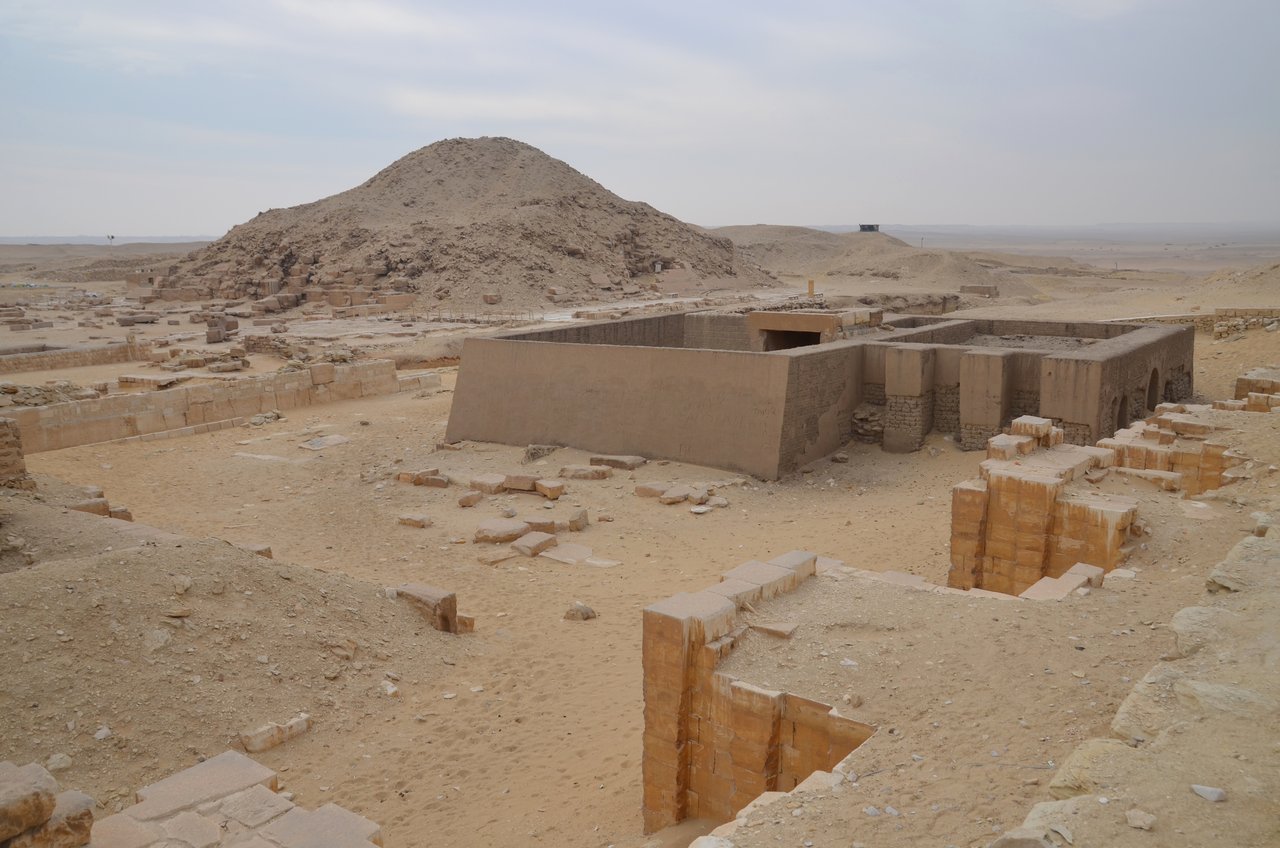
In 1881 an Egyptologist crawled through a break in the wall of a collapsed pyramid at Saqqara and found the burial chamber packed floor to ceiling with hieroglyphs filled with blue-green pigment. They were spells, and they had one job: to kill the pharaoh's death, reassemble his body, and launch him into the northern sky to live forever among the stars that never set. These are the Pyramid Texts, the oldest religious writing on Earth, older than the Rigveda, the Torah, and Homer. This page reports them in Egyptology's own terms, tier by tier: the resurrection formulas, the Cannibal Hymn carved in only one pyramid, the serpents that guard and the serpents that kill, and the modern claims about star maps and stargates, each weighed for exactly what it is.
Almost everything people know about the pyramids is about the outside: the geometry, the casing stones, the impossible tonnage. The strangest thing the Egyptians ever put in a pyramid is on the inside, and hardly anyone has read it. Carved into the walls of the burial chambers, in columns of hieroglyphs no living visitor was ever meant to see, is a set of instructions for doing something no text had ever attempted before: taking a dead man and making him a god. The Pyramid Texts are the oldest body of religious literature in the world, and they are not prayers. They read closer to a launch sequence. This page reports what they actually say, in the terms Egyptology uses, and marks the exact points where careful scholarship stops and modern speculation takes over.
01The Discovery Inside The Pyramid
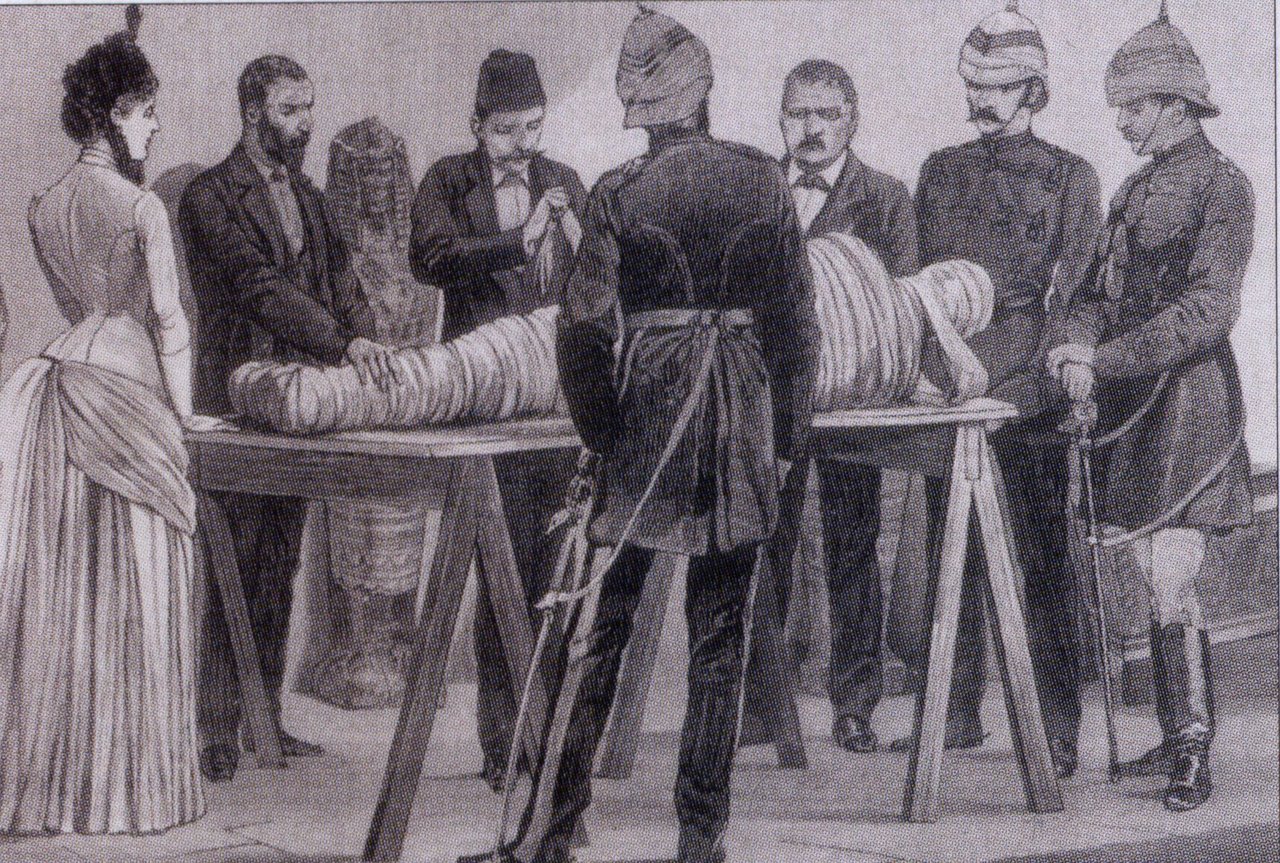
The story starts with a breach in a wall. In 1881 the Egyptologist Gaston Maspero entered the pyramid of Unas at Saqqara through a break in the burial chamber and found something no one expected inside a pyramid: writing. The walls were covered, floor to ceiling, with vertical columns of hieroglyphs. Pyramids were supposed to be silent stone. This one was talking.
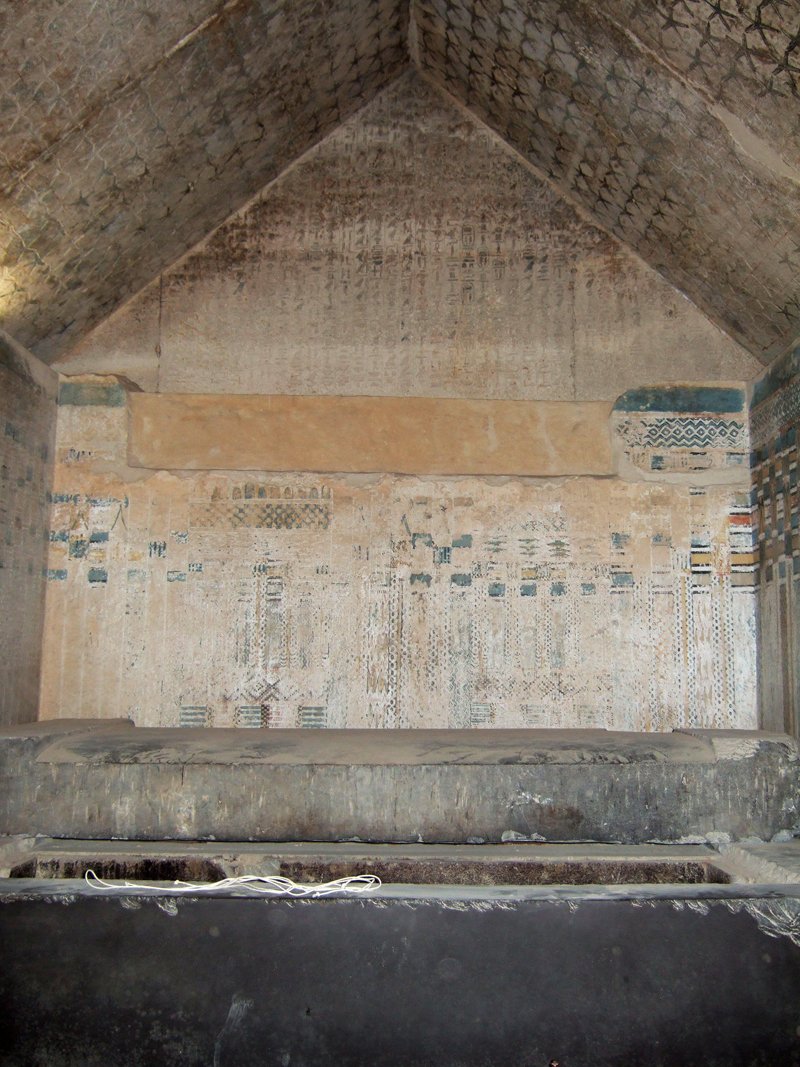
The texts are not painted on. They are incised into the limestone, cut as sharp hieroglyphs and then filled with a blue-green pigment, a malachite or copper-based color, so the signs stand out vividly against the white stone. The effect was deliberate, and it was permanent: sacred words locked into the fabric of the tomb itself.
Unas was not alone. Over roughly the next two centuries the same kind of texts were carved into a chronological series of royal pyramids, and then, strikingly, into the pyramids of three queens. The corpus grew across the whole line.
| Pyramid | Reign, And What It Adds |
|---|---|
| Unas | Last king of the 5th Dynasty, c. 2350 BCE. The oldest and most complete set, and the one Maspero found in 1881 |
| Teti | First king of the 6th Dynasty. The tradition carries into a new royal line |
| Pepi I | 6th Dynasty |
| Merenre I | 6th Dynasty |
| Pepi II | 6th Dynasty, reigned about 94 years. His pyramid holds the single largest collection of any |
| Neith, Iput II, and Wedjebetni | Three queens of the 6th Dynasty. The texts reach beyond kings to royal women |
| Middle Kingdom pyramids | Later than the Old Kingdom originals. Additional fragments survive |
Counted together and numbered by Kurt Sethe, in an edition published between 1908 and 1922 that is still the foundation of the field, the corpus runs to 759 distinct utterances. No single pyramid holds all of them: Unas' has 228, and Pepi II's has the most. Across all the pyramids the inscribed text amounts to roughly 4,000 lines of hieroglyphs.
And the placement is not random. The texts appear only inside the pyramid, in the antechamber, the corridor, and the sarcophagus chamber, never on the exterior the way later temple inscriptions would be, so that the spells physically surround the dead king's body. Their arrangement follows the journey they describe: spells for one stage of the afterlife are carved in one part of the pyramid, spells for the next stage in the next, the architecture itself laid out as a route through death.
02Older Than The Rigveda, The Torah, And Homer
The Unas inscriptions of around 2350 BCE are the oldest known copy of the Pyramid Texts. They are almost certainly not the oldest version. The language gives it away: the utterances carry archaic grammatical forms and vocabulary that were already obsolete by the Old Kingdom, and some spells describe conditions from before Egypt was unified, referencing the 'Followers of Horus,' nomadic life, and a political world that no longer existed. Both point the same way, toward material carried orally for a long time before anyone carved it. James P. Allen put it plainly in 2005: 'some utterances may go back to the time of unification or even earlier.'
How much earlier is a real question. A conservative reading places some of the underlying oral material at least as far back as 2600 to 2700 BCE; more speculative estimates push elements into the pre-dynastic period, before 3100 BCE. Either way, this is the oldest religious literature on Earth, and the comparison is not close.
| Text | Approximate Date | Age Relative To The Pyramid Texts |
|---|---|---|
| Pyramid Texts | Inscribed c. 2350 BCE, with older oral sources | The baseline: the oldest religious literature on Earth |
| Kesh Temple Hymn (Sumer) | c. 2600 BCE | Roughly contemporary |
| Rigveda | c. 1500-1200 BCE | Younger by 800 to 1,000 years |
| Torah / Pentateuch | c. 900-500 BCE | Younger by 1,400 to 1,800 years |
| Iliad and Odyssey | c. 750 BCE | Younger by roughly 1,600 years |
03How To Turn A Dead King Into A Star
Death is where the Pyramid Texts get to work, and their first move is audacious: the dead pharaoh becomes Osiris. Osiris is the god murdered by his brother Seth, cut apart, reassembled by his wife Isis, and brought back to rule the dead, and the texts simply assert that what happened to the god now happens to the king. They say it directly, and they say it as a denial: 'You have not gone away dead; you have gone away alive' (Utterance 134); 'Raise yourself, O King! You have not died!' (Utterance 258). This is, as far as anyone can tell, the first articulation of resurrection in world literature. The dead king is not merely admitted to an afterlife. He is put back together, his faculties restored, and stood back up.
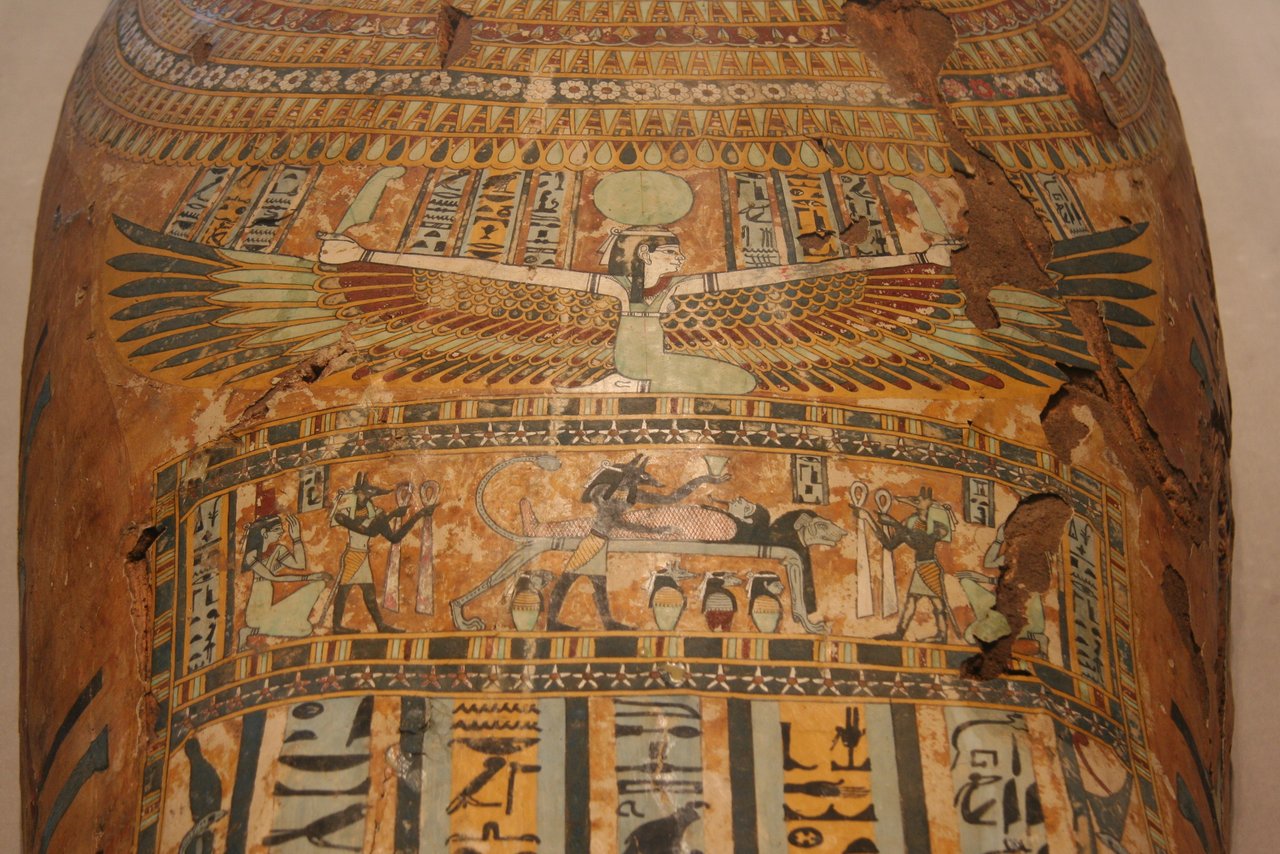
Restored, he has to reach the sky, and the texts describe the ascent in a startling variety of ways, as if the writers were reaching for every image that might work. He climbs: 'A stairway to the sky is set up for me that I may ascend on it' (Utterance 267). He flies: 'The king flies as a bird, he alights as a beetle' (Utterance 302). He rides a reed float across the Celestial Nile, he is carried up by the wind, and he is born into the sky by the goddess Nut herself: 'O my mother Nut, spread yourself over me, that I may be placed among the imperishable stars' (Utterance 427).
The imperishable stars are the destination, and the Egyptians chose them for a precise astronomical reason: the circumpolar stars, the ones that wheel around the celestial pole, never sink below the horizon at Egyptian latitudes. A star that never sets is a star that never dies, which is exactly the point. The texts also tie the king's ascent to Orion, whom they call Sahu, and to Sirius, whom they call Sopdet, and they set him beside the sun god Re in his solar barque, sailing across the sky by day and through the underworld, the Duat, by night.
All of this ascending aims at a single transformation. The king is not just granted an afterlife; he is remade into an akh, the 'effective spirit' or 'shining one,' a luminous, immortal being formed when his ka, his vital double, and his ba, his mobile personality, are joined after he passes safely through the afterlife. The akh is what the whole apparatus is for: it is what the pharaoh is climbing the ladder to become. The fuller Egyptian map of the self, seven named parts in all, is laid out on our page for the Egyptian Book of the Dead; here it is enough to know the akh is the goal.
04The Cannibal Hymn
One text in the whole corpus stands apart, and it is the strangest thing the Egyptians ever wrote down. It is called the Cannibal Hymn, it occupies Utterances 273 and 274, and it is found only in the pyramid of Unas. No later pyramid repeats it, whether because it was thought too dangerous, too archaic, or simply superseded by a gentler theology. Its language is among the oldest in the corpus, and its uniqueness suggests it preserves an extremely early layer of Egyptian religion that the rest of the tradition had already left behind.
What it describes is the king devouring the gods. He hunts them like animals: they are caught, bound, slaughtered, cooked, and eaten, and the king grows mighty by consuming them. The lines are explicit. 'The king is the one who eats men and lives on the gods' (Utterance 273). 'It is the king who eats their magic and swallows their spirits,' the magic and the spirits of the gods themselves. 'The great ones are for his supper, the middle-sized are for his breakfast, the small ones are for his dinner.' And the result: 'The king's ka has been served with their ka's; he has swallowed the wisdom of every god.'
Egyptologists read the hymn two ways, and the file does not force a choice. One camp takes it more literally: an echo of genuine pre-dynastic rituals, cannibalistic practices long abandoned by Unas' own day but fossilized in a sacred text too old to discard. The other reads it as magic rather than menu, the king absorbing the power of the gods, their heka, their very magic, to take on their attributes and become divine himself, a kind of spiritual technology for turning a man into a god. Both readings are live, and the hymn is disturbing enough to carry either one.
05The Guardians And The Killers
Serpents are everywhere in the Pyramid Texts, and they cut both ways. On the king's own brow sits the uraeus, the rearing cobra, embodying the goddess Wadjet, and in these texts she is not a symbol but a living protector: 'The serpent is on your brow... she will strike at anyone who resists you' (Utterance 194). The cobra on the crown is described as a real entity, awake and acting on the king's behalf.
Other serpents are the enemy. The Duat, the underworld the king must cross, is infested with hostile serpents that have to be overcome or driven off, and the texts hand him the words to do it, a blunt repelling formula that recurs in the pattern 'Back, serpent! Fall, serpent!'
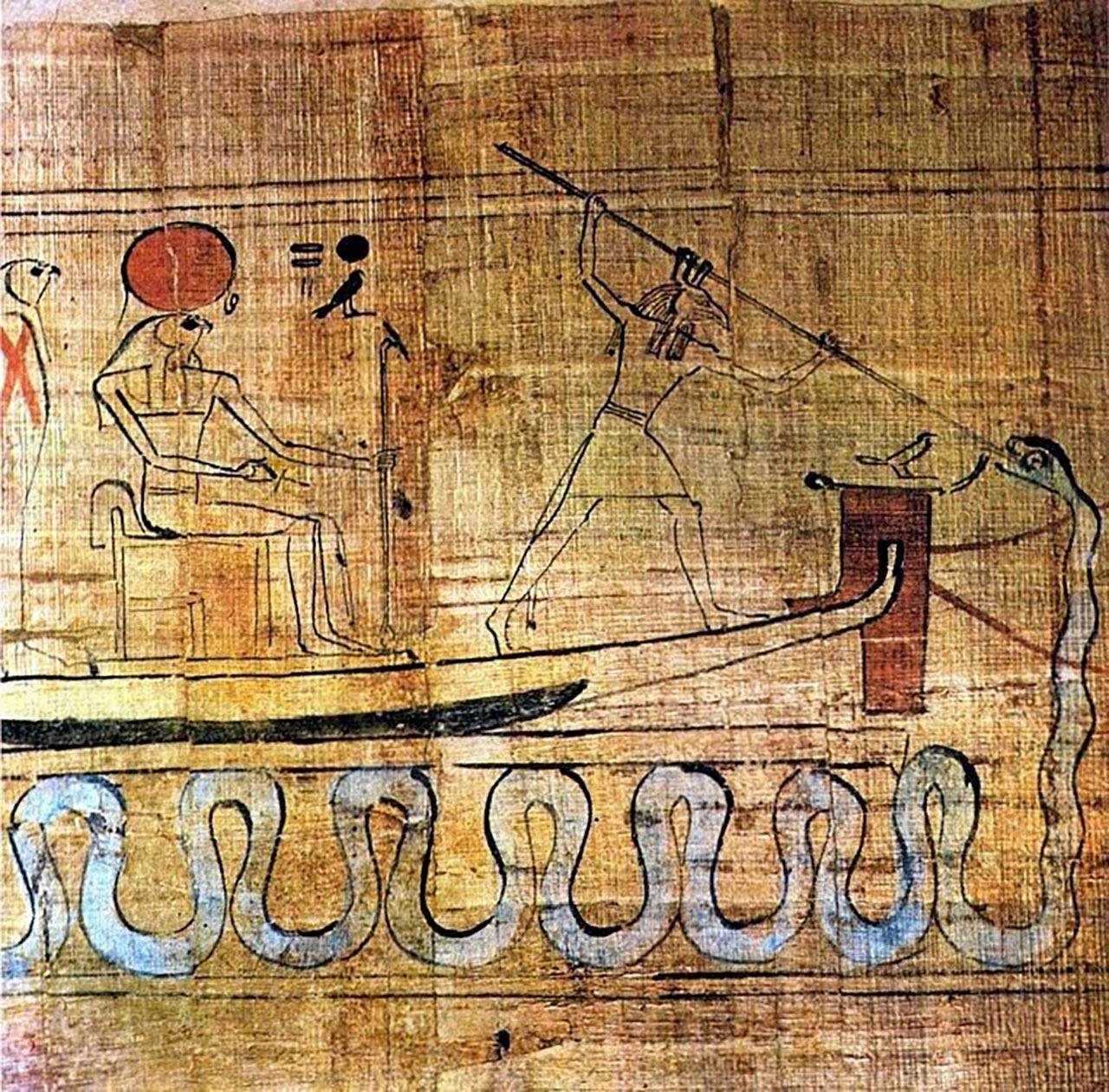
The greatest of the hostile serpents is Apophis, also called Apep, the serpent of chaos who tries to swallow the sun god Re every single night. In the Pyramid Texts the king is not a bystander in that cosmic fight: he joins Re and helps defeat Apophis, taking his place in the nightly battle to keep the sun rising.
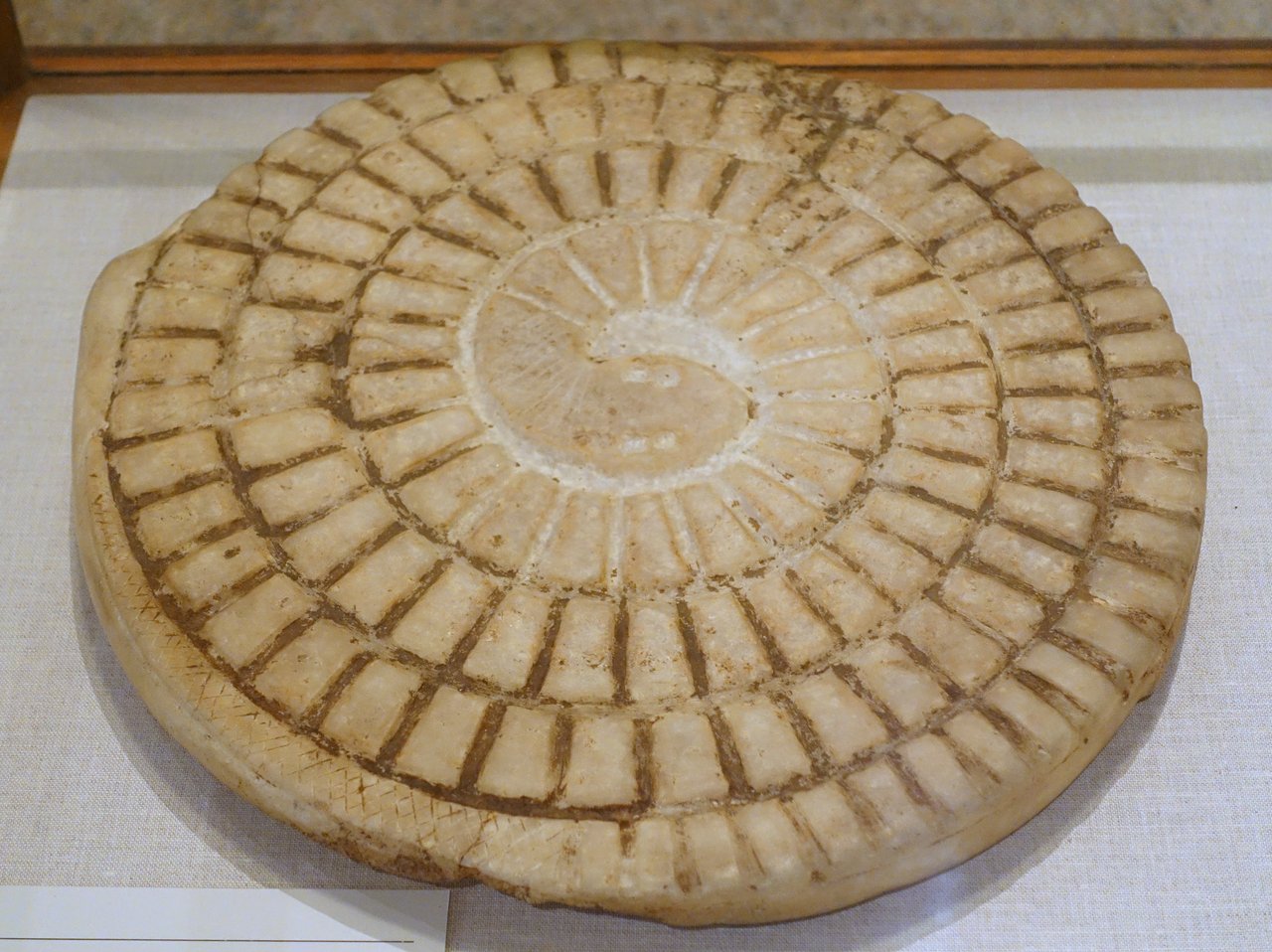
And one great serpent is on the king's side. Mehen coils protectively around Re's solar barque as it sails through the underworld, a guardian wrapped around the boat, the mirror image of Apophis and his sworn opposite.
So the same corpus holds both faces of the serpent at once: protector and destroyer, the uraeus and Mehen guarding, the Duat serpents and Apophis attacking. The file notes that this exact split, the snake as both guardian and monster, turns up in culture after culture rather than only in Egypt, the same pattern our page on the World Serpent traces across the world. It stops short of claiming to know why the pattern recurs; it only records that it does.
06Not Written But Performed
The Pyramid Texts were never meant to be read the way you are reading them now. They were performed. Embedded in the utterances are rubrics, stage directions telling the officiant how to act them out: 'To be recited four times,' 'To be said while facing west.' They belonged to a sequence of funerary rites that included washing and mummifying the body, the Opening of the Mouth ceremony that restored the dead king's senses, the presentation of offerings, and the spoken spells. And the architecture matches the liturgy: spells about emerging from death cluster in the sarcophagus chamber, spells about ascension in the antechamber, spells about departure in the corridor. Harold M. Hays argued in 2012 that the whole corpus worked as a 'liturgy of the afterlife,' recited by priests at the exact spots in the pyramid where each spell belonged.
07Written In The Stars, And The Argument About It
The pyramids point at the sky, and not vaguely. In the Great Pyramid of Khufu, the northern shaft of the King's Chamber was aimed at the circumpolar stars, specifically Thuban, which was the pole star around 2560 BCE, and the southern shaft pointed toward Orion's Belt. Set that alongside the Pyramid Texts, which describe the king ascending to Orion and Sirius over and over, and the celestial orientation of the pyramids stops looking like coincidence. There is a real, unambiguous textual basis for it: the Egyptians told us, in the texts, that the king was headed for those stars.

This is where a famous modern theory has to be handled with care. In 1994 Robert Bauval, with Adrian Gilbert, proposed the Orion Correlation Theory: that the three Giza pyramids were laid out on the ground to mirror the three stars of Orion's Belt, matching their relative positions and even their brightness. The idea is seductive, and it is not accepted by mainstream Egyptology. The fit is inexact, it depends on selective scaling, and no Old Kingdom text anywhere states that the Giza plateau was designed as a map of the sky. The distinction is worth stating precisely, because it is easy to blur: the evidence that the Pyramid Texts treat the stars, and Orion in particular, as the king's destination is solid and textual. The stronger, specific claim that Giza was built as a literal star map is a different thing, and that one remains debated rather than demonstrated. It is neither proven right nor safely dismissed.
08The Readings That Reach Further
Some readers push further still. In his 2005 book Shamanic Wisdom in the Pyramid Texts, Naydler argued that the utterances describe not only what happens to a dead pharaoh but what happened to a living one: initiation rituals in which the king symbolically 'died' and was 'reborn' while still breathing, with the pyramid serving as an initiation chamber rather than a tomb, and the 'journey to the stars' recording an out-of-body or visionary state reached through ritual. The file grades this Tier 3 and states the objection in the same breath: the texts consistently address a dead king, and the scholarly consensus treats them as funerary literature, which makes the paradoxical line 'you have gone away alive' paradoxical only if you pull it out of its funerary setting. It is a provocative reading, not an established one.
There is a last question the file is willing to raise but not to overreach on. If the oldest utterances really do reach into pre-dynastic times, before 3100 BCE, then they carry fully formed religious ideas, resurrection, a stellar afterlife, divine judgment, out of the same formative window that produced Göbekli Tepe and the first Sumerian settlements, which sits awkwardly with any model of religion as a slow, gradual climb. The file is careful about what that does and does not mean. It does not imply a lost civilization. It implies only that sophisticated concepts may have run ahead of the material markers, the writing and the monuments, that we usually treat as the proof that civilization has arrived.
Fast Facts
- Discovered
- By Gaston Maspero in 1881, in the pyramid of Unas at Saqqara, through a breach in the burial chamber
- What it is
- 759 numbered utterances of funerary spells, carved inside Old Kingdom royal pyramids, the oldest religious literature on Earth
- The goal
- To resurrect the dead pharaoh as Osiris and launch him to the imperishable stars, the circumpolar stars that never set, to live forever
- Oldest known copy
- The pyramid of Unas, c. 2350 BCE, though the language and content point to a far older oral tradition
- The Cannibal Hymn
- Utterances 273-274, found only in Unas' pyramid: the king hunts, cooks, and eats the gods to absorb their power
- The serpents
- Both guardians (the uraeus, Mehen) and killers (Apophis, the hostile serpents of the Duat) run through the same texts
- The Orion question
- The Pyramid Texts' stellar importance is solid; Bauval's claim that Giza is a literal star map is debated, not accepted
- Numbered by
- Kurt Sethe, in an edition published between 1908 and 1922, still foundational to the field
What We Can Actually Stand Behind
The core is settled Egyptology, and it is exactly as reported here. Maspero found the texts in 1881 in the pyramid of Unas; they run to 759 numbered utterances carved inside a series of Old Kingdom pyramids and several queens' pyramids; and their purpose is stated in their own words. The resurrection formulas ('You have not gone away dead; you have gone away alive'), the ascension imagery, the destination among the imperishable stars, the Cannibal Hymn's lines in Unas' chamber, and the uraeus, Apophis, and Mehen serpents are all direct primary-source content, not paraphrase. That the Unas inscriptions are the oldest known copy, with the language pointing to an older oral tradition, is Tier 1 as well.
Three readings are credible and correctly kept one step back. The Pyramid Texts were performed, not just inscribed: rubrics inside them and the architectural placement of the spells support Harold M. Hays' 'liturgy of the afterlife' reading. The pyramids carry real astronomical alignments, and the texts' own repeated language about Orion and Sirius gives that a genuine textual basis. And the Cannibal Hymn's dual reading, literal old ritual versus magical absorption of divine power, is a live scholarly split, not a settled fact. On the Orion Correlation Theory specifically the line has to be drawn exactly where the file draws it: the Pyramid Texts' stellar importance is solid, but Robert Bauval's stronger claim that the Giza plateau was laid out as a literal map of Orion's Belt is debated and not accepted by mainstream Egyptology, and it should be flattened neither into 'Bauval was right' nor into 'Bauval was debunked.'
Two further readings are genuinely speculative, and the file grades them that way. Naydler's argument that the texts describe a living initiation, the king symbolically dying and being reborn while still alive with the pyramid as an initiation chamber, runs against the mainstream consensus that these are funerary texts addressed to a dead king, and the file states that counter-argument in the same breath. And the idea that the oldest utterances carry pre-dynastic religious concepts sophisticated enough to complicate tidy models of gradual development is worth considering, but the file is explicit that this implies no lost civilization, only that complex ideas may predate the monuments and writing we usually treat as civilization's markers.
Two popular claims are unsupported, and the file refuses both outright. The pyramids were not literal stargates or technological portals: the texts describe spiritual and magical processes, not engineering, and the real shaft alignments do not make a machine. And the Pyramid Texts were not written by Atlanteans or a pre-Flood civilization: their archaic elements trace cleanly through the evolution of the Egyptian language itself, and they are the product of Egyptian civilization, not an unrelated precursor. On both, the answer is no.
What began in the pyramid of Unas did not stay there. For the first thousand years these spells were the pharaoh's alone, carved where no living eye would read them, but the promise inside them, resurrection and a place among the gods, slowly spread outward, onto the painted coffins of nobles and at last onto papyrus scrolls any literate Egyptian could buy, the long widening that Egyptologists call the democratization of the afterlife and that we tell in full on our page for the Egyptian Book of the Dead. But it starts here, with a dead king on a stone floor, walled in by hieroglyphs that insist he has not died, that a stairway to the sky has already been set up for him, that he is on his way to become a star that never sets. The Egyptians believed the words themselves did the work. We can still read the same words, on the same walls, forty-four centuries later. So the Pyramid Texts leave one question standing over everything else: why is the oldest religious writing our species ever carved into stone, at its very heart, a flat refusal to accept that death is the end?
Sources & further reading
Everything above is drawn from our research library on Theories of Anything, and every tiered claim traces to the file below, A_3_02, the Pyramid Texts research document, together with the cross-referenced files it connects to. The primary-source utterances are quoted as the file quotes them. Where the file keeps a question open, so does this page: the Orion Correlation Theory in particular is reported exactly as the file grades it, with the Pyramid Texts' stellar importance kept solid and Bauval's specific star-map claim kept debated, neither promoted nor dismissed.
Image credits
- The Pyramid of Unas, Saqqara, Egypt photograph by Carole Raddato, via Wikimedia Commons. CC BY-SA 2.0 Source.
- Gaston Maspero at work on a mummy, Cairo, 1886 via Wikimedia Commons. Public domain Source.
- Burial chamber interior, Pyramid of Unas, Saqqara photograph by Vincent Brown, via Wikimedia Commons. CC BY 2.0 Source.
- The goddess Nut, mummy coffin of Pedusiri, Milwaukee Art Museum photograph by Jonathunder, via Wikimedia Commons. Public domain Source.
- The god Set spearing the serpent Apep (Apophis), Book of the Dead of Cheritwebeshet, 21st Dynasty via Wikimedia Commons, Egyptian Museum, Cairo. Public domain Source.
- Mehen ("snake") game board, alabaster, Old Kingdom, Oriental Institute Museum photograph by Daderot, via Wikimedia Commons. CC0 1.0 Public Domain Dedication Source.
- Orion's Belt (Alnitak, Alnilam, Mintaka) and surrounding nebulae astrophotograph by Keesscherer, via Wikimedia Commons. CC BY-SA 4.0 Source.
- Card crop of The Pyramid of Unas, Saqqara, Egypt photograph by Carole Raddato, via Wikimedia Commons. CC BY-SA 2.0 Source.
.jpg)


_game,_Egypt,_Old_Kingdom,_Dynasties_3-6,_c._2750-2250_BC,_alabaster,_pigment_-_Oriental_Institute_Museum,_University_of_Chicago_-_DSC07928.JPG)
