The World Serpent
Pull the thread on almost any mythology and a serpent the size of the world comes loose. The Norse wrapped one around the whole ocean and called it Jormungandr. Hindus rest the sleeping cosmos on the thousand hoods of Shesha. In Benin, the Fon rainbow serpent Dan Aida Hwedo holds the earth up beneath the sea, and the ground shakes when it moves, the same thing the Hindus say of Shesha, though the two peoples never met. In Egypt the serpent bends into a circle and eats its own tail. This is the World Serpent, and it is not one more dragon for a hero to kill. It is the architecture of the cosmos drawn as a snake: encircling the world, holding it up, threatening to end it. It turns up independently on nearly every inhabited continent, which is either the strangest coincidence in mythology or a clue about how the human mind is built. Here is the whole pattern, each tradition wearing the evidence it has actually earned, the honest boundary between convergence and contact kept in view, and one question left coiled at the center: why is the serpent everywhere?
Pull the thread on almost any mythology and a serpent comes loose. Not a dragon to be slain by a hero, though those are everywhere too, but something larger and stranger: a serpent the size of the world, wrapped around it, holding it up, or waiting at the end of time to swallow it whole. The Norse called it Jormungandr. Hindus call it Shesha. In Haiti and Benin it is Danbala. In Egypt it eats its own tail. These peoples did not share a map or a language or, in most cases, a single moment of contact, and yet they reached for the same picture. This is the World Serpent, and it is one of the closest things the human imagination has to a universal. The real question is not what it is. It is why it is everywhere.
01The World Serpent
Start by separating this from the dragon-slaying stories it is so easily confused with. A great many serpent myths are about killing the serpent: the hero, the storm god, the order of the world winning a fight. Those are their own subject. The World Serpent is something else. It is not the enemy in the story, it is the setting of the story, the boundary and the foundation of the cosmos rendered as a snake. Sort the world's serpents this way, by what they DO to the world rather than whether they are good or evil, and three jobs come up again and again: the serpent that encircles the world, the serpent that holds it up, and the serpent that threatens to end it. Often the same snake does all three.
02Jormungandr, the Serpent That Encircles the World
Jormungandr, the Midgard Serpent, comes to us from the primary Norse sources: the Prose Edda of Snorri Sturluson (about 1220 CE, Iceland) and the Poetic Edda, a 13th-century compilation of older poems. It is one of three monstrous children of Loki and the giantess Angrboda, its siblings being Fenrir the wolf and Hel, the goddess of the dead. Odin cast the serpent into the ocean that surrounds Midgard, and there it grew until it encircled the entire world and closed its jaws on its own tail. That is the image in its purest Norse form: not a snake in the world, but a snake that is the edge of the world.
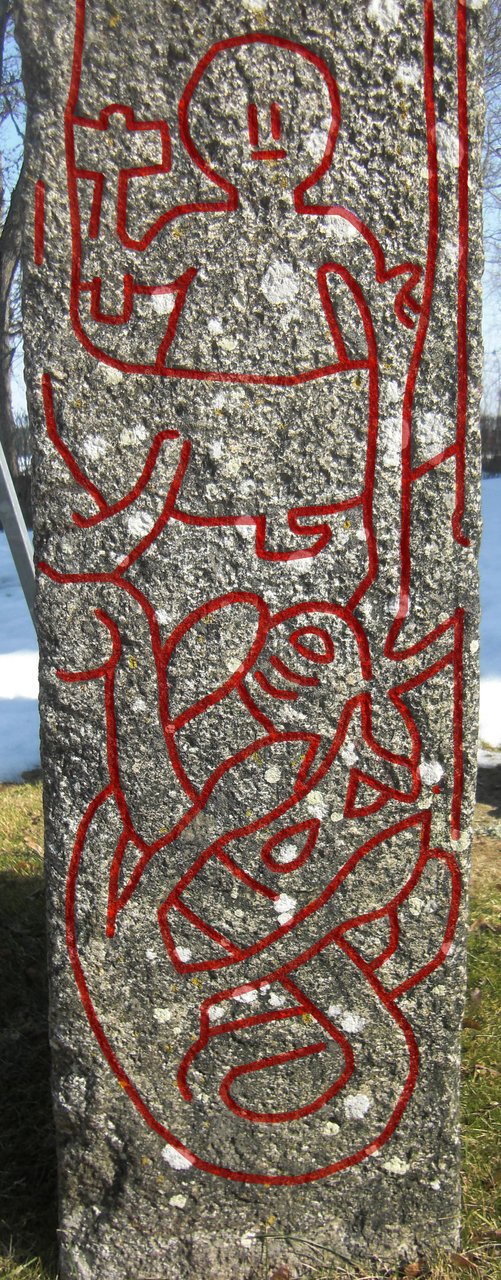
It surfaces once before the end. In the Hymiskvida of the Poetic Edda, Thor goes fishing with the giant Hymir, baits his hook with an ox head, and hooks Jormungandr itself. The serpent rears up out of the deep; Hymir, terrified, cuts the line, and the reckoning between Thor and the serpent is put off to Ragnarok.
At Ragnarok, the Doom of the Gods, Jormungandr releases its tail, rises from the sea, and comes ashore spraying venom. Thor kills it with the hammer Mjolnir, then staggers nine steps and dies of its poison. In the Norse telling the serpent is primordial chaos held in check through the ordered age of the world, breaking loose at the end of the cycle to destroy it and clear the ground for its renewal. That dragon-against-the-gods pattern, the Chaoskampf, runs from Thor and Jormungandr to Indra and Vritra to Zeus and Typhon, and we lay it out in full in our companion dossier, Dragon Typology. What matters here is narrower and stranger: not that the serpent is fought, but that before the fight it is the boundary of the world itself, wrapped around everything, holding its own tail.
03Shesha, the Serpent That Holds Up the Cosmos
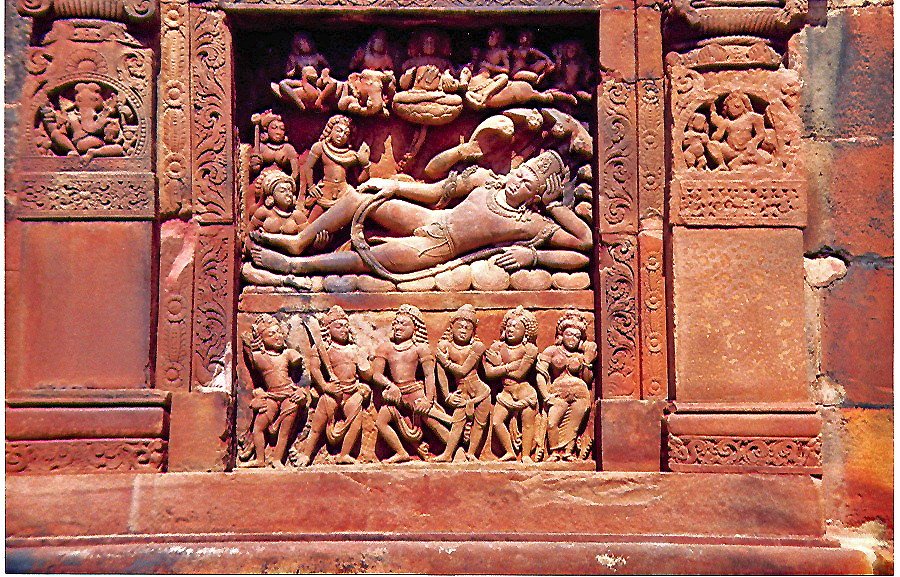
Half a world from Iceland, the serpent does the opposite job. Shesha, whose name means 'remainder,' what is left when everything else is destroyed, and who is also called Ananta, 'the endless,' is a thousand-headed serpent floating on the cosmic Ocean of Milk. Where Jormungandr threatens the world from its edge, Shesha carries it from beneath.
In Vaishnavite cosmology Vishnu reclines on Shesha's coils during pralaya, the periodic dissolution of the cosmos, sleeping between one creation and the next; when Vishnu wakes, a lotus rises from his navel bearing Brahma, who makes the universe again. The texts that carry this are old: the Vishnu Purana (about the 1st to 4th century CE), the Bhagavata Purana (about the 8th to 10th century CE), and the Mahabharata (about 400 BCE to 400 CE).
Shesha is said to hold all the planets on his thousand hoods, and when he shifts his weight, the earth quakes. Hold onto that detail. It returns, unprompted and with no possible connection, on the far side of the world.
The serpent runs all through Hindu tradition beyond Shesha. Vasuki is the giant snake the gods and demons used as a churning-rope to stir the Ocean of Milk in the Samudra Manthana. And below both stands the whole Naga tradition: semi-divine serpent beings who guard treasure and sacred waters and rule a subterranean realm called Patala.
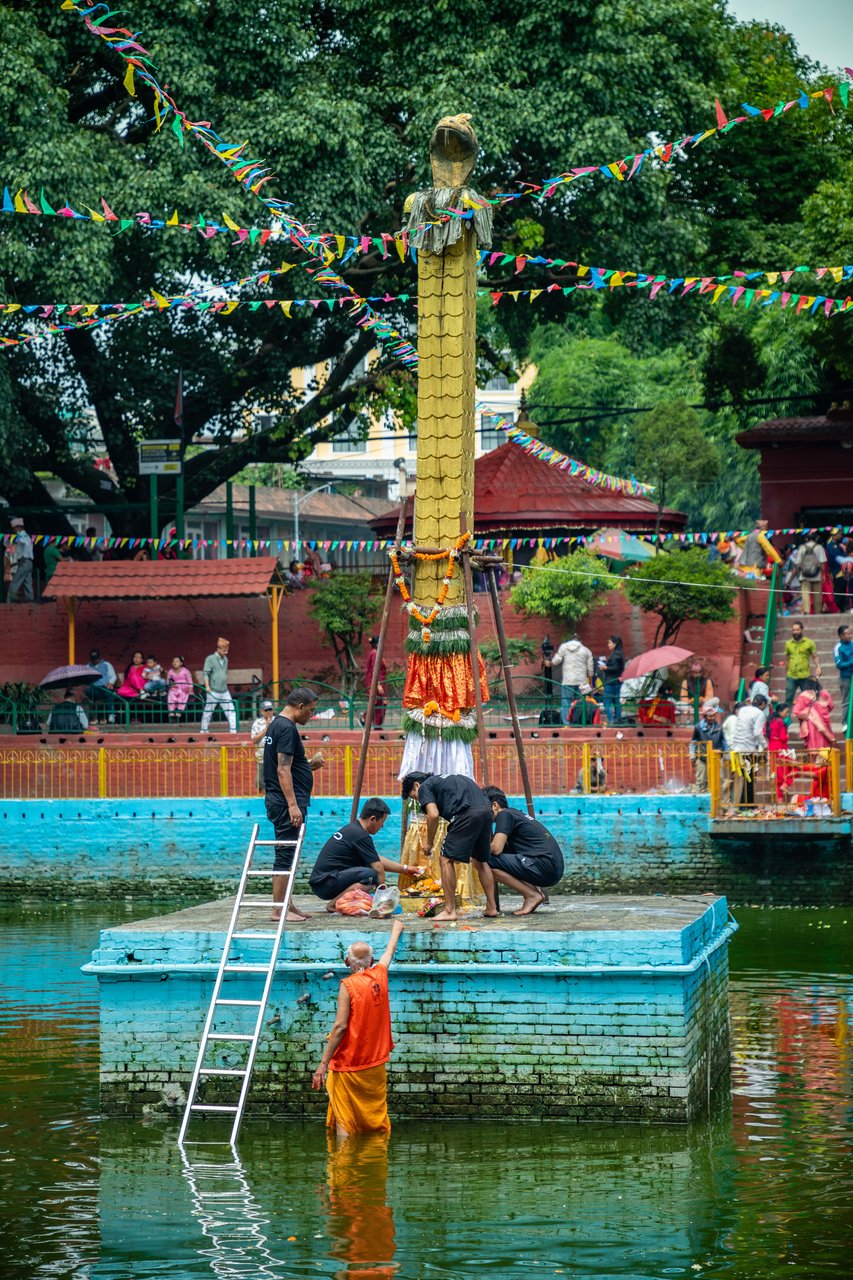
This is not a dead mythology. Naga worship is alive: the festival of Naga Panchami is still kept across India, Nepal, and Southeast Asia, a continuous tradition of serpent veneration more than two thousand years old, not a historical curiosity.
04Danbala and Dan Aida Hwedo, the Serpent Beneath the Ocean
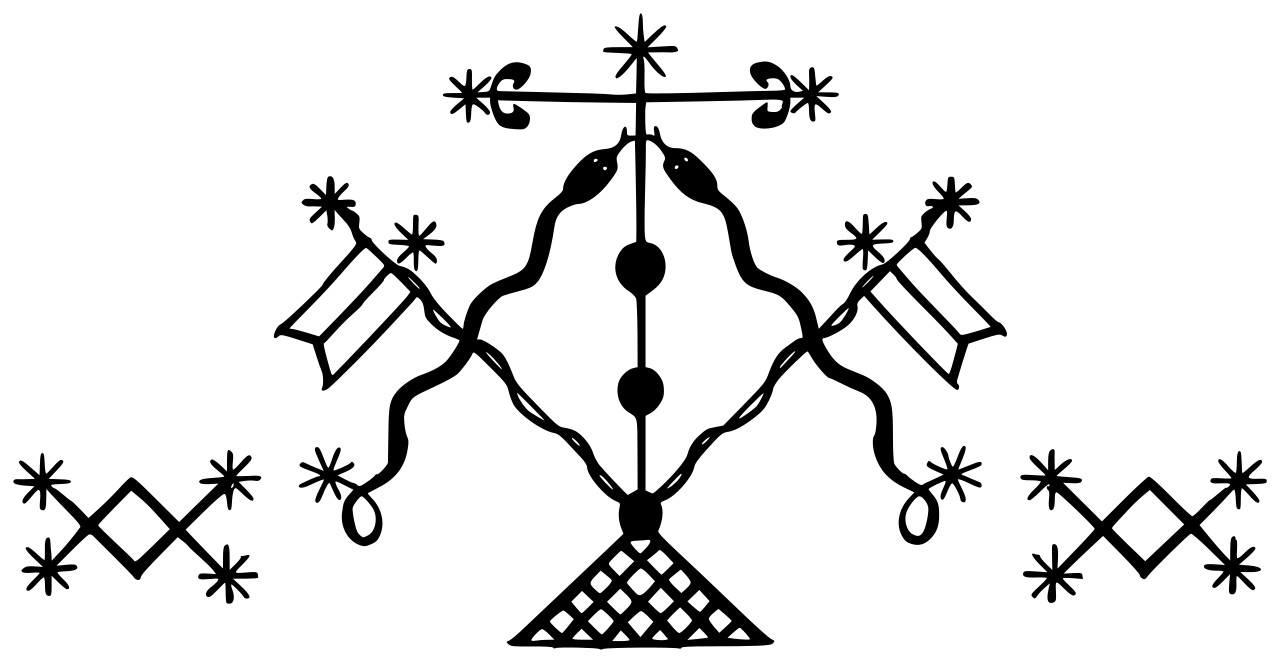
The same job, the serpent that holds the world up, appears again in West Africa and its diaspora. In Haitian Vodou he is Danbala, or Damballah Wedo; in the Fon and Ewe Vodun of Benin and Togo he is Dan. He is the primordial serpent of creation, coiled around the world and supporting it, tied to water, rain, wisdom, fertility, and the color white. This is a living religion, practiced today in Haiti and West Africa, and it belongs in this company by right.
In Fon cosmology the rainbow serpent Dan Aida Hwedo carried the creator god Mawu-Lisa in its mouth while the world was being made, and now holds the finished earth up in its coils beneath the ocean. When it shifts, there are earthquakes. Set that beside Shesha, holding the planets on his hoods, earthquakes when he moves, and beside Jormungandr encircling the world-ocean, and the resemblance is genuinely striking.
That resemblance is the kind of thing that launches a thousand lost-civilization theories, so here is the honest boundary. There is no evidence of any historical contact between West Africa and Norse or Hindu tradition. West Africa did not borrow its world-serpent from the Norse, and the Norse did not borrow one from the Fon. Three peoples who never met arrived at nearly the same image of a serpent holding up the world, and one of them independently attached the very same seismic detail, the earth trembling when the serpent stirs, that the Hindus attached to Shesha. That is convergence, not contact, and the whole discipline of comparative mythology lives in the difference between those two words. Keep it in mind, because everything that follows is an attempt to explain the convergence without smuggling in a contact that was never there.
| Serpent | What It Does to the World | Where It Lies | When It Moves |
|---|---|---|---|
| Jormungandr (Norse) | Encircles the world, biting its own tail | In the world-ocean around Midgard | It lets go at Ragnarok, and the world ends |
| Shesha / Ananta (Hindu) | Holds the cosmos up on his thousand hoods | On the cosmic Ocean of Milk | When he shifts, the earth quakes |
| Dan Aida Hwedo (Fon / Haitian Vodun) | Holds the earth up in its coils | Beneath the ocean | When it shifts, the earth quakes |
05The Ouroboros, Born in Egypt
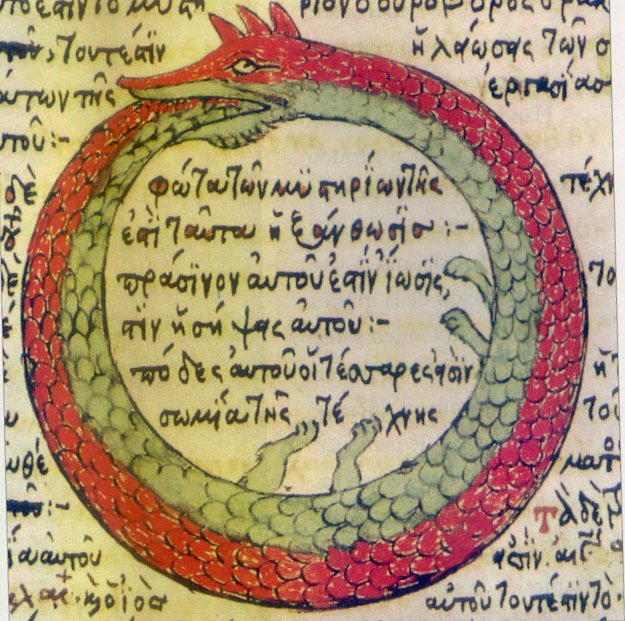
Egypt gave the world the third image, the serpent bent into a ring to devour its own tail. The earliest known ouroboros image belongs to the Enigmatic Book of the Netherworld tradition, 18th-Dynasty Egypt, dating to about 1600 BCE, a serpent encircling the head and feet of a figure to mark the unity of beginning and end. The image's best-known early example decorates the tomb of Tutankhamun itself (about 1323 BCE). From there it passed into the Greek magical papyri, into Gnostic texts, and finally into European alchemy, and circular serpent imagery in Mesopotamian art may run older still.
Egypt's serpent-circuit is older than the ouroboros image itself. Mehen is the protective coiled serpent who wraps around the sun god Ra's night-barque as a defensive wall, and Mehen also names an ancient Egyptian board game played on a coiled-serpent track, attested from the Predynastic period (about 3500 BCE). The idea of the serpent as a circle enclosing what matters was already almost two thousand years old when the first true ouroboros was drawn.
Egypt also kept the serpent as pure threat, which completes the set within a single culture. Apep, whom the Greeks called Apophis, is the great chaos serpent who dwells in the Duat, the underworld, and attacks Ra's barque every night as the sun passes through the dark. Ra and his defenders, Set and Mehen among them, must beat Apep back each night so the sun can rise. It is attested from the Middle Kingdom (about 2055 to 1650 BCE) onward, in the funerary texts and the Amduat. Encircling, supporting, threatening: Egypt alone shows the whole range.
But the tail-eater is not Egyptian property, and this is the part that should give a careful reader pause. The ouroboros appears independently in places with no known line of contact: Egypt (about 1600 to 1323 BCE), Greece (Platonic dialogues gesture at circular self-generation by the 4th century BCE, with the explicit image in the Greek magical papyri of the Greco-Roman period), the Norse Jormungandr biting its own tail, China (circular dragon and serpent imagery on Shang-dynasty bronzes, about 1600 to 1046 BCE), and Mesoamerica (circular serpent motifs at Teotihuacan and the Aztec fire-serpent Xiuhcoatl, sometimes coiled into a ring). Five civilizations, one idea, no shared drawing board.
Carl Jung took that recurrence and named it. In Psychology and Alchemy (1944) he read the ouroboros as a key archetype: a symbol of primordial unity, of the union of opposites, of a psyche that creates and destroys itself in one motion. Its appearance across unconnected cultures was, to him, evidence of archetypal content shared in a collective unconscious. Whether that is an explanation or a very elegant restatement of the puzzle is a question this article comes back to.
06The Serpent and the Crown
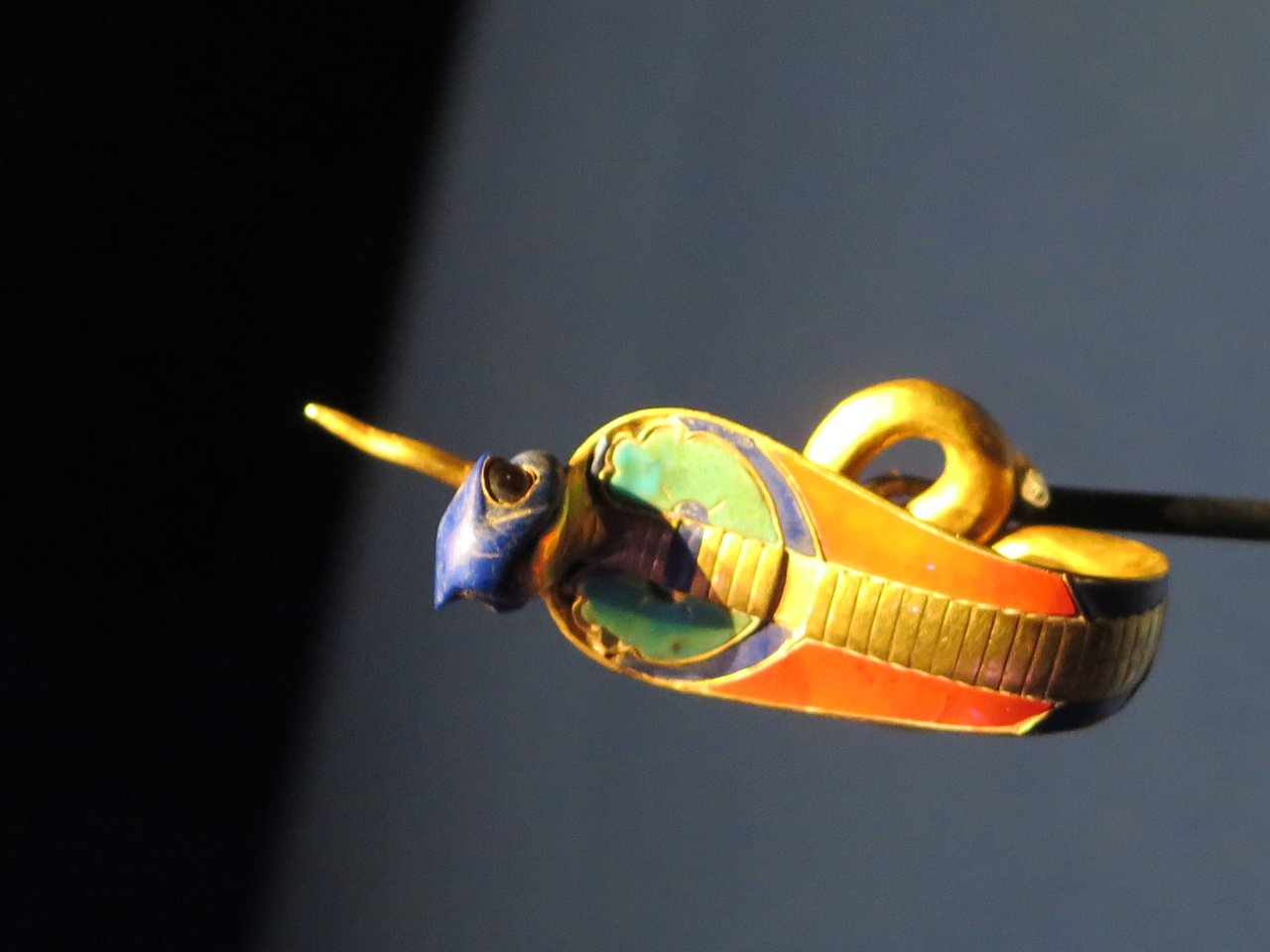
There is one more thread the World Serpent runs, and it has nothing to do with cosmology. It has to do with power. Start with Egypt, where the serpent sat literally on the ruler's head: Wadjet, the cobra goddess of Lower Egypt, rides the pharaoh's crown as the uraeus, a rearing snake that marks royal authority and divine protection. Egypt's serpent pantheon runs far deeper, but for the story of kingship the uraeus is the piece that counts: the serpent as the emblem of the crown.
| Culture | The Royal Serpent | What It Signals |
|---|---|---|
| Egypt | The uraeus, Wadjet's rearing cobra on the pharaoh's crown | Divine protection of the king |
| India | The naga canopy arched over the Buddha and over kings | Sacred sanction of the ruler |
| Cambodia | The many-headed naga of Angkor Wat, about 1150 CE | The serpent as cosmic boundary and royal emblem |
| Mesoamerica | The feathered serpent, patron of rulers and priests | Authority over sky and earth at once |
| China | The dragon, the long, once a serpentine being | The exclusive emblem of the emperor |
Set those side by side and a common political logic shows through the different costumes. Maurice Bloch, the LSE anthropologist, reads the serpent-king link as a claim about power itself: the ruler stands between human society and the dangerous cosmic forces the serpent embodies, and claims the sole right to control what everyone else fears. Notice that this is a completely different axis from whether a given dragon is good or evil. It is not about the serpent's morality. It is about what the serpent does for a throne, and it is a thread the moral sorting of dragons does not touch.
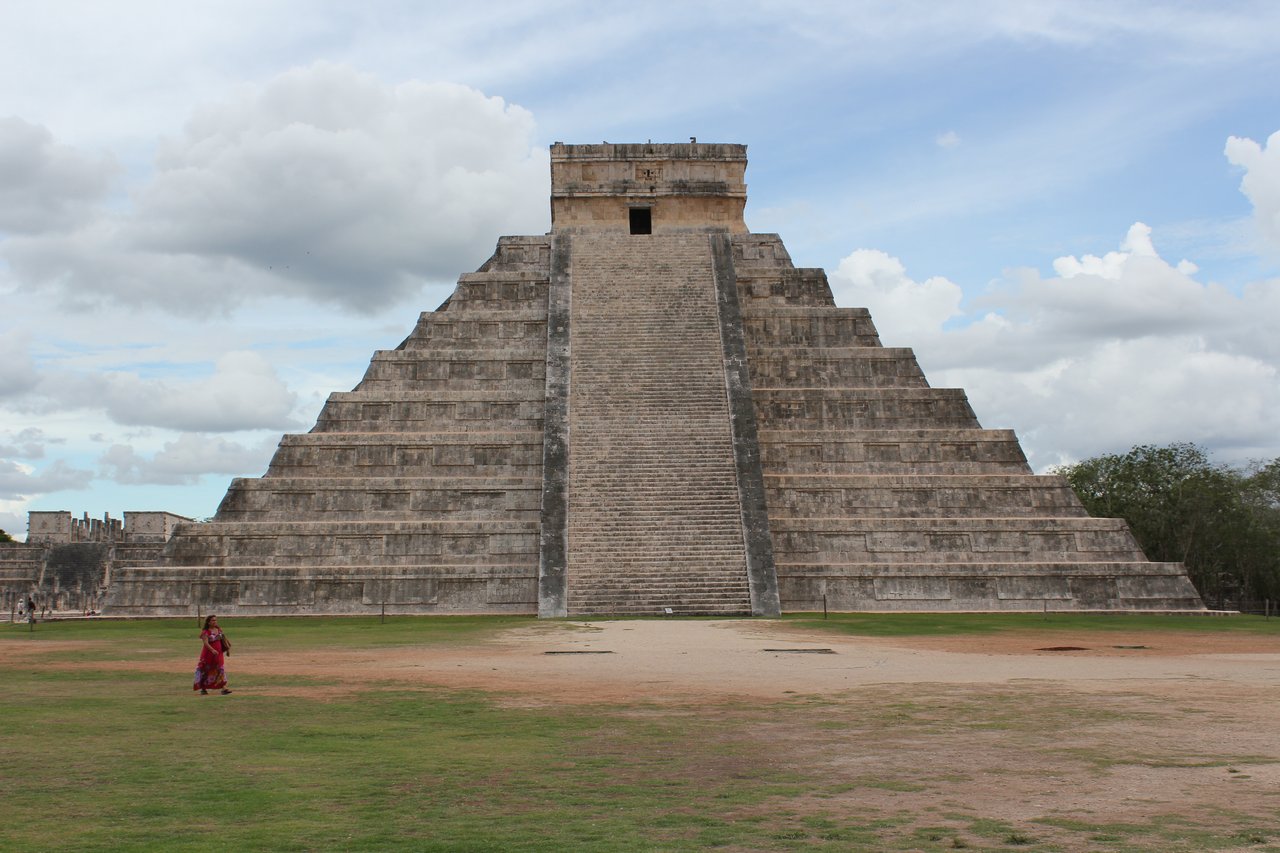
In Mesoamerica the crown-serpent puts on feathers. The feathered serpent, a snake sheathed in quetzal plumage, folds sky (feathers, air, flight) and earth (serpent, water, underworld) into a single mediating deity, and it stood as patron of rulers and priests: Quetzalcoatl to the Aztec, Kukulkan to the Yucatec Maya at Chichen Itza, Q'uq'umatz in the K'iche' Popol Vuh. It first appears at Teotihuacan (about 200 BCE to 250 CE), with earlier serpentine imagery among the Olmec at La Venta (about 1000 to 400 BCE). We give it two dossiers of its own, Quetzalcoatl and Kukulkan; here it is one more crown-serpent among several.
07Water, Fertility, and the Rainbow Serpent
Step back from any single tradition and one association repeats almost everywhere: serpent and water, serpent and fertility. Jormungandr is the ocean. Shesha floats on the cosmic sea. The Rainbow Serpent is the waterhole and the monsoon. Danbala is rain. The naga guards rivers and springs. The likeliest reason is not mystical but observational: real snakes are found near water, many are semi-aquatic, they emerge from holes in the ground as if from an underworld, and their moving line looks like the pouring of water itself. The symbol may simply be good natural history.
Nowhere is the serpent more plainly a maker of water than in Aboriginal Australia. The Rainbow Serpent, known by dozens of names across the continent's language groups, Ungud, Yurlungur, Ngalyod, Borlung, and many more, is a primordial creative being recorded across the whole of Australia. In the creation narratives it travels the first landscape carving out rivers, valleys, and mountains, and where it rests and coils, waterholes form. It belongs to water, to fertility, and to the coming of the monsoon.
The Rainbow Serpent may be among the oldest continuously maintained religious concepts on Earth, but this is exactly where a careless writer flattens a hedge into a headline, so read it precisely. Aboriginal Australians have inhabited the continent for at least 65,000 years (Clarkson et al., Nature, 2017, from dating at the Madjedbebe rock shelter), and serpentine rock art in Arnhem Land has been dated to at least 6,000 years ago (Tacon et al., 2006). Those are two different measurements. The 65,000-year figure is a maximum bound on human presence in Australia; it is not a date for the Rainbow Serpent tradition itself, which no method can carry back that far. Only the 6,000-year rock art is directly dated, and everything older is inference. The oral tradition may be substantially older than the surviving visual art, and Rainbow Serpent imagery has parallels across Melanesia and parts of Southeast Asia that hint at deep Sahul-era origins, but 'may be' is the honest verb here, not 'is.'
08Why the Serpent Is Everywhere
So why does the same animal crawl through every mythology on the planet? The deepest answer starts in the eye. Lynne Isbell's Snake Detection Theory (The Fruit, the Tree, and the Serpent, 2009) argues that the long evolutionary pressure of venomous snakes on primates shaped primate vision itself to pick out snake-like shapes with extraordinary speed and sensitivity. If she is right, the human brain was built, before it was even human, to notice serpents first and fear them fast, and that predisposition would go a long way toward explaining why we mythologize them the world over.
David Lewis-Williams adds a second source, from inside the skull. In The Mind in the Cave (2002) he documents serpentine, wavy forms as one of the common entoptic patterns, geometric images the nervous system generates on its own during trance, fever, migraine aura, or psychedelic states. On this reading the serpent is partly something people see with their eyes closed, a shape the brain manufactures and the culture then names.
Balaji Mundkur's The Cult of the Serpent (1983) remains the widest survey of serpent worship ever assembled, documenting it on every inhabited continent and rooting it in a mix of fear, of fascination with the snake's shedding (an apparent death and rebirth), and of phallic symbolism. The blunt finding underneath the whole survey is this: the serpent is the single most represented animal in the world's mythologies, more widespread than the sky god, the trickster, or the flood.
And then there is the boldest reading of all, which has to be handled with tongs. Jeremy Narby, in The Cosmic Serpent (1998), proposed that the intertwined serpents shamans report in visions, and the double-serpent motifs of the caduceus, the twined nagas, and the Aztec double-headed snake, are the DNA double helix itself, perceived at the molecular level in ayahuasca and other trance states. The problem is fatal in its current form: the double helix was not described until Watson and Crick in 1953, so reading it into ancient serpent art is anachronistic pattern-matching, and the anthropologist Philippe Descola has criticized Narby for mistaking a visual resemblance for a cause. What survives is only Narby's softer point, that indigenous knowledge systems can encode real biological insight in symbolic language. The specific DNA claim does not.
Two narrower explanations deserve a mention and a boundary. Historical linguists have reconstructed a Proto-Indo-European dragon-slaying myth, tying the formulaic language of Indra and Vritra, Thor and Jormungandr, Zeus and Typhon, and the Hittite Tarhunt and Illuyanka back to a shared poetic tradition dated to at least 4000 BCE (Calvert Watkins, How to Kill a Dragon, 1995); and large fossil bones, dinosaurs, marine reptiles, Ice Age megafauna, may have seeded serpent and dragon imagery (Adrienne Mayor, The First Fossil Hunters, 2000). Both are real, and both are covered in depth in our Dragon Typology dossier. Note the limit, though: the reconstruction explains one branch, the Indo-European one, not the Aboriginal, West African, or Mesoamerican serpents. It is a common origin for some of the pattern, not the whole of it.
09What the World Serpent Is Not
The serpent gods were not reptilian aliens. The idea that nagas, feathered serpents, and world-serpents are cultural memories of visiting reptilian extraterrestrials has no evidence of any kind, and it is the least economical story available. An evolved fear response, a snake on every continent, and a way of seeing shared by all humans account for the entire pattern without a single spacecraft.
The ouroboros is not encoded atomic physics. The claim that the tail-eating serpent secretly diagrams the benzene ring or the structure of subatomic particles is a projection running backward. August Kekule did report a dream of a snake seizing its own tail before he proposed benzene's ring structure in 1865, but that is an anecdote about how one chemist's imagination worked, not evidence that ancient Egyptians understood molecular chemistry.
And the global serpent is not the memory of one lost source. The Indo-European dragon-slayer myth really does share a documented common origin, as the linguists show. But the worldwide pattern, Aboriginal Australian, West African, Mesoamerican, Austronesian, and the rest, cannot be pulled from a single well. Multiple independent origins are the parsimonious answer, driven by the same two facts everywhere: a human mind built to notice snakes, and snakes on every continent except Antarctica.
10The Lumping Problem, and What the Serpent Might Just Be
The strongest objection to this whole article is a warning about its own method. Wendy Doniger calls it the lumping problem: comparative mythology is forever tempted to treat superficially similar images as 'the same thing' across cultures that share nothing. A Norse chaos-serpent slain at the end of the world, a Hindu cosmic serpent cradling a sleeping god in loving service, and an Aboriginal creative serpent carving the rivers are doing utterly different theological work despite sharing the big-snake picture. Calling all three 'the World Serpent' can flatten exactly the cultural specificity that matters most (The Implied Spider, 1998).
A second objection is quieter and sharper: selection bias. The serpent looks like the most universal mythic being partly because that is what researchers go looking for. The traditions with famous serpents, India, Egypt, Norse, Maya, are also the ones Western comparative mythology writes about most, while less-documented traditions, Central Asian, Arctic, sub-Saharan African beyond the cases here, may not center the serpent nearly as heavily as the comparative literature implies. Some of the universality may be a trick of the reading list.
And the plainest objection of all may be the right one. Maybe the convergence needs no deep archetype, no wired-in fear, no collective unconscious. Maybe snakes are simply real, dangerous, and fascinating animals found on every inhabited continent, and people everywhere responded to a genuine and genuinely lethal animal the way anyone would. On this reading the 'archetype' is nothing more than a natural response to a natural stimulus, and the mystery dissolves quietly into biology. It is the most deflating explanation on the table, and it has never been ruled out.
Fast Facts
- The pattern
- In tradition after tradition a single great serpent is not a monster to kill but the architecture of the world: it encircles the world, holds it up, or threatens to end it. The image appears independently across Norse, Hindu, Egyptian, Mesoamerican, Aboriginal Australian, and West African traditions.
- Encircling
- Jormungandr, the Midgard Serpent, grew so large it wrapped the whole world-ocean and closed its jaws on its own tail. At Ragnarok it lets go, and the world ends.
- Holding it up
- Shesha bears the cosmos on his thousand hoods, and Dan Aida Hwedo holds the earth up in its coils beneath the ocean. Both are said to cause earthquakes when they shift. The two traditions never met.
- Eating its own tail
- The ouroboros, the serpent devouring itself, was born in Egypt and appears independently in Greece, Norse myth, China, and Mesoamerica as a symbol of cyclical renewal.
- Why it might be universal
- A brain evolved to spot snakes fast (Snake Detection Theory), serpent shapes the nervous system generates in trance (entoptic patterns), and snakes on every inhabited continent. None of it is settled.
- Ruled out
- That the serpent gods were reptilian aliens, that the ouroboros encodes atomic physics, and that the whole global pattern descends from one lost source. All three have no support.
- The open question
- Whether the World Serpent is a deep feature of the human mind, or just the natural response to a real and dangerous animal that lives nearly everywhere people do.
What the Evidence Actually Holds
The documented spine is solid across six independent traditions. Jormungandr in the Eddas and Thor's fishing in the Hymiskvida; Shesha and Ananta in the Puranas and the Mahabharata; the ouroboros born in the tomb of Tutankhamun, with Egypt's Mehen and Apep in its funerary texts; the feathered serpent at Teotihuacan; the Rainbow Serpent across Aboriginal Australia, its antiquity honestly bounded by the 6,000-year rock art that is actually dated and not by the 65,000-year human occupation, which is a different measurement; and the still-living serpent traditions of Hindu Naga worship and West African and Haitian Vodun. All of it is on the record.
The explanations are credible and unsettled. That an evolved snake-detecting visual system (Isbell), serpent forms generated in altered states (Lewis-Williams), and a documented global fascination with the shedding, water-dwelling snake (Mundkur) together account for the serpent's near-universality; that Jung's archetype names the same recurrence; that a common political logic links the serpent to kingship (Bloch); and that the whole comparison must survive three real objections, Doniger's lumping problem, selection bias, and the chance that no deep archetype is needed at all, are each argued and none closed.
Two readings stay speculative. Jeremy Narby's claim that ancient serpent imagery is the DNA double helix glimpsed in trance is not falsifiable in its current form and has been criticized for mistaking resemblance for cause; and the Proto-Indo-European dragon-slayer reconstruction, real as it is, explains one branch of the pattern, not the Aboriginal, West African, or Mesoamerican serpents. This article does not pretend either is closed.
Three readings the evidence rules out. That the serpent gods were memories of reptilian extraterrestrials; that the ouroboros secretly diagrams the benzene ring or subatomic physics, on the strength of one chemist's dream in 1865; and that the entire global pattern descends from a single lost source. The first has no evidence, the second runs the anecdote backward, and the third is beaten flat by the simplest fact in the whole file: there are snakes on every continent but Antarctica, and a human mind built to notice them everywhere they live.
So keep the two answers in view, because the evidence has not chosen between them. Either the serpent that holds up the world is a genuine deep structure of the human mind, surfacing on every continent because we are all built the same way and afraid of the same thing, or it is something far simpler: snakes are real, they are everywhere people live, they kill and they shed their skins and seem to come back, and any species that met them was always going to make them into gods. The convergence is real on either account. Jormungandr still bites its tail in the cold ocean, Shesha still holds the planets on his hoods, Dan Aida Hwedo still stirs beneath the sea and the ground still shakes when it does. The question the World Serpent leaves coiled at the center of all of it is the oldest one there is, and it is still open: when a person looks at the world and asks what holds it together, why does the answer, so often, have scales?
Sources & further reading
Everything above is drawn from our research library on Theories of Anything, which is where we worked from. The papers, reports and primary records listed beneath them are where you can check us independently.
Image credits
- Anantasayi Vishnu relief, Dashavatara Temple, Deogarh, India photograph by Bob King, via Wikimedia Commons. CC BY 2.0 Source.
- Detail of the Altuna Runestone (U 1161), Sweden, showing Thor hooking Jormungandr photograph by Gunnar Creutz, via Wikimedia Commons. CC0 1.0 Source.
- Devotee offering prayers at the Naga Panchami festival, Nag Pokhari, Kathmandu, Nepal photograph by Bijay Chaurasia, via Wikimedia Commons. CC BY-SA 4.0 Source.
- The veve of Damballah and Ayida-Weddo, Haitian Vodou via Wikimedia Commons. Public domain Source.
- Ouroboros illustration, Codex Parisinus graecus 2327, 1478 CE Byzantine Greek alchemical manuscript via Wikimedia Commons. Public domain Source.
- Gold uraeus from a royal crown of Pharaoh Sesostris II, 12th Dynasty Egypt photograph by Tangopaso, via Wikimedia Commons. Public domain Source.
- El Castillo (Temple of Kukulcan), Chichen Itza, Mexico photograph by Arian Zwegers, via Wikimedia Commons. CC BY 2.0 Source.


.jpg)
.jpg)