Crop Circles: Two Men Confessed In 1991, Demonstrated The Method, And Reproduced The Formations The Experts Had Already Certified Unexplainable
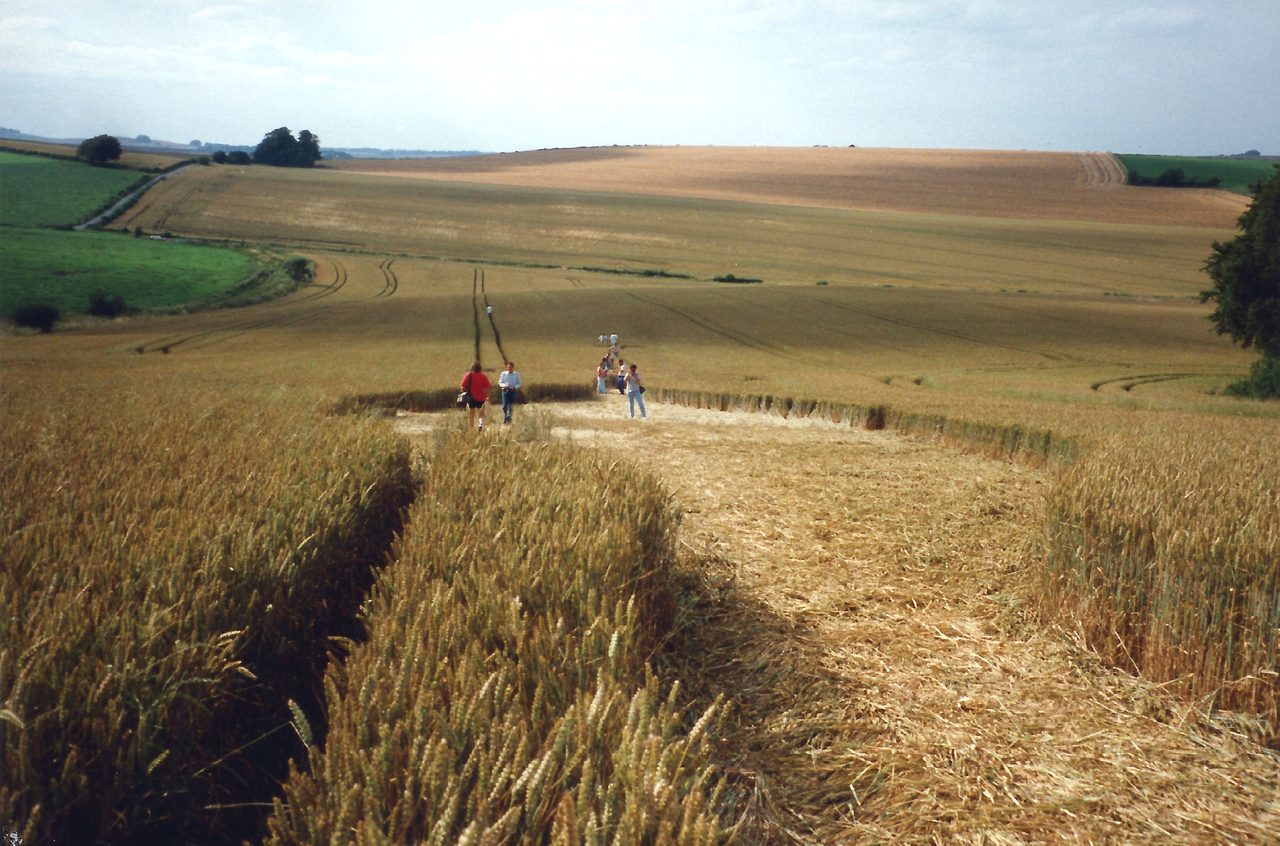
In September 1991 two retired Southampton men, Doug Bower and Dave Chorley, told the press they had been making crop circles since 1978, and then they went out and made one while people watched. Their kit was foot-held planks, known as stomper boards, garden rollers, surveyors' tape, and a loop of wire fitted to a baseball cap so a man could sight a straight line across a dark field. That is the part everyone remembers. The part most retellings drop is what happened next: the pair reproduced formations that had previously been attributed to paranormal origins. A claim of authorship is cheap. A demonstration that closes an expert's own file is not, and that is what this page is built on. Our research document is titled History, Analysis, and Debunking, its Tier 1 section is headed Human Creation Confirmed, and its own one-line verdict is that crop circles are overwhelmingly human-made landscape art. So this page does not ask who makes them. It answers that in the first section and then spends the rest of its length on the things that genuinely are not settled, which are smaller, stranger and far more interesting than the question everybody argues about: whether the plants inside a formation are physically altered, whether an atmospheric vortex could ever have made a plain circle, and what a body of monumental anonymous work made by people who refuse the credit actually is.
Most pages about crop circles keep the answer back until the end, because the answer spoils the atmosphere. This one puts it first, because the answer is better than the atmosphere.
Crop circles, also called agriglyphs, are geometric patterns made by systematically flattening a cereal crop, usually wheat, barley or rapeseed. The modern phenomenon started in the late 1970s in southern England, in the Wiltshire landscape centred on Avebury, Silbury Hill and Stonehenge, and through the 1980s and 1990s the designs escalated from plain circles into elaborate fractal, geometric and symbolic work. That escalation is real and it is documented. So is the reason for it.
Our own research document on this subject is titled History, Analysis, and Debunking. Its first evidence section is headed Human Creation Confirmed and sits at Tier 1. Its summary states the scientific consensus outright: crop circles are overwhelmingly human-made landscape art. This page carries that faithfully, which means the boldest thing available to write here is not a mystery. It is a confession, a plank, and a wire on a baseball cap.
01September 1991: The Plank, The Rollers, And The Wire On A Baseball Cap
In September 1991 Doug Bower and Dave Chorley, retired Southampton residents, publicly confessed to and demonstrated that they had created crop circles since 1978. Their equipment: foot-held planks, known as stomper boards, garden rollers, surveyors' tape, and a sighting wire attached to a baseball cap for straight-line guidance. They demonstrated the technique for journalists and researchers, and their confession was verified by their ability to reproduce formations that had previously been attributed to paranormal origins.
Read the last clause again, because it is the whole case and it is the clause that goes missing. Two men saying they did it proves nothing; people confess to things they did not do all the time. What Bower and Chorley did was go into a field with equipment a gardener already owns and produce, on demand and under observation, formations that specialists had examined and certified unexplainable. That is not a confession. That is an experiment, and the specialists' own certifications were the control group.
The confession was broken by the British newspaper Today on 9 September 1991, and reported the following day, 10 September 1991, in the New York Times, in William E. Schmidt's article 'Two Jovial Con Men Demystify Those Crop Circles in Britain'. Contemporary reporting records that the pair claimed responsibility for more than two hundred crop circles made between 1978 and 1991, and describes their tools as a plank of wood, a rope, and a baseball cap fitted with a loop of wire used to walk in straight lines.
Two things there are worth separating. The tool description was confirmed twice over: our research file and the contemporary press agree on the plank and on the wire loop, independently, which is why the first card on this page can be stated as flatly as it is. The count, more than two hundred formations across thirteen years, comes from the reporting rather than from our file, and it is written here as a claim the two men made rather than as an audited total. Nobody counted their fields for them.
02The Circlemakers Who Signed Nothing
The obvious objection to 1991 is that two retired men could not possibly account for what came afterwards. The designs got harder. They got much harder. And the people who made the hard ones wrote a book about how.
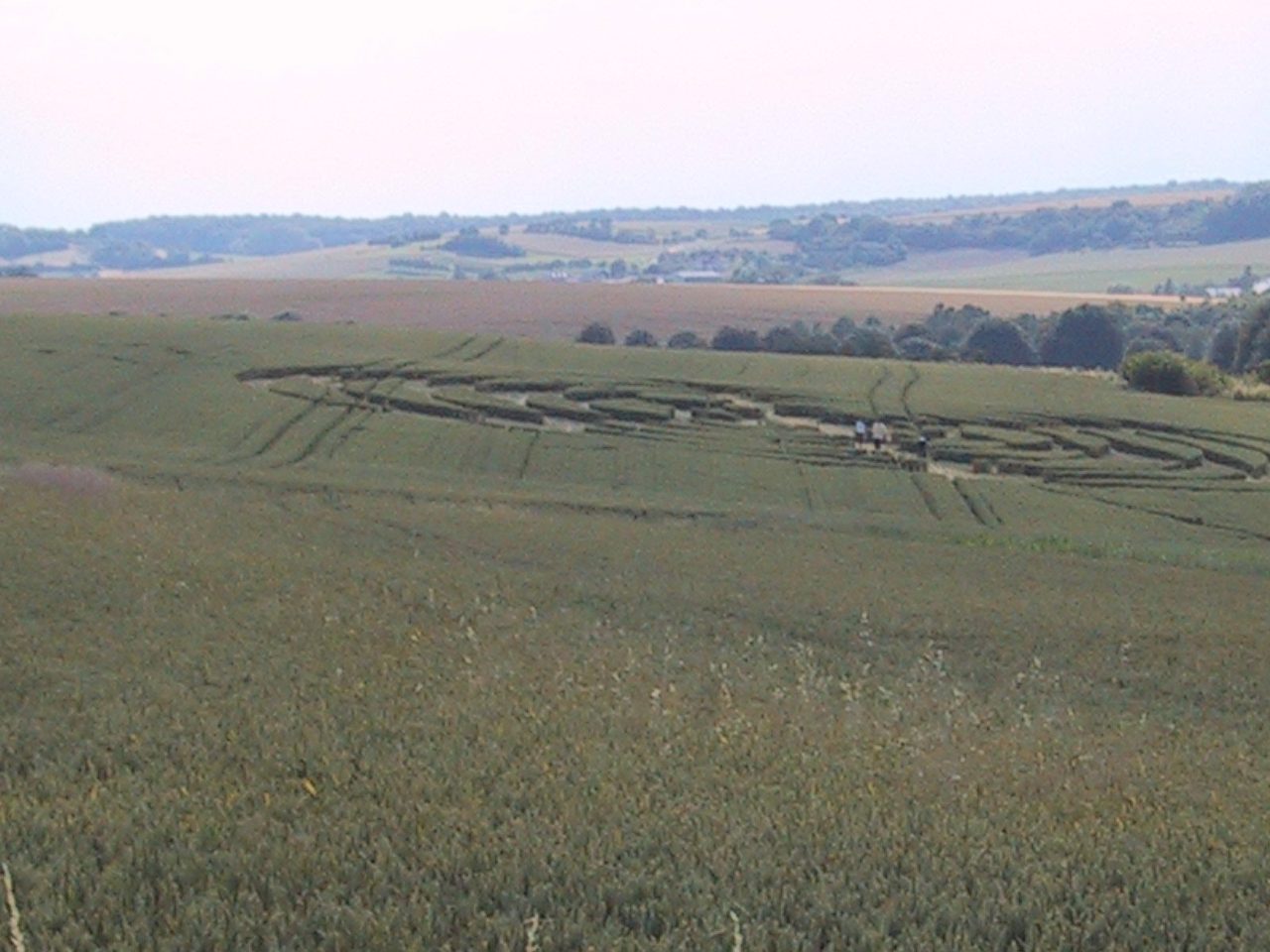
Organised groups calling themselves circlemakers, including John Lundberg and Rob Irving, openly documented their methods and created increasingly complex formations, demonstrating that human teams can produce even the most elaborate designs.
Irving and Lundberg published The Field Guide: The Art, History and Philosophy of Crop Circle Making in 2006. That is not a confession extracted from anyone. It is practitioners describing their own craft in print, which is the most ordinary kind of evidence there is and the kind this subject is oddest about ignoring.
Professional circlemaker groups have since created documented formations of extraordinary complexity, including the 2001 Milk Hill formation, which contained 409 circles and spanned roughly a quarter of a kilometre, and mathematical representations of the Mandelbrot set, Fibonacci spirals, and binary-coded messages.
No span in metres or feet is printed here, deliberately. Our research file gives one figure and the widely repeated popular figure is a different one, neither traces to a measured published source, and a formation whose size is quoted to the metre by people who never measured it is exactly the kind of number this page will not launder. The circle count is solid. The scale is written as what it honestly is: enormous.
Time-lapse recording and documented team operations confirm that complex formations can be completed in a single night, in four to six hours, by teams of three to twelve people.
Proponents argue that some formations appear too complex to be human-made overnight, and that the reported plant anomalies cannot be mechanically replicated. However, documented circlemaker operations have repeatedly produced formations of equivalent or greater complexity in single nights.
The too-complex-for-a-night argument is the load-bearing beam of the entire pro-anomaly case, and it was answered not by an argument but by a stopwatch. A dozen people, a summer night, and six hours of work is a substantial amount of labour. It is roughly the effort a village puts into a carnival float. Applied to standing wheat with planks and tape and a plan drawn out beforehand, it produces the thing on the front of the postcard.
03Bent, Not Broken: What The Plants Are Actually Doing
The second beam is about the crop itself. Walk into a fresh formation and the stems are not snapped off; they are laid over, alive, and within a couple of days they start standing back up. Investigators built a great deal on that, and the plants were doing something completely ordinary.
Plant scientists confirm that bent but unbroken stems in crop circles are consistent with phototropism, stems regrowing toward light, and gravitropism, stems bending upward after being flattened. These are natural plant responses that occur within twenty-four to seventy-two hours of flattening, regardless of the method used to flatten the crop.
Regardless of the method is the clause that does the work. A stem that has been pushed over by a plank, by a garden roller, by a gust of wind or by a tractor wheel responds the same way, because the response is the plant's, not the pusher's. It carries no information at all about what did the pushing. An entire generation of field investigation treated it as a signature.
The swirled pattern of flattened stems is a natural result of the stomper-board technique, which creates a circular downdraft-like lay pattern.
The swirl was the other signature, and it is the same story. It looks like something descended and span. It is what a person walking a circle with a board under their feet leaves behind, every time, because that is the geometry of the motion.
| The Argument For Something Other Than People | What Answers It | At What Grade |
|---|---|---|
| The designs are too complex to be made by people in a single night. | Documented circlemaker operations have repeatedly produced formations of equivalent or greater complexity in single nights: four to six hours, teams of three to twelve people, recorded on time-lapse. | Tier 1, settled |
| The stems are bent, not broken, which no plank could do. | Phototropism and gravitropism bend flattened stems back upward within twenty-four to seventy-two hours, regardless of the method used to flatten the crop. | Tier 1, settled |
| The lay of the crop is swirled, as though something descended and rotated. | The stomper-board technique produces exactly that circular, downdraft-like lay pattern. | Tier 1, settled |
| The plants themselves are physically altered in ways a board cannot cause. | The BLT Research Team reported node elongation and expulsed cavities in peer-reviewed journals; critics name small samples, non-blinded collection, selection bias and ordinary gravitropism, and the reported effects have not been independently replicated under rigorous controlled conditions. | Tier 2, genuinely open |
04The One Thing In This File That Is Genuinely Open
Here is where this page stops agreeing with itself so easily. The following two cards are a matched pair and neither of them is ever printed here without the other, because separated they both become lies.
The BLT Research Team, W. C. Levengood, N. P. Talbott and J. A. Burke, published findings in peer-reviewed journals. Levengood's 'Anatomical Anomalies in Crop Formation Plants', in Physiologia Plantarum volume 92 in 1994, reported statistically significant elongation of stem nodes and expulsed cavities, holes blown outward in the nodes, in crop circle plants compared with controls. Levengood and Talbott's 'Dispersion of Energies in Worldwide Crop Formations', in Physiologia Plantarum volume 105, followed in 1999.
Kevin Folta, a plant geneticist at the University of Florida, and others have noted methodological problems with the BLT findings: small sample sizes, non-blinded collection, potential selection bias, and the fact that node elongation can result from normal gravitropism in flattened plants. The reported effects have not been independently replicated under rigorous controlled conditions.
Take that at exactly its own weight and no more. This is not a hoax being exposed and it is not a discovery being suppressed. It is a real methodological dispute in a real journal, of the kind that runs quietly in every field, and our file grades it Tier 2 in both directions. Have not been independently replicated under rigorous controlled conditions is our file's own precise formulation, and it is neither an accusation of fraud nor an endorsement. It means what it says: nobody neutral has gone and done it again properly.
Notice also what this dispute is and is not about. Even at its strongest, the BLT claim is a claim about plant tissue. It is not a claim about who flattened the crop, and it cannot become one, because the origin question was already answered in section 01 by people who went out and did it in front of witnesses. A node anomaly with no explanation is an open question in plant physiology. It is not a spacecraft.
05Before 1978: A Devil With A Scythe, And Some Fairy Rings
The other line of defence is history. If circles were reported centuries before Bower and Chorley were born, the argument goes, then the modern makers cannot be the origin of the phenomenon. Our file grades the historical material Tier 2, and the hedges it attaches are half of what the cards say.
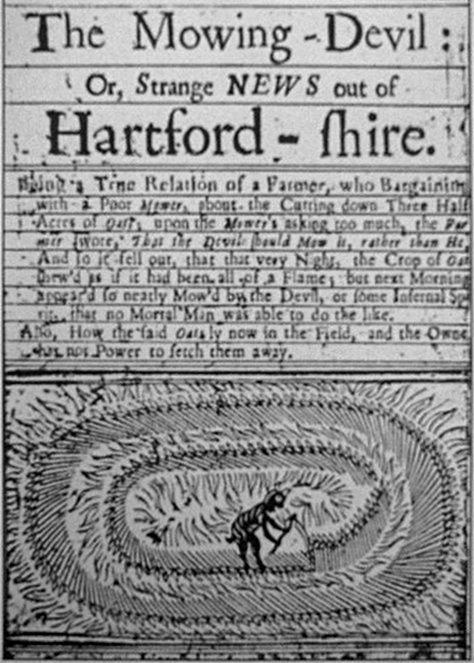
The Mowing-Devil, an English pamphlet of 1678 from Hertfordshire carrying a woodcut, depicts a circular pattern in an oat field attributed to the Devil. It is often cited as the earliest crop circle report, but the account describes the crop as cut rather than flattened, and the single source prevents verification.
Cut rather than flattened is not a quibble. It is the difference between the thing under discussion on this page and a completely different event. A crop circle is standing grain pressed over and left alive; the 1678 pamphlet describes grain reaped. Anyone who reproduces that woodcut without those two hedges, the reaping and the single unverifiable source, is using a genuine seventeenth-century object to make a twentieth-century argument it cannot carry.
Simple circular formations, called fairy rings, appear in folklore across cultures, typically attributed to fairies, witches, or atmospheric phenomena. Most historical accounts likely describe fungal fairy rings or wind damage.
Most, not all: that is our file's own hedge and it stays. Fungi genuinely do grow outward in rings, and weather genuinely does knock down patches of standing crop in shapes with clean edges. Between them they cover the great bulk of the old accounts without anybody needing to have made anything.
06The Vortex, And The Instrument Readings
One correction to the popular version of this argument, because it matters: the debate inside the field was never simply human against alien. The most serious alternative hypothesis anyone put forward was weather, and it came from a physicist.
Terence Meaden, an atmospheric physicist at Oxford, proposed that some simple circular formations could be created by descending plasma vortices, that is electrically charged atmospheric vortices similar to dust devils but with additional electromagnetic properties. He published this in 'The Circles Effect and Its Mysteries' in 1989. Our file's own assessment is that it could potentially account for very simple single-circle formations but cannot explain the complex geometric designs that dominate modern reports.
That limitation is part of the claim, not an editorial swipe at it. Meaden's hypothesis was a serious attempt to explain the plain circles of the early reports with ordinary atmospheric physics, and it stayed at Tier 3 because it could not scale to the pictograms. The atmospheric-vortex family in general is handled in our wider file on anomalous atmospheric phenomena, and this page does not develop the physics further than the card above.
Researchers report elevated radiation readings, electromagnetic interference, and unusual compass behaviour within fresh crop formations. These reports are anecdotal, poorly controlled, and inconsistent across studies.
Anecdotal, poorly controlled, inconsistent. Three hedges, all our file's own, and they are the claim rather than a caveat bolted to it. Properly instrumented anomalous-reading work at Wiltshire monuments does exist and it is a different and much better body of material; it belongs to our dossier on magnetic anomalies at ancient sites, and nothing on this page should be allowed to borrow its credibility.
| What Is Claimed | Who Puts It Forward | Grade | The Limit That Travels With It |
|---|---|---|---|
| Stem nodes in formation plants show statistically significant elongation and expulsed cavities compared with control plants. | The BLT Research Team, W. C. Levengood, N. P. Talbott and J. A. Burke, in Physiologia Plantarum in 1994 and 1999. | Tier 2 | Kevin Folta and others name small sample sizes, non-blinded collection, potential selection bias, and ordinary gravitropism in flattened plants. The effects have not been independently replicated under rigorous controlled conditions. |
| Some simple circular formations could be made by descending plasma vortices: electrically charged atmospheric vortices similar to dust devils, with additional electromagnetic properties. | Terence Meaden, atmospheric physicist at Oxford, in 'The Circles Effect and Its Mysteries', 1989. | Tier 3 | Our file's own assessment: it could potentially account for very simple single circles and cannot explain the complex geometric designs that dominate modern reports. |
| Elevated radiation readings, electromagnetic interference and unusual compass behaviour inside fresh formations. | Researchers reporting from inside formations. | Tier 3 | Anecdotal, poorly controlled, and inconsistent across studies. |
| Complex formations constitute a distinctive contemporary land art tradition, comparable to the work of Robert Smithson or Andy Goldsworthy. | Art historians and cultural commentators. | Tier 2 | It is a claim about what the work is, not about who makes it. The origin question is settled at Tier 1 before this row starts. |
07What This Page Refuses
Claims that crop circles are communications from extraterrestrial intelligences, products of alien technology, or manifestations of Earth energy lack any supporting physical evidence. The confirmed human creation of even the most complex formations eliminates the need for extraordinary explanations.
The 2002 Crabwood alien face formation near Winchester, which included an ASCII-encoded binary message, was designed and documented by human circlemakers.
Sit with the second one for a moment, because it is the best single fact in the file. The most explicitly extraterrestrial artifact the phenomenon ever produced, a face and a coded message in a field, addressed to us, has a documented human author. Not a suspected one. Not an alleged one. Documented. If a message from another intelligence were going to survive scrutiny anywhere in this subject, it would have been that one, and it did not survive at all.
08The Question That Is Still Worth Asking
Our research file ends on an observation about people rather than about crops. Its own words are that the cultural persistence of the phenomenon, despite definitive debunking, illustrates the sociological dynamics of belief maintenance in the face of disconfirming evidence. The phrase definitive debunking is our file's, and so is the interesting complication that follows it.
Because the same file that says definitive debunking also grades this next reading at Tier 2, which is real support, and the two sit side by side without contradiction. Some of the persistence is people refusing evidence. Some of it is people responding correctly to something that is genuinely worth responding to, and getting the category wrong.
Art historians and cultural commentators have increasingly recognised complex crop formations as a distinctive contemporary land art tradition, comparable to the work of Robert Smithson or Andy Goldsworthy: monumental, ephemeral, site-specific works created in collaboration with the landscape and visible primarily from above.
Look at what that description contains. The work is enormous, and it lasts until harvest. It is made for a viewpoint almost nobody occupies. It is site-specific in the strictest sense, since it is made out of the field it stands in and cannot be moved or sold. And it is anonymous by choice: the makers publish their methods and decline the credit for individual pieces, which is close to the opposite of how the rest of the contemporary art world operates. Richard Taylor made this argument in Nature in 2010, which is not a venue that indulges the subject lightly.
Fast Facts
- The Confession
- September 1991. Doug Bower and Dave Chorley, retired Southampton residents, publicly confessed to and demonstrated making crop circles since 1978.
- The Kit
- Foot-held planks known as stomper boards, garden rollers, surveyors' tape, and a sighting wire attached to a baseball cap for straight-line guidance.
- The Clause Everyone Drops
- Their confession was verified by their ability to reproduce formations that had previously been attributed to paranormal origins. Not a claim. A demonstration, in front of journalists and researchers.
- Where It Broke
- The British newspaper Today, 9 September 1991, then the New York Times the following day with William E. Schmidt's 'Two Jovial Con Men Demystify Those Crop Circles in Britain'. Contemporary reporting records the pair claiming more than two hundred formations between 1978 and 1991.
- The Home Ground
- The Wiltshire landscape centred on Avebury, Silbury Hill and Stonehenge, from the late 1970s, with the designs escalating sharply in complexity through the 1980s and 1990s.
- What A Formation Costs In Labour
- Four to six hours, in a single night, by teams of three to twelve people. Confirmed by time-lapse recording and documented team operations.
- The Showpiece
- The 2001 Milk Hill formation: 409 circles, spanning roughly a quarter of a kilometre. Also documented from circlemaker groups: the Mandelbrot set, Fibonacci spirals, and binary-coded messages.
- Why No Diameter Is Printed Here
- Our research file gives one span for Milk Hill and the widely repeated popular figure is a different one. Neither traces to a measured published source, so this page gives the scale in words instead.
- Why The Stems Are Bent And Not Broken
- Phototropism and gravitropism return flattened stems upward within twenty-four to seventy-two hours, regardless of the method used to flatten the crop. The response is the plant's; it says nothing about the cause.
- Why The Lay Is Swirled
- The stomper-board technique produces a circular, downdraft-like lay pattern as a matter of course.
- The Genuinely Open Dispute
- BLT Research reported node elongation and expulsed cavities in Physiologia Plantarum in 1994 and 1999. Kevin Folta and others name small samples, non-blinded collection, selection bias and ordinary gravitropism, and the effects have not been independently replicated under rigorous controlled conditions. Tier 2 in both directions.
- The Non-Alien Alternative
- Terence Meaden's plasma-vortex hypothesis, published in 1989: charged atmospheric vortices like electrified dust devils. Tier 3, and our file's own limit is that it could cover very simple single circles and cannot explain the complex designs.
- The Energy Readings
- Elevated radiation, electromagnetic interference and unusual compass behaviour reported inside fresh formations. Anecdotal, poorly controlled, and inconsistent across studies. Tier 3.
- The Earliest Cited Precedent
- The Mowing-Devil, a 1678 Hertfordshire pamphlet with a woodcut of a devil and a scythe. Tier 2, and the account describes the crop as cut rather than flattened, with a single source that prevents verification.
- The Most Alien Formation Ever Made
- The 2002 Crabwood face near Winchester, complete with an ASCII-encoded binary message. Designed and documented by human circlemakers. Tier 4, debunked.
So Who Makes Crop Circles?
People do, and it was proved by demonstration rather than by argument. In September 1991 Doug Bower and Dave Chorley confessed publicly, showed journalists and researchers the plank, the rollers, the surveyors' tape and the wire on the baseball cap, and reproduced formations that had previously been attributed to paranormal origins. Organised circlemaker groups including John Lundberg and Rob Irving then documented their own methods openly and produced the elaborate designs, including the 2001 Milk Hill formation of 409 circles, the Mandelbrot set, Fibonacci spirals and binary-coded messages. Time-lapse and documented team operations put the labour at four to six hours in a single night for teams of three to twelve. The two field signatures that carried the phenomenon for a generation both dissolve at this tier: stems bend back upward through phototropism and gravitropism within twenty-four to seventy-two hours regardless of the method used to flatten them, and the swirled lay is simply what a stomper board leaves. Our research file's own verdict is that crop circles are overwhelmingly human-made landscape art.
One evidential question is still moving, and it is narrower than anyone wants it to be. The BLT Research Team, W. C. Levengood, N. P. Talbott and J. A. Burke, reported statistically significant node elongation and expulsed cavities in formation plants against controls, in Physiologia Plantarum in 1994 and 1999. Kevin Folta, a plant geneticist at the University of Florida, and others name small sample sizes, non-blinded collection, potential selection bias, and the fact that node elongation can result from normal gravitropism in flattened plants, and the reported effects have not been independently replicated under rigorous controlled conditions. Both halves of that are Tier 2 and neither is printed on this page without the other. Also at this tier, and unresolved on its own terms: the 1678 Mowing-Devil pamphlet, with its own hedges that the crop was cut rather than flattened and that a single source prevents verification; the folklore fairy rings, most of which likely describe fungal rings or wind damage; and the land art reading, which our file supports at Tier 2 and which is a claim about what the work is rather than about who makes it.
Two things sit here and neither of them is extraterrestrial. Terence Meaden, an atmospheric physicist at Oxford, proposed in 1989 that descending plasma vortices, charged atmospheric vortices resembling dust devils, could produce some simple circular formations; our file's own assessment is that this could potentially account for very simple single circles and cannot explain the complex geometric designs that dominate modern reports. And researchers report elevated radiation readings, electromagnetic interference and unusual compass behaviour inside fresh formations, which our file grades anecdotal, poorly controlled, and inconsistent across studies. Those three words are the claim, not a caveat attached to it.
A flat no, and it is our own research file's, at its own lowest tier, in a file that spends its Tier 2 and Tier 3 sections taking the open questions seriously. That crop circles are communications from extraterrestrial intelligences, products of alien technology, or manifestations of Earth energy: no. Those claims lack any supporting physical evidence, and the confirmed human creation of even the most complex formations eliminates the need for extraordinary explanations. The 2002 Crabwood alien face near Winchester, with its ASCII-encoded binary message, the single most explicitly extraterrestrial object the phenomenon ever produced, was designed and documented by human circlemakers. There is no residue here. This is not a subject with a small unexplained remainder at the bottom of it; the origin question was answered in a field in 1991 and the answer has held ever since.
So the honest position on crop circles is not the fun one and it is not the sour one either. It is that the mystery was solved, publicly, by the people who made it, and that solving it did not make the fields empty. Somebody is still out there at two in the morning with a plank and a plan, working in someone else's wheat, making something the size of a village that will be gone at harvest and that they will never sign. Our file grades the reading that this is a land art tradition at Tier 2, alongside Smithson and Goldsworthy, and once you accept that the origin question is closed, that is the question that is actually left. Is a body of monumental, ephemeral, site-specific, anonymous work made by people who refuse the credit best described as a thirty-year hoax, or as the largest unsigned art movement in Britain? Nobody has answered that one. It is a better question than the one it replaced.
Sources & further reading
Everything above is drawn from our research library on Theories of Anything, which is where we worked from. The papers, reports and primary records listed beneath them are where you can check us independently.
Image credits
- Inside a crop formation, Alton Barnes, Wiltshire Rodhullandemu, via Wikimedia Commons. CC BY-SA 4.0 Source.
- Crop formation made by Sudwestrundfunk, Bedersdorf, Germany Roger Zenner, via Wikimedia Commons. CC BY-SA 3.0 (also CC BY-SA 2.0 DE, GFDL) Source.
- The Mowing-Devil pamphlet, 1678 via Wikimedia Commons. Public domain (published 1678) Source.
- Card crop of Inside a crop formation, Alton Barnes, Wiltshire Rodhullandemu, via Wikimedia Commons. CC BY-SA 4.0 Source.


