Where Is Everybody? The Drake Equation and the Fermi Paradox
Seven numbers multiplied together are supposed to tell you how many civilizations are broadcasting in this galaxy right now. Three of them are astrophysics, and all three now carry real measurements, though one of those measurements is not even in the units the equation asks for. Four of them, including how often life starts and how long a technological species lasts, have no measurement behind them at all, which means the answer belongs to whoever picked the guesses. So the Drake equation predicts nothing. It organises ignorance into seven named unknowns, and that is the more useful thing. The silence it points at, the Fermi paradox, is a question a physicist asked walking to lunch in 1950, not evidence for anyone's conclusion. Here is what each term is actually worth now, where the paradox really comes from (the hard version is not Fermi's), and why serious people keep publishing incompatible answers in the same journals.
In early November 1961, the first scientific meeting ever devoted to the search for extraterrestrial intelligence convened at the National Radio Astronomy Observatory in Green Bank, West Virginia. The astronomer who called it, Frank Drake, needed an agenda. What he wrote down was not a theory and it was not a prediction. It was a list of the things you would have to know in order to answer the question, arranged as a multiplication, and it has framed the argument ever since.
Today, three of its seven terms carry real measurements with real error bars. Four of them carry nothing. That imbalance is not a flaw in the equation. It is the equation's entire point, and it is why a formula that cannot predict anything is still the most useful object in the field.
01What Drake Actually Wrote
The Drake equation is a product of seven factors: N = R* x f_p x n_e x f_l x f_i x f_c x L. N is the number of communicative civilizations in the Milky Way. R* is the rate of star formation. f_p is the fraction of stars with planets. n_e is the number of habitable planets per planetary system. f_l is the fraction of those on which life develops. f_i is the fraction of those on which intelligence evolves. f_c is the fraction of those that develop detectable technology. L is the average lifetime, in years, of a communicating civilization. Multiply the seven, get N. That is the whole apparatus, and it has not changed.
| Term | What It Counts | What We Actually Know |
|---|---|---|
| R* (star formation rate) | Stars formed per year in the Milky Way | Measured as a mass rate, not as the count the equation asks for. Converting between them requires assuming an initial mass function. |
| f_p (fraction with planets) | Share of stars that have a planetary system | Close to 1.0. Two methods with completely different systematics agree. The one term that can honestly be called settled. |
| n_e (habitable planets per system) | Rocky worlds in the habitable zone per system | Measured, with published error bars close to the size of the values themselves. |
| f_l (fraction where life starts) | Share of habitable worlds that produce life | Unknown. Bayesian arguments exist from the timing of Earth's own history, and they point in more than one direction. |
| f_i (fraction where intelligence evolves) | Share of living worlds that produce intelligence | Deeply unknown. That is our own research file's phrasing, and it is the right one. |
| f_c (fraction that build detectable technology) | Share of intelligent species we could detect at all | Unknown. No measurement of any kind exists. |
| L (communicating lifetime) | Average years a civilization stays detectable | Unknown, and the answer is more sensitive to this one than to anything else in the product. |
The meeting itself is a matter of archival record. The NRAO/AUI Archives holds the primary file under the title 'Conference on Extraterrestrial Intelligent Life, Green Bank, 1-2 November 1961', and describes its contents as correspondence, a meeting programme, and a listing of the members of the group that named itself The Order of the Dolphin. Secondary accounts often give the dates as 1 to 3 November. The archive's own title says 1 to 2, so that is what we use.
And the equation was never intended to calculate anything. Our own research file states it flatly: it was 'originally a discussion framework, not a prediction tool', and its function is to organise ignorance by naming which variables matter and showing how badly constrained most of them remain. That is not a convenient retrofit. Mark Burchell made the same case in a refereed journal in 2006, writing that the terms, 'when combined, allow an informed discussion of the likelihood of contact with an alien intelligence', and that 'whilst it has a mathematical form (i.e. a series of terms multiplied together to give an overall probability) it is best understood not as an equation in the strictly mathematical sense'.
The attendees then did the obvious thing and ran the numbers themselves. Their estimates for N came out between 1,000 and 100 million, from one room of experts working the same formula. That is our own file's figure and we could not confirm the specific range against a primary source, so take it as ours rather than the archive's. The spread is the point either way: the disagreement was never about the arithmetic.
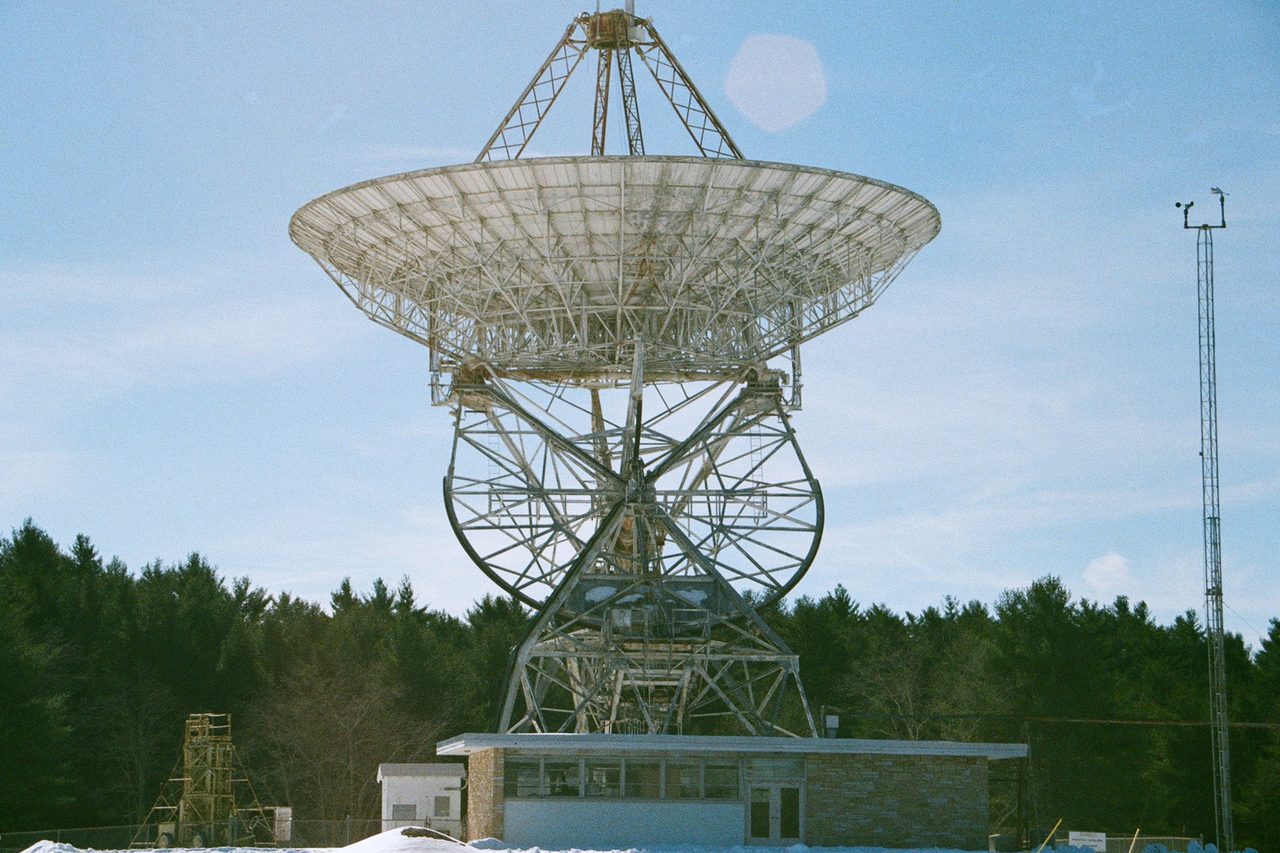
Drake was the one convening that meeting for a concrete reason. Two years earlier, Giuseppe Cocconi and Philip Morrison had proposed in Nature that anyone hunting for interstellar communications should listen at the 21-centimetre hydrogen line. In 1960, Drake did exactly that: a two-month observing programme on the 85-foot Howard E. Tatel telescope at Green Bank, aimed at Tau Ceti and Epsilon Eridani with a receiver tuned to that line. He called it Project Ozma, he listened for roughly 150 hours, and he detected nothing. A year later he needed a list of everything that would have to be true for the listening to be worth continuing. (Ozma and the wider history of the search belong to a separate research file, I_1_06, and we leave them there.)
02The Three Terms That Now Have Numbers
Here is what the exoplanet era actually bought. Three of Drake's seven terms have moved out of guesswork and into measurement, and one of the three did not move nearly as far as everyone assumes. It is worth being precise about how far each one moved, because measured is not the same as known, and on this subject the difference is the whole story.
R* comes first and everybody treats it as the easy one. It is not. R* is a count: how many stars the Milky Way produces per year. The best measurement of the neighbouring quantity is not a count at all. Licquia and Newman's 2015 hierarchical Bayesian meta-analysis puts the Galaxy's star formation rate at 1.65 plus or minus 0.19 solar masses per year, and their abstract states the assumption in the same clause, 'assuming a Kroupa initial mass function (IMF)'. Solar masses per year is a mass rate. Turning it into a number of stars means assuming how that mass divides between big stars and small ones, which is exactly what an initial mass function is. The opening term of the equation is measured in the wrong units for the equation that uses it.
Our own research file gives R* as roughly 1.5 to 3 per year. It cites nothing for that, and it never states per year of what. The numbers happen to land near the measured mass rate, which is a coincidence of magnitude and not a confirmation, so we are not carrying the figure. Flagging it costs us nothing and hiding it would cost a reader everything.
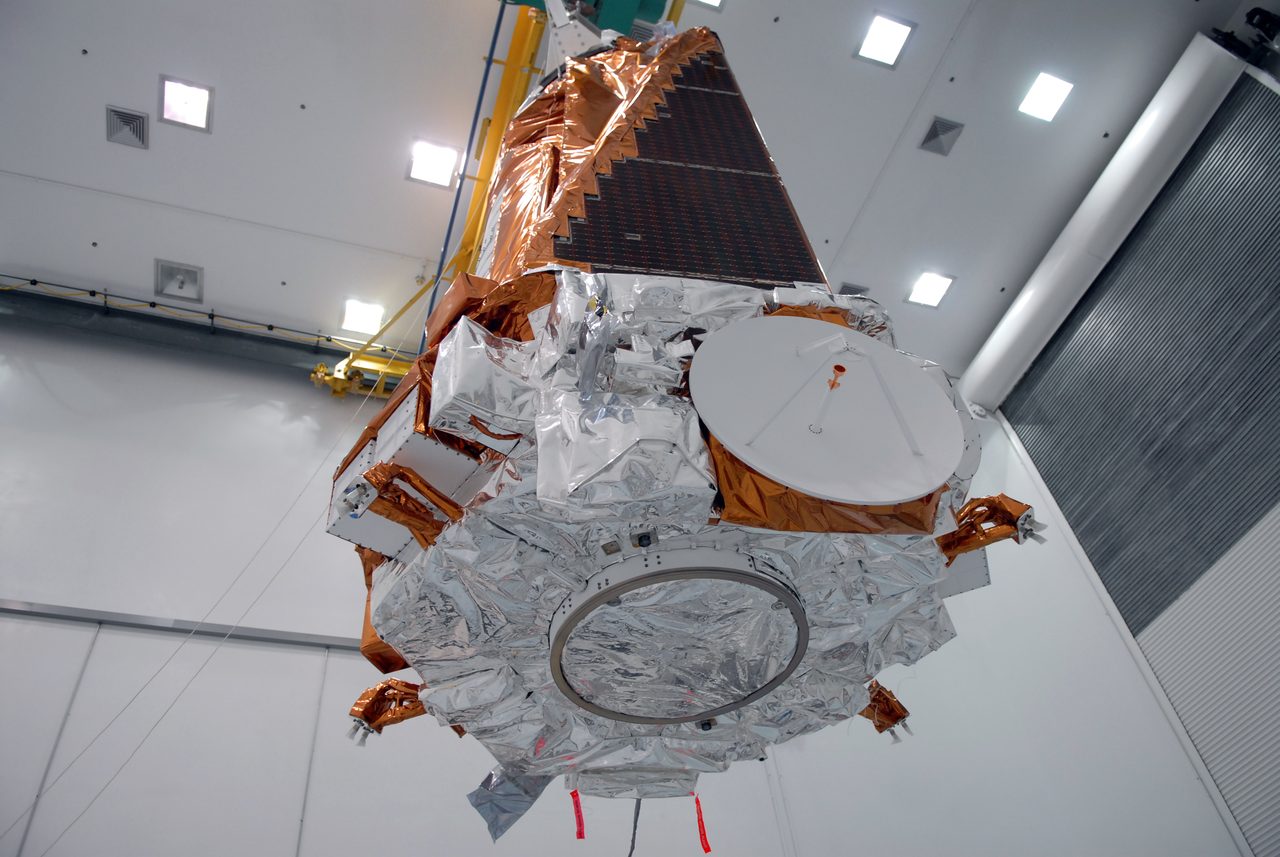
f_p is the success story, and it is the only term in the equation that can honestly be described as settled. The fraction of stars with planets is close to 1.0: essentially every star has a planetary system. That verdict does not rest on one instrument. NASA's Kepler mission, launched 6 March 2009 and retired 30 October 2018 with a legacy of more than 2,600 confirmed planet discoveries, got there by watching stars dim as planets crossed in front of them. Cassan and colleagues got there in Nature in 2012 by an entirely different route, gravitational microlensing, concluding that there is one or more bound planet per Milky Way star. Two techniques, completely different systematics, one answer.
n_e is where the word improved gets interesting. Our own file gives the number of habitable planets per system as roughly 0.2 to 0.5 and credits Petigura and colleagues in PNAS, 2013. That paper says something else. Its abstract reports that 11 plus or minus 4 percent of Sun-like stars harbour an Earth-size planet receiving one to four times Earth's stellar intensity, and, extrapolating, that 5.7 (+1.7/-2.2) percent harbour one with an orbital period of 200 to 400 days. The 0.2 to 0.5 range is defensible as a summary of the modern literature, but it belongs to a different paper, and we are correcting the citation here rather than repeating it.
The paper that does support it is Bryson and colleagues, in the Astronomical Journal in 2021. Defining eta-Earth as the habitable-zone occurrence of planets between 0.5 and 1.5 Earth radii around stars between 4800 K and 6300 K, they find between 0.37 (+0.48/-0.21) and 0.60 (+0.90/-0.36) planets per star for the conservative habitable zone, and between 0.58 (+0.73/-0.33) and 0.88 (+1.28/-0.51) for the optimistic one. They add, at 95 percent confidence, that the nearest habitable-zone planet around a G or K dwarf is about 6 parsecs away, and that there are about 4 habitable-zone rocky planets around G and K dwarfs within 10 parsecs of the Sun. Now read the error bars. The lower bound of the conservative estimate is 0.16 and the upper bound of the optimistic one is over 2. That is more than an order of magnitude of spread on the one term everybody assumes is now solved, and the authors say why in their own abstract: the uncertainties are large because so few small habitable-zone planets have actually been detected.
03The Four Terms That Have Nothing
f_l, f_i and f_c have no measurements at all, and our own file's words for them are the honest ones: f_l is 'unknown, optimists ~1.0, pessimists vanishingly small'; f_i is 'deeply unknown'; f_c is 'unknown'. Burchell's refereed assessment reaches the same place in colder language, separating the astrophysical terms, which are becoming directly measurable, from the social ones, which are 'still a priori unknowable'. Three of seven factors are unbounded. A product with three unbounded factors has an unbounded answer, and no amount of better telescopes changes that.
L is worse, because L is the term the answer is most sensitive to. It is the average number of years a civilization stays detectable, and nothing in physics, biology or history constrains it. Our own file puts its plausible range at anywhere from about 100 years to millions of years, depending entirely on which assumptions are adopted, and cites nothing for either end. Watch what that does downstream. When Westby and Conselice published their estimate of how many civilizations are out there, they set L to 100 years, on the stated ground that our own radio era has lasted about that long. Move that single assumption and the answer moves by orders of magnitude. One unmeasured term, and it swings the result harder than every measured term combined.
Nobody has measured f_l or f_i, but people have done serious statistics on them, and the results are modest and point in opposite directions. Kipping's objective Bayesian analysis in PNAS in 2020 takes two facts about Earth, that life appeared very early in the planet's habitable window and technological intelligence appeared very late, and asks what odds they imply. The earliest microfossil evidence makes rapid abiogenesis at least 2.8 times more likely than slow abiogenesis, rising to 8.7 times if the more disputed carbon-13-depleted zircon evidence is accepted. For intelligence, the analysis slightly favours a rare-intelligence scenario, at 3 to 2 betting odds. Kipping's own summary: rerun Earth's clock and life should frequently reemerge, but intelligence may not be as inevitable. Three to two is not much of a lead, and he says so.
Snyder-Beattie, Sandberg, Drexler and Bonsall came at the same terms from the other end, in Astrobiology in 2021, with a Bayesian model of the timing of Earth's major evolutionary transitions: abiogenesis, eukaryogenesis, sexual reproduction, multicellularity, intelligence. Their finding is that the expected times for those transitions likely exceed the lifetime of Earth, perhaps by many orders of magnitude, which they read as corroborating Brandon Carter's argument that intelligent life in the universe is exceptionally rare, on the assumption that intelligence elsewhere requires analogous transitions. They also name what would overturn them: exceptionally conservative priors, evidence for much earlier transitions, multiple instances of transitions, or an alternative model. That is a falsifier, written by the authors, which is why this result belongs in the argument and a vague feeling that life must be rare does not.
How life starts in the first place is an enormous subject and it is not this one. The chemistry lives in a separate research file on abiogenesis, R_1_01. What belongs here is the statistics, and the two papers above are exactly that: not claims about how life began, but claims about what the timing of Earth's own transitions can and cannot tell you about the odds.
04So What Is N?
Put it together and modern estimates of N run from much less than 1, meaning we are alone, out to thousands or millions. That is not a field in disarray. It is the arithmetic being honest with you. When four of seven factors are guesses, any single N a source quotes is a statement about that source's assumptions, not a statement about the galaxy.
Westby and Conselice put a number on it in the Astrophysical Journal in 2020, and they did it in a major refereed journal with their assumptions on the table. Adopting what they call the Strong Astrobiological Copernican condition, that intelligent communicating life forms between 4.5 and 5.5 billion years after its host star does, as it did on Earth, they find there should be at least 36 (+175/-32) communicating civilizations in our Galaxy, and that if these were spread uniformly the nearest would be at most 17,000 (+33,600/-10,000) light years away. They state plainly that this is a lower limit resting on L being 100 years, and that most such hosts would have to be M dwarfs, which may not be stable enough to support life over long timescales. Look at the error bar before you look at the 36: it runs from 4 to 211.
Two years earlier, Sandberg, Drexler and Ord had argued that the paradox is an artifact of how the equation gets used. Point estimates for each term hide the fact that current scientific knowledge corresponds to uncertainties spanning multiple orders of magnitude. Propagate realistic probability distributions through the equation instead of single numbers and the result, in their words, is 'a substantial ex ante probability of there being no other intelligent life in our observable universe'. No speculative mechanism destroying alien civilizations is required. The paradox dissolves. This one sits a tier down for a reason that has nothing to do with its quality: it is an arXiv preprint and it has not been through peer review.
Frank and Sullivan reframed the whole question in Astrobiology in 2016 in a way that sidesteps the worst of the problem. Instead of asking how many civilizations exist now, they asked how likely it is that ours is the only one that has ever existed anywhere. Their result: as long as the probability that a habitable-zone planet develops a technological species is larger than about 10 to the minus 24, humanity is not the only time technological intelligence has evolved in the observable universe. Read that carefully, because it is easy to inflate into something it is not. It is a lower bound on a probability, stated across the entire observable universe and all of cosmic history. It is not a headcount of anyone alive now.
| Result | What It Concludes | Publication Status |
|---|---|---|
| Westby and Conselice 2020, Astrophysical Journal | At least 36 (+175/-32) communicating civilizations in the Galaxy, on the explicit assumption that L is 100 years | Peer reviewed |
| Sandberg, Drexler and Ord 2018, 'Dissolving the Fermi Paradox' | A substantial ex ante probability that there is no other intelligent life in our observable universe | arXiv preprint, not refereed |
| Frank and Sullivan 2016, Astrobiology | If the probability that a habitable-zone planet develops a technological species exceeds about 10 to the minus 24, ours is not the only time it has happened anywhere in cosmic history | Peer reviewed |
Those results are incompatible and all of them are serious. One says the Galaxy should hold at least 36 communicating civilizations on an assumed 100 year communicating lifetime, with an error bar running from 4 to 211. Another says there is a substantial chance we are the only intelligent life in the observable universe. They were produced by credentialed people, using published methods, from broadly the same data, inside the same decade, and not one of them has been refuted. That is not a failure of the field. It is the honest state of it, and it is precisely what a formula built to organise ignorance is supposed to expose.
None of this is a popular mnemonic that working scientists merely tolerate, either. Prantzos published a joint analysis of the equation and the paradox in the International Journal of Astrobiology in 2013. Cirkovic published on the equation's temporal aspect in Astrobiology in 2004, arguing that a formula 'usually presented as the central guide for the research on extraterrestrial intelligence' nonetheless 'tacitly relies on unverifiable and possibly false assumptions'. Prantzos's paper appeared in that journal's special issue on the fifty years of the Drake equation, the same issue that carries Drake's own retrospective on it.
05Fermi Asked a Question. He Did Not Answer It.
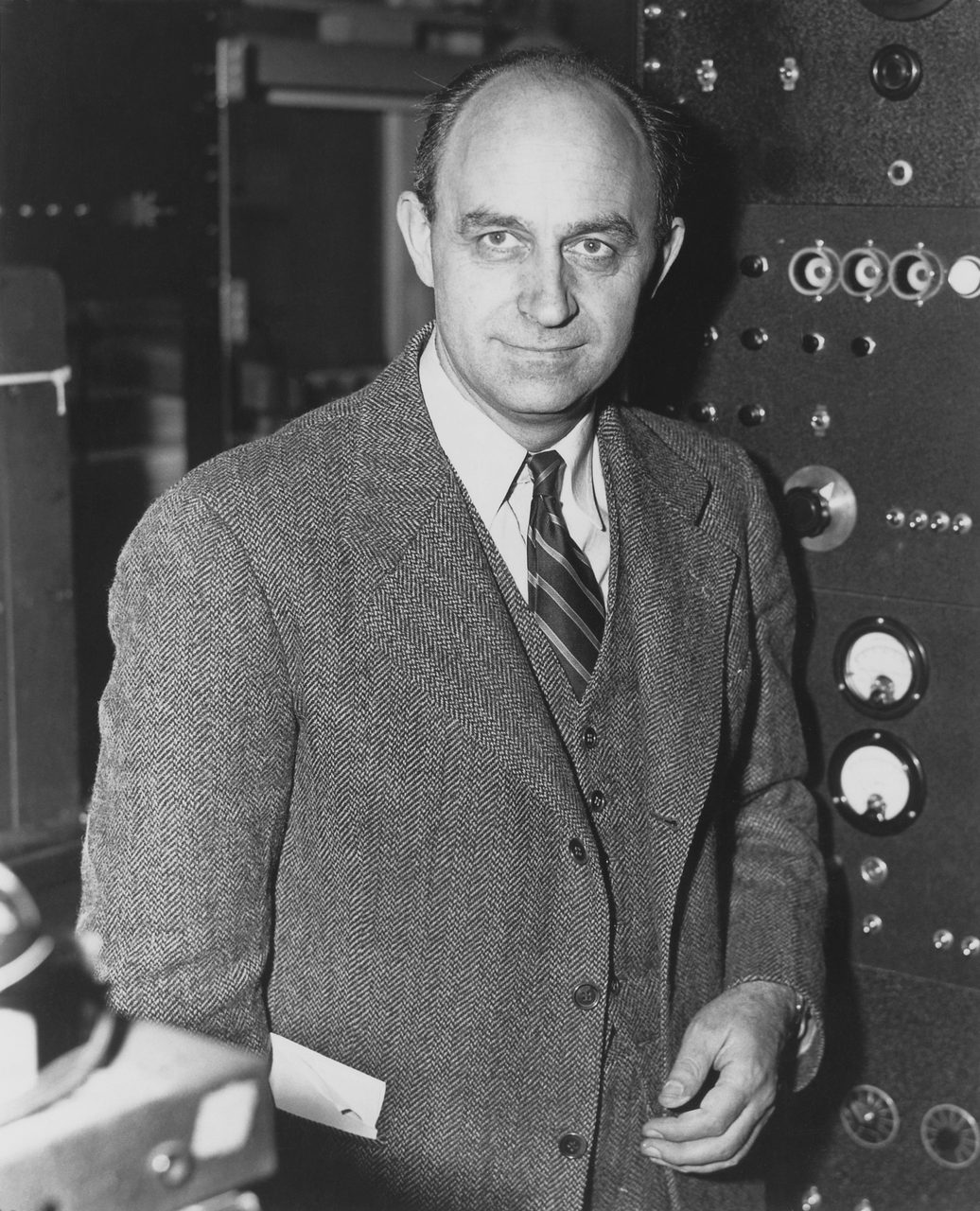
The most famous question in the field has a primary record, and almost nobody reads it. In March 1985 the Los Alamos National Laboratory published a report by Eric M. Jones, LA-10311-MS, titled 'Where Is Everybody? An Account of Fermi's Question', in which Jones collected the recollections of the surviving witnesses. Here is what it says. In the summer of 1950, Enrico Fermi, Emil Konopinski, Edward Teller and Herbert York were walking to lunch at Fuller Lodge. They had been talking about flying-saucer reports and about whether faster-than-light travel was feasible. The subject had already moved on when Fermi asked his question. The three witnesses do not agree on the words: Teller recalls 'Where is everybody?'; York recalls 'Don't you ever wonder where everybody is?'; Konopinski recalls 'but where is everybody?'. York further recalls that Fermi ran a series of rough calculations on the spot, covering the probability of Earth-like planets, of life given a planet, of humans given life, and the likely rise and duration of high technology, and concluded that we ought to have been visited long ago and many times over.
And then, per York, Fermi offered explanations. Three of them: that interstellar flight is impossible; that it is possible but always judged not worth the effort; or that technological civilization does not last long enough. Not one of those is 'nobody is out there'. The man the paradox is named after asked a question, sketched some arithmetic, and suggested the travel might simply not happen. He never published a word on the subject. That three eyewitnesses to the most quoted question in the field cannot agree on its wording is not a footnote, either. It is the shape of the whole subject in miniature.
This is not our quibble. Robert Gray argued it in the peer-reviewed journal Astrobiology in 2015, in a paper whose title is the entire argument: 'The Fermi Paradox Is Neither Fermi's Nor a Paradox'. Fermi never published on the subject, and his only documented remark suggested that interstellar travel might be infeasible rather than that extraterrestrial intelligence does not exist. The argument that intelligent life would inevitably colonise the galaxy and therefore does not exist, because we see no visitors, originates with Michael Hart. Gray also argues that the misattribution has had practical consequences, having been invoked in congressional discussions to defund SETI. Our own research file makes exactly this mistake, building the colonisation argument and hanging it on Fermi. We are correcting it here rather than repeating it.
The hard version has authors and they signed it. Michael Hart's 1975 paper in the Quarterly Journal of the Royal Astronomical Society, which our own file calls 'the first rigorous discussion of the paradox in peer-reviewed literature', argued that the absence of extraterrestrial visitors or probes on Earth is the strongest evidence that they do not exist. Frank Tipler pushed it further in the same journal in 1980, under a title that leaves nothing to interpretation: 'Extraterrestrial intelligent beings do not exist'. Tipler's mechanism was self-replicating probes, which would let any technological species explore the galaxy on a timescale far shorter than the galaxy's own age, so their absence implies the species' absence. The literature calls the pair the Hart-Tipler conjecture. Specific colonisation timescales circulate in secondary sources attached to both men; we did not read either primary paper, so we are not repeating those numbers.

The puzzle underneath is real regardless of who framed it, and the scale is now measured rather than assumed. Xiang and Rix, in Nature in 2022, used precise ages for a large sample of subgiant stars and found that formation of the Galactic old thick disk started 13 billion years ago, only 0.8 billion years after the Big Bang, with most of those stars forming 11 billion years ago during the Gaia-Sausage-Enceladus merger. The Planck 2018 cosmological parameters put the age of the universe itself at about 13.8 billion years. Whatever else here is uncertain, the head start is not: the Galaxy had a stellar population for billions of years before the Sun existed. The Milky Way's total stellar mass comes out at 6.08 plus or minus 1.14 times 10 to the 10 solar masses, which is why its star count is always quoted as a range, on the order of 100 to 400 billion, rather than as a measurement. Converting mass into a count needs that initial mass function again.
Then comes the step that makes the silence bite. Even at sublight speeds, a single technologically advanced civilization could in principle settle the entire galaxy in something on the order of 1 to 10 million years, which, against a Galactic disk that started forming 13 billion years ago, is a blink. The absence of any unambiguous evidence that this has happened is what the literature calls the Great Silence. And it is a modelling result rather than a hand-wave: Carroll-Nellenback, Frank, Wright and Scharf found in the Astronomical Journal in 2019 that the Milky Way 'can be readily filled-in with settled stellar systems under conservative assumptions about interstellar spacecraft velocities and launch rates'. It is also not undisputed. Newman and Sagan modelled galactic settlement in Icarus in 1981 as a diffusion process rather than an expanding wavefront and obtained much longer timescales, and that counter-tradition has never gone away.
06Seventy-Five Answers and No Winner
The scale of the disagreement has actually been catalogued. Stephen Webb's book, in its second edition from Springer in 2015, works through seventy-five proposed solutions to the Fermi paradox, sorted into three families: they are here; they exist but have not communicated; they do not exist. The number is in the book's own subtitle. It is the figure to hold onto, because it tells you exactly how far from settled the question is.
Milan Cirkovic's 'The Great Silence: Science and Philosophy of Fermi's Paradox' (Oxford University Press, 2018) argues that the paradox is underrated as a scientific problem and that its resolution carries profound implications for humanity's future. Our own file calls it the most philosophically sophisticated treatment available. That is our file's editorial judgement rather than a fact about the literature, and we are flagging it as such instead of passing it off as one.
What follows are the serious resolutions, each at its strongest, each with the best objection to it. Nobody is crowned, because nobody has won.
The Great Filter. Robin Hanson's 1998 working paper frames the emptiness as a bottleneck: if the galaxy looks this empty, at least one step on the road from prebiotic chemistry to a galaxy-spanning civilization must be extraordinarily improbable. Hanson's own sentence is the memorable one: 'There thus exists a great filter between death and expanding lasting life, and humanity faces the ominous question: how far along this filter are we?' Behind us means life or intelligence is rare and we are already through. Ahead of us means technological civilizations routinely destroy themselves.
The Great Filter is also not unfalsifiable, which is the charge usually thrown at it. Haqq-Misra, Kopparapu and Schwieterman showed in Astrobiology in 2020 that it is observationally constrainable in principle: upcoming space telescopes searching for biosignatures from the ultraviolet through the near infrared can place upper bounds on how many planets host life. If technosignatures turn out to be common, the filter is probably behind us. If life turns out to be widespread while technosignatures stay absent, the filter probably lies ahead. That is a real test, with instruments that are actually being built.
Rare Earth. Peter Ward and Donald Brownlee's 2000 book argues that one or more of the equation's probabilities is effectively zero, so intelligent civilizations are extraordinarily rare. The exoplanet results cut this hypothesis in half rather than refuting it, and that distinction matters. Its planetary-rarity leg is badly weakened: habitable-zone rocky planets are not scarce, and Bryson and colleagues put about 4 of them, at 95 percent confidence, around G and K dwarfs within 10 parsecs of us. Its complex-life-rarity leg is untouched by exoplanet data and is arguably strengthened by the evolutionary-timing result above. Half a hypothesis is still a hypothesis.
The Zoo Hypothesis. John A. Ball proposed in Icarus in 1973 that advanced civilizations exist but deliberately avoid contact, leaving Earth as a kind of wilderness preserve. The lazy objection is that it cannot be falsified. The good objection is Forgan's, in the International Journal of Astrobiology in 2011: maintaining a galaxy-wide embargo on contact requires a degree of coordination that breaks down, because a single defecting civilization is enough to end it. That is a critique with a mechanism in it, and it is the one worth arguing against.
The Dark Forest. Everyone hides, because the galaxy is dangerous and any civilization that reveals itself risks destruction by a more advanced predatory one. Our own file rates this Tier 3 and it is right to. It is intellectually compelling, and it is a literary and philosophical construct that cannot currently be tested. Most readers met it in Liu Cixin's novel 'The Dark Forest' (Tor, 2015, translated by Joel Martinsen; first published in Chinese in 2008), and a novel is a novel, however good. The refereed antecedent is older and better: David Brin argued the hiding-from-danger family of solutions out in the Quarterly Journal of the Royal Astronomical Society in 1983, in a paper called 'The Great Silence'. It sits in our own file's bibliography and our own file never uses it. We are using it.
The Sustainability Solution. Jacob D. Haqq-Misra and Seth D. Baum argued in the Journal of the British Interplanetary Society in 2009 that exponential expansion is not sustainable, so any civilization that survives long enough becomes slow-growing, low-energy and correspondingly hard to see. A galaxy full of long-lived civilizations would look empty to a search tuned for expansion and waste heat. Their opening line is the whole position: 'No present observations suggest a technologically advanced extraterrestrial intelligence (ETI) has spread through the galaxy.'
We Have Barely Looked. This one has been quantified rather than asserted, and the number is the part you will remember. Wright, Kanodia and Lubar built an eight-dimensional model of the SETI search space, the cosmic haystack, in the Astronomical Journal in 2018, and integrated it analytically to work out what fraction the large radio programmes have collectively examined. Their answer, in their own words: a fraction 'similar to the ratio of the volume of a large hot tub or small swimming pool to that of the Earth's oceans'. They note that many statements of the Fermi paradox implicitly assume we have looked and found nothing, and that this assumption does not survive the arithmetic.
We Are Early. Loeb, Batista and Sloan computed in the Journal of Cosmology and Astroparticle Physics in 2016 the relative formation probability per unit time of habitable Earth-like planets, from the first stars out into the distant cosmic future. Unless habitability around low-mass stars is suppressed, life is most likely to exist near 0.1-solar-mass stars ten trillion years from now, which would make us not lonely but premature. They frame the observational test explicitly: spectroscopic searches for biosignatures around low-mass stars will determine whether present-day life is premature or typical. Note the lead author, who turns up again later in this dossier arguing about an interstellar object. He publishes mainstream cosmology in refereed journals, and flattening him into one position would be a mistake.
The Aurora Effect and Steady States. Carroll-Nellenback and colleagues modelled galactic settlement including the motion of the stars themselves, which adds a diffusive component to any expanding settlement front, and allowed settling civilizations to have finite lifetimes. The result is steady states in which the galaxy sustains a population of interstellar civilizations while many settleable systems sit empty. The authors state the consequence plainly: this breaks the link between Hart's 'Fact A', that there are no interstellar visitors on Earth now, and the conclusion that humans must therefore be the only technological civilization in the galaxy. If you carry only one rebuttal to Hart and Tipler, carry that one, because it answers them with the same physics rather than with a rhetorical move.
Read them together and the useful observation is not which one is right. It is that every one of them is a live position held by people who can do the arithmetic, that several of them make testable predictions, and that no single one of them has won. Anyone who tells you the Fermi paradox has a known answer is telling you about themselves.
07Where UAP Enter, and Where They Stop
There is a fourth family of resolutions, and this is a site about non-human intelligence, so we are not going to skip it. We are also not going to let it take over an article about astrophysics. Here it is, stated fairly, answered fairly, and kept to its size. (There is a further option this article does not weigh at all, that whatever is here never crossed interstellar space in the first place. That argument has its own dossier, Not From Space, From Next Door?.)
The fourth family holds that we do have evidence and do not recognise or accept it. This is the point where UAP discourse intersects the paradox: if unidentified anomalous phenomena represent genuine non-human intelligence, then the paradox is resolved by 'they are here, and we have evidence, but we do not accept it'. Our own research file takes the position seriously enough to file it at Tier 2, which is where it stays here.
The same file then lists three standing objections against its own position, which is a point in its favour. First, UAP evidence does not meet the scientific standard of proof. Second, the Drake and SETI framework assumes electromagnetic communication, not physical visitation, so a UAP resolution is answering a different question from the one the equation asks. Third, the cost and energy requirements of interstellar travel are enormous, though not necessarily prohibitive for a civilization millions of years older than ours. Whether the evidence clears the bar is argued out at length in two companion dossiers, UAP 101 and The Five Observables, and we are not re-arguing it here.
Avi Loeb's 2021 book 'Extraterrestrial: The First Sign of Intelligent Life Beyond Earth' argues that the scientific establishment's dismissal of anomalous physical evidence, including the interstellar object 1I/2017 U1 'Oumuamua and its non-gravitational acceleration, reflects cultural bias rather than scientific rigour. The argument about institutional reflexes is Tier 2 and deserves an answer. His conclusion about that particular object is a separate matter, and it has one.
Both halves of the 'Oumuamua story are published, and any article that gives you only one half is selling something. The measurement is real: Micheli and colleagues reported a non-gravitational acceleration in the trajectory of 1I/2017 U1 'Oumuamua in Nature in 2018. So are the natural explanations. The 'Oumuamua ISSI Team's 2019 review in Nature Astronomy assessed the object's properties and found no compelling evidence favouring an artificial origin, and in 2023 Bergner and Seligman proposed and modelled a specific natural mechanism in Nature: outgassing of molecular hydrogen produced radiolytically inside water ice. Notice the actual shape of this. The anomaly was genuine, it was measured by a mainstream team and published in Nature, and it took five years for a mechanism to be modelled. Loeb's complaint that anomalies get dismissed too quickly and the mainstream's conclusion that this one has a natural explanation are both defensible, and we are not picking a winner between them.
There is also a genuine methodological convergence here, and it is not an endorsement of anything. There is growing recognition within the scientific community that the search should extend beyond radio signals to atmospheric biosignatures, megastructures such as Dyson spheres, industrial pollution, directed-energy signatures and physical artifacts. The 2018 NASA Technosignatures Workshop, held at the Lunar and Planetary Institute in Houston that September, produced a report that is exactly that kind of roadmap. Our own file calls this a partial convergence between SETI methodology and UAP research interests. That gloss is our file's, not the workshop's: the report is a technosignature roadmap, and nothing in it endorses UAP research.
And there is a real fault line running through all of it. The SETI community generally dismisses UAP as a scientific topic; the UAP research community argues that SETI's assumptions about electromagnetic communication ignore the possibility of physical presence. Our own file calls that a significant fault line in contemporary science, and it is. It is also somebody else's article: research file I_1_06 owns that dispute in depth, and this one defers to it after a sentence.
Fast Facts
- The Equation
- N = R* x f_p x n_e x f_l x f_i x f_c x L. Seven factors multiplied together, written by Frank Drake for the first scientific meeting devoted to the search for extraterrestrial intelligence, at Green Bank, West Virginia, in early November 1961.
- What It Is For
- Not prediction. Our own research file calls it 'originally a discussion framework, not a prediction tool', and Burchell's 2006 assessment in the International Journal of Astrobiology says it 'is best understood not as an equation in the strictly mathematical sense'.
- Measured Now
- f_p, the fraction of stars with planets, is close to 1.0 and two independent methods agree. n_e has published occurrence rates whose error bars approach the size of the values: the conservative habitable-zone estimate runs from 0.37 (+0.48/-0.21) to 0.60 (+0.90/-0.36) planets per star, the optimistic one higher still. R* is measured as a mass rate, which is not the star count the equation asks for.
- Not Measured At All
- f_l, f_i, f_c and L. Our own file's words are 'unknown', 'deeply unknown' and 'unknown'; Burchell calls the social terms 'a priori unknowable'. Four unbounded factors inside a seven-factor product.
- Fermi's Actual Question
- Summer 1950, walking to lunch at Fuller Lodge in Los Alamos, recorded in a 1985 Los Alamos report by Eric M. Jones. Three witnesses give three different wordings. Fermi offered three explanations, and not one of them was that nobody exists.
- Whose Argument It Really Is
- The colonise-the-galaxy-therefore-they-do-not-exist argument is Michael Hart's (1975), extended by Frank Tipler (1980). The correction is Robert Gray's, in Astrobiology in 2015. Our own research file gets this wrong, and we correct it above rather than repeating it.
- How Far From Settled
- Stephen Webb's 2015 survey works through seventy-five proposed solutions in three families. Two results two years apart, one peer reviewed and one an unrefereed preprint, give at least 36 communicating civilizations in the Galaxy, on an assumed communicating lifetime of 100 years (the authors' own error bar runs from 4 to 211) against a substantial probability that we are alone in the observable universe. Neither has been refuted.
- Still Refused
- That the paradox has been solved. Our own file carries exactly one Tier 4 tag in its entire length, [UNSUPPORTED], attached to precisely that claim. The refusal runs in both directions.
What the Equation and the Silence Actually Support
Start with what is documented, because there is a lot of it. Drake wrote the equation for the first scientific meeting devoted to the search for extraterrestrial intelligence, at Green Bank in early November 1961, and the NRAO/AUI Archives holds the primary file. Three of its seven terms now carry real measurements: f_p is close to 1.0 with two independent methods agreeing; n_e has published occurrence rates with published error bars; R* has a well-measured neighbouring quantity, a mass rate, which is not the star count the equation actually asks for. The primary account of Fermi's question is a 1985 Los Alamos report, and it records three witnesses disagreeing about the wording and Fermi offering three explanations, none of which was that nobody exists. The colonisation argument belongs to Hart, extended by Tipler, and Gray published the correction in a peer-reviewed journal. All of that is on the record and none of it is in dispute here.
The most serious deflation of the whole question sits here rather than higher, and the reason is publication status, not quality. Sandberg, Drexler and Ord's propagation of realistic uncertainty distributions through the equation, which yields a substantial ex ante probability that there is no other intelligent life in our observable universe, is an arXiv preprint and has not been refereed. The Sustainability Solution sits here too. So does the position that UAP already resolve the paradox, which is where our own research file puts it, and which that file answers with three objections of its own: the evidence does not meet the scientific standard of proof, the framework assumes electromagnetic communication rather than physical visitation, and interstellar travel is enormously expensive, though not necessarily prohibitive for a much older civilization.
The Dark Forest stays here, at our own file's grading, and we are not moving it up. It is intellectually compelling, it is the resolution most readers have actually met, and it is a literary and philosophical construct that cannot currently be tested. A novel is a novel, however good. If you want to argue the hiding-from-danger position seriously, argue it from Brin's 1983 paper in a refereed journal, not from the fiction that popularised it.
And here is the refusal, which is the only verdict this article can honestly reach. No proposed solution has definitively resolved the Fermi paradox. No solution has gained consensus, and the paradox remains an open problem in astrobiology and cosmology. Our own research file carries exactly one Tier 4 tag in its entire length, [UNSUPPORTED], and it is attached to the claim that the paradox has been solved. That refusal runs in both directions, and we mean both. The silence is not evidence that nobody is out there, because Wright, Kanodia and Lubar showed that the searched fraction of the haystack compares to a hot tub against the Earth's oceans. It is also not evidence that somebody is, because nothing has been detected. Seventy-five catalogued solutions and no winner is not a scandal. It is what a genuinely open question looks like after decades of serious people working on it.
So the equation still does the job Drake built it for. It does not tell you how many neighbours you have. It tells you exactly which seven things you would need to know, which three of them we have learned since 1961, and which four are still doing all the work in the answer. That is a sharper instrument than a number would be, and it is why nobody has replaced it. What it cannot tell you is the only thing anyone really wants to know. So here is the question the whole apparatus finally turns on: are the four unmeasured terms small because life and intelligence really are that rare, or do they only look small because we are reasoning from the single example we happen to be?
Sources & further reading
Two files in our own research library stand behind this dossier, I_1_08 and I_1_06. They are where we worked from, not where we can be checked, and this dossier corrects the first of them in three places: it attributes the colonisation argument to Fermi when the primary record and the peer-reviewed correction both give it to Hart and Tipler, it credits an exoplanet figure to a paper that reports a different number, and it gives the equation's first term with no citation and no unit. Everything else here is tied to the record listed beneath: the primary Los Alamos account of Fermi's question, the archive record of the 1961 Green Bank conference, the peer-reviewed papers behind every measured term and every proposed resolution, and the books, preprints and working papers named in the text with the publication status of each stated where it appears. Three Royal Astronomical Society papers predate DOIs entirely and are linked by their NASA ADS records, which we could not machine-resolve; each says so on its own line. Where our own file and a primary source disagree, this dossier follows the primary source and says so in the text.
Image credits
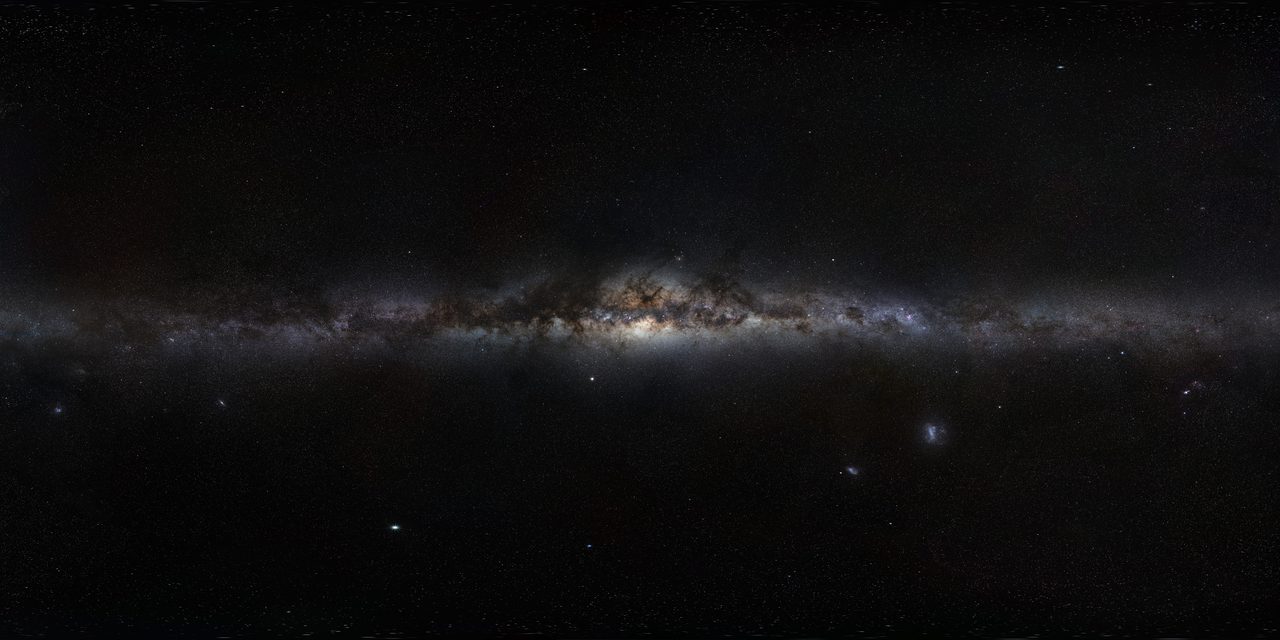
- A 360 degree panoramic mosaic of the whole sky ESO/S. Brunier, via Wikimedia Commons. CC BY 4.0 Source.
- The Kepler spacecraft in the processing facility before launch NASA/Troy Cryder, via Wikimedia Commons. Public domain (a work of NASA) Source.
- The 85 foot Howard E. Tatel Radio Telescope at Green Bank photograph by Z22, via Wikimedia Commons. CC BY-SA 4.0 Source.
- Enrico Fermi, archive-dated between 1943 and 1949 US Department of Energy, Office of Public Affairs, restored by Yann, via Wikimedia Commons. Public domain (a work of a US Department of Energy employee made as part of official duties) Source.
- Fuller Lodge, Los Alamos photograph by Mike McBey, via Wikimedia Commons. CC BY 2.0 Source.
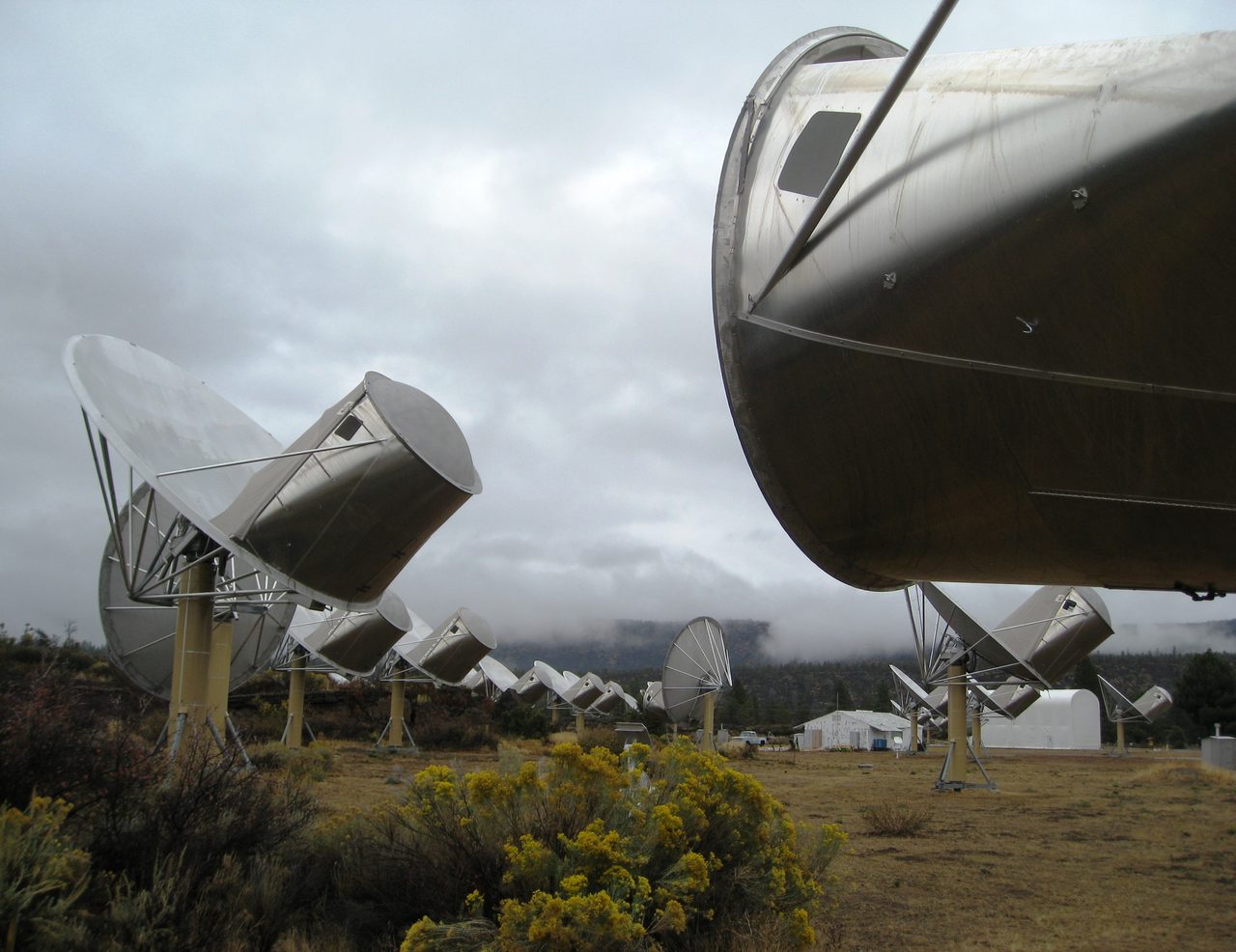
- Dishes of the Allen Telescope Array, northern California photograph by brewbooks, via Wikimedia Commons. CC BY-SA 2.0 Source.
- Card crop of A 360 degree panoramic mosaic of the whole sky ESO/S. Brunier, via Wikimedia Commons. CC BY 4.0 Source.


.jpg)
