Elongated Skulls: Bound, Not Born
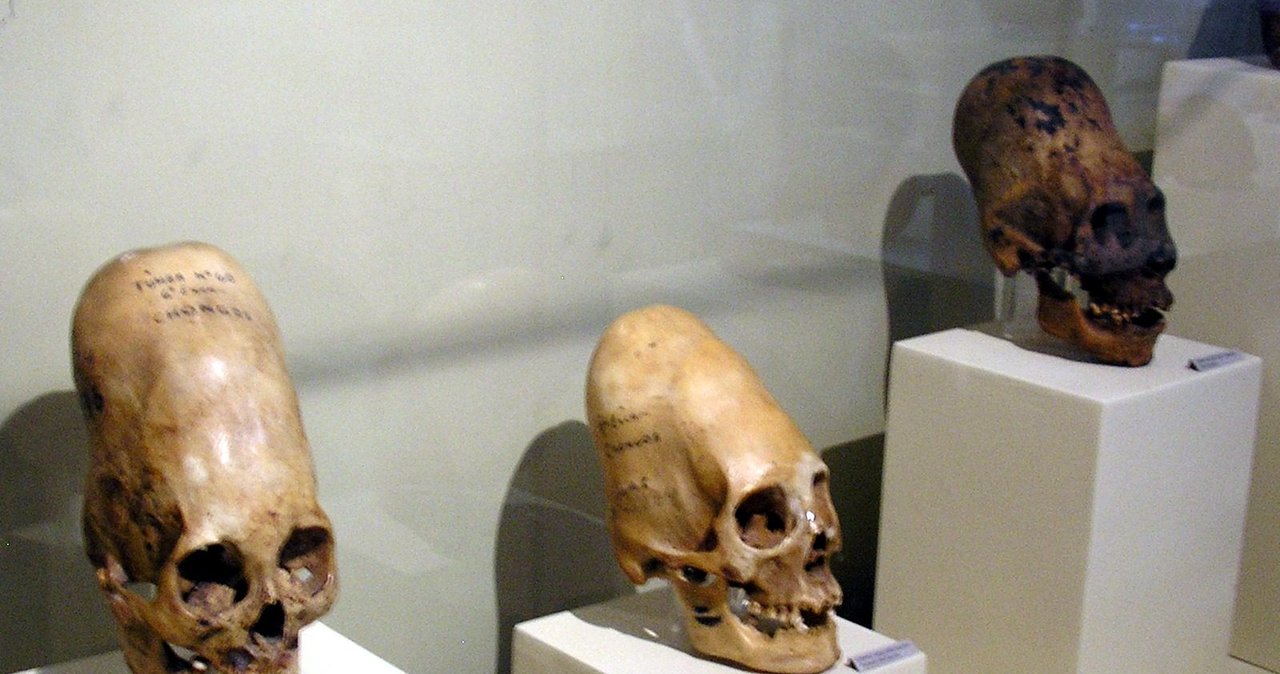
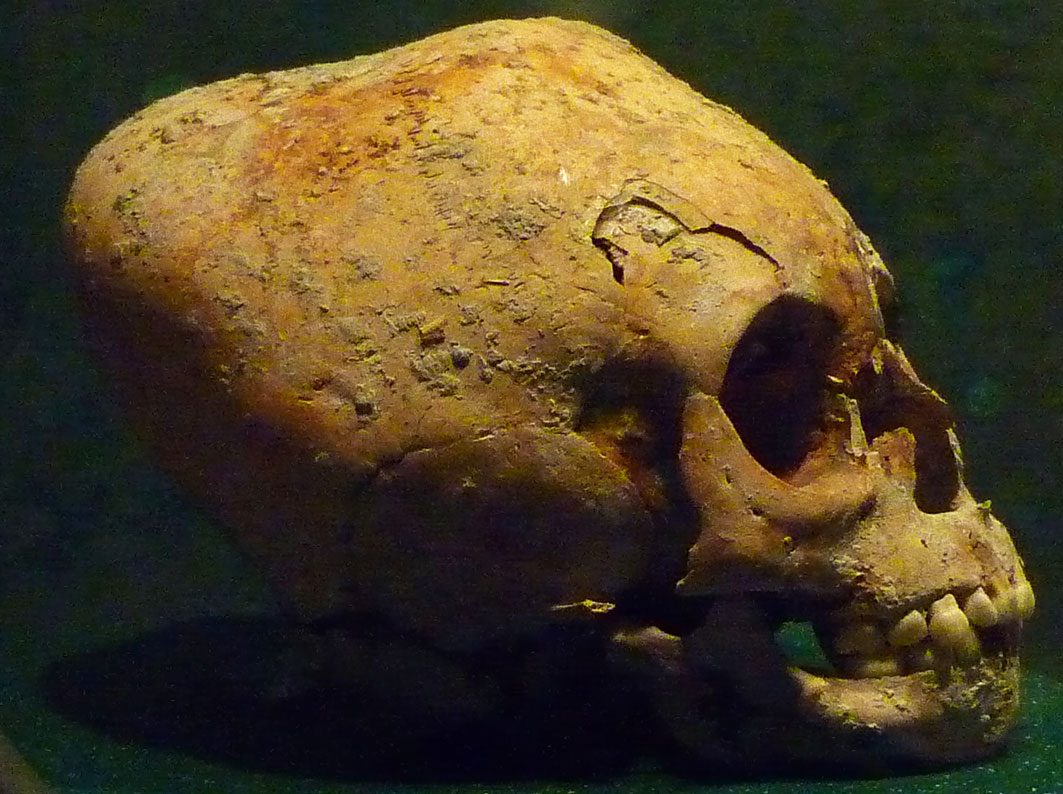
Two thousand years ago, on the south coast of Peru, a woman wound cloth around her newborn's head and drew it a little tighter each month for the next two or three years. Families in Classic Maya cities did the same thing with boards. So did households in Neolithic northeast China, in Migration Period Europe, and on Malakula in Vanuatu. The shape they made is permanent, it is documented across virtually every inhabited continent, and it is why the Paracas skulls look the way they do.
Start in the house, because that is where this happened. A woman on the south coast of Peru winds a length of woven cloth around her infant's head, and draws it a little tighter as the child grows, month after month, for two years and perhaps three. Then she stops, because by then the shape is set for life. The skulls that end up in photographs began with decisions like that one, taken indoors, with cloth and patience.
That is not the version most people meet. The version that travels says the skulls from the Paracas peninsula are too long, too strange, too capacious to be human, that their DNA came back unknown, that they are the remains of something that was not us. Every part of it fails on one sentence of ordinary anatomy you already half know: an infant's skull is not finished. It is still being built.
One thing has to be said before anything is built on top of it. The skulls in this article belonged to individual people. They had families who buried them, and descendants alive right now in Peru, Bolivia, Chile, Mexico, Guatemala, the Pacific Northwest and Vanuatu. Many were taken out of their graves without the consent of any descendant community. They are ancestors, not exhibits, and an article that forgets that has already lost the argument it thinks it is winning.
So this is not a mystery file. It is a file about something human beings have done to their own children on continent after continent, and about the question that is genuinely still open: why so many of them thought of it.
01The Skull That Is Still Being Built
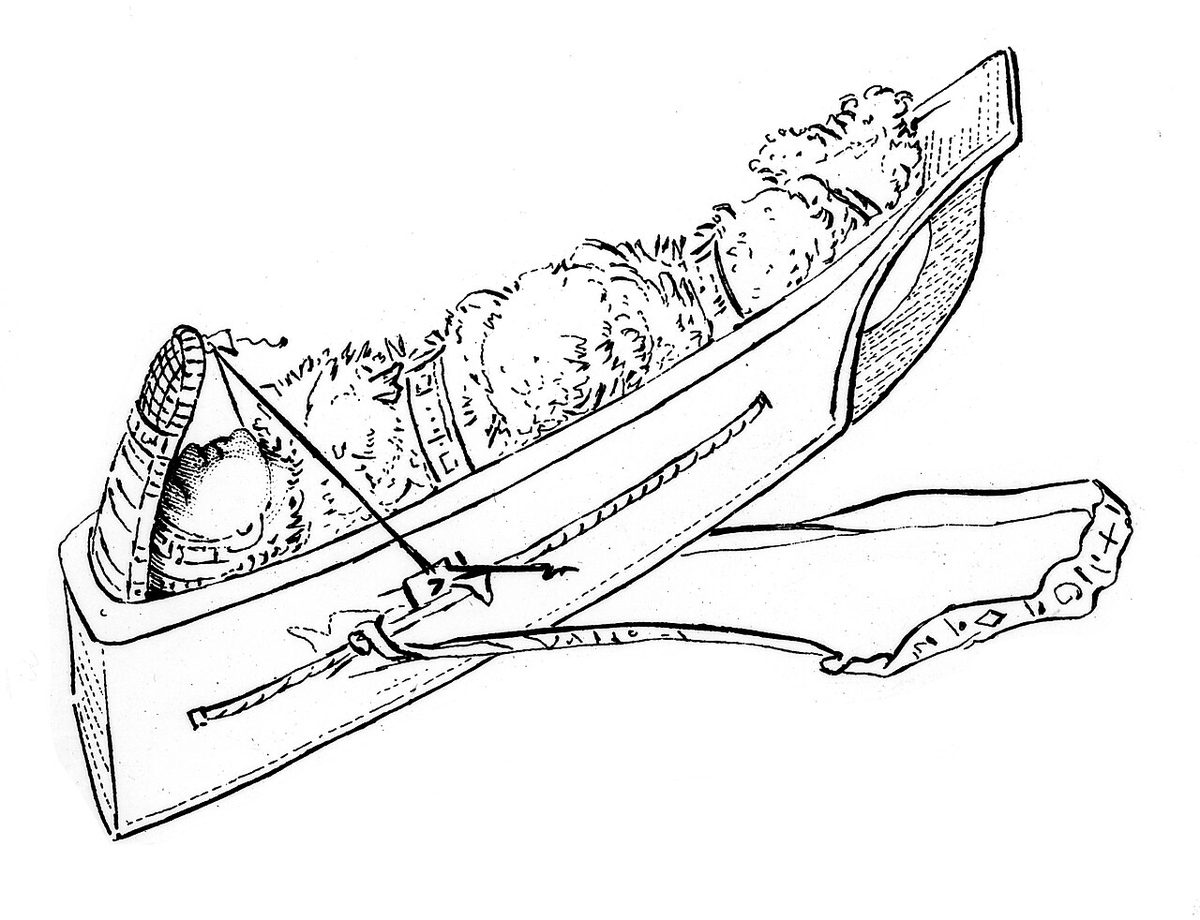
A human infant's skull is not one bone. The vault is a set of separate plates joined by flexible fibrous sutures, with open fontanelles at the corners where several plates meet. That arrangement exists so the head can compress on its way through the birth canal and then keep expanding while the brain grows behind it. The major sutures, sagittal, coronal, lambdoid and metopic, do not fully fuse until late adolescence or adulthood. Apply sustained, gentle pressure during the first two or three years of life and the growing vault expands in the direction of least resistance. The resulting shape is permanent.
Deliberate modification can also be told apart from an accident of infancy, and that has been measured. Black and colleagues showed in 2021, in the journal HOMO, that three dimensional geometric morphometrics, which compares the whole shape of a skull rather than a handful of measurements, reliably separates intentional cranial vault modification from the flattening that can happen when a baby lies habitually in one position. Ross and colleagues had already quantified how intentional modification moves craniofacial landmarks.
02Shape Is Not Volume
Here is the sentence the rest of this article leans on. Binding changes the SHAPE of the skull. It does not increase the amount of bone, and it does not create extra room inside. The vault's material is redistributed, not added, and the brain expands to fill whatever intracranial space is available, whatever outline that space happens to have. A long skull is a rearranged skull, not a bigger one.
Hold on to it, because almost every extraordinary claim made about these skulls is a claim about volume wearing the costume of a claim about shape. Once you know that binding moves bone around rather than making more of it, the claims stop needing to be refuted one at a time.
Reshaping the vault does not stop at the vault. It alters the cranial base and the face in measurable, patterned ways, quantified separately for the two techniques: for fronto-occipital modification by Cheverud, Kohn, Konigsberg and Leigh in 1992, and for annular modification by Kohn, Leigh, Jacobs and Cheverud in 1993, both in the American Journal of Physical Anthropology, following Susan Anton's 1989 study of induced changes to the base and face. Push on the top of a growing skull and the bottom of it, and the face, come along.
The joins themselves respond too. Anton, Jaslow and Swartz published a study of sutural complexity in artificially deformed human crania in the Journal of Morphology in 1992, establishing that the seams between the plates develop differently under a different mechanical regime. A growing skull is not a rigid box being squeezed. It is a living structure growing to the load it is given.
One claim has to be refused rather than repeated, and it comes from this article's own backing research file. That file states, inside its verified section, that some Paracas skulls show naturally higher cranial capacity than average. It names no study, gives no figure and cites no source, and none could be found. The word doing the damage is 'naturally', which concedes the whole premise it is supposedly answering. No cranial capacity figure appears anywhere in this article. Binding redistributes vault material rather than adding any, a measurement on a reshaped vault is not straightforwardly comparable to one on an unmodified skull, and ordinary human capacity varies widely between living people in any case.
03Boards And Cords
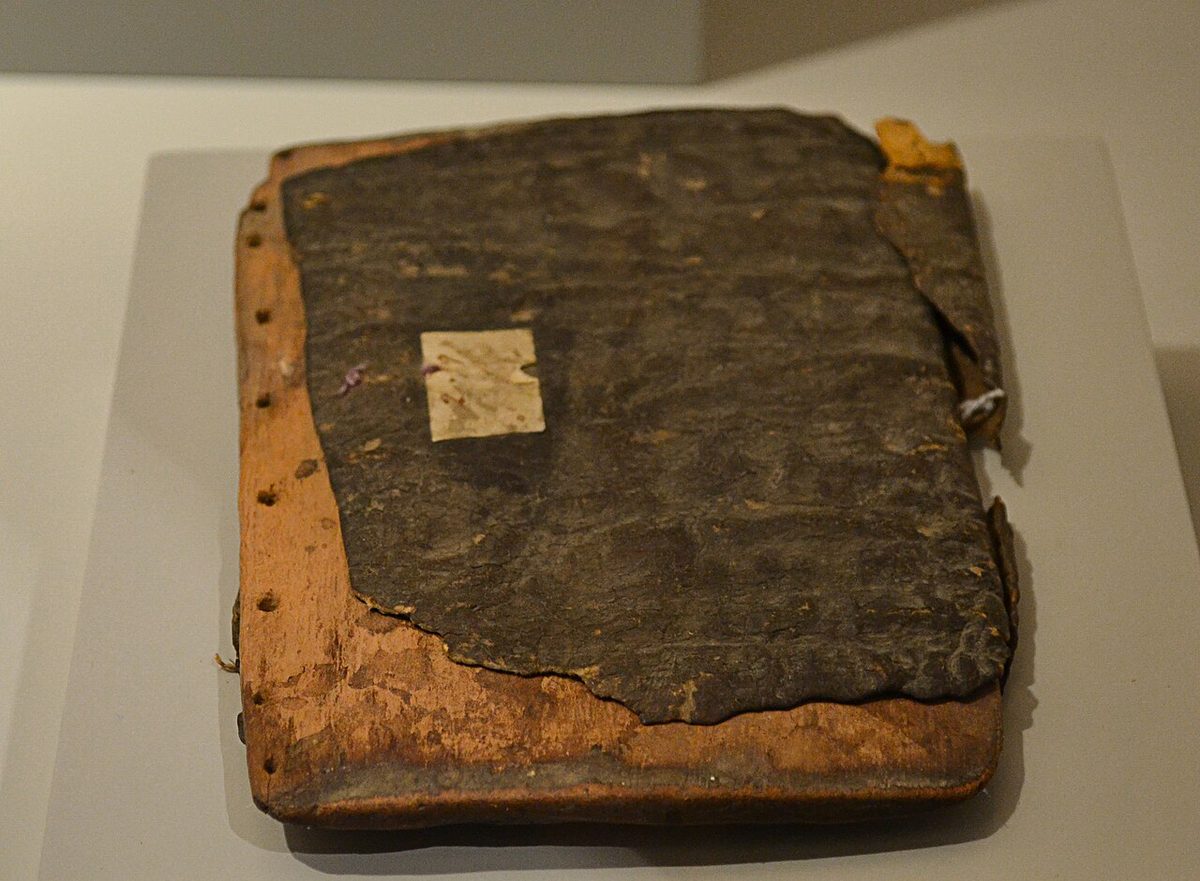
The archaeological record documents two primary techniques, and they are not two settings on one practice. TABULAR modification, also called fronto-occipital, applies flat boards or firm pads to the forehead and the back of the head, producing a broad, flattened vault. CIRCUMFERENTIAL modification, also called annular, wraps bindings around the circumference of the head, producing the tall, tower-like elongation that gives this subject its name. The two leave different signatures, and O'Brien and Stanley showed in the International Journal of Osteoarchaeology that board shaping and cord shaping can be discriminated from the bone itself in Andean populations.
| Technique | How It Was Applied | The Shape It Produces | Where This Article Meets It |
|---|---|---|---|
| Tabular, also called fronto-occipital | Flat boards or firm pads against the forehead and the back of the head | A broad, flattened vault and a sloping forehead | Maya cradle boards; most of the modified crania at Houtaomuga in Jilin |
| Circumferential, also called annular | Bindings wrapped around the circumference of the head | Tall, tower-like vertical elongation | Paracas, predominantly; the Malakula skull the Wellcome Collection records as elongated by circular constriction |
| Combined forms | Both principles at once, in varying proportions | Shapes sitting between the two | Named in the 1938 scheme the vocabulary still descends from |
The vocabulary comes from 1938. Adolfo Dembo and Jose Imbelloni, publishing in Buenos Aires in the Humanior series, set out the scheme archaeologists still work from: tabular erect, tabular oblique, annular or circumferential, and combined forms. Modern bioarchaeology has refined it and in places replaced it, and Vera Tiesler's book-length study is the standing modern reference. But the words in the literature descend from that monograph, which predates ISBNs and for which no identifier could be resolved here, so it carries no link below.
04Twelve Thousand Years Ago, In One Place
The earliest confirmed cases anywhere in the eastern Old World come from the Houtaomuga site in Jilin, in northeast China. Zhang and colleagues, publishing in the American Journal of Physical Anthropology in 2019, examined twenty five skeletons from successive cultural phases and identified eleven showing modification, in both sexes and across a range of ages, spanning roughly twelve thousand to five thousand years before present. Most were the ordinary fronto-occipital pattern. The authors describe the site as carrying the earliest confirmed evidence from the easternmost Old World and the longest continuous practice of it at any single Neolithic site.
Read that span again, because it is what this subject most often gets wrong in the other direction. Not one burial and not one strange individual, but a sequence in one place, running on the order of seven thousand years, excavated, dated and published. That is a long time to keep doing anything on purpose.
It is documented in the Near East as well. Meiklejohn and colleagues surveyed artificial cranial deformation in the Proto-Neolithic and Neolithic Near East across four sites, in Paleorient in 1992, and modified skulls are reported from Tell Arpachiyah in northern Iraq, in the excavation report Mallowan and Rose published in the journal Iraq in 1935.
One much older claim gets made and should not be leaned on. Erik Trinkaus published a two page note in Current Anthropology in 1982 suggesting that the Shanidar 1 and Shanidar 5 Neandertal crania show artificial deformation. This article's backing research file turns that suggestion into a floor date for the entire practice, far older than anything securely excavated, while flagging it as debated inside the same sentence. It is a suggestion about two individuals of a different human species, made in a short comment piece, and it never became consensus. The figure is not used here.
05The Same Idea, Continent After Continent
Artificial cranial modification is documented across virtually every inhabited continent and across many thousands of years, in South America, Mesoamerica, North America, Europe, Africa, the Near East, East Asia and Oceania, among unconnected societies with no plausible contact. This article's backing research file estimates tens of thousands of modified skulls recovered worldwide, and that is an estimate rather than a census.
| Region | What Is Attested | A Named Source For It |
|---|---|---|
| Northeast China | Eleven of twenty five individuals at Houtaomuga in Jilin, across successive phases, from roughly twelve thousand to five thousand years before present | Zhang and colleagues, American Journal of Physical Anthropology, 2019 |
| The Near East | Proto-Neolithic and Neolithic modification across four surveyed sites; modified skulls reported from Tell Arpachiyah in northern Iraq | Meiklejohn and colleagues, Paleorient, 1992; Mallowan and Rose, Iraq, 1935 |
| The Andes | Paracas, Chinchorro communities in Chile, Tiwanaku society in Bolivia, Omo M10 in the Moquegua Valley, the San Pedro de Atacama oases, the Colca Valley | Torres-Rouff 2002; Blom 2005; Hoshower and colleagues 1995; Velasco 2018; Gerszten 1993 |
| Mesoamerica | Maya, Aztec and Zapotec populations, in skeletal remains and in those societies' own sculpture and painting | Tiesler, The Bioarchaeology of Artificial Cranial Modifications, 2014 |
| North America | Head flattening with cradle boards among Chinookan communities of the lower Columbia River and the Choctaw, observed and recorded in the nineteenth century while it was still being done | Tubbs, Salter and Oakes, Clinical Anatomy, 2006; Tiesler 2014 |
| Migration Period Europe | Elongated skulls in fourth to seventh century burials associated with the Huns, Alans, Burgundians, Gepids and Alamanni | Mayall, Pilbrow and Bitadze 2017; Mayall and Pilbrow 2018 and 2019; Fernandes and colleagues 2019 |
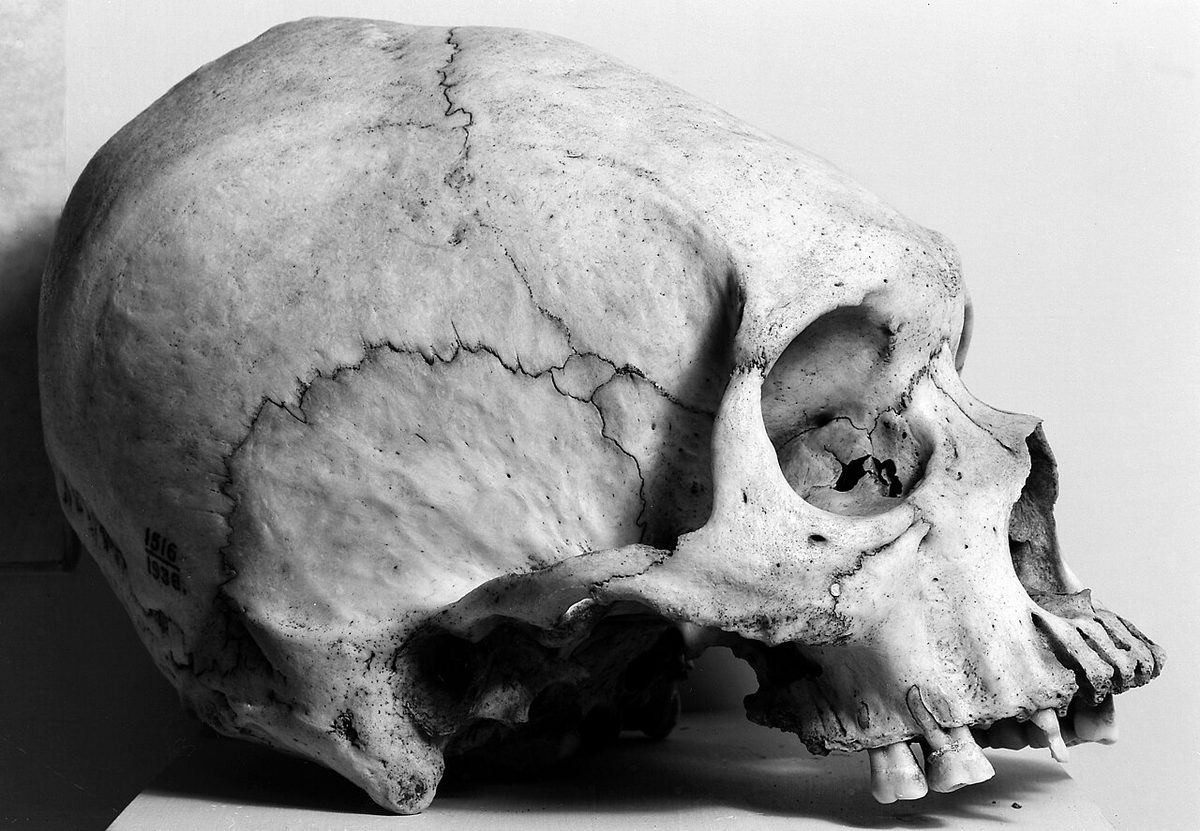
| Oceania | A skull from south-west Malakula, Vanuatu, recorded as showing cranial elongation produced by circular constriction | The Wellcome Collection's own catalogue record |
| Africa | Head shaping recorded in parts of the continent, with Congo, Nigeria and Chad named | This article's backing research file. No peer reviewed regional study was reachable here, which is why this row and the Oceania row are carried at Tier 2 |
Head shaping is extensively documented in Mesoamerica, among Maya, Aztec and Zapotec populations, in skeletal remains and also in those societies' own sculpture and painting. Maya families used cradle boards on infants, and a flattened, sloping forehead was regarded as beautiful. Vera Tiesler's book-length study is the standing reference for the Mesoamerican material.
The art is the underrated evidence there. These societies did not merely practise head shaping, they depicted it, in a visual idiom where the modified profile is the beautiful profile. That is testimony about intent from the people who did it, and it beats any inference drawn from a bone.
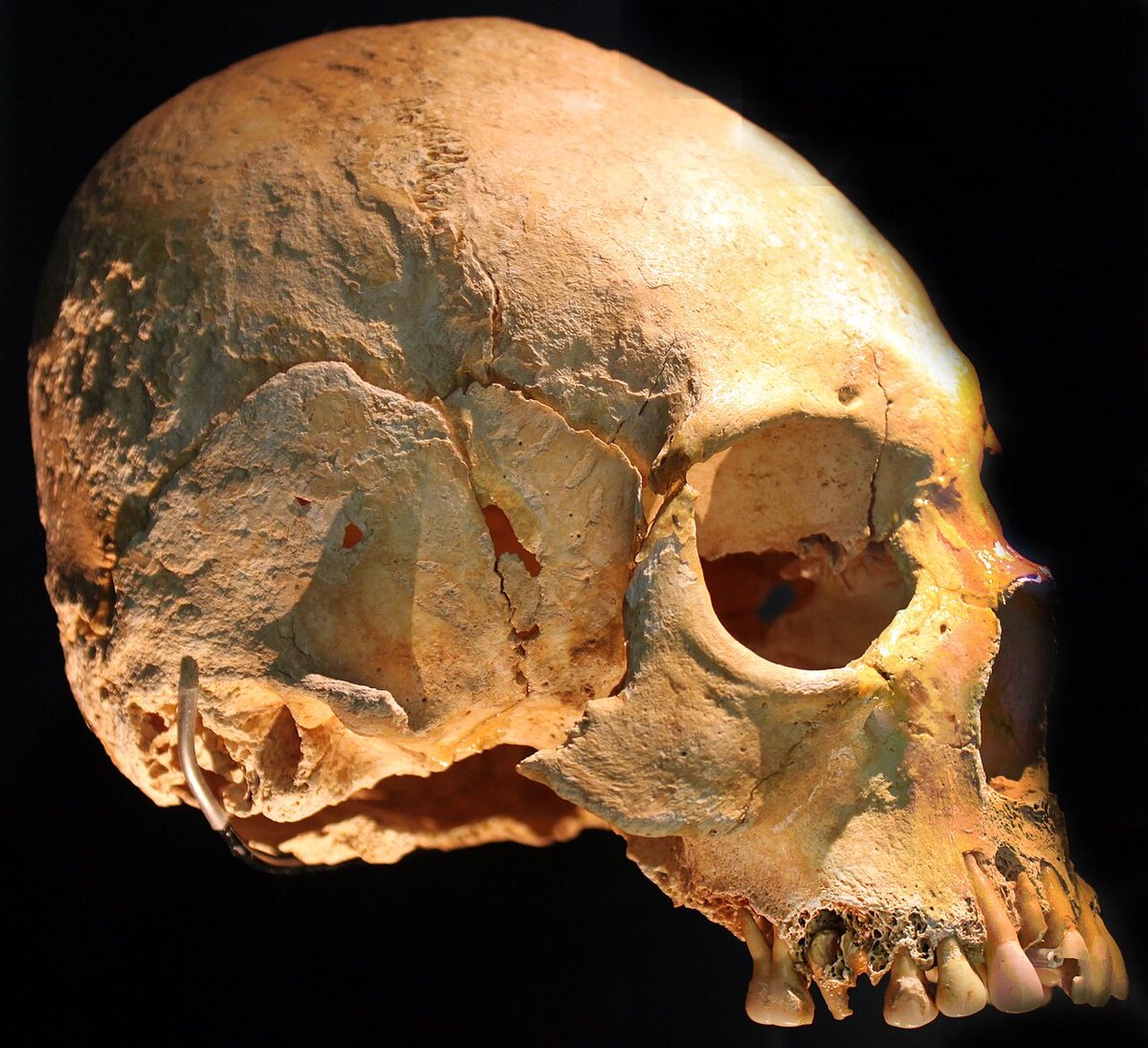
Elongated skulls turn up across Europe in the fourth to seventh centuries CE, in burials associated with the Huns, Alans, Burgundians, Gepids and Alamanni, spreading westward with Central Asian steppe populations during the Migration Period. It is one of the best studied episodes of the practice anywhere. Mayall, Pilbrow and Bitadze compared modified crania from Hungary and Georgia by eigenshape analysis in 2017; Mayall and Pilbrow followed with an ontogenetic study in 2018 and a review of the whole Eurasian record in 2019; and Fernandes and colleagues published genome-wide ancient DNA from three deformed skulls from fifth century Croatia. A tower-shaped skull is not a Peruvian anomaly.
Several Native American peoples of the Pacific Northwest and the Southeast, including Chinookan communities of the lower Columbia River and the Choctaw, practised head flattening using cradle boards. Nineteenth century travellers and artists recorded it while it was still being carried out, which makes the North American material one of the few places where the technique itself, and not only its result, is on the historical record. Those sources file it under an exonym applied from outside, which none of these peoples uses of itself, so this article names the peoples instead.
For Africa and Oceania the record is real and the literature this article could reach is thinner. The backing research file records head shaping in parts of Africa, naming Congo, Nigeria and Chad, and in Oceania, naming Vanuatu and Malakula Island. The strongest single piece of documentation is a museum record: the Wellcome Collection holds a skull from south-west Malakula described in its own catalogue as showing cranial elongation produced by circular constriction, which is the annular technique named by its method.
One line about Vanuatu has to come off the table. The backing research file states twice that cranial modification is still practised in Vanuatu communities today, and gives no source for either statement. This article could not verify it: the peer reviewed literature returned no study of a currently continuing Ni-Vanuatu practice, and the strongest verified evidence is the museum-held skull above, which documents that the practice existed on Malakula rather than that it exists now. Nothing is lost by saying so. The point is that the practice reached Oceania, and that survives intact.
Now count the entries in that table, then count the pairs of them that had any contact with each other. Neolithic northeast China. Proto-Neolithic Iraq. Classic Maya cities. The Andean coast. Migration Period Europe. An island in Melanesia. That is not one idea spreading from one source. That is a species repeatedly arriving at the same idea.
06A Mark You Cannot Take Off
In the Andes the practice is exceptionally well documented: at Paracas and among Chinchorro communities in Chile, across Tiwanaku society in Bolivia, at Omo M10 in Peru's Moquegua Valley, in the San Pedro de Atacama oases, and in the Colca Valley. It is attested there from the early pre-ceramic period onward and into the period after European contact, through peer reviewed excavation and osteology. Christina Torres-Rouff's 2002 study, Deborah Blom's 2005 study, Lisa Hoshower and colleagues' 1995 analysis of Omo M10 and Peter Gerszten's 1993 investigation of northern Chile are a starting shelf, not an exhaustive one.
Bioarchaeologists read cranial modification as a marker of social identity: which group a person belonged to, and sometimes what standing they held inside it. Torres-Rouff examined vault modification and ethnicity at San Pedro de Atacama; Blom treated body modification and diversity across Tiwanaku society; Hoshower and colleagues analysed deformation at Omo M10. Because the shape is applied in infancy and lasts a lifetime, it is a mark of belonging a person can neither put on later nor take off.
The clearest demonstration is the Colca Valley of southern Peru, where two neighbouring peoples chose opposite shapes. The Collagua and the Cabana practised distinct head shaping styles, elongated in one case and flattened in the other, functioning as ethnic identifiers that stayed legible after death. If a long head were simply beautiful in the abstract, two peoples living side by side would not have chosen opposite shapes for their children. The study establishing this is Matthew Velasco's, in Current Anthropology in 2018; this article's backing research file attaches the finding to Blom's 2005 study instead, which is about Tiwanaku, a different society, region and period.
The backing research file records that the shaping was typically carried out by mothers or other female relatives, and that colonial-era Spanish ethnohistorical accounts of Andean practice describe it. No chronicler is named there and none could be located here, so it is carried as what the ethnohistorical record describes rather than as a quotation from anybody. The picture is worth keeping, because it is the opposite of the register this subject usually attracts: a woman with cloth and boards, in a house, adjusting them month after month.
Whether the practice carried health costs is not settled. Some studies have reported higher rates of certain conditions in modified individuals, including raised intracranial pressure during infancy and possible associations with cribra orbitalia, the porous lesions in the eye sockets often read as a marker of anaemia. The evidence is inconsistent across populations. Peter Gerszten and Enrique Gerszten's 1995 review in Neurosurgery is one of the standing clinical treatments.
Both easy answers are wrong there. 'It was harmless' makes the practice comfortable. 'It damaged children' makes it lurid. The evidence supports neither, and saying so is not fence sitting. It is the finding.
There is no convincing evidence that cranial modification affected intelligence, cognition or brain structure in the adults who had undergone it. That matters more than it looks, because the unspoken question underneath a great deal of the writing on this subject is whether these people were different in kind. They were not.
07Paracas: The People In The Bundles
The Paracas culture occupied the Ica Region of Peru's south coast from roughly 800 to 100 BCE. Its burial grounds on the peninsula, above all the Necropolis of Wari Kayan, produced large numbers of mummy bundles, many containing dramatically elongated skulls. Wari Kayan is a continuing peer reviewed research subject: Kelly Knudson, Ann Peters and Elsa Tomasto Cagigao published carbon and nitrogen isotope work on the diet of the people buried there in the Journal of Archaeological Science in 2015.
The Peruvian archaeologist Julio C. Tello excavated the Paracas Necropolis in the late 1920s and recovered a very large number of mummy bundles, more than four hundred by the count this article's backing research file gives, many containing elongated skulls. Tello's own account was published posthumously, with Toribio Mejia Xesspe, as Paracas, Segunda Parte: Cavernas y Necropolis, for which no identifier could be resolved here. Two of the backing file's bibliography entries carry identifiers that resolve to book reviews rather than to the books, one of them a review of a different book by the same author, and neither is cited anywhere in this article.
Physical anthropological examination finds that the Paracas skulls fall inside the range of Homo sapiens cranial anatomy. Despite the outline, every constituent bone of an ordinary human skull is present and correctly identifiable: frontal, parietals, occipital, temporals. The skulls are predominantly of the circumferential type, the wrapped-binding technique that produces extreme vertical elongation.
Say it the plain way, because it needs no expertise to follow. A skull built out of exactly the human parts, in exactly the human arrangement, is a human skull. And these ones belonged to people who lived on the Peruvian south coast about two thousand years ago and were buried by their families in woven textiles of extraordinary quality.
08The Features The Story Leads With
The order of this section is deliberate. Two features carry almost all the weight in the version where these are not people: a single parietal plate, and a foramen magnum in an unusual position. Both stop being puzzles once you know what section 02 established, which is why section 02 came first. Reshaping the vault reorganises the base, the face and the sutures in patterned ways. These are not anomalies. They are predictions.
| What Is Pointed At | What Is Claimed From It | What The Evidence Supports |
|---|---|---|
| A single fused parietal plate, in a small number of skulls | That the skull is built differently from a human one | Fused parietals are a rare but documented anatomical variant in Homo sapiens, and modification is known to affect suture morphology, so a heavily reshaped vault can present a suture that has closed or become hard to read |
| A foramen magnum in an unusual position | That the head sat on the spine differently, so whoever this was, they were built or moved differently | Reshaping the vault alters the cranial base in measurable, patterned ways, quantified separately for board shaping and for cord shaping since the late 1980s |
| Greater cranial capacity | That the skull holds more brain than a human skull does | No study is named for it in the backing research file or was reachable elsewhere. Binding redistributes vault material rather than adding any, a measurement on a reshaped vault is not straightforwardly comparable to one on an unmodified skull, and ordinary living human capacity varies widely in any case |
A small number of Paracas skulls are reported to show what looks like a single fused parietal plate, where two separate parietals joined by the sagittal suture would be expected. Two ordinary explanations are available. Fused parietals are a rare but documented anatomical variant in Homo sapiens. And modification is known to affect suture morphology, so a heavily reshaped vault can present a suture that has closed or become hard to read. The backing research file states flatly that extreme modification causes premature fusion; the study located here establishes an effect on sutural complexity, which is weaker, and this article does not make the stronger claim.
In heavily modified skulls the foramen magnum, the opening at the base through which the spinal cord passes, can appear displaced relative to its usual position. That is a consequence of the overall reshaping rather than a separate finding. Reshaping the vault alters the cranial base in measurable, patterned ways, and that has been quantified separately for board shaping and cord shaping since the late 1980s.
09What A Haplogroup Actually Is
A mitochondrial haplogroup is a branch of the maternal family tree. Everyone alive is on one, and the American branches are known and named: haplogroups A, B, C, D and X are the founding maternal lineages of the Indigenous peoples of the Americas, carried in from Beringia at the peopling of the continents. Tamm and colleagues set out the standard account in PLoS ONE in 2007. So finding one of those lineages in an ancient Peruvian individual is finding precisely what an ancient Peruvian individual is expected to carry.
Which means a headline announcing that a Paracas individual carried one of the American founding lineages is a headline announcing that an ancient Peruvian was an ancient Peruvian. The backing research file names three subclades as findings without attaching any study to them, and this article could not determine which analysis produced them, so it does not repeat them as a result.
Ancient DNA from the Peruvian south coast has been in the peer reviewed literature for over fifteen years. Lars Fehren-Schmitz, Markus Reindel, Elsa Tomasto Cagigao, Susanne Hummel and Bernd Herrmann analysed mitochondrial DNA from 218 ancient individuals across chronologically successive sites in the Palpa region, publishing in the American Journal of Physical Anthropology in 2010, and placed the Nasca populations in clear proximity to the preceding Paracas culture, within Native American mitochondrial lineages. The same group extended the work to Andean highlanders in 2011 and to the region's demographic history in 2014. The backing research file sends readers to the wrong journal for the 2010 paper, which matters, because it is the one citation a sceptic would follow.
The deeper population history has been reconstructed from ancient genomes in two large studies in the journal Cell: Nakatsuka and colleagues on the Andes in 2020, and Posth and colleagues on Central and South America in 2018. Both describe populations descended from the founding peopling of the Americas, and neither reports any non-human or unattributable genetic component anywhere in the record. Read that as what it is, an absence rather than a test: after two decades of ancient genomics across the Americas, nothing anomalous has turned up, and it would be very hard to hide.
Now the part that decides the whole controversy, and it is not glamorous. Ancient DNA is exquisitely vulnerable to contamination by modern human DNA, and controlling for it is a formal discipline with published protocols covering handling in the field as well as in the laboratory. Llamas and colleagues set these out in STAR: Science and Technology of Archaeological Research in 2016. Remains excavated informally, displayed, and handled by many people over decades are among the hardest material in the world to work with, and a result from such material that arrives without contamination controls cannot be interpreted at all.
Somebody did look at these skulls directly, and published. A 2022 paper by Thornton, Richards, McClintock, Johnson, Smith and Jones, 'Raman Spectroscopy and STR Analysis of the Elongated Skulls from the Paracas Mummies of Peru', examined hair and tissue from Paracas remains by microscopy, Raman spectroscopy and short tandem repeat DNA typing. Its own reported conclusion is that the hair is human hair, that the DNA profiles are consistent with those observed in modern human populations, and that the remains are those of anatomically modern humans rather than an unknown species. Three limits travel with it. It appeared in the Journal of Biotechnology and Bioinformatics Research, whose peer review standing this article did not establish, so it is called published rather than peer reviewed. STR typing is built for fresh modern samples, the technique most exposed to the contamination problem above. And it is carried only for the conclusion it reached, never as corroboration of equal weight with the peer reviewed genetics.
10The Answer Is No
No. The Paracas skulls are not non-human, not alien, and not a separate species or a hybrid. Every anatomical feature offered as evidence falls inside the range of Homo sapiens variation or is a known consequence of the modification itself. The ancient genetics of the region has been studied for over fifteen years in named peer reviewed journals and shows populations descended from the founding peopling of the Americas. No qualified physical anthropologist has identified a non-human feature in any of these skulls. This is not a case of nothing having been found yet, with the door left open. The features on offer are already accounted for.
It is worth naming what that refusal is defending, once, plainly. This is not a dispute about an artefact. It is a claim that a named population of real human beings, whose descendants are alive in Peru today, were not people. The skulls here are the remains of individuals with living descendants in Peru, Bolivia, Chile, Mexico, Guatemala, the Pacific Northwest, Vanuatu and elsewhere, many removed from their graves without any descendant's consent. Refusing the claim is not pedantry. It is the minimum owed to the dead and to their families.
No, binding cannot be ruled out on the grounds that the shapes are too extreme to have been made. The mechanism is understood, the techniques are recoverable from the bone, the developmental sequence has been studied across individuals at different ages, and comparable elongation is documented in modified skulls from four continents. And the strongest answer is not an assertion that it can be done. It is the same shape turning up in Hungary, in Georgia, on Malakula, in northern Chile, and at a site in Jilin where the sequence runs for seven thousand years.
| The Question To Ask Of Any Result | What The Paracas Announcements Offered |
|---|---|
| Was it submitted to peer review? | No |
| Is there a methods description? | None could be obtained for this article |
| Were contamination controls described? | None could be obtained |
| Is the dataset published? | None could be obtained |
| Where was it announced? | Alternative media and a self-published book |
| What was the material? | Remains informally excavated, displayed and handled for decades |
The widely circulated claims of unknown or alien DNA in the Paracas skulls came from preliminary laboratory work commissioned outside the academic system and announced through alternative media and a self-published book, principally by Brien Foerster in association with a private museum on the Peruvian coast. No laboratory report was submitted to peer review. This article could not obtain any methods description, contamination protocol or dataset for those announcements. They are claims, not findings. The backing research file says the early results were later shown to be consistent with Native American haplogroups; that could not be verified either, so this article does not adopt it.
The specific lineages those announcements named are not printed here, and that is a rule rather than a dodge. The only source for them is alternative media reporting a claim, which makes them a claim about a claim. The structural point is stronger and it needs no names at all.
That is the honest shape of the refusal. It is not made on authority, and not by asking who is allowed to speak. It is made on method: when an unpublished analysis of much-handled museum remains returns a maternal lineage from the wrong continent, the ordinary explanation is that it detected a modern person, which is exactly why contamination controls exist.
11Amarna, And The Gap Nobody Has Closed
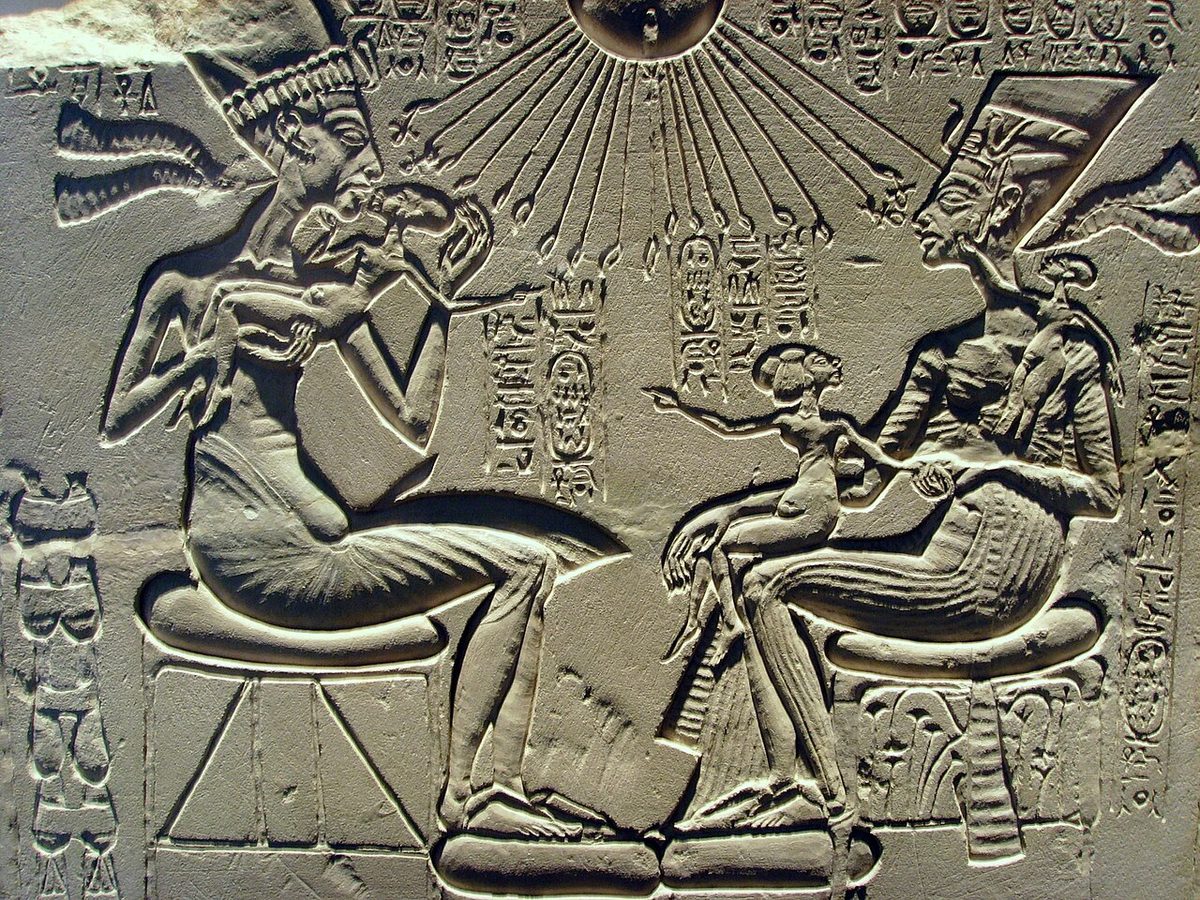
Egyptian art of the Amarna period, under Akhenaten in the fourteenth century BCE, consistently depicts the pharaoh, Queen Nefertiti and their daughters with dramatically elongated skulls, across a large body of reliefs, statues and stelae. Why is unresolved. The candidates are an artistic convention adopted as a religious or philosophical statement, an inherited medical condition, deliberate modification of the royal children, or some combination, and no source available to this article settles between them.
The bodies tell a different story from the art. Zahi Hawass and colleagues published 'Ancestry and Pathology in King Tutankhamun's Family' in JAMA in 2010, reporting genetic and radiological study of the Amarna royal mummies. This article's backing research file summarises the skull finding as mild natural dolichocephaly, an ordinary long-headed shape, in a family in which close-kin marriage is documented. Medical explanations have been proposed for the depictions and this article names none of them, because none could be verified here.
The gap is the finding, and this is the one place in the file where the question stays open in both directions. The artwork is extreme and consistent across a large body of work. The actual remains show, at most, a mild ordinary long-headedness. Nobody has closed the distance, and a file that spends its length closing questions can afford to leave one standing.
12Why So Many Peoples Thought Of It
One more refusal, and it is aimed inward. The research file behind this article carries a section, filed there as speculative and called consistent with the evidence, that explains the global practice by attributing it to contact with an outside population. It is refused here and it is not restated, because its own words describe the societies this article is about in terms this article will not reproduce about anybody, because those words describe the societies this article is about in terms this article will not reproduce about anybody. Three further reasons, each sufficient alone. Its supporting line says the practice was restricted to elites, while another section of the same document says it was widespread. Its other support carries no citation. And it is unfalsifiable by construction.
The question underneath it is a real one, and nobody has answered it. Nobody knows why the practice arose independently in so many unconnected places. The explanations offered include imitation of naturally long-headed individuals who came to be admired, and association of an elongated head with gods, spirits or ancestral beings. The mainstream position is independent invention: infant skulls are malleable everywhere, human beings modify their bodies everywhere, and the practice is what happens when those two facts meet.
And the answer is probably not one answer. Whether the practice spread by contact or arose independently is settled case by case rather than globally. Its appearance in late Roman Europe is a clear instance of spread, arriving with steppe populations during the Migration Period. Its emergence in the Andes and in Melanesia, thousands of years and an ocean apart, is convergence. Both are true, in different places, and insisting on one global answer is the mistake.
On the fundamentals there is no scholarly fight to report, and manufacturing one would be a lie by structure. This article's backing research file states that no significant scholarly counter-argument exists to its core claims. On the mechanism, the typology and the global distribution, that is accurate. It is not true of everything inside the subject: the Shanidar attribution is contested, the Amarna explanation is open, the health effects are inconsistent, and one section of that same file is refused outright above. The practice is not disputed. Several specific questions inside it are.
So here is the finding, and it is not the deflating one. Human societies across the world, most with no contact of any kind, independently worked out that an infant's head can be shaped, and then chose to do it, deliberately, to their own children, for thousands of years, because of what the shape said about who that child belonged to. That is the discovery. It requires no visitors, and it is stranger than the alternative.
How To Read An Elongated Skull Headline
- The Paracas Skulls Are Not Human
- Every constituent bone of an ordinary human skull is present and correctly identifiable, and every feature offered as evidence is either inside the range of Homo sapiens variation or a known consequence of the binding. No qualified physical anthropologist has identified a non-human feature in any of them.
- DNA Testing Found Unknown Lineages
- The announcements were commissioned outside the academic system, never submitted to peer review, and made through alternative media and a self-published book. No methods description, contamination protocol or dataset could be obtained for this article. They are claims, not findings.
- Binding Cannot Produce Shapes That Extreme
- It demonstrably can. The mechanism is understood, the technique is recoverable from the bone, the developmental sequence has been studied across individuals of different ages, and comparable elongation is documented from four continents.
- The Skulls Hold A Bigger Brain
- Binding redistributes the growing vault rather than adding to it. No study for the higher capacity claim is named in this article's backing research file or was reachable elsewhere, a measurement on a reshaped vault is not straightforwardly comparable to one on an unmodified skull, and ordinary capacity varies widely between living people.
- Neandertals Were Already Doing It
- That rests on a two page 1982 note suggesting deformation in two individuals from Shanidar, which never became consensus. The securely dated floor for the eastern Old World is roughly twelve thousand years before present, at Houtaomuga in Jilin, where the sequence then runs for about seven thousand years.
- Only One Culture In Peru Did This
- Head shaping is documented across virtually every inhabited continent: Neolithic northeast China, the Proto-Neolithic Near East, Mesoamerica, North America, Migration Period Europe, the Andes, parts of Africa and Melanesia, among peoples with no plausible contact.
- Akhenaten's Skull Explains The Amarna Art
- The art is extreme and consistent; the royal remains studied and published in JAMA in 2010 show at most a mild ordinary long-headedness. Medical explanations have been proposed and this article names none, because none could be verified. The gap is unresolved.
- It Is Still Practised In Vanuatu Today
- The practice is documented on Malakula, including a skull the Wellcome Collection records as elongated by circular constriction. This article could not verify that it continues anywhere today, and does not say that it does.
What Holds, And What Does Not
The practice and the anatomy under it. An infant's vault is separate plates joined by flexible fibrous sutures with open fontanelles; the major sutures do not fully fuse until late adolescence or adulthood; and sustained gentle pressure in the first two or three years reshapes the vault permanently. Two primary techniques, boards and cords, produce two different shapes and leave signatures that can be told apart from the bone. Binding redistributes the vault rather than adding to it, and it alters the cranial base, the face and the sutures in patterned, measured ways. Deliberate modification is distinguishable from accidental infant flattening. The practice is documented across virtually every inhabited continent among unconnected peoples, with the earliest securely dated evidence from the eastern Old World at Houtaomuga in Jilin, where eleven of twenty five individuals show modification across a span of roughly twelve thousand to five thousand years before present. The Paracas skulls fall inside the range of Homo sapiens cranial anatomy, every constituent bone present and correctly identifiable, and they are predominantly circumferential. Haplogroups A, B, C, D and X are the founding maternal lineages of the Indigenous Americas. And these are the remains of individual people whose descendants are alive.
Why it was done, and what it may have cost. Cranial modification read as a marker of social identity and standing, in named studies at San Pedro de Atacama, across Tiwanaku society, at Omo M10, and in the Colca Valley, where the Collagua and the Cabana used opposite shapes as ethnic identifiers, a finding that belongs to Velasco and not to the study this article's backing file assigns it to. That the shaping was typically done by mothers or other female relatives, as the ethnohistorical record describes, with no specific chronicler located here. That the health evidence is genuinely inconsistent across populations and settles in neither direction, and that there is no convincing evidence of any effect on intelligence, cognition or brain structure. Tello's excavation of the Paracas Necropolis in the late 1920s and the bundle count carried in the backing file. The single parietal plate and the displaced foramen magnum, both accounted for by ordinary variation and by the known effects of the modification. Fifteen years of published ancient DNA from the Peruvian south coast, two large paleogenomic reconstructions in Cell reporting nothing anomalous, and the contamination protocols that make any result from handled remains interpretable at all. The 2022 Thornton paper, carried for the conclusion it reached and described as published rather than peer reviewed. Africa and Oceania in the distribution, where the record is real and the reachable literature thinner. And the Amarna material, where the art and the bodies do not match.
Why so many unconnected societies invented the same practice. Nobody knows. The offered explanations, admiration of naturally long-headed individuals and association of the shape with gods, spirits or ancestral beings, are unresolved, and the mainstream position is independent invention. Whether the practice spread or arose independently is answered case by case: Migration Period Europe is spread, the Andes and Melanesia are convergence. Also here, and demoted from the summary of this article's backing research file: Trinkaus's 1982 two page suggestion that the Shanidar 1 and 5 Neandertal crania show artificial deformation, which never became consensus and is not used as a date for the practice anywhere in this article. And the unsourced statement, made twice in that file, that the practice continues in Vanuatu today, which could not be verified here and is not repeated.
No, the Paracas skulls are not non-human, not alien, and not a separate species or a hybrid. Every anatomical feature offered as evidence is inside the range of Homo sapiens variation or is a known consequence of the modification; the region's ancient genetics has been published in named peer reviewed journals for over fifteen years and shows populations descended from the founding peopling of the Americas; and no qualified physical anthropologist has identified a non-human feature in any of these skulls. No, no DNA analysis has produced unknown or non-human material: the announcements that said so were never peer reviewed, carried no methods description, no contamination protocol and no dataset, and were made about remains informally excavated, displayed and handled for decades. No, binding cannot be excluded on grounds of extremity, because the same shapes are documented from four continents and the technique has been reconstructed from the bone. No cranial capacity figure appears anywhere in this article, and the unsourced claim of naturally greater capacity carried in this article's own backing research file is refused rather than repeated. And no, the imitation-of-visitors framing carried in that same file is not reproduced here in any form, because its own supporting line is contradicted elsewhere in the same document, its other support carries no citation, and it is unfalsifiable by construction.
So the open question is not what these people were. That one is closed, and it was never really open. The open question is why so many of them, in places that had never heard of each other, arrived at the same idea about a baby's head.
Think about what it takes. Cloth is cheap and boards are easy. Time is the only real cost, and the cost is two or three years of daily attention to one specific child. Somewhere in that arithmetic, over and over, in Jilin and in northern Iraq and in the Andes and on Malakula, people worked out that they could write belonging directly onto a body and have it stay there for a lifetime. What would you have to believe about your own people, and about your own child, to decide it was worth doing?
Sources & further reading
The research file M_5_08 is where this article was worked from. It is not where the article can be checked, and on a dozen specific points it is what the article corrects. The checking is in the external literature linked beneath it: the review and book-length treatments of the practice, the craniometric and sutural studies, the excavation and identity studies from the Andes, the Migration Period papers, fifteen years of ancient DNA from the Peruvian south coast, and the published contamination protocol that decides how any genetic result from handled remains can be read at all. Five limits travel with them, and they are why several sentences above are hedged the way they are. First, none of that literature was read in full here. Every identifier below was resolved against CrossRef and its returned title read back against the work named, and three abstracts were read, for Zhang and colleagues 2019, Fehren-Schmitz and colleagues 2010, and Thornton and colleagues 2022. Those three abstracts are the source of every specific figure taken from external literature in this article; everything else is cited for its subject, its existence and its standing, never for a page, a measurement or a quotation. Second, this article departs from its backing research file in a dozen places, each named on the page: the East Asian record, the age of the practice, the Colca Valley attribution, the journal the genetics is cited to, the cranial capacity claim, the Vanuatu present tense, the summary of the DNA announcements, and one whole section refused on the grounds set out in section 12. Third, two of that file's bibliography entries carry identifiers that resolve to book reviews of other works, one of them a review of a different book by the same author, and two further entries could not be shown to exist; none of the four is cited here, and nothing was lost, because every point they were attached to is carried by a source below that resolves. Fourth, two works named in the text have no resolvable identifier at all, Dembo and Imbelloni's 1938 monograph and Tello and Mejia Xesspe's posthumous Paracas volume, so they are named by author, year and title and carry no link. Fifth, the 2022 Paracas paper appeared in a journal whose peer review standing was not established here, which is why it is described as published rather than peer reviewed and is never treated as evidence of equal weight with the peer reviewed genetics.
Image credits
- ParacasSkullsIcaMuseum Marcin Tlustochowicz from Poland, via Wikimedia Commons. CC BY 2.0 Source.
- ParacasSkullsIcaMuseum Marcin Tlustochowicz from Poland, via Wikimedia Commons. CC BY 2.0 Source.
- Child in cradle or carrier Wellcome M0013587 Unknown, via Wikimedia Commons. CC BY 4.0 Source.
- Tablilla para deformar el cráneo. Museo de América Dorieo, via Wikimedia Commons. CC BY-SA 4.0 Source.
- 0510 Turmschädel Württembergisches Landesmuseum Stuttgart anagoria Anagoria, via Wikimedia Commons. CC BY 3.0 Source.
- Skull showing cranial elongation, Vanuatu Republic. Wellcome M0016054 Unknown, via Wikimedia Commons. CC BY 4.0 Source.
- Mayancranialmodification ·Maunus· ƛ ·, via Wikimedia Commons. CC BY-SA 3.0 Source.
- Akhenaten, Nefertiti and their children myself ( Gerbil from de.wikipedia), via Wikimedia Commons. Public domain Source.


