Leviathan: The Formula That Crossed A Border
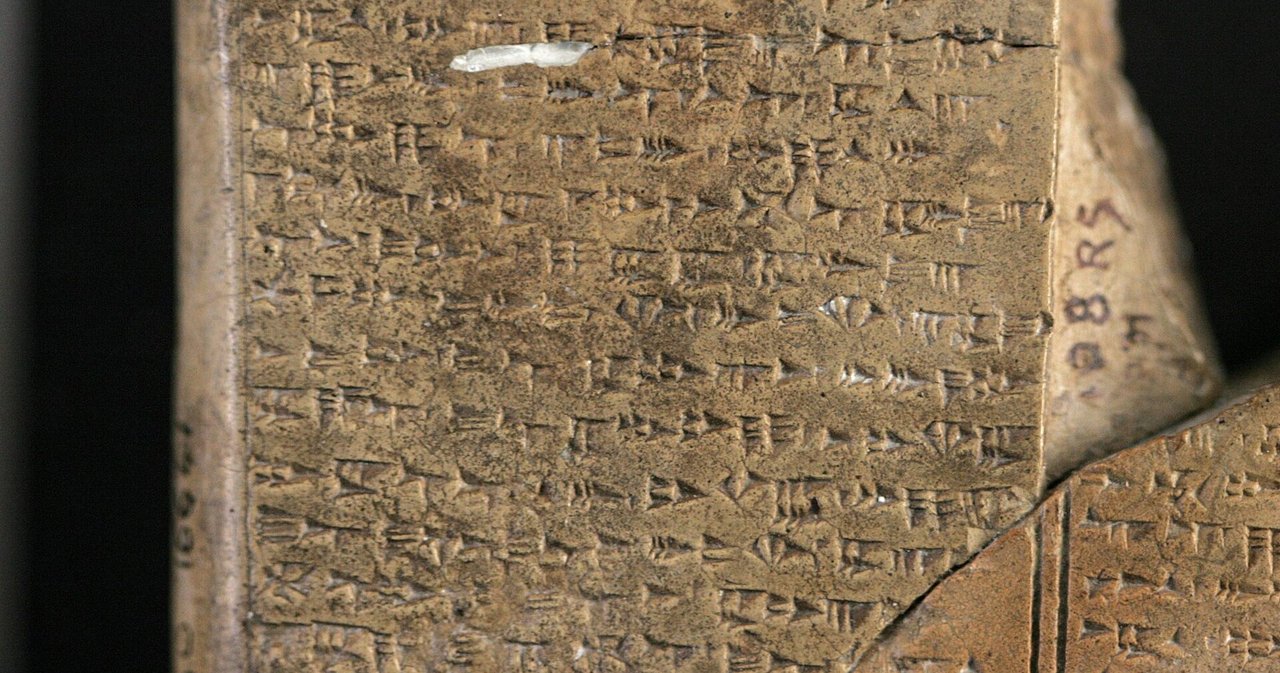
A slab of fired clay fifteen centimetres high sits in case 12 of the Louvre. Written on it before 1200 BCE, in a language nobody could read until the tablets came out of the ground in 1929, is a monster called ltn: the fleeing serpent, the twisting serpent, the tyrant with seven heads. Centuries later a Hebrew prophet uses the same two adjectives, with a different noun, for a creature called Leviathan. What travelled was a phrase, and nobody has ever found the document that carried it.
Sully wing, room 301, case 12. Inside it sits a piece of fired clay fifteen centimetres high, fifteen and a half wide and just over three centimetres thick. It is broken, and it is covered in alphabetic cuneiform, wedge marks pressed into wet clay by a scribe dead for more than three thousand years. The Louvre catalogues it as AO 16641 plus AO 16642. Somewhere on it is a sentence about a serpent with seven heads.
Centuries after that clay was fired, a Hebrew prophet writes two of the same words about a creature called Leviathan. Not the same creature. The same words. That distinction is the whole of this article, and almost every popular account gets it wrong in the same direction, because the wrong version is smoother: the Bible's sea monster, borrowed whole from the Canaanites, seven heads and all. Every part of that is a step too far. The names are related words rather than one being, the seven heads are on the tablet and nowhere in the Hebrew Bible, and borrowed whole asserts a route nobody has documented.
The true version is better and more specific. A poetic formula for a monster, fleeing serpent and twisting serpent, is written down in a Bronze Age port some time before 1200 BCE. It surfaces again in a Hebrew prophetic oracle centuries later with its adjectives intact and its noun swapped. This file can show you the tablet, the verses, the exact shape of the correspondence, and what four biblical writers each did with the creature. What it cannot show is how the phrase got from one to the other.
01The Object In Case Twelve
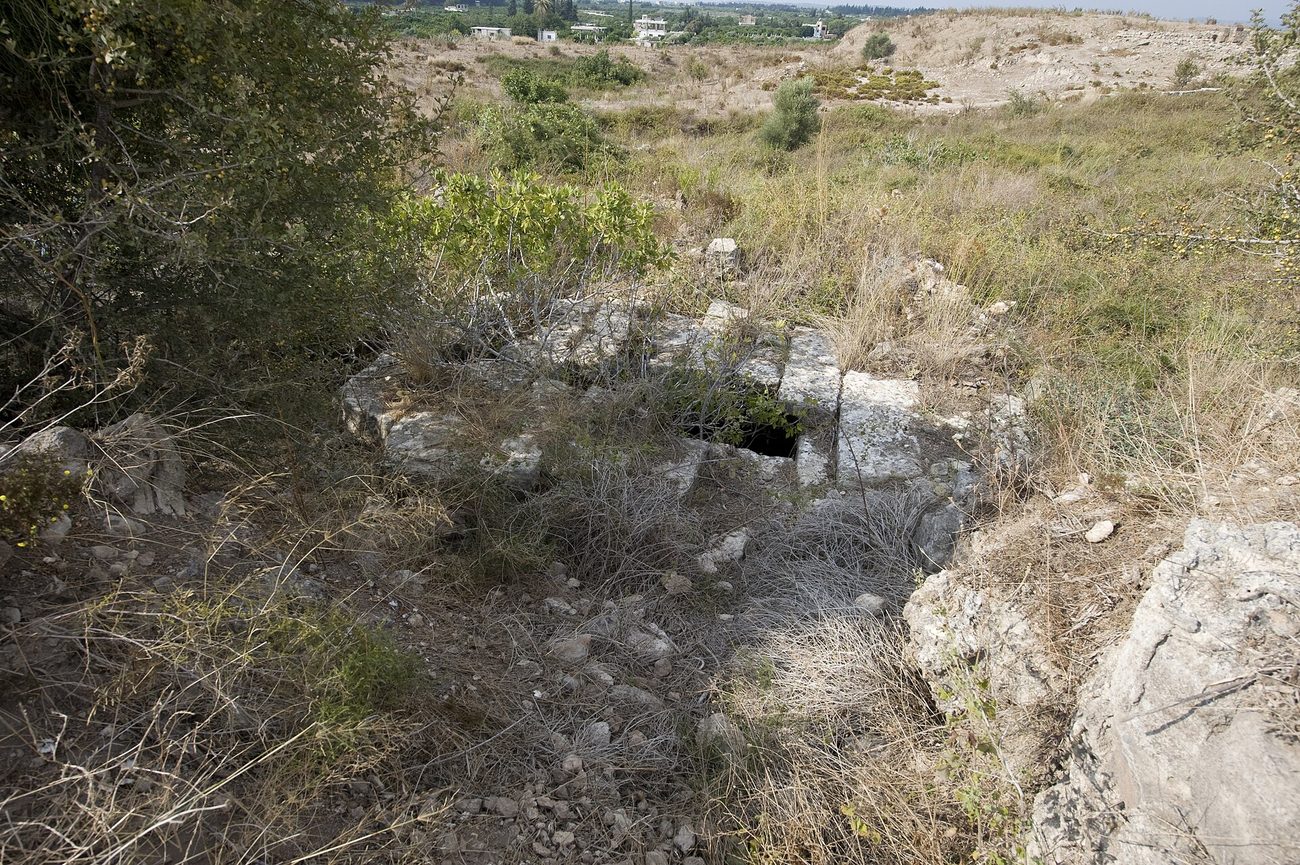
The tablet is a real object with an inventory number and a display case. The Louvre catalogues it as AO 16641 plus AO 16642, excavation numbers RS 2.[022] plus RS 3.[565]: terracotta, 15 cm high, 15.5 cm wide and 3.1 cm thick, inscribed in alphabetic cuneiform, its text type recorded by the museum as 'mythe (cycle de Ba'al)'. The museum dates it to Bronze recent II, which it defines as 1400 to 1200 BCE, and gives its findspot as the Ras Shamra acropolis, House of the High Priest. It is on display in the Sully wing, room 301, case 12.
One thing has to be said before anything is built on that record. The museum's own text field says 'Baal cycle' and nothing more. It does not name Litan, or Leviathan, or Mot, or a serpent. The identification of this object as the tablet catalogued in the standard editions as KTU 1.5 is a concordance step, made here by matching the two RS excavation numbers to the tablet those numbers are known to carry. It is a step this file takes and the Louvre does not.
The passage on that tablet, KTU 1.5 I 1-3, is spoken by Mot, the god of death, addressing Baal. In one standard English translation it runs: 'When you struck Litan, the fleeing serpent, finished off the twisting serpent, the tyrant with seven heads.' The three descriptive terms in the Ugaritic are btn brh, the fleeing serpent, btn 'qltn, the twisting serpent, and slyt d sb't rasm, the tyrant with seven heads. Translations differ on small things, so no single English rendering is the text: 'struck' appears elsewhere as 'smote', and 'tyrant' as 'potentate' or 'powerful one'.
Notice what kind of sentence that is. Not a sighting report and not a description of an animal, but a boast, spoken by one god about another god's past victory. On the oldest surviving copy the serpent is already a thing that was defeated.
02The Same Words, Centuries Later
Isaiah 27:1 reads, in the 2023 Revised JPS translation: 'In that day God will punish with a great, cruel, mighty sword Leviathan the Elusive Serpent, Leviathan the Twisting Serpent; The Dragon of the sea will be slain.' The two epithets in the Hebrew are nahash bariah and nahash 'aqallaton. The creature killed in the sea is a tannin, the ordinary Hebrew word for a dragon or large serpent. Older English versions render bariah as 'fleeing' rather than 'Elusive', which is a translator's choice and not a textual dispute.
Now the correspondence, precisely. The two epithets match directly: Ugaritic brh and Hebrew bariah, Ugaritic 'qltn and Hebrew 'aqallaton. The nouns do not. Ugaritic btn corresponds to Hebrew peten, a word for a viper or a cobra, while Isaiah uses nahash, the general word for serpent. Isaiah is using the same inherited formula with a different noun, which is exactly what reworking an inherited phrase looks like. Aren M. Wilson-Wright and John Huehnergard, writing in Vetus Testamentum in 2021, treat the formula in KTU 1.5 i 1-3 and in Isaiah 27:1 as a single Northwest Semitic poetic formula.
This is where almost every account of Leviathan takes one step too many, and both research files behind this article take it. One says in bold that Litan is the same creature as Leviathan. The other prints the two passages side by side, calls their wording lexically identical, and equates Ugaritic btn with Hebrew nahash. That equation is wrong, and the overstatement was never needed. A cognate is a fact about two words: it says two languages inherited a term from a common ancestor, the way English 'father' and German 'Vater' did, and it says nothing about whether two cultures centuries apart thought they were talking about the same thing. The evidence supports a formula that travelled and was reworked, not a monster that was sighted twice.
| Element | Ugarit, KTU 1.5 I 1-3 | Hebrew Bible, Isaiah 27:1 | The Relationship |
|---|---|---|---|
| The Name | ltn, written without vowels | liwyatan, Leviathan | Cognate. Recent work derives both from a common Northwest Semitic ancestor |
| The Noun | btn | nahash, the general word for serpent | NOT a match. Ugaritic btn corresponds to Hebrew peten, a viper or cobra |
| First Epithet | brh, fleeing | bariah, rendered fleeing or elusive | Direct correspondence |
| Second Epithet | 'qltn, twisting | 'aqallaton, twisting | Direct correspondence |
| The Heads | slyt d sb't rasm, the tyrant with seven heads | No head count, here or anywhere else in the Hebrew Bible | Present at Ugarit, absent from the Hebrew |
There is a further honesty owed about the name itself. Ugaritic was written without vowels, so the monster's name survives as three consonants, ltn, and how to pronounce it has been argued in print for decades. J. A. Emerton devoted an article in Vetus Testamentum in 1982 to exactly that question, under the title 'Leviathan and ltn: the Vocalization of the Ugaritic Word for the Dragon'. Wilson-Wright and Huehnergard in 2021 propose reading it litan, and derive it and Hebrew liwyatan alike from a common ancestor. The familiar spelling 'Lotan' is an older scholarly convention rather than something written on the tablet. Nobody has ever heard either name spoken.
03The Argument Nobody Could Have Made Before 1929
The Ugaritic texts were unknown to everyone until the twentieth century. They were excavated at Ras Shamra on the Syrian coast in campaigns led by Claude Schaeffer beginning in 1929, and the Commons file page for the museum's own tablet photograph reproduces the excavation field credit 'Fouilles C. Schaeffer 1930-1931'. So every argument here about where Leviathan's language came from is one nobody could have made before about 1930, because the comparison material was under a mound.
That single fact reframes the subject. For two thousand years every reader of Job and Isaiah and the Psalms had no older text to hold the verses against: the commentaries, the sermons, Hobbes, the Victorian engravings, all of it made by people who did not know a Bronze Age scribe had used two of those adjectives about a seven headed serpent. This is a comparison less than a century old.
The Ugaritic material is also messier than the summaries suggest. Both research files behind this article say the seven headed serpent was defeated by Baal. In KTU 1.5 I 1-3 the god of death does credit Baal, addressing him with 'when you struck Litan'. But in a separate passage, KTU 1.3 III, the goddess Anat lists her own victories and claims to have crushed the twisting serpent with seven heads herself, alongside Yamm and River. Both claims stand in the surviving text, and this file does not adjudicate between them: the cycle is a compilation rather than one seamless narrative.
One popular detail has to be demoted rather than repeated. Both research files state that Litan was a servant, ally or weapon of Yamm, the sea god. No surviving Ugaritic passage says so. What the texts give is a list of defeated water enemies, Yamm, River, the dragon and the twisting serpent with seven heads, standing together in the same boasts. Their association is an inference from proximity in those lists. It is a reasonable inference, and it is still an inference, and exactly the sort of decorative detail that hardens into fact in a summary box.
Which matters, because the tradition was already plural at the source. If the earliest recoverable version is already a compilation of competing boasts, the later Hebrew handling looks like one more retelling rather than a corruption of some fixed original.
04Four Leviathans, And They Do Not Agree
Quote Job, Psalm 74 and Isaiah, as most writing on this subject does, and a reader comes away certain the Hebrew Bible has one Leviathan and that it is a monster. It has at least two.
| Text | What It Says About The Heads |
|---|---|
| KTU 1.5 I 1-3, Ugarit, before 1200 BCE | 'the tyrant with seven heads'. Seven, named |
| Psalm 74:14, Hebrew Bible | 'the heads of Leviathan', rashe. Plural, no number |
| Isaiah 27:1, Hebrew Bible | Two epithets and no anatomy. No count |
| Job 41, Hebrew Bible | The longest creature description in the Hebrew Bible. No count |
| Revelation 12:3 and 13:1, late first century CE | 'seven heads and ten horns'. Seven again |
Psalm 74:13-14 reads, in the 2023 Revised JPS translation: 'it was You who drove back the sea with Your might, who smashed the heads of the monsters in the waters; it was You who crushed the heads of Leviathan, who left it as food for the denizens of the desert'. The monsters of verse 13 are tanninim, the plural of tannin. Leviathan's heads in verse 14 are plural, rashe, and the psalm gives no number.
The seven heads are Ugaritic. No passage in the Hebrew Bible ever counts Leviathan's heads: the psalm says heads, plural, and stops. Anyone writing about 'the seven headed Leviathan of Psalm 74' has imported a number from a Canaanite tablet into a Hebrew verse that does not carry it.
Then Psalm 104:26, which puts Leviathan in a completely different register. In the 2023 Revised JPS translation it reads: 'There go the ships, and Leviathan that You formed to sport with.' The Hebrew phrase is lesaheq bo, which can mean either that God formed Leviathan to play with, or that Leviathan was formed to frolic in the sea. Either way this Leviathan is not an enemy. It is one item in a hymn cataloguing the ordinary furniture of a well made world, listed between the shipping lanes and the animals God feeds.
Hold the two psalms side by side and do not resolve them. In one, God smashes Leviathan's heads and leaves the carcass out for scavengers. In the other, God makes Leviathan for the fun of it and puts it in the sea next to the shipping. Those are not two descriptions of one animal. They are two uses of one image.
05The Chapter Whose Number Moves
The famous Leviathan speech is not in the same place in every Bible. In the Hebrew Masoretic text it begins at Job 40:25 and runs to 41:26. In English Bibles descended from the Vulgate tradition it begins at Job 41:1 and runs to 41:34, which is where the familiar count of thirty four verses comes from. The Latin Vulgate numbers it differently again. The opening line is the same in all of them: 'Can you draw out Leviathan by a fishhook? Can you press down its tongue by a rope?' (Job 40:25 in the Hebrew, 41:1 in English, Revised JPS 2023).
That detail quietly demonstrates the article's real subject. This text has been copied, translated, renumbered and re-divided for two and a half thousand years, and the history of that handling is visible in the verse numbers. When two books cite the same line of Job and give different chapter and verse, neither is wrong. Everything below uses the English numbering, because that is the one a reader can find.
Job 41 in the English numbering is the longest single description of any creature in the Hebrew Bible. In the NRSV rendering carried by the research file: it cannot be caught with a fishhook (41:1); its back is 'made of shields in rows, shut up closely as with a seal' (41:15); 'out of its mouth go flaming torches; sparks of fire leap out. Out of its nostrils comes smoke' (41:19-20); 'the sword that reaches it does not avail, nor does the spear, the dart, or the javelin' (41:26); and 'on earth it has no equal, a creature without fear' (41:33). The chapter opens with a series of rhetorical questions and then simply describes the animal.
The point of that chapter inside the book of Job is not zoological. The Leviathan speech is the climax of God's answer out of the whirlwind, and its argument is that Job cannot master this creature and God can, so Job is in no position to put God on trial. The creature's function in the poem is to be unmasterable. A creature that could be identified, netted and written up in a field guide would not do the job the poem needs it to do.
| Passage | What Leviathan Is There | The Detail That Fixes It |
|---|---|---|
| Psalm 74:13-14 | An enemy whose heads God smashed | Left 'as food for the denizens of the desert'; heads plural, no number (Revised JPS 2023) |
| Psalm 104:26 | A creature God formed to sport with | Listed between the shipping lanes and the animals God feeds (Revised JPS 2023) |
| Job 40:25 to 41:26 Hebrew, 41:1 to 41:34 English | An animal no human can hook, arm against or master | 'On earth it has no equal, a creature without fear' (NRSV) |
| Isaiah 27:1 | An enemy still to be killed, on a day still ahead | Punished with 'a great, cruel, mighty sword'; the dragon of the sea slain (Revised JPS 2023) |
06The Words Around The Monster
Leviathan is one term in a small family of Hebrew chaos vocabulary, and the family is more informative than the individual. Rahab is a separate sea monster, at Job 26:12, Isaiah 51:9 and Psalm 89:10 in the English numbering. Tannin is the general word for dragon or sea serpent, at Isaiah 27:1, Isaiah 51:9 and, applied to Pharaoh, at Ezekiel 29:3 and 32:2. Tehom is 'the deep', at Genesis 1:2 and Psalm 104:6. Yam is simply 'sea', personified at Psalm 74:13 and Habakkuk 3:8. Behemoth is the land counterpart, described at Job 40:15-24, immediately before the Leviathan speech.
One entry in that list is worth stopping on. In Ezekiel the dragon word, tannin, is pointed at a living head of state: Pharaoh, a man with an address and an army. This vocabulary gets aimed at politics, by name, which is the clearest demonstration that these creatures were always partly a way of talking about power.
One correction inside that vocabulary, because the popular version is the wrong way round. Hebrew tehom and Akkadian Tiamat are related words, but tehom is not a borrowing from the Babylonian goddess's name and is not a demythologised version of her. Both descend from a common Semitic root for the primordial ocean, and the standard philological objection is that a direct borrowing would not have produced the form tehom. David Tsumura's 2005 book is a sustained argument that the biblical texts using this vocabulary are describing storms and floods rather than replaying a primordial combat. This file did not read that book: it is cited for the position it is known for holding.
07The Dominant Reading, And Its Named Dissenters
The framework almost everyone uses for these passages is the chaos combat pattern: a divine warrior defeats the sea or the sea dragon and thereby establishes order and his own kingship, and Psalm 74, Isaiah 27 and Job 41 are reflexes of it. Hermann Gunkel's 1895 book is the origin of the modern version of that argument. It explains a great deal. It is also, in one of this article's research files, called universal in modern scholarship, which is a word that should not have survived the fact checking.
The chaos combat reading of Psalm 74, Isaiah 27 and Job 41 is the majority position in critical scholarship, and it is not universal. Two book length dissents were published in the same year: David Tsumura's 'Creation and Destruction: A Reappraisal of the Chaoskampf Theory in the Old Testament' (Eisenbrauns, 2005) and Rebecca Watson's 'Chaos Uncreated: A Reassessment of the Theme of Chaos in the Hebrew Bible' (de Gruyter, BZAW 341, 2005). Both argue that the framework has been read into texts that are using different imagery. The mainstream case is not thin either: John Day's 'God's Conflict with the Dragon and the Sea' (1985) and Carola Kloos's 'Yhwh's Combat with the Sea' (1986) are its standard monographs. So the honest word is dominant, and the dissent has names.
What makes this worth a paragraph rather than a footnote is where the overstatement came from. The file that calls the reading universal lists Tsumura's book in its own bibliography, with the word Chaoskampf in the subtitle. It cited the refutation while calling the position settled. That is what happens when a summary gets written from other summaries, and it is named here rather than quietly fixed.
Two further questions here are genuinely open and should be carried unresolved. First, whether the correspondence between the Ugaritic and the Hebrew demonstrates direct literary borrowing at all, or a shared inherited poetic tradition that both drew on independently. Second, whether the Leviathan material in Job 40 to 41 is early, belonging to the original poem, or a later editorial addition to it. Neither is settled, and this file's own research documents concede the first while asserting the opposite a few pages earlier.
08The Monster Becomes A Meal, Then A Roof
What happens next gets left out of the documentaries, and it shows most clearly that this is a tradition rather than a sighting: the creature stops being a thing to be feared and becomes a thing to be stored, then served.
| Source | What Happens To Leviathan |
|---|---|
| Isaiah 27:1 | Still to be killed, with a sword, on a day still ahead |
| 2 Esdras 6:49-52, late first century CE | Created on the fifth day, separated from Behemoth, kept back to be eaten |
| Bava Batra 74b | The female leviathan killed and salted, preserved for the banquet |
| Bava Batra 75a | A feast from its flesh and a shelter from its skin, for the righteous |
| Medieval Jewish manuscripts | Drawn as a scaled fish, and beside Behemoth and Ziz at the feast |
In 2 Esdras 6:49-52, also known as 4 Ezra and usually dated to the late first century CE, God creates Behemoth and Leviathan on the fifth day and then separates them, because the waters could not hold them both. Behemoth is given the dry land and Leviathan the watery part, and both are kept back to be eaten by whom God wishes and when God wishes. Note the direction of travel: in Isaiah the destruction of Leviathan is future, and in 4 Ezra the creature is explicitly being held in reserve. That is a tradition growing an eschatology, not a tradition remembering an animal.
The Babylonian Talmud, tractate Bava Batra, completes the turn. At 75a the text reads, in the Steinsaltz English: 'The Holy One, Blessed be He, will make a feast for the righteous from the flesh of the leviathan' and 'In the future, the Holy One, Blessed be He, will prepare a sukka for the righteous from the skin of the leviathan.' The same passage says the remainder of the skin is spread on the walls of Jerusalem and its glory radiates from one end of the world to the other. At 74b the text says God killed and salted the female leviathan to preserve it for that banquet.
A shelter built from the skin of the thing that used to be the terror of the sea. That completes an arc which began with a boast on a clay tablet: the monster becomes lunch, and then it becomes a roof.
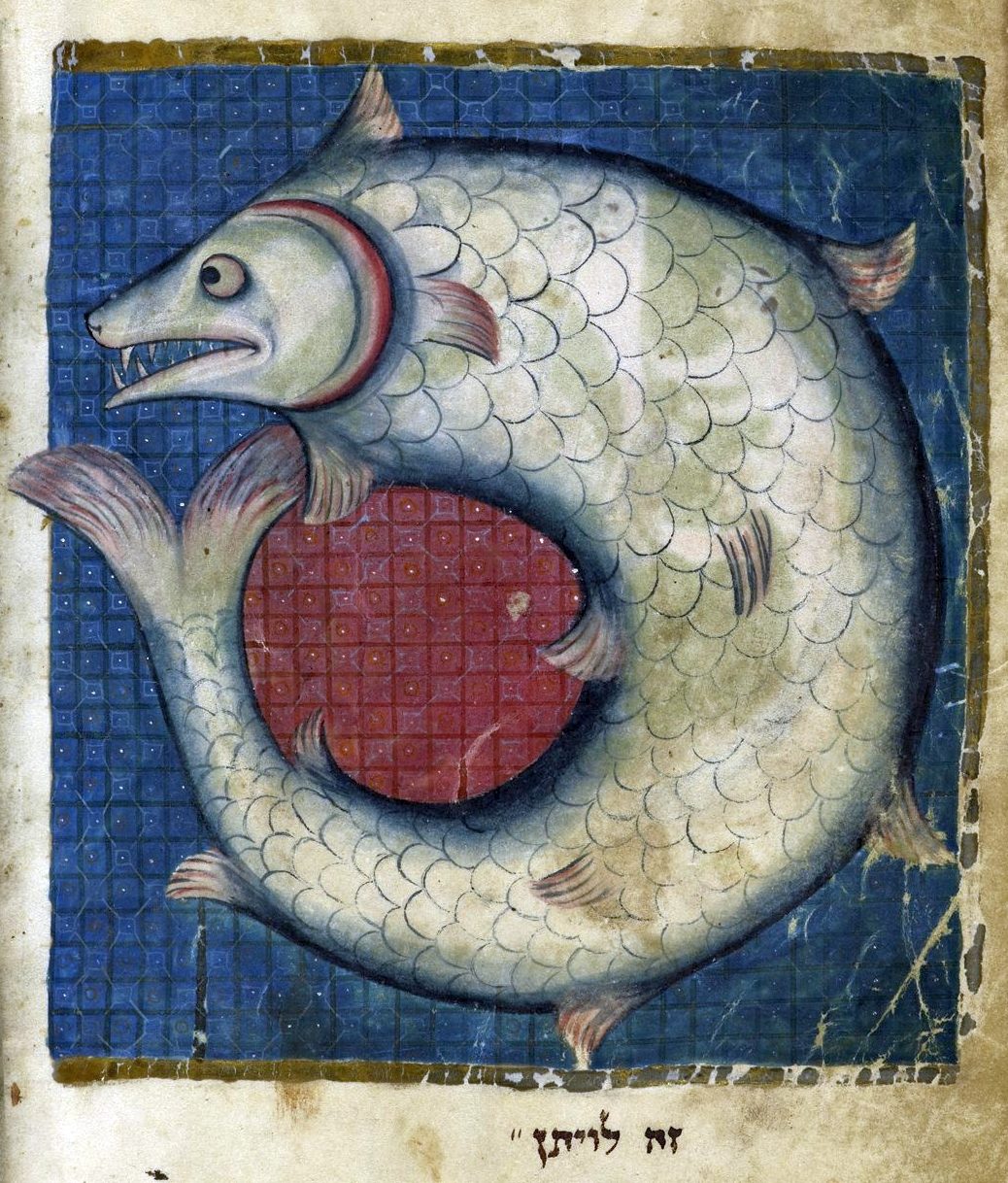
Medieval Jewish manuscripts illustrate the banquet rather than the combat. The North French Hebrew Miscellany, British Library Add MS 11639, made in northern France between roughly 1278 and 1298, shows Leviathan as a large scaled and finned fish, according to the description carried with the digitised image. The Ambrosian Bible, made in Ulm in 1238 and now Biblioteca Ambrosiana B 32 inf, folio 136r, shows Leviathan, Behemoth and the bird Ziz together, in the miniature associated with the messianic feast of the righteous. Both identifications come from descriptions attached to the digitised reproductions rather than the libraries' own catalogues.
09Seven Heads, A Thousand Years Later
Revelation 12:3 describes 'a great red dragon, with seven heads and ten horns', and Revelation 13:1 'a beast rising out of the sea, with ten horns and seven heads'. That these figures stand in some relation to the older Near Eastern chaos dragon tradition is standard in critical commentary. What the relation MEANS is contested: whether the Revelation dragon is still functioning as a primordial chaos monster, or has been repurposed entirely as a political symbol for Rome, is unresolved in New Testament scholarship. Gunkel's 1895 book, whose full title names Genesis 1 and Revelation 12 as its two subjects, is where the modern argument that they are connected begins.
Look at the head count and resist the urge to draw the arrow. Seven heads appear on a clay tablet at Ugarit some time before 1200 BCE. They appear nowhere in the Hebrew Bible's Leviathan passages. They reappear in a Greek Christian text at the end of the first century CE. That is either a very long lived oral tradition, a coincidence of a common mythological number, or independent reinvention, and no source consulted here settles it.
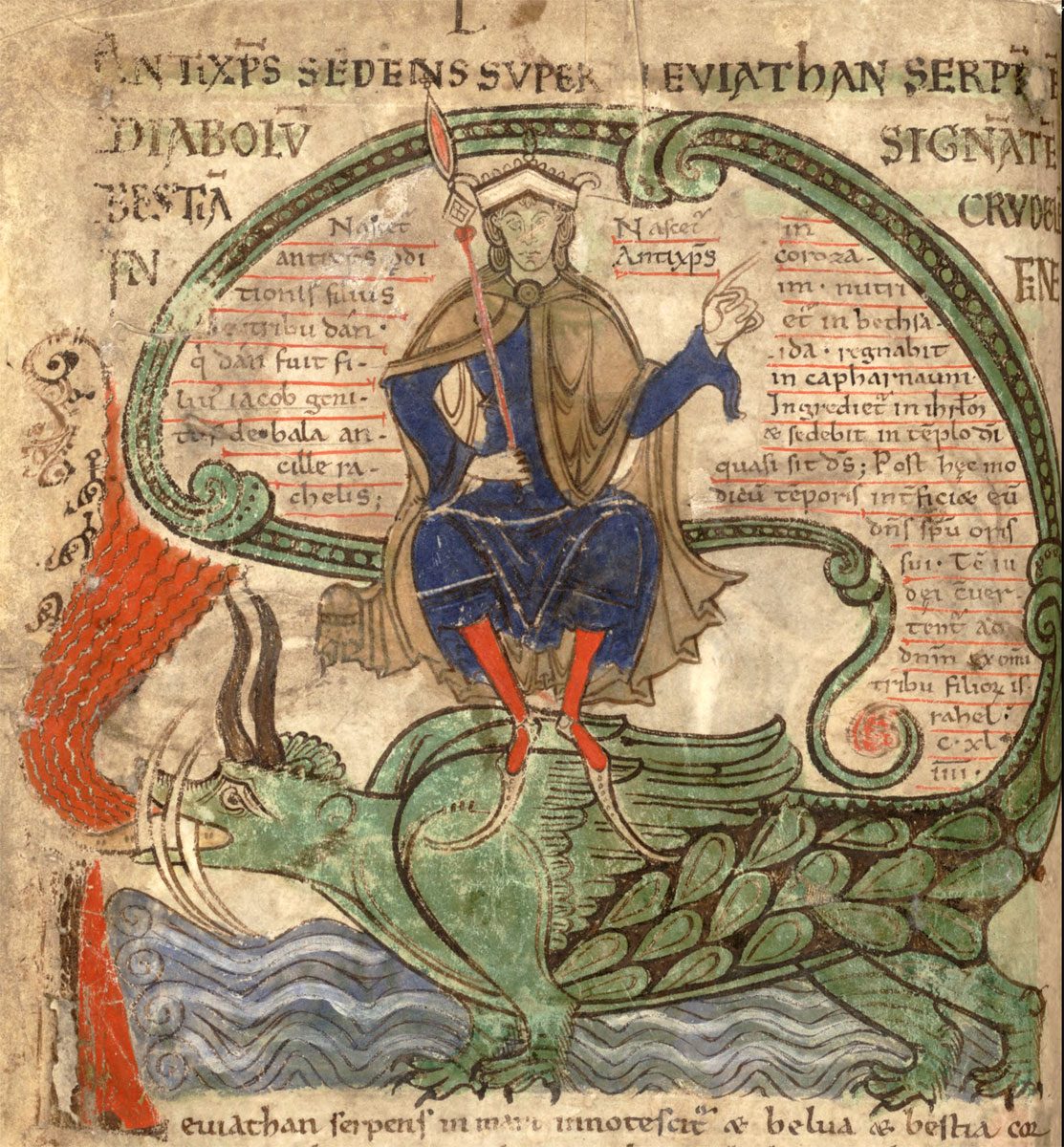
In later Christian tradition Leviathan was progressively identified with the devil, and the sea monster became the mouth of hell. Medieval manuscript art shows the result. In the twelfth century Liber Floridus the Antichrist is drawn seated on Leviathan. In the Hortus Deliciarum tradition God fishes for Leviathan with a line baited by the cross, an image that survives only in copies, because the manuscript itself burned in 1870.
That fishing image is the best single thing in the reception history. Job 41 opens with a taunt: can YOU draw out Leviathan with a fishhook. Twelfth century theology answered by drawing God doing exactly that, with the cross as the bait. That is a reading of a verse rendered as a picture, not a memory of an encounter.
The afterlife of the pair has its own scholarly literature. Mark Sneed's 'Taming the Beast: A Reception History of Behemoth and Leviathan' (de Gruyter, 2021) traces how they were interpreted across Christianity, Judaism and Islam. K. William Whitney's 'Two Strange Beasts' (Harvard Semitic Monographs 63, 2006) makes a more surprising argument, and it is his argument rather than an established finding: that post-biblical and rabbinic traditions preserve ancient material not all present in the biblical texts themselves, which would mean a stream of tradition running alongside the canonical texts rather than out of them.
10The Sovereign Made Of People
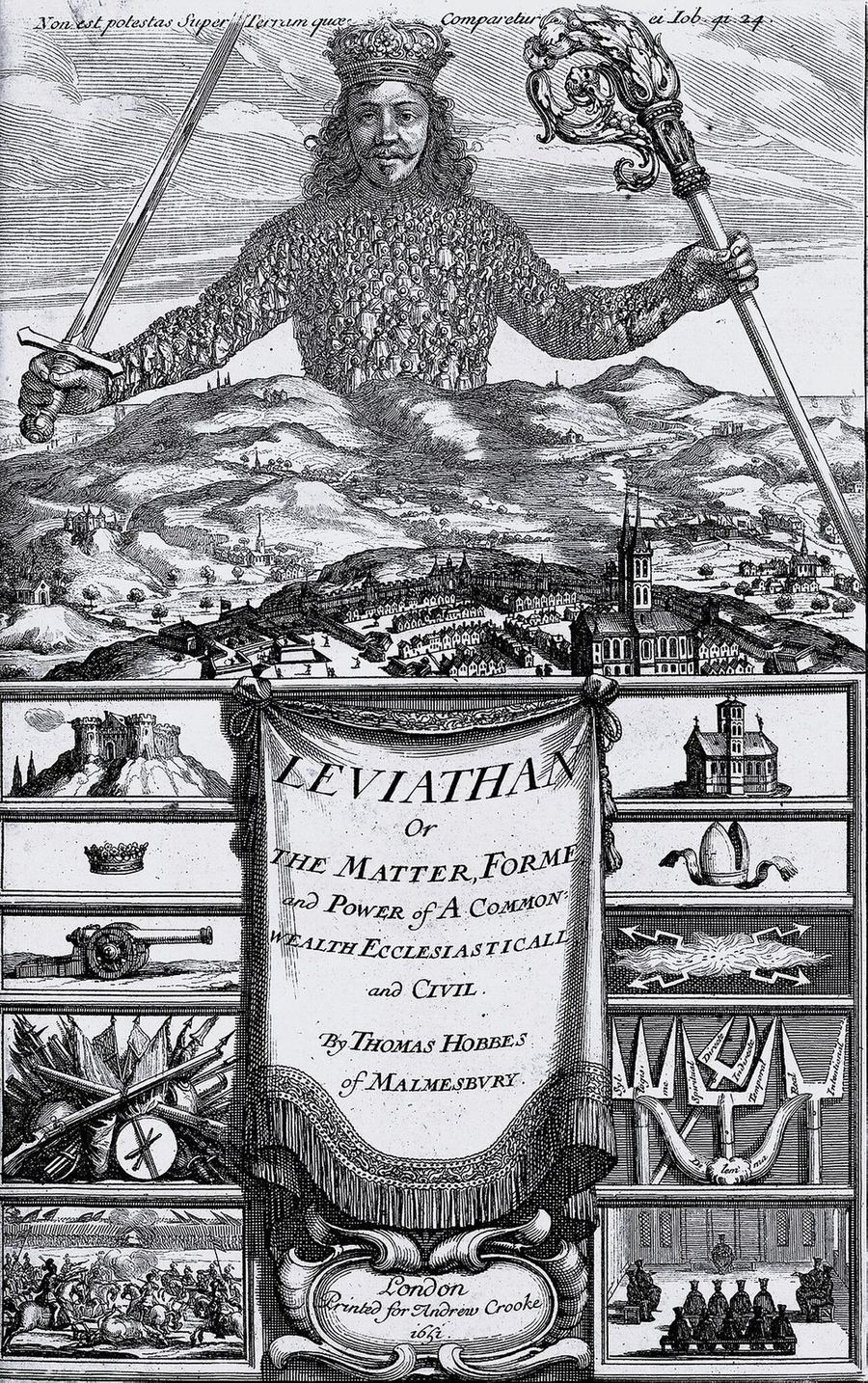
Thomas Hobbes published 'Leviathan, or The Matter, Forme and Power of a Common-Wealth Ecclesiasticall and Civill' in 1651, using the biblical sea monster as his figure for the sovereign state: the only power great enough to hold down the war of all against all. The choice was not decorative. The engraved title page, by Abraham Bosse, carries a Latin motto across the top: 'Non est potestas Super Terram quae Comparetur ei', 'There is no power on earth to be compared to him'. That is Job 41:24 in the Vulgate numbering, the same verse that reads 'on earth it has no equal' at Job 41:33 in English Bibles. The text is cited here from the revised student edition edited by Richard Tuck (Cambridge University Press, 1996).
Follow that loop. The verse quoted in section 05, from a Hebrew poem about a creature no human can master, is printed in Latin along the top edge of Hobbes's title page, above an engraving of a crowned giant whose body is made of tiny human figures. He did not reach for a metaphor. He reached for a specific verse.
Debra Scoggins Ballentine's 2015 study 'The Conflict Myth and the Biblical Tradition' (Oxford University Press) argues that the combat myth, in which a divine warrior defeats the sea or the sea dragon and thereby secures his throne, was adapted across more than two thousand years to validate particular ideologies and political arrangements. On that reading, the interesting question about Leviathan is not what it was, but what claiming to have beaten it was FOR. This file did not read the book; it is cited for the thesis its publisher states.
Which joins three things this article reports separately. Baal's kingship at Ugarit is established by defeating the sea and its serpents. Ezekiel points the dragon word at a sitting Pharaoh. Hobbes puts Job 41 over a picture of a sovereign made of people. A creature that exists to be defeated is useful to anyone who wants to be the one who defeated it.
11So What Animal Was It
Before the identifications, a caution about pictures. Gustave Dore engraved 'The Destruction of Leviathan' in 1865 as part of his illustrated Bible, showing a vast coiled sea serpent being struck down from the clouds. It is an illustration of Isaiah 27:1, and it is the image most people picture when they hear the word Leviathan. It is also a Victorian artist's reading of a Hebrew verse, made roughly sixty years before anyone alive had read the Ugaritic tablet. It is evidence about the nineteenth century and nothing earlier.
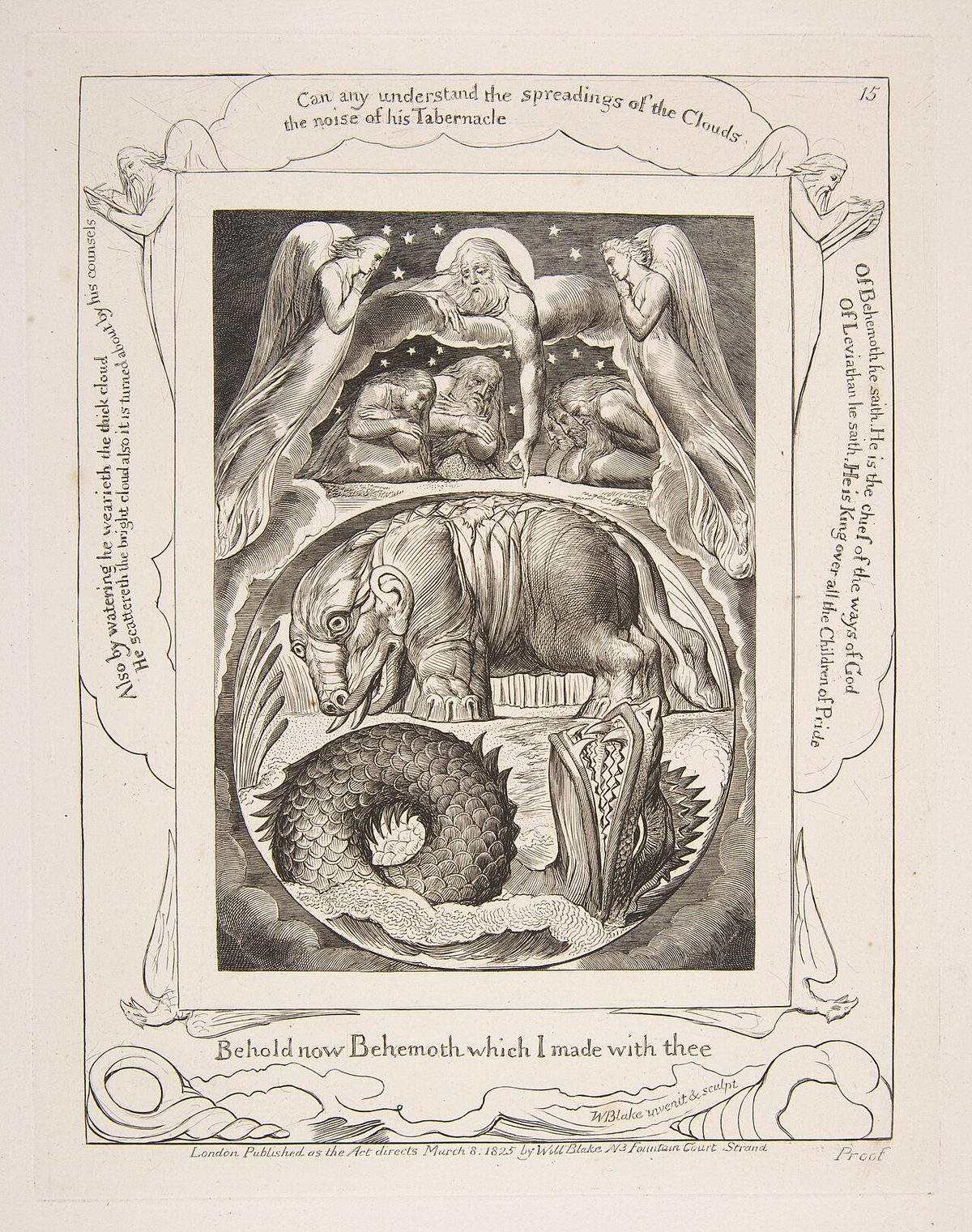
The same caution covers the other famous image. William Blake engraved 'Behemoth and Leviathan' in 1825 to 1826 as plate 15 of his Illustrations of the Book of Job, showing God indicating the two creatures to Job; the Metropolitan Museum of Art's impression carries that title on the museum's own record. Blake illustrates the pairing, both animals at once, which is what the poem does. Neither engraving shows what an ancient writer imagined.
The oldest naturalistic reading identifies the Job 41 Leviathan with the Nile crocodile, on the strength of the armoured back, the impenetrable hide and the terror it inspires. It is not merely a pre-critical guess. The palaeontologist Robert T. Bakker presented an abstract to the Geological Society of America in 2018 titled 'Paleontological Myths in Ugaritic and Old Testament Stories: Leviathan is the Nile Crocodile, Behemoth is a Young Adult African Elephant'. That is a conference meeting abstract rather than a peer reviewed paper and should be weighed as one, though it is a real citable item by an eminent palaeontologist. Mark Sneed's 2021 reception history observes that modern biblical scholars have converted these two originally cosmic monsters into a crocodile and a hippopotamus.
So argue with it properly rather than dismissing it. Against the crocodile: crocodiles do not breathe fire, do not have multiple heads, are not sea creatures, and do not appear in cosmic combat with a god. All of that is in the texts and the identification accounts for none of it. In its favour: an armoured river reptile is plainly part of the imaginative furniture the poem draws on. Both can be true at once.
A popular alternative identifies Leviathan with a whale, chiefly on the strength of size and of Psalm 104:26 putting it in the open sea alongside ships. It fits worse than the crocodile: it accounts for nothing in Job 41's armour, fire or weaponry, and it has no place in the combat tradition at all. Most readers meet it through modern Hebrew, where livyatan means whale, a clean illustration of this article's method: a word can end up naming an animal without that having been its original referent.
12The Question And Its Shape
The reading of Leviathan as a surviving dinosaur, plesiosaur or mosasaur, advanced in young earth creationist literature, has no evidential support. It requires humans and non avian dinosaurs to have overlapped, which the fossil and radiometric record excludes. And it requires a poem whose whole rhetorical purpose is that the creature cannot be captured or described to be read as a field description of one. This is not a live scholarly debate with two sides: no peer reviewed biblical or palaeontological literature holds it.
There is likewise no basis for reading Leviathan as a craft, a machine, an extraterrestrial, or a garbled memory of one. Every element usually pressed into that reading, the smoke from the nostrils, the fire from the mouth, the impenetrable armour, the boiling sea, belongs to a poetic vocabulary documented four centuries earlier at Ugarit describing a seven headed serpent, and to a genre whose purpose is to describe something no human can master. The imagery is already fully formed in an older text, on an object on public display. A tradition whose earlier form is a clay tablet in the Louvre does not need an unknown origin.
Which leaves the question itself, and this is the refusal that matters. 'What real animal was Leviathan' misreads the genre. A chaos monster in a Ugaritic combat poem, a psalm of complaint, a wisdom poem and an apocalyptic oracle is a theological and political figure. It was not offered as a report, and the texts give it different properties depending on what each needs it to do: an enemy crushed at creation in Psalm 74, a creature formed to play in Psalm 104, an unmasterable animal in Job 41, an enemy still to be killed in Isaiah 27. Four incompatible characters in one book is not what the record of an animal looks like.
Notice the shape of that refusal, because it is not a debunk. The claim is narrower and stronger than saying the writers were fools: the question has the wrong shape for the evidence, and the evidence is the four Leviathans laid out above, which no single animal could be. Ask instead what each writer wanted the creature FOR, and every one of these texts answers immediately.
And then the gap, which is the honest end of the subject. Nobody has ever found a manuscript link between Ugarit and the writers of the Hebrew Bible. The Ugaritic tablets date to roughly 1400 to 1200 BCE and the city was destroyed around 1185 BCE. The biblical passages using the formula are later, in some cases centuries later, and Isaiah 24 to 27 in particular is conventionally dated well after the eighth century prophet whose name the book carries, though its date is disputed. So the connection is argued from shared vocabulary, shared poetic formulae and shared imagery, not from a chain of copies. This article's own research file concedes it: the correspondence 'is not universally accepted as demonstrating direct literary borrowing'.
How To Read A Leviathan Headline
- Leviathan Is The Canaanite Lotan
- Two related words, not one creature. The epithets correspond exactly; the nouns do not, since Ugaritic btn matches Hebrew peten rather than the nahash Isaiah uses. 'Lotan' is an older scholarly convention for an unvocalized name.
- The Seven Headed Leviathan Of The Bible
- Seven heads are on the Ugaritic tablet. No Hebrew Bible passage counts Leviathan's heads: Psalm 74 says heads, plural, and gives no number. Seven reappears in Revelation, a thousand years after the tablet.
- Scholars Agree It Is A Chaos Myth
- It is the dominant reading, not a universal one. Tsumura and Watson each published a book length dissent in 2005, and one of them sits in this file's own research bibliography.
- Job 41 Describes A Real Animal
- Job 41 is the climax of God's answer out of the whirlwind, and its argument is that Job cannot master the creature and God can. Its function in the poem is to be unmasterable.
- The Bible's Leviathan Is Always A Monster
- Psalm 104:26 has God form Leviathan to sport with, listed between the shipping lanes and the animals God feeds. The Hebrew lesaheq bo can mean God plays with it, or that it frolics in the sea.
- Leviathan Was A Nile Crocodile
- A real minority position, put to a Geological Society of America meeting in 2018 by the palaeontologist Robert T. Bakker, in a conference abstract rather than a peer reviewed paper. It explains the armour and none of the fire, heads or sea.
- The Leviathan Speech Is Thirty Four Verses
- In English Bibles, where it runs Job 41:1 to 41:34. In the Hebrew it is Job 40:25 to 41:26, and the Vulgate numbers it differently again. Same text, different chapter divisions.
- It Was A Surviving Dinosaur Or Plesiosaur
- No. That reading requires humans and non avian dinosaurs to have overlapped, which the fossil and radiometric record excludes, and no peer reviewed literature holds it.
What Holds, And What Does Not
The objects and the texts. A terracotta tablet in the Louvre, AO 16641 plus AO 16642, excavation numbers RS 2.[022] plus RS 3.[565], 15 by 15.5 by 3.1 cm, from the Ras Shamra acropolis, dated by the museum to 1400 to 1200 BCE and displayed in Sully room 301, case 12. The passage catalogued KTU 1.5 I 1-3, in which Mot credits Baal with striking Litan, the fleeing serpent, the twisting serpent, the tyrant with seven heads. Isaiah 27:1 with its nahash bariah and nahash 'aqallaton. And the correspondence at its true strength: the two EPITHETS match, brh to bariah and 'qltn to 'aqallaton, and the NOUN does not, since Ugaritic btn corresponds to Hebrew peten while Isaiah wrote nahash. That is inheritance and reworking, not one creature appearing twice, and no line above says otherwise. Also Tier 1: ltn is unvocalized and its reading has been argued in print since at least 1982; Psalm 74 gives plural heads and no number; Psalm 104:26 has Leviathan formed to sport with; the speech runs Job 40:25 to 41:26 in Hebrew and 41:1 to 41:34 in English, is the longest single description of any creature in the Hebrew Bible, and functions in the poem as something Job cannot master; Ras Shamra was excavated from 1929, so this comparison is under a century old; and Hobbes's 1651 title page carries Job 41:24 in Latin across Bosse's engraving.
The chaos combat reading of these passages, which is the dominant position and carries two named book length dissents from 2005, Tsumura and Watson. That tehom and Tiamat are a common inheritance rather than a borrowing from the goddess's name. That both Baal and Anat are credited with killing the seven headed serpent in the surviving Ugaritic text, which this file does not adjudicate. The Second Temple and rabbinic development, 4 Ezra's storing of the creature and Bava Batra's feast and sukka, and the medieval Jewish images of the banquet, whose manuscript identifications come from descriptions attached to digitised reproductions. That the Revelation dragon stands in some relation to the older tradition, with its meaning genuinely contested. Whitney's argument that rabbinic tradition preserves material not present in the biblical texts, carried as his argument. Ballentine's reading of the combat myth as a political instrument. And the transmission itself: shared vocabulary, formulae and imagery, with no chain of copies behind them.
The Nile crocodile as the referent behind the Job 41 description. It is a real minority position with a named modern proponent, sourced to a conference abstract rather than a peer reviewed paper, and it accounts for the armour while accounting for none of the fire, the multiple heads, the sea or the combat with a god. The whale, weaker again, resting on size and on Psalm 104:26. And the claim, printed in both of this file's research documents, that Litan was Yamm's servant, ally or weapon: no surviving Ugaritic passage says so, and the association is an inference from the two appearing in the same lists of defeated enemies.
No, Leviathan was not a surviving dinosaur, plesiosaur or mosasaur. That reading requires humans and non avian dinosaurs to have overlapped, which the fossil and radiometric record excludes, and it requires a poem built on the creature being uncatchable and indescribable to be read as a field description. No peer reviewed biblical or palaeontological literature holds it, and this article does not readmit it through the side door as a possible extinct referent either. No, Leviathan was not a craft, a machine or an extraterrestrial: every element pressed into that reading is already present, fully formed, in a poetic vocabulary written down centuries earlier on an object anyone can go and look at in Paris. And no, 'what real animal was Leviathan' is not a well formed question about these texts. Four biblical passages give the creature four incompatible characters, which is what a symbol in use looks like and not what the record of an animal looks like.
So the closing question is not whether Leviathan was real. It is how a phrase gets from a scribe's tablet in a Bronze Age port to a prophet in Jerusalem centuries later, with its adjectives intact and its noun swapped. The usual answer is a shared Northwest Semitic poetic tradition carried orally, which is plausible and unprovable. Not one document connects the two ends.
And that is the more interesting thing anyway. A city burned and was buried, its language unread for three thousand years. A French archaeologist opened the mound in 1929, and two linguists were still arguing about the vowels of one word on one broken tablet in 2021. Whatever crossed the border between those two texts was not a monster. It was a way of saying something, and it survived long enough for you to check it in a museum case and in a Bible on the same day.
Sources & further reading
The two research files, B_3_06 and A_1_06, are where this article was worked from, not where it can be checked. The checking is in the external links below them: the Louvre's own object records for the tablet, the primary biblical and rabbinic texts as fetched from Sefaria, the two Vetus Testamentum papers on the shared formula and on the vocalization of ltn, the monographs on both sides of the chaos combat argument, and the Pitts Theology Library record for the 1651 frontispiece. Four limits travel with them, and they are why several sentences above are hedged the way they are. First, this article corrects its own research files where they overstate: they call Litan and Leviathan the same creature, one of them prints the two passages as lexically identical while equating Ugaritic btn with Hebrew nahash, and one calls the chaos combat reading universal while listing a book length refutation of it in its own bibliography. Second, five of the fifteen bibliography entries in B_3_06 carry an identifier that resolves to a different work, among them a labour economics book about job creation standing in for Tsumura and a history of addiction treatment standing in for Batto; none of the five is cited or paraphrased here, and four have verified replacements. Third, most of the modern scholarship linked below was verified by resolving its identifier and reading the returned title, author, publisher and year back against the work named. It was not read in full, so each of those books is cited for its subject and its stated thesis and never for a page or a quotation. The exceptions, read directly at source, are the two Louvre records, the Pitts frontispiece record and the six Sefaria texts. Fourth, the identification of the Louvre tablet as the text catalogued KTU 1.5 is made here from the standard concordance of excavation numbers to KTU numbers; the museum's own record says only 'Baal cycle', and the Blake and Dore links below carry institutional field values confirmed through indexed records rather than pages fetched in full.
Image credits
- Mythological poem, Baal death, AO16641 AO16642 Rama, via Wikimedia Commons. CC BY-SA 2.0 fr Source.
- Tablet Baal death Louvre AO16641-AO16642 Rama, via Wikimedia Commons. CC BY-SA 2.0 fr Source.
- Behemoth and Leviathan, from Illustrations of the Book of Job MET DP81 William Blake, via Wikimedia Commons. CC0 Source.
- Leviathan frontispiece cropped British Library Abraham Bosse, via Wikimedia Commons. CC0 Source.
- North French Hebrew Miscellany 518b Leviathan Binyamin, via Wikimedia Commons. Public domain Source.
- Liber floridus-1120-Leviathan-p135 Lambert- Liber Floridus (1120), via Wikimedia Commons. Public domain Source.
- Ugarit, view at the acropolis Dosseman, via Wikimedia Commons. CC BY-SA 4.0 Source.


